KitGuru KitGuru.net – Tech News | Hardware News | Hardware Reviews | IOS | Mobile | Gaming | Graphics Cards


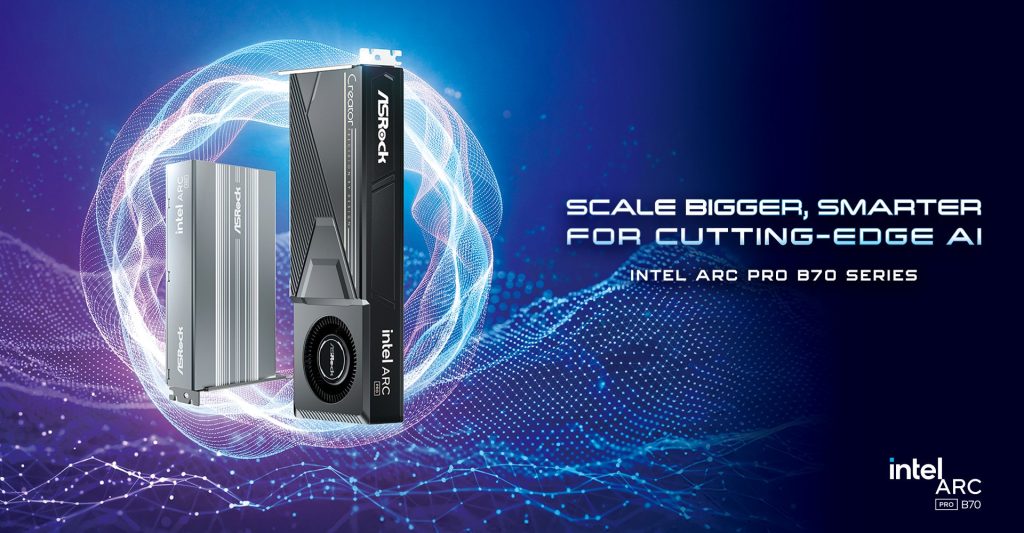
ASRock has officially rolled out its custom take on the Intel Arc Pro B70. Targeting the growing demand for local AI inference and professional rendering, ASRock has introduced two distinct models: the Intel Arc Pro B70 Creator 32GB and the Intel Arc Pro B70 Passive 32GB.
The Intel Arc Pro B70 Creator 32 GB is designed for high-performance workstations that require sustained reliability. It features a classic 2-slot blower-style cooler built around a vapour chamber, making it suitable for multi-GPU setups. To ensure optimal heat transfer, ASRock is using Honeywell PTM7950 phase-change material, a high-end thermal solution chosen to prevent the performance throttling that often plagues workstation cards during long rendering or training sessions. For high-density server environments and industrial PC (IPC) applications, the Intel Arc Pro B70 Passive 32GB offers a fanless, maintenance-free alternative with a minimalist metal shroud.
Both cards leverage Intel's latest Xe2-HPG microarchitecture, which brings significant improvements to AI-driven creative tools and OpenGL-heavy professional software. Both cards have a 32GB memory pool and a 256-bit bus, providing 608GB/s of bandwidth and a peak AI performance of 367 INT8 TOPS. With 32 Xe cores clocked at 2,540MHz, these B70 cards are positioned as a cost-effective rival to Nvidia's RTX Pro 4000 series.
Discuss on our Facebook page, HERE.
KitGuru says: Intel's “Big Battlemage” has finally arrived. Unfortunately for gamers, it's currently limited to the Pro series.