KitGuru KitGuru.net – Tech News | Hardware News | Hardware Reviews | IOS | Mobile | Gaming | Graphics Cards


Continuing its announcement spree, Thermaltake has unveiled the latest addition to the Ceres lineup, the new Ceres 500 TG ARGB chassis. Available in black and white, this new mid-tower was designed with cooling as its central pillar, offering broad cooling component compatibility with support for 420mm radiators.
Packing four pre-installed CT140 ARGB Sync fans, a metal front frame design, and a 3mm tempered glass panel, the new Ceres 500 TG ARGB case offers premium aesthetics and features worthy of pairing with high-end components.
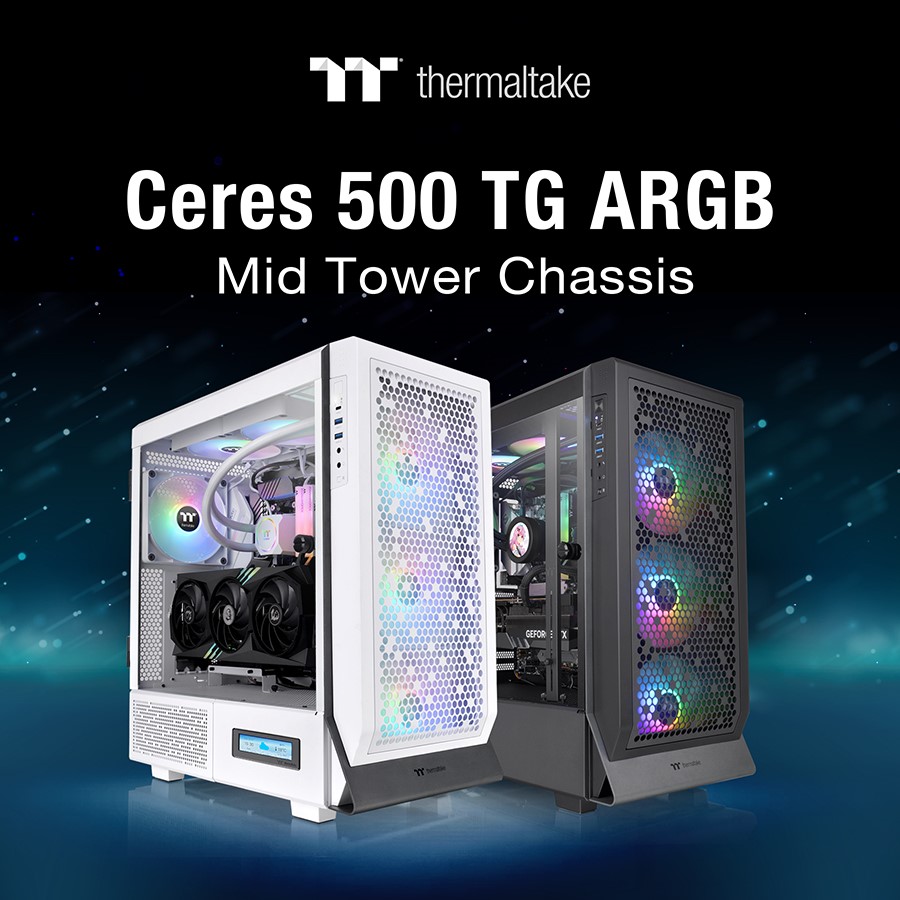
On the front, you can mount up to 360/420mm radiators, while the top supports up to 360mm. Inside the case, there's also plenty of space for storage, including up to five 3.5-inch HDDs and eight 2.5-inch SSDs.
The case includes a GPU holder to prevent the graphics card from sagging and a riser cable bracket to mount the GPU vertically or turn it 180º. The latter is complemented by the patented rotational PCIe slots. There's also an optional LCD kit with a 3.9-inch screen that you can use to monitor your system or configure it with images, GIFs, and clips in TT RGB Plus 2.0 software.
KitGuru says: If you're in the market for a new case, the Ceres 500 TG ARGB might be worth checking out.