KitGuru KitGuru.net – Tech News | Hardware News | Hardware Reviews | IOS | Mobile | Gaming | Graphics Cards


Test System Specifications:
- CPU: AMD Ryzen 9 9950X
- Motherboard: ASRock Phantom Gaming X870E Nova WiFi
- Memory: 32GB (2 x 16GB Modules) Kingston Fury DDR5-6000
- Graphics card: MSI Radeon RX 6600 XT Gaming X
- Storage: 1TB Corsair MP600 Elite PCIe Gen4x4 NVME M.2 SSD
- Power Supply: Seasonic Prime TX-1600
- Chassis: Open Test Bench
- Thermal Compound: Arctic MX-6
- O/S: Windows 11 Version 24H2
Testing Methodology:
We are primarily focusing on the performance of each cooler at 100% fan speed and also when locked to 40dBA noise output. We will focus on cooling performance using a manual overclock with all-core frequency and VCORE locked to 5.2GHz/1.3V (AMD) and 5.5GHz/1.3V (Intel) and Precision Boost Overdrive performance.
- The test data is logged using HWINFO and the final 10 minutes of the data is calculated to find the average CPU temperature and CPU clock multiplier (AMD PBO Test) and then plotted in the charts.
- For testing, we use a 30-minute looped run of Cinebench R23 and record the steady-state CPU temperature at the end of the test. This ensures that the CPU has had ample time to warm up and reach a steady state under all of the coolers.
- The ambient is maintained at 19-21 degrees Celsius. Where there is variation beyond this temperature range, we add extra repeated tests to ensure consistency. However, this is well controlled now with A/C.
- We also test each cooler with at least two fresh installs (typically three) to mitigate the likelihood of poor mounting spoiling results.
- Ambient temperature and humidity are controlled via a mini split air conditioning system inside the test room. Ambient temperature is maintained between 19-20°C; temperature delta figures are shown in the charts (ambient temperature is deducted from the measured component temperature).
Test Results:
Acoustics
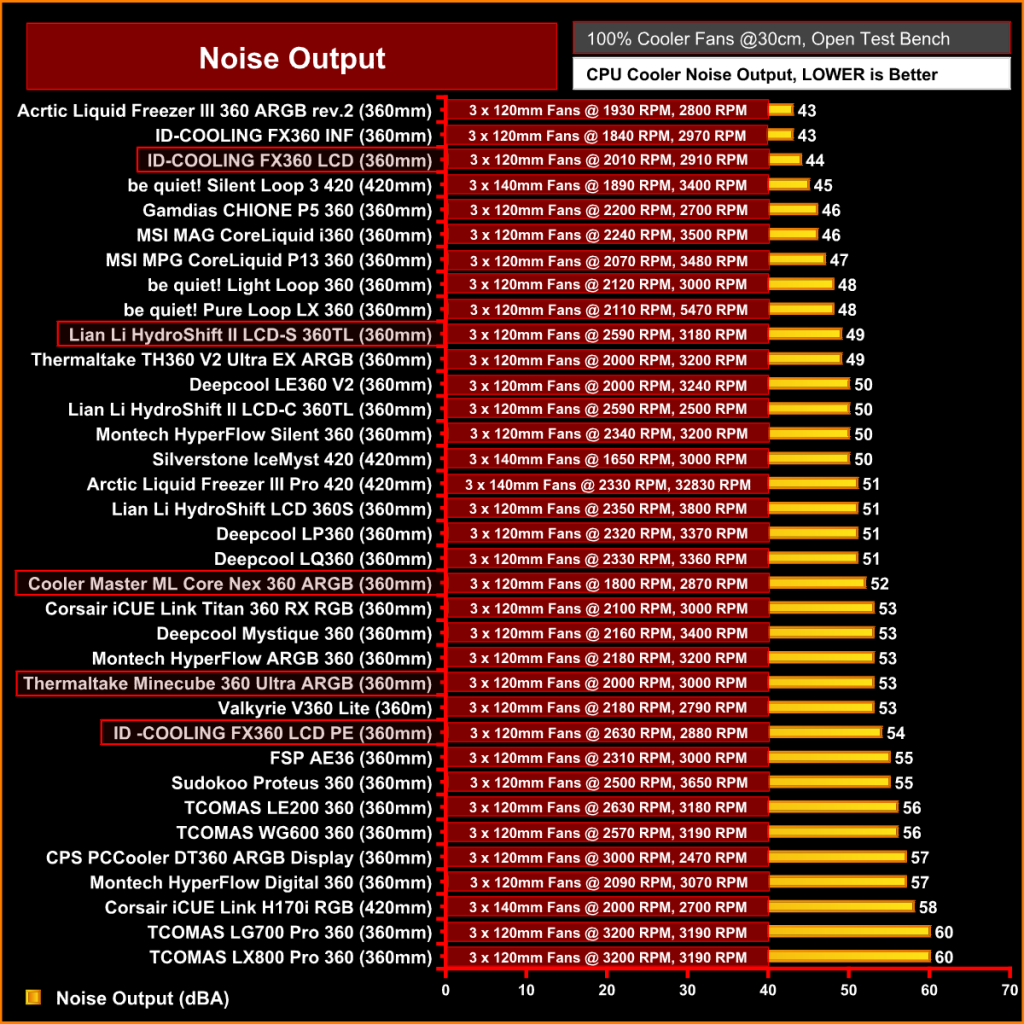
Looking at the noise data, the Cooler Master Core Nex 360 ARGB hits 52 dBA, putting it in the upper-mid range of the chart. At full fan speed, it’s noticeably louder than the quietest performers around 43–45 dBA, but still well below the most aggressive high-RPM designs that push past 58–60 dBA. For a cooler using mainstream 120mm fans with RGB lighting and a relatively compact pump assembly, the noise output is acceptable – definitely audible, but not harsh or too distracting. Compared to typical performance-oriented 360mm AIOs, it sits roughly where you’d expect a balanced model to land.
The two ID-Cooling models show a clear split in acoustic performance. The FX360 LCD comes in at 44 dBA, making it one of the quietest coolers tested, while the FX360 LCD PE reaches 54 dBA, reflecting its higher-performance, higher-pressure fan setup. Lian Li’s HydroShift II LCD-S 360TL sits at 49 dBA, a moderate result that keeps it quieter than many LCD-equipped rivals. Meanwhile, the Thermaltake Minecube 360 Ultra registers 53 dBA, placing it on the louder end of the scale with its SWAFAN EX12 fans running flat out.
Thermal Performance: AMD Ryzen 9 9950X
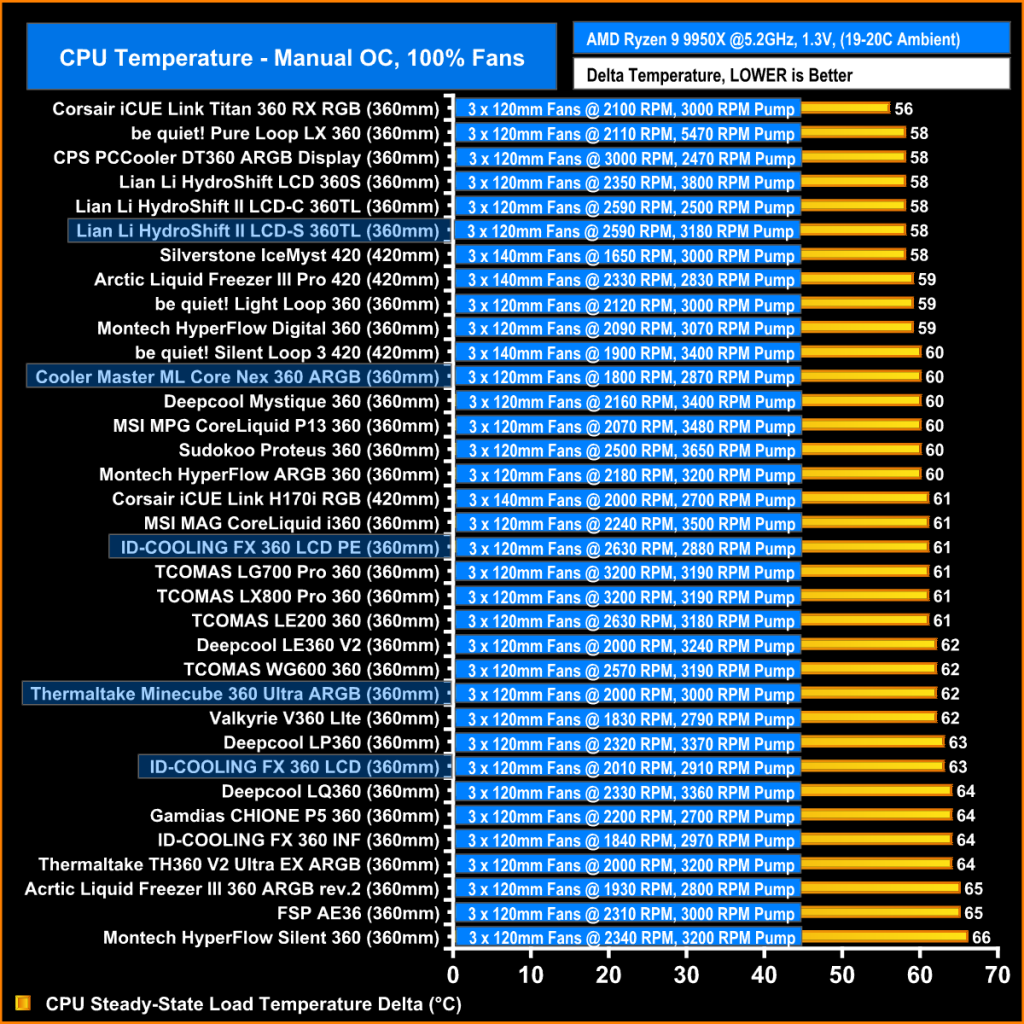
Starting with the Cooler Master Core Nex 360 with a result of 60°C over ambient, puts it in mid-table. It doesn’t trouble the leaders, but it's perfectly serviceable for a mainstream 360mm unit on a high-end CPU. It delivers consistent performance under sustained load, though it clearly isn’t tuned to chase the absolute lowest temperatures. Interestingly, the ID-Cooling FX360 LCD PE lands at 61°C, only a degree behind the Core Nex. Given its higher-pressure fans, you’d expect a slightly stronger showing, but the PE ends up sitting in the same general performance tier – so it's capable, but nothing special in this max speed test.
The Lian Li HydroShift II LCD-S 360TL performs much better at 58°C over ambient, placing it among the top-performing coolers, offering genuinely high-end thermal performance when the fans are allowed to run at their maximum. At 63°C over ambient, the ID-Cooling FX360 LCD slides a bit further down the table; it’s clearly tuned more for acoustics and aesthetics than raw cooling power. Finally, the Thermaltake Minecube 360 Ultra comes in at 62°C, which isn’t terrible, but certainly doesn’t match its premium price tag. It falls into that familiar category of feature-heavy, LCD-focused AIOs that prioritise functionality and design over outright thermal dominance.
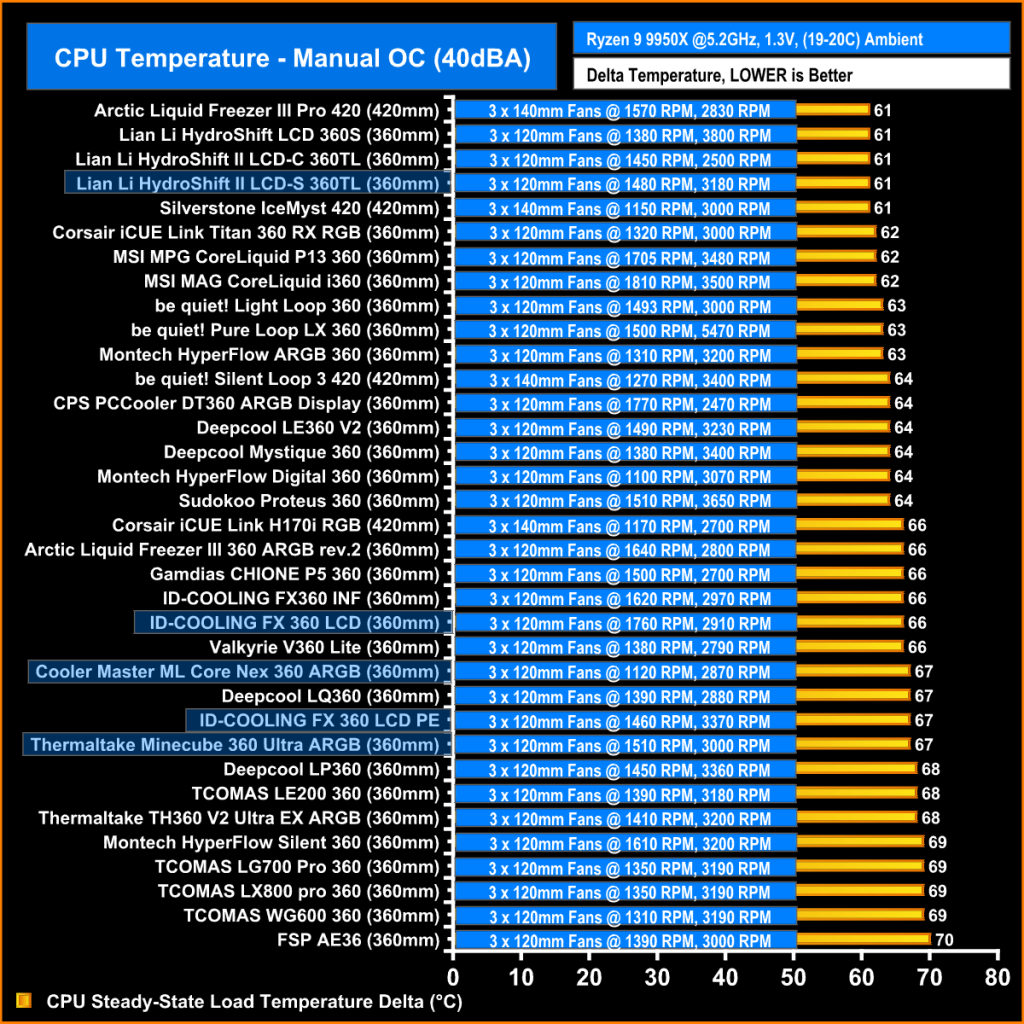
Noise-normalised testing gives us a true reading of performance, and often shuffles the chart positions, which is the case here. The Lian Li HydroShift II LCD-S 360TL performs particularly well, delivering 61°C average over ambient at 40 dBA, putting it right up with the strongest coolers in this noise focused scenario. It clearly doesn’t rely on high fan speeds to be competitive. The ID-Cooling FX360 LCD, by contrast, lands on 66°C, sliding back into the lower half of the table. This aligns with its acoustic-first design: once restricted to a fixed noise level, its lower-pressure fans simply don’t move as much air as its rivals, and that shows in the thermals.
The Cooler Master Core Nex 360 posts a 67°C over ambient, which puts it firmly in the lower tier under noise limits. Stable, but lacking the efficiency curve of the better-tuned high-end units. Right alongside it is the ID-Cooling FX360 LCD PE, also at 67°C, which is interesting given its far more aggressive fans. Once capped at 40 dBA, its advantage diminishes, suggesting it relies heavily on raw RPM for performance. The Thermaltake Minecube 360 Ultra also returns 67°C, landing squarely in the same bracket. With its feature-heavy design – quad displays, VRM fan, magnetic daisy-chain fans etc – thermal efficiency at lower fan speeds isn’t its strength.
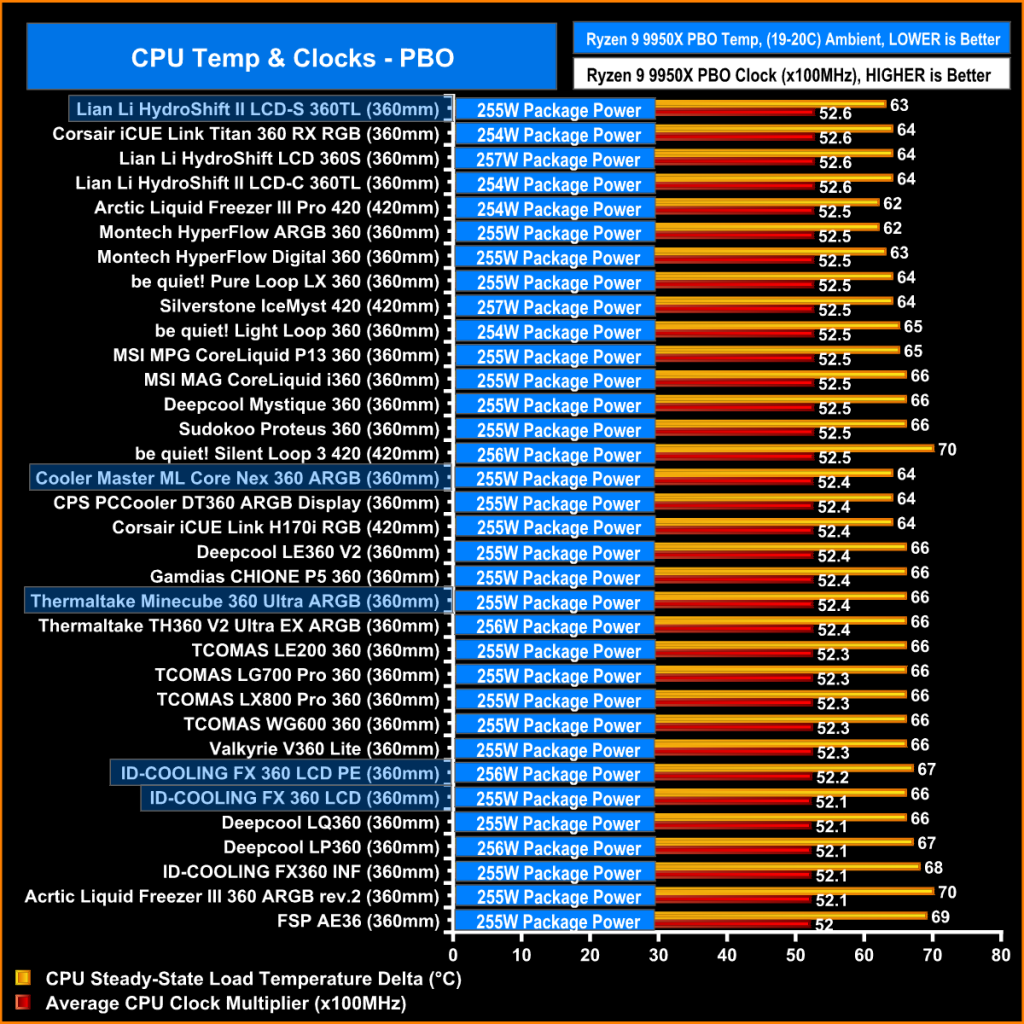
Under PBO workloads with fans and pumps at full speed, the Lian Li HydroShift II LCD-S 360TL continues to impress, holding 63°C over ambient and sustaining an average CPU multiplier of 52.6x, placing it at the top of our chart, proving excellent thermal headroom and allowing the CPU to maintain its maximum boost frequencies more consistently. The HydroShift’s radiator efficiency and pump design clearly help it keep thermals in check without compromising boost performance.
The Cooler Master Core Nex 360 ARGB delivers a 64°C delta and 52.4× multiplier, sitting in the mid-range. It offers steady performance under PBO, but without the top-end thermal efficiency, it loses a small amount of maximum boost potential. Finally, the Thermaltake Minecube 360 Ultra records 66°C delta with a 52.4× multiplier, showing competent cooling but, it’s slightly restricted by its design, focusing on features rather than performance.
The ID-Cooling FX360 LCD and FX360 LCD PE are behind in PBO performance. The LCD hits 66°C over ambient with an average multiplier of 52.1x, while the PE variant posts 67°C delta and 52.2x. While the PE is tuned for stronger airflow at the cost of higher noise, both models maintain reasonable clock speed, though the higher temperatures slightly limit their PBO headroom. Overall, the hierarchy under PBO is clear: Lian Li leads, Cooler Master sits comfortably in the middle, Thermaltake trades slightly higher temperatures for added features, while ID-Cooling shows solid performance for budget options.