KitGuru KitGuru.net – Tech News | Hardware News | Hardware Reviews | IOS | Mobile | Gaming | Graphics Cards


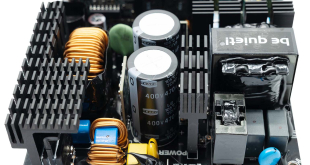
It has been some time since we last looked at a power supply from German brand be quiet! Today we analyse their latest Power Zone 2 which is due for release this week. This new series comprises four power supplies in 750W, 850W, 1000W and 1200W capacities, and we look at the flagship unit today. This supply has both Platinum 80 Plus and Cybenetics certifications, is fully modular and is supported with a 10-year warranty.
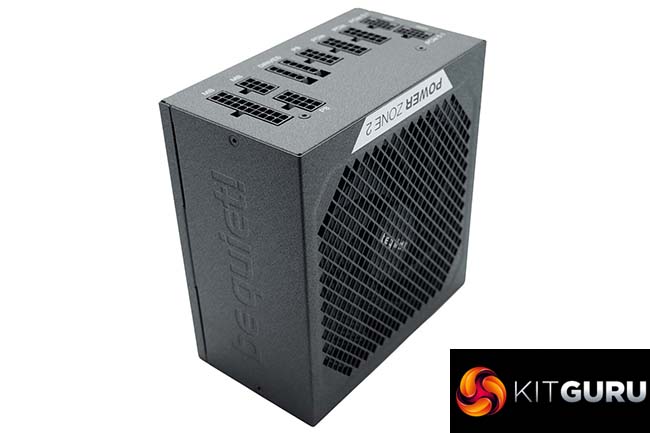
These new units ship with 90-degree angled 12V-2×6 connectors and have PCIe 5.1/ATX 3.1 compatibility. There is also a semi-passive zero-RPM mode to keep noise levels down when enabled.
Highlights:
- Available in 1200W, 1000W, 850W and 750W models
- 80 PLUS® Platinum and Cybenetics Platinum efficiency rating (up to 94.3%)
- Semi-passive zero-RPM cooling
- Fan runs on for 2-5 minutes to avoid frequent starting noise
- Pure Wings 3 140mm fan for quiet and efficient cooling
- 90° angled 12V-2×6 connector and PCIe 5.1/ATX 3.1 compatibility
- Advanced voltage regulation and stability thanks to LLC technology
- One massive high-performance 12V-rail
- Unique look with an unmistakable mesh design
- 10-year manufacturer’s warranty
- Product conception, design and quality control in Germany
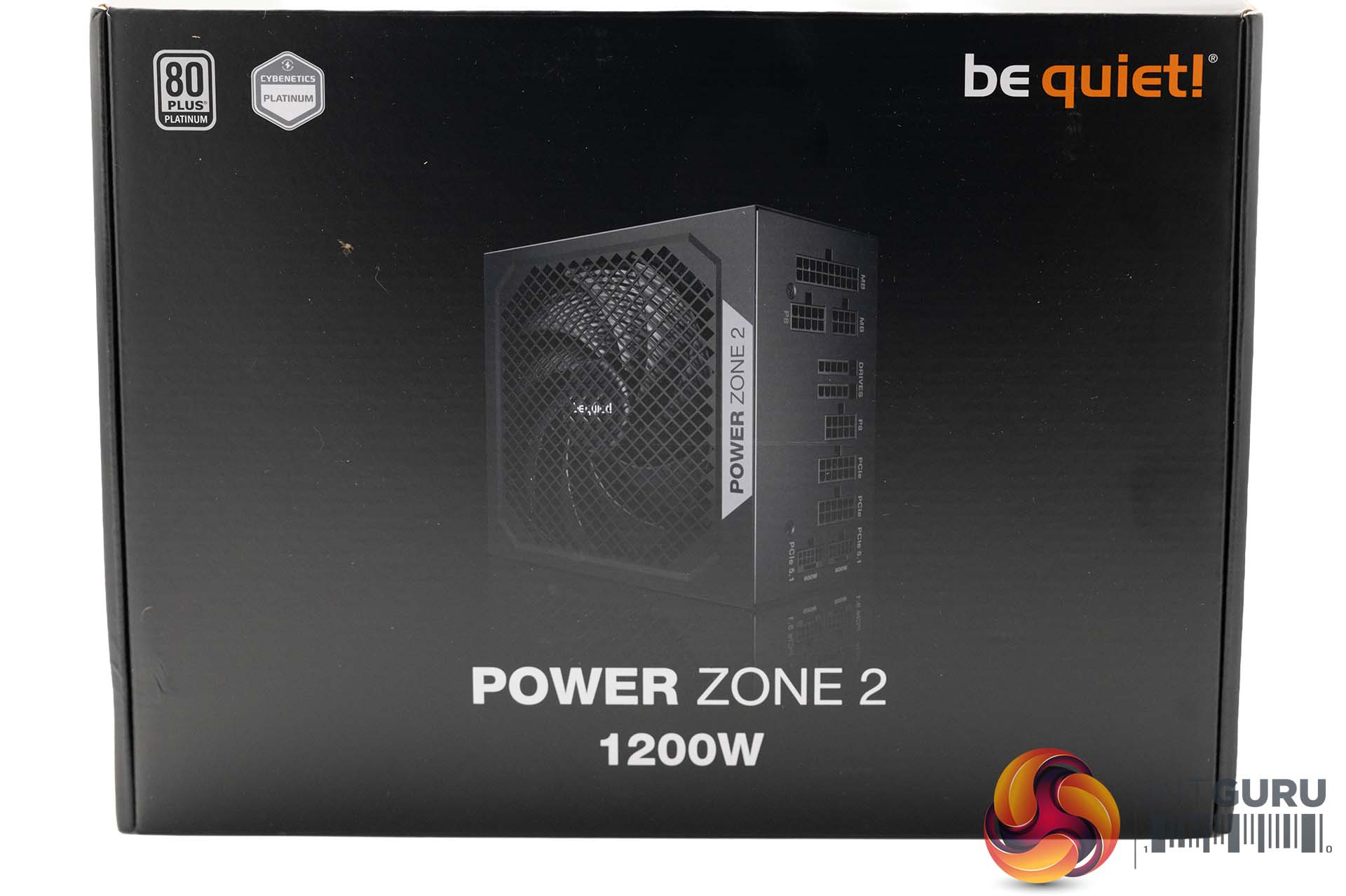
The be quiet! Power Zone 2 1200W power supply arrives in a traditionally coloured black and orange-accented box, with a high resolution image of the unit on the front. Two badges take pride of place top left – the 80 Plus Platinum certification and a Cybenetics Platinum certification.
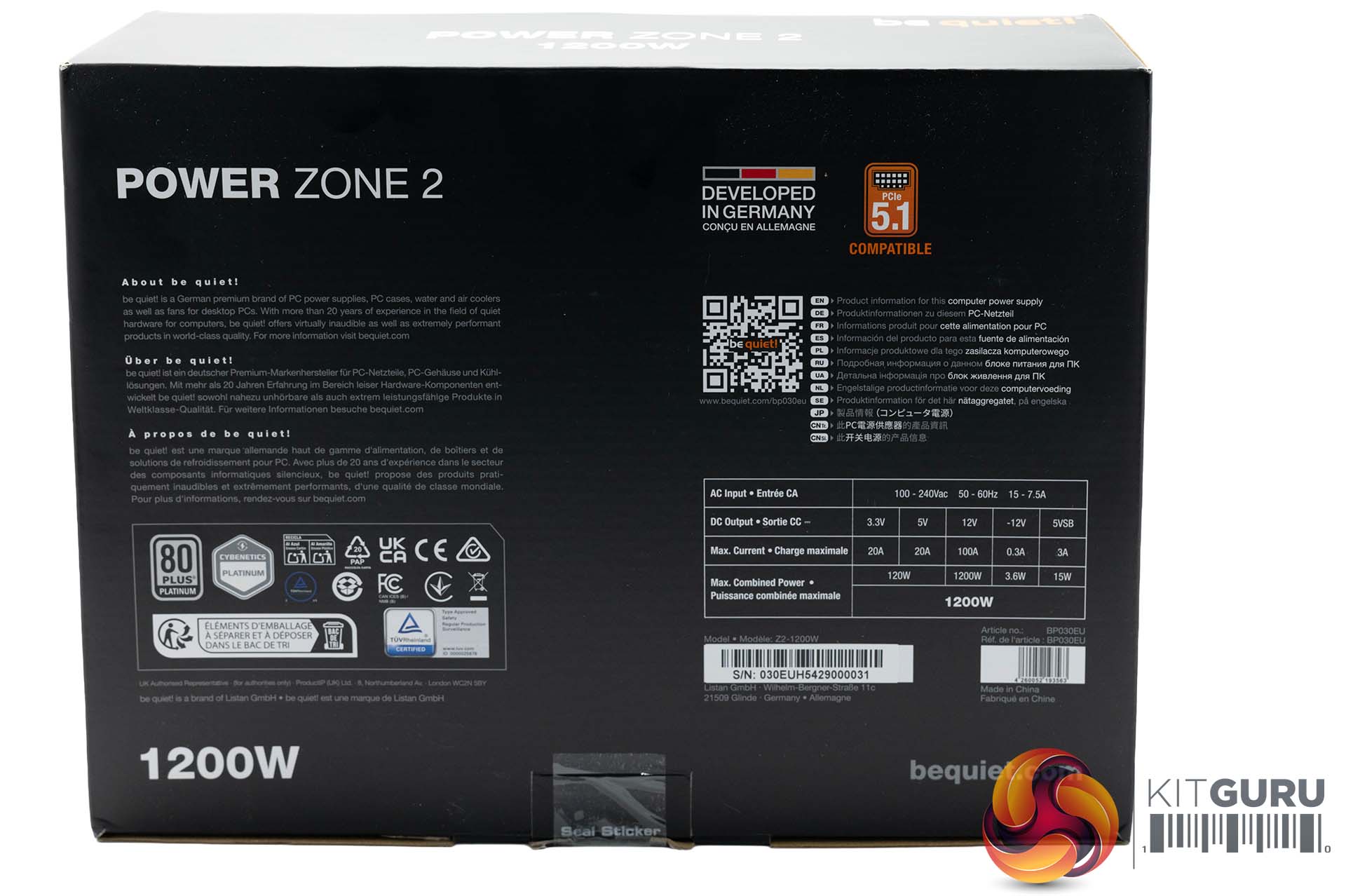
The rear of the box is pretty much devoid of any useful end user information. There is a little PCIe 5.1 badge top corner, however.
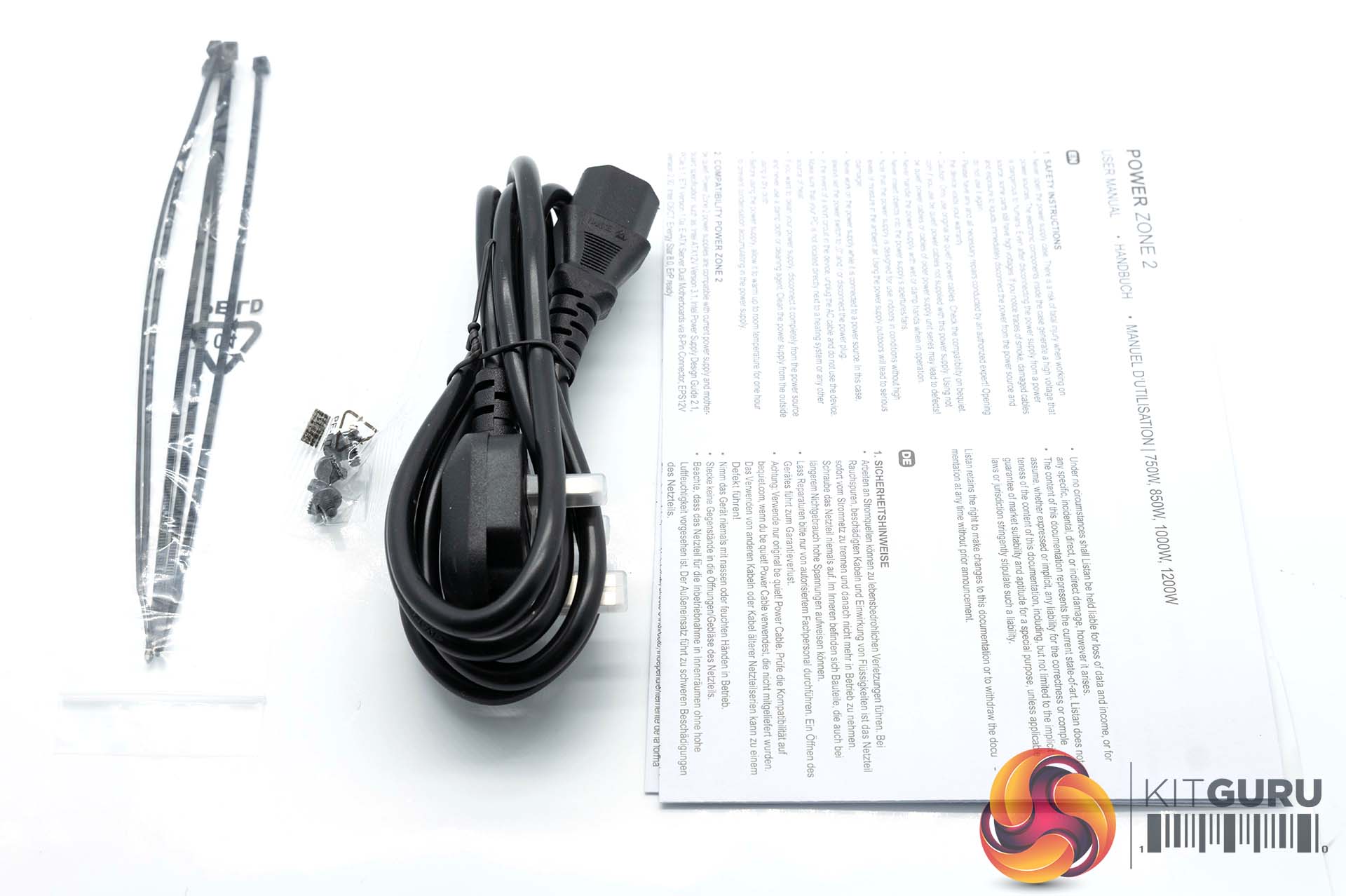
Inside there is some literature on the product, mounting screws, a regional power cable and some cable ties.
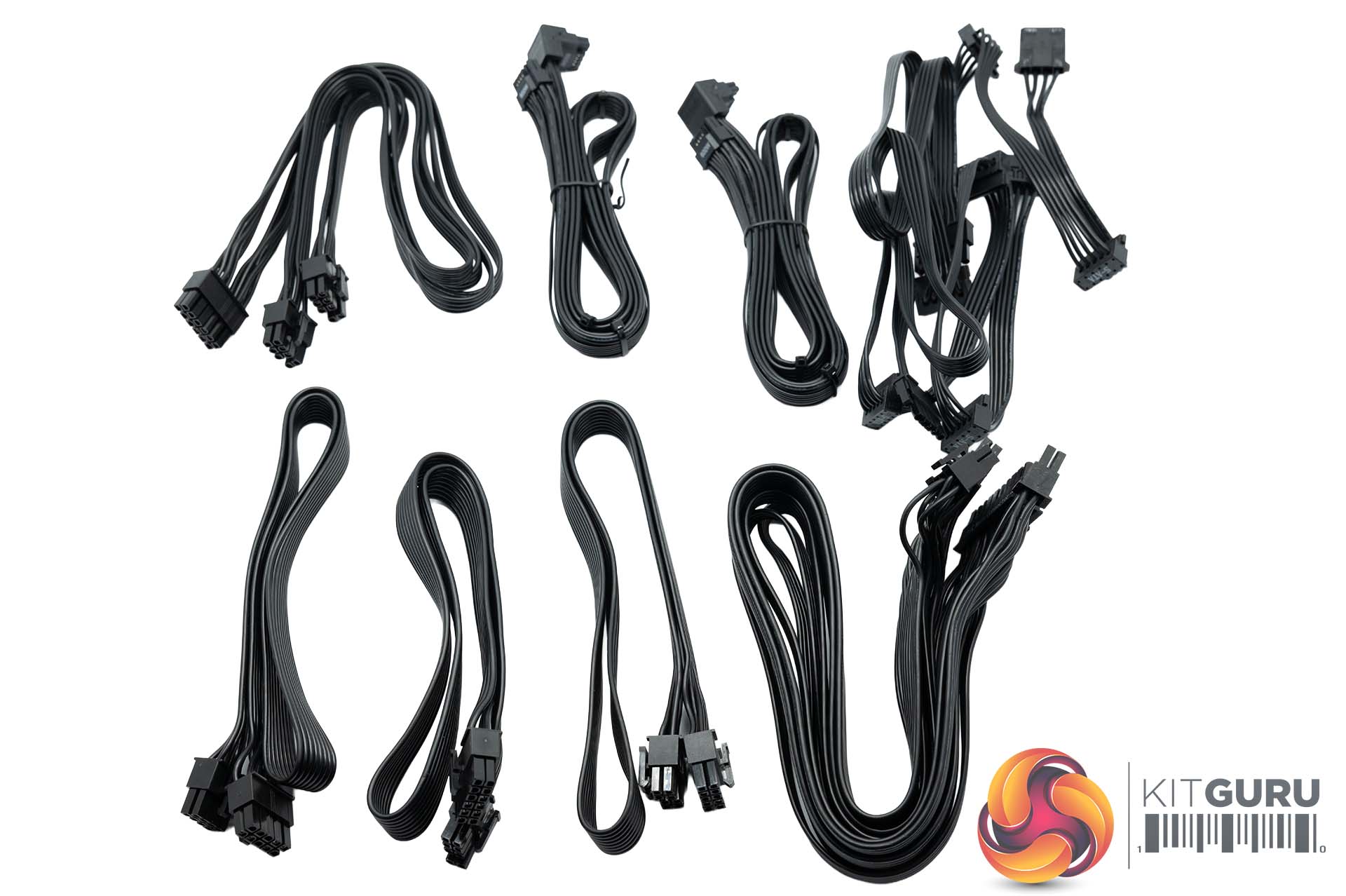
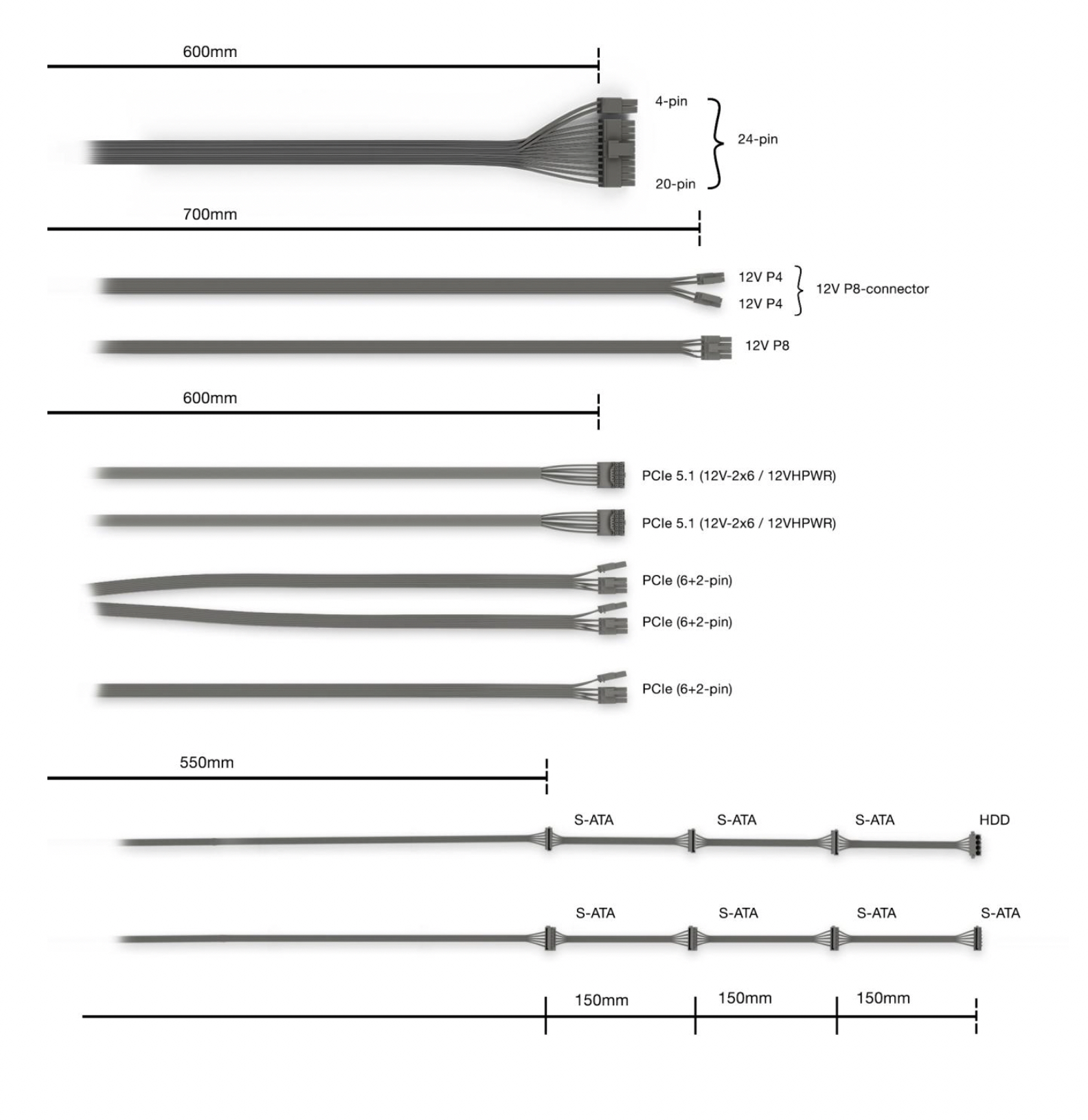
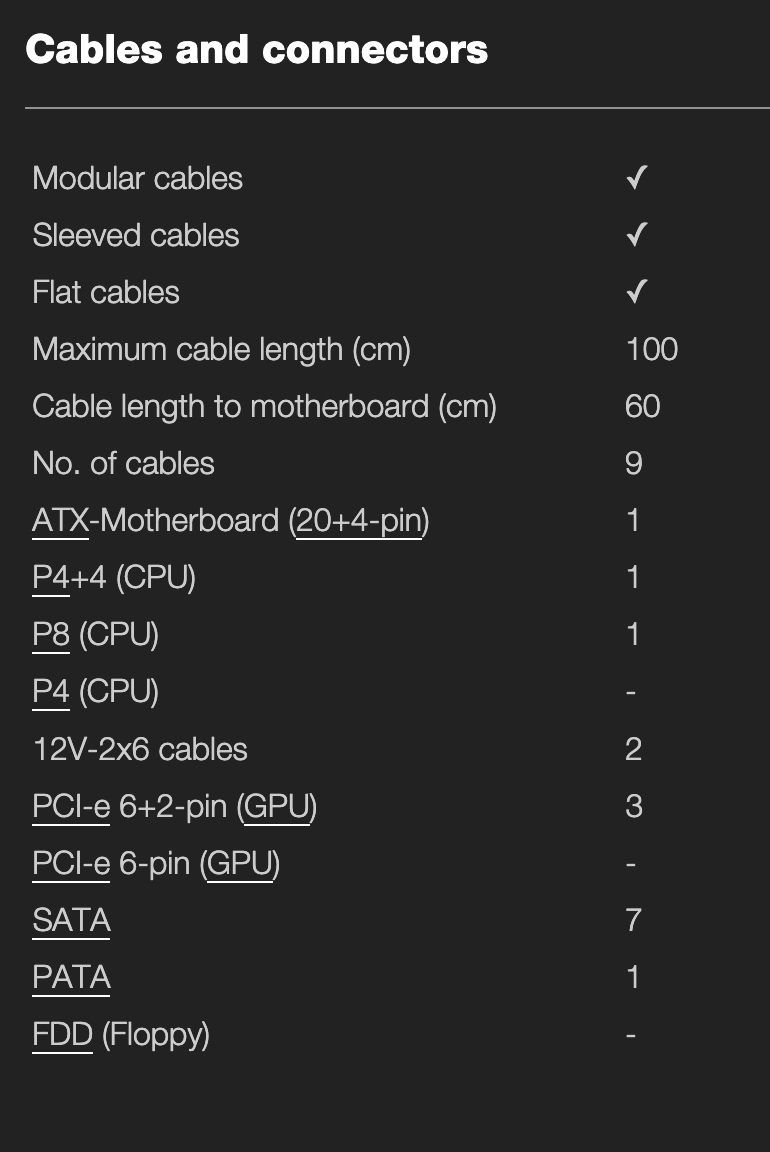
The quality of the cabling is good – all are flat ribbon style for ease of routing during the build phase. Cable lengths are pretty good with 150mm between SATA cables for instance. The 12V-2X6 connector is angled at 90 degrees.
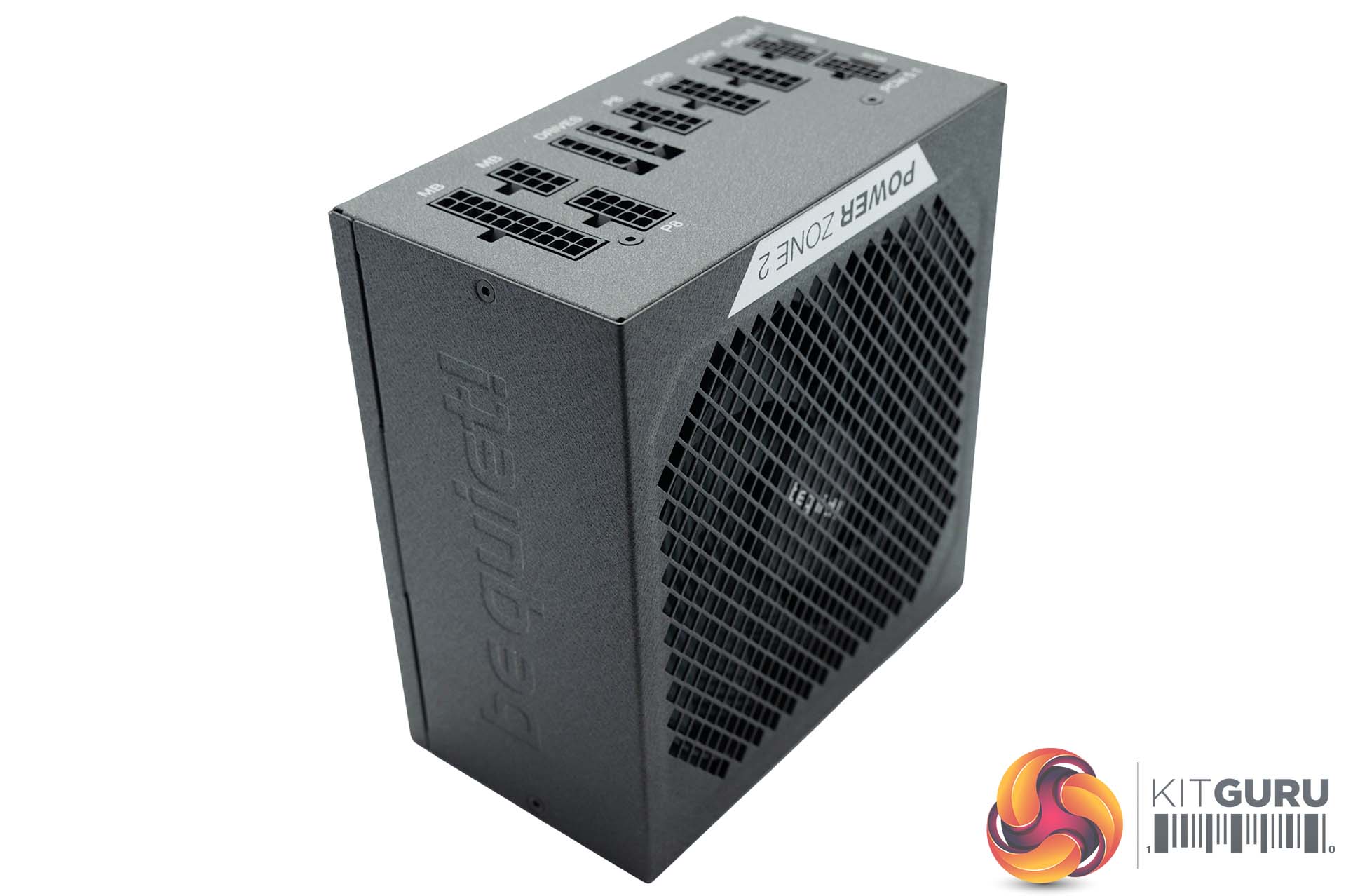
We quite like the appearance of this power supply. Sure, you could argue they are all similar, but the finish quality is pretty high. The chassis measures 160x150x86 mm (LxWxH). It weighs 1.88kg.
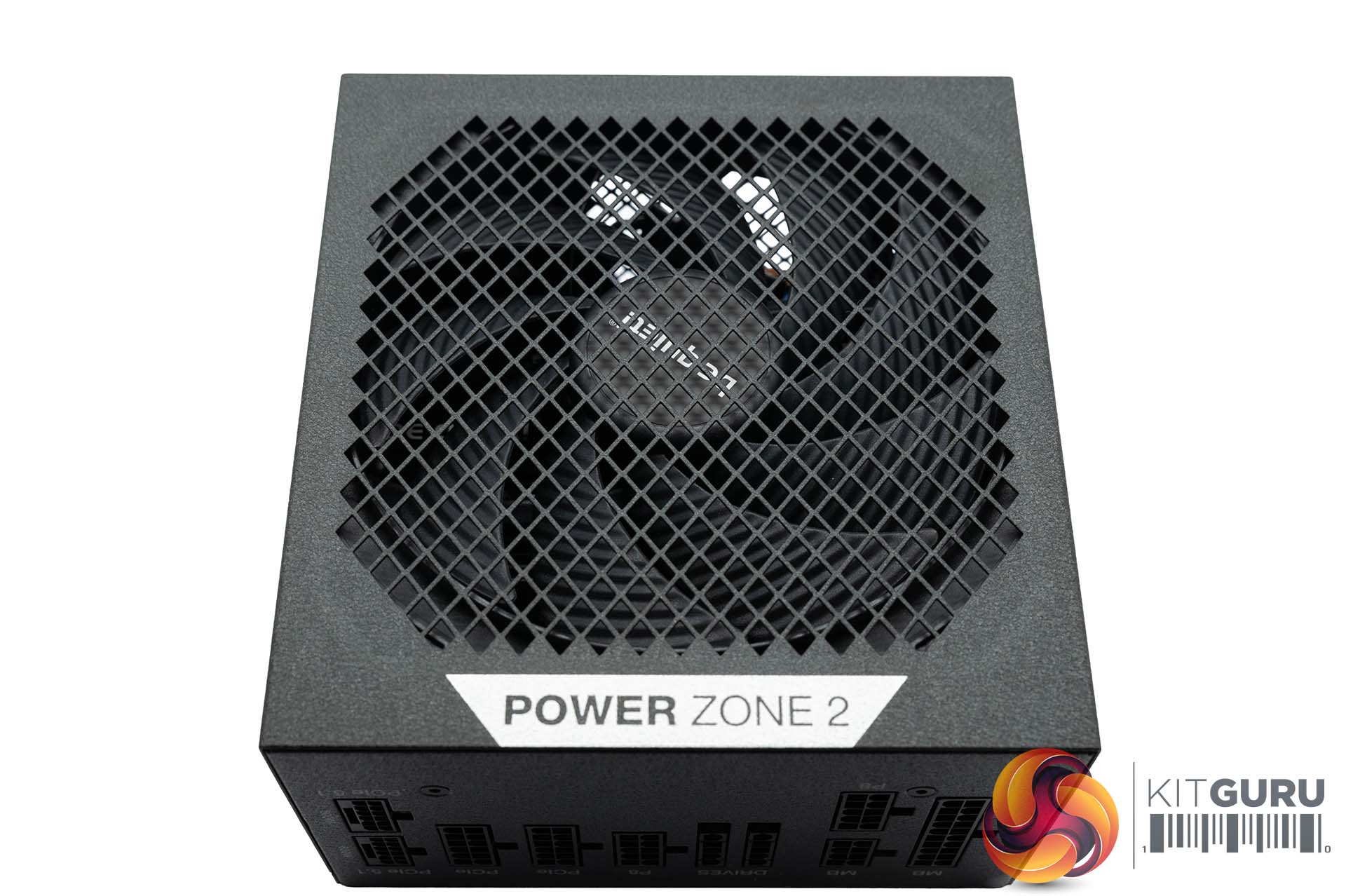
We like the mesh design on some of the panels as well. The design has large holes cut into the grille, too, aiding fan airflow.
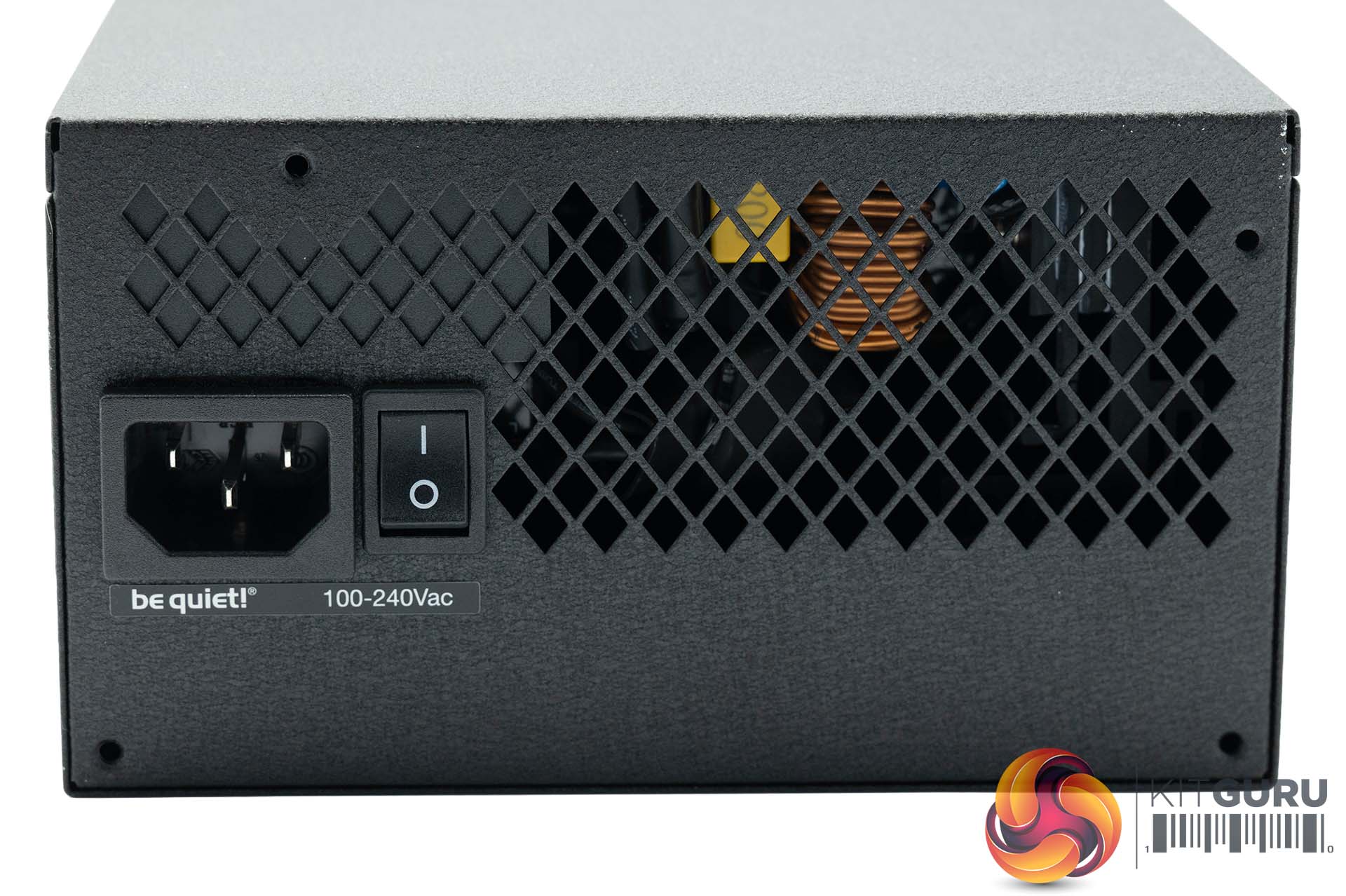
The power side is home to a power connector and switch, along with a panel to help expel warm air.
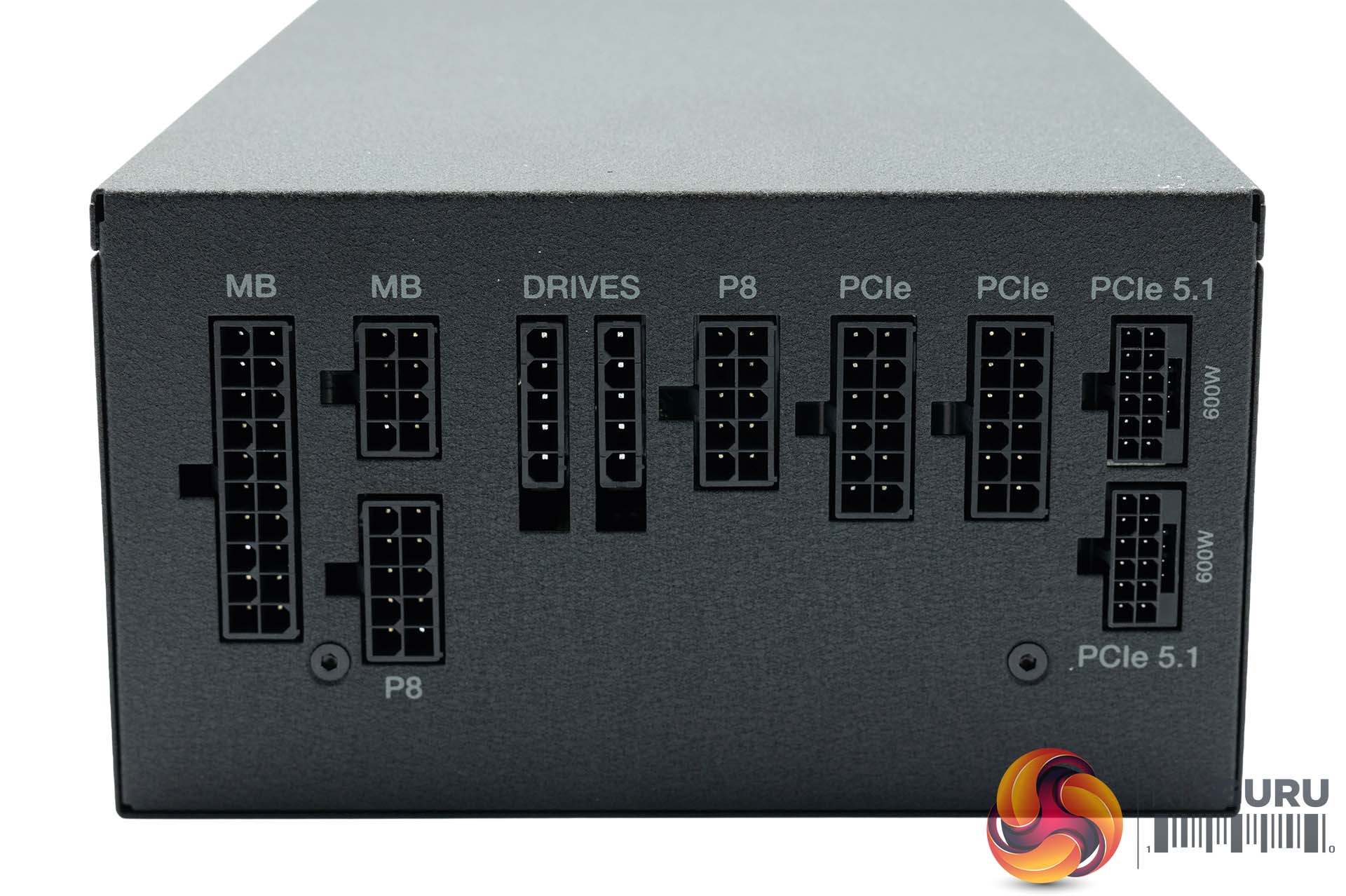
The other side is home to the modular bay, all mounted in a vertical pattern and labelled for ease of use.
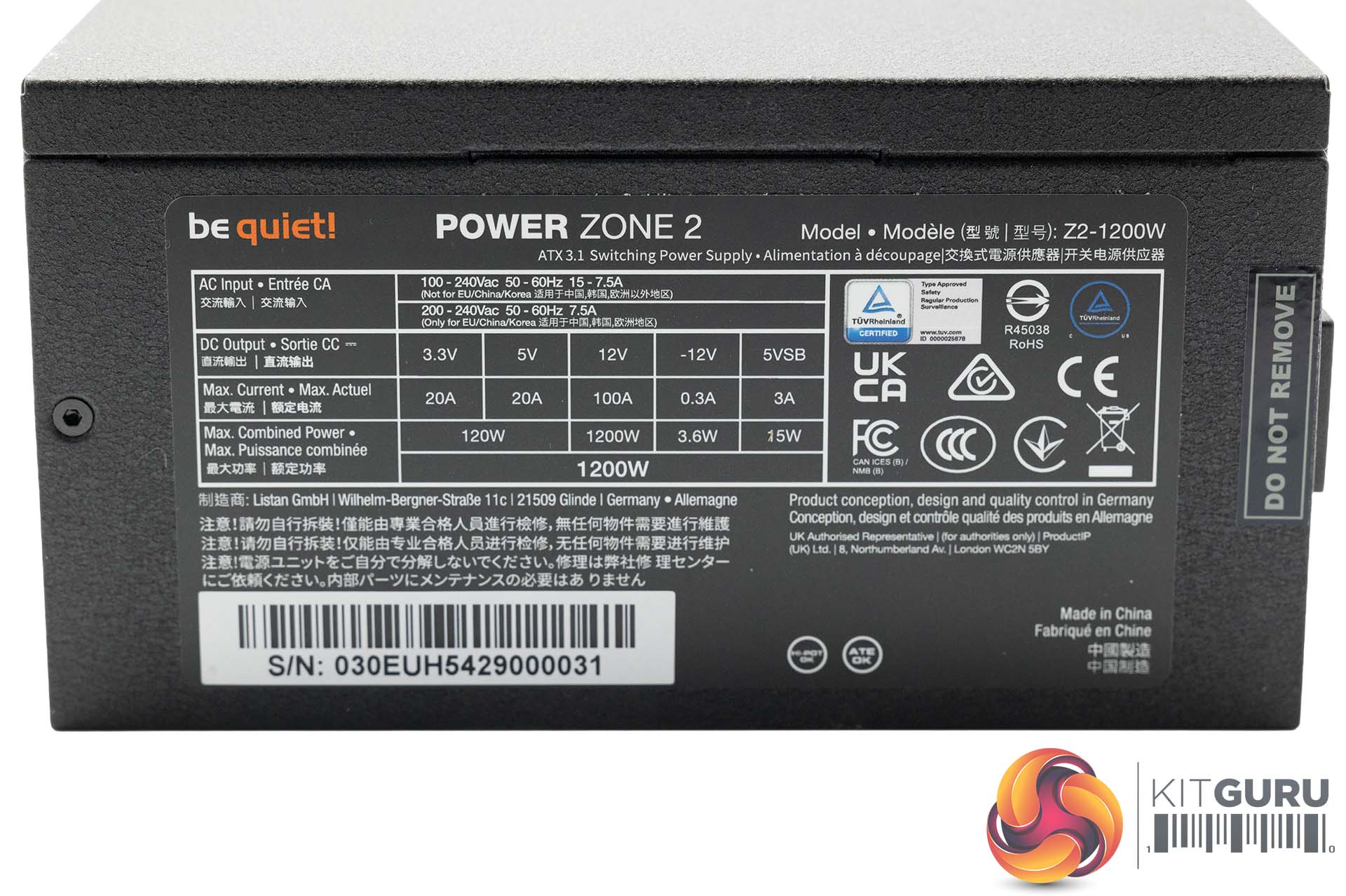
This unit is able to deliver 100A via the +12V rail, for a total of 1200 Watts.
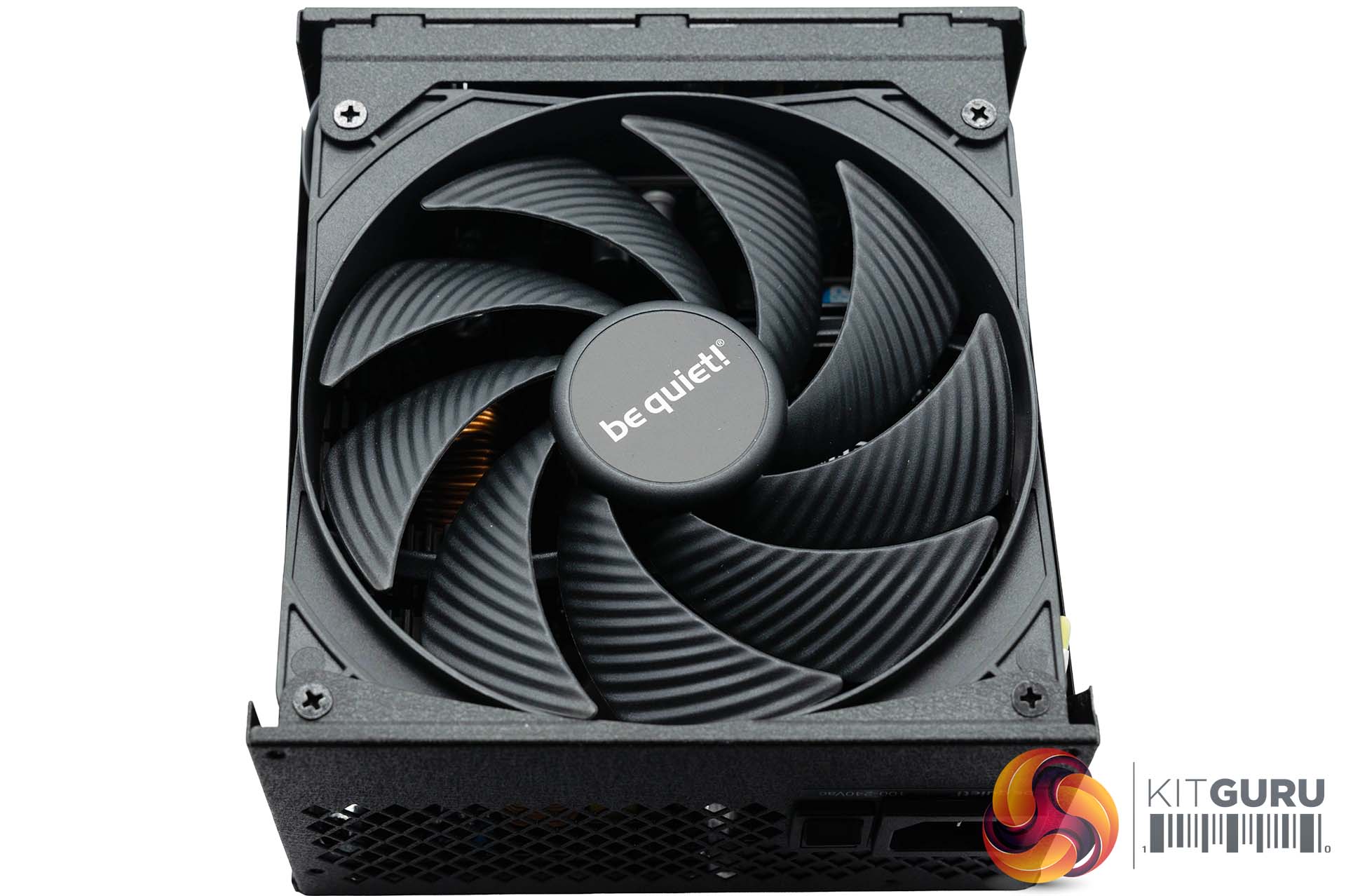
The be quiet! fan is mounted to a bracket system underneath the top grille. Most PSU designs have the fan mounted to the top panel.
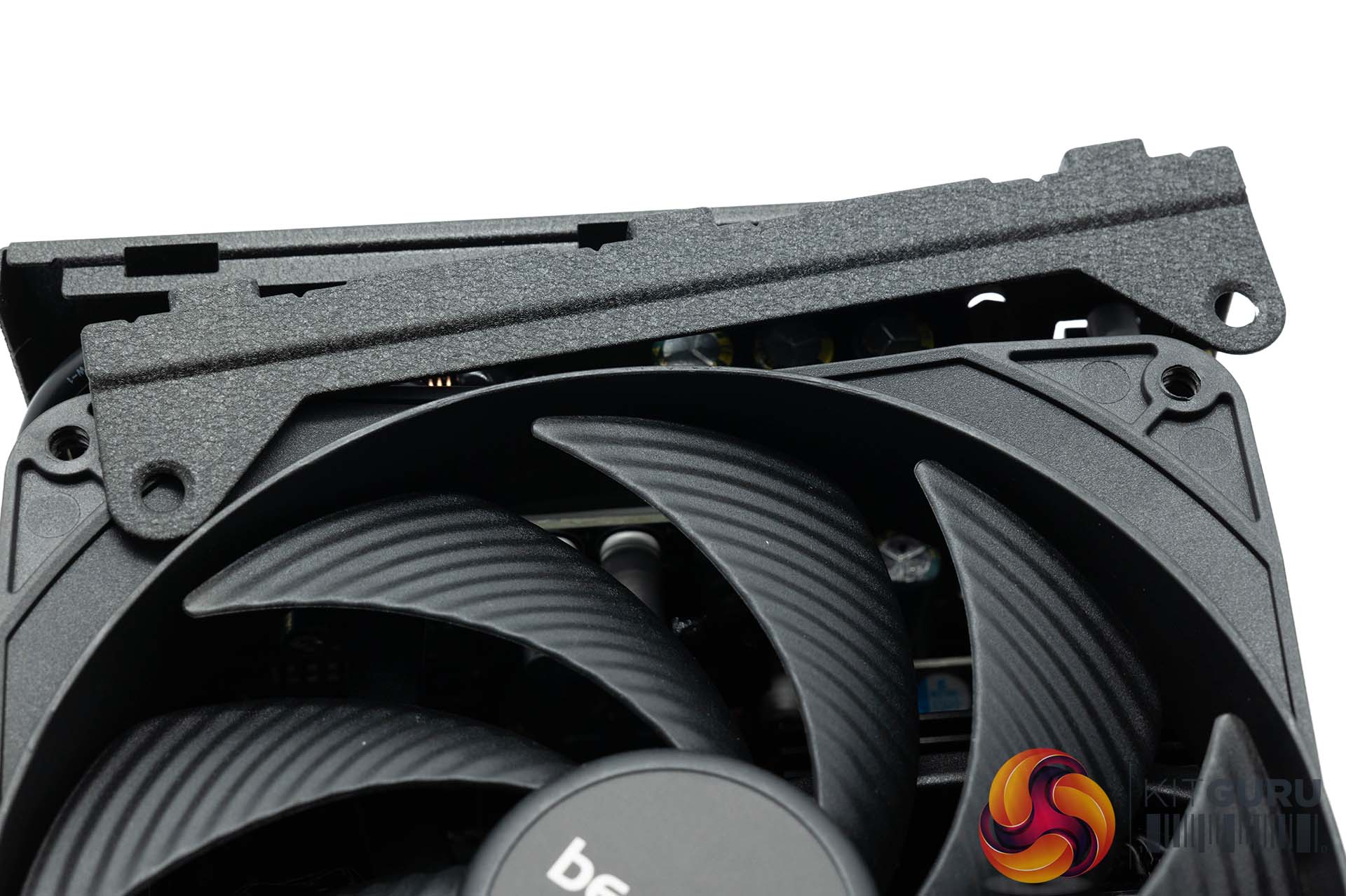
Quite an unusual mounting system, I don't think I have ever seen this implemented before.
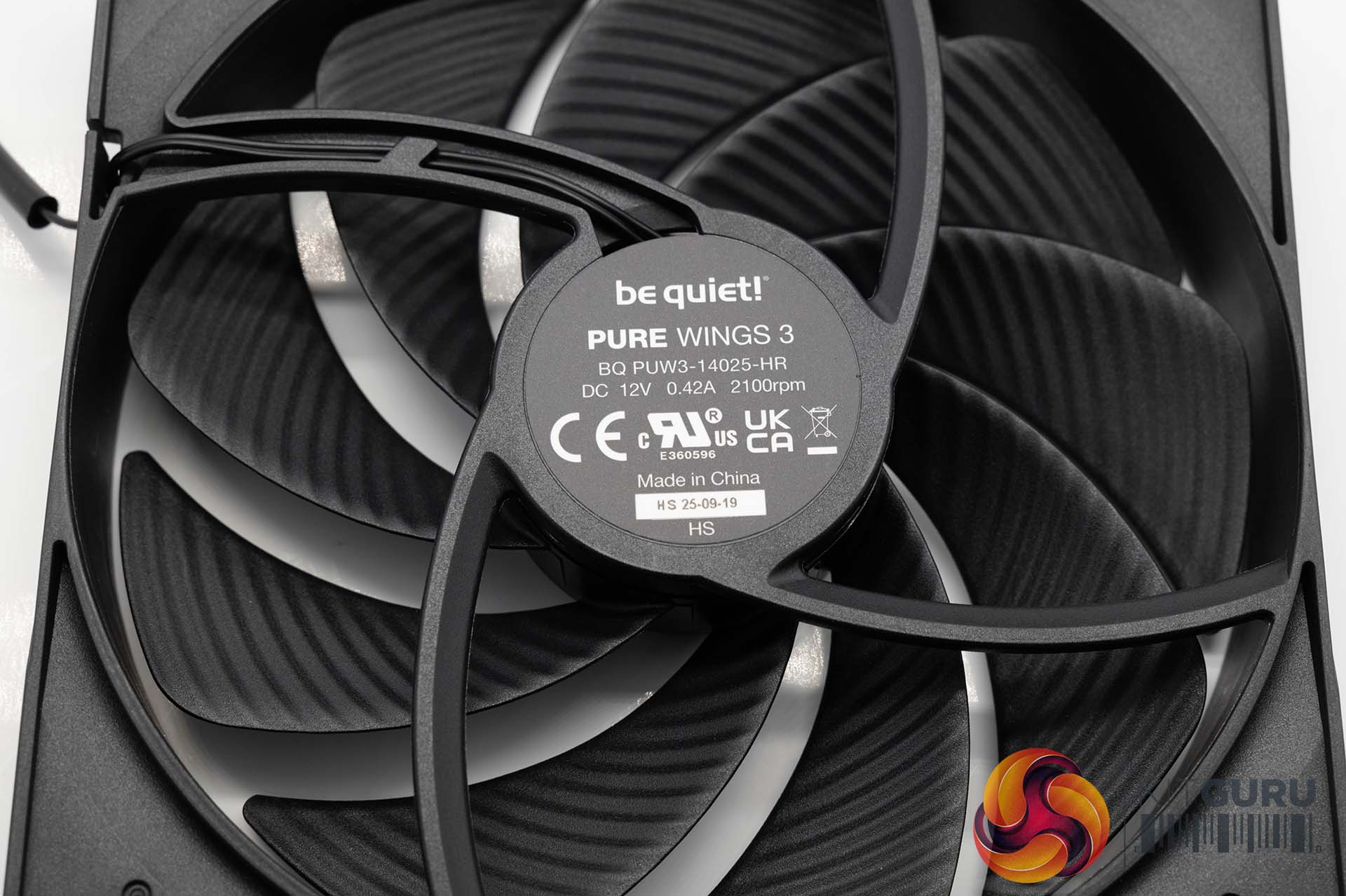
be quiet! are using one of the Pure Wings 3 fans, model BQ PUW3-14025-HR rated 12V, 0.42A with a maximum rotational speed of 2,100 rpm. This is not one of the more commonly known base model (1,200 rpm) or high speed (1,800 rpm) fans and is designed specifically for these power supplies. This is a rifle bearing fan which tend to be not as durable or quiet as more expensive fluid dynamic bearing fans. It's a little disappointing to see to be honest. The motor in this fan is a 4-pole fan motor. MTBF is rated at 100,000 hours.
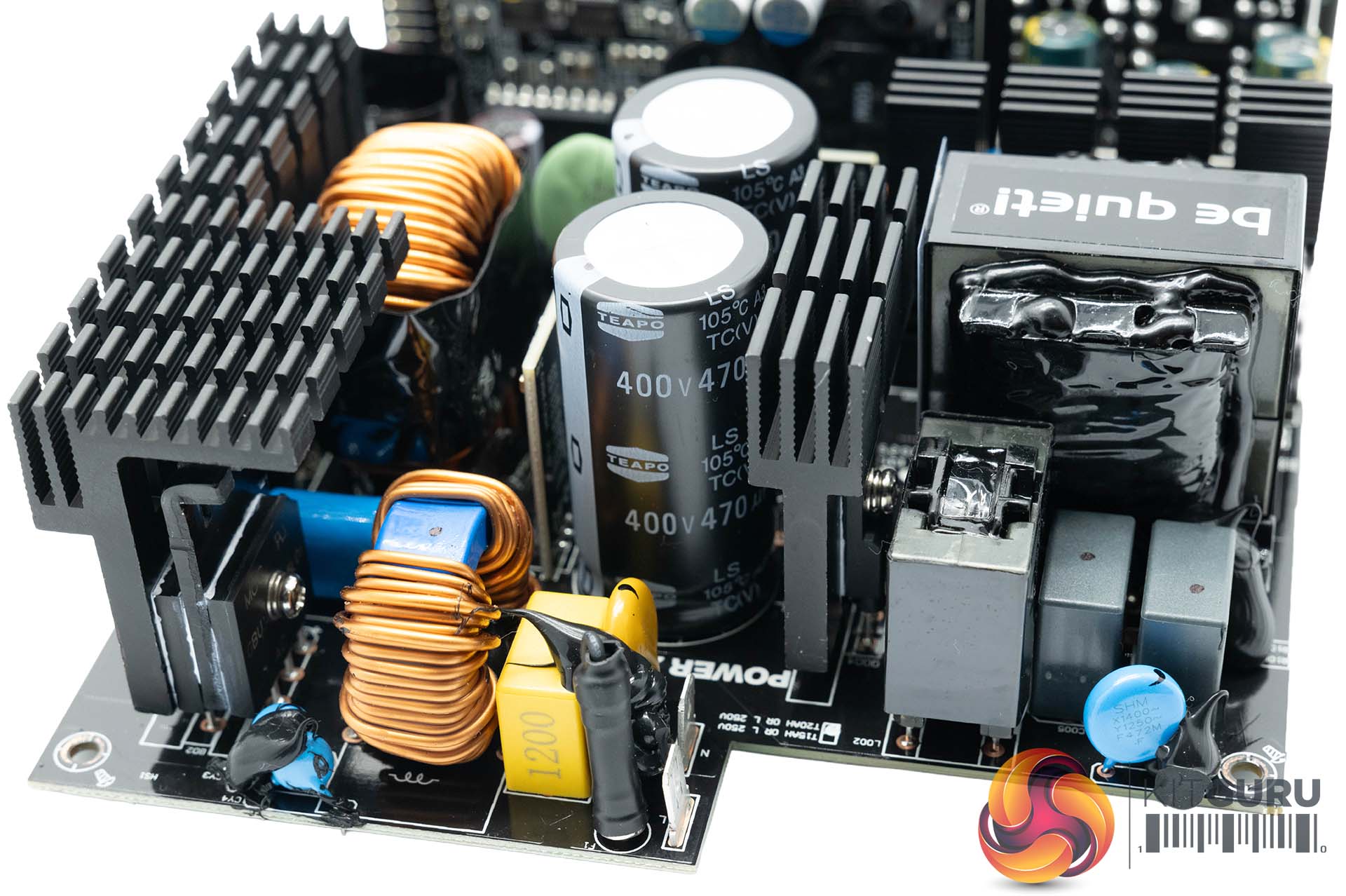
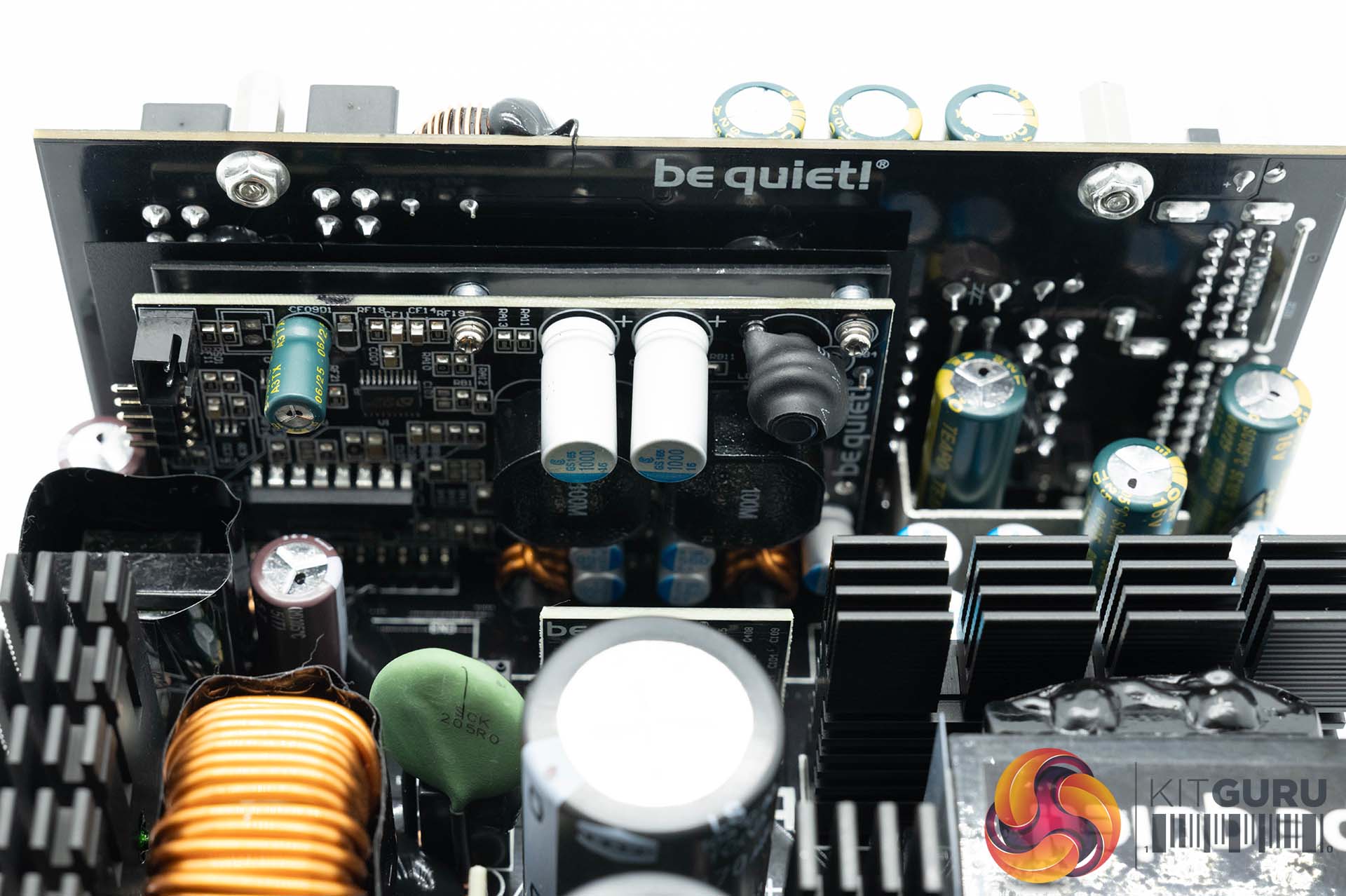
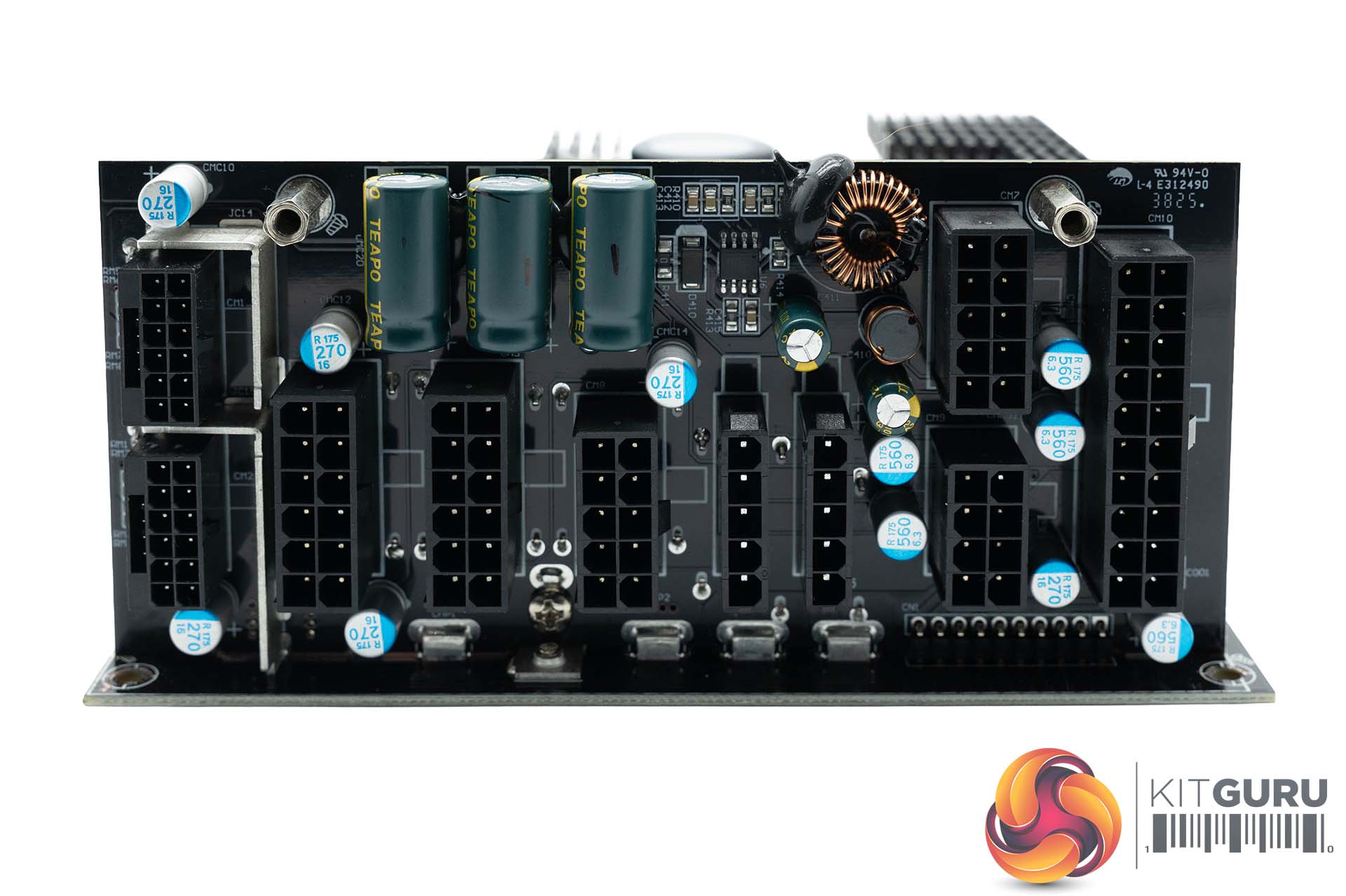
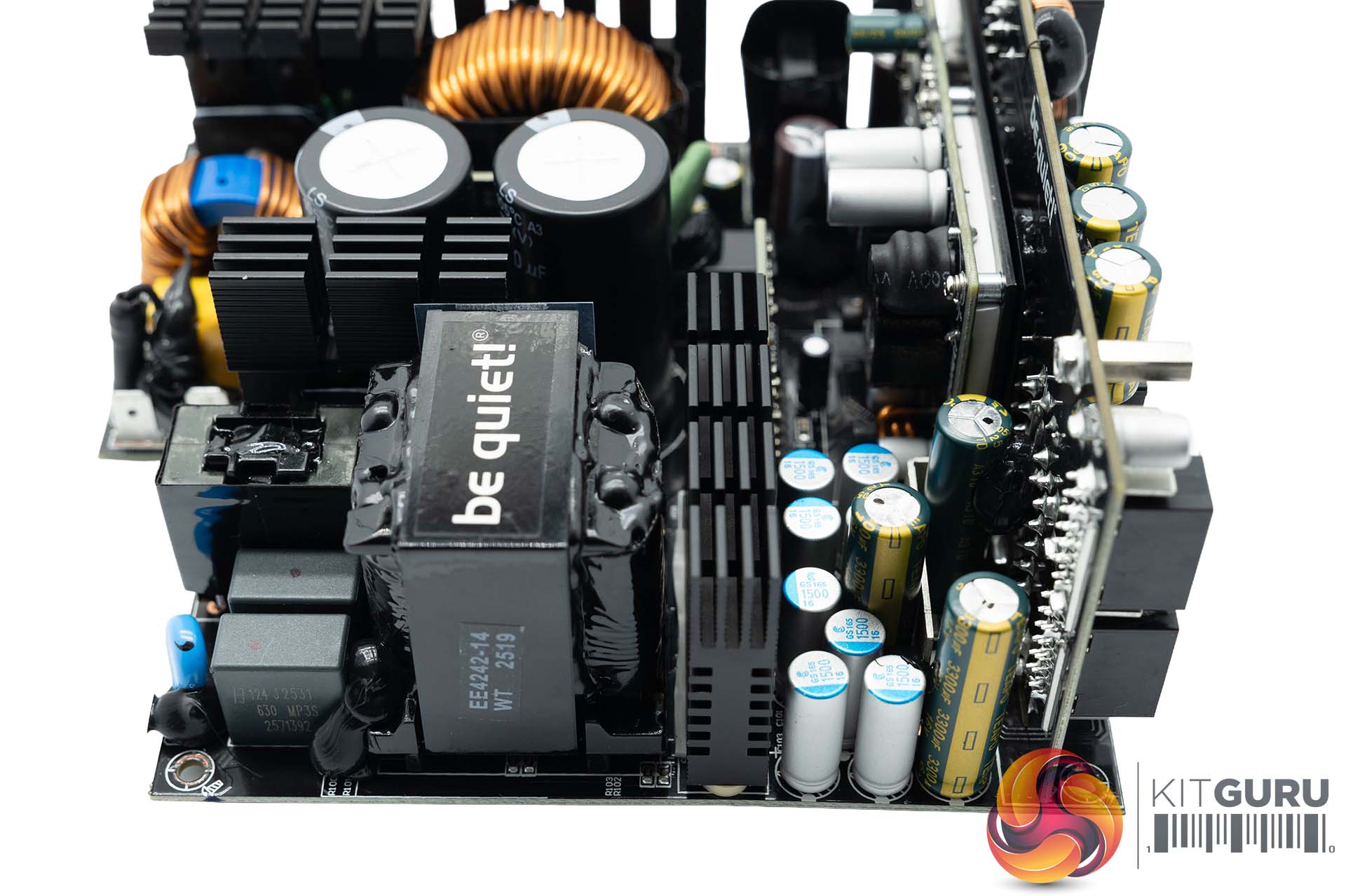
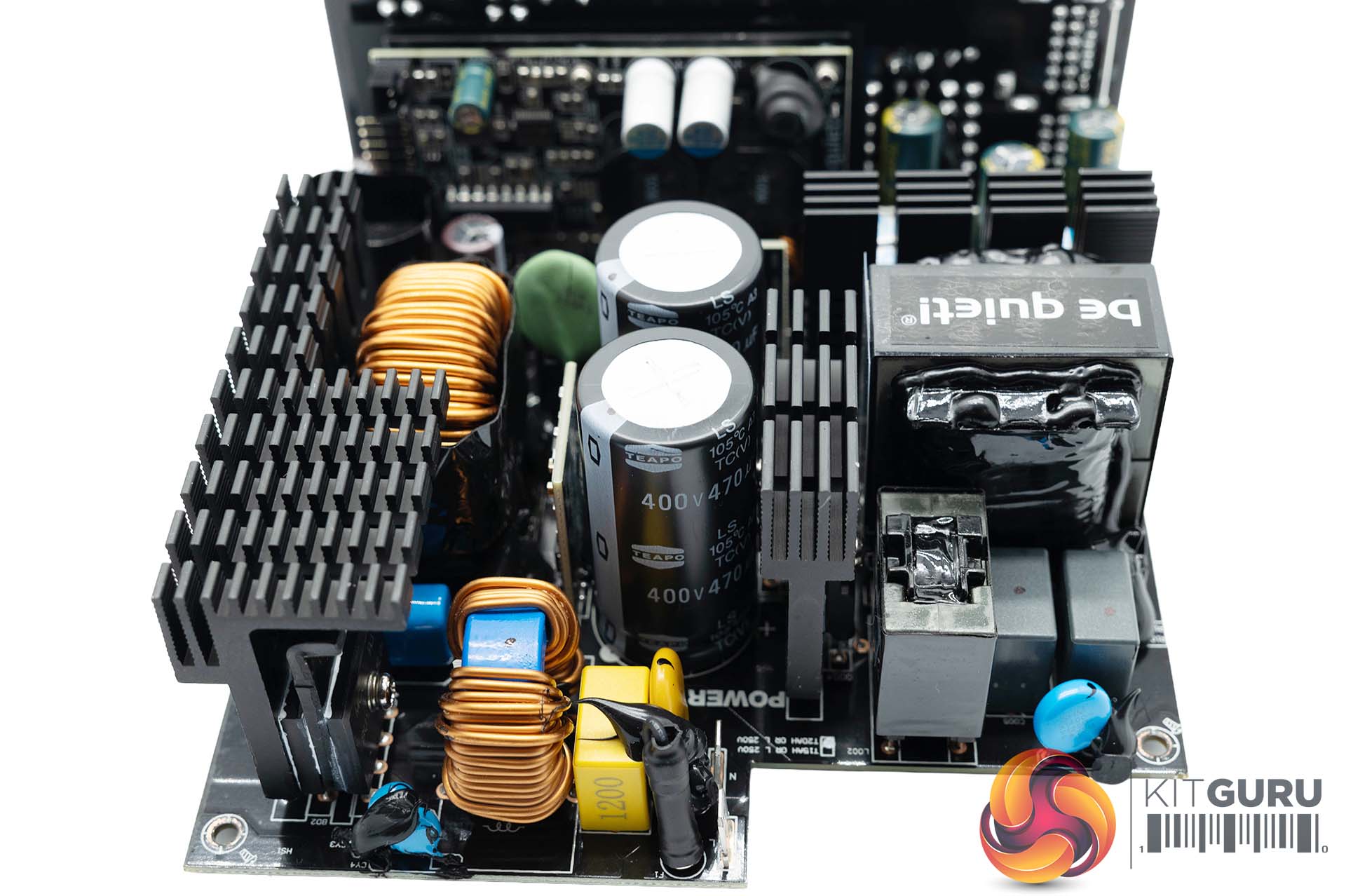
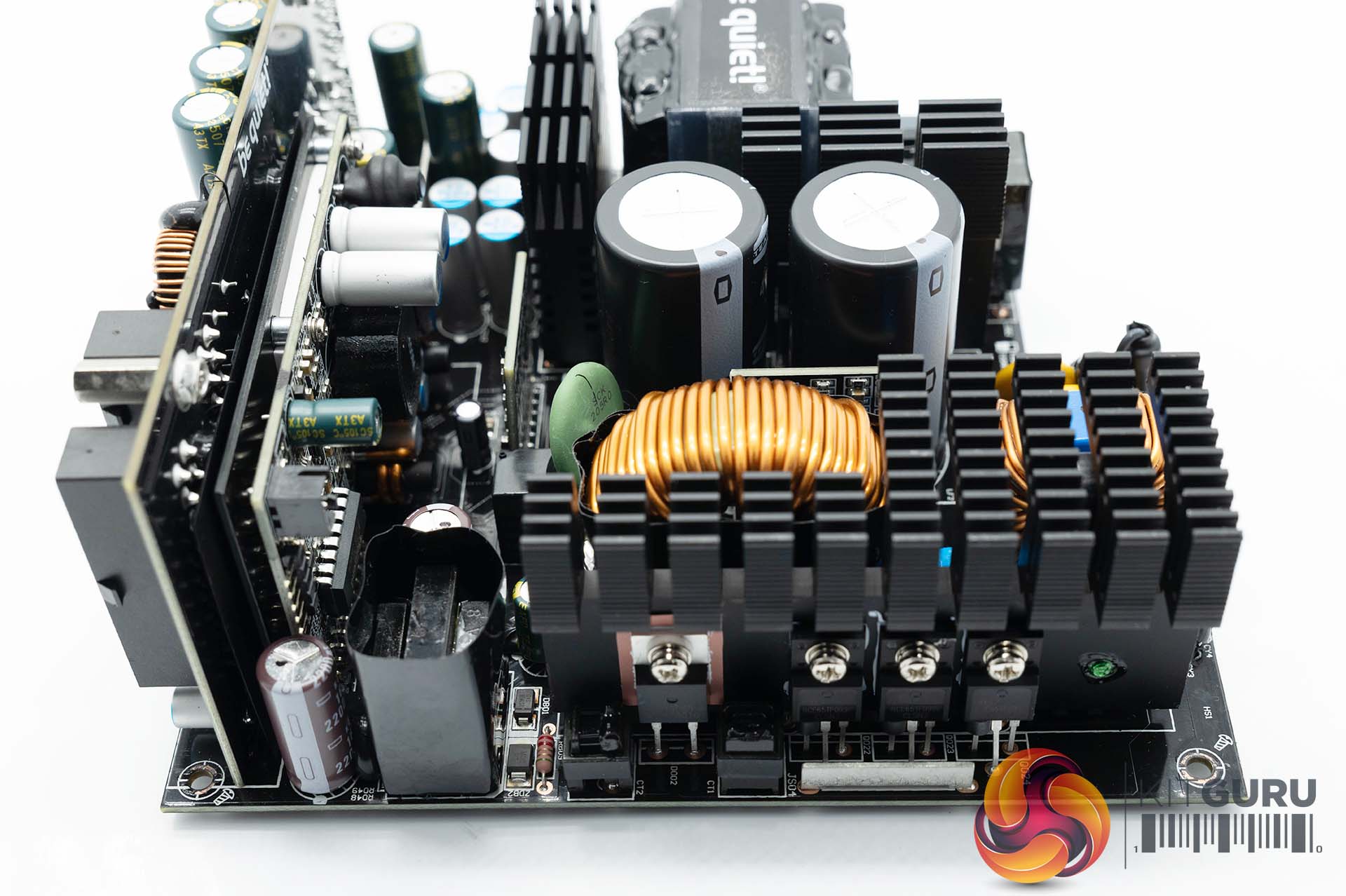
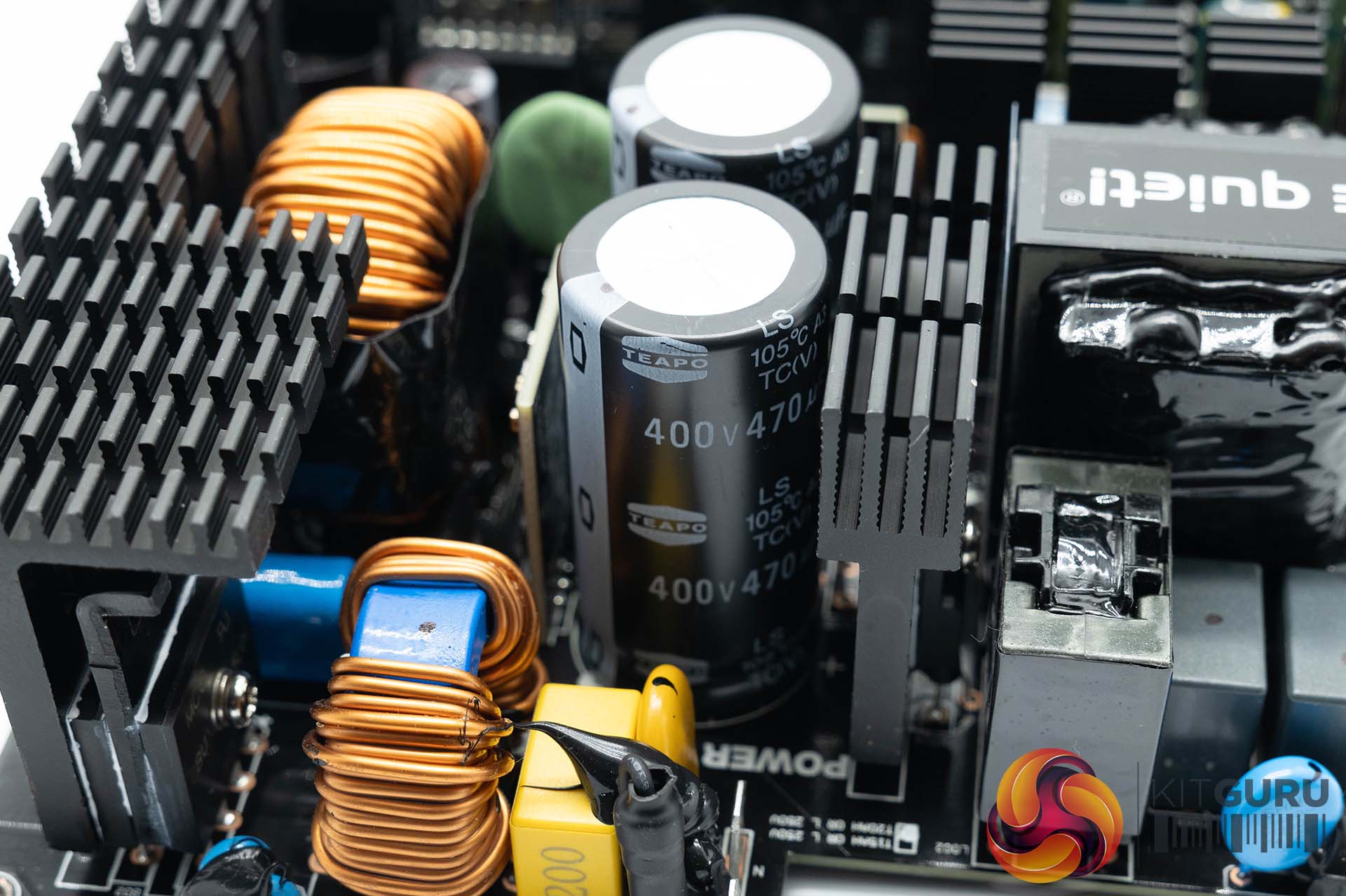
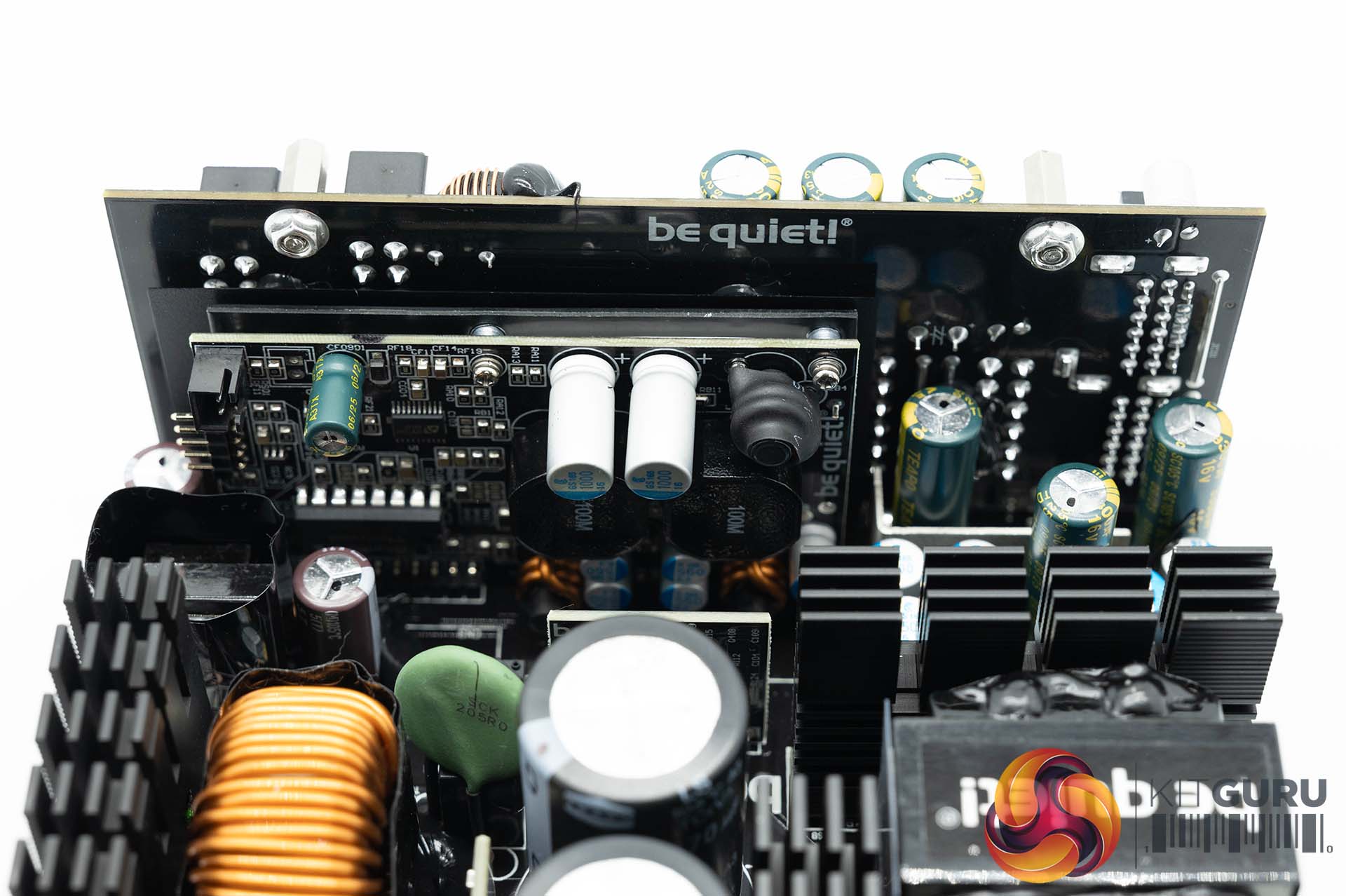
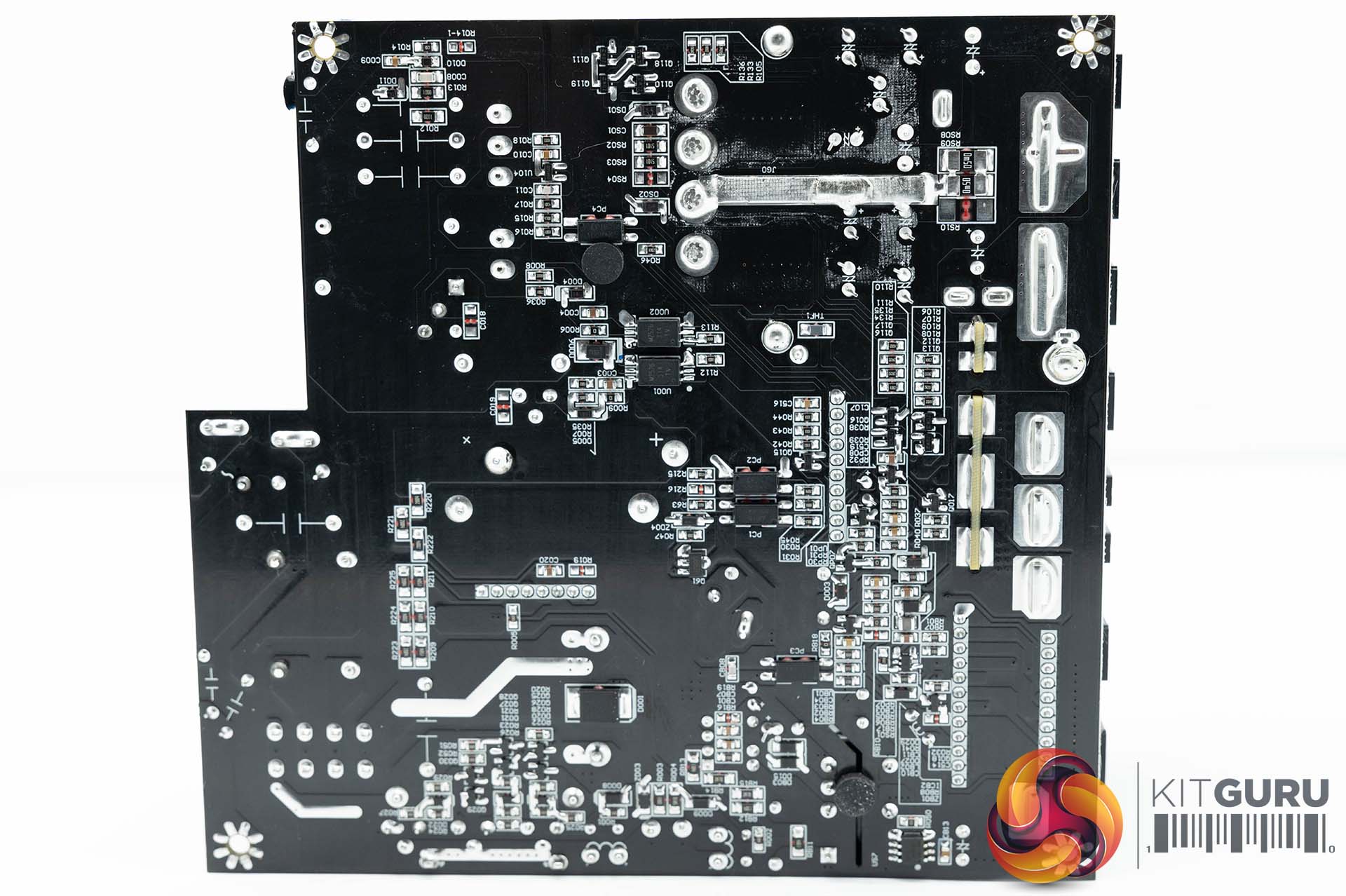
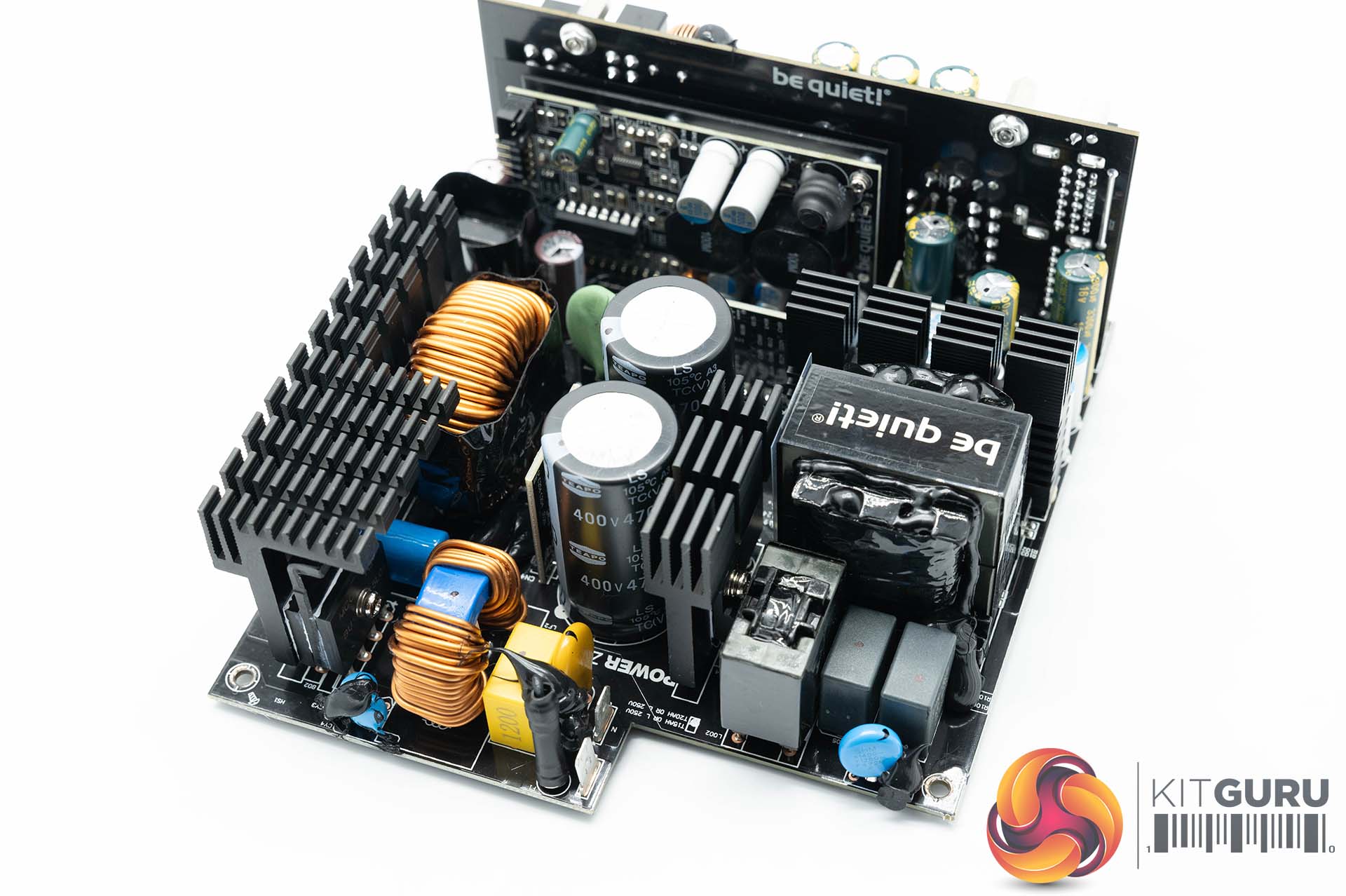
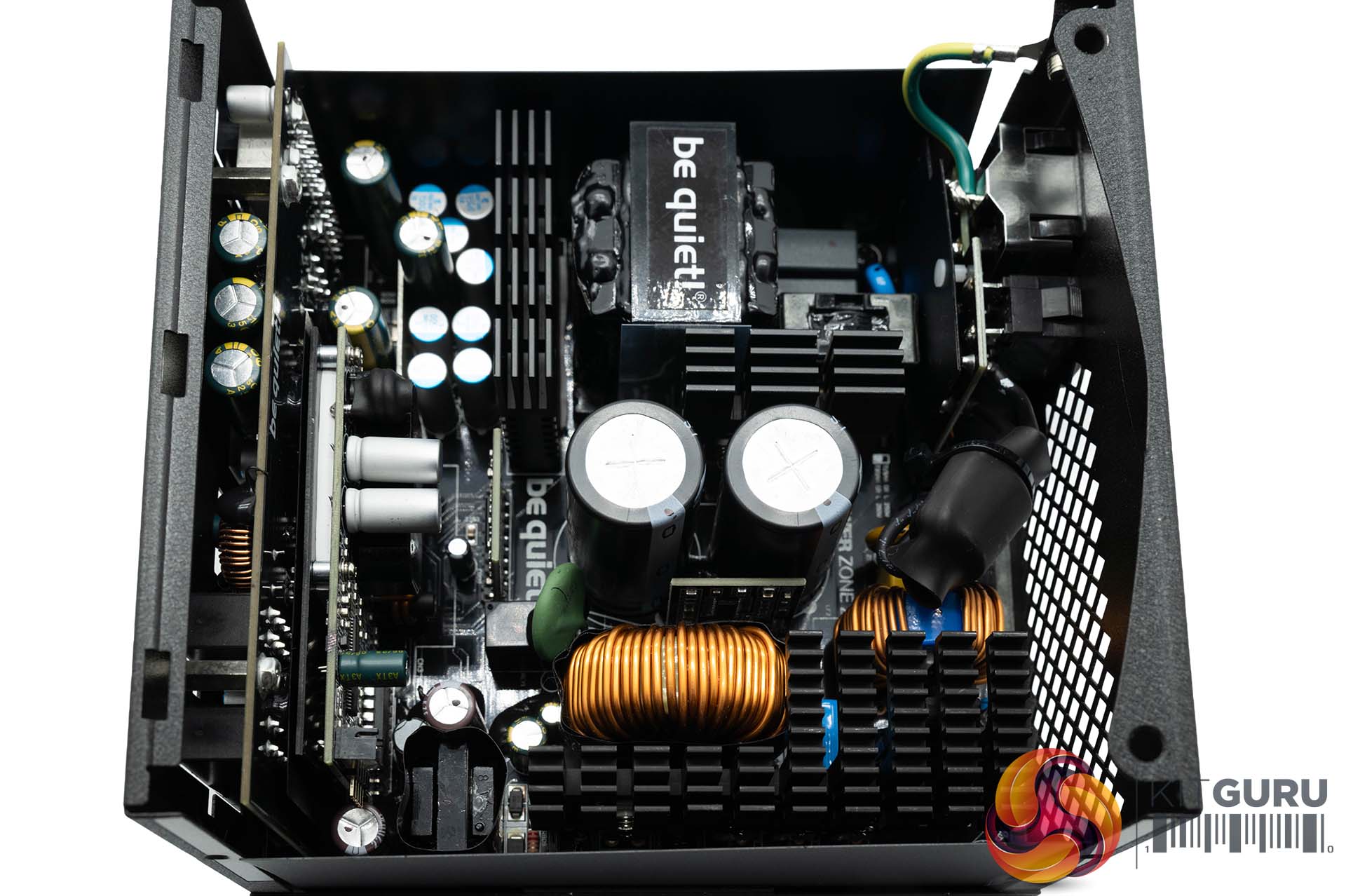
This unit is a HEC OEM design in cooperation with be quiet!. The design adopts an LLC topology (LLC+SR+DC/DC). Soldering quality, PCB design and implementation of components through the board design is excellent. I am very disappointed, however, to see that be quiet! and HEC have adopted Chinese Teapo capacitors in this design, but at least they are 105C-rated. Both primary caps are also Teapo, rated 400V 470uF at 105C.
I don't know the current status of Teapo capacitors compared to leading caps from well-regarded Japanese brands such as Nippon Chemi Con – they may have improved in recent years. Still, for adoption into a 1200W Platinum unit priced at £200 in the United Kingdom, I am disappointed.
The Power Zone 2 ships with OTP, OCP, OPP, SCP, OVP, UVP and SIP protections.
Correctly testing power supplies is a complex procedure and KitGuru have configured a test bench which can deliver up to a 2,000 Watt DC load.
We test ambient temperatures at 35C in our environment to greater reflect warmer internal chassis conditions.
We use combinations of the following hardware:
• SunMoon SM-268
• CSI3710A Programmable DC load (+3.3V and +5V outputs)
• CSI3711A Programmable DC load (+12V1, +12V2, +12V3, and +12V4)
• Extech Power Analyzer
• Extech MultiMaster MM570 digital multimeter
• Extech digital sound level meter
• Digital oscilloscope (20M S/s with 12 Bit ADC)
• Variable Autotransformer, 1.4 KVA
|
DC Output Load Regulation
|
||||||||||
|
Combined DC Load |
+3.3V
|
+5V
|
+12V
|
+5VSB
|
-12V | |||||
|
A
|
V
|
A
|
V
|
A
|
V
|
A
|
V
|
A | V | |
|
120W
|
0.90
|
3.33
|
0.92
|
5.01
|
8.95
|
12.03
|
0.50
|
5.01
|
0.20
|
-12.00
|
|
240W
|
1.63
|
3.33
|
1.63
|
5.01
|
18.46
|
12.03
|
1.00
|
5.00
|
0.20
|
-12.01
|
| 600W |
3.00
|
3.33
|
3.12
|
5.01
|
46.74
|
12.02
|
1.50
|
5.01
|
0.30
|
-12.00
|
| 900W |
4.01
|
3.33
|
4.07
|
5.00
|
70.82
|
12.01
|
2.00
|
5.00
|
0.30
|
-12.01
|
|
1200W
|
5.02
|
3.33
|
5.20
|
5.00
|
94.59
|
12.00
|
2.50
|
5.00
|
0.30
|
-12.01
|
Load regulation is very good across the rails.
Next we want to try Cross Loading. This basically means loads which are not balanced. If a PC for instance needs 500W on the +12V outputs but something like 30W via the combined 3.3V and +5V outputs then the voltage regulation can fluctuate badly.
| Cross Load Testing | +3.3V | +5V | +12V | -12V | +5VSB | |||||
| A | V | A | V | A | V | A | V | A | V | |
| 1190W | 4.0 | 3.33 | 3.0 | 5.01 | 88.0 | 12.01 | 0.2 | -12.01 | 0.50 | 5.01 |
| 240W | 19.0 | 3.32 | 22.0 | 5.00 | 2.5 | 12.03 | 0.2 | -12.01 | 0.50 | 5.00 |
The Power Zone 2 handled the cross load test very well, with no issues.
We then used an oscilloscope to measure AC ripple and noise present on the DC outputs. We set the oscilloscope time base to check for AC ripple at both high and low ends of the spectrum. ATX12V V2.2 specification for DC output ripple and noise is defined in the ATX 12V power supply design guide.
|
ATX12V Ver 2.2 Noise/Ripple Tolerance
|
|
|
Output
|
Ripple (mV p-p)
|
|
+3.3V
|
50
|
|
+5V
|
50
|
|
+12V1
|
120
|
|
+12V2
|
120
|
|
-12V
|
120
|
|
+5VSB
|
50
|
Obviously when measuring AC noise and ripple on the DC outputs the cleaner (less recorded) means we have a better end result. We measured this AC signal amplitude to see how closely the unit complied with the ATX standard.
| AC Ripple (mV p-p) | ||||
| DC Load | +3.3V | +5V | +12V | 5VSB |
| 100W | 8 | 9 | 8 | 7 |
| 200W | 10 | 11 | 11 | 9 |
| 400W | 14 | 13 | 14 | 10 |
| 600W | 17 | 14 | 17 | 11 |
| 800W | 18 | 15 | 19 | 11 |
| 1000W | 20 | 17 | 23 | 12 |
| 1200W | 21 | 19 | 27 | 12 |
This unit passes our ripple suppression tests without any issues. Results are solid if nothing remarkable.
|
Efficiency (%)
|
|
|
100W
|
87.1
|
|
200W
|
91.8
|
|
400W
|
93.1
|
|
600W
|
94.1
|
|
800W
|
93.7
|
| 1000W | 93.3 |
| 1200W | 92.6 |
Efficiency is good overall, hitting around 94% at peak. This drops to 92.6% at full load. These are Platinum efficiency levels.
We take the issue of noise very seriously at KitGuru and this is why we have built a special home brew system as a reference point when we test noise levels of various components. Why do this? Well this means we can eliminate secondary noise pollution in the test room and concentrate on components we are testing. It also brings us slightly closer to industry standards, such as DIN 45635.
Today to test the power supply we have taken it into our acoustics room environment and have set our SkyTronic DSL 2 Digital Sound Level Meter (6-130dBa) one meter away from the unit. We have no other fans running so we can effectively measure just the noise from the unit itself.
As this can be a little confusing for people, here are various dBa ratings with real world situations to help describe the various levels.
KitGuru noise guide
10dBA – Normal Breathing/Rustling Leaves
20-25dBA – Whisper
30dBA – High Quality Computer fan
40dBA – A Bubbling Brook, or a Refrigerator
50dBA – Normal Conversation
60dBA – Laughter
70dBA – Vacuum Cleaner or Hairdryer
80dBA – City Traffic or a Garbage Disposal
90dBA – Motorcycle or Lawnmower
100dBA – MP3 Player at maximum output
110dBA – Orchestra
120dBA – Front row rock concert/Jet Engine
130dBA – Threshold of Pain
140dBA – Military Jet takeoff/Gunshot (close range)
160dBA – Instant Perforation of eardrum
|
Noise (dBA)
|
|
|
100W
|
<28.0
|
|
200W
|
<28.0
|
|
400W
|
<28.0
|
|
600W
|
28.9
|
| 800W | 31.8 |
| 1000W | 33.7 |
| 1200W | 36.4 |
Even though this is a rifle bearing fan, the overall performance is great. It's basically inaudible (to my ears anyway) until around 800 watts is demanded. Speeds rise a little over 1000 watts and it becomes audible as load increases to 1200 watts. I always rated these Pure Wings fans very highly.
|
Temperature (c)
|
||
|
Intake
|
Exhaust
|
|
|
100W
|
35
|
37
|
|
200W
|
36
|
40
|
|
400W
|
38
|
43
|
|
650W
|
43
|
45
|
|
800W
|
45
|
51
|
| 1000W | 47 | 54 |
| 1200W | 50 | 57 |
The fan pushes a good amount of air around the components and the large vented panels seriously help airflow. The high levels of efficiency help as well.
This is our first look at a new be quiet! power supply in some time, and there is no doubt that the Power Zone 2 1200W is a very capable unit. It passed all of our testing without issue, and build quality is consistently high throughout.
First impressions are strong. The finish and mesh design look excellent, and the wide spacing around the fan intake is well thought out, allowing plenty of airflow to cool the internal components. The fan uses a rifle bearing design, it is not a fluid dynamic bearing implementation, but the results are excellent regardless. It remains extremely quiet across most of its operating range, only becoming audible when approaching the upper end of its speed, close to 2,000 rpm.
From a technical standpoint, the Power Zone 2 1200W performs well. Ripple suppression, while not best-in-class, is well controlled, and the unit passed our load regulation testing with ease. Efficiency is also strong, consistently meeting Platinum-level expectations without concern.
On a more negative note, it was surprising to find lower-grade Teapo capacitors used in this unit. At around the £200 price point, and for a Platinum-rated power supply, we would normally expect to see higher-grade Japanese capacitors from brands such as Nippon Chemi-Con, Rubycon, or Nichicon. While it is entirely possible that modern Teapo capacitors have improved compared to past generations, previous personal experiences leave some lingering doubts. This feels like an area where a relatively small additional cost could have removed any concerns altogether, and it is surprising that this was not challenged internally before finalising the design.
be quiet! does include a 10-year warranty, which is respectable, but it does fall slightly behind some competing Platinum units from brands such as Seasonic at a similar price point. They offer 12+ year warranty support.
UK pricing is expected to land around £200, with Scan already listing the Power Zone 2 1200W at £199.99 on preorder HERE.
Pros:
- Well made, nice finish
- Fully modular.
- 10-year warranty is good.
- Quiet.
- Ripple suppression.
- high levels of efficiency.
Cons:
- lower grade Teapo caps – not Japanese.
- Warranty is a little behind market leaders like Seasonic.
KitGuru says: The Power Zone 2 1200W is an excellent power supply that should do very well for the company. Hitting a price point just below £200 will ensure it appeals to a large enthusiast audience powering a high draw modern graphics card.