KitGuru KitGuru.net – Tech News | Hardware News | Hardware Reviews | IOS | Mobile | Gaming | Graphics Cards


It has been some time since I looked at a new power supply from Enermax however today we managed to get our hands on the Platimax II 1200DF unit, recently released. This unit is Platinum certified and it ATX 3.1/PCIe 5.1 ready. Enermax supply mesh sleeved cables with this modular unit and with an asking price around $230, we find out today if it is worth the money.
- ATX 3.1 & PCIe 5.1 Ready
Fully compliant with Intel ATX 3.1 and PCIe 5.1 standards, featuring a native 600W 12V-2×6 connector for next-gen GPUs. - Efficiency
Achieves up to 92% efficiency at 50% load, and ≥70% efficiency at 2% low load. - Extreme Power Excursion Support
Handles up to 235% power excursion (0.1ms), ideal for high-performance GPU spikes. - Silent and Durable Cooling
Equipped with a 135mm D.F. fan and 100% Japanese capacitors for over 100,000 hours MTBF at 25°C full load. - Fully Modular with Comprehensive Protections
Fully modular cable design with built-in protections: OVP, OPP, OCP, SCP, OTP, UVP; certified for operation up to 5000m altitude.
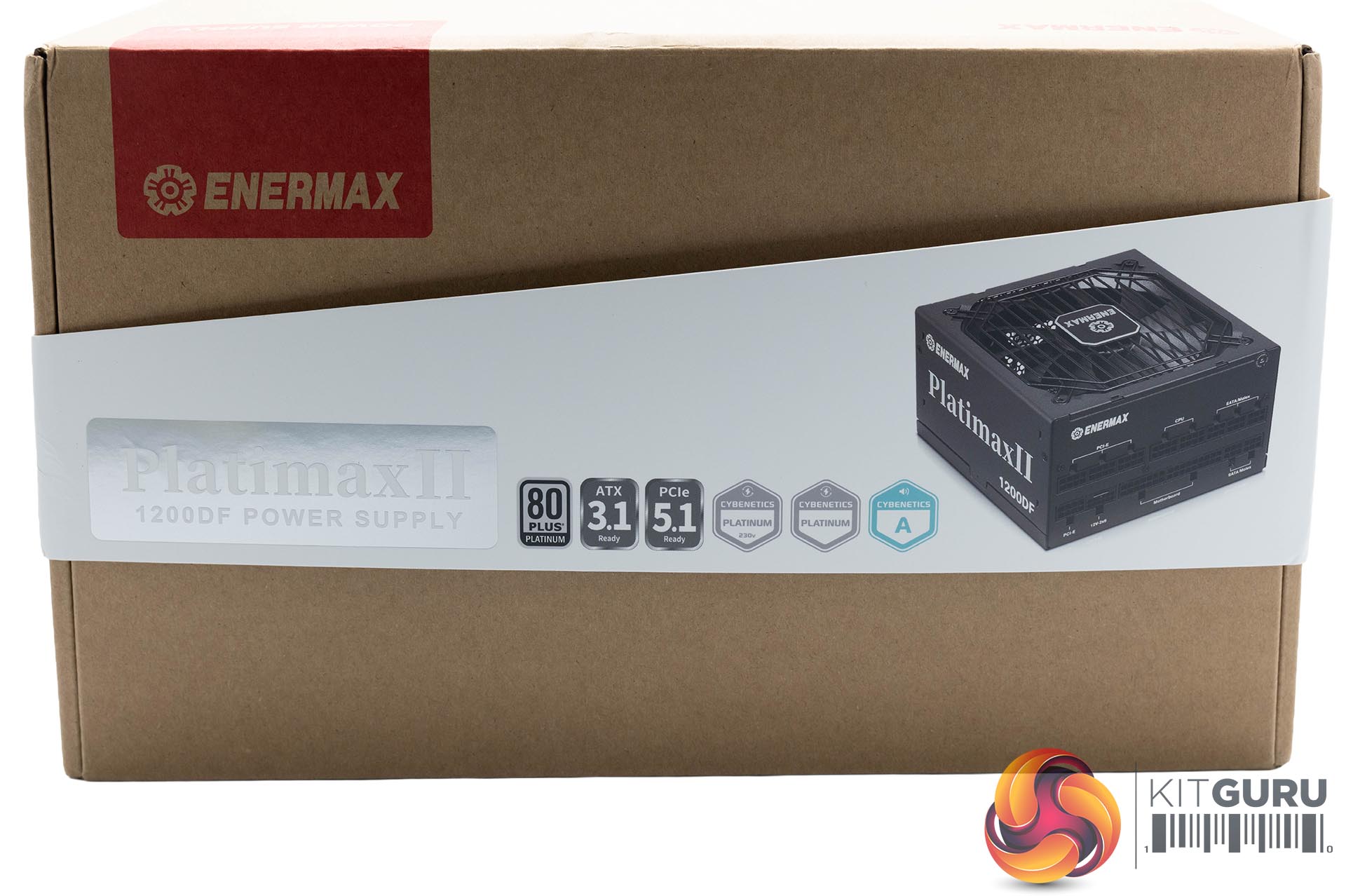
Enermax have opted for a plain brown box with a center overlay, showing a picture of the unit along with a handful of main features and certifications. Always good to see a company working with Cybenetics.
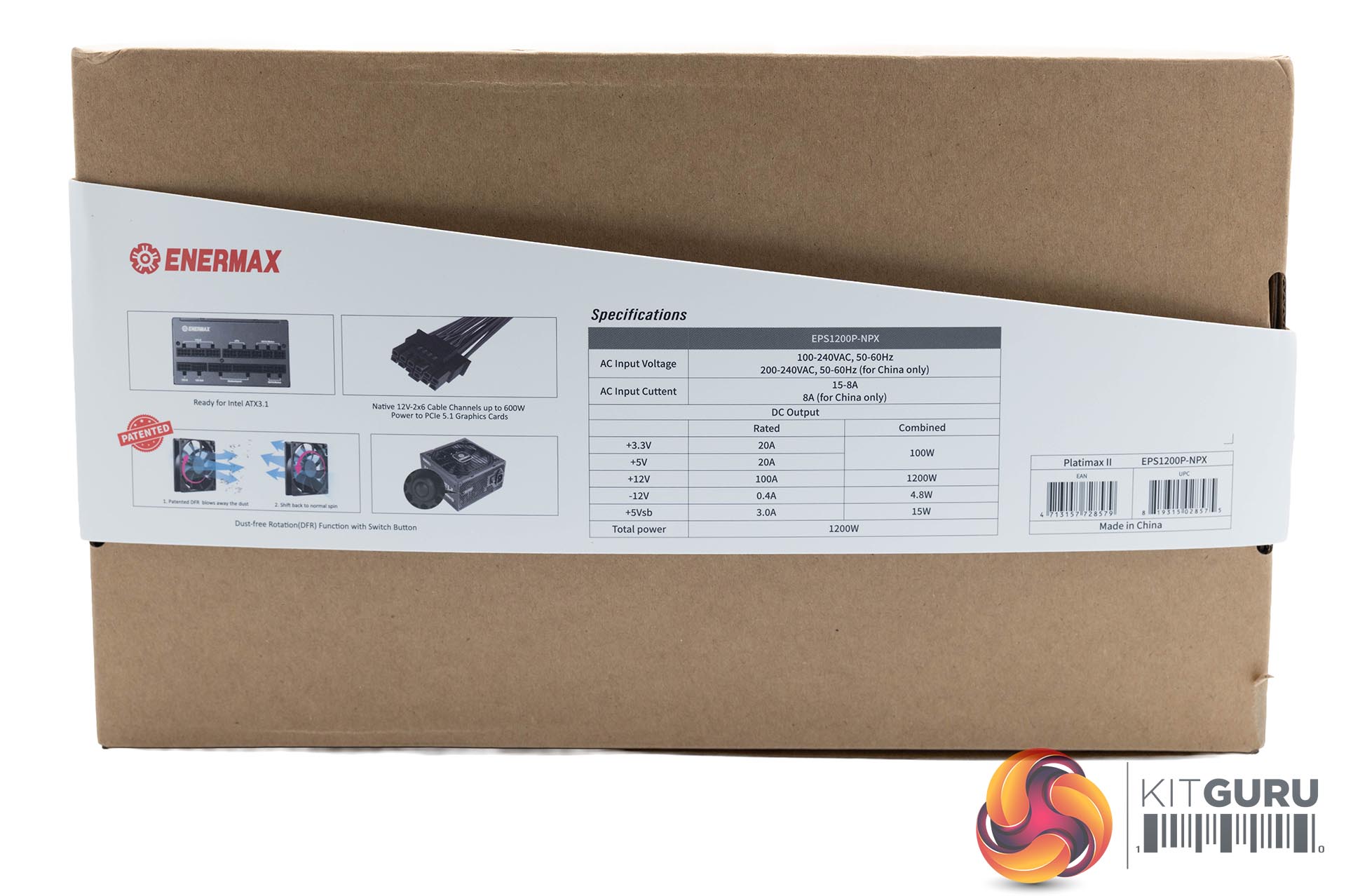
Some other details are highlighted on the rear of the box.
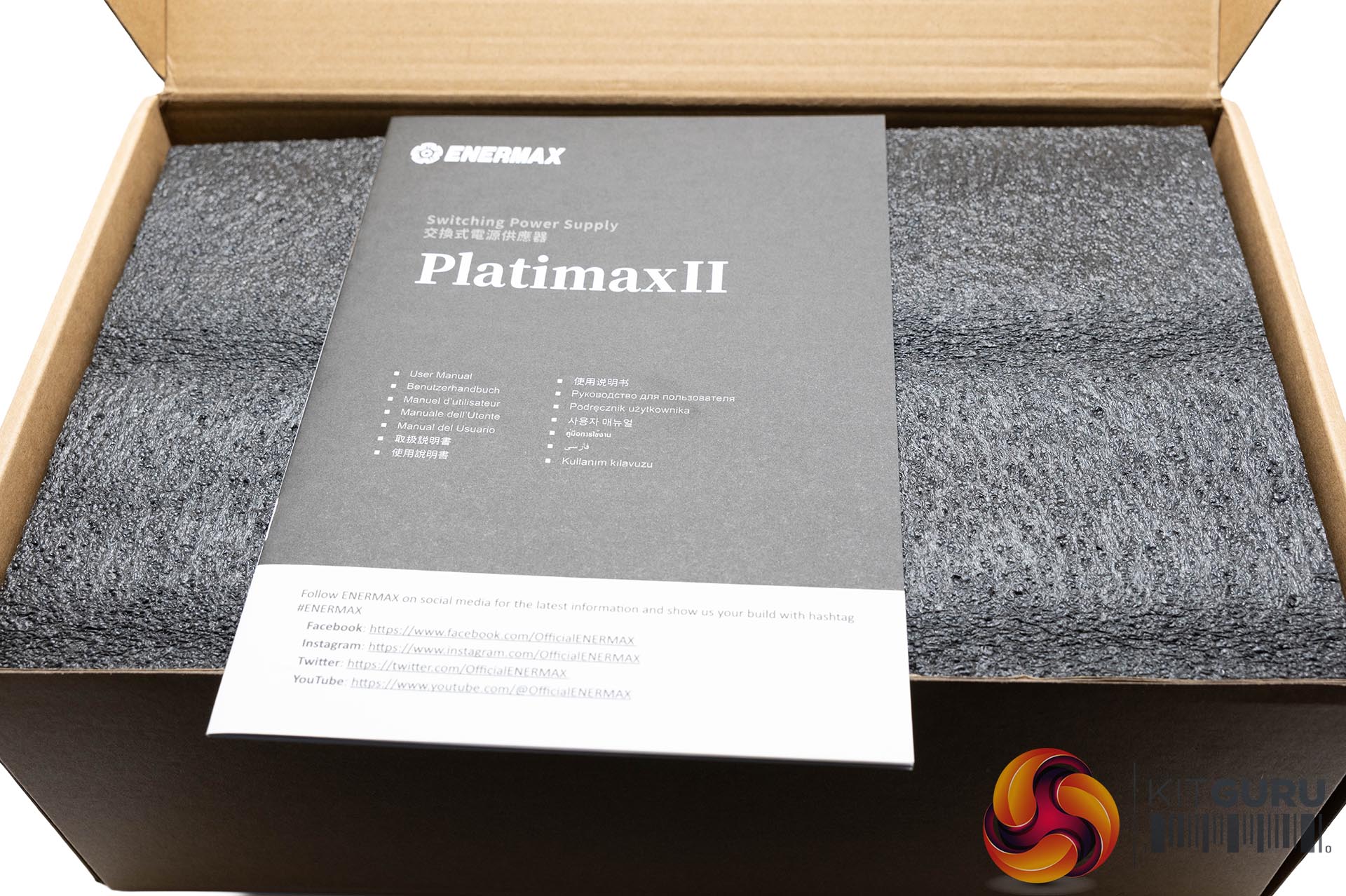
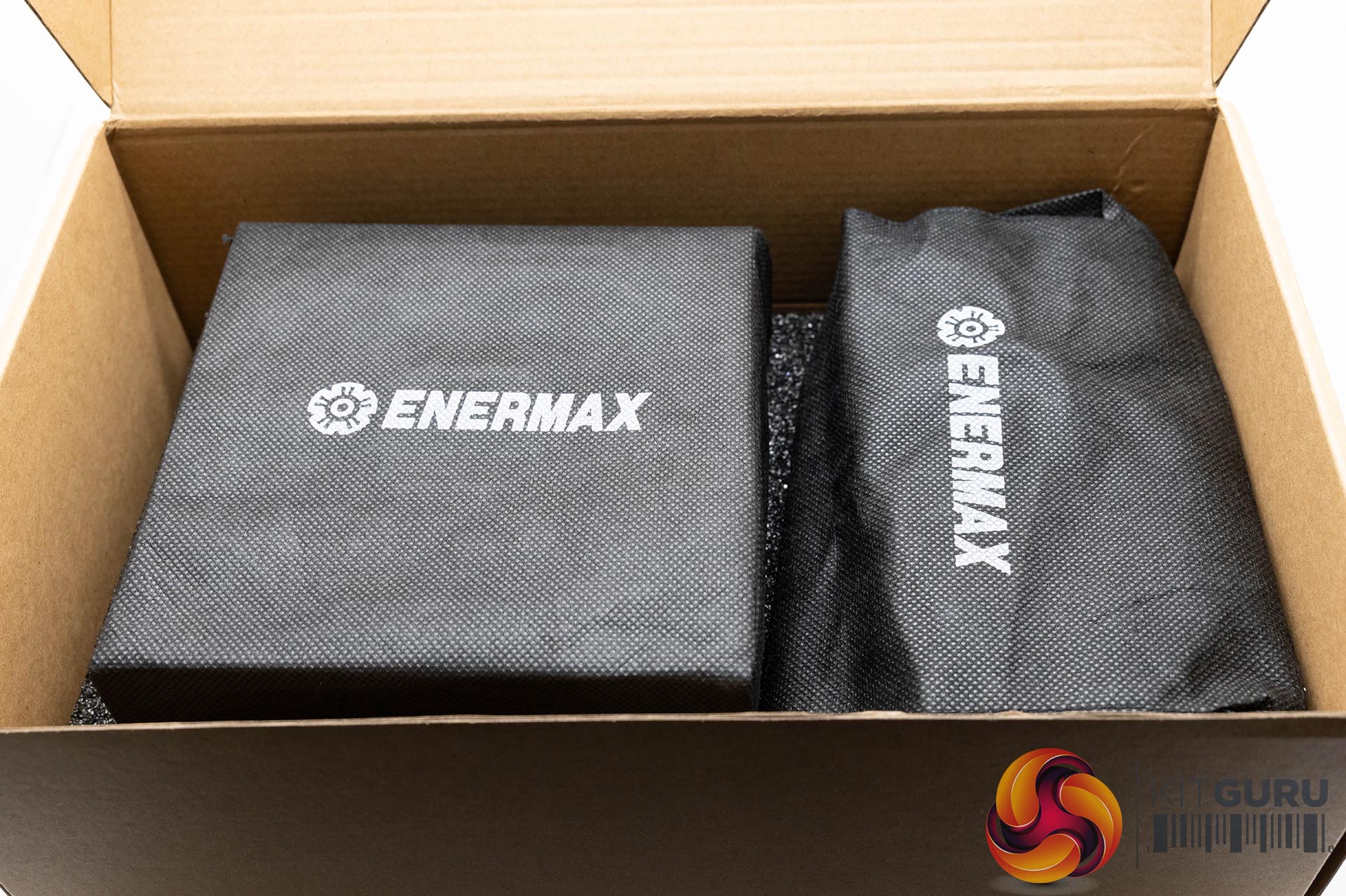
The box contains the unit itself, a leaflet with details on the supply, and a separate bag with cables inside it.
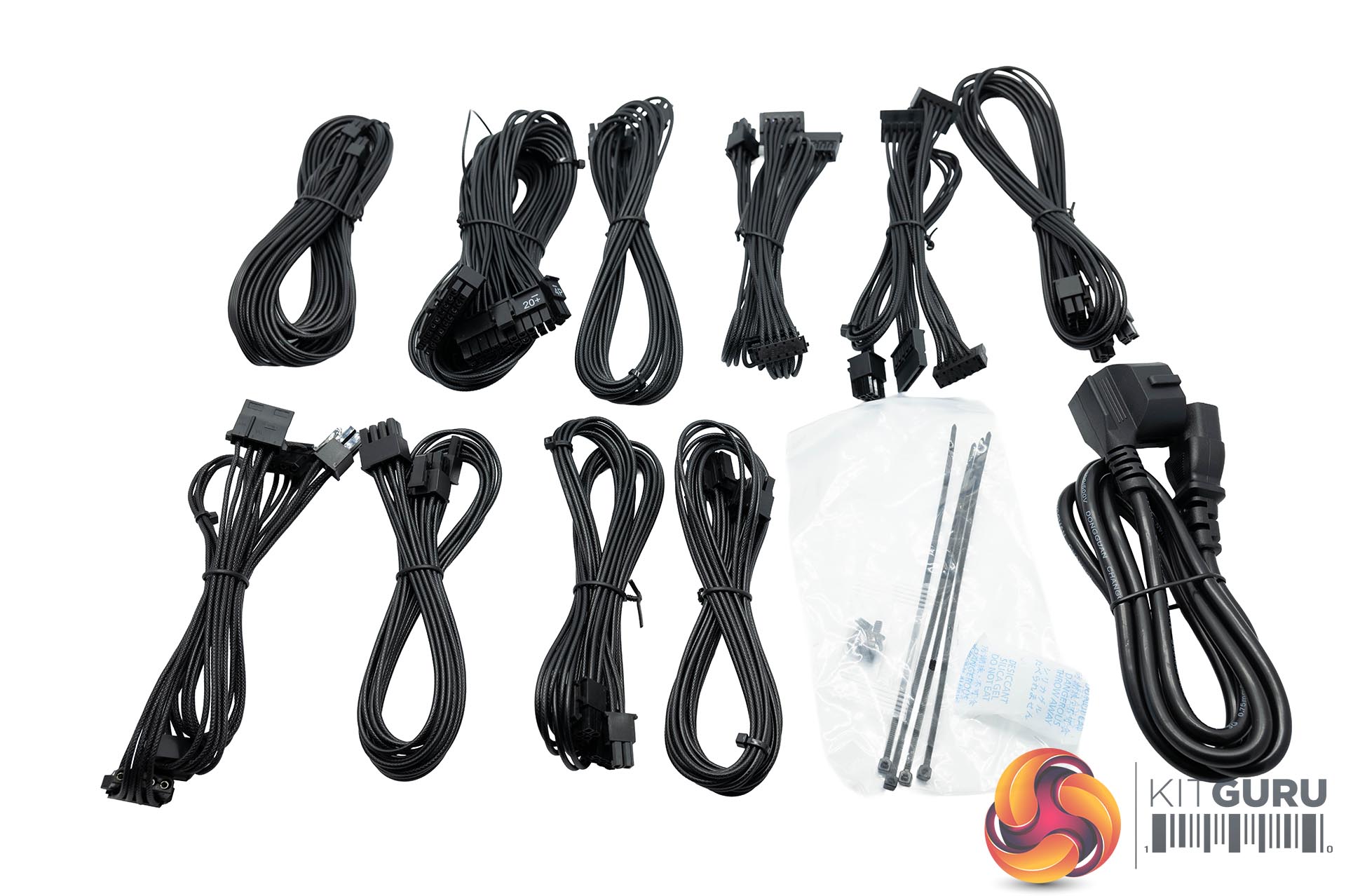
The cables are stored inside a soft bag. Along with mounting screws and some cable ties and a power cable.
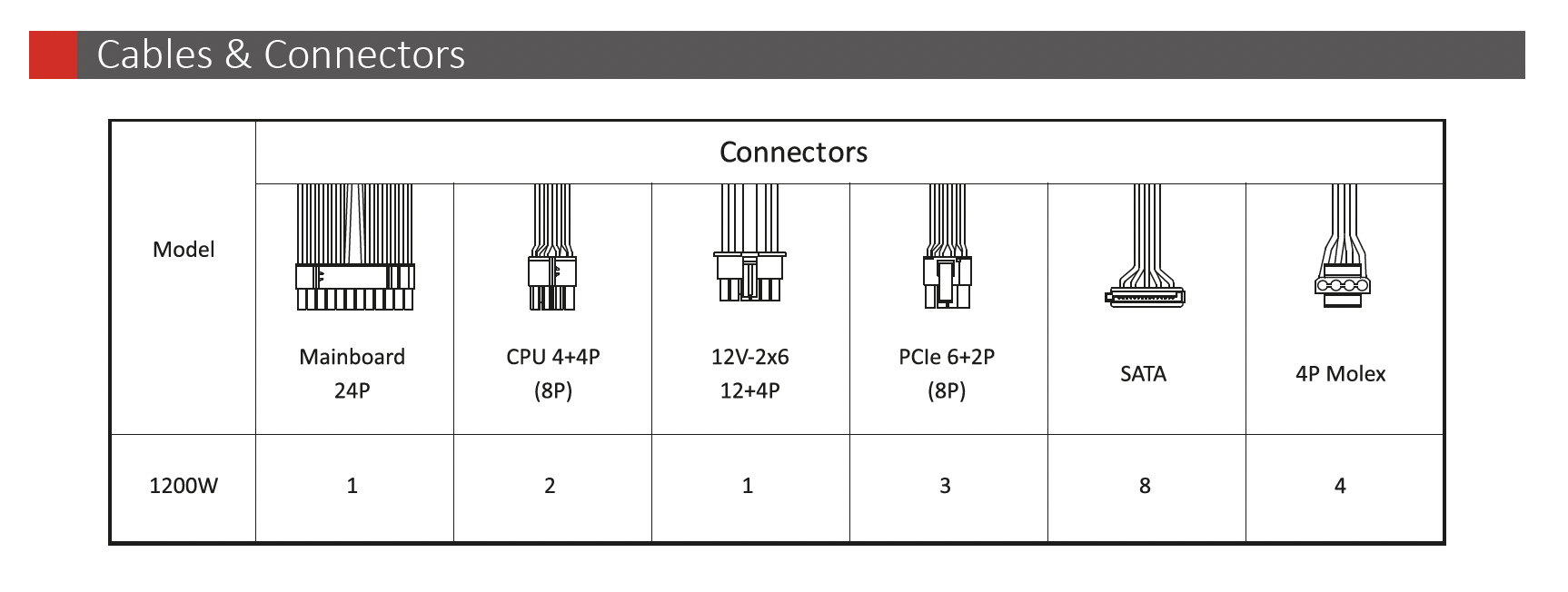
The cable quality is good and they are individually sleeved, they are mostly 18AWG gauge with the 600W cable 16-24AWG Gauge. Spacing between the SATA connectors is 150mm. The 4+4 PIN ATX12V cable is 700mm long.
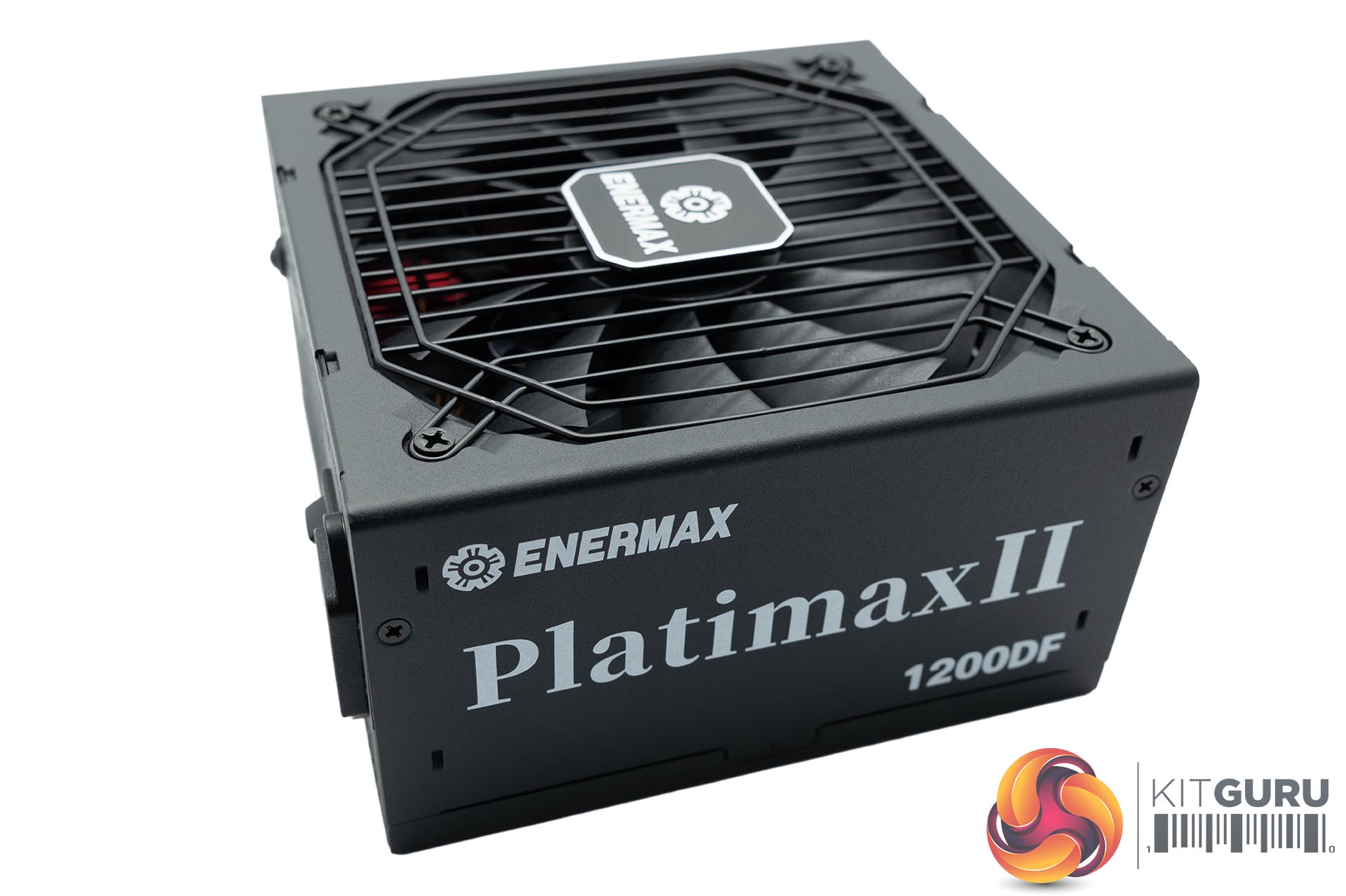
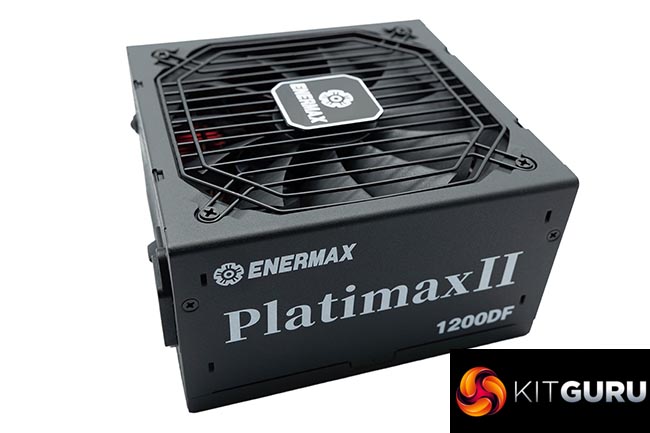
We received the black version of the Enermax Platimax II 1200DF. It is well finished, simple in design and a simple black/grey aesthetic. The power supply measures 150 x 85 x 150 mm and weighs 1.67KG. It is not an oversized unit and will fit into a variety of chassis designs on the market.
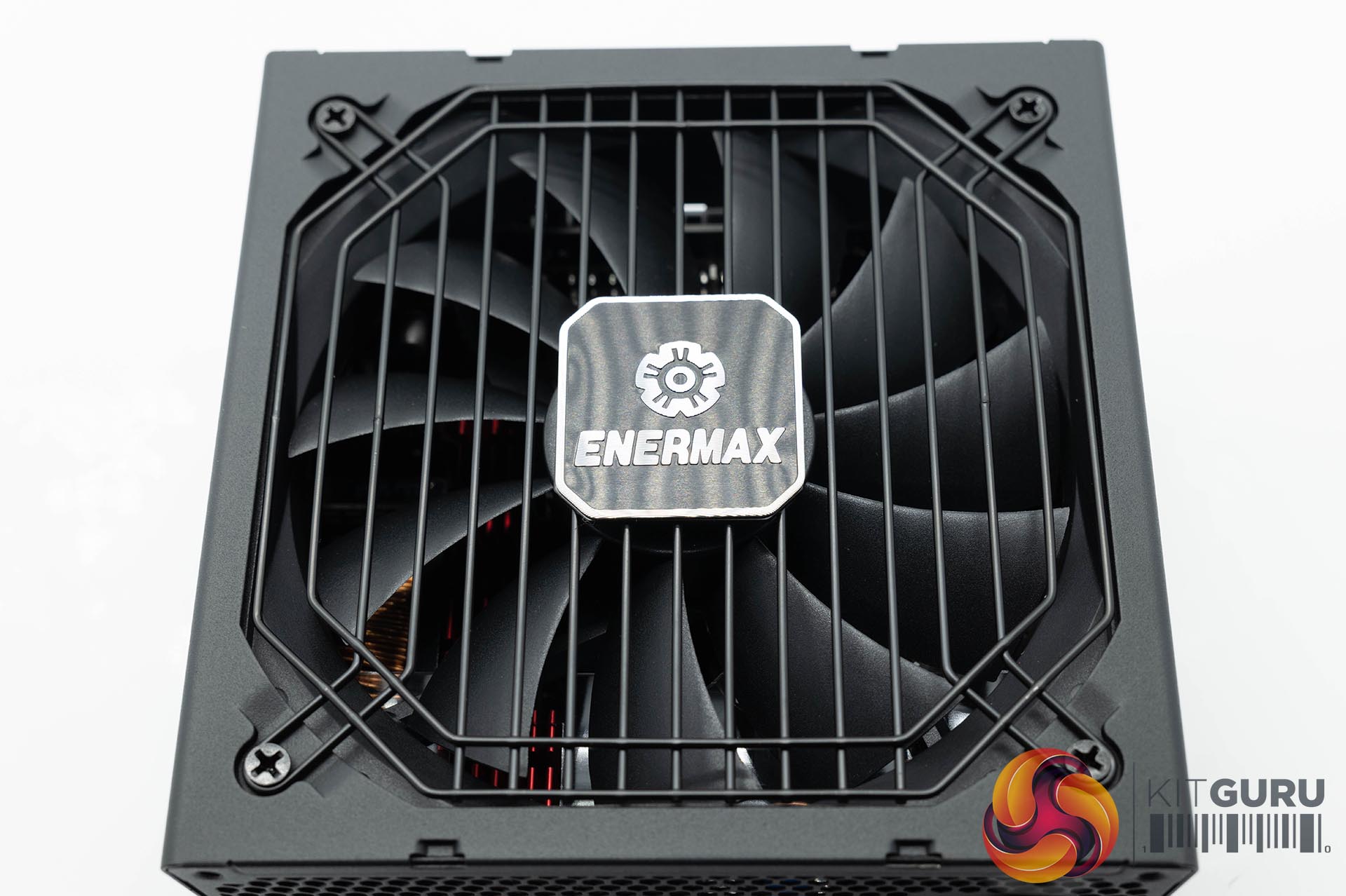
The large fan resides behind a metal grille with the ‘Enermax' badge the middle. There is plenty of vent spacing for airflow.
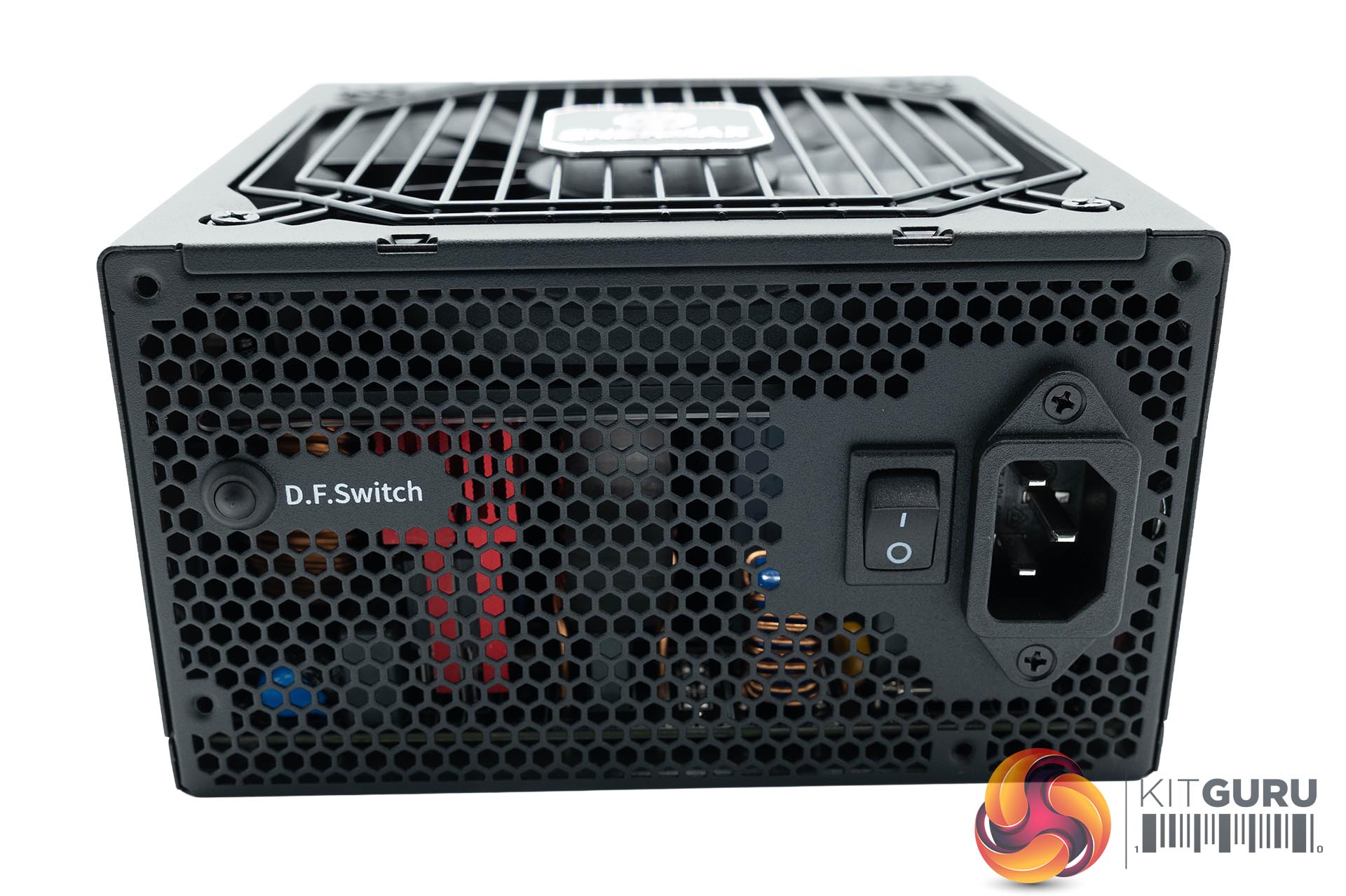
On one side of the unit, we have the power connector port and the power switch.
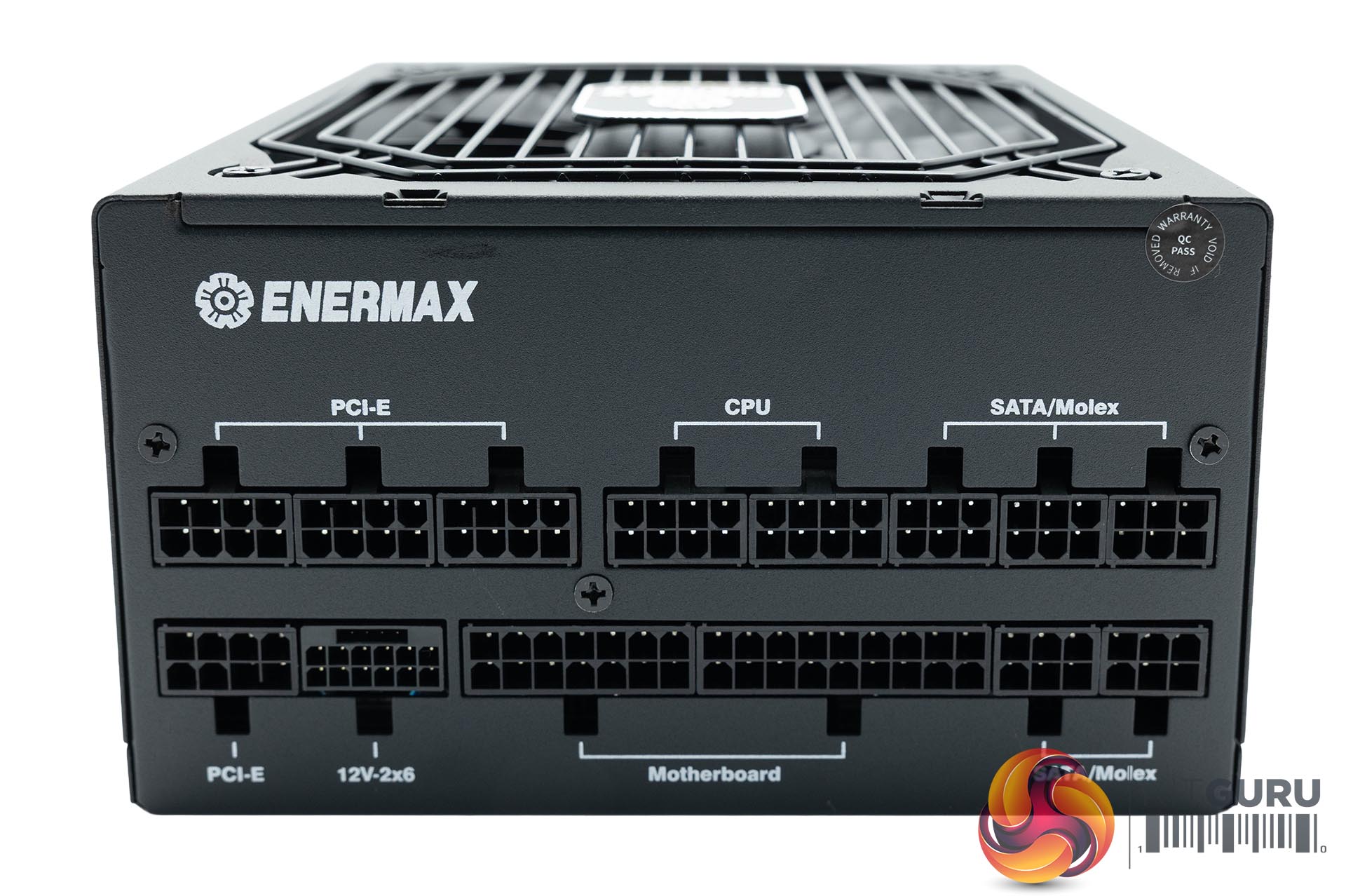
The other side of the power supply is home to the modular bay – in this case all arranged over two rows and labelled.
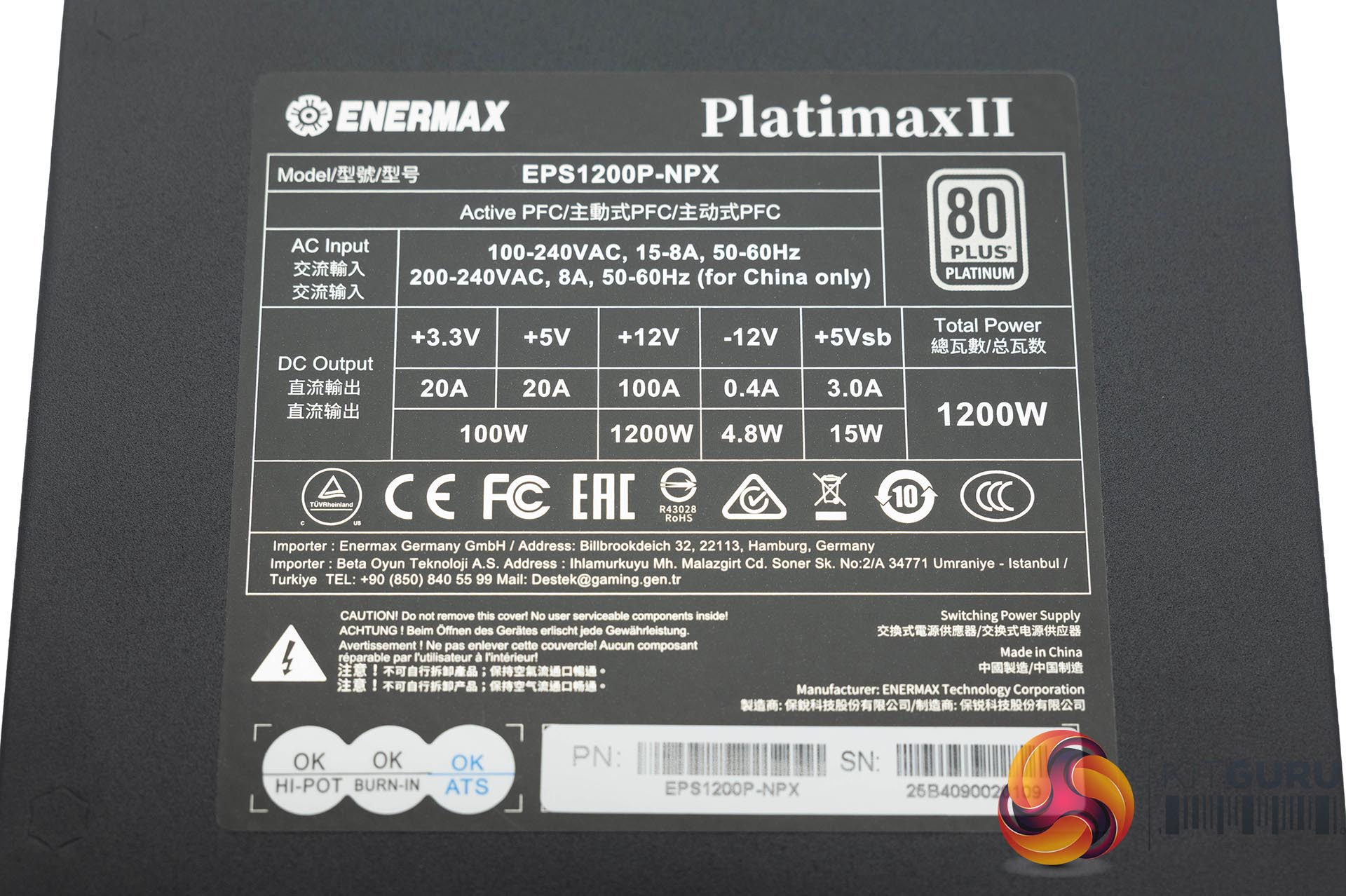
The power label on top shows the power delivery. Up to 100A via on the +12V rail and 20A on both secondary +3.3V and +5V rails.
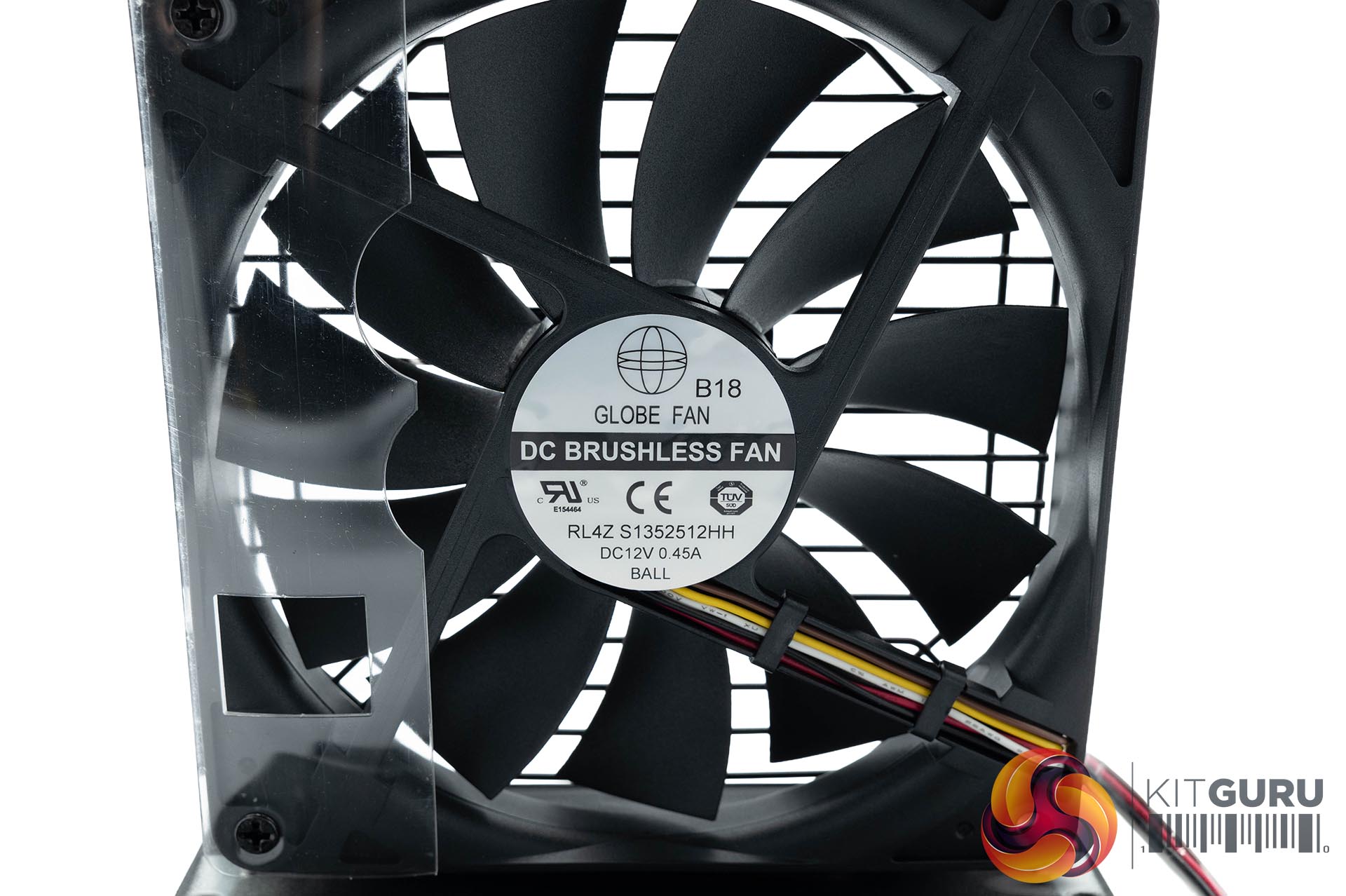
Enermax have adopted a 135mm (25mm deep) Globe Fan unit rated at 12V 0.45A for this power supply. This is a Dual Ball Bearing fan (S1352512HH). MBTF is 100,000 hours.
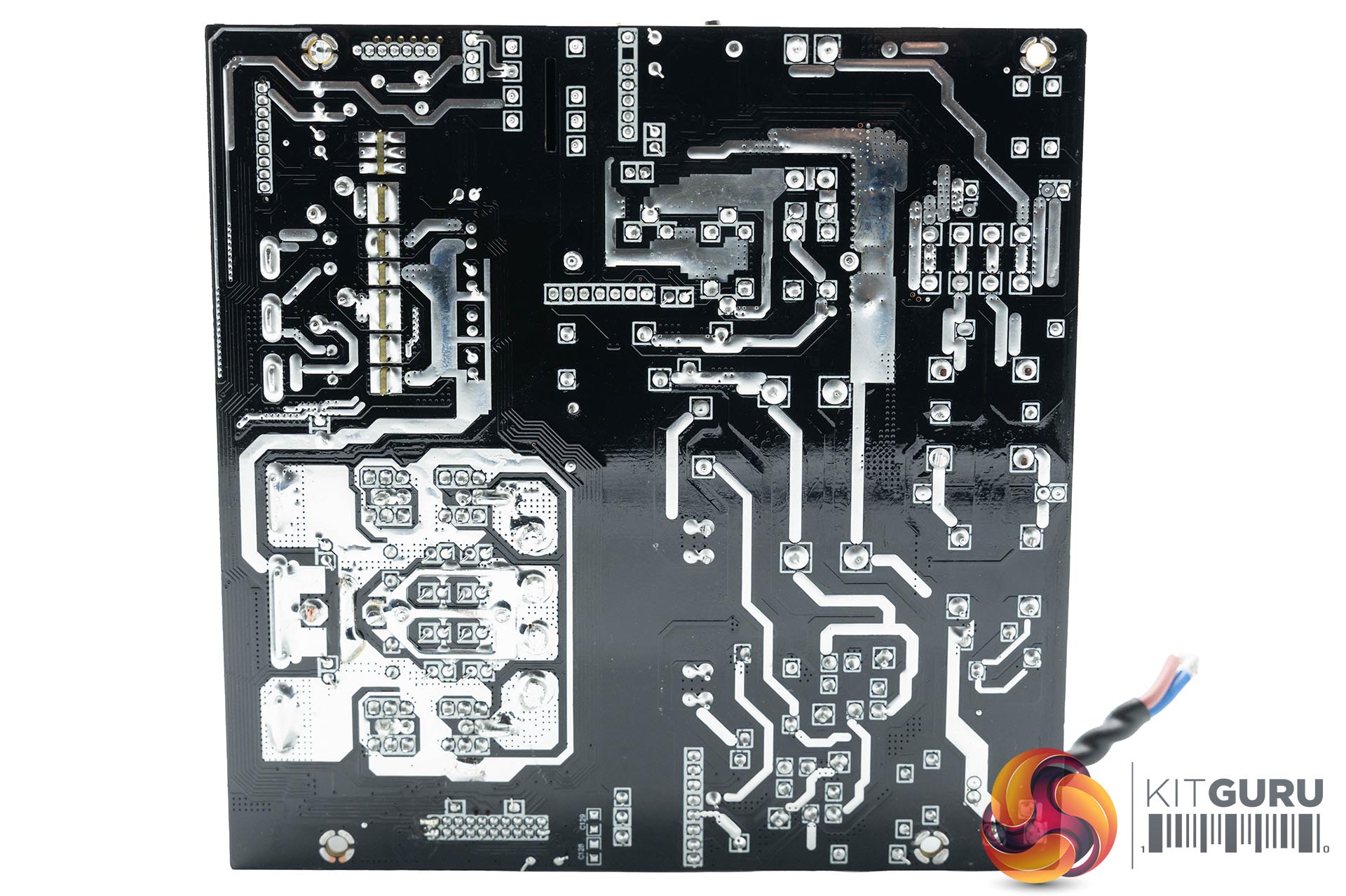
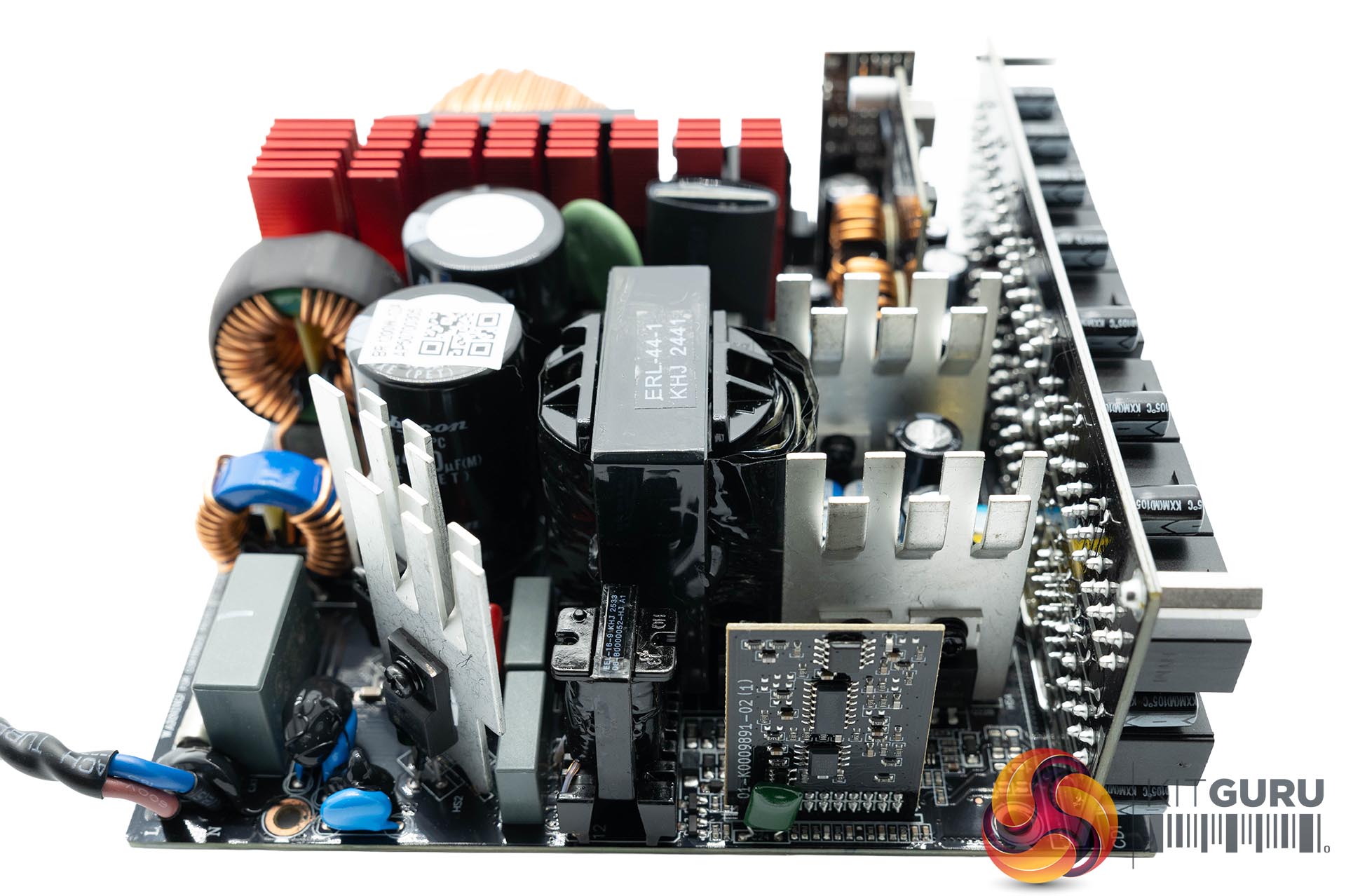
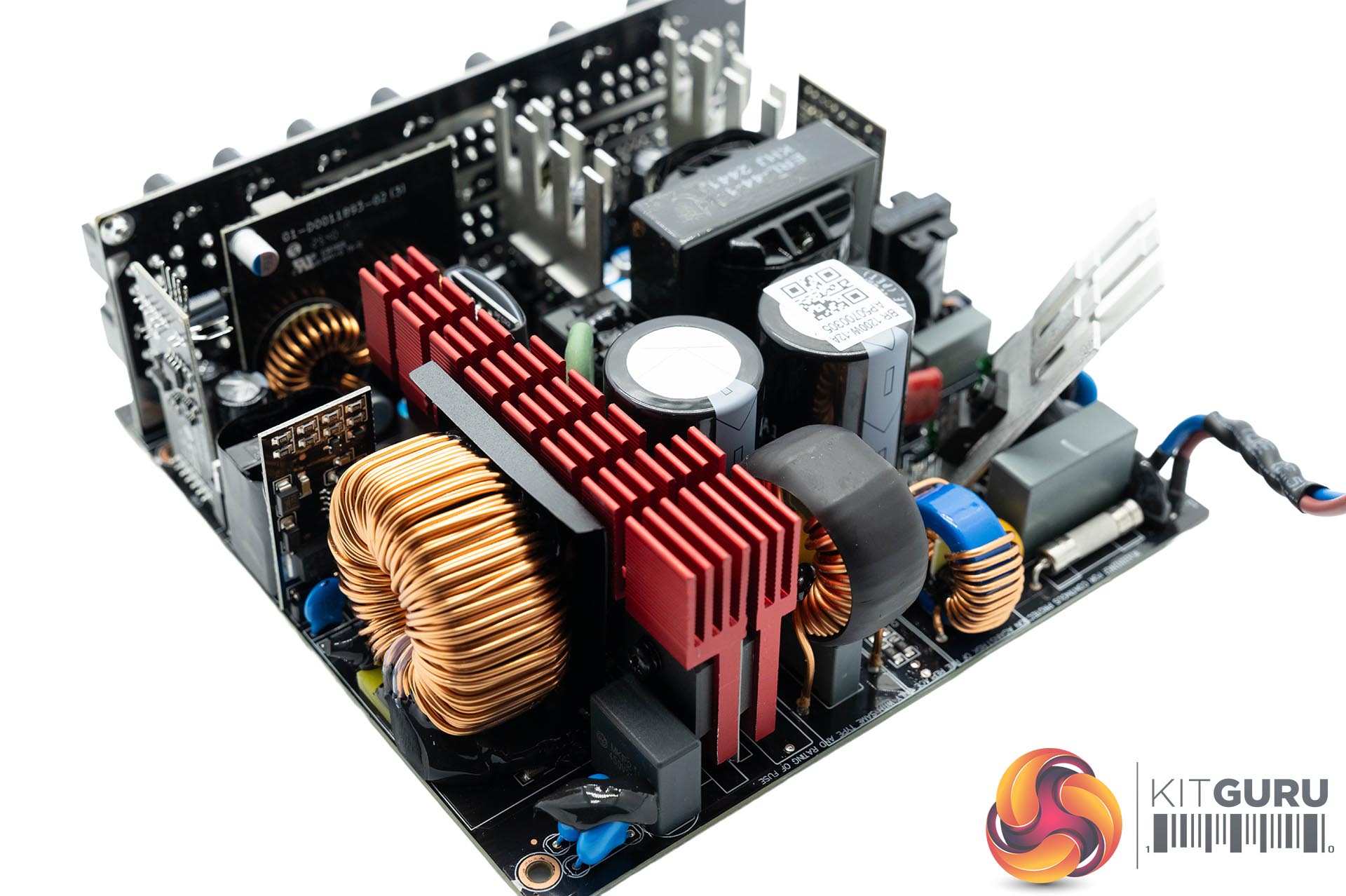
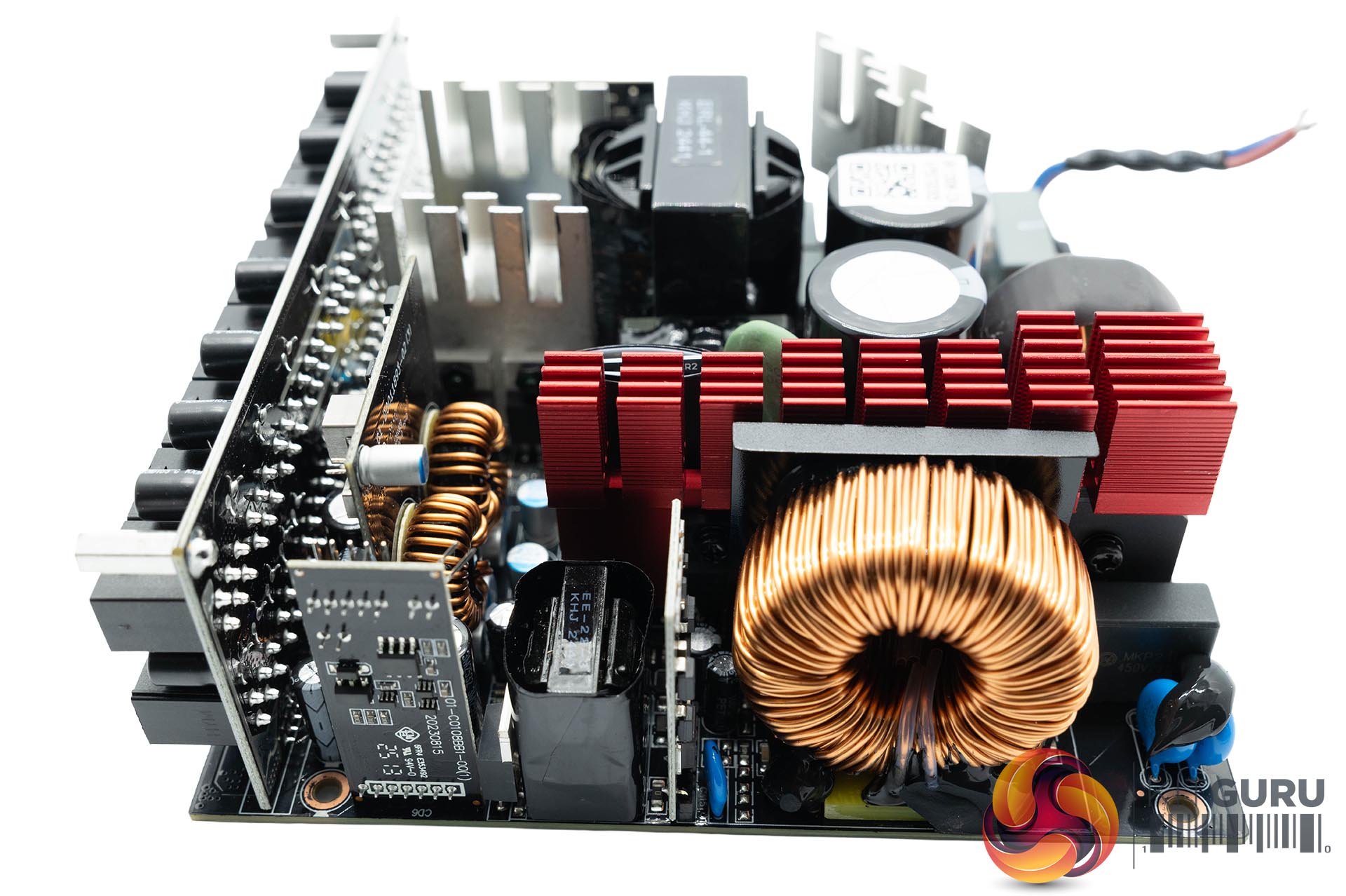
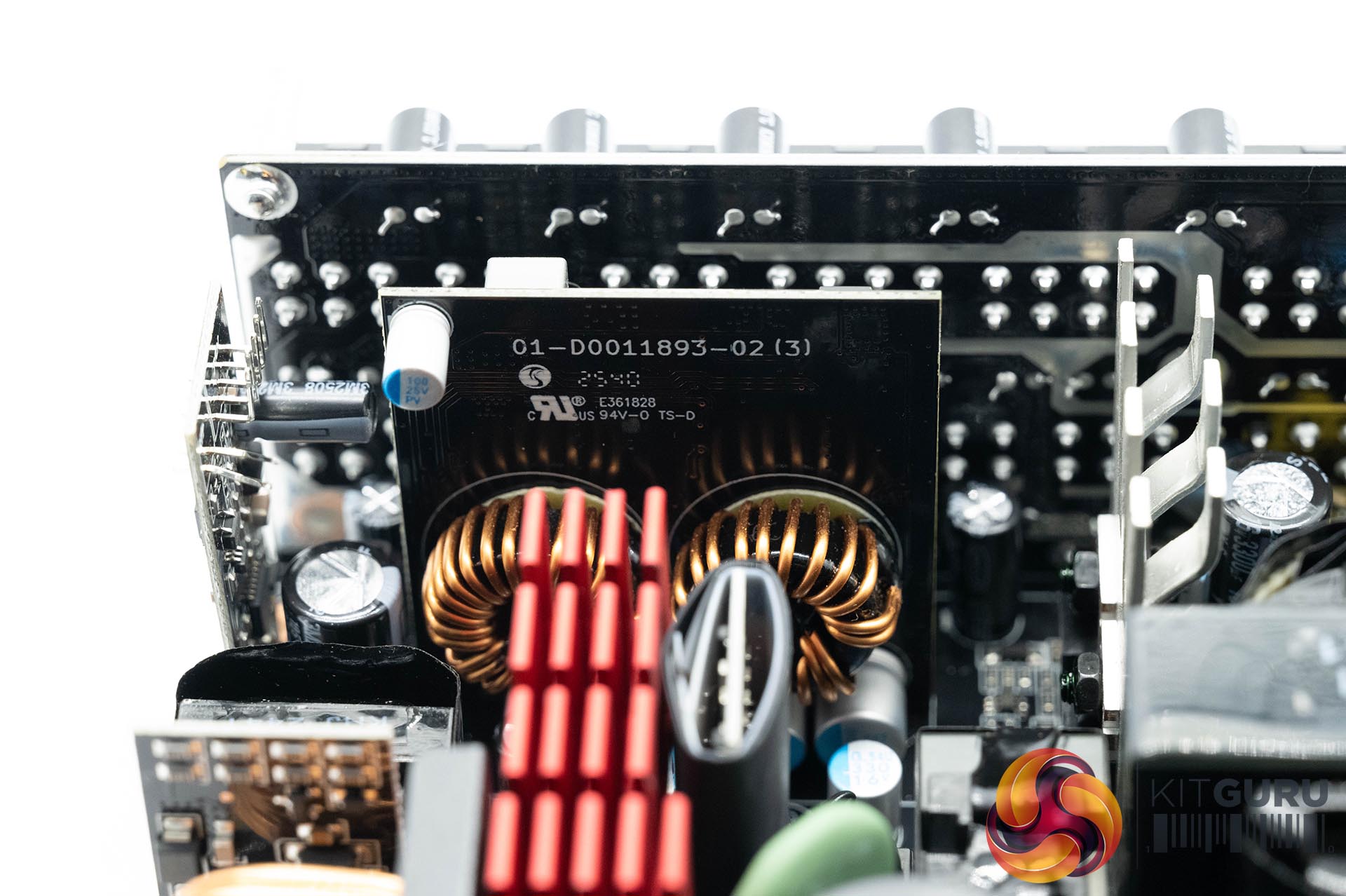
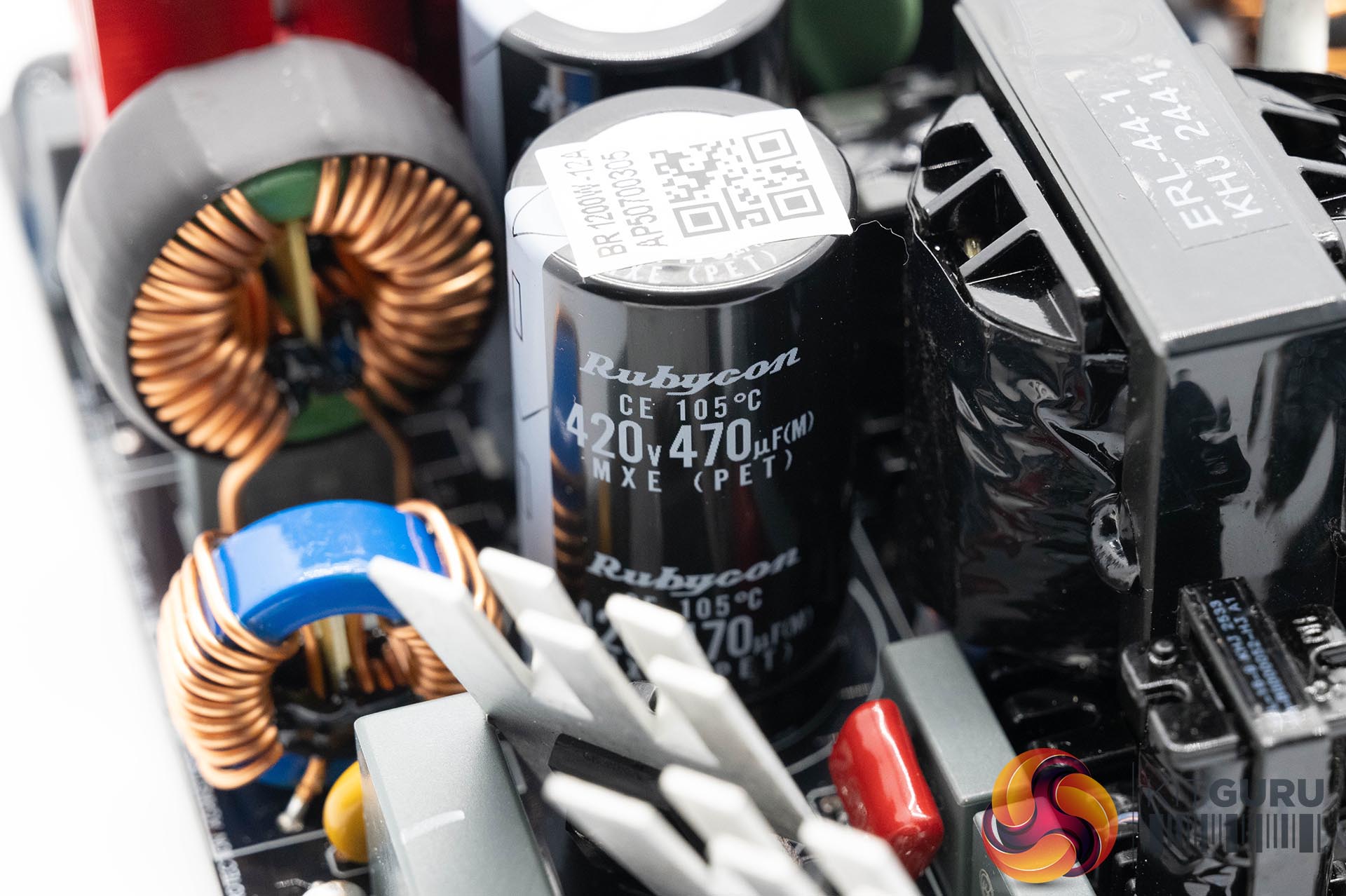
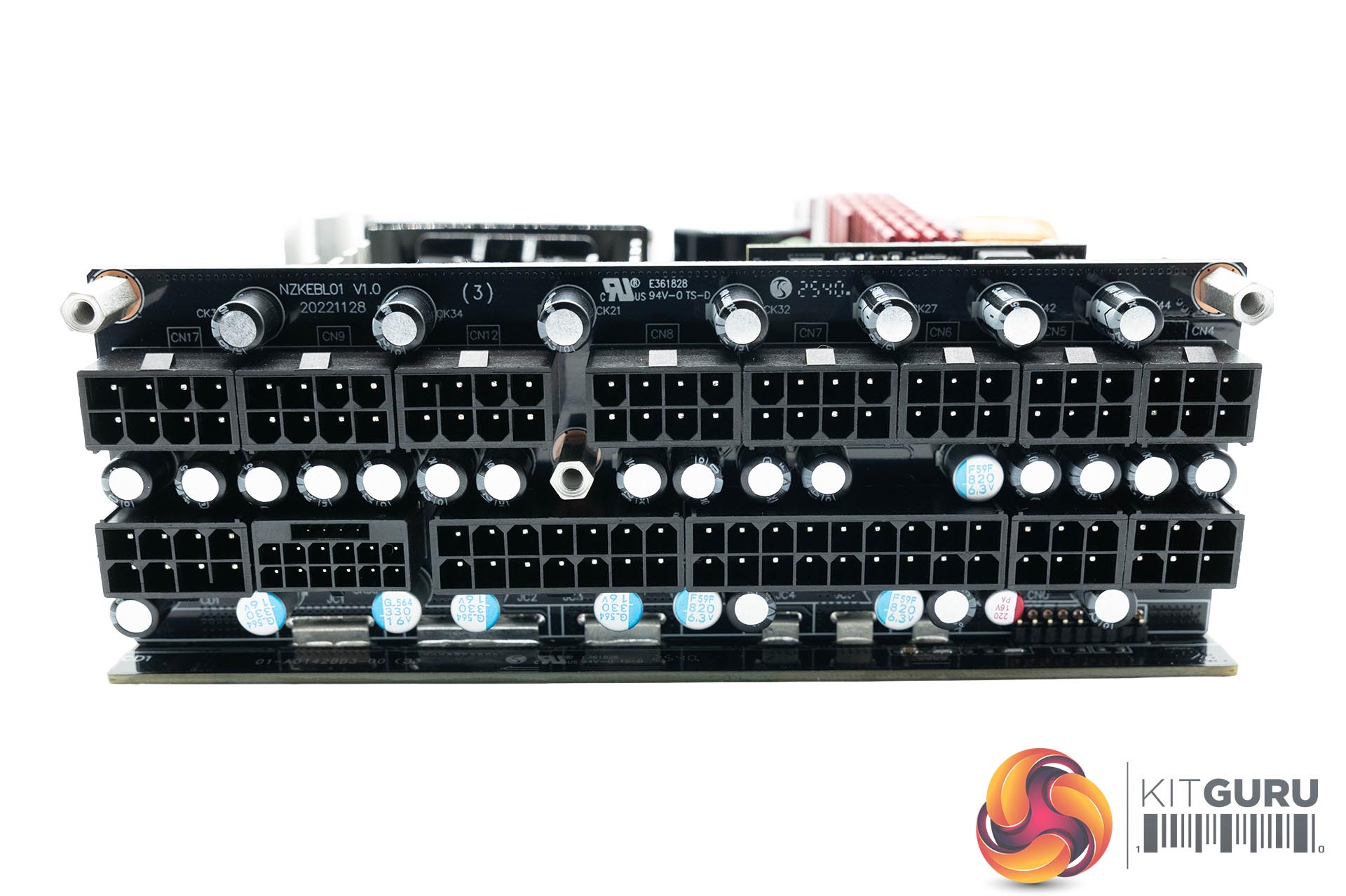
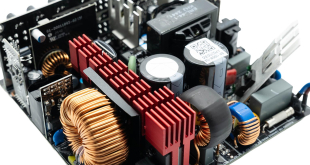
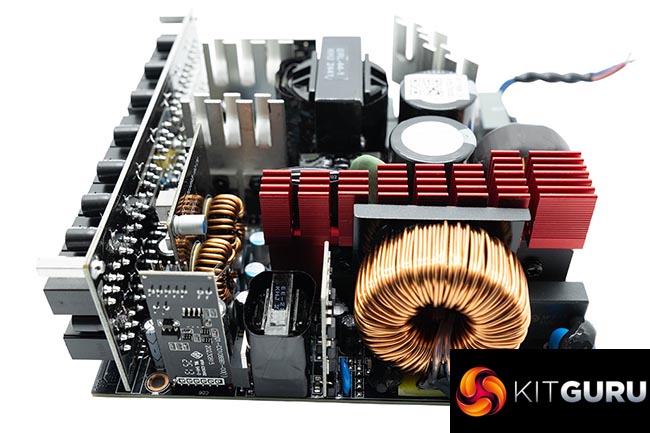
This is an RSY OEM design in collaboration with Enermax. It is an APFC, Full Bridge & LLC Resonant Converter topology with the secondary side 12V synchronous rectification and minor rails generated by DC-DC converters.
The primary capacitors are high grade 105C Japanese rated Rubycon (MXE), 420V, 470uF to give a total of 940uF. Filtering caps are a mixture of 105c caps from Nippon Chemi Con, Rubycon and UNICON. All quality capacitors throughout. The PCB Soldering quality is high throughout and build quality is overall very good.
The unit ships with OVP, OCP, OPP, SCP, OTP, UVP protections in place.
Correctly testing power supplies is a complex procedure and KitGuru have configured a test bench which can deliver up to a 2,000 Watt DC load.
We test ambient temperatures at 35C in our environment to greater reflect warmer internal chassis conditions.
We use combinations of the following hardware:
• SunMoon SM-268
• CSI3710A Programmable DC load (+3.3V and +5V outputs)
• CSI3711A Programmable DC load (+12V1, +12V2, +12V3, and +12V4)
• Extech Power Analyzer
• Extech MultiMaster MM570 digital multimeter
• Extech digital sound level meter
• Digital oscilloscope (20M S/s with 12 Bit ADC)
• Variable Autotransformer, 1.4 KVA
|
DC Output Load Regulation
|
||||||||||
|
Combined DC Load |
+3.3V
|
+5V
|
+12V
|
+5VSB
|
-12V | |||||
|
A
|
V
|
A
|
V
|
A
|
V
|
A
|
V
|
A | V | |
|
120W
|
0.90
|
3.34
|
0.92
|
4.99
|
8.95
|
12.11
|
0.50
|
4.98
|
0.20
|
-12.03
|
|
240W
|
1.63
|
3.34
|
1.63
|
4.98
|
18.46
|
12.10
|
1.00
|
4.98
|
0.20
|
-12.02
|
| 600W |
3.00
|
3.34
|
3.12
|
4.98
|
46.74
|
12.10
|
1.50
|
4.98
|
0.30
|
-12.03
|
| 900W |
4.01
|
3.34
|
4.07
|
4.97
|
70.82
|
12.08
|
2.00
|
4.98
|
0.30
|
-12.01
|
|
1200W
|
5.02
|
3.34
|
5.20
|
4.97
|
94.59
|
12.06
|
2.50
|
4.98
|
0.30
|
-12.02
|
Load regulation is very good across the rails.
Next we want to try Cross Loading. This basically means loads which are not balanced. If a PC for instance needs 500W on the +12V outputs but something like 30W via the combined 3.3V and +5V outputs then the voltage regulation can fluctuate badly.
| Cross Load Testing | +3.3V | +5V | +12V | -12V | +5VSB | |||||
| A | V | A | V | A | V | A | V | A | V | |
| 1190W | 4.0 | 3.34 | 3.0 | 4.99 | 88.0 | 12.03 | 0.2 | -12.03 | 0.50 | 4.98 |
| 240W | 19.0 | 3.32 | 22.0 | 4.97 | 2.5 | 12.11 | 0.2 | -12.03 | 0.50 | 4.98 |
The power supply handled the cross load test without any issues.
We then used an oscilloscope to measure AC ripple and noise present on the DC outputs. We set the oscilloscope time base to check for AC ripple at both high and low ends of the spectrum. ATX12V V2.2 specification for DC output ripple and noise is defined in the ATX 12V power supply design guide.
|
ATX12V Ver 2.2 Noise/Ripple Tolerance
|
|
|
Output
|
Ripple (mV p-p)
|
|
+3.3V
|
50
|
|
+5V
|
50
|
|
+12V1
|
120
|
|
+12V2
|
120
|
|
-12V
|
120
|
|
+5VSB
|
50
|
Obviously when measuring AC noise and ripple on the DC outputs the cleaner (less recorded) means we have a better end result. We measured this AC signal amplitude to see how closely the unit complied with the ATX standard.
| AC Ripple (mV p-p) | ||||
| DC Load | +3.3V | +5V | +12V | 5VSB |
| 100W | 15 | 13 | 16 | 9 |
| 200W | 17 | 14 | 17 | 13 |
| 400W | 18 | 15 | 18 | 14 |
| 600W | 19 | 16 | 20 | 16 |
| 800W | 23 | 16 | 21 | 18 |
| 1000W | 24 | 18 | 23 | 20 |
| 1200W | 25 | 20 | 25 | 22 |
This unit passes our ripple suppression tests without any issues. Results are pretty good but not class leading.
|
Efficiency (%)
|
|
|
100W
|
91.2
|
|
200W
|
93.3
|
|
400W
|
94.4
|
|
600W
|
94.3
|
|
800W
|
93.3
|
| 1000W | 92.8 |
| 1200W | 91.6 |
Efficiency is excellent, hitting around 94.5% at peak. This drops to 91.6% at full load. These are very good results.
We take the issue of noise very seriously at KitGuru and this is why we have built a special home brew system as a reference point when we test noise levels of various components. Why do this? Well this means we can eliminate secondary noise pollution in the test room and concentrate on components we are testing. It also brings us slightly closer to industry standards, such as DIN 45635.
Today to test the power supply we have taken it into our acoustics room environment and have set our SkyTronic DSL 2 Digital Sound Level Meter (6-130dBa) one meter away from the unit. We have no other fans running so we can effectively measure just the noise from the unit itself.
As this can be a little confusing for people, here are various dBa ratings with real world situations to help describe the various levels.
KitGuru noise guide
10dBA – Normal Breathing/Rustling Leaves
20-25dBA – Whisper
30dBA – High Quality Computer fan
40dBA – A Bubbling Brook, or a Refrigerator
50dBA – Normal Conversation
60dBA – Laughter
70dBA – Vacuum Cleaner or Hairdryer
80dBA – City Traffic or a Garbage Disposal
90dBA – Motorcycle or Lawnmower
100dBA – MP3 Player at maximum output
110dBA – Orchestra
120dBA – Front row rock concert/Jet Engine
130dBA – Threshold of Pain
140dBA – Military Jet takeoff/Gunshot (close range)
160dBA – Instant Perforation of eardrum
|
Noise (dBA)
|
|
|
100W
|
<28.0
|
|
200W
|
<28.0
|
|
400W
|
<28.0
|
|
600W
|
29.4
|
| 800W | 32.3 |
| 1000W | 32.8 |
| 1200W | 35.7 |
Fan noise levels are very good, hitting 35.7% peak at full load. The fan while not the quietest we have tested, is never too intrusive.
|
Temperature (c)
|
||
|
Intake
|
Exhaust
|
|
|
100W
|
35
|
37
|
|
200W
|
36
|
39
|
|
400W
|
38
|
42
|
|
650W
|
43
|
44
|
|
800W
|
45
|
50
|
| 1000W | 47 | 53 |
| 1200W | 50 | 56 |
The fan pushes a reasonable amount of air around the case, ensuring the temperatures are well controlled at all load levels. A very good level of optimisation from FSP.Internally, the Platimax II 1200DF is built on a modern RSY platform with a solid set of components. Rubycon caps are on the primary side, Nippon Chemi-Con and UNICON on the secondary. Build quality is good overall. Soldering is clean and nothing stood out as being rushed or cut back. It is a modern design as well, LLC resonant with DC-DC for the minor rails, so all as expected really for a unit at this level.
Thermals are handled well. Even pushing the unit up towards full load in a 35C environment, temperatures stayed under control. The fan is doing its job, shifting enough air through the unit without things getting out of hand.
Enermax have gone with a 135mm Globe Fan here, dual ball bearing, rated at 0.45A. On paper that sounds like it could be quite aggressive, but it is not spinning hard for most of the load range. Up to mid load it stays quiet enough, and you only really start to hear it once you move past 800W or so. At full load we measured 35.7 dBA. Not the quietest result we have seen, but it never becomes irritating either. A quality high grade FDB fan would likely have helped matters in this regard.
Feature set is what you would expect. Full ATX 3.1 and PCIe 5.1 support, native 12V-2×6 connector for 600W GPUs, and good transient handling. Cables are decent as well, individually sleeved and easy enough to work with.
Right now we have no UK pricing information, apart from a link to Amazon DE which currently shows an asking price of £127 for the black version and £164 for the white version. This is quite different to the information we were fed from Enermax directly, highlighting a price of $229.99 for the Black version (HERE) and $239 for the white version (HERE). We reached out to Enermax for some details on pricing and I will update this page when I get more information. Where it actually lands in the UK is going to matter.
Overall, this is a solid power supply. It performs well, it is built properly, and thermals are under control. It is not the quietest unit in this class when pushed hard, but for most systems it is not going to be an issue. If pricing ends up closer to the lower end we have seen, it becomes a very easy recommendation. All we have right now however are links to the DE Amazon website.
Pros
-
Strong electrical performance across all rails.
-
Very good efficiency levels.
-
Solid internal component selection.
-
Good thermal control under load.
-
ATX 3.1 and PCIe 5.1 ready.
-
Compact size for a 1200W unit.
Cons
-
Not the most refined acoustics at higher loads.
-
Ball bearing fan choice shows under heavy load.
-
Pricing currently unclear.
KitGuru says: A solid 1200W power supply that gets the important things right. Not the quietest under load, but well built, efficient and worth a look if pricing lands where it should.