KitGuru KitGuru.net – Tech News | Hardware News | Hardware Reviews | IOS | Mobile | Gaming | Graphics Cards


ASUS and AMD recently collaborated to create the ASUS ROG Ally handheld games console, which features two custom AMD system-on-chips (SoCs): the Ryzen Z1 and Ryzen Z1 Extreme. Some people have pointed out that the specifications of the Z1 series are similar to those of AMD's 7040U family of mobile and ultra-portable chipsets, suggesting that the Z1 were just repurposed 7840U and 7540U CPUs for handheld gaming.
Although that's not that far from the truth, there are some differences that will make these chips behave differently. According to Tom's Hardware, who talked with Matthew Hurwitz, a client PR manager at AMD, the Z1 APUs share the same technology building blocks as the 7040 series, hence the similarities.
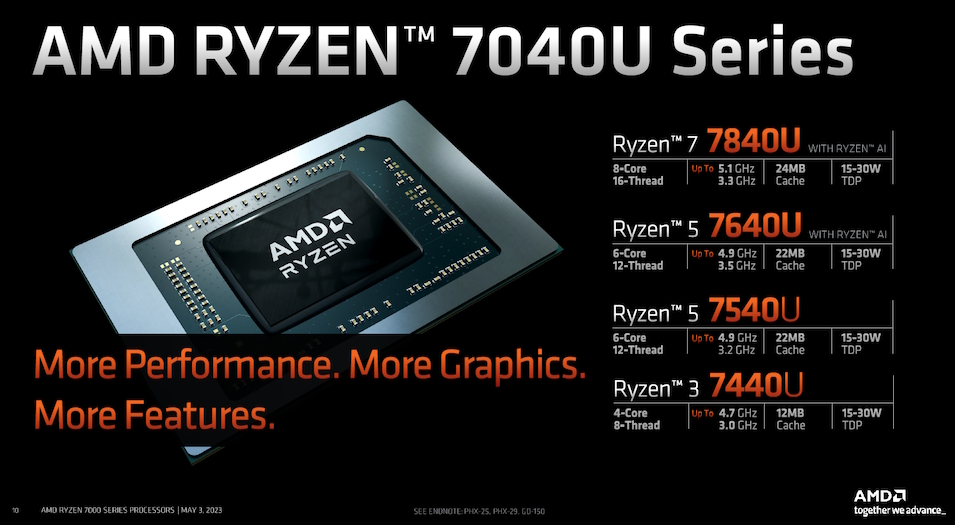
However, Hurwitz added that AMD engineers had to validate entirely new power ranges and optimise the voltage curves of the Z1, as these would be specifically used for handheld consoles. One example is the cTDP, which ranges between 15-30W in the 7040U chips and 9-30W on the Z1 chip. He also confirmed that the AMD Ryzen AI engine is not available on the Ryzen Z1 APUs (the hardware is there, but it's disabled).
While some differences exist between the gaming and laptop chipset ranges, AMD and ASUS have likely saved money on development costs by creating and adopting the slightly adjusted Z1 SoC series. The Ryzen Z1 chips are designed specifically with handheld gaming in mind, and as per the AMD representative, this optimisation and validation work should not be trivialised.
KitGuru says: Considering these differences alone, do you think they justify creating the Z1 series instead of just putting 7040U APUs on handheld consoles?