KitGuru KitGuru.net – Tech News | Hardware News | Hardware Reviews | IOS | Mobile | Gaming | Graphics Cards


Razer has just launched the second generation of the world's thinnest gaming laptop but now it also has the highest resolution of any gaming laptop, quadrupling the pixels from 1600×900 all the way up to 3200×1800.
In total, the new 14 Inch Razer Blade sports 5.76 million pixels with a density of 226 PPI, Razer's choice of TFT display uses IGZO technology which supposedly delivers unmatched colour and image quality. Min-Liang Tan, Razer co-founder, CEO and Creative Director said in the press release: “The Razer Blade sets the benchmark by which all laptops should be measured. The Razer Blade, the world’s thinnest and most powerful gaming laptop, now comes with the best 14-inch notebook display on the planet.”
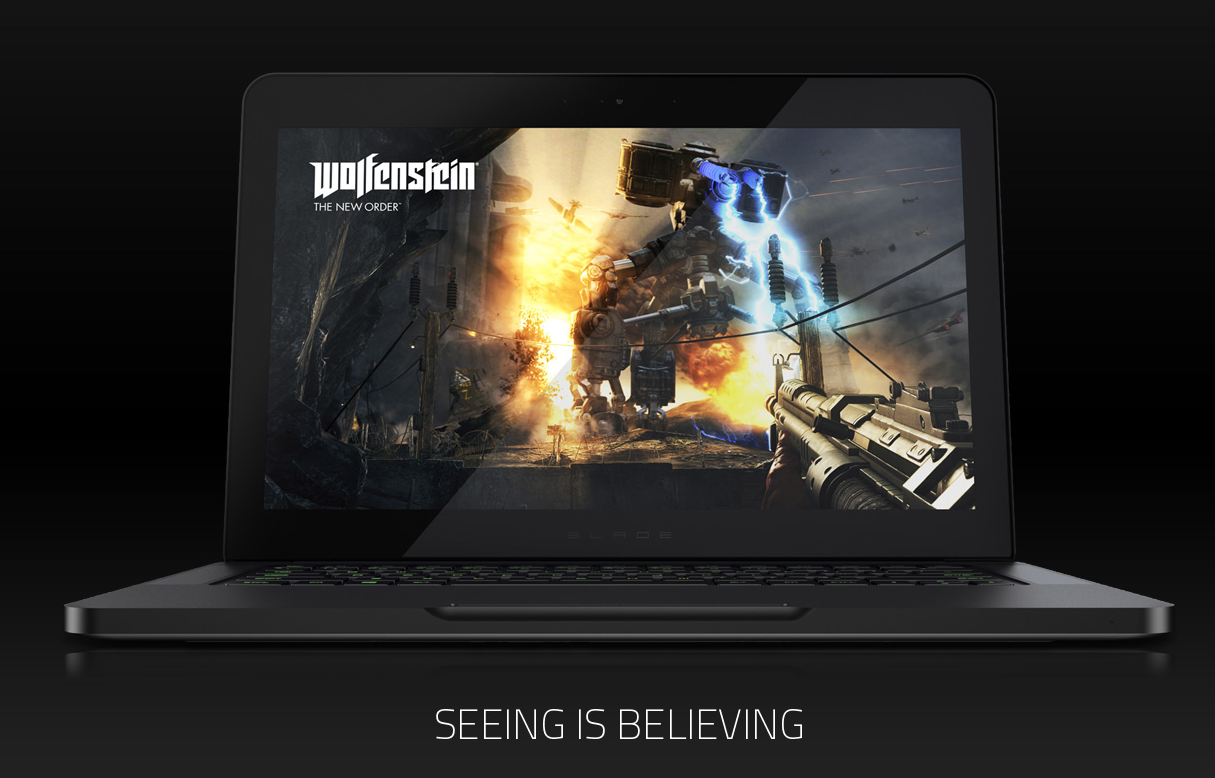
Obviously with a new high resolution screen, you're going to need a brand new graphics chip powering it which is why the Blade will feature a brand new Nvidia GeForce GTX 870M with 3GB GDDR5 VRAM, coupled with an Intel Core i7-4702HQ quad-core CPU clocked at 2.2GHz which is pushed to 3.2GHz once turbo boost is activated.
As always, Razer's laptops are only available in the US at launch and there is currently no sign of a UK release of either the 14 Inch Razer Blade or the 17 Inch Razer Blade pro. However if you are outside of the UK looking to buy one, it will set you back $2199.99 for the 128GB model, $2399.99 for the 240GB and finally $2699.99 for the 512GB, all laptops come pre-installed with Windows 8 and the system won't ship for 3-4 weeks. Razer has a track record for selling out almost instantly, so get in quick.
KitGuru Says: I like Razer's laptop design, and on paper, the specs seem pretty powerful. Unfortunately the Razer Blade line isn't available in the UK so I've not had a chance to spend any time with one, hopefully one day that will change. What do you guys think of Razer's new and improved 14 Inch laptop?