KitGuru KitGuru.net – Tech News | Hardware News | Hardware Reviews | IOS | Mobile | Gaming | Graphics Cards


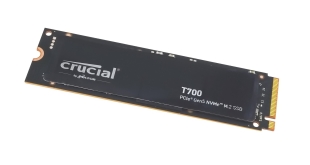
The latest Gen5 SSD to land on the test bench is Crucial's T700. Part of Crucial's Pro series, the T700 uses a combination of Micron 3D TLC NAND and a Phison controller and needless to say, it's the fastest Crucial SSD to date. We test the 2TB model on sale for £330 in the UK.
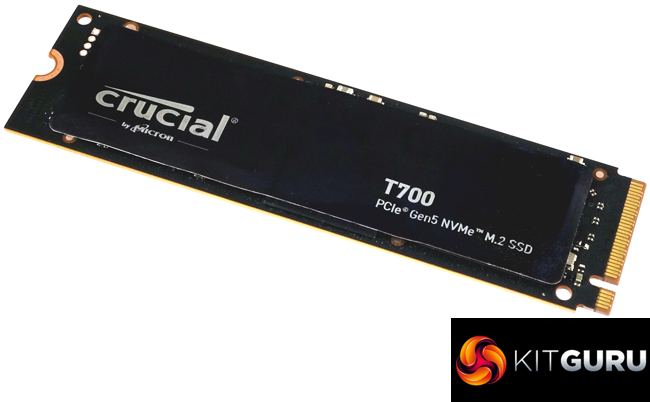
At the heart of the T700 is a Phison PS5026-E26 8-channel controller (the world's first consumer Gen 5 controller) which looks after Micron's own 232-layer 3D TLC NAND Flash. The T700 also uses Micron's LPDDR4 DRAM for caching (1GB per 1TB of NAND flash).
The T700 is available in three capacities; 1TB, 2TB (the drive we are looking at here) and a 4TB flagship model. There are two versions of the drive; plain (the drive we are reviewing here) and one with a factory-fitted heatsink.
Sequential performance is quoted as up to 11,700MB/s and 9,500MB/s for read/writes respectively for the 1TB model and up to 12,400MB/s (reads) and up to 11,800MB/s (writes) for the 2TB and 4TB drives.
Random performance ratings for the drives are; up to 1,350,000 IOPS and up to 1,400,000 IOPS for the 1TB drive with the 2TB and 4TB drives rated as up to 1,500,000 IOPS for both reads and writes.
The TBW endurance for the 2TB model is quoted as 1,200 with the 1TB drive rated at 800TBW and the 2TB model 2,400TBW. Crucial back the drive with a five-year warranty.
Physical Specifications:
- Usable Capacities: 2TB.
- NAND Components: Micron 232-layer 3D TLC NAND.
- NAND Controller: Phison PS5026-E26 8-channel.
- Cache: 2GB LPDDR4.
- Interface: PCIe Gen 5 x4.
- Form Factor: M.2 2280.
- Dimensions: 80 x 22 x 2.3 mm.
Firmware Version: PACR5101.