KitGuru KitGuru.net – Tech News | Hardware News | Hardware Reviews | IOS | Mobile | Gaming | Graphics Cards


AMD has introduced the Ryzen AI Max 400 series of processors for local AI development platforms. Serving as an architecture refresh to the previous Ryzen AI Max (PRO) 300 series Strix Halo hardware, the new silicon combines Zen 5 CPU cores, RDNA 3.5 integrated graphics, a dedicated NPU, and AMD PRO enterprise management features. Consumer-targeted iterations of these processors are scheduled to debut later this year.
The primary update centres on the integrated memory controllers, which have been modified to support up to 192GB of LPDDR5X unified memory via a 4-channel, 256-bit interface. Users can manually partition this pool to allocate up to 160GB directly to the integrated graphics subsystem, providing the capacity needed to run LLMs with more than 300 billion parameters. Performance modifications include a maximum GPU boost frequency increase to 3.00GHz, a maximum CPU boost clock increase to 5.20GHz, and a 10% performance uplift for the built-in NPU to reach 55 TOPS.
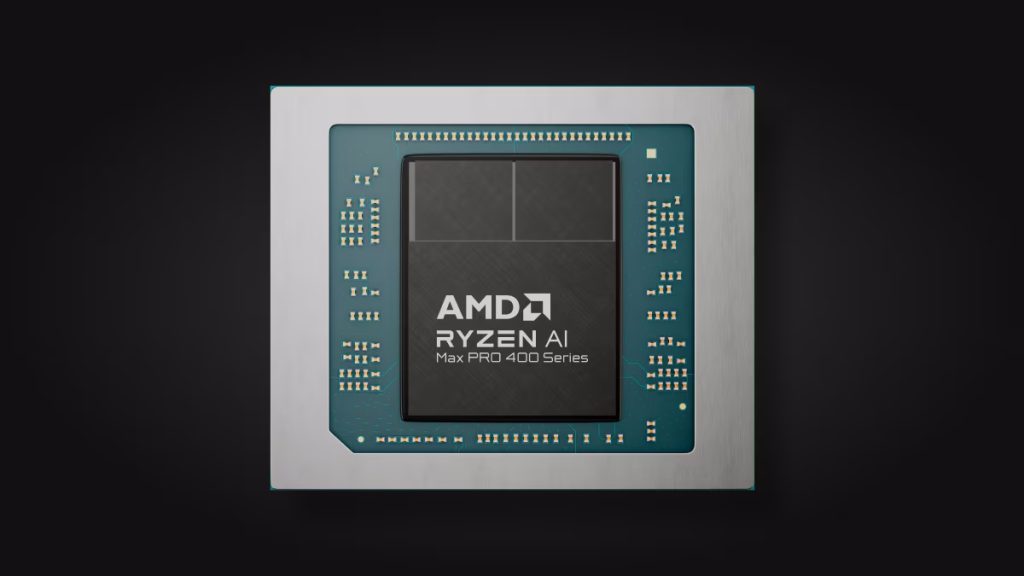
The product stack consists of three distinct processor designs. The top-tier Ryzen AI Max+ PRO 495 features 16 cores and 32 threads, boosting up to 5.20GHz, a fully enabled 40-compute-unit iGPU (Radeon 8065S), 80MB of cache, and a 55 TOPS NPU. The mid-range Ryzen AI Max PRO 490 scales back to a 12-core, 24-thread configuration, clocking up to 5.00GHz, paired with a 32-compute-unit iGPU (Radeon 8050S), 76MB of cache, and a 50 TOPS NPU. The entry-level Ryzen AI Max PRO 485 maintains the 32-compute-unit iGPU (Radeon 8050S) and 50 TOPS NPU, but uses an 8-core, 16-thread CPU layout, boosting up to 5.00GHz and accompanied by 40MB of cache.
KitGuru says: These aren't for the general consumer yet, but consumer versions of these chips are expected at a later date.