KitGuru KitGuru.net – Tech News | Hardware News | Hardware Reviews | IOS | Mobile | Gaming | Graphics Cards


We’ve already examined some of SilentiumPC’s air cooling products and have continuously been impressed by their cooling performance and build quality for very affordable price tags. In this one, we’re taking a looking at a foray into AIO liquid cooling for the vendor – that’s with the Navis F240 ARGB. So, how will this 240mm liquid cooler perform? And how will its value appear with a price tag of £75 or £85 the ARGB fans version?
Video Timestamps
00:00 Start
00:47 Unboxing and radiator
01:41 Tubing / coldplate
02:22 Pump and block
03:19 Looking at the fans
04:11 Cable management / warranty
05:22 Installation process
05:42 Test setup
07:08 Noise results
07:48 Thermal results
10:11 Closing thoughts
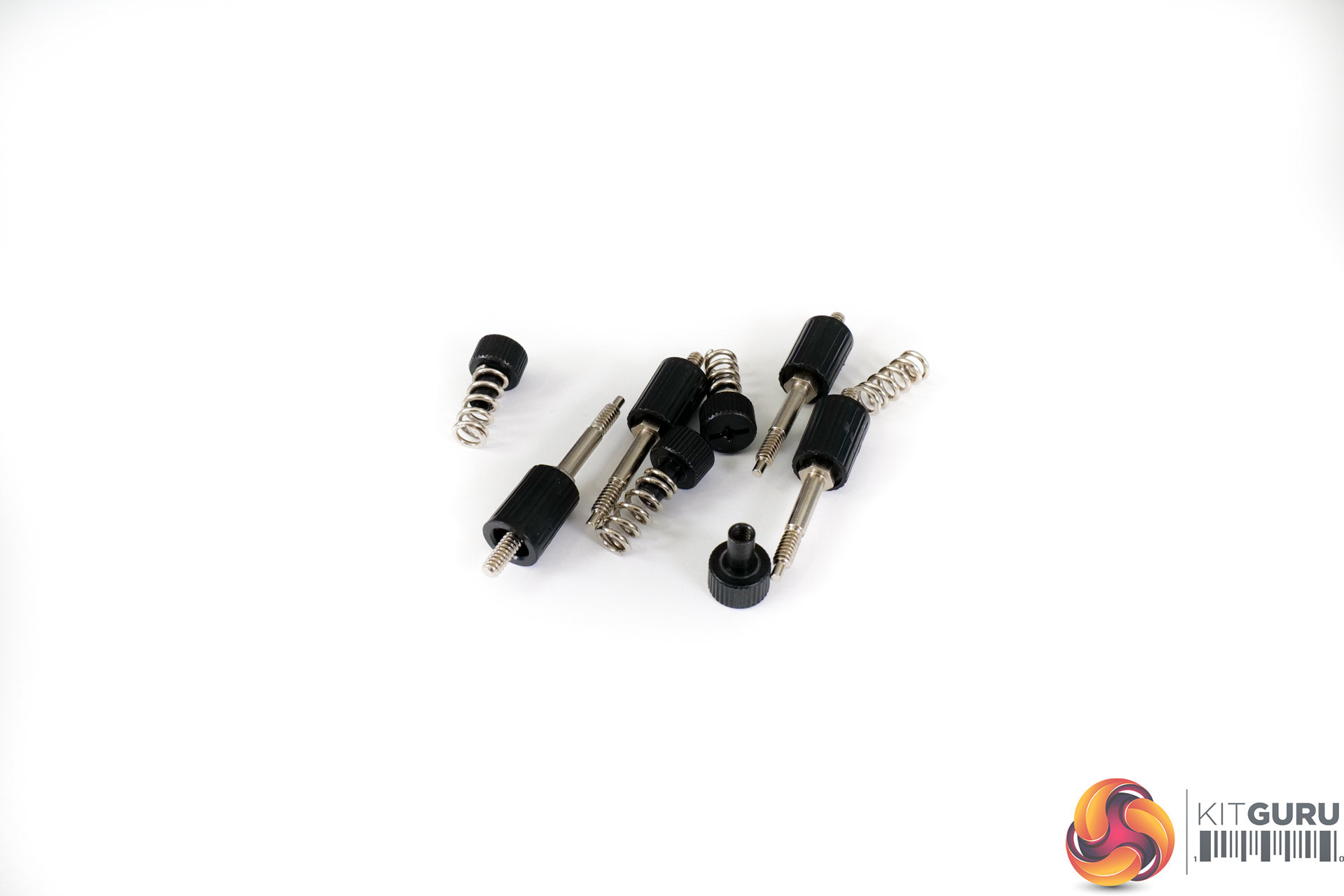
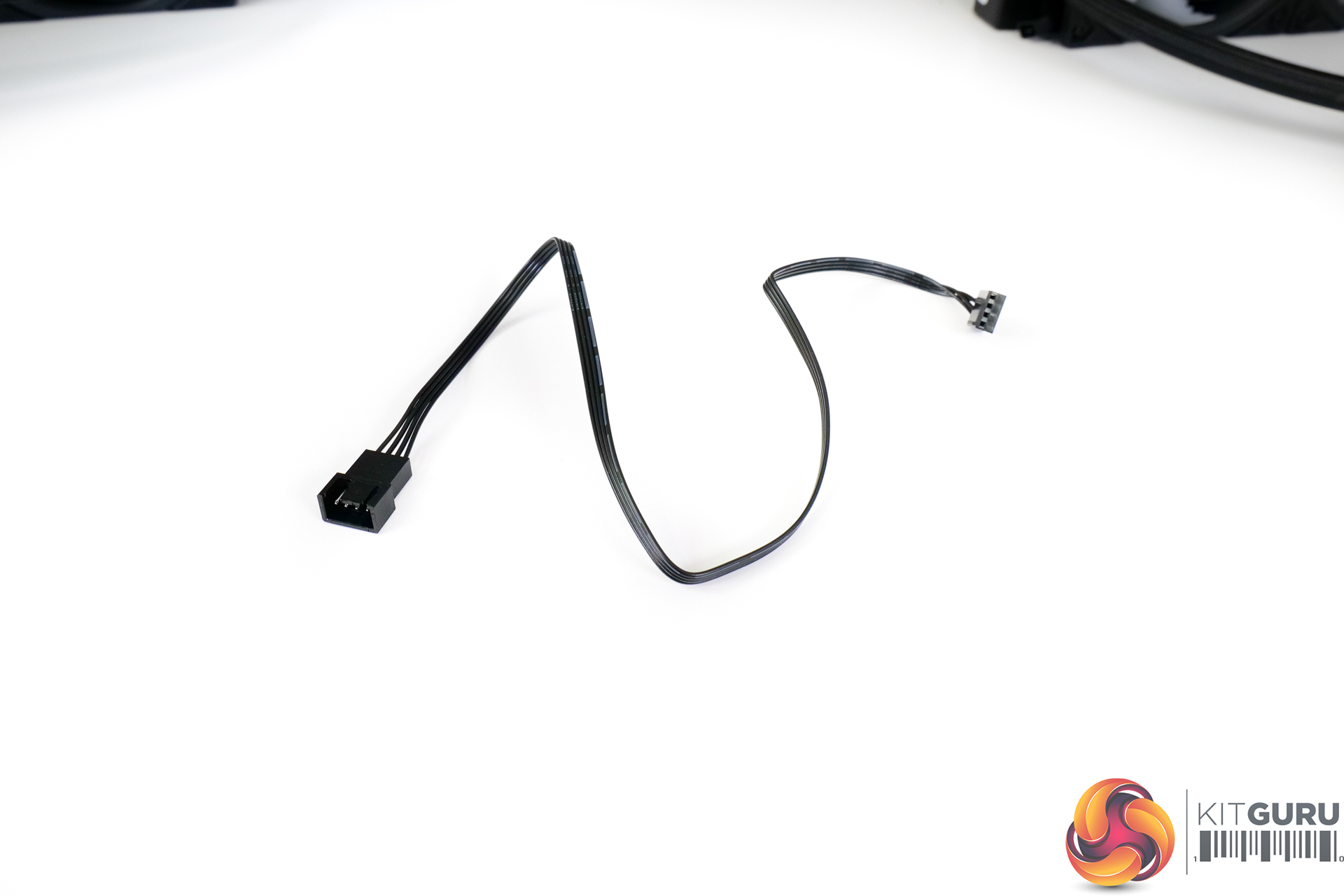
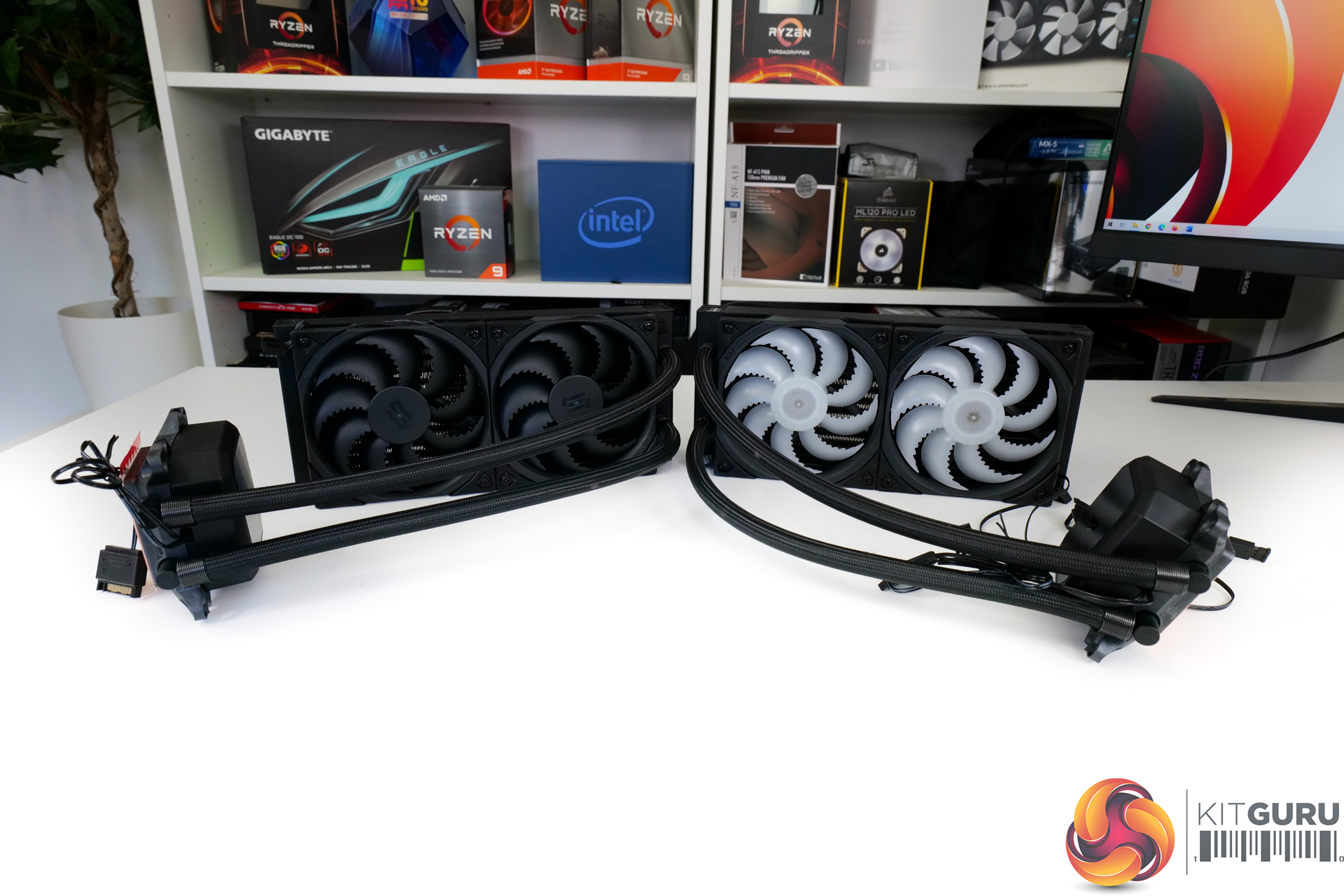
Mounting hardware and accessories are provided for all modern Intel platforms as well as AM4. You get some cables for handling the fans and connections, plus there’s a tube of Pactum PT-3 thermal paste which I always like to see included.
A pleasant surprise was the SilentiumPC pre-applied the cooling fans. This gives the user one less installation task – nice!
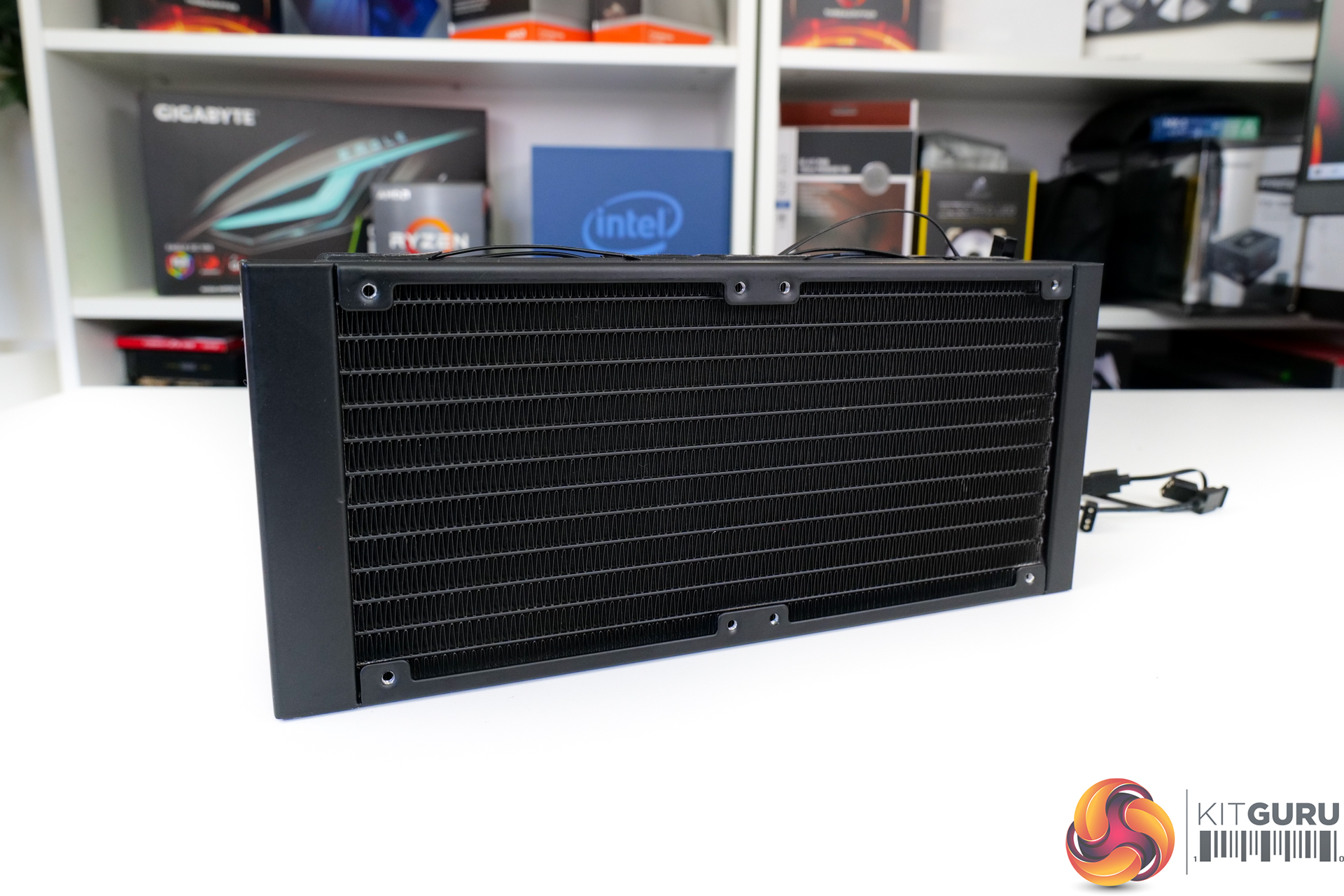
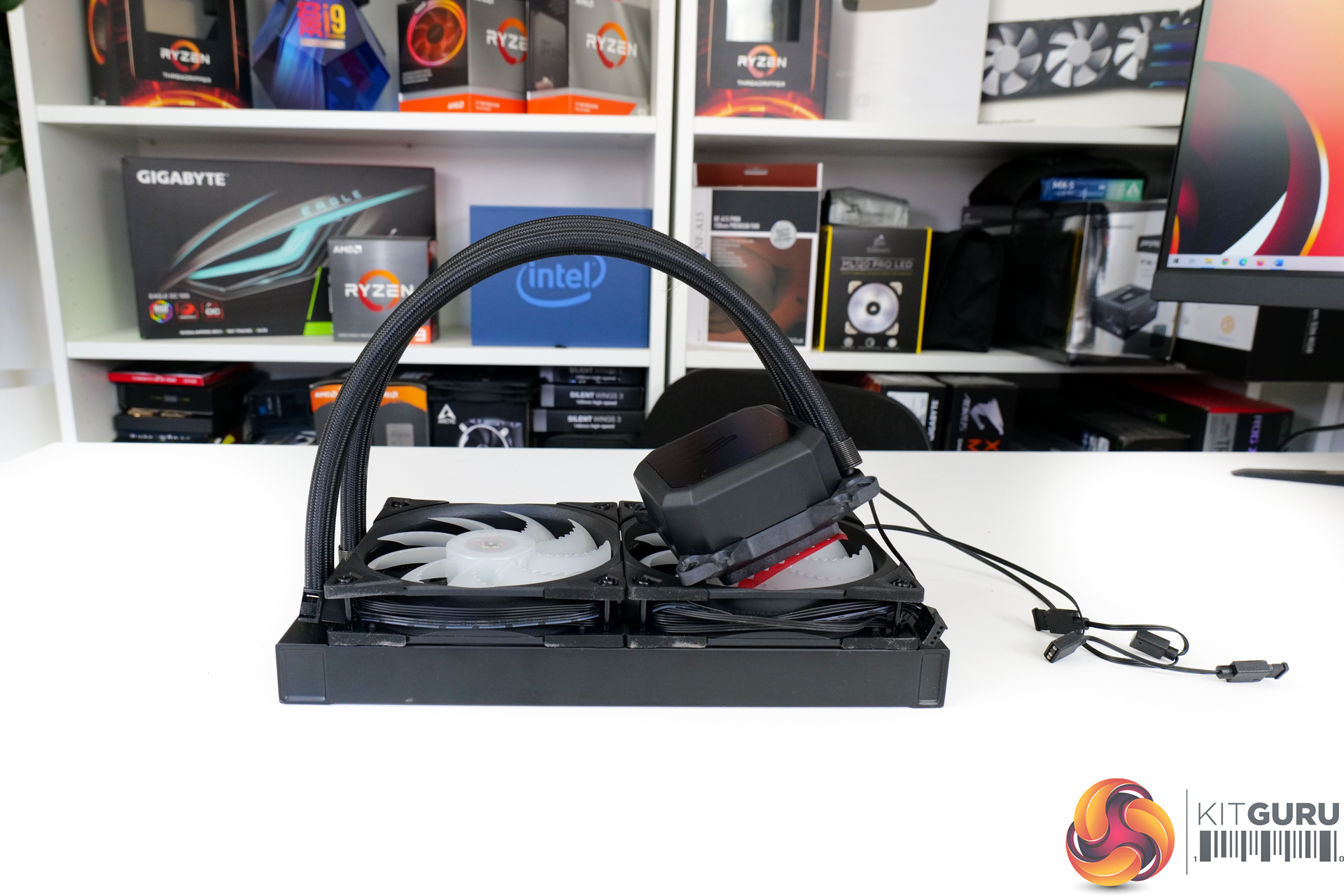
SilentiumPC uses a conventional 27mm-thick, 240mm-class black aluminium radiator, albeit with fins that don’t span the entire thickness. There is some form of fill/drain port on the unit, but this is not intended for user applications.
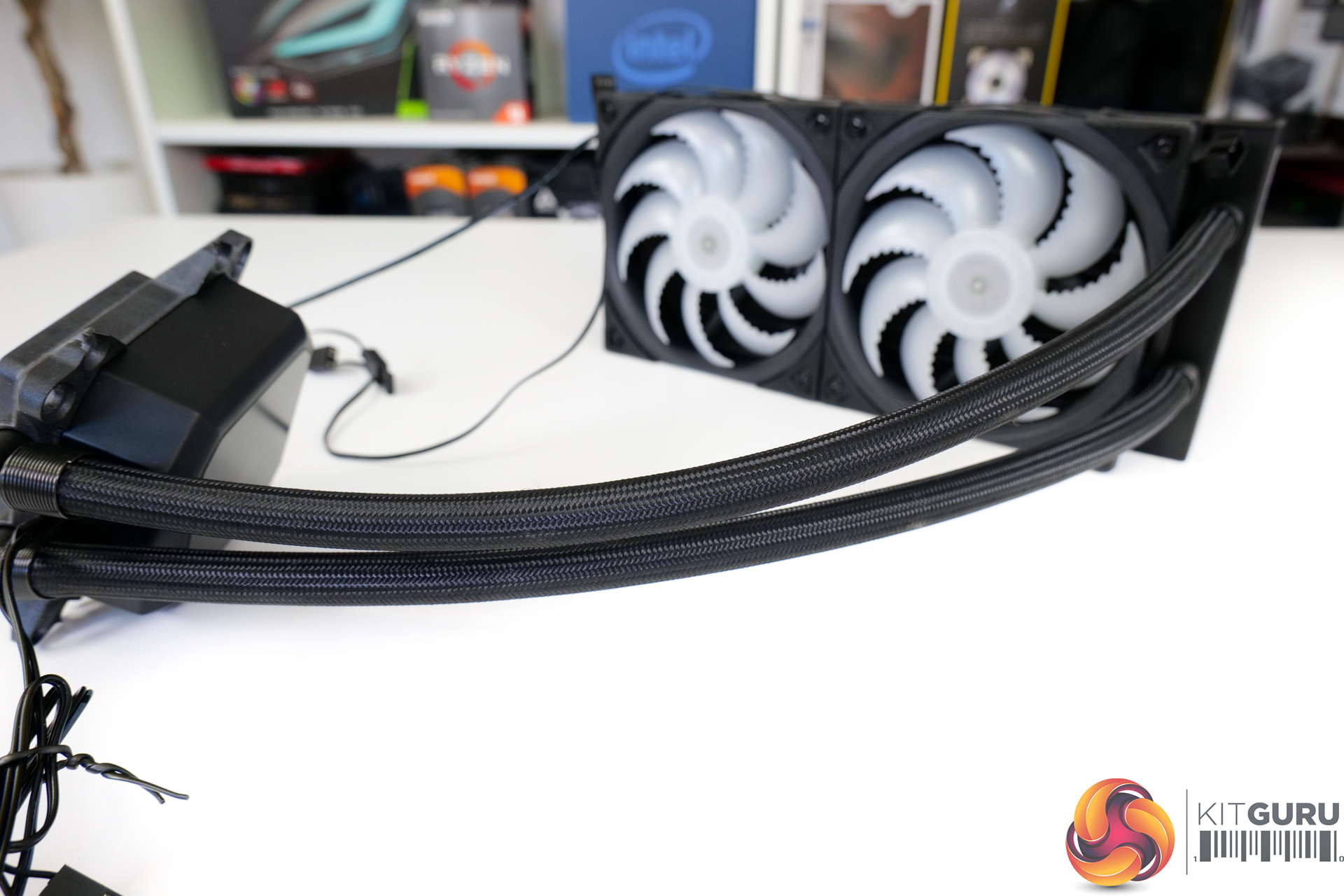
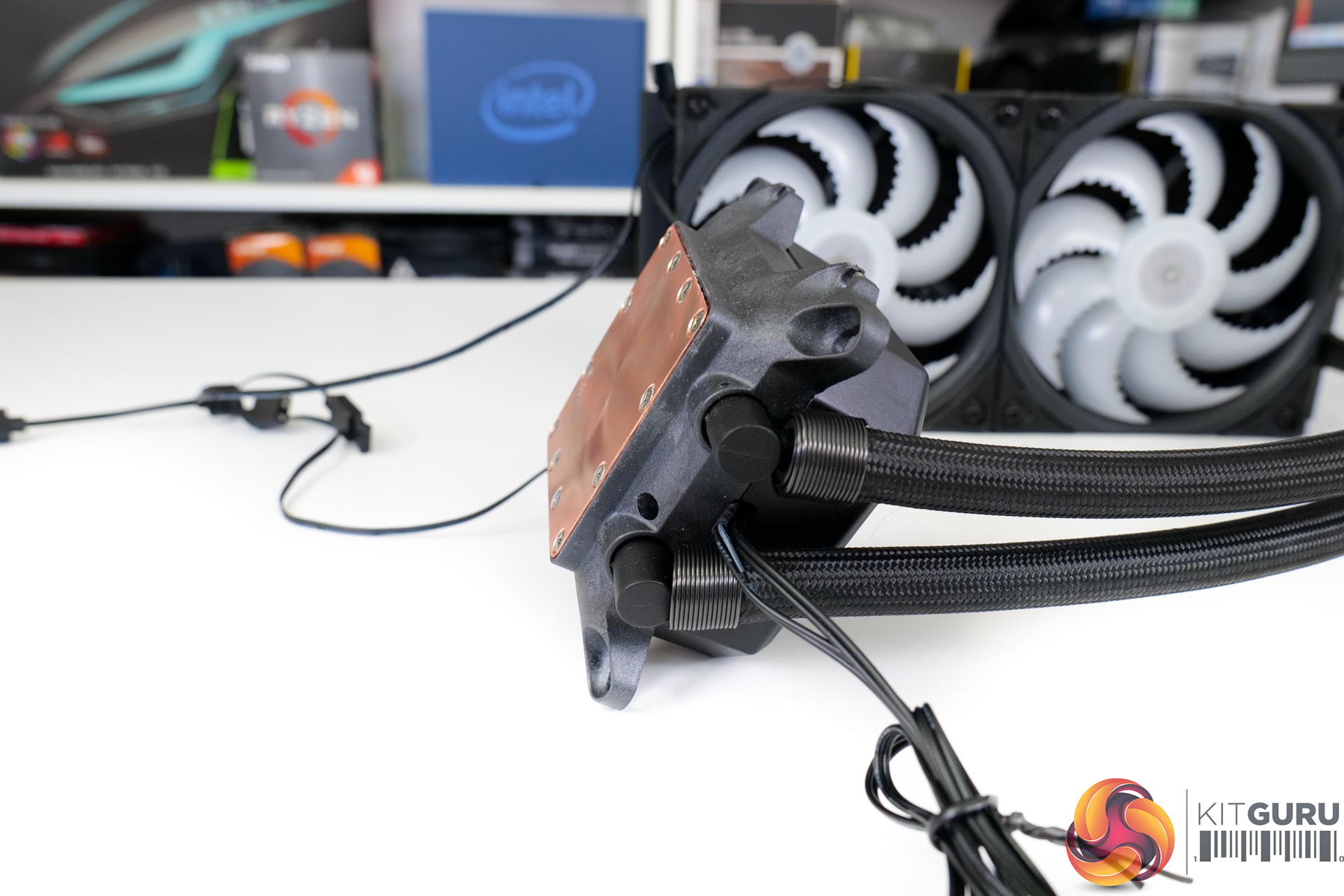
The liquid tubes are around 390mm in length and are covered by a high-quality, attractive braiding. Flexibility of the tubes is positive, especially when coupled with the reasonable degree of movement for the entry points at the pump-block unit.
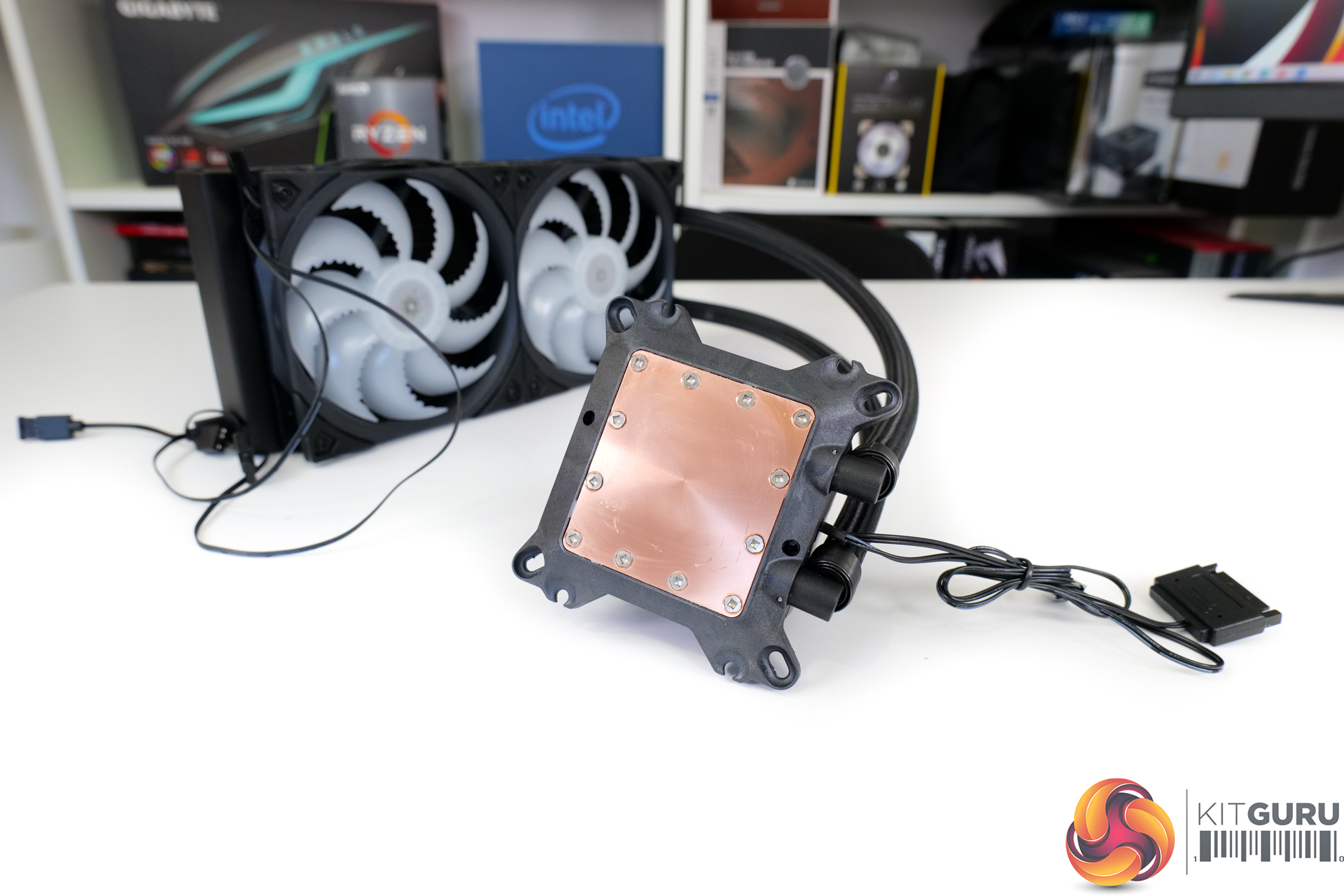
A well-sized bare copper cold plate is used to extract heat from a CPU. Despite being bare copper in form, SilentiumPC highlights compatibility with liquid metal thermal interface material if you’re feeling fancy.
I prefer that the cold plate is void of pre-applied thermal paste, particularly as SilentiumPC includes a 1.5g tube which is sufficient for multiple applications.
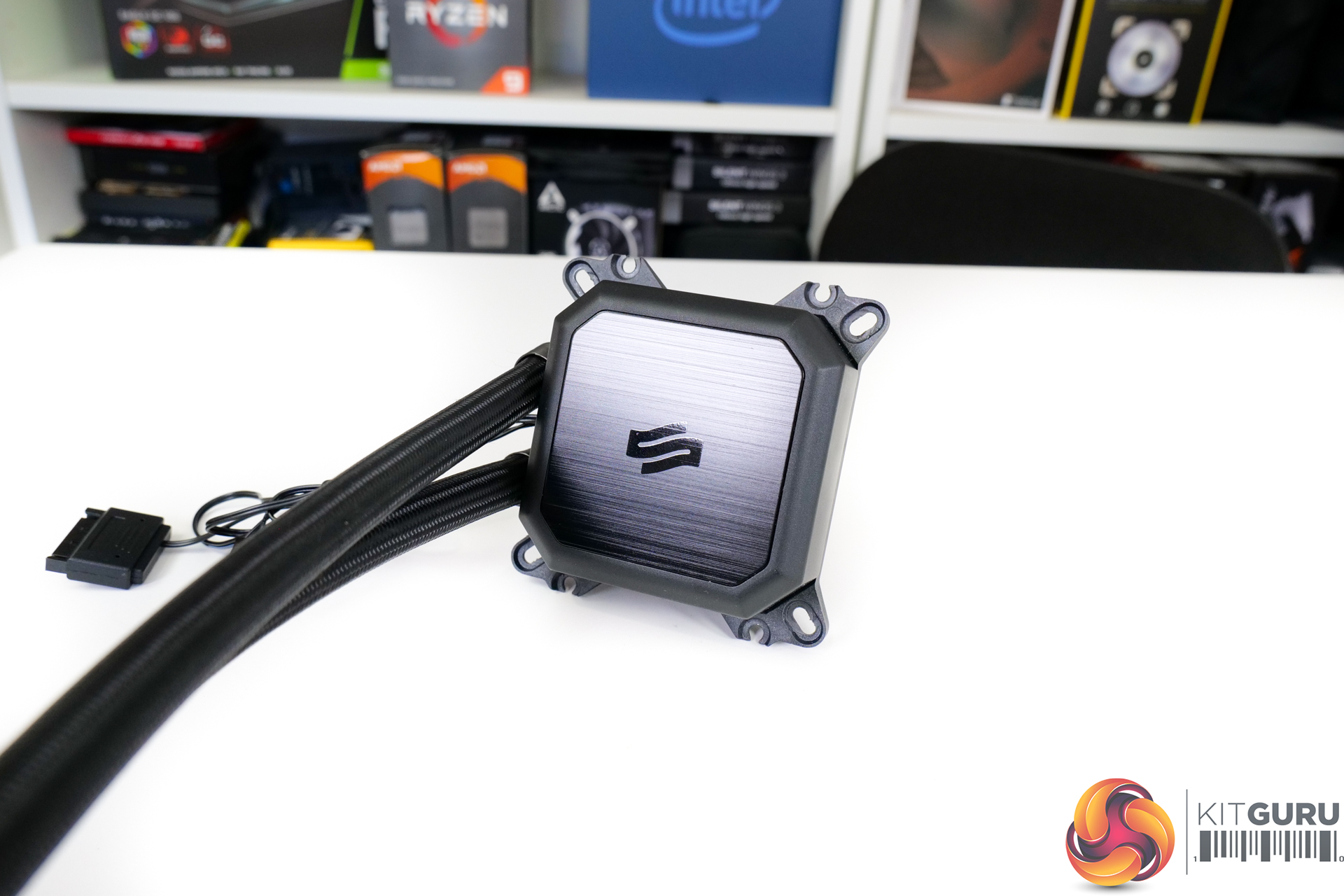
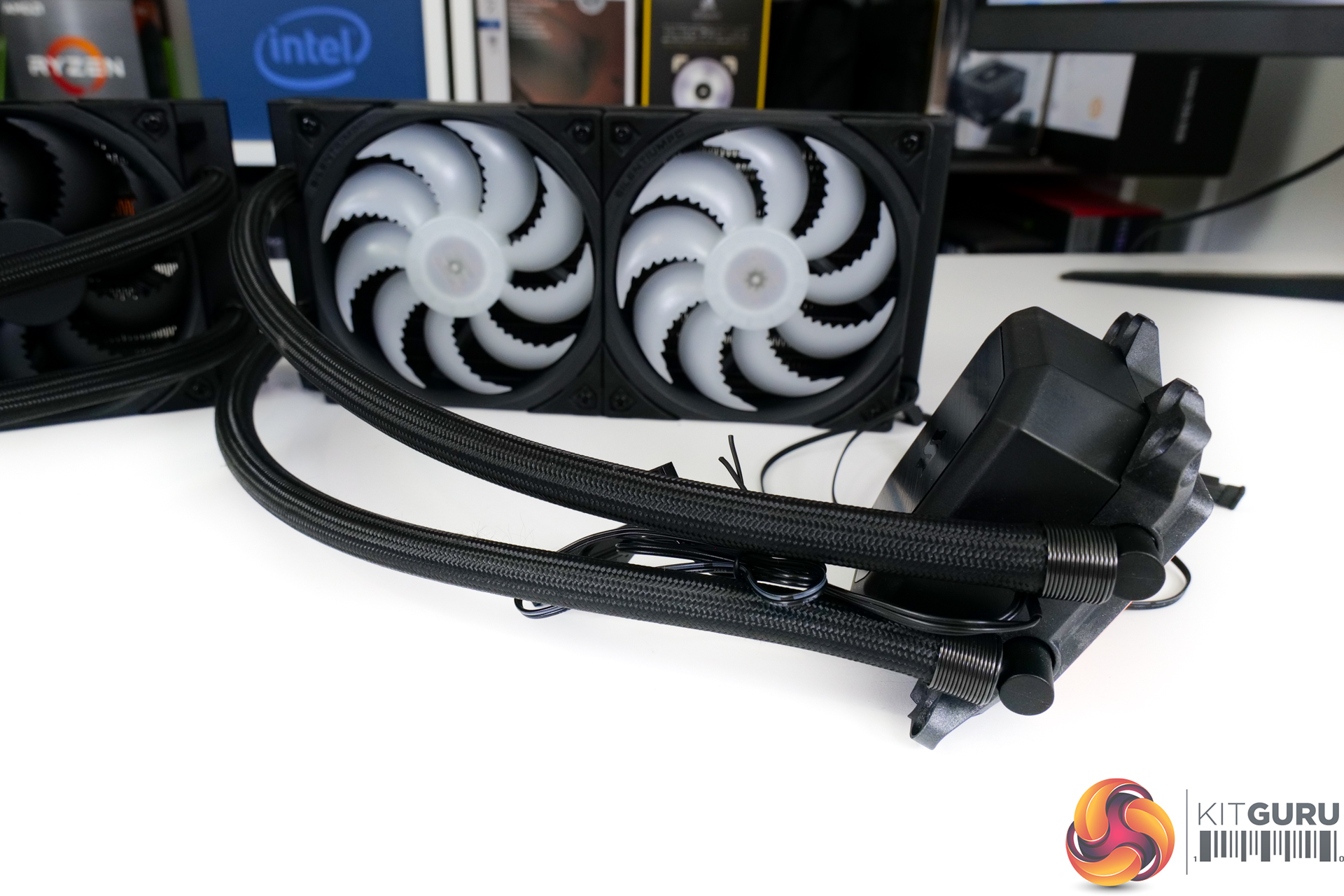
Physically very chunky, the pump-block unit features integrated mounting hardware for the Intel and AMD platforms that this cooler supports.
This is a unique design as most competitors use brackets for mounting capability. I guess this has the benefit of ease of installation because it’s one less part to think about. But it does have the downside of making future upgraded support of new sockets a more challenging – perhaps impossible – task.
PWM control is used for the ceramic-bearing pump. This allows the unit to operate in a speed range of 1600 to 2600 RPM, which is ideal for noise output. Interestingly, there is no LED lighting on the pump housing, which feels like a bit of a missed opportunity for an ARGB liquid cooler.
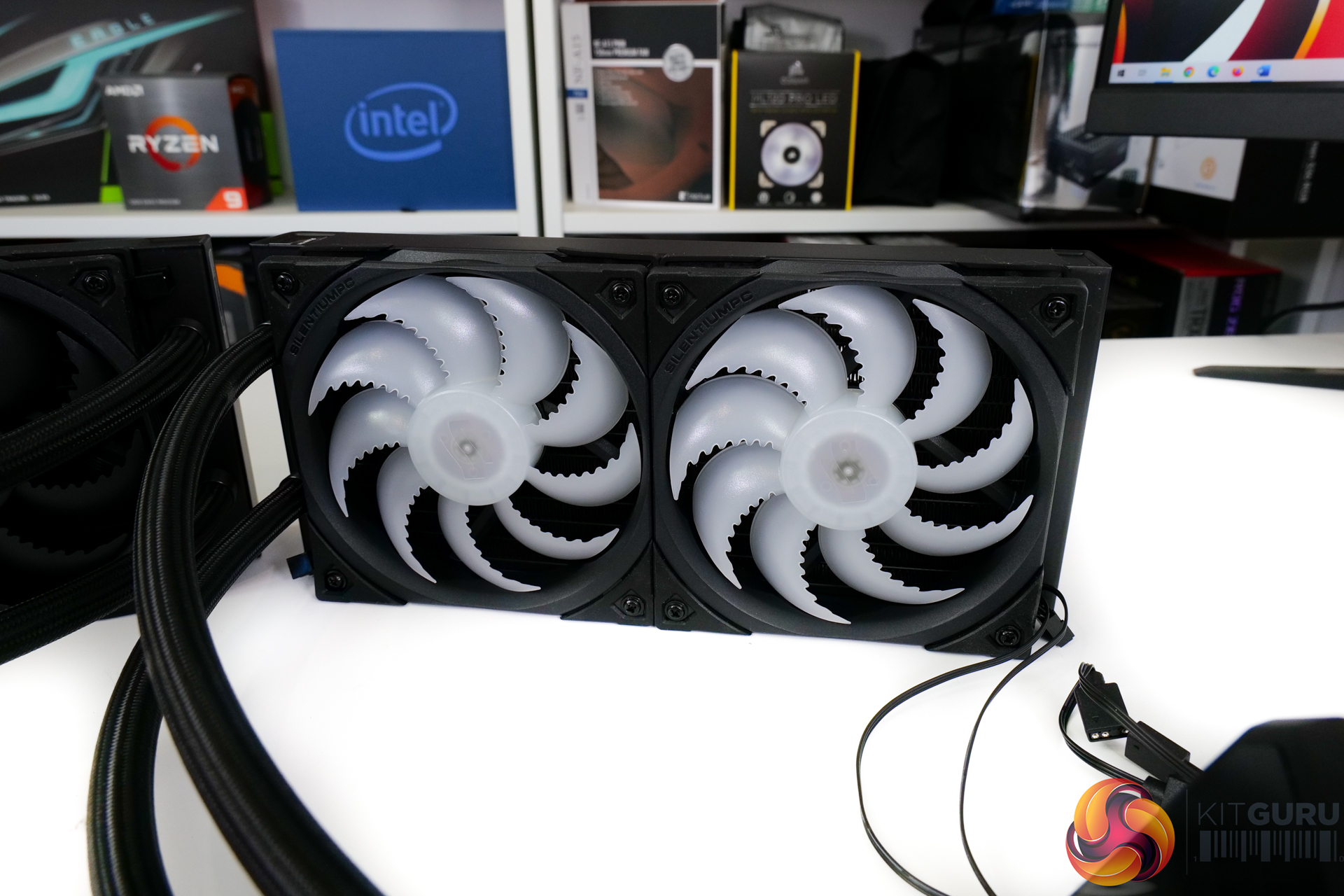
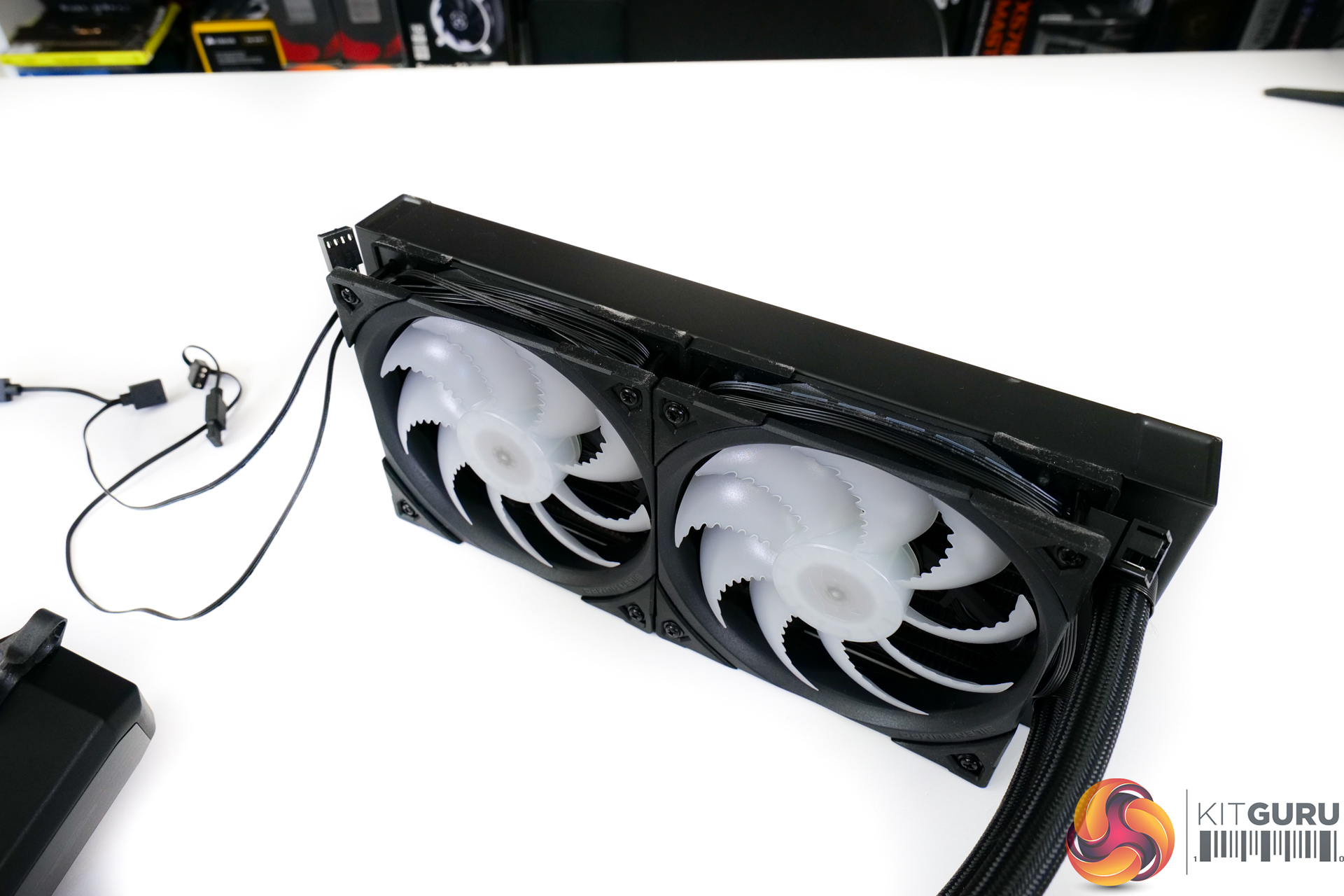
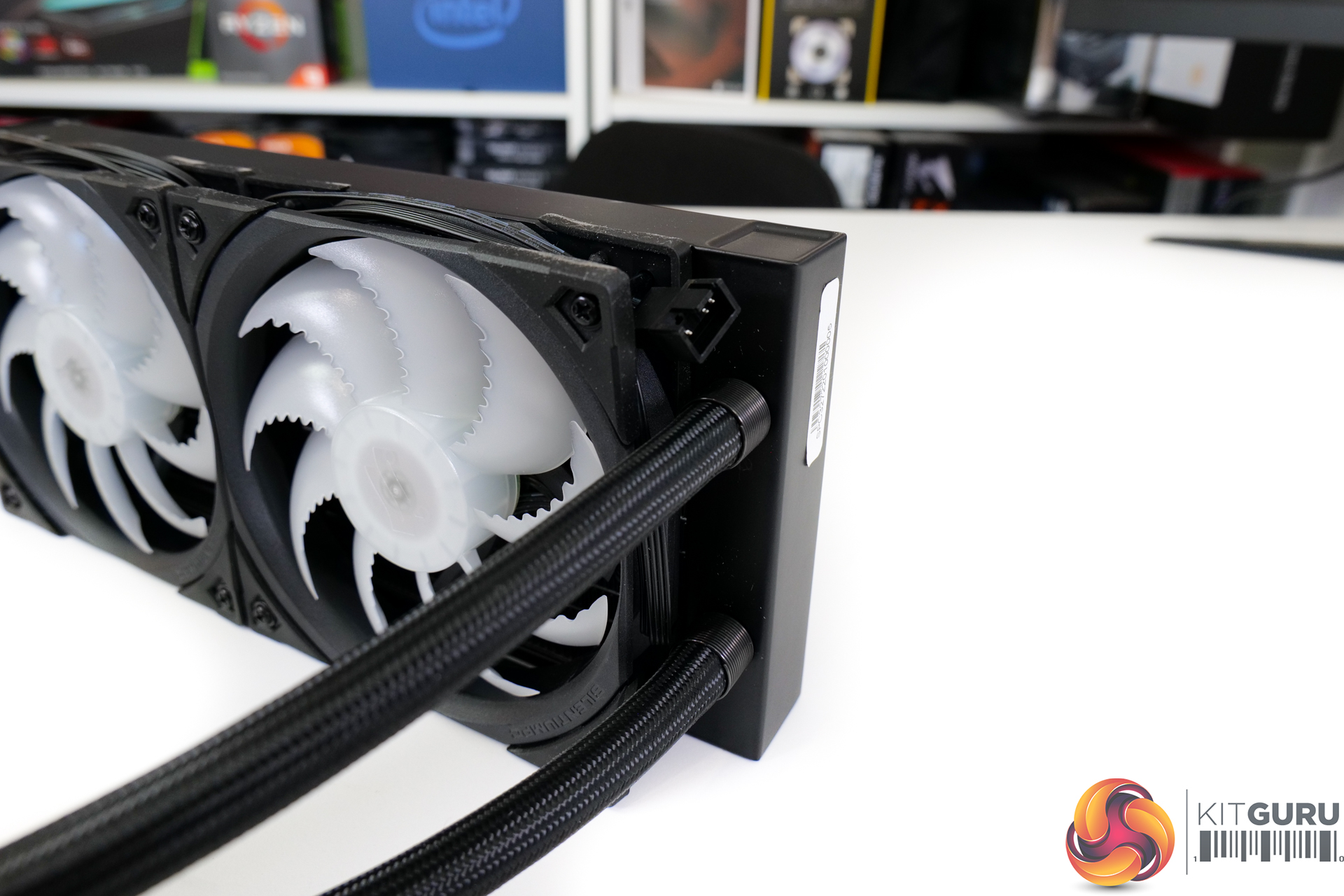
The pair of Fluctus 120 PWM ARGB fans come pre-applied on the radiator. These fans are rated at a speed range of 300-1800 RPM via their 4-pin PWM control. The two fans are daisy-chained together on the radiator meaning that only a single 4-pin header is required to power them – that’s smart!
SilentiumPC uses a Fluid Dynamic Bearing inside the fans and there are clear optimisations on the blades to suit the pressure-biased use case.
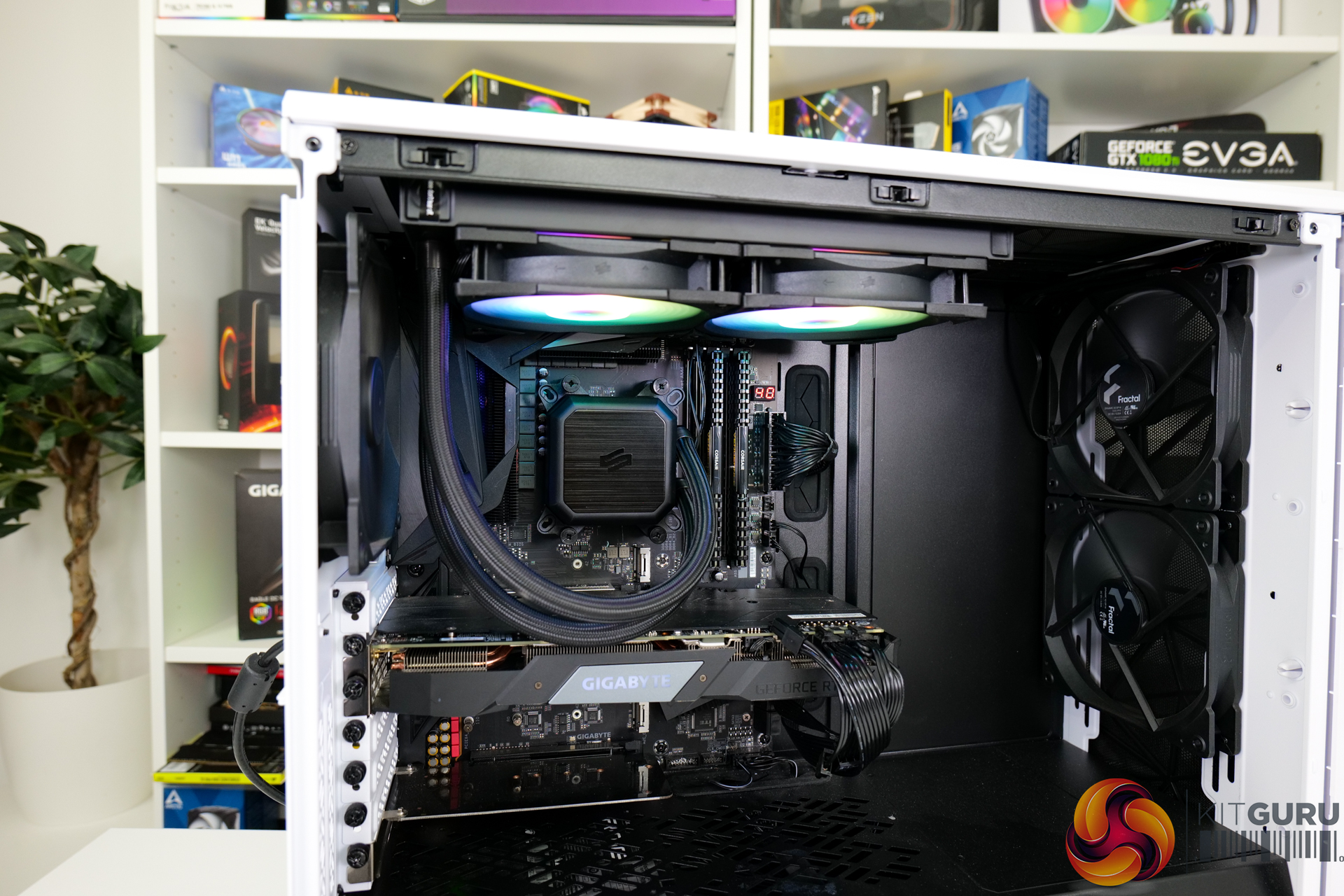
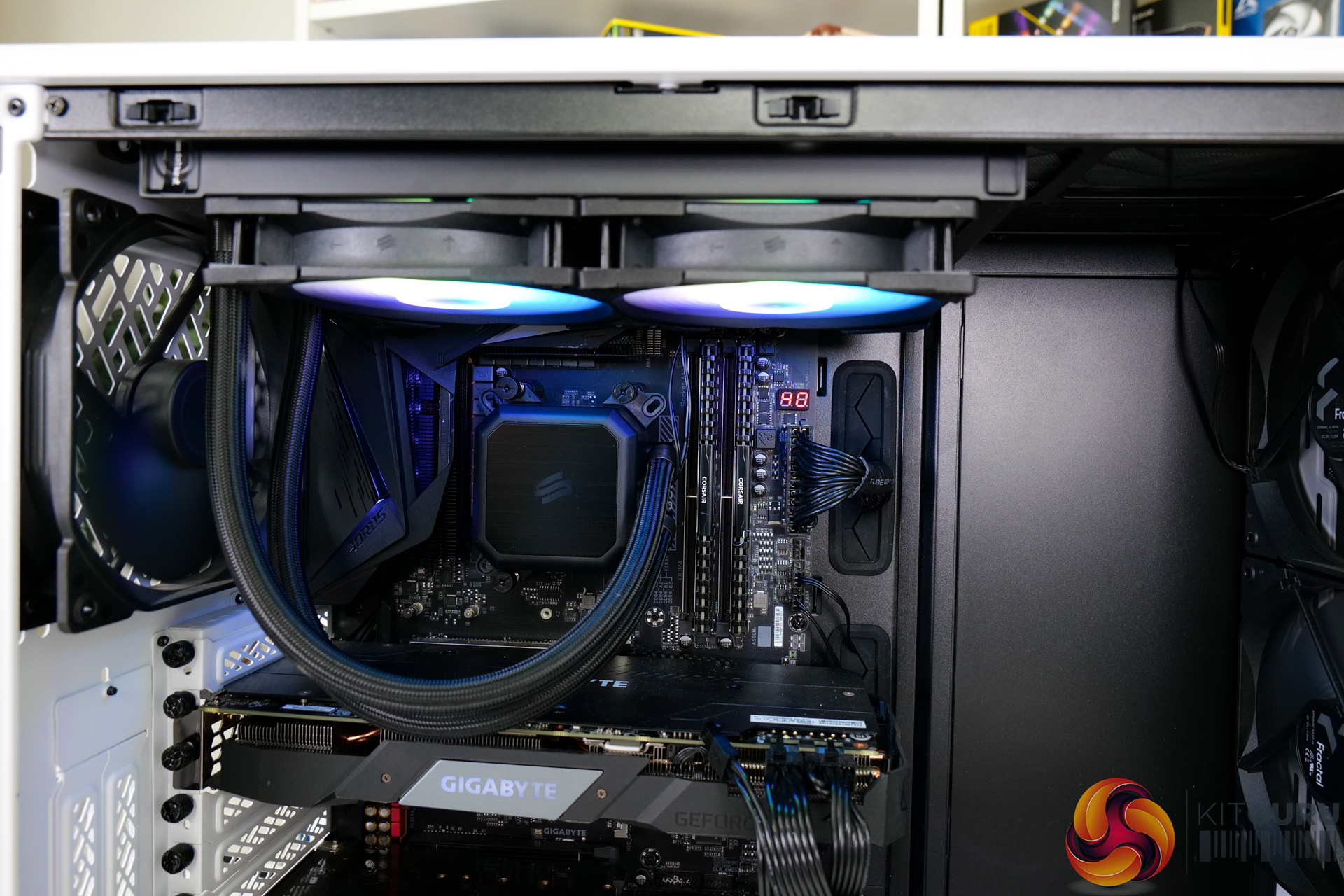
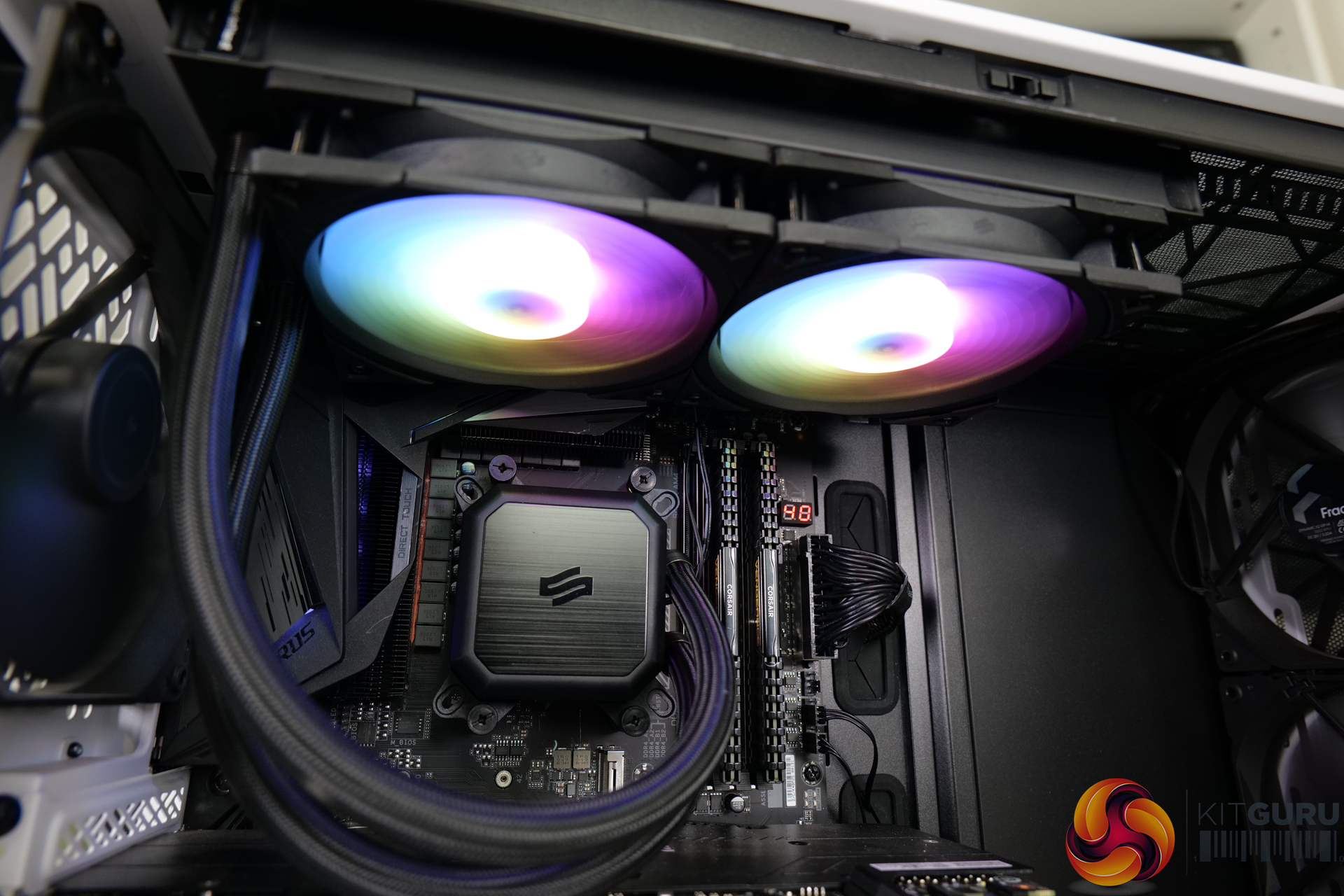
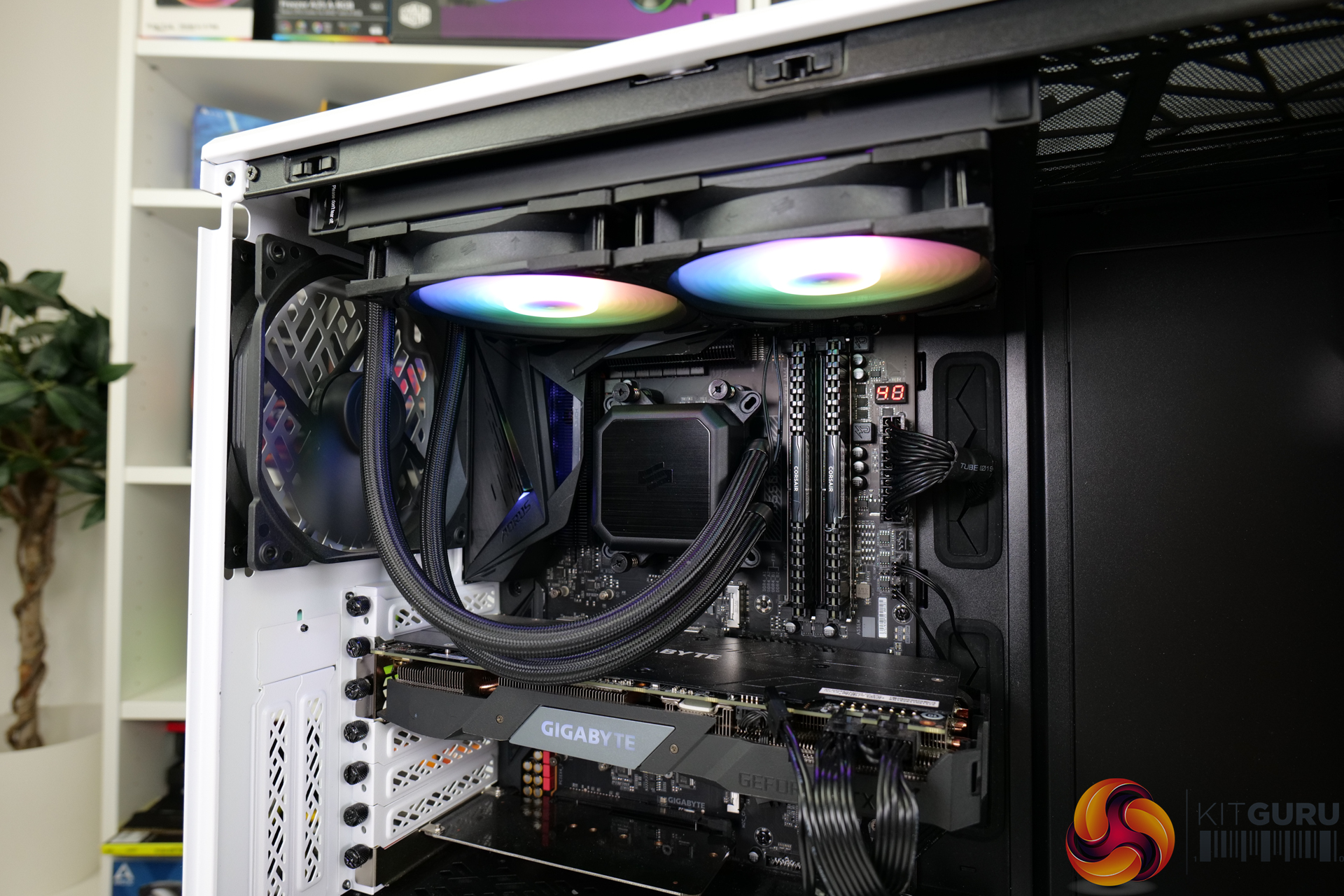
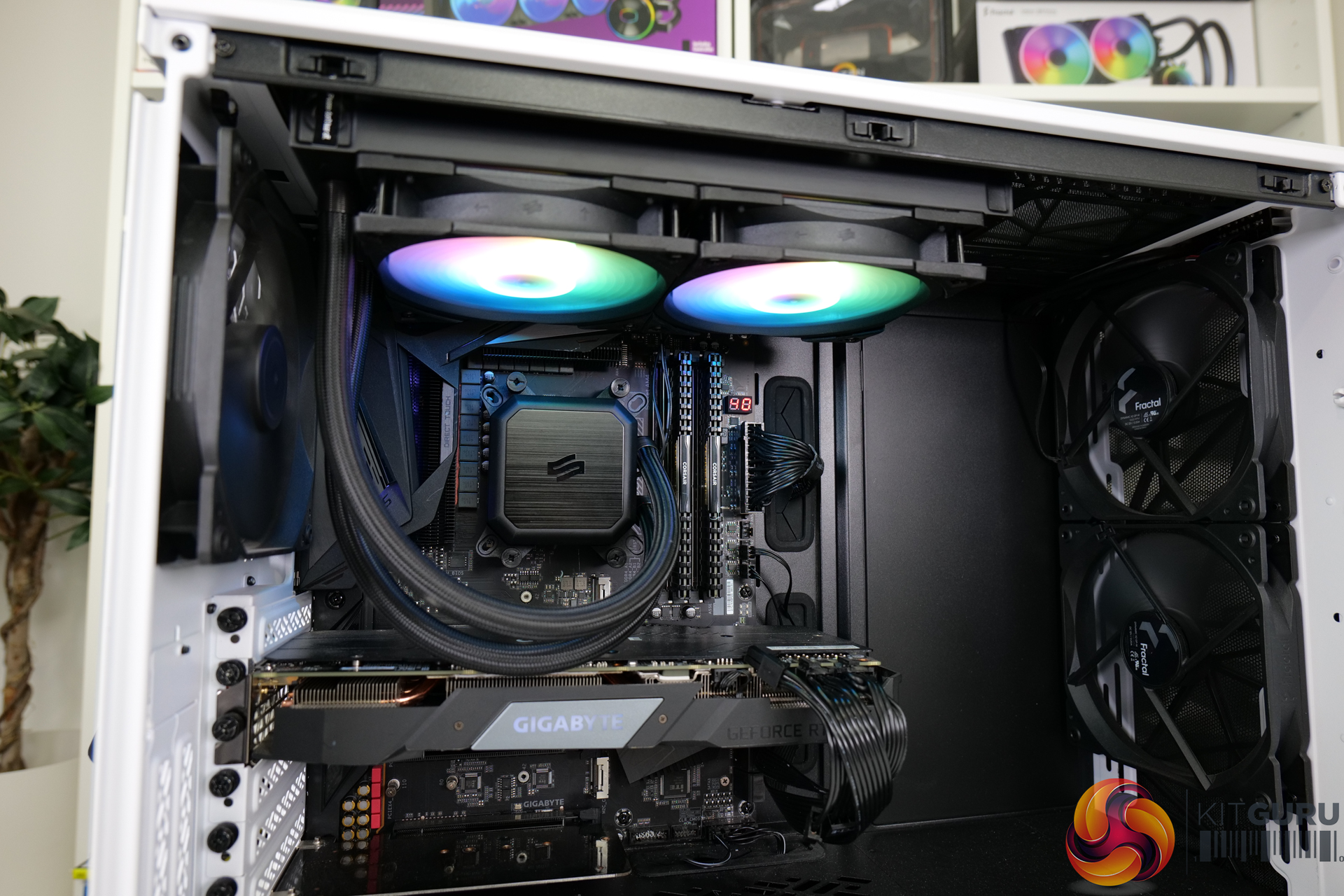
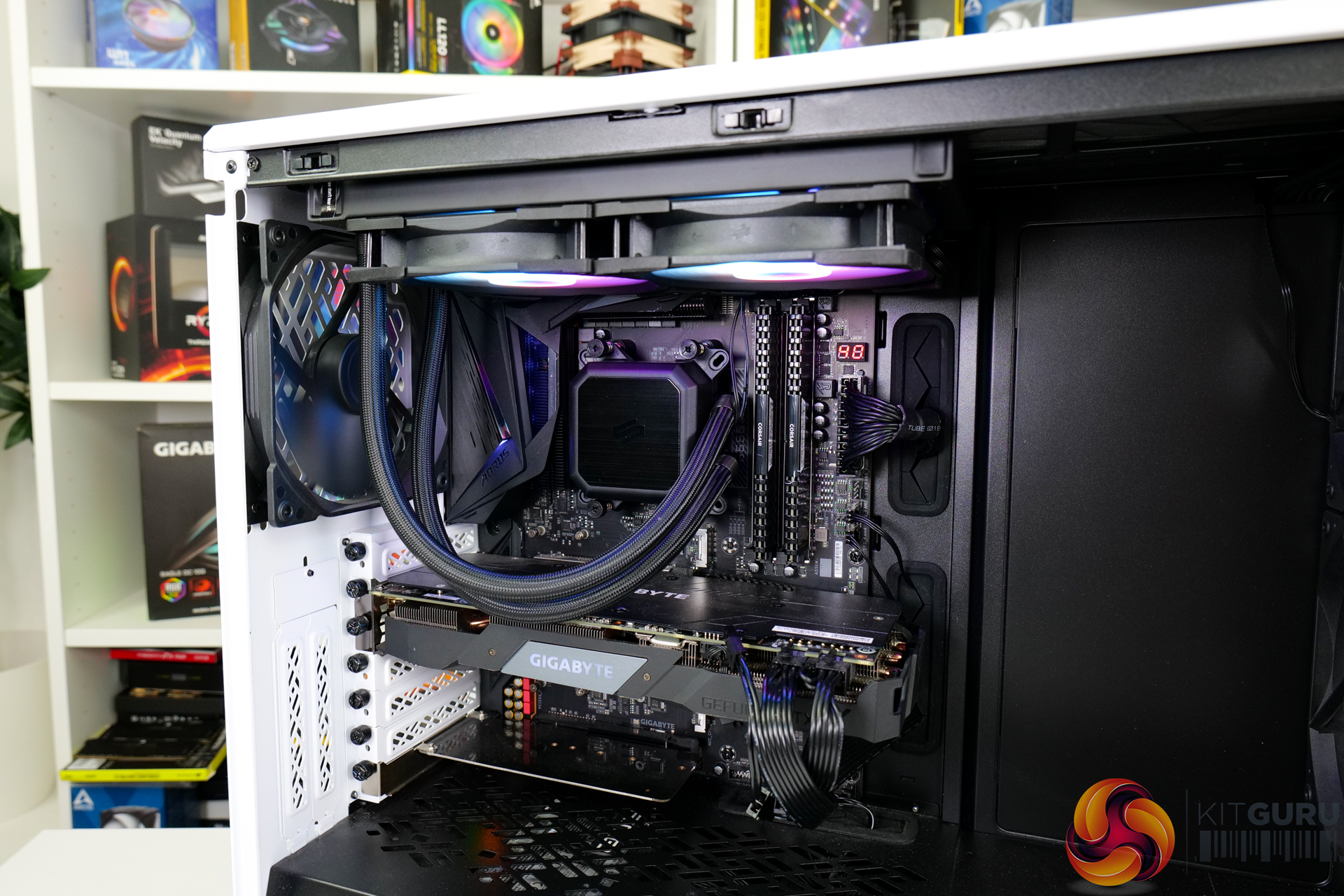
As far as ARGB goes, control is handled via the standard 3-pin header and management is done by your motherboard vendor’s software. This means that there is no requirement for third-party or SIlentiumPC-specific software. And synchronisation with your other components should be seamless.
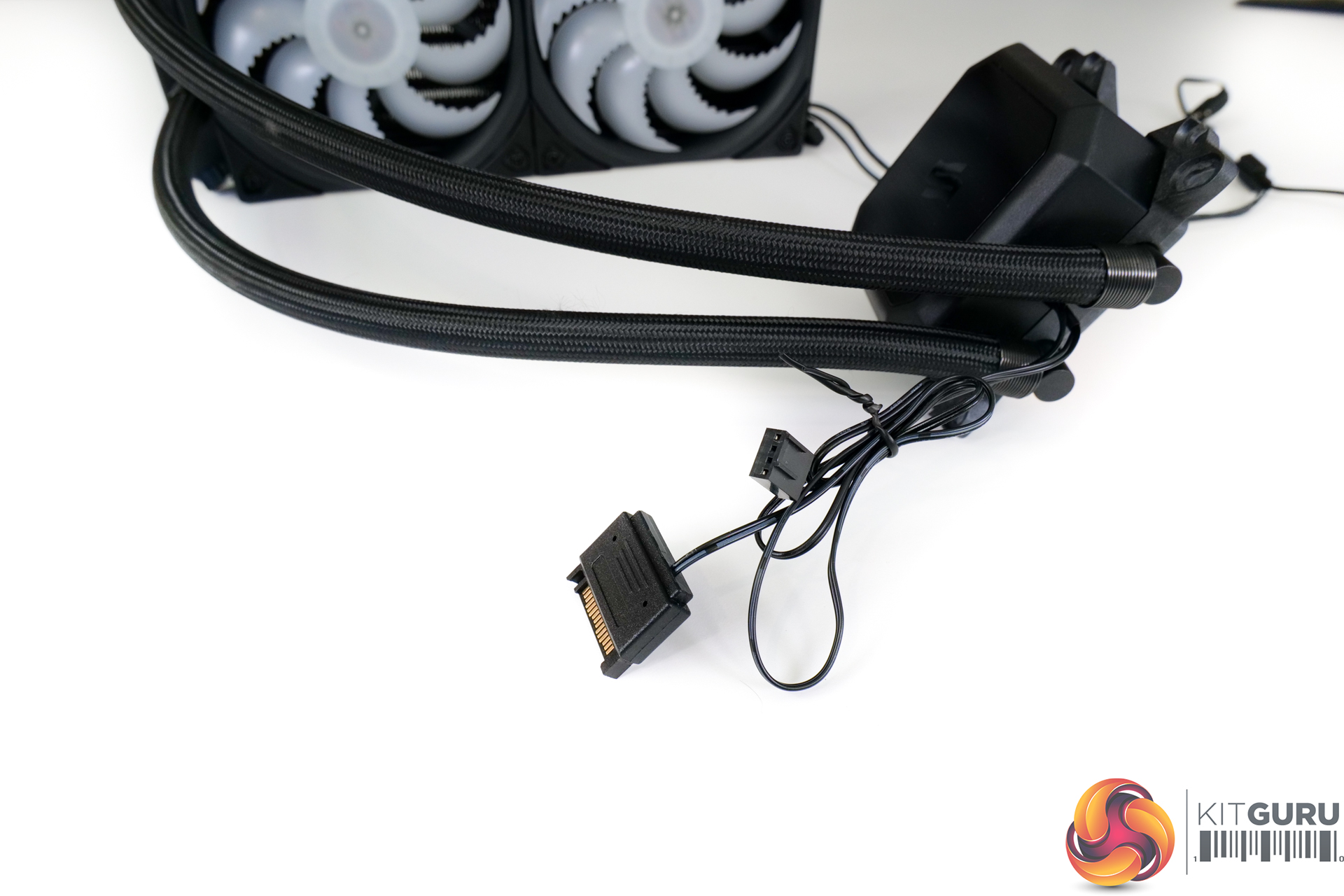
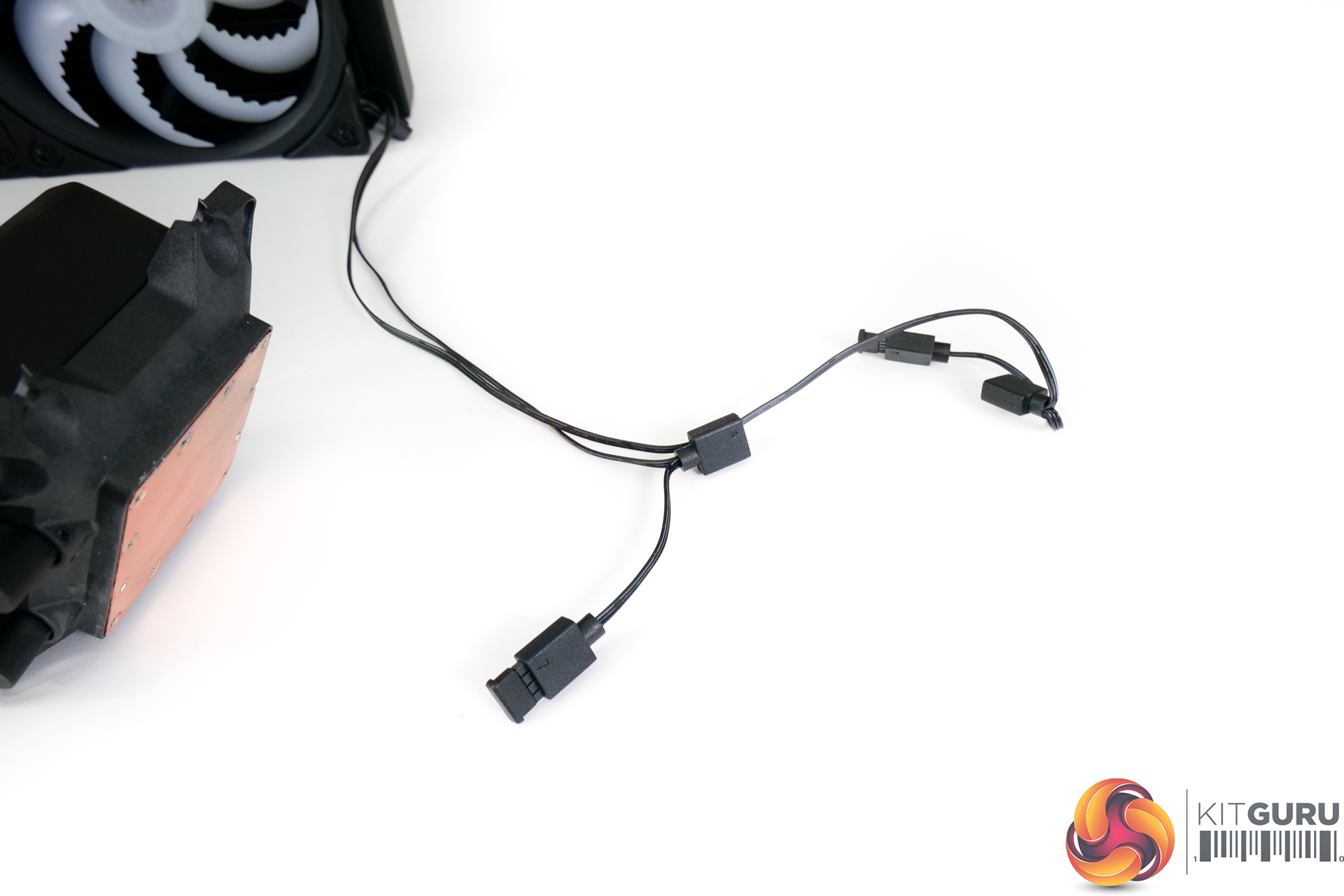
Given the smart daisy-chaining of the pre-installed fans’ cables, management is very easy. There’s just the pair of cables leaving the pump-block unit – SATA power and 4-pin PWM control. And then the 4-pin and 3-pin ARGB fan cables can be hidden easily behind the motherboard tray without sprawling across the CPU socket area.
Warranty is just OK on the £75 Navis F240 and the £85 Navis F240 ARGB. Three years for a modern 240mm AIO cooler is fine at this price point, albeit hardly inspiring. The fans are rated at 100,000 hours MTBF, which is also absolutely fine.
But competition namely from Arctic and Corsair is strong at below £90 and those two vendors offer 6-year and 7-year warranties, respectively.
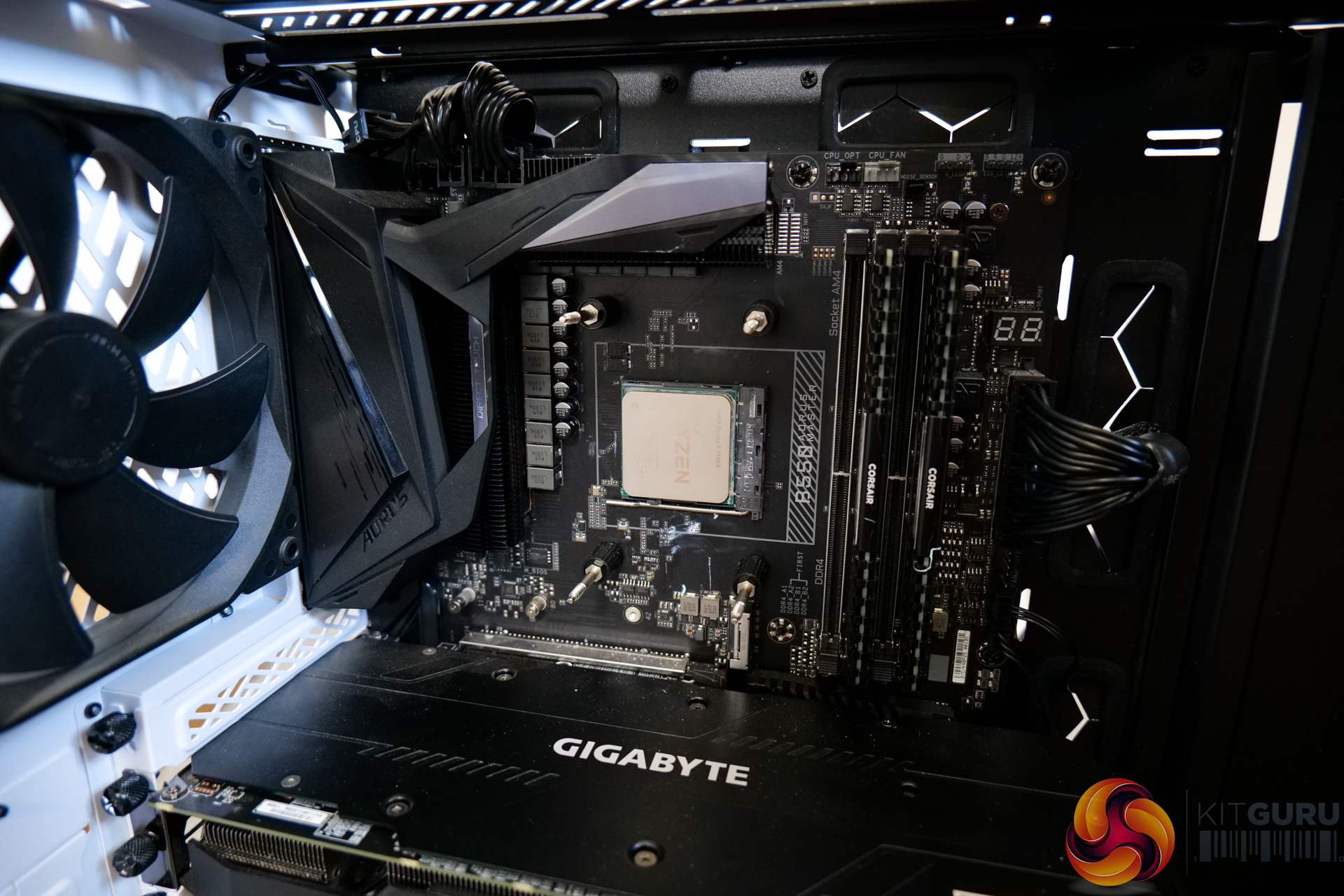
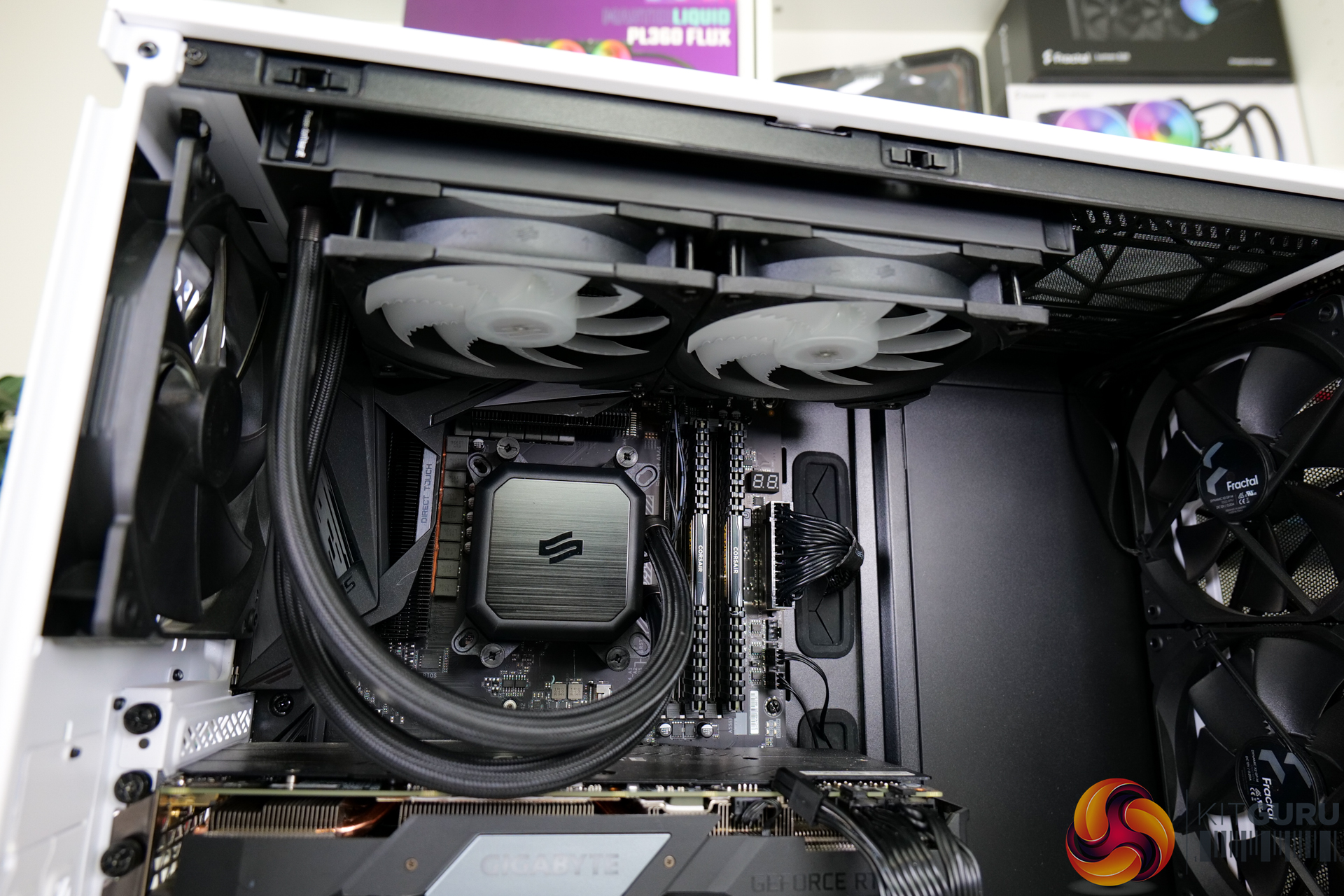
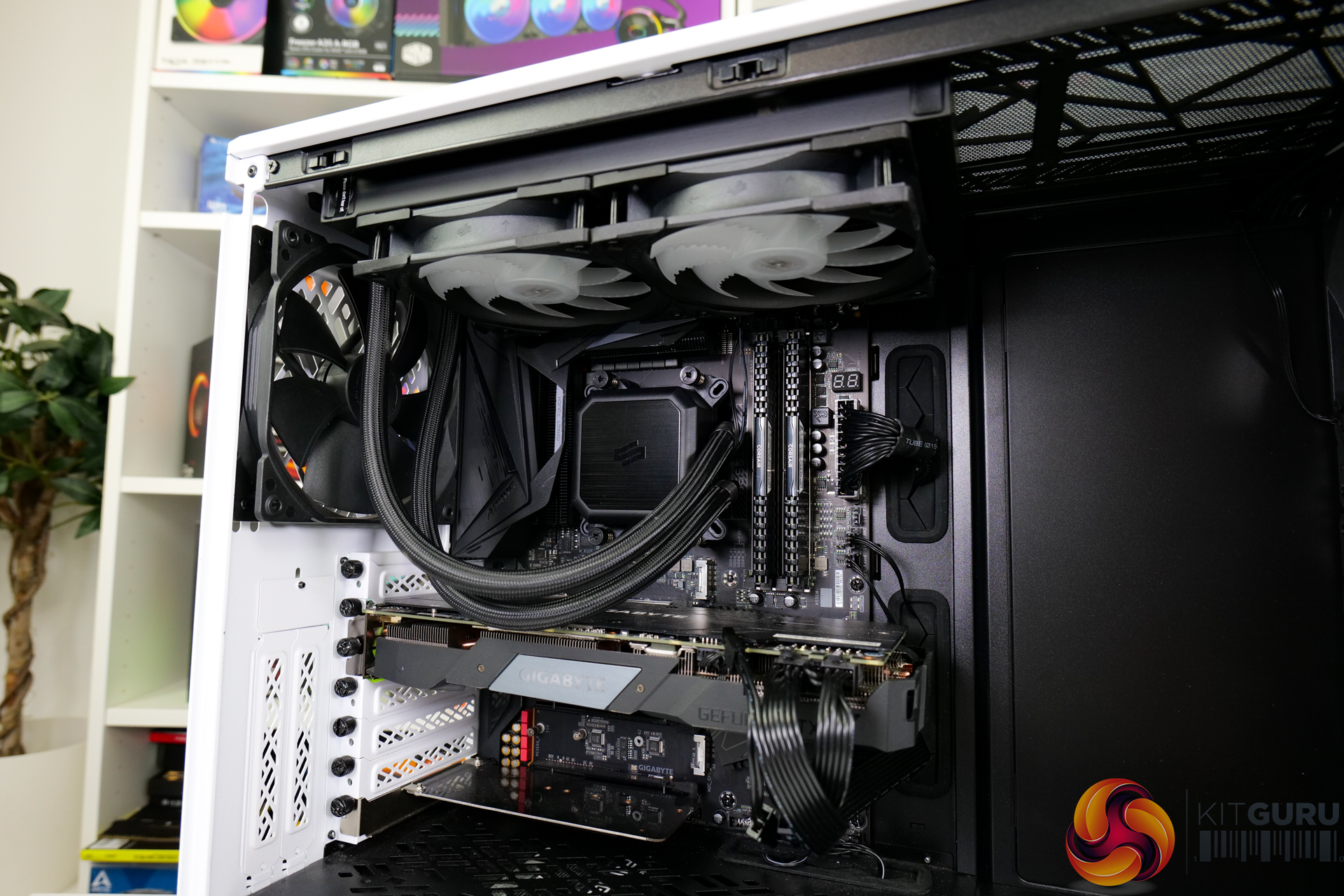
Installation was very quick and easy, thanks in large to SilentiumPC’s pre-applied hardware.
All we needed to do was insert the threaded stand-offs into the default AM4 backplate. We then applied paste and positioned the pump-block unit, and once the spring and thumbscrew were tightened, the block was in position.
Pre-applied fans made radiator installation quick and simple, and then the reasonable number of cables was easy to route and deal with neatly.
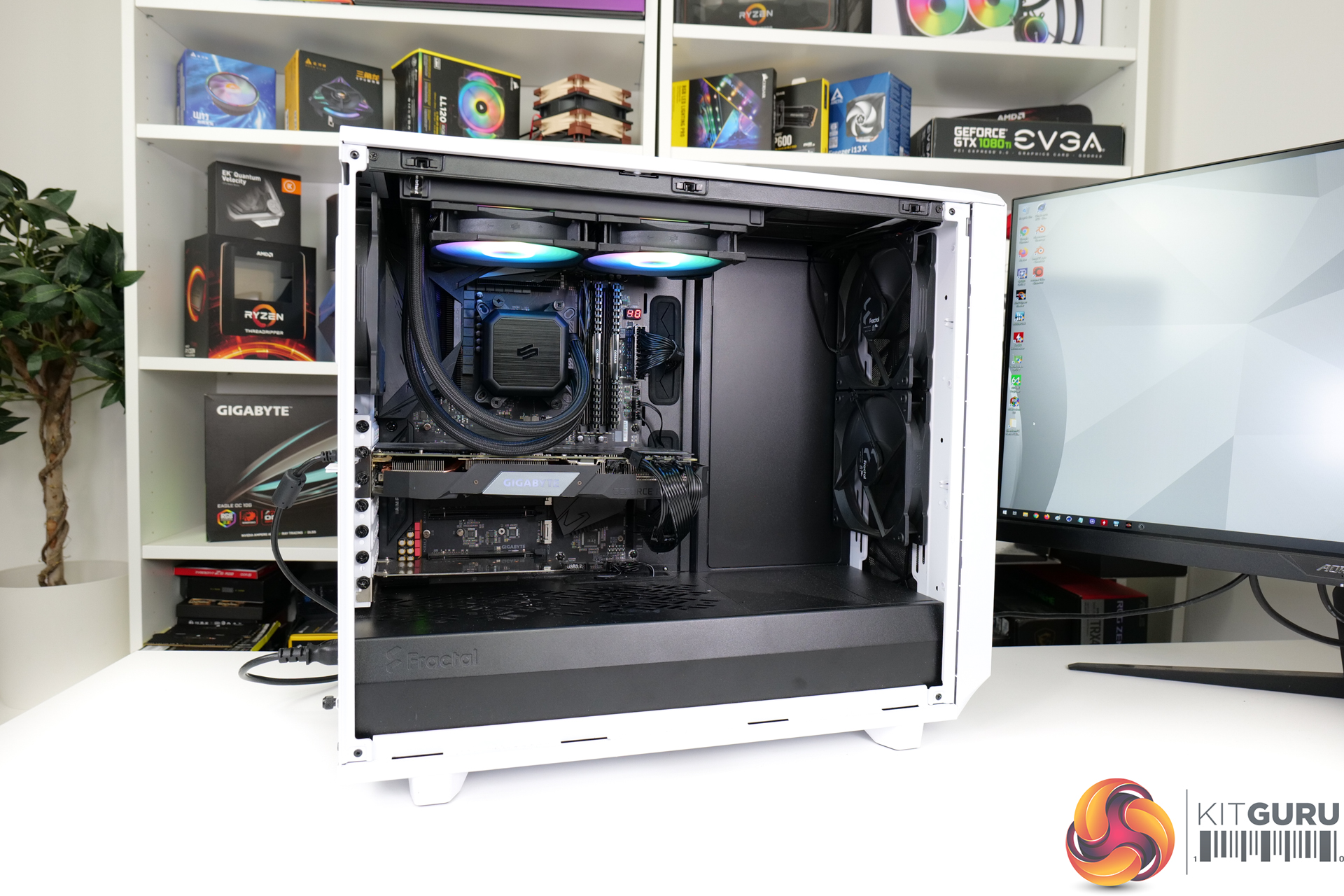
Test System:
- Processor: AMD Ryzen 9 5950X
- Overclocked Settings: 4.45GHz all-core @ 1.312V (UEFI), Medium LLC – around 1.3V delivered
- Motherboard: Gigabyte B550 Aorus Master
- Memory: 32GB (2x16GB) Corsair Vengeance LPX 3600MHz 16-18-18-36 DDR4 @ 1.35V
- Graphics Card: Gigabyte RTX 2060 Super 0dB Mode
- Chassis: Fractal Design Meshify 2
- Chassis Fans: 2x140mm 1000 RPM Fractal Front Intake, 1x140mm 1000 RPM Fractal Rear Exhaust, 1x140mm 1000 RPM be quiet! Pure Wings 2 Roof Exhaust (for air cooler testing)
- Power Supply: Seasonic Prime TX-1000
- Operating System: Windows 10 Pro 64-bit
Testing Methodology:
- For testing, we use a 30-minute looped run of Cinebench R23 and record the steady-state CPU temperature at the end of the test. This ensures that the CPU has had ample time to warm up and reach steady state under all of the coolers.
- Ambient is maintained around 22-24 degrees Celsius. Where there is variation beyond this temperature range, we add in extra repeated tests to ensure consistency.
- We also test each cooler with at least two fresh installs (typically three) to mitigate the likelihood of a dodgy mount spoiling results.
Test Results:
Acoustics
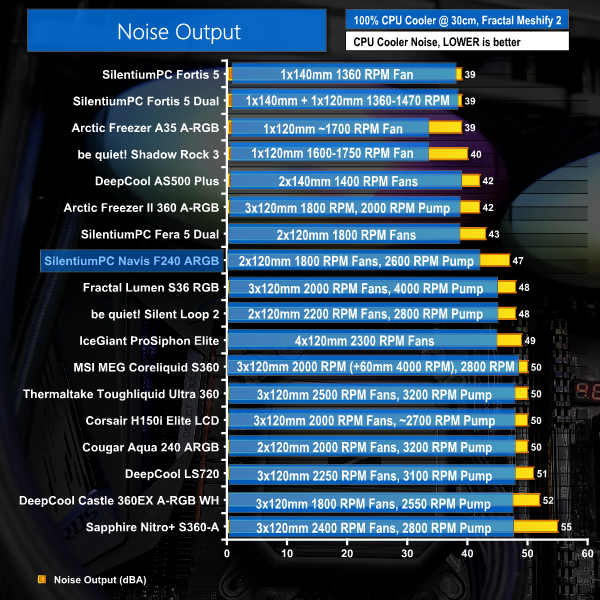
Let’s start off with noise performance at 100% fan speed. This is important for getting an indication of where our performance expectations should lie based on noise output.
Running at 47 dBA in our test system, noise output from the SilentiumPC Navis F240 ARGB is reasonable when it comes to liquid coolers. The noise output is very slightly better than the be quiet! Silent Loop 2 and its 2200 RPM fans.
47 dBA at full 1800 RPM fan speeds is certainly audible, but it isn’t too unbearable for periods of heavy load. Plus, there’s the strong 300-1800 RPM PWM curve of the fans to further improve noise output.
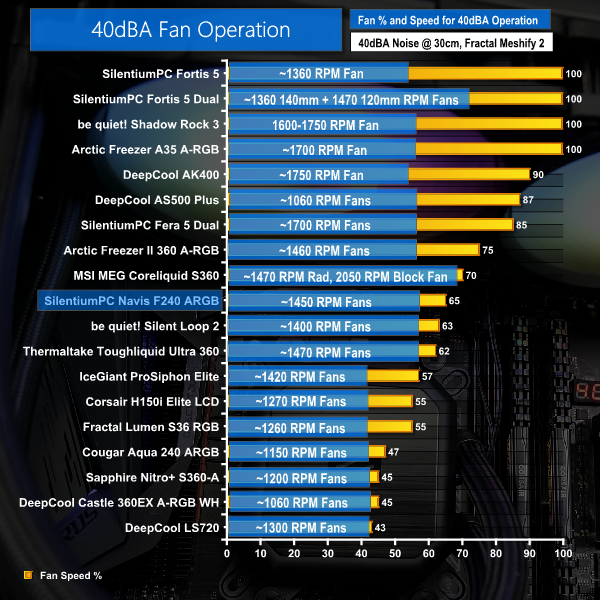
In order to get the unit running at 40 dBA, we had to restrict the pair of fans down to 65% fan speed. This translated into around 1450 RPM operating speed according to the UEFI and HWInfo readings.
Cutting about a third off the fan speeds to hit 40 dBA noise output is actually quite reasonable. We aren’t choking the cooler too significantly in favour of noise, but we also have some capacity available if better temperatures are required.
Thermal Performance
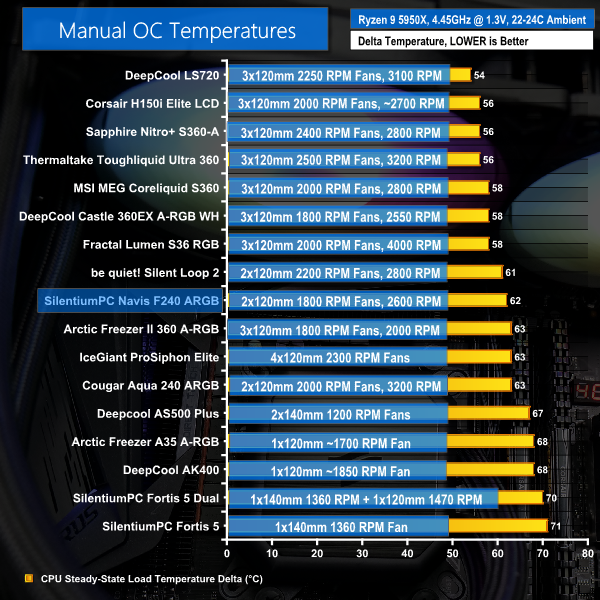
Full-speed performance cooling an overclocked Ryzen 9 5950X processor is strong from SilentiumPC. The 240mm Navis F240 ARGB is very marginally behind the more expensive 240mm be quiet! competitor. But SilentiumPC’s cooler manages to outperform the budget-friendly Cougar Aqua 240 ARGB by a slim margin.
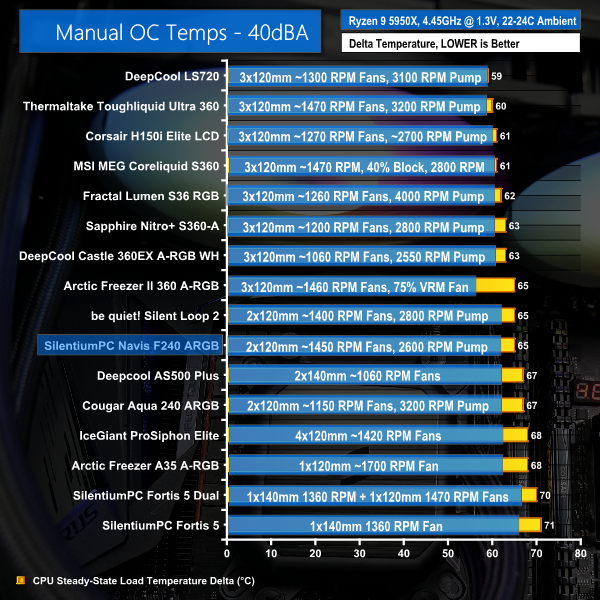
When locked at 40 dBA noise output, the SilentiumPC Navis F240 ARGB actually manages to very slightly improve its performance offering versus the be quiet! Silent Loop 2 240mm by matching its delta temperature. There’s clear headroom to the other 240mm AIO in our charts too – the Cougar Aqua 240 ARGB.
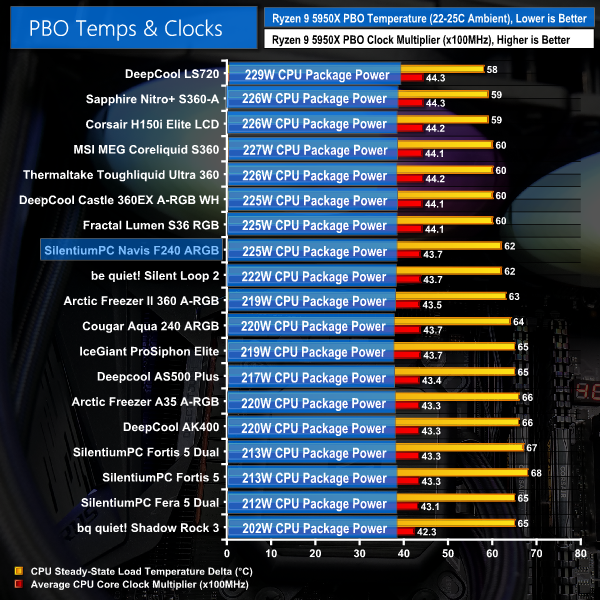
As always, it is critical to note that small difference in the displayed delta temperatures are not as important for our PBO testing because the clock speed and cooling power achieved are more important metrics.
With the processor running in Precision Boost Overdrive mode, once again we see solid performance from the SilentiumPC Navis F240 ARGB cooler that has it matching the 240mm be quiet! Silent Loop 2.
In fact, the Navis F240 ARGB actually manages a slightly higher power level dissipated, albeit for the same CPU clock speed, so this is a draw between those two.
Looking at the other budget 240mm AIO, Cougar’s Aqua 240 ARGB cannot keep up with the SilentiumPC offering and is once again beaten by a couple of degrees.
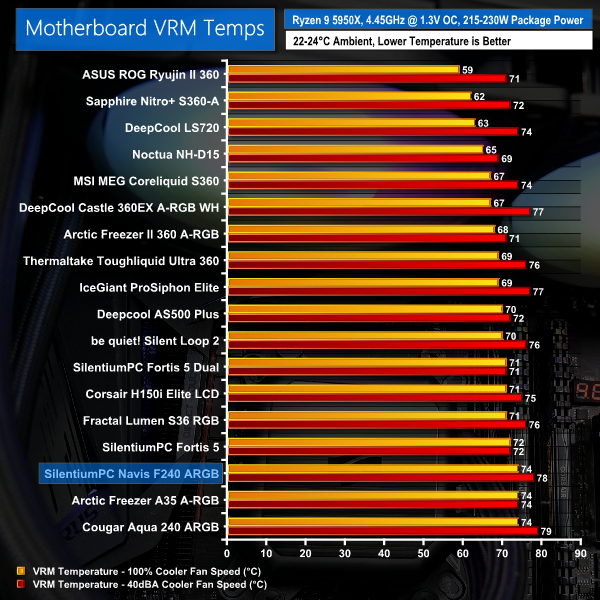
VRM cooling performance is uninspiring for the Navis F240 ARGB. That’s the case with the cooler running at 100% fan speed and when locked to 40 dBA fan speeds.
The Cougar Aqua 240 ARGB is just as bad as SilentiumPC’s unit when it comes to VRM cooling, but be quiet!’s Silent Loop 2 is a few degrees better in this test.
We can summarise the SilentiumPC Navis F240 ARGB cooler quite nicely. This is a well-priced, sensibly-designed 240mm liquid cooler that offers stellar cooling performance. You also get perfectly tolerable maximum noise output as well as a solid fan speed curve control mechanism and a PWM pump.
Cooling performance that is comparable to a premium – and more expensive – 240 AIO cooler such as the be quiet! Silent Loop 2 is a positive for SilentiumPC. And it was good to see that the cooler’s competitive performance was maintained when locked to 40 dBA fan speed.
I like the ARGB lighting implementation because it is simple yet effective. Personally, I think handing over control to the motherboard software is an ideal approach for most CPU coolers – unless you’re Corsair! And the LED lighting was bright and smooth with good colour accuracy.
I was, however, surprised to see no LED lighting on the pump-block cover as this seemed like a missed opportunity.
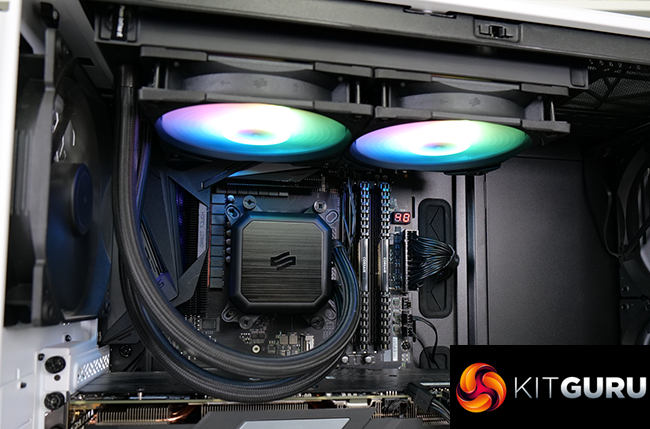
While installation for the cooler is very straightforward thanks to the pre-installed fans and integrated motherboard socket bracket, I can’t help but feel that upgrading this unit to support future Intel or AMD platforms will be incredibly tricky.
And in regards to the warranty, three years is fine for a £75 240mm AIO cooler or an £85 ARGB version, but it’s hardly inspiring when the big competitors such as Arctic and Corsair both have units in a similar price range with warranties over five years.
Overall, the SilentiumPC Navis F240 ARGB is a competent CPU cooler that offers up plenty of positives for its £85 asking price. The fan speed curves are positive, cooling performance is strong, and I like the inclusion of ARGB lighting. I don’t have any problems giving this unit a recommendation based on my usage.
You can buy it for £84.9 from Scan HERE.
Discuss on our Facebook page HERE.
Pros:
- Solid cooling performance.
- Good noise results and speed controls.
- ARGB control through motherboard vendor software.
- Pre-installed, daisy-chained fans for easy installation.
- Very reasonable price point for a 240mm, ARGB AIO.
Cons:
- No LED lighting on the pump-block unit.
- Integrated CPU socket bracket could limit upgradability.
KitGuru says: Solid cooling performance, great aesthetic, and a tolerable price point; SilentiumPC’s sensible recipe delivers once again.