KitGuru KitGuru.net – Tech News | Hardware News | Hardware Reviews | IOS | Mobile | Gaming | Graphics Cards


We take our noise measurements with the sound meter positioned 1 foot from the graphics card. I measured the noise floor to be 32 dBA, thus anything above this level can be attributed to the graphics cards. The power supply is passive for the entire power output range we tested all graphics cards in, while all CPU and system fans were disabled. A reading under load comes from running Cyberpunk 2077 for 30 minutes for 30 minutes.
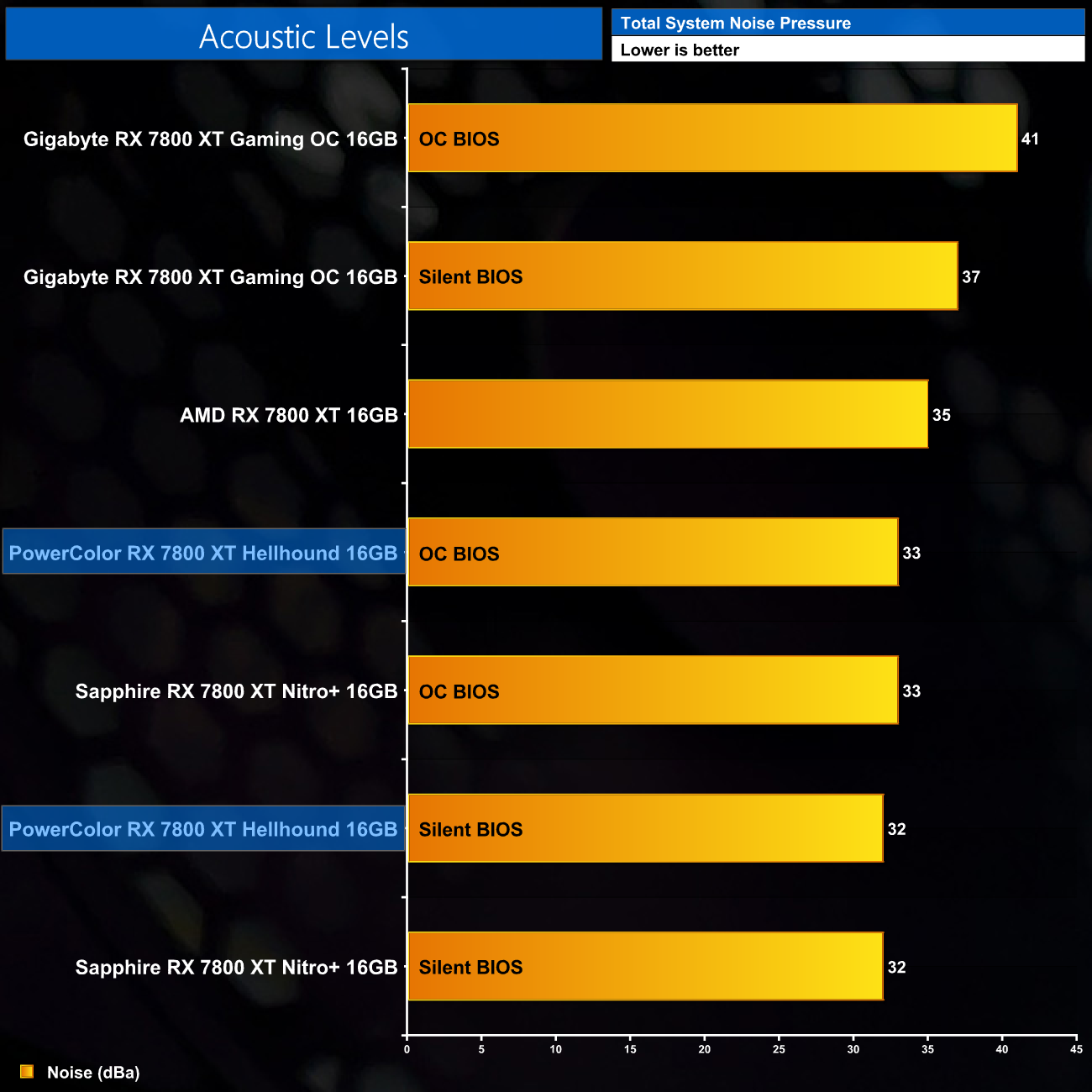
You may not think there was much difference in thermal performance between the OC and Silent BIOS, but that's mainly due to the fact that the fans don't spin that much slower using the Silent mode. Even the OC BIOS is whisper-quiet, with the fans running at 900 rpm, hitting 33dBa on our sound meter. The Silent BIOS drops fan speed top just 720rpm, and at that point we actually hit our ambient noise floor of 32dBa. In other words, the card ran so quietly it became impossible to accurately measure its noise levels in my test environment. There was also no audible coil whine throughout my testing.