KitGuru KitGuru.net – Tech News | Hardware News | Hardware Reviews | IOS | Mobile | Gaming | Graphics Cards


The high-end graphics card market is bracing for a literal storm as MSI prepares to resurrect its legendary Lightning brand at CES 2026. While the company hasn't confirmed it officially just yet, a series of calculated “weather forecast” teasers on social media predict thunder and lightning for the first day of CES. On top of that, a number of record-breaking benchmark submissions have also been unearthed, pointing to an RTX 5090 Lightning announcement.
Various overclockers have shared the results of their work on HWBot (via Wccftech), where the MSI RTX 5090 Lightning was explicitly named in submissions from TSAIK, Lucky_n00b, and littleboy. TSAIK seems to have been the most successful, setting new world records for GPUPI v3.3 1B (1-core), 3DMark Port Royal, 3DMark Time Spy GPU, 3DMark Wild Life Extreme, 3DMark Speed Way, and Geekbench 6 Compute. During these runs, the overclocker also set the world record for RTX 5090 GPU frequency at 3,742 MHz. Lucky_n00b and littleboy were also reasonably competent, with the former getting the world record for Geekbench 5 Compute and the latter for 3DMark Solar Bay and Solar Bay Extreme.
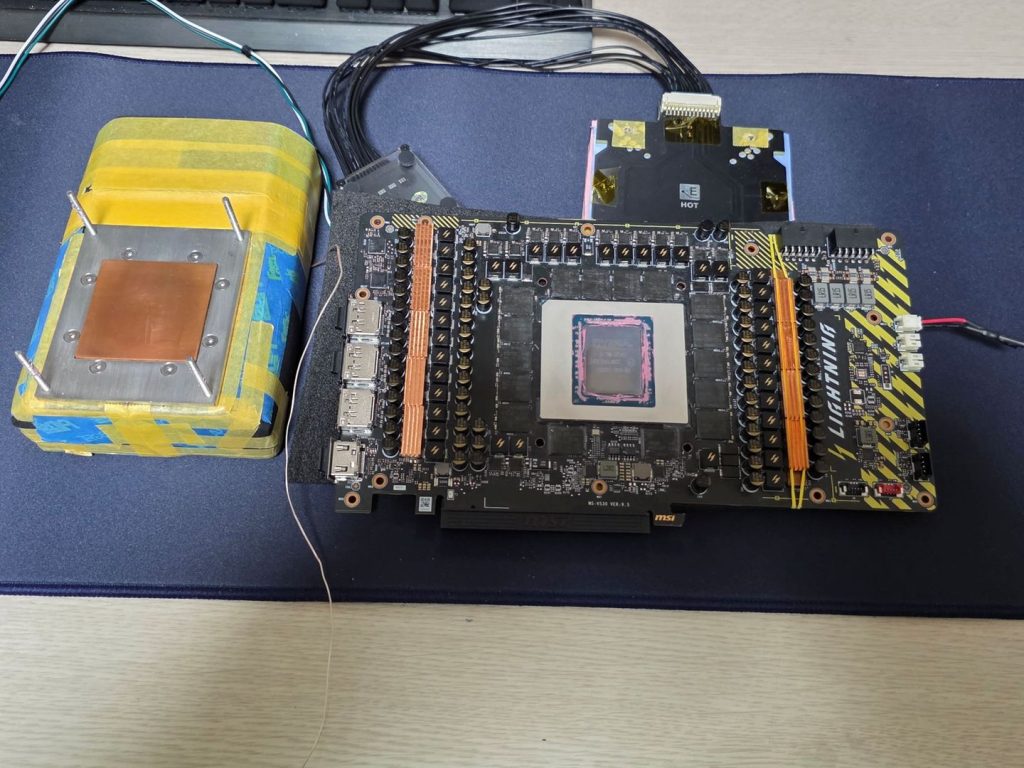
Image credit: HWBot (littleboy)
The GPU itself appears to be an absolute behemoth designed for extreme scenarios. Leaked images and early technical data point to a massive 40-phase VRAM power delivery system. Perhaps most telling of its power requirements is the presence of dual 12V-2×6 power connectors, a configuration that doubles the potential power input compared to standard enthusiast cards.
Furthermore, Lucky_n00b has shared what appears to be the maximum power limit in the BIOS for the MSI GeForce RTX 5090 Lightning graphics card, which can reach 2500W. The overclocker also stated that the sample he received didn't include a proper cooling solution. Instead, he got the “OCER” version, which consists of a bare PCB and a test heatsink.
MSI has not used the Lightning moniker for a flagship Nvidia card since the RTX 2080 Ti Lightning Z in 2019. By bringing it back to the Blackwell architecture, MSI is signalling a return to the over-the-top engineering that defined the GTX 1080 Ti and Radeon R9 290X Lightning eras. For the average consumer, these records serve as a demonstration of silicon potential rather than out-of-the-box performance. However, for those with the budget to reach the absolute ceiling of the RTX 5090, the Lightning is positioning itself as the new benchmark to beat.
Discuss on our Facebook page, HERE.
KitGuru says: The return of the Lightning brand marks MSI's first real “halo” card since the 20-series. With a 40-phase VRM and dual 12V-2×6 connectors, the new Lightning card is clearly not intended for the average gamer but rather for extreme overclocking in a lab.