KitGuru KitGuru.net – Tech News | Hardware News | Hardware Reviews | IOS | Mobile | Gaming | Graphics Cards


The RTX 4060 Ti launched this month to very little fanfare, as review units of the updated GPU were not sampled out to press. MSI has shared some of its own benchmark results for the RTX 4060 Ti 16GB, comparing it to the original 8GB model that was widely reviewed earlier in the year.
During the MSI Insider podcast (via Videocardz), employees discussed the new 16GB GPU and shared testing results for the card. The 16GB RTX 4060 Ti does not seem to offer a performance boost, which should be expected due to the similar TDPs of the 16GB and 8GB variants. However, it is also worth noting that the benchmark results shared lacked thoroughness, with limited testing runs.
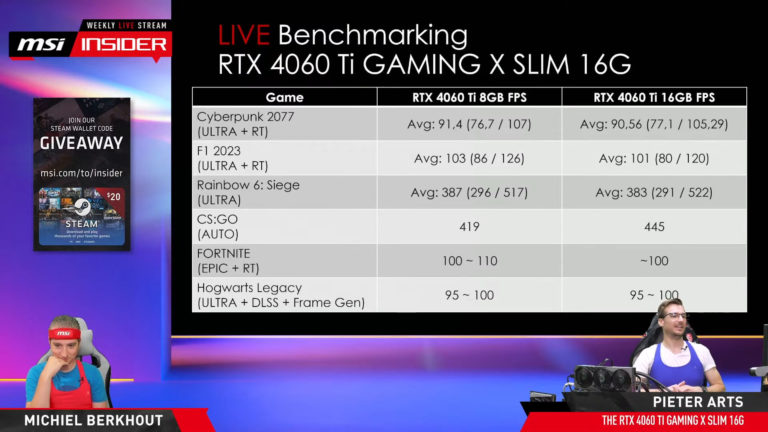
In the benchmarks, we see that the RTX 4060 Ti 16GB Gaming X Slim performs worse than the 8GB model in four of the six games tested, although not by much, so we would chalk up the small variance to margin of error. Even in Hogwarts Legacy, which is a more memory-intensive title, performance did not change between the 8GB and 16GB versions, although the use of DLSS 3 with Frame Generation may have squashed potential differences.
Given the lack of reviews for the 16GB RTX 4060 Ti, it is going to be mostly up to board partners themselves to try and communicate the difference between the 16GB and 8GB versions and why you may potentially want to spend $100 more for the 16GB variant over the cheaper version.
Discuss on our Facebook page, HERE.
KitGuru Says: While Nvidia did impress us at the top-end of the market this generation, every other GPU since has been a little more eyebrow-raising. Are any of you considering making the jump to RTX 40? Or are you holding out for price cuts or new-gen cards at this point?