KitGuru KitGuru.net – Tech News | Hardware News | Hardware Reviews | IOS | Mobile | Gaming | Graphics Cards


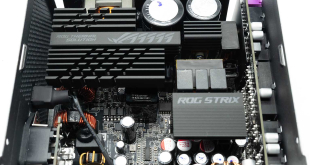
It has been some time since we took a look at a power supply from ASUS, and while we have nothing brand new to review, today we take a look at a popular unit that has been on sale now for some time, the ROG Strix 1000W. This Platinum rated fully modular power supply is on sale in the United Kingdom right now for around £240 and it ships with a 10 year warranty.
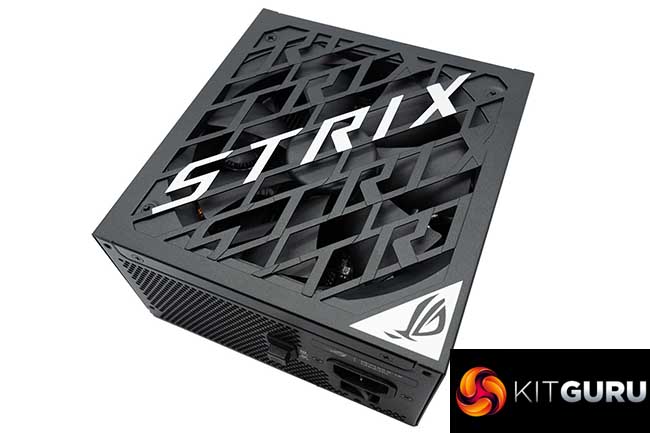
The ROG Strix Platinum power supply ships with GaN FETs which help improve energy losses and improve efficiency – if the rest of the design is good of course. Pricing in the United Kingdom as of time of press is £239.99 from Amazon (HERE).
Features:
- GaN MOSFET delivers superior power efficiency and a more organized internal layout for cooler operation.
- ASUS-patented intelligent voltage stabilizer ensures stable power delivery to your graphics card for smoother gameplay and unwavering performance.
- Large ROG heatsinks cover critical components, delivering lower temperatures and noise than reference designs.
- Dual ball fan bearings can last up to twice as long as sleeve bearing designs.
- 0dB technology lets you enjoy light gaming in relative silence.
- ATX 3.1 compatible: ROG Strix Platinum is compliant with ATX 3.1 standard, ensuring enhanced voltage and current regulation.
- PCIe 5.0 Ready: ROG Strix Platinum features a native 12V-2×6 connector for next-gen graphics card power.
- 80 PLUS platinum certified: ROG Strix Platinum utilizes low-ESR capacitors and premium components for industry-leading power efficiency.
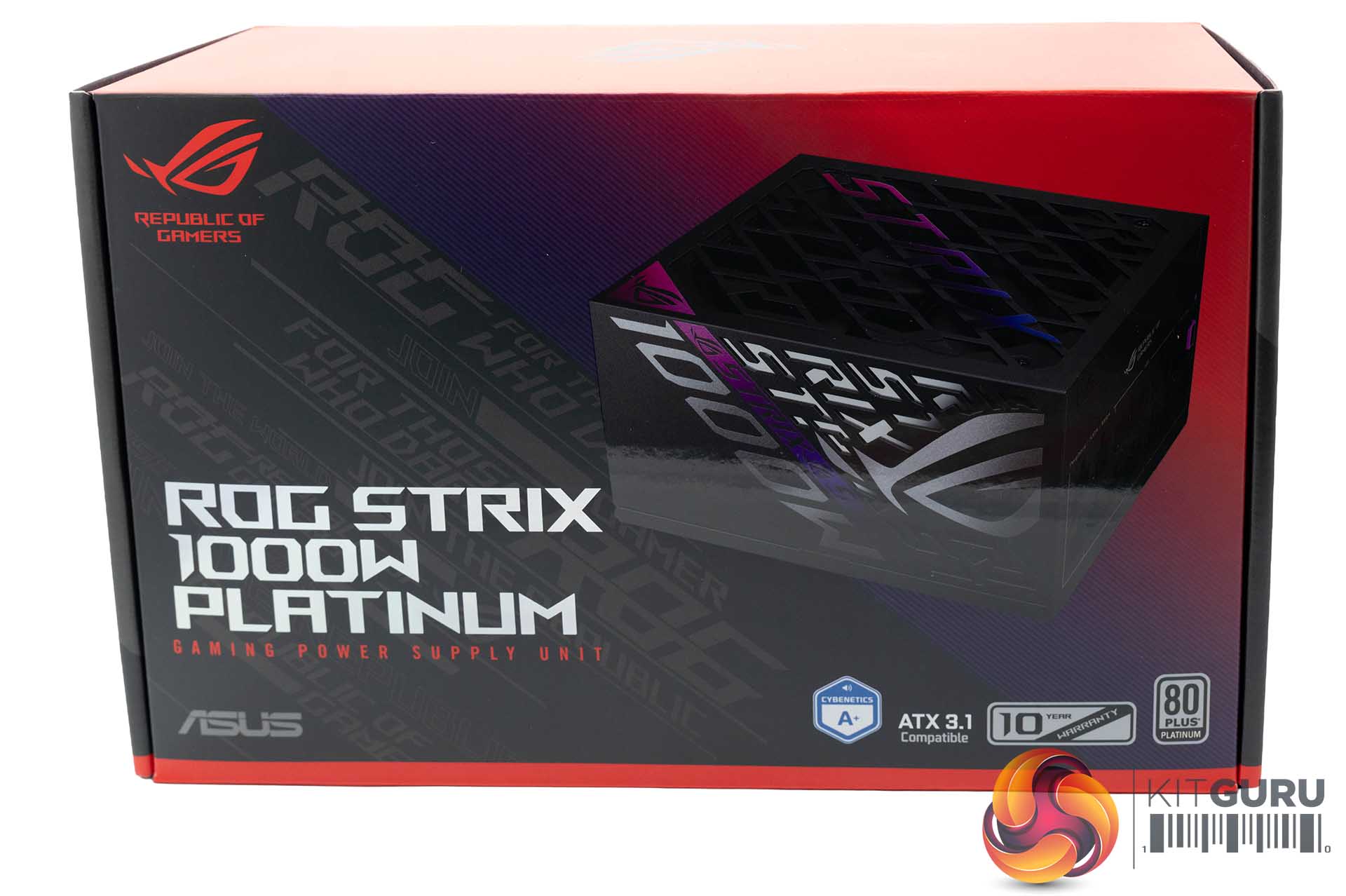
The ASUS power supply ships in a box with a photo on the front, along with some key selling points listed bottom right. These include the Platinum efficiency badge, the Cybenetic A+ noise certification, the 10 year warranty logo and the ATX 3.1 compatibility. I was rather confused to see the Cybenetics efficiency badge doesn't seem to be listed, just the noise one.
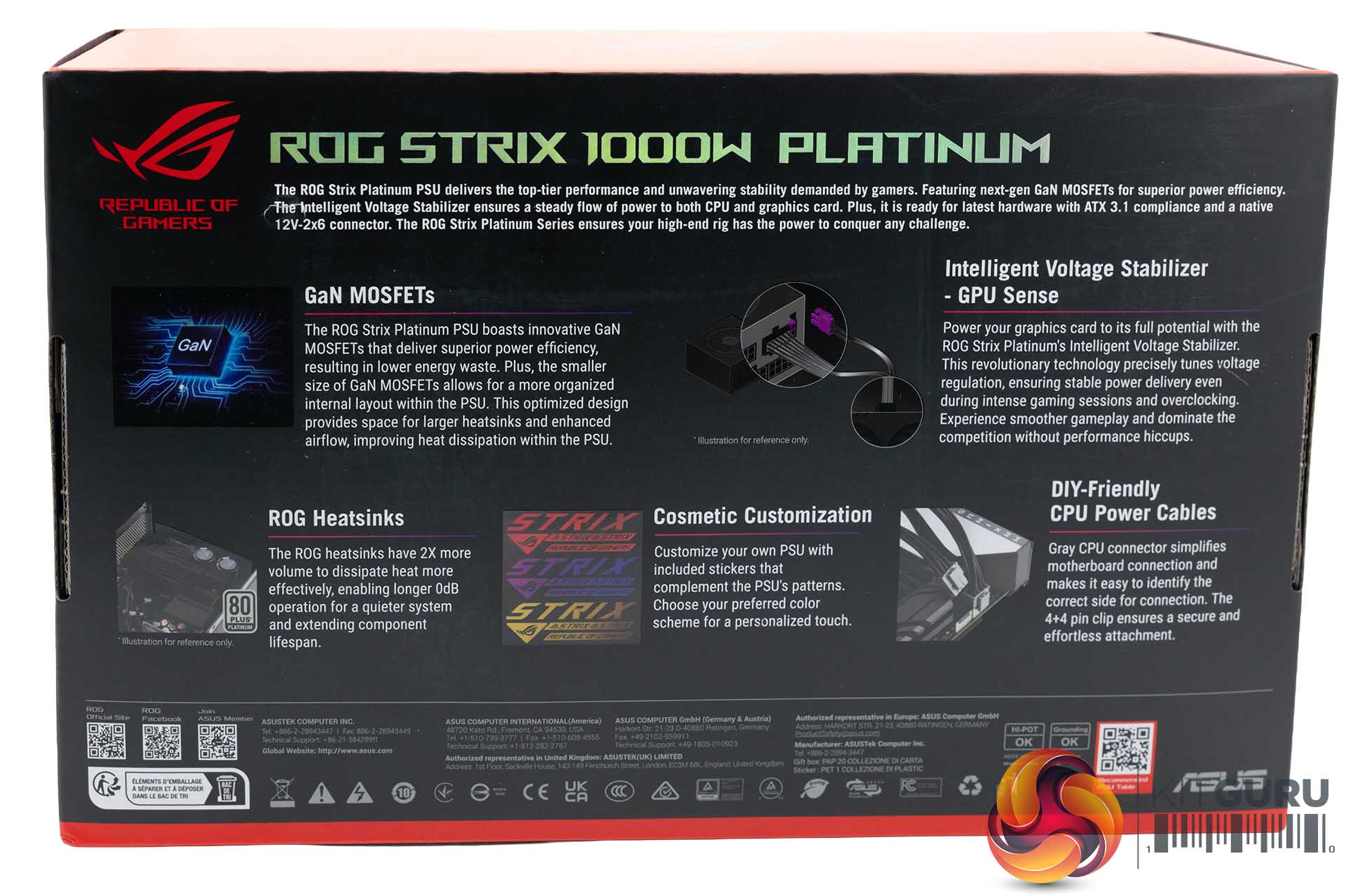
The rear of the box is loaded with information, including the GaN MOSFETs, Intelligent Voltage Stabiliser – GPU Sense and other things such as ‘DIY Friendly' cables, and the ROG Heatsinks.
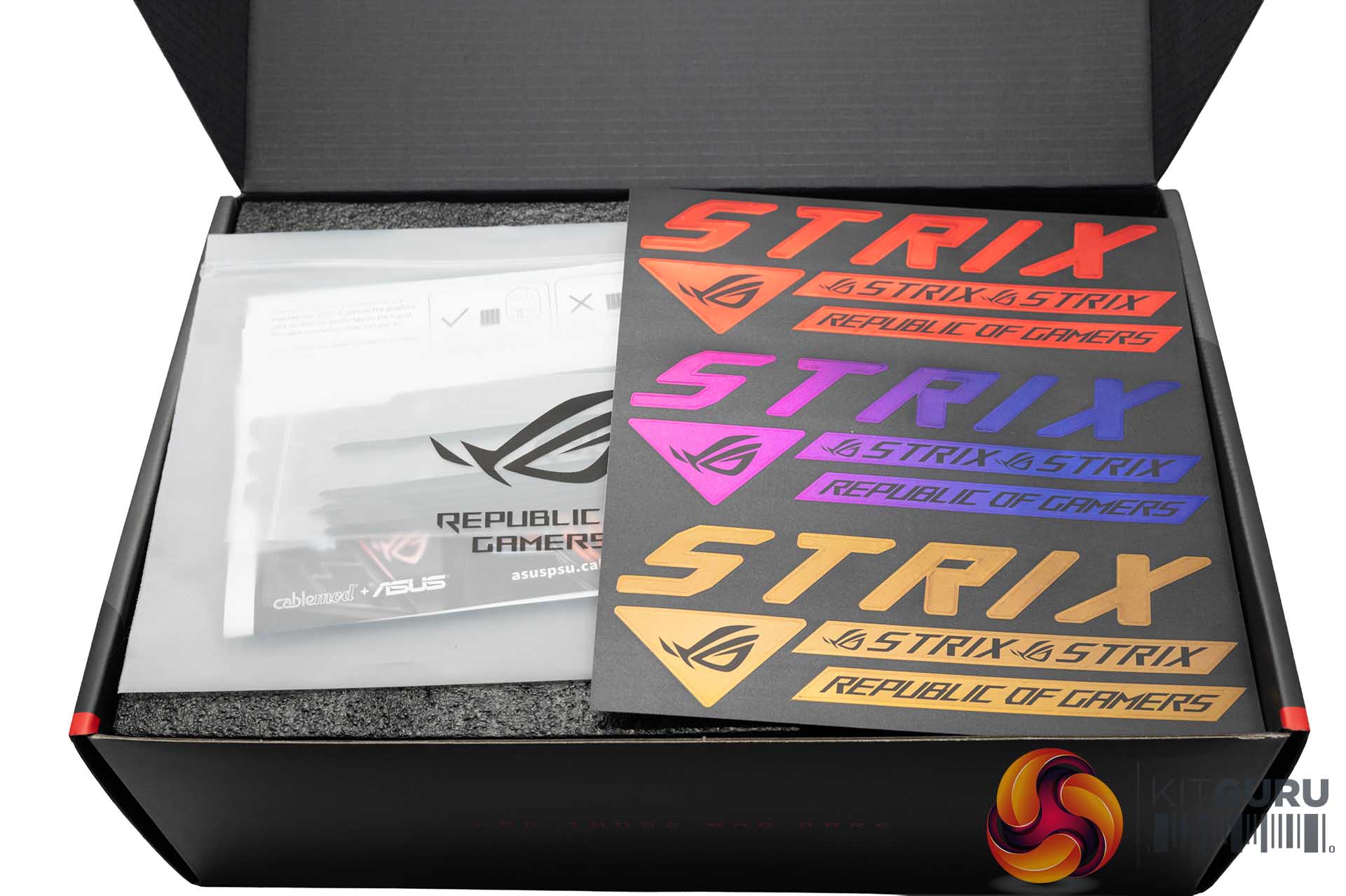
The power supply ships well sandwiched between pieces of foam. Packaging is good. Inside the box, we see some ‘stickers' that ASUS include to let the end user customise the looks of the power supply.
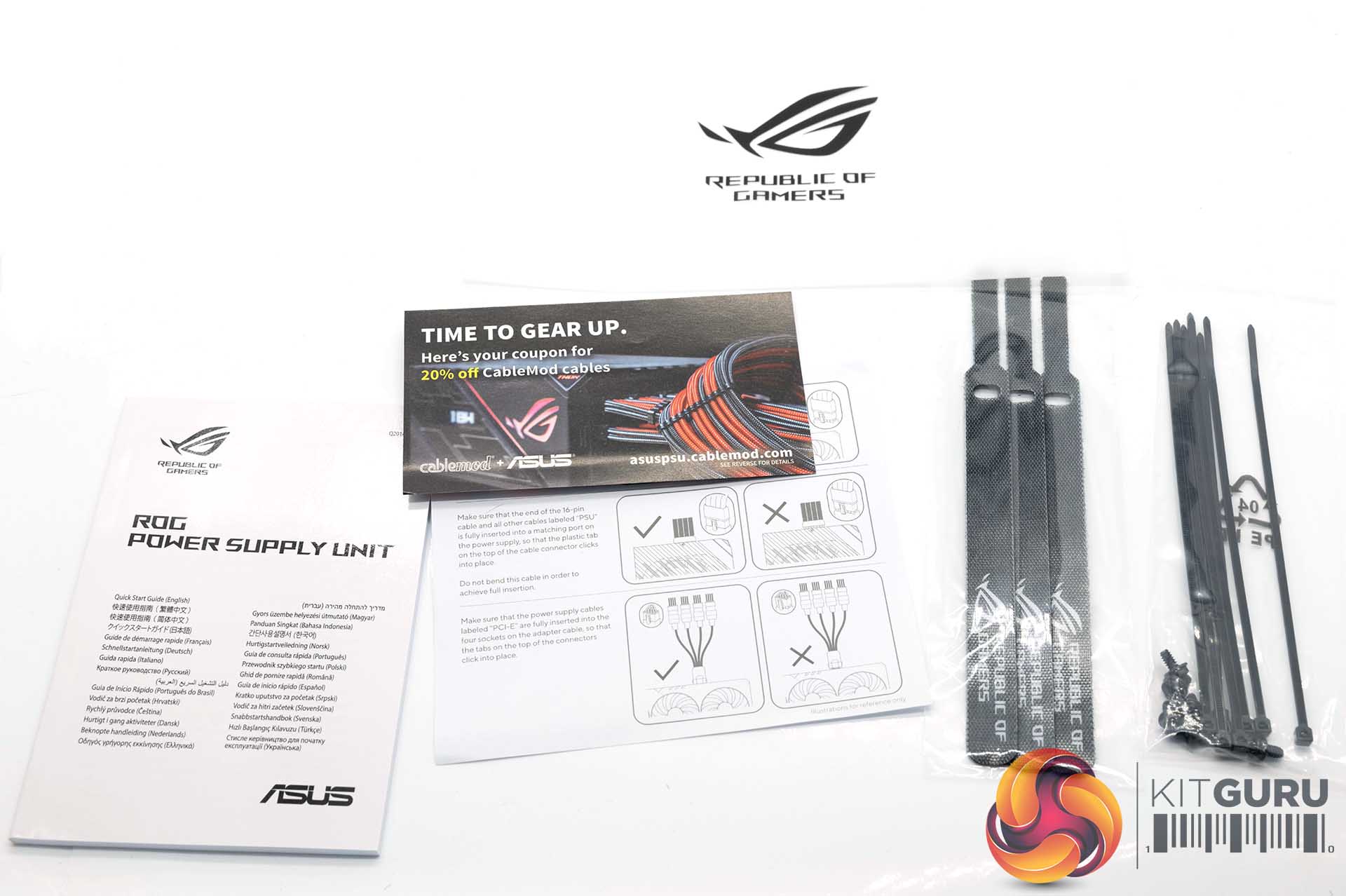
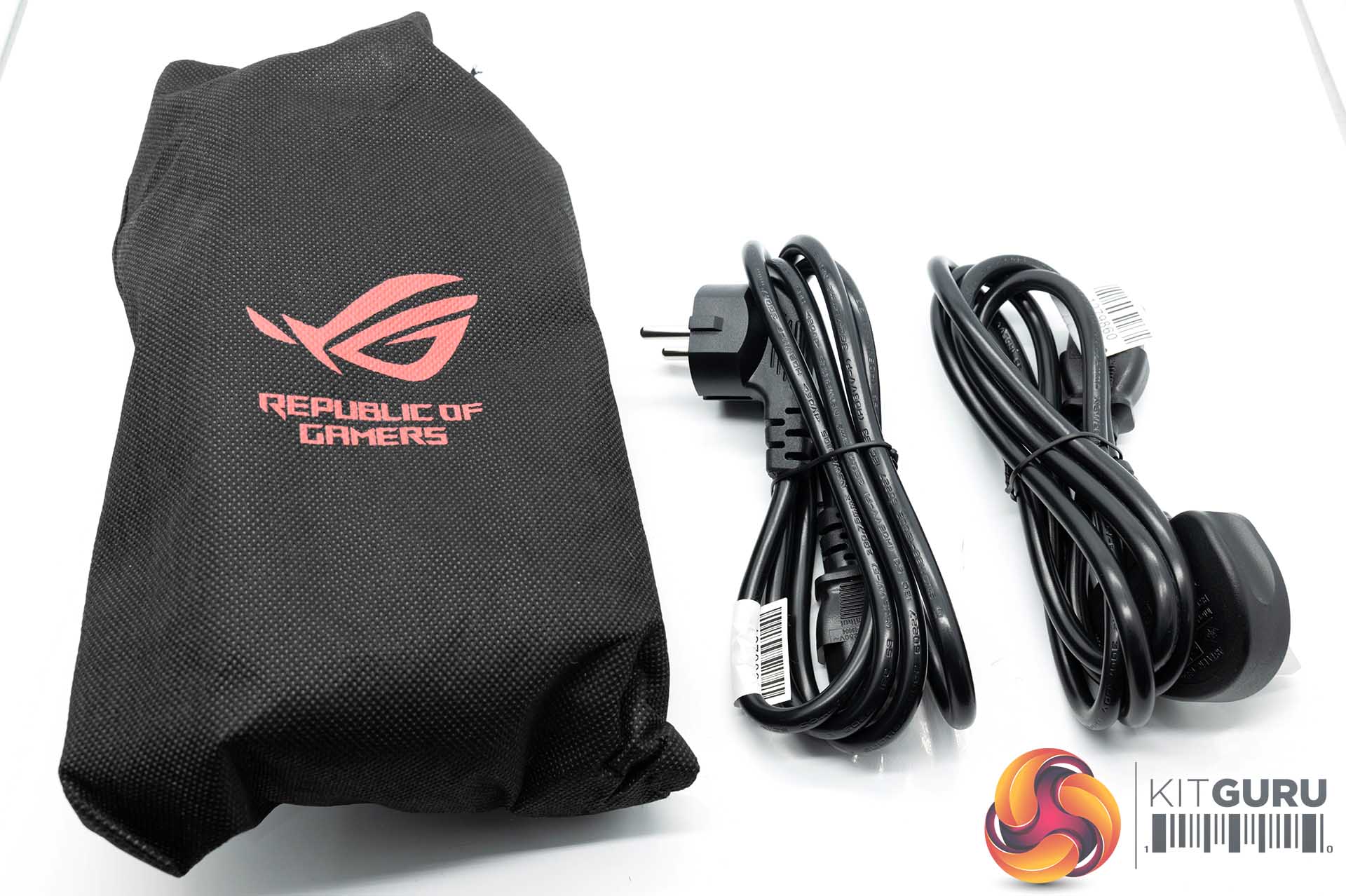
The ASUS bundle is comprehensive. You get a variety of cable ties, both plastic and felt, and our sample included several power cables for Europe and the United Kingdom.
Package contents:
Power Cord x 1
Motherboard Power Cable x 1 (610mm)
CPU Cable x 2 (1000mm)
PCI-E Gen 5.1 (16-pin-to-16-pin) Cable x 1 (750mm)
PCI-E (8-pin-to-6+2pin) Cable x 4 (750mm)
SATA 1-to-3 Cable x 2 (400+120+120mm)
Peripheral 1-to-3 Cable x 1 (400+150+150mm)
ROG Strix DIY sticker x 1
User Manual x 1
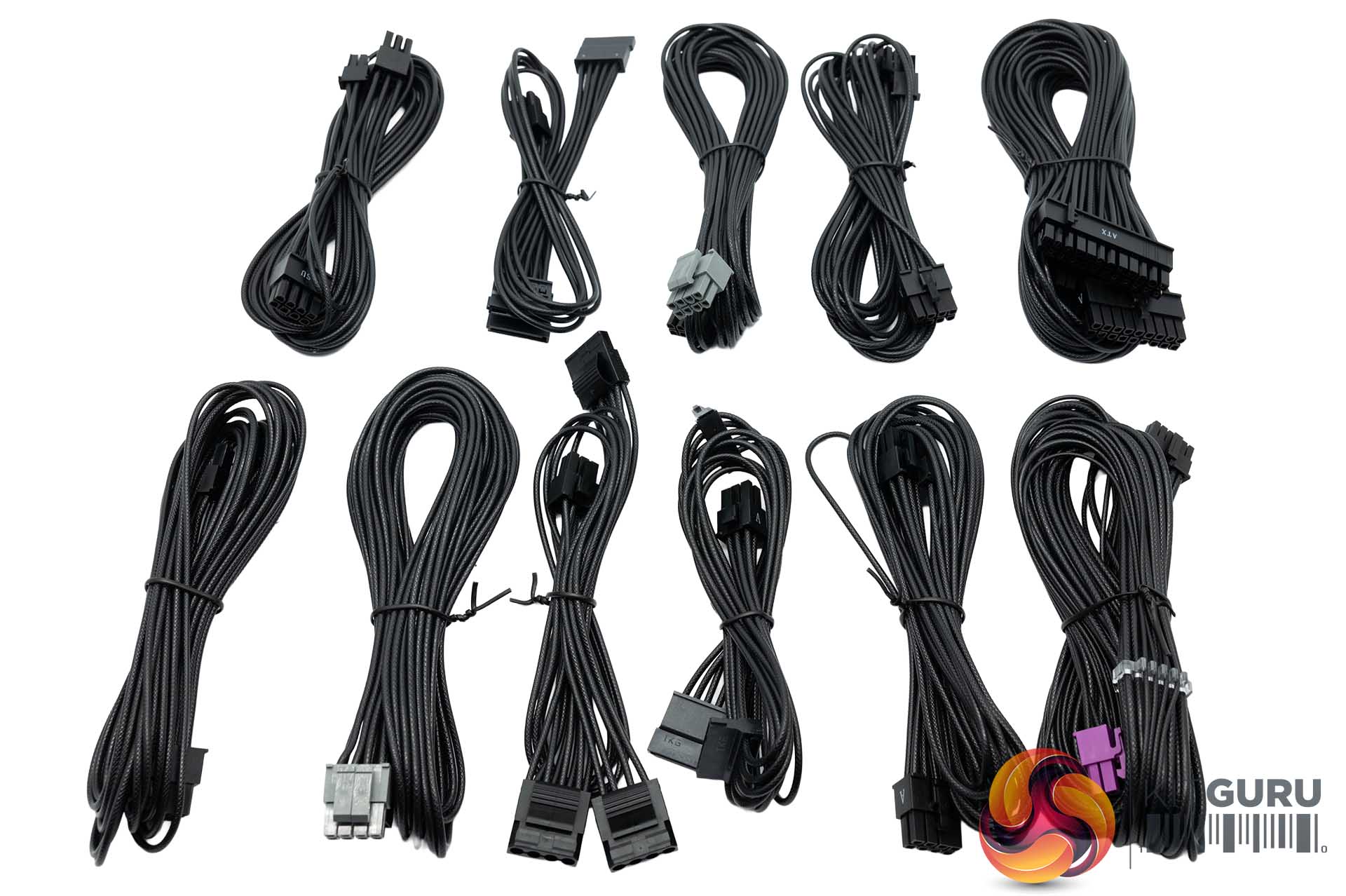
The quality of these individually sleeved cables seems really good, they are soft and flexible and are easily bent during use. Asus say the cables operate at temperatures '50c lower than the safety limit when bent'. They meet UL1581 flame test and UL758 certifications.
Asus say that these cables have upgraded copper pins which improves thermal conductivity for cooler operation and improved power delivery efficiency. Their claimed reductions in temperatures are 29% which translates to up to 12.28c.
- ATX connector 20+4 pin (610mm) x 1 Cable and 1 Connector.
- 4+4 Pin EPS12V (1000mm) x 2 Cables and 2 Connectors.
- 12+4 Pin PCIe (745mm) (600w) x 1 Cable and 1 Connector.
- 6+2 Pin PCIe (750mm) x4 Cables and 4 Connectors.
- SATA (400mm+115mm+115mm) x 1 Cable and 3 Connectors.
- SATA (400mm+120mm+120mm) x 1 Cable and 3 Connectors.
- 4 Pin Molex (400mm+150mm+150mm) x 1 Cable and 3 Connectors.
The cable configuration for this power supply is pretty robust and the cables are long enough to suit a variety of large case designs on the market today. None of the cables have in cable capacitors inside and they all measure around 18AWG Gauge with the 600W cable measuring 16-24AWG. Asus did a pretty good job here of supplying quality, flexible cables which are noticeably better than most I have tested in recent years.
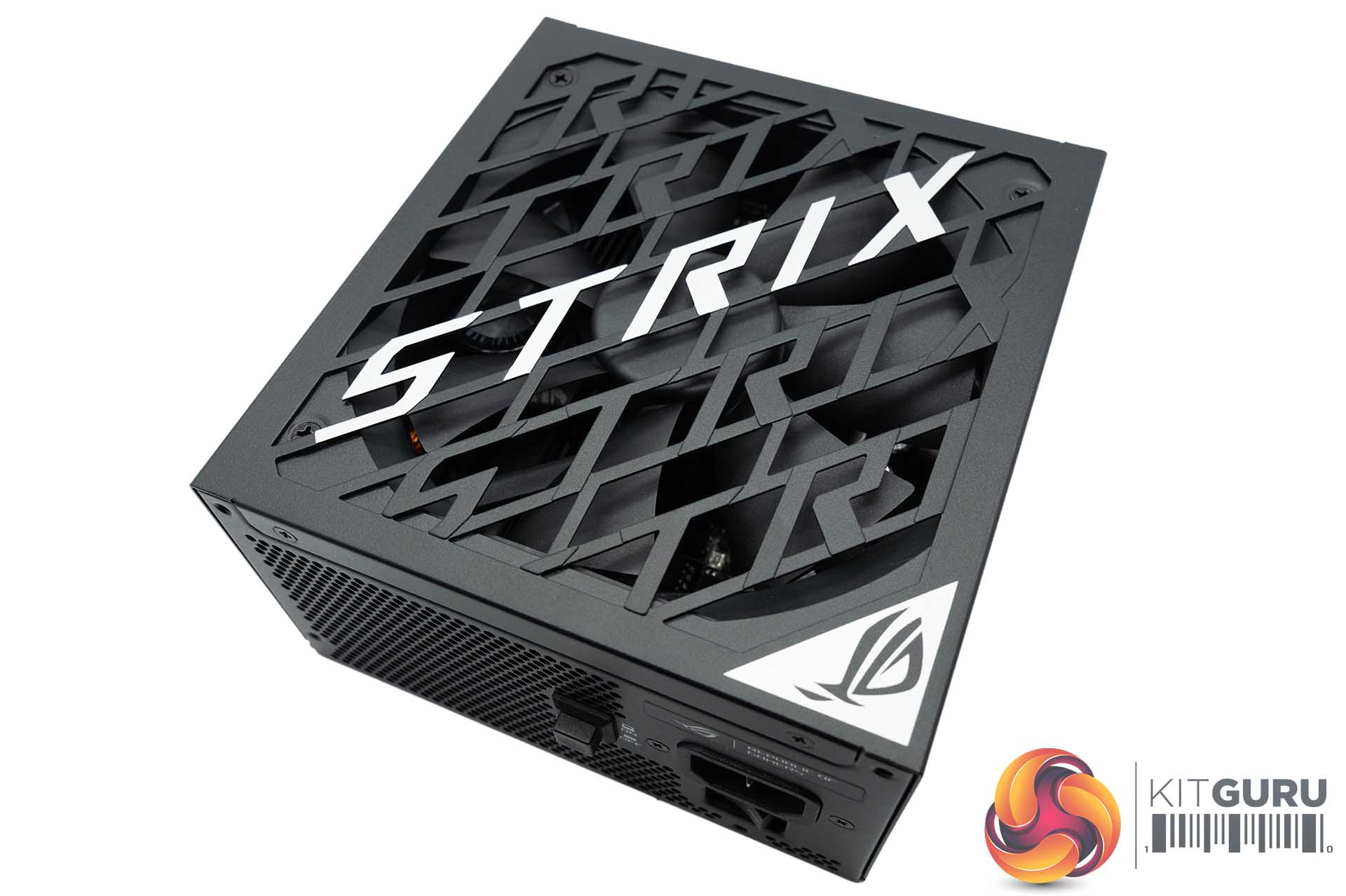
The ASUS ROG Strix is a very interesting looking power supply and it certainly stands out in a market of bland designs. I like how they have cut the STRIX word into the grille with the added benefit that it will also give plenty of airflow for the fan underneath. The power supply measures 150 mm x 85 mm x 160 mm so it will fit into most cases on the market today. It weighs 1.81kg.
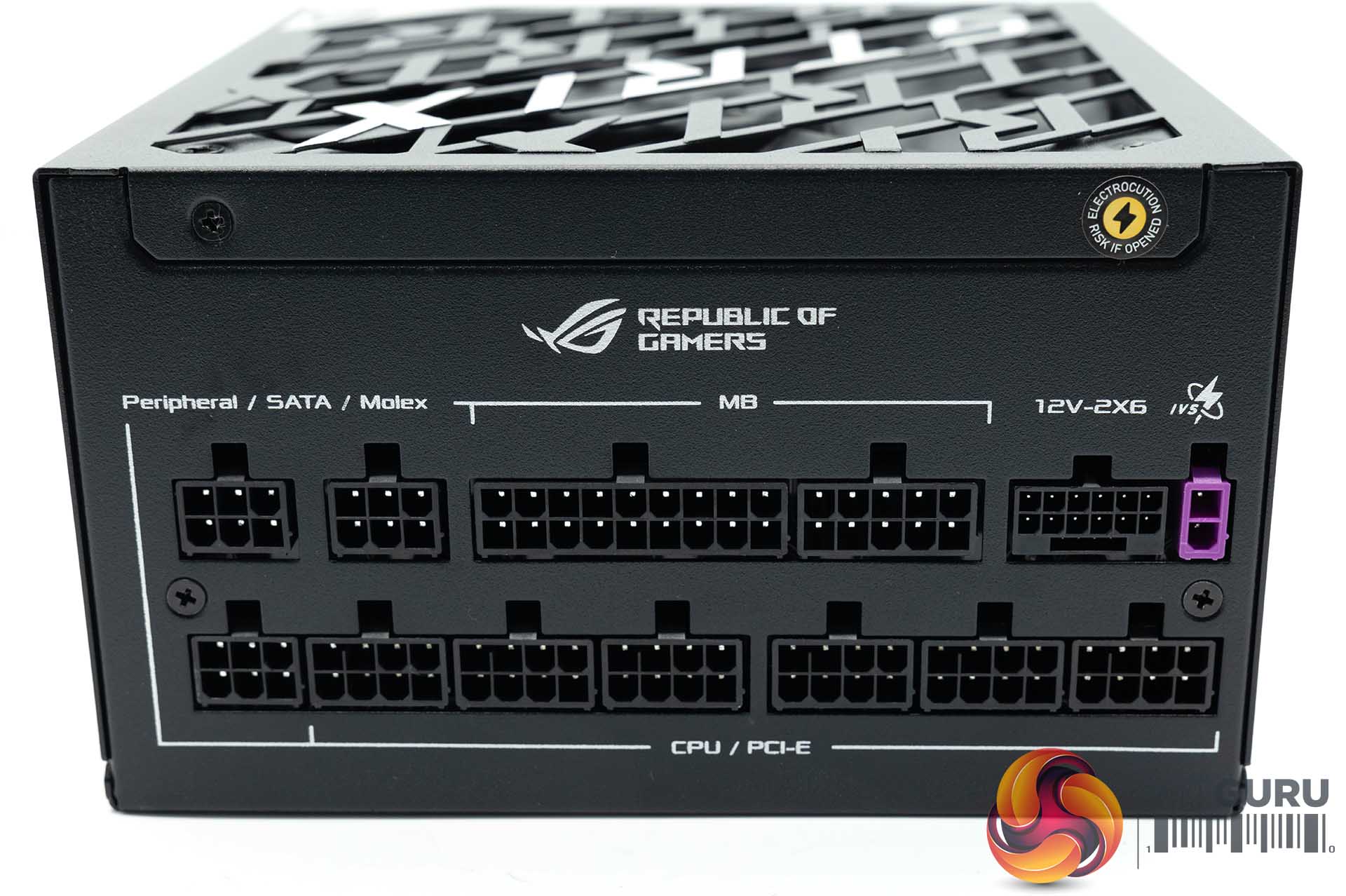
The modular side of the power supply is nicely laid out across two rows of modular ports – all labelled for ease of use during the install phase. There is a purple socket right next to the 12V-2X6 port which offers two ‘sense' pins. ASUS say this port helps the unit deliver tighter load regulation on the 12+4 pin connector.
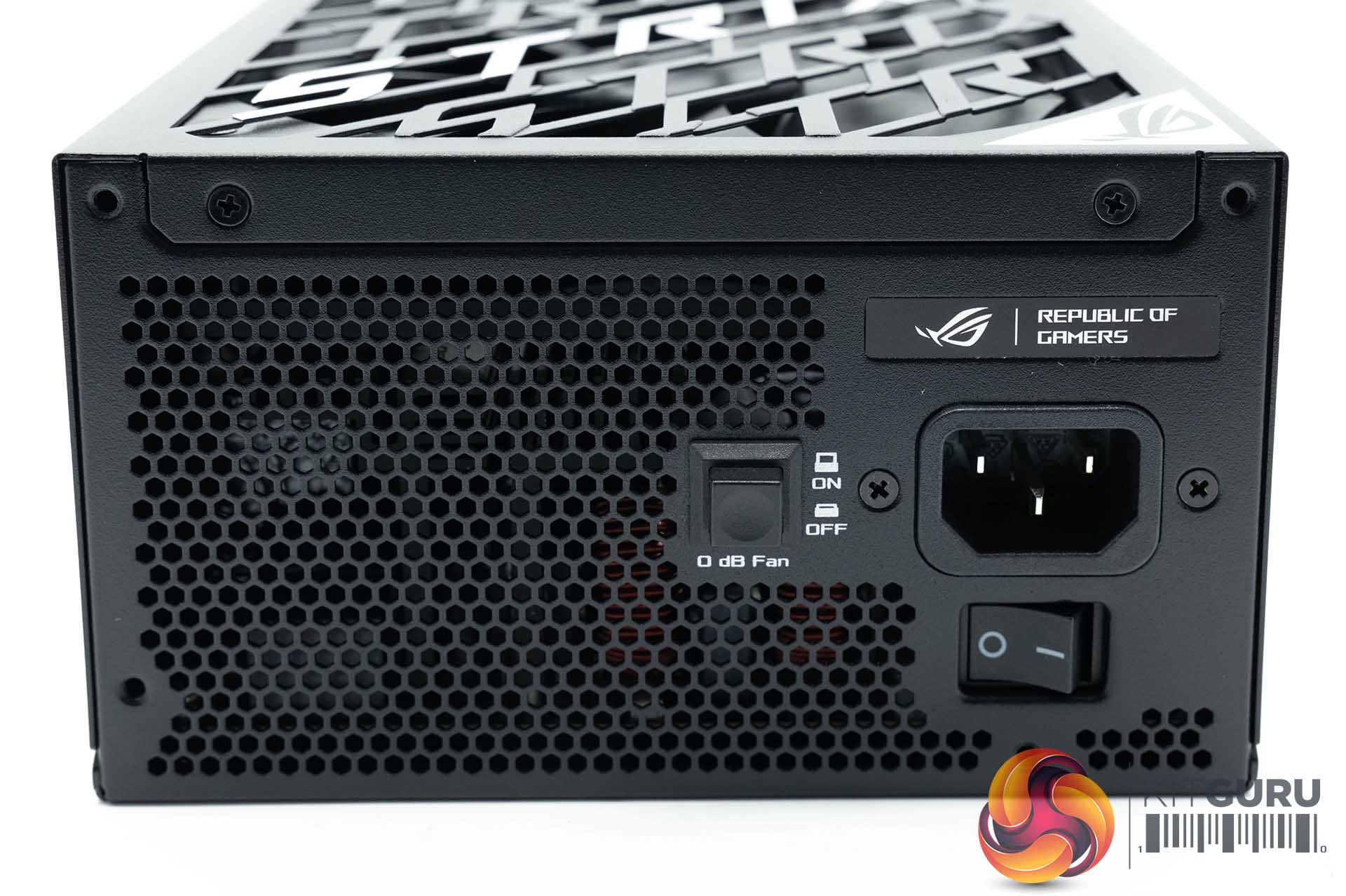
The power side of the unit is home to the power switch and connector, along with a button to toggle on the semi passive fan mode.
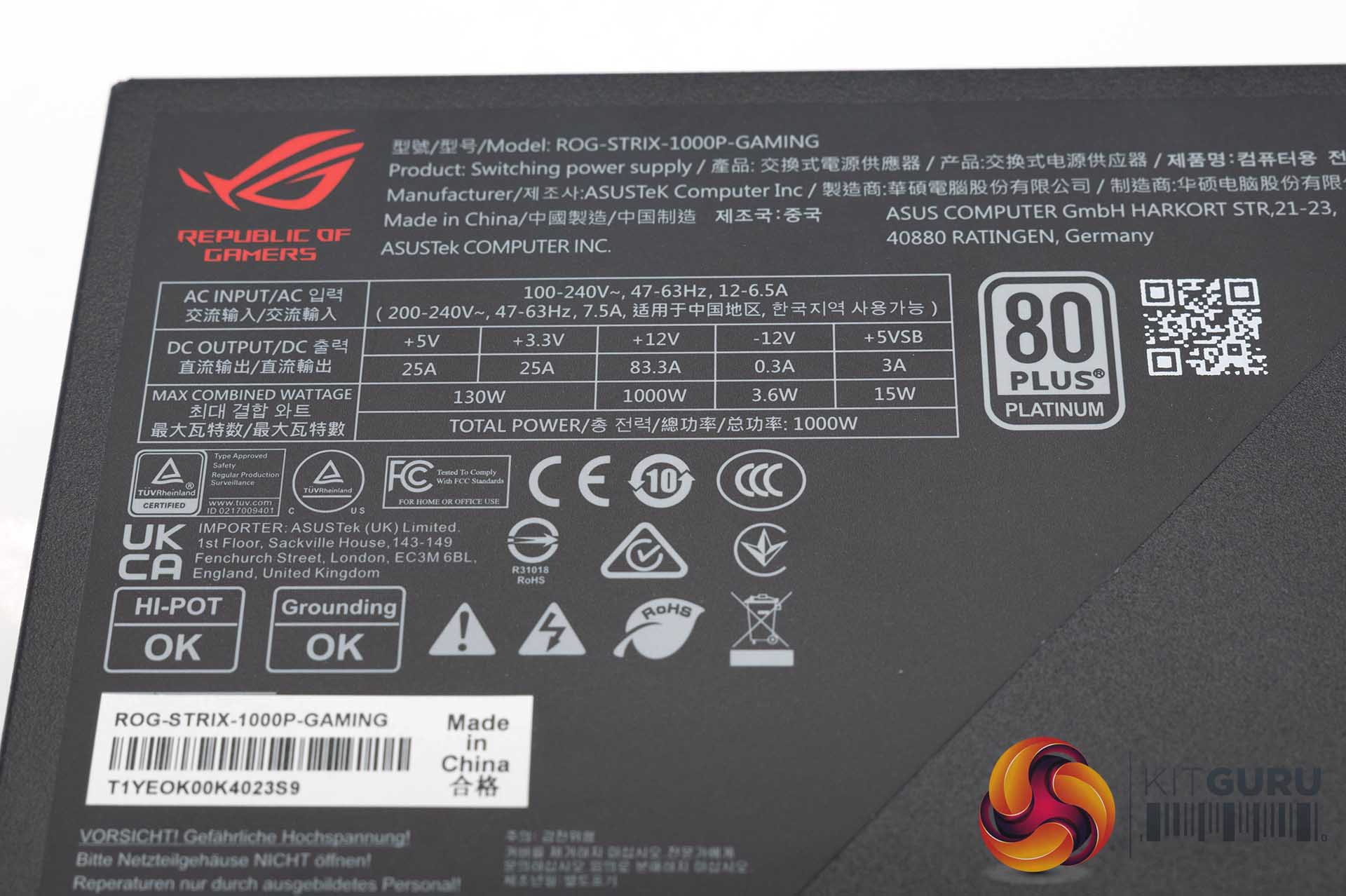
The power supply is able to deliver 83.3A on the primary +12V rail and 25A on both +3.3V and +5V rails. for a total of 1000 watts.
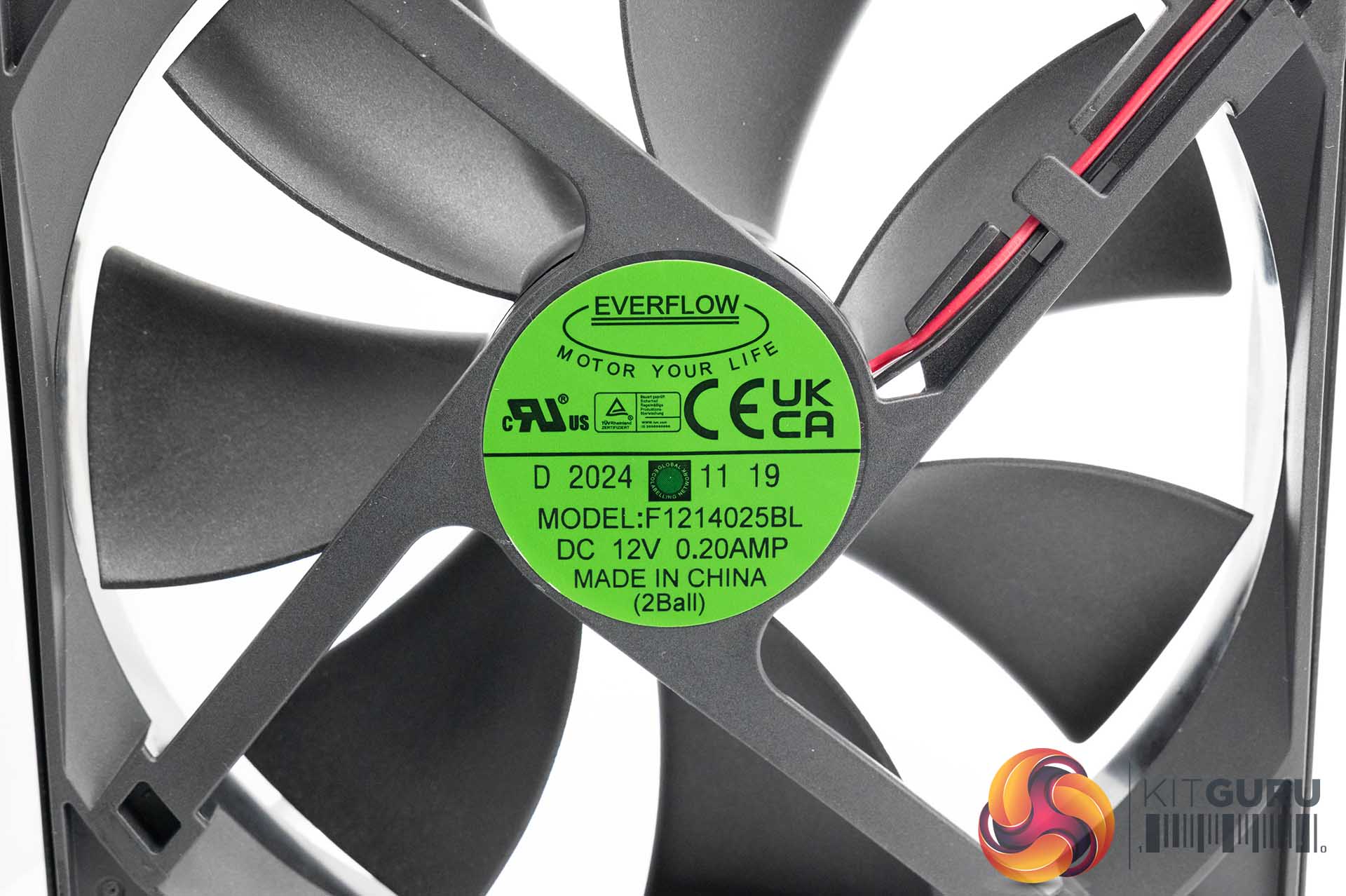
The ROG Strix 1000 Watt supply that we received has an EverFlow fan inside it, model number F1214025BL, rated 12V 0.2 AMP. This is a Double ball bearing fan made in China and has a maximum rotational speed of around 1,600 rpm to produce 74CFM. I don't know much about this fan or have previous experiences – its the first time I have seen one to be honest. I was a little surprised to see that ASUS did not opt for a better known Fluid Dynamic bearing fan in such a high end design.
Asus did send me a product guide PDF with the power supply and they state ‘Dual Ball Bearings have a remarkable lifespan of 80,000 hours, lasting twice as long as sleeve bearings and exceeding even fluid dynamic bearings.' Personally I would argue that the reduced bearing noise and more than adequate long life under general conditions sways a decision in favour of FDB fans, but we can agree to disagree.
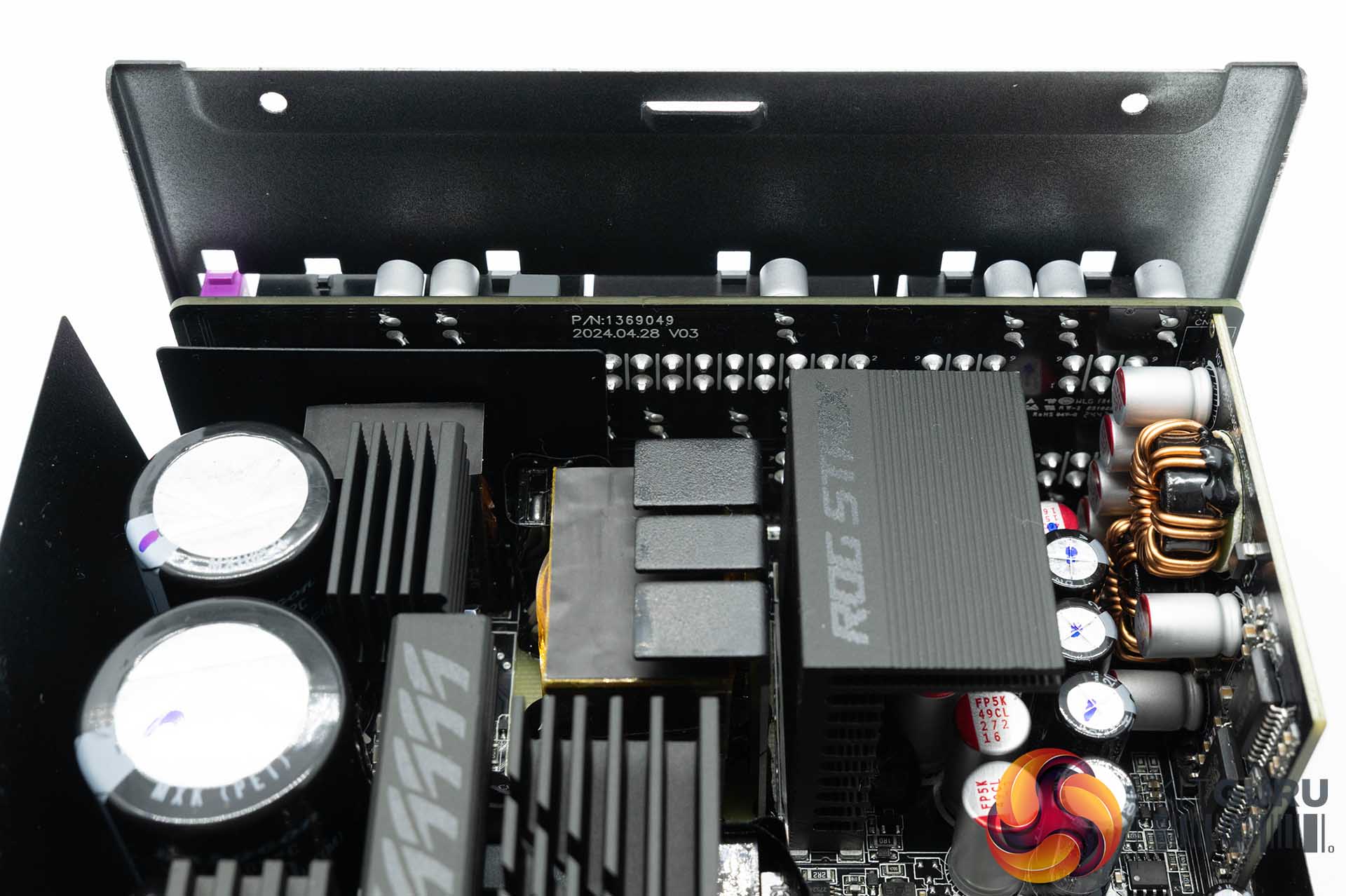
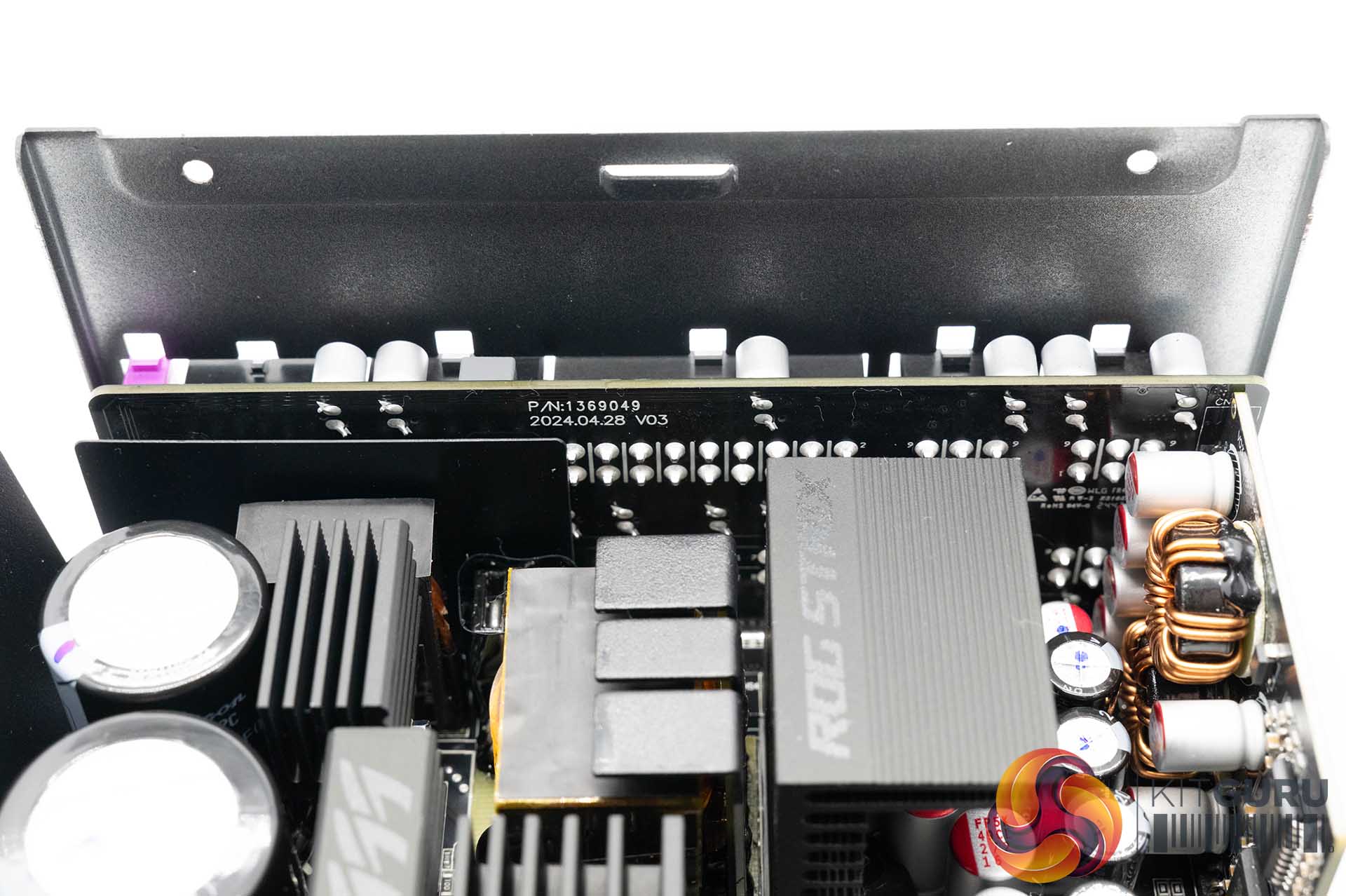
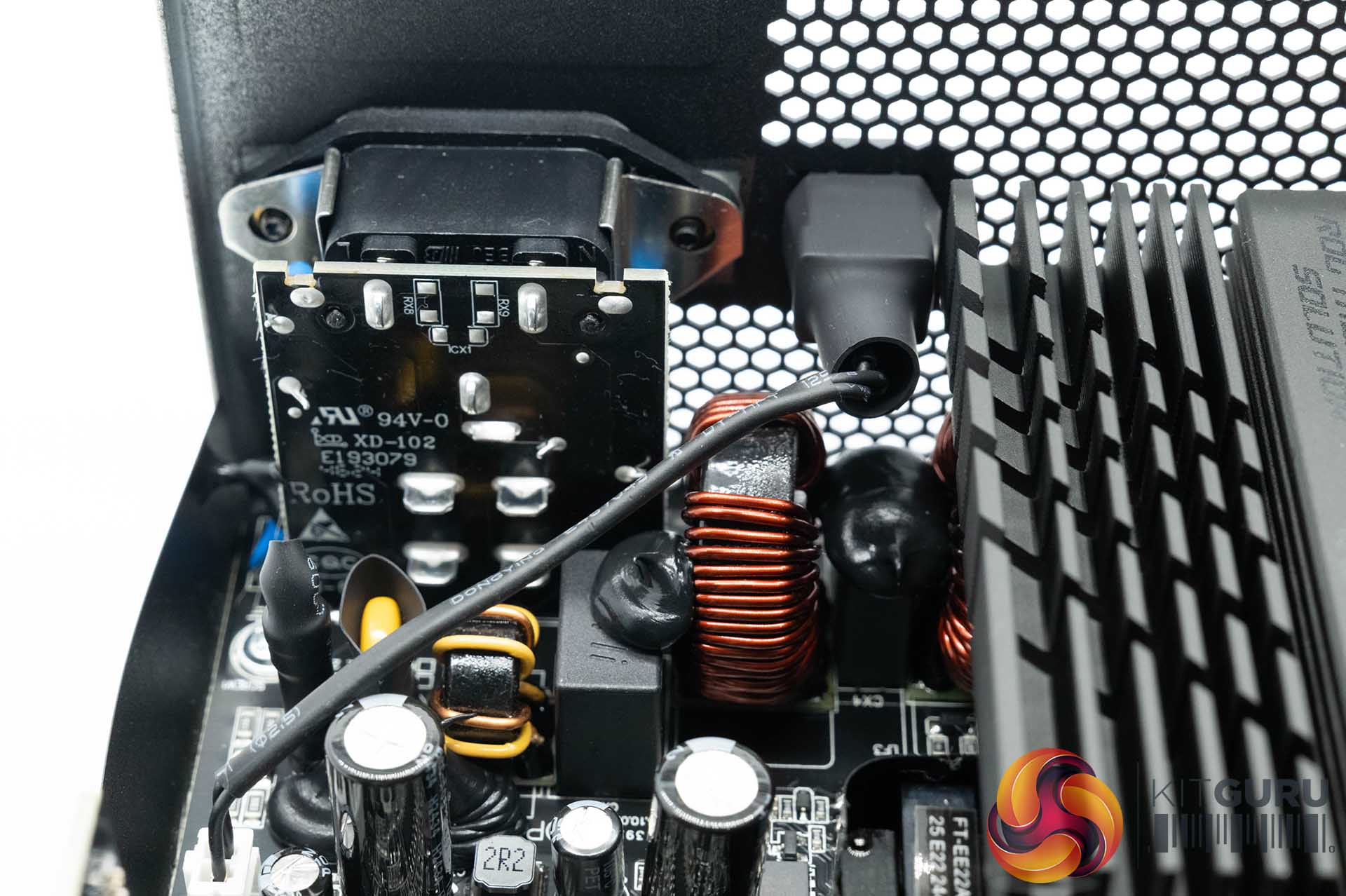
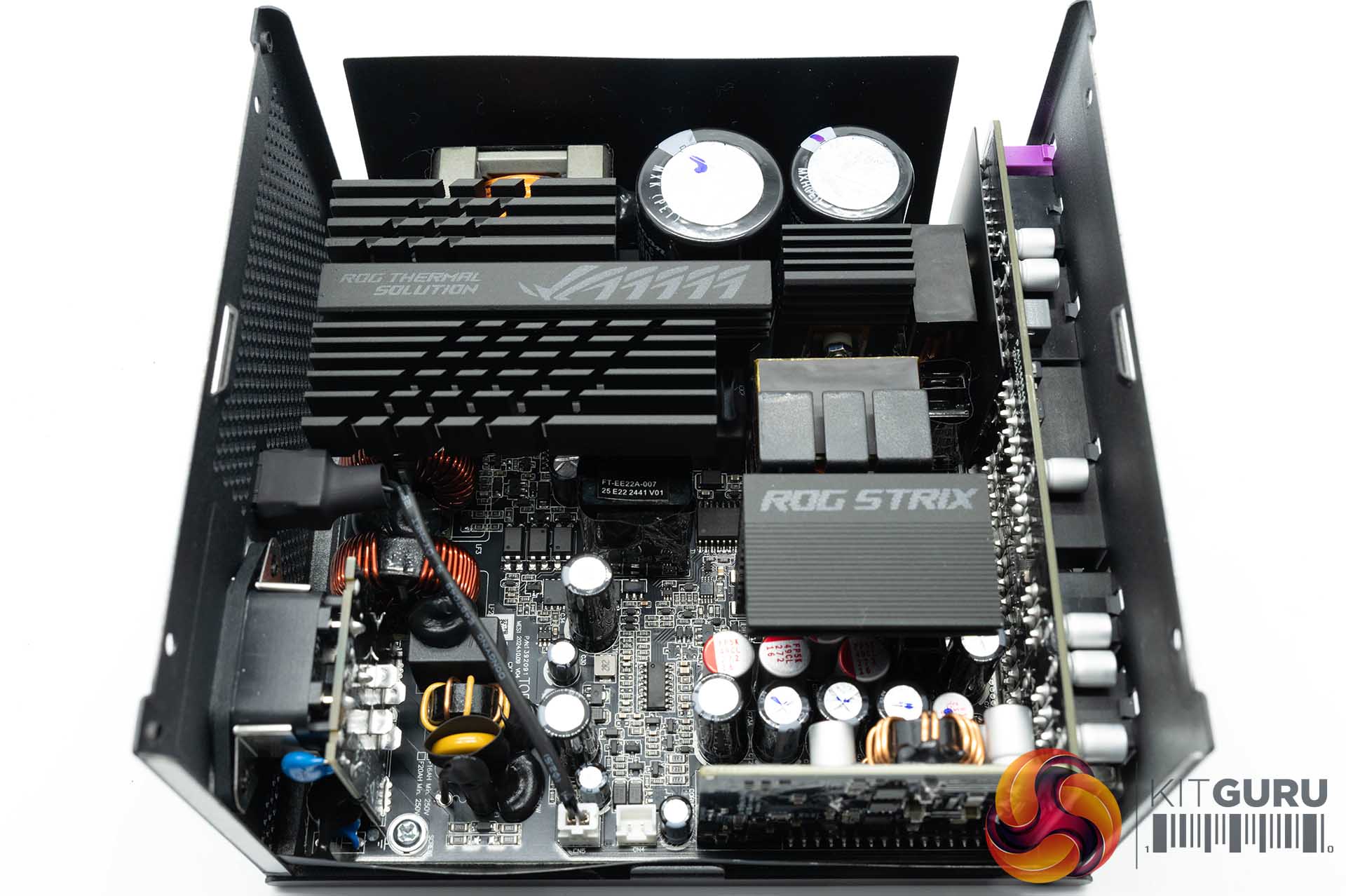
The design is by Great Wall and it seems very clean throughout. Asus told us they wanted to collect this power supply to use elsewhere after our technical analysis so we didn't do the complete breakdown as we normally would.
There are primarily Rubycon and Nichicon capacitors in the design, all high grade 105c Japanese rated. The two primary capacitors are rated 680uF and 330uF for a total of 1010uF.
The primary ROG branded heatsinks are large – it seems a little excessive to me considering the platforms rated efficiency, but they certainly wouldn't hinder the cooling regardless and will likely aid the extended 0dBa operation. A daughter card holds the DC-DC converters – this generates the minor rails.
The design has an APFC converter, along with a half bridge topology and an LLC resonant converter. A synchronous rectification system on the secondary side regulates the 12V rail, with two DC-DC controllers and six Infineon FETs handling the minor rails.
Correctly testing power supplies is a complex procedure and KitGuru have configured a test bench which can deliver up to a 2,000 Watt DC load.
We test ambient temperatures at 35c in our environment to greater reflect warmer internal chassis conditions.
We use combinations of the following hardware:
• SunMoon SM-268
• CSI3710A Programmable DC load (+3.3V and +5V outputs)
• CSI3711A Programmable DC load (+12V1, +12V2, +12V3, and +12V4)
• Extech Power Analyzer
• Extech MultiMaster MM570 digital multimeter
• SkyTronic DSL 2 Digital Sound Level Meter (6-130dBa)
• Digital oscilloscope (20M S/s with 12 Bit ADC)
• Variable Autotransformer, 1.4 KVA
We test in a single +12V configuration.
|
DC Output Load Regulation
|
||||||||||
|
Combined DC Load |
+3.3V
|
+5V
|
+12V
|
+5VSB
|
-12V | |||||
|
A
|
V
|
A
|
V
|
A
|
V
|
A
|
V
|
A | V | |
|
100W
|
0.90
|
3.32
|
0.90
|
5.08
|
7.35
|
12.00
|
0.50
|
5.01
|
0.20
|
-12.01
|
|
200W
|
1.60
|
3.32
|
1.64
|
5.08
|
15.13
|
12.00
|
1.00
|
5.02
|
0.20
|
-12.00
|
|
500W
|
3.21
|
3.32
|
3.24
|
5.08
|
38.60
|
12.00
|
1.50
|
5.01
|
0.20
|
-12.01
|
| 750W |
4.03
|
3.32
|
4.17
|
5.08
|
58.53
|
12.00
|
2.00
|
5.01
|
0.30
|
-12.00
|
|
1000W
|
5.45
|
3.32
|
5.51
|
5.08
|
78.13
|
11.99
|
2.50
|
5.02
|
0.30
|
-12.01
|
The load regulation of this power supply is pretty good across the board.
Next we want to try Cross Loading. This basically means loads which are not balanced. If a PC for instance needs 500W on the +12V outputs but something like 30W via the combined 3.3V and +5V outputs then the voltage regulation can fluctuate badly.
The power supply had no problems sustaining at constant 1000W load.
| Cross Load Testing | +3.3V | +5V | +12V | -12V | +5VSB | |||||
| A | V | A | V | A | V | A | V | A | V | |
| 885W | 2.0 | 3.32 | 2.0 | 5.08 | 72.0 | 11.98 | 0.2 | -12.01 | 0.50 | 5.00 |
| 240W | 20.0 | 3.31 | 23.0 | 5.06 | 2.0 | 12.00 | 0.2 | -12.01 | 0.50 | 5.00 |
The supply handled our cross load test very well, holding stable results across the range.
We then used an oscilloscope to measure AC ripple and noise present on the DC outputs. We set the oscilloscope time base to check for AC ripple at both high and low ends of the spectrum. ATX12V V2.2 specification for DC output ripple and noise is defined in the ATX 12V power supply design guide.
|
ATX12V Ver 2.2 Noise/Ripple Tolerance
|
|
|
Output
|
Ripple (mV p-p)
|
|
+3.3V
|
50
|
|
+5V
|
50
|
|
+12V1
|
120
|
|
+12V2
|
120
|
|
-12V
|
120
|
|
+5VSB
|
50
|
Obviously when measuring AC noise and ripple on the DC outputs, the cleaner (less recorded/lower) means we have a better end result. We measured this AC signal amplitude to see how closely the unit complied with the ATX standard.
| AC Ripple (mV p-p) | ||||
| DC Load | +3.3V | +5V | +12V | 5VSB |
| 100W | 8 | 9 | 8 | 6 |
| 250W | 11 | 10 | 10 | 6 |
| 500W | 12 | 11 | 13 | 9 |
| 750W | 14 | 12 | 15 | 11 |
| 1000W | 16 | 14 | 22 | 12 |
The unit passes the ripple test without any issues, falling well within industry rated tolerance across the board. Both secondary rails peak at around 15mV at full load, with the primary +12V rail peaking at around 22mV.
|
Efficiency (%)
|
|
|
100W
|
90.4
|
|
250W
|
92.8
|
|
500W
|
94.5
|
|
750W
|
92.5
|
|
1000W
|
90.7
|
The efficiency results are excellent, peaking at 94.5% at around 50% load. This drops to around 91.4% efficiency at full load.
We take the issue of noise very seriously at KitGuru and this is why we have built a special home brew system as a reference point when we test noise levels of various components. Why do this? Well this means we can eliminate secondary noise pollution in the test room and concentrate on components we are testing. It also brings us slightly closer to industry standards, such as DIN 45635.
Today to test the Power Supply we have taken it into our acoustics room environment and have set our SkyTronic DSL 2 Digital Sound Level Meter (6-130dBa) one meter away from the unit. We have no other fans running so we can effectively measure just the noise from the unit itself.
As this can be a little confusing for people, here are various dBa ratings in with real world situations to help describe the various levels.
KitGuru noise guide
10dBA – Normal Breathing/Rustling Leaves
20-25dBA – Whisper
30dBA – High Quality Computer fan
40dBA – A Bubbling Brook, or a Refrigerator
50dBA – Normal Conversation
60dBA – Laughter
70dBA – Vacuum Cleaner or Hairdryer
80dBA – City Traffic or a Garbage Disposal
90dBA – Motorcycle or Lawnmower
100dBA – MP3 Player at maximum output
110dBA – Orchestra
120dBA – Front row rock concert/Jet Engine
130dBA – Threshold of Pain
140dBA – Military Jet takeoff/Gunshot (close range)
160dBA – Instant Perforation of eardrum
|
Noise (dBA)
|
|
|
100W
|
<28.0
|
|
250W
|
<28.0
|
|
500W
|
<28.0
|
|
750W
|
29.3
|
| 1000W | 32.4 |
In general use the power supply is extremely quiet, and it is only when 750 watts is tasked from it that the fan starts to actively ramp up to deal with rising temperatures inside the chassis.
At full load, the fan is audible, but still very quiet, at just over 32dBa. Some great results from this fan they are using. I did notice a little bearing noise at lower RPM's (often inherent with dual ball bearing fan designs) but it was not anything that would stop me using the power supply in my own system.
|
Temperature (c)
|
||
|
Intake
|
Exhaust
|
|
|
100W
|
37
|
40
|
|
250W
|
38
|
43
|
|
500W
|
40
|
48
|
|
750W
|
45
|
54
|
|
1000W
|
47
|
60
|
Temperatures inside the chassis are excellent thanks to the efficiency levels, and at higher loads the fan is actively pushing warm air outside the chassis, ensuring the temperatures are never too much of an issue.
It has been a while since we looked at any branded ASUS power supply and i have been impressed with the technical design of the ROG Strix 1000W Platinum. From the outside, the design is certainly eye catching and I like how they have cut the STRIX logo into the usual venting plate above the fan. It not only looks cool, but it allows for high levels of airflow as well.
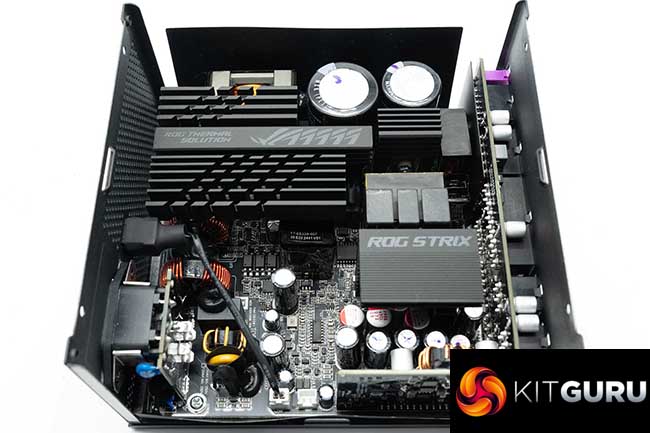
On a technical level this Great Wall design is more than capable. The internal component selection (such as high grade Japanese Rubycon and Nichicon capacitors) is first class, and soldering quality on the main PCB and other components is excellent. I didn't completely disassemble the power supply as ASUS want to collect this unit – but from what I can see, there are no obvious concerns with the design. I also appreciated the excellent ROG heatsink designs which aid cooling throughout, ensuring that the 0dBa operation can be extended for a quieter experience.
The unit did not fail any of the tests over the last week, performing well in our load regulation test, and cross load test and ripple suppression scored well in our analysis too.
The use of a Double Ball bearing fan in this high cost design is unusual to me, many manufacturers have moved to FDB fans (Fluid Dynamic Bearing) as they generally operate at a lower noise output at a variety of rotational speeds.
ASUS in their reviewer literature are focused on the Dual Ball Bearing ‘remarkable lifespan of 80,000 hours' and claim ‘this can even exceed fluid dynamic bearing fan life'. I would argue that the lifetime benefits are marginal at best, and that Fluid Dynamic bearing fans can operate at quieter noise levels when spinning at lower speeds – this is why many companies have switched to them, especially in higher level cost designs.
I have heard reports that earlier versions of this power supply adopted a Champion Dual ball bearing fan which was very noisy at lower speeds. The EverFlow F1214025BL fan in our sample performed really well under most conditions, but we did notice a little bearing noise at lower speeds but it was so minor that it hardly seems worth mentioning. So the move from Champion fan to Everflow fan seems like a good move for ASUS. Still, I have no doubts in my mind that a Fluid Dynamic bearing fan would have been the smarter move.
Pricing in the UK is around the £240 price point, from Amazon (HERE) and SCAN (HERE). This is not a budget power supply by any stretch of the imagination, but considering the overall performance, stability, choice of high grade components and high levels of Platinum efficiency it earns a place in the highest scoring units we have tested so far.
Pros:
- 10 year warranty.
- ATX 3.1 and PCIe 5.1 capable.
- Cables are fantastic.
- Fully modular design.
- Chassis Design is quite exciting for a power supply.
- High quality components inside.
- Ripple suppression is great.
- 105c Rated Japanese capacitors.
- High levels of efficiency.
Cons:
- Fluid Dynamic Bearing Fan would be a better option.
Kitguru says: This is a great design for ASUS, and one of the best 1000 watt power supplies we have tested to date. The use of high level Japanese components throughout will help with longevity and stability. The overall performance of the ROG Strix 1000W Platinum power supply is excellent.