KitGuru KitGuru.net – Tech News | Hardware News | Hardware Reviews | IOS | Mobile | Gaming | Graphics Cards



Today we look at a new power supply from Endorfy, the Supremo FM6. Endorfy are releasing two capacities in this range a 850 watt unit, and a 1000 watt unit which they sent us for review. These power supplies have an 80 Plus Gold certification on the box, are fully modular and ship with a 10 year warranty. Sadly we didn't see Cybenetics certifications on the box, but Endorfy told us they have gotten those certifications recently, and we will talk more about that later in the review.
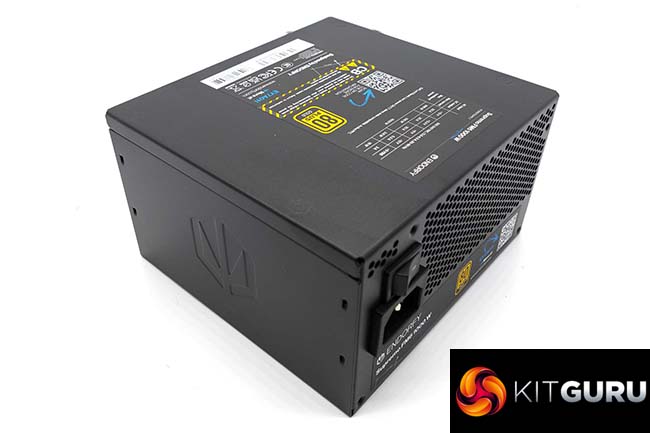
Endorfy have set the pricing to be very competitive in the UK for this unit, around £120 inc vat – which (special etailer offers aside) puts it in the lower end of the pricing spectrum currently on the UK Market. Endorfy told me that they are planning to release 750 watt version of the PSU later, but no date on this is confirmed just yet. An 850 Watt and 1000 Watt unit ticks most of the boxes in the enthusiast sector anyway, so focusing on these two capacities makes a lot of sense to me.
Endorfy have been promoting these units and focusing on aspects such as the Fluctus fan, Japanese Capacitors, ATX 3.1 support and 80 Plus Gold certification.
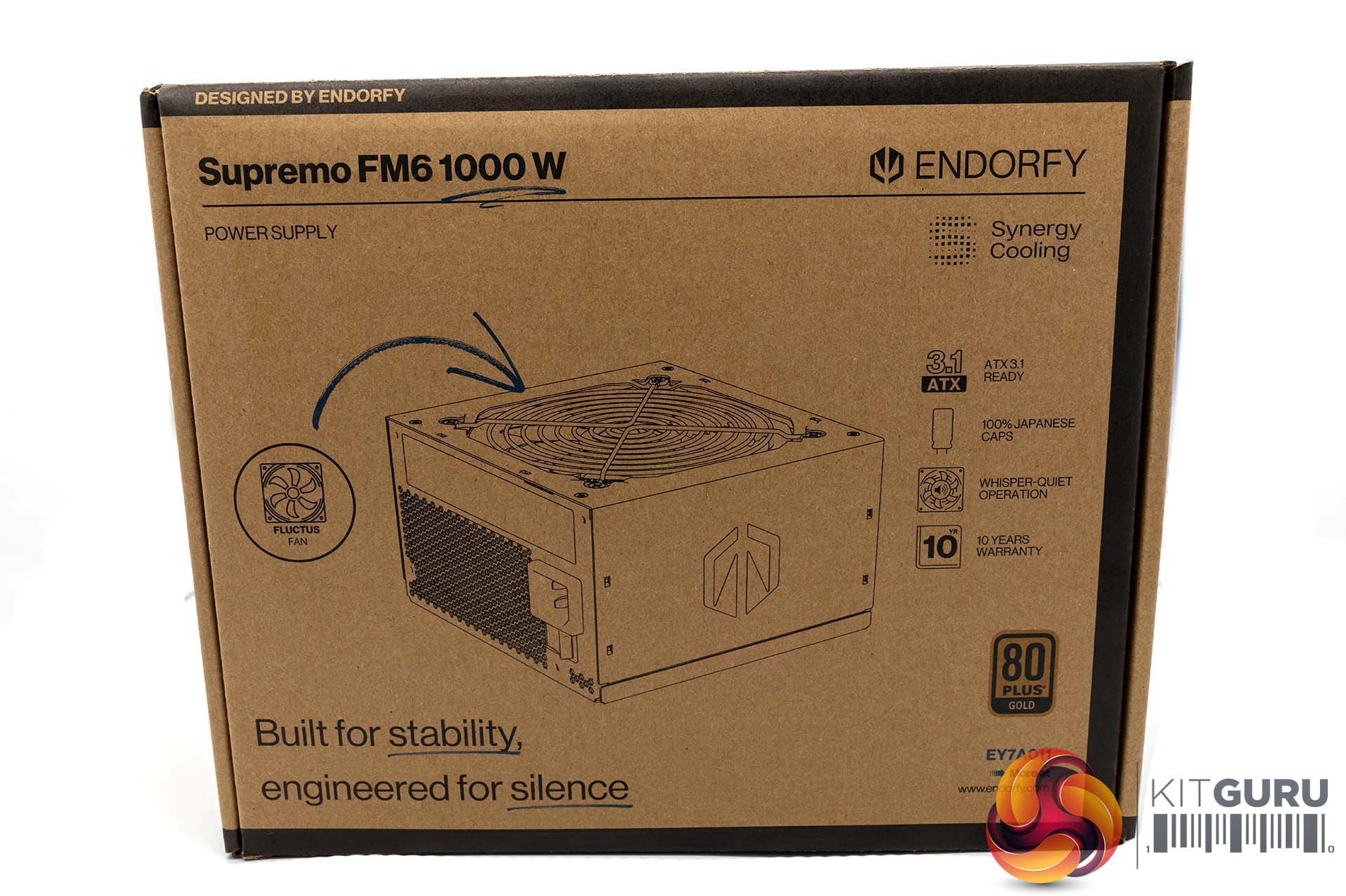
Endorfy ship these power supplies in a two tone brown box with some unit details on the front. You get the ATX 3.1 ready stamp, a highlight to the Fluctus Fan inside, notification of 100% Japanese caps, and the 10 year warranty support.
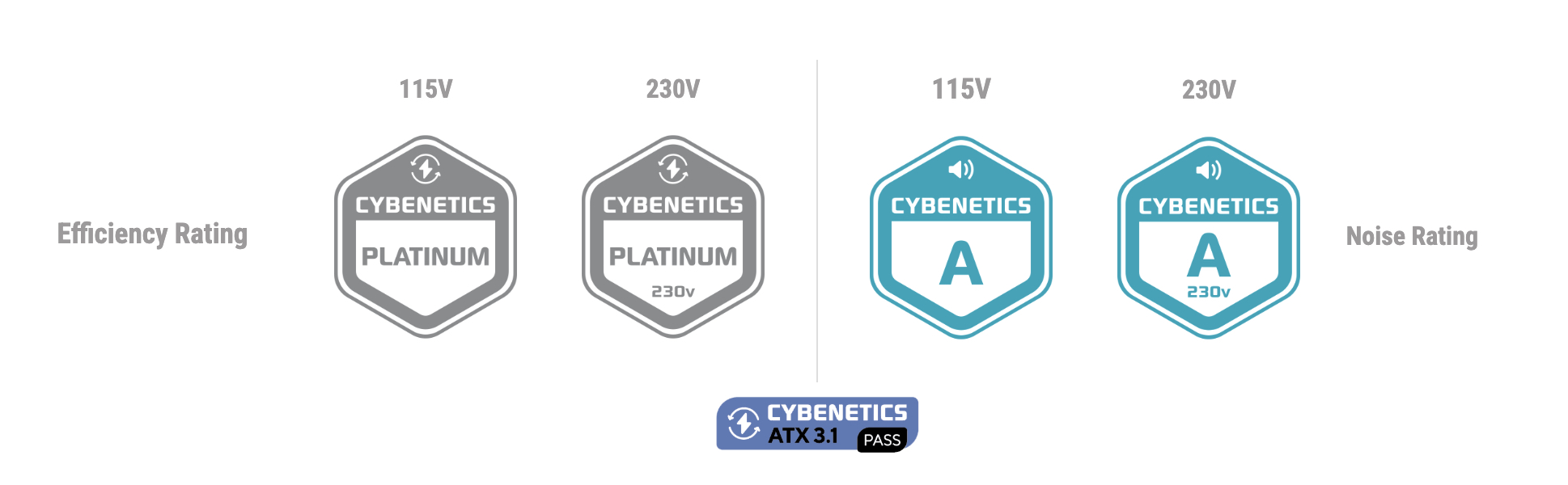
As mentioned earlier in the review the Endorfy box highlights the 80 Plus Gold badge with no mention of Cybenetics certifications. We did ask Endorfy about this and they told us that this unit had since passed certification with Cybenetics recently. The approvals are shown above. As I continually say in our power supply reviews, the only ratings worth anything now are Cybenetics.
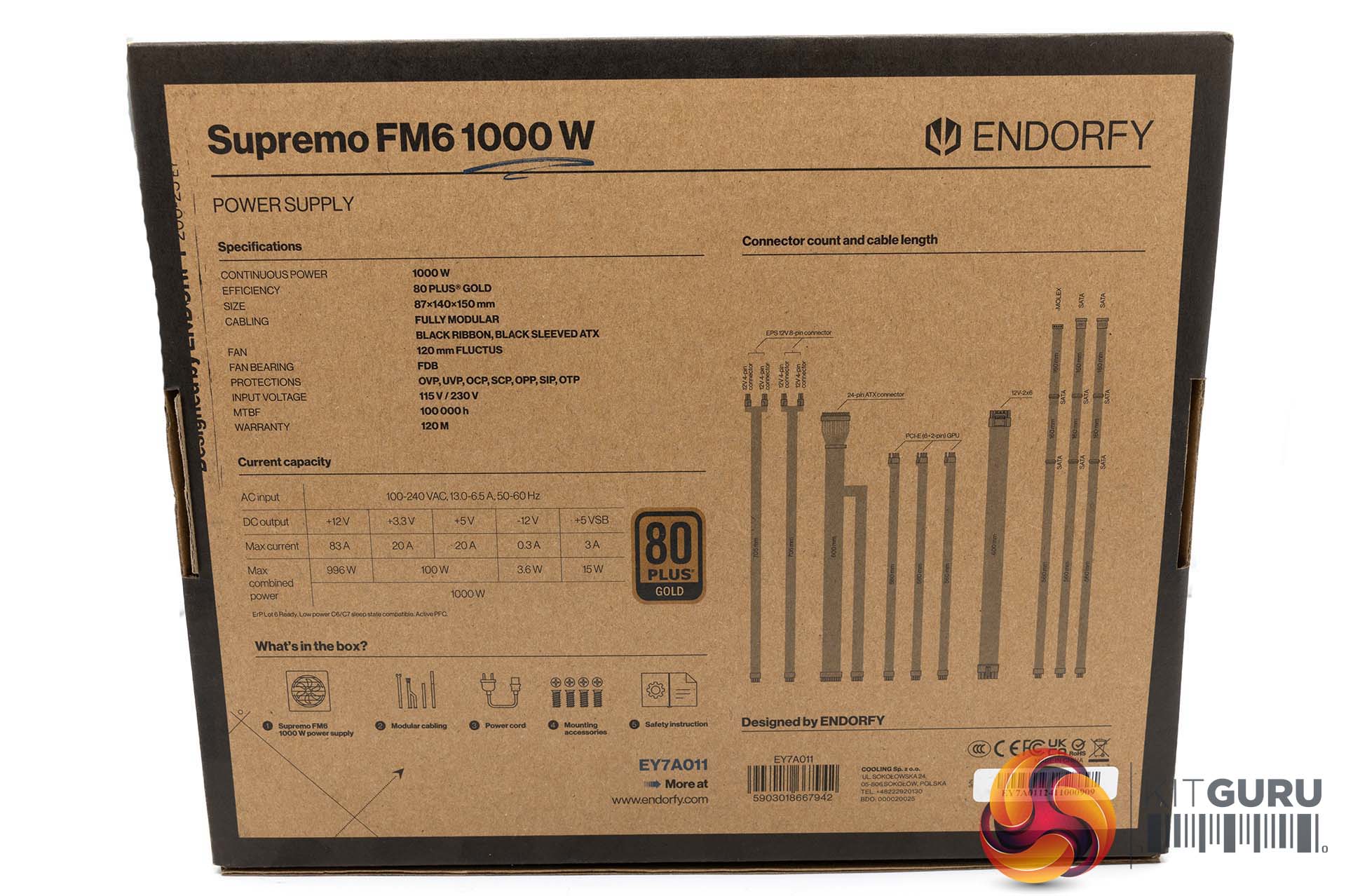
The rear of the box gives a list of primary specifications such as the dimensions, the fan and mean time before failure, along with protections. It is pretty basic box design, but effective enough.
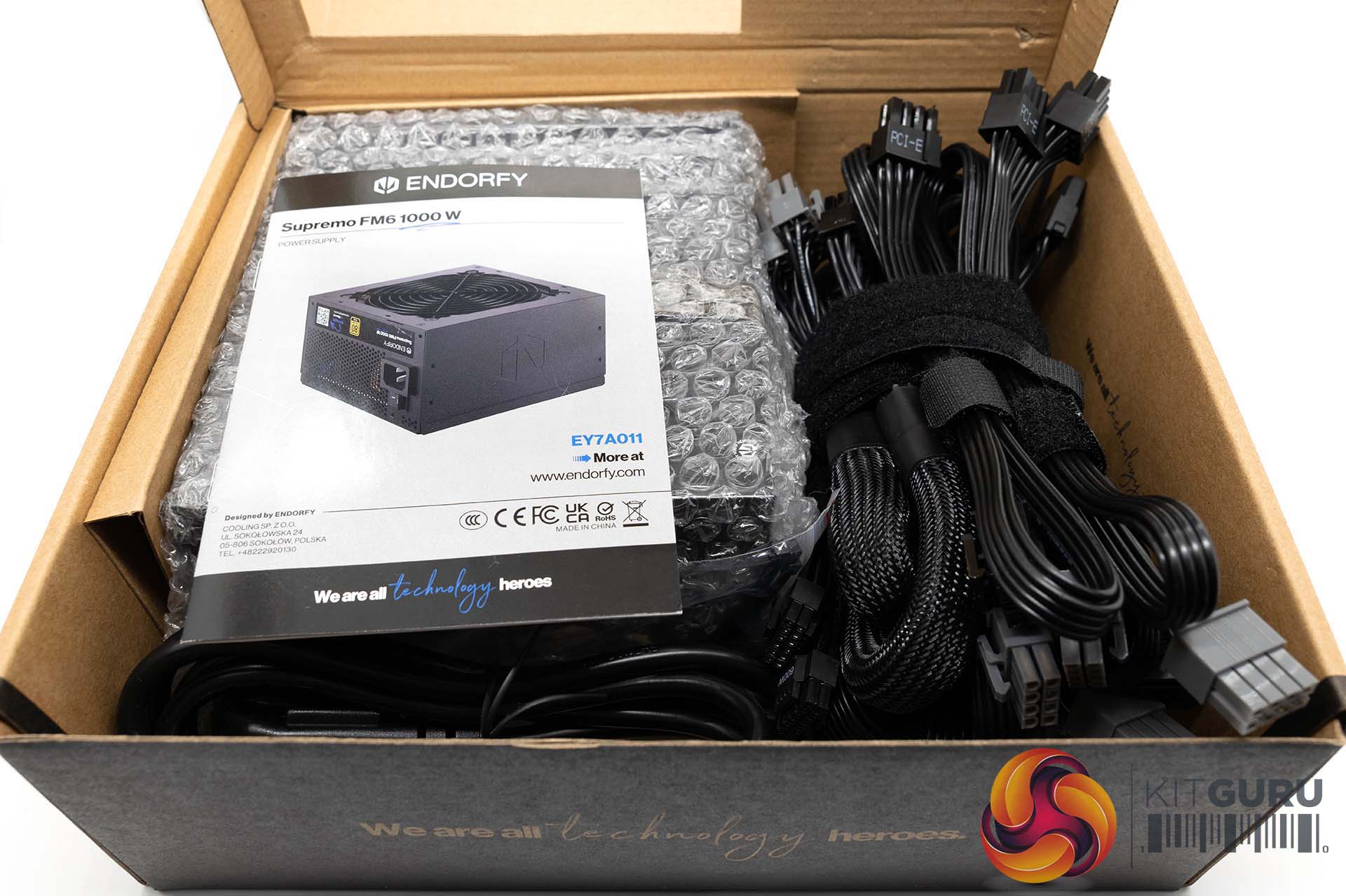
Inside the box the power supply is protected with some bubblewrap. The accessories and cables take up the remainder of the box.
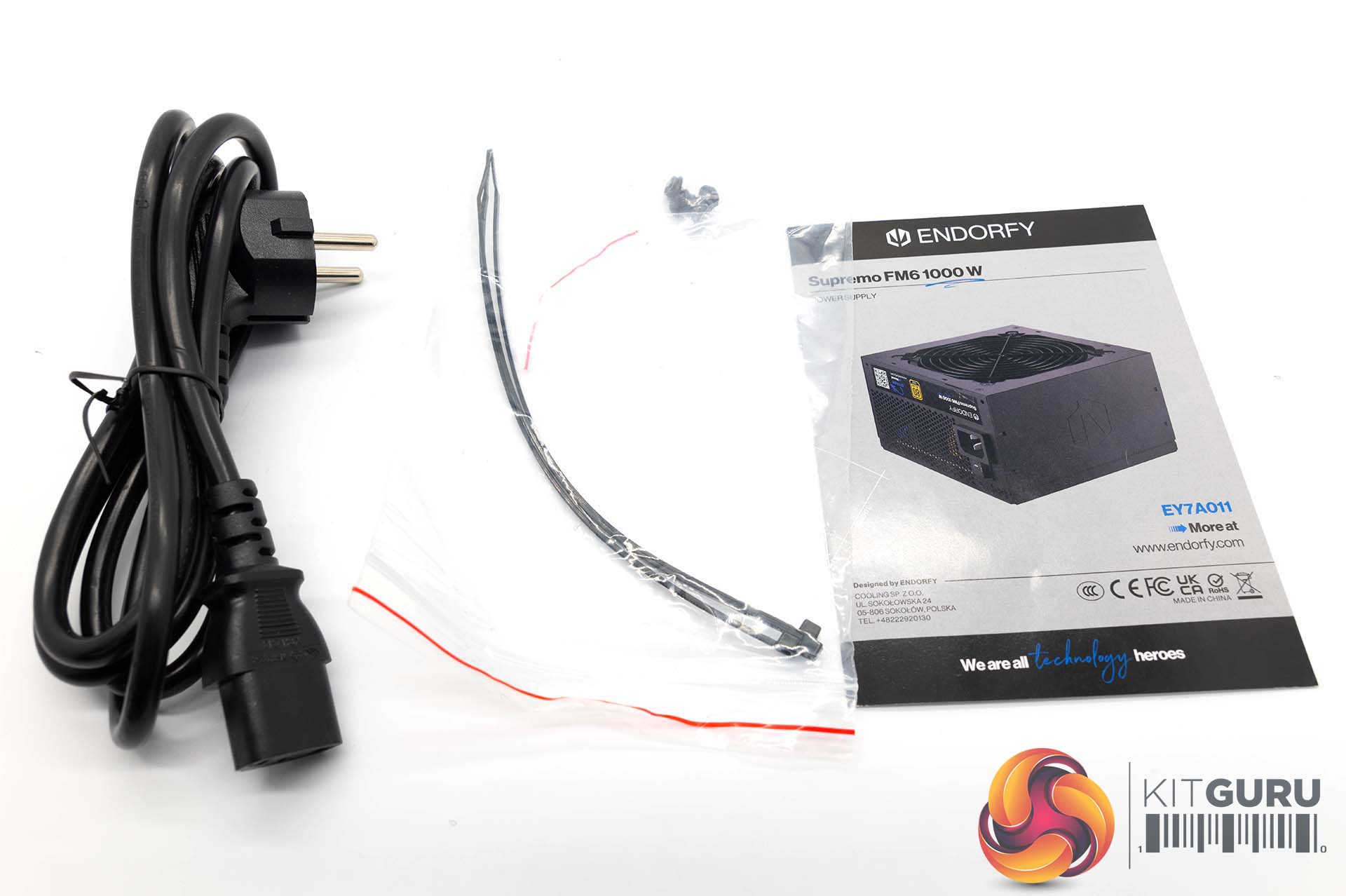
The accessories include a C13 specific power cable (we got a European cable, but you should get the right one for your region if you buy it locally), some cable ties, a user manual and mounting screws. All you really need to get the power supply installed into your system.
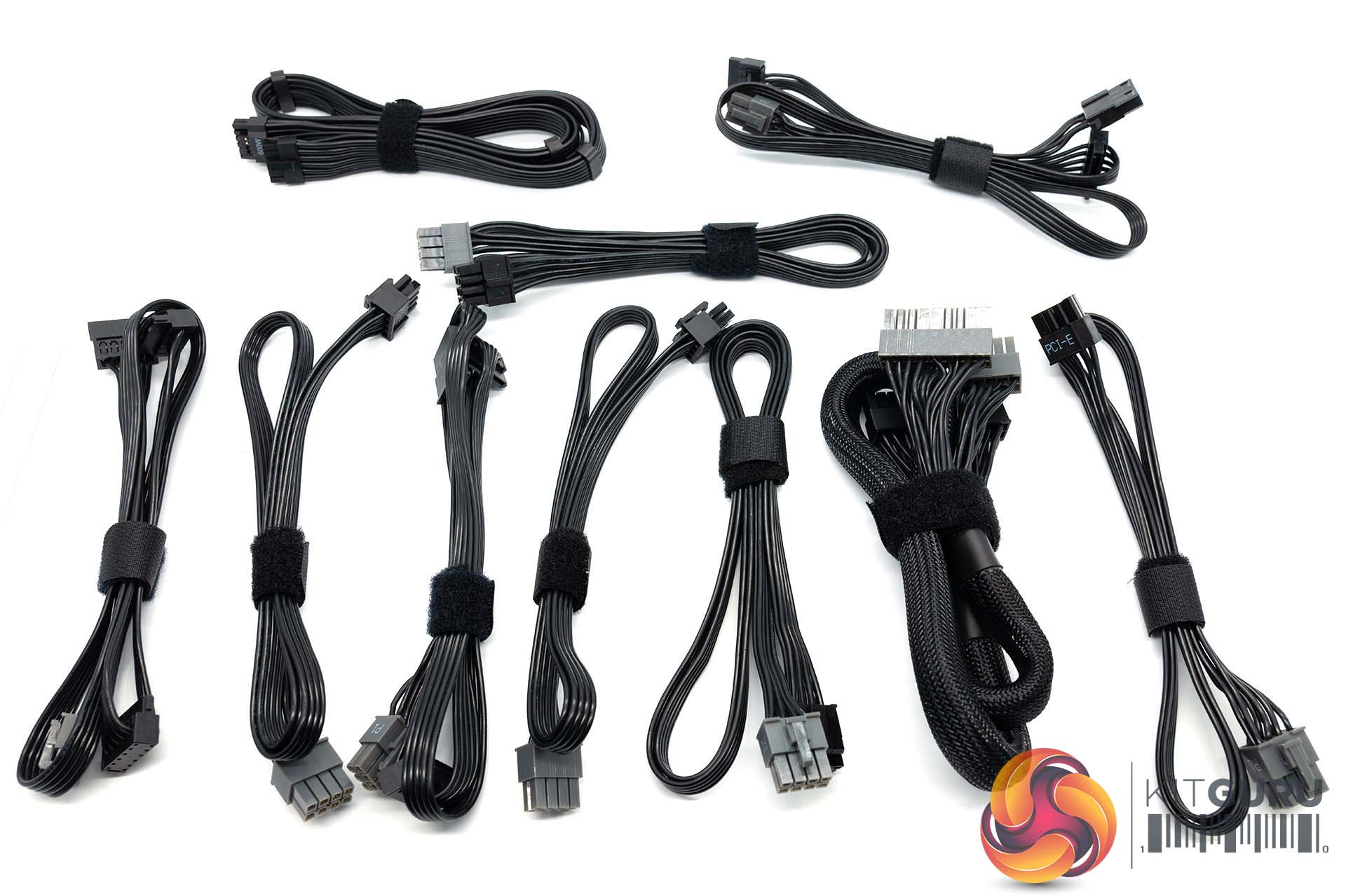
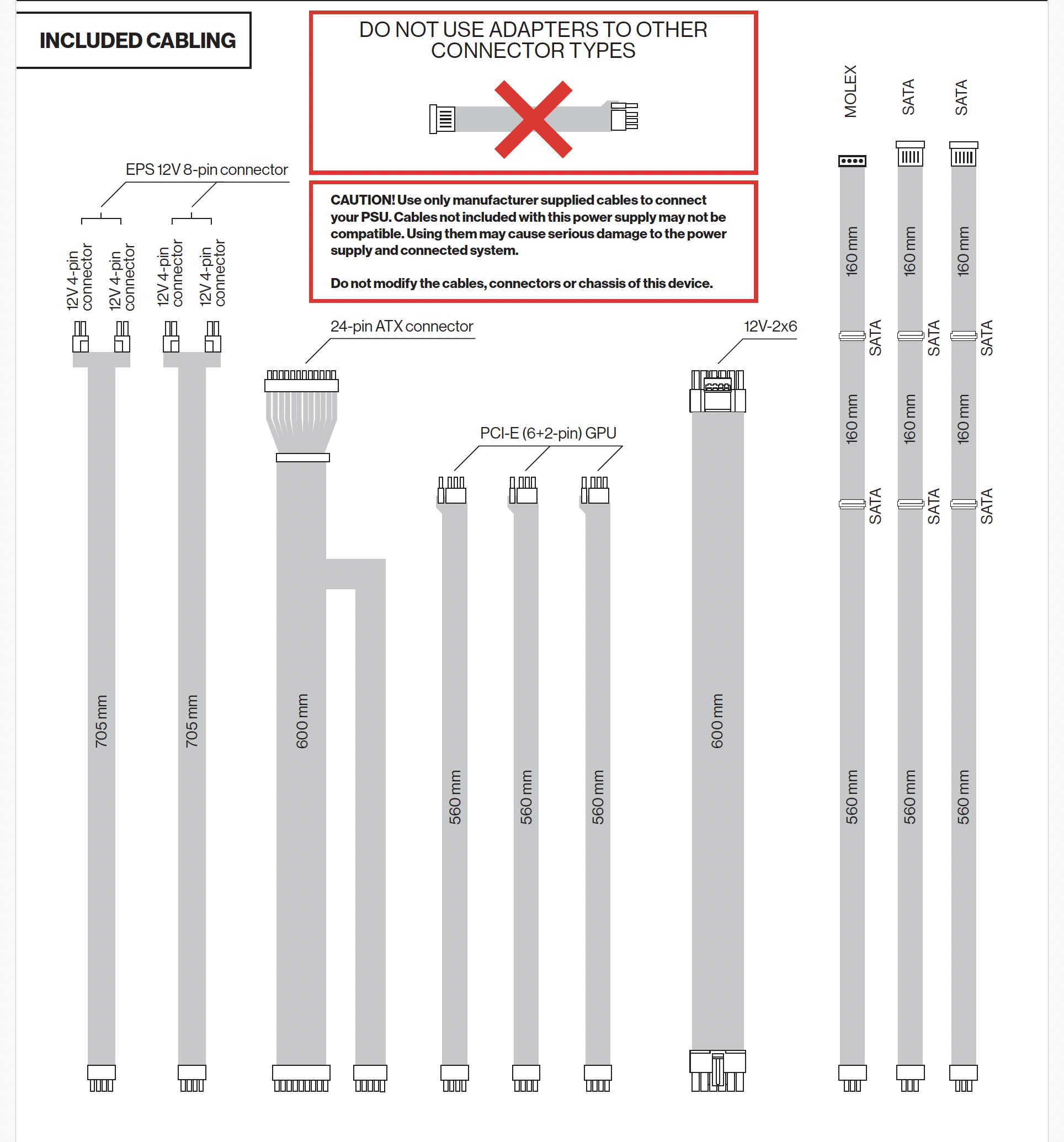
Endorfy include a range of ribbon/flat style cables which prove easier to route in a modern system. None of the cables have in cable capacitors and they are reasonably high quality throughout. The ATX connector is 18-20AWG and the 4+4 pin EPS12V measures 710mm and is 18AWG. The PCIe cables are 560mm long and 18 AWG. SATA cables are also 18AWG and measure 560 mm with 155mm lengths between. The 12+4 Pin PCIe cable is 605mm and is rated to 600 watts. It is 16-22 AWG Gauge.
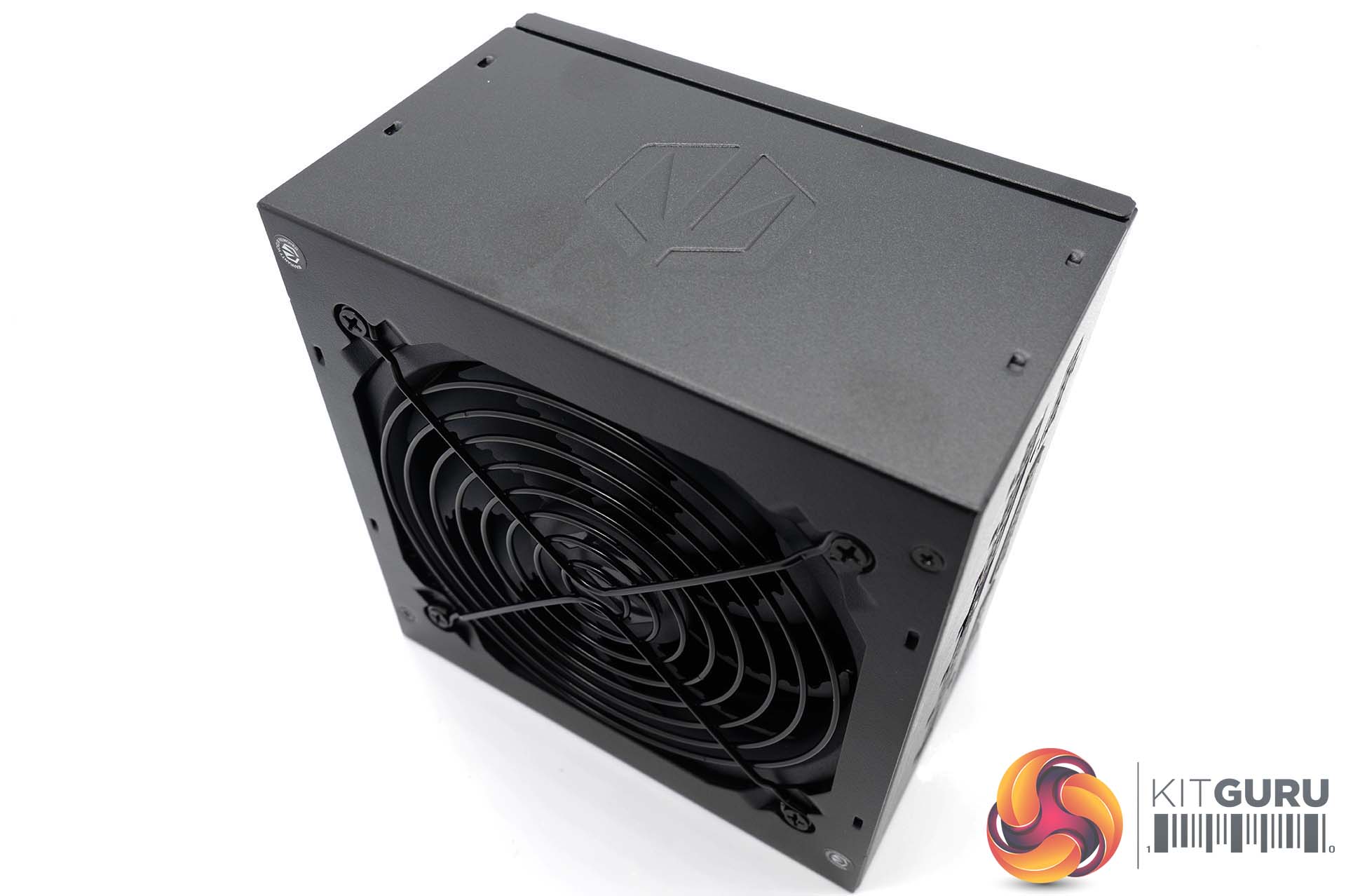
The Endorfy Supremo FM6 1000W is a pretty simple design, its basically just black with some company branded logos embossed into the side panels. The power supply measures 87mm x 140mm x 150 mm (HxWxL) and the finish is pretty good overall. It weighs around 1.5kg.
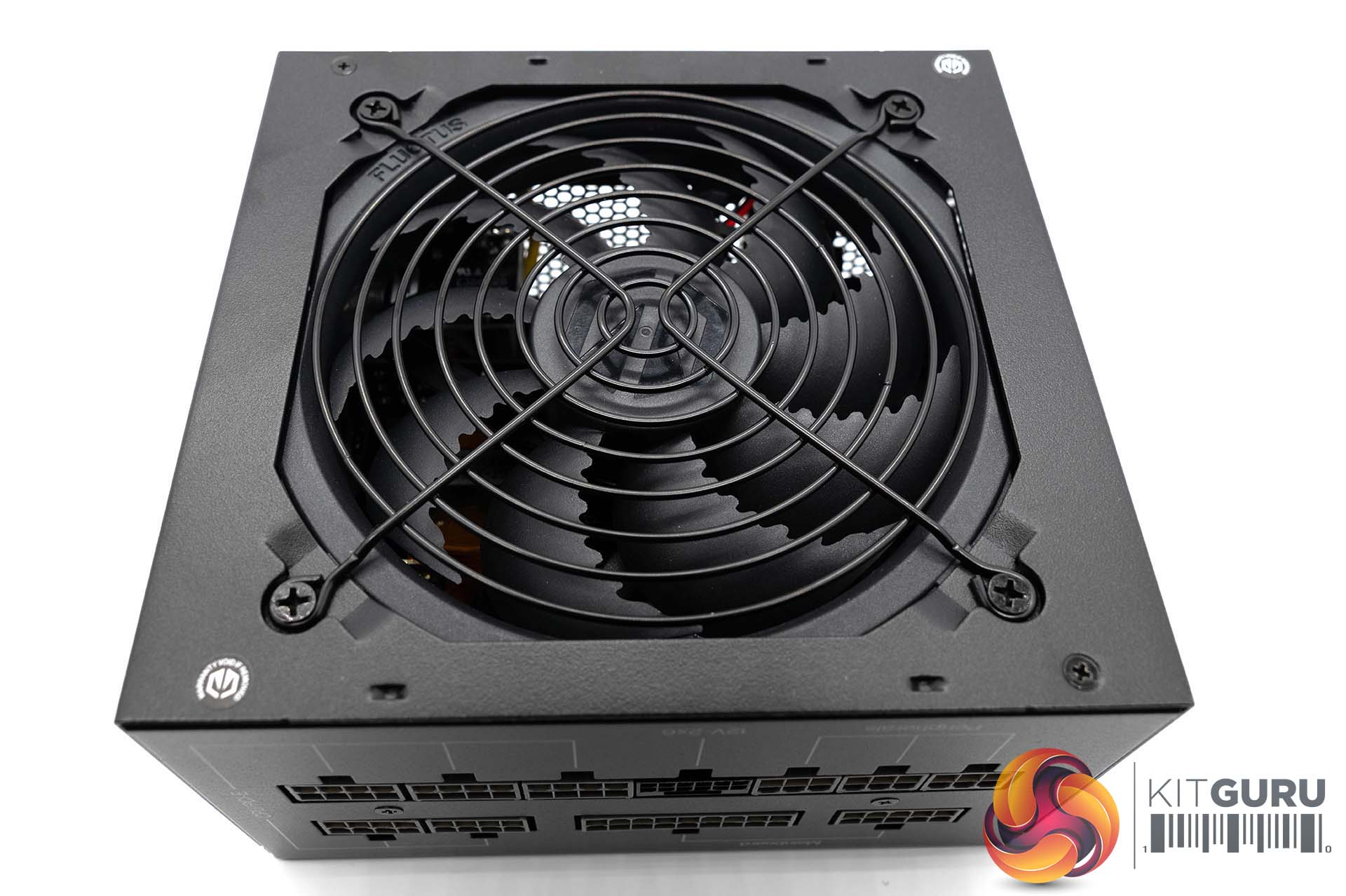
The fan is hidden behind a black grille at the top of the unit. We will take a closer look at the fan when we open the power supply later.
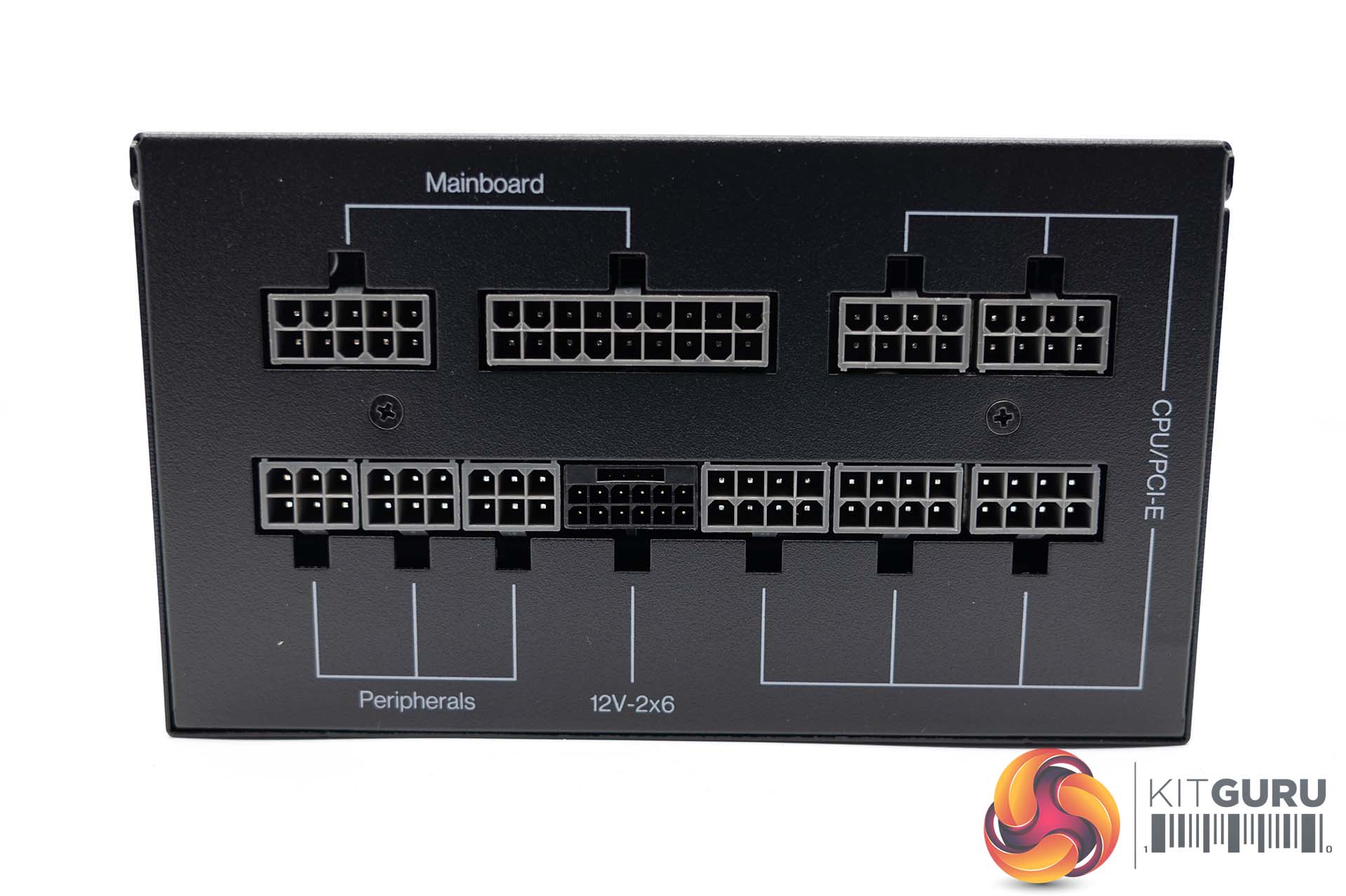
The modular bay is split across two rows as shown in the image above. Its a very simple layout with the 12v-2×6 port in the centre position along the bottom row.
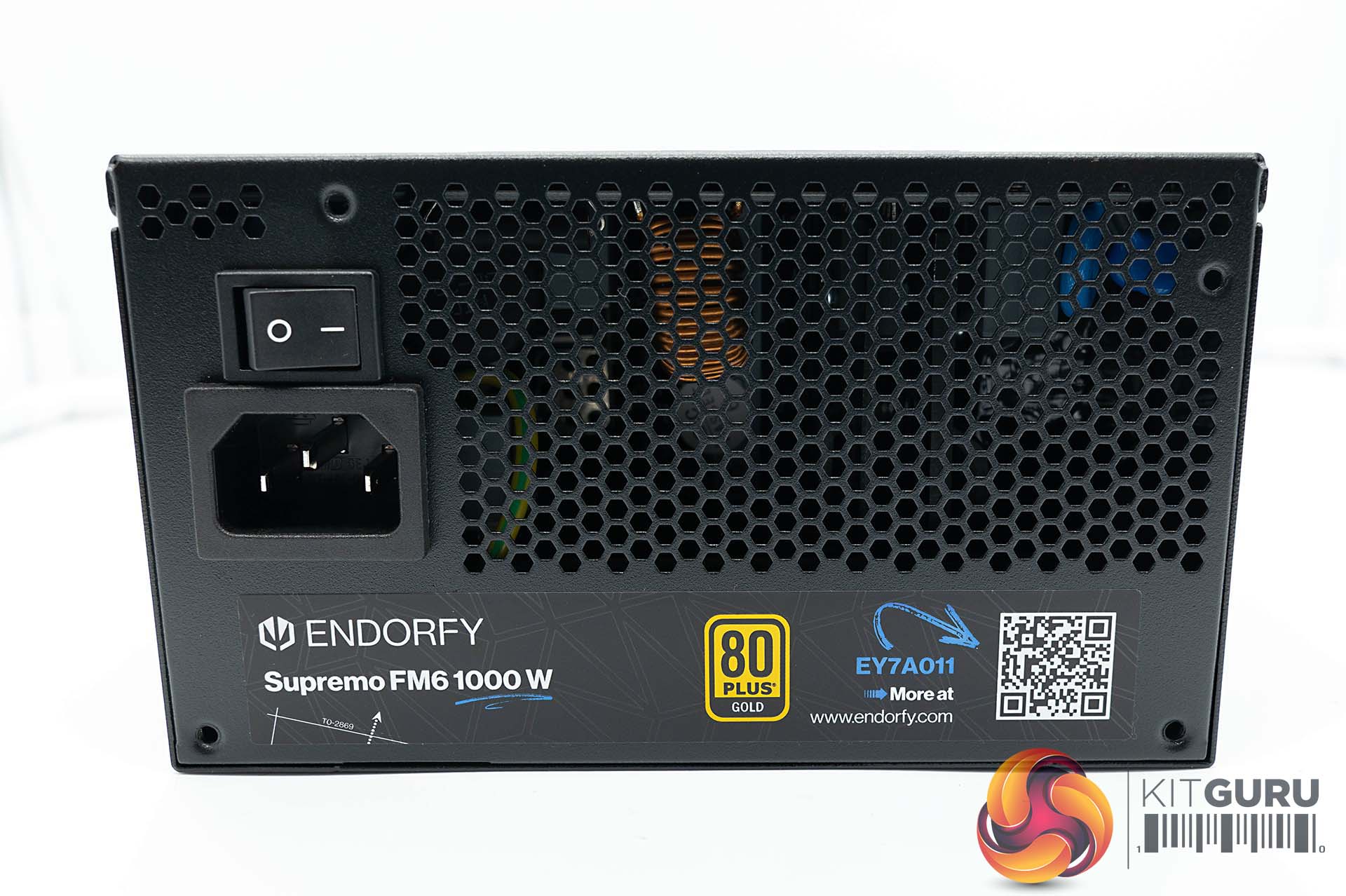
The power side of the unit is home to a power connector, and switch. No zero mode on this unit. There is also a honeycomb cutaway panel to aid with airflow on this side.

This unit can deliver 20A across the minor rails, and 83A from the primary +12V rail. for a total of 1000 watts of power.
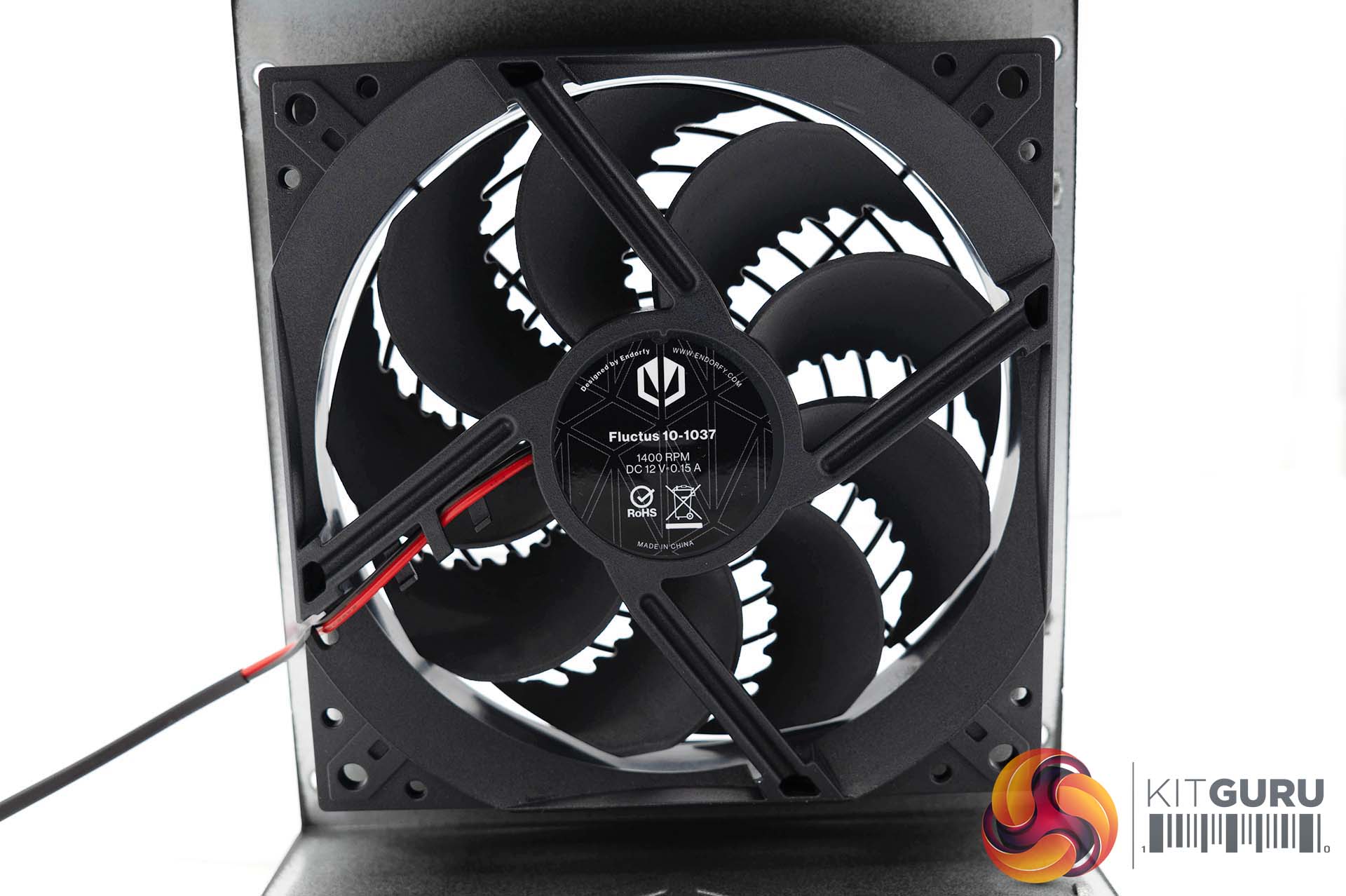
Endorfy are using a Fluid Dynamic Bearing (FDB) fan in this unit, one we have seen before in 2023 – in the Supremo FM5 Gold 1000W PSU. This fan is rated at 1,400 rpm, 12V, 0.15A. Its a 120mm fan with a speed range between 600 and 1,400 rpm.
The MTBF (mean time before failure) is rated at 100,000 hours, which is a pretty standardised rating. This is a good fan and based on previous experience it does run fairly quiet if the fan profile is configured properly. There is no partial plastic panel on this to direct airflow over specific components which is a little unusual.
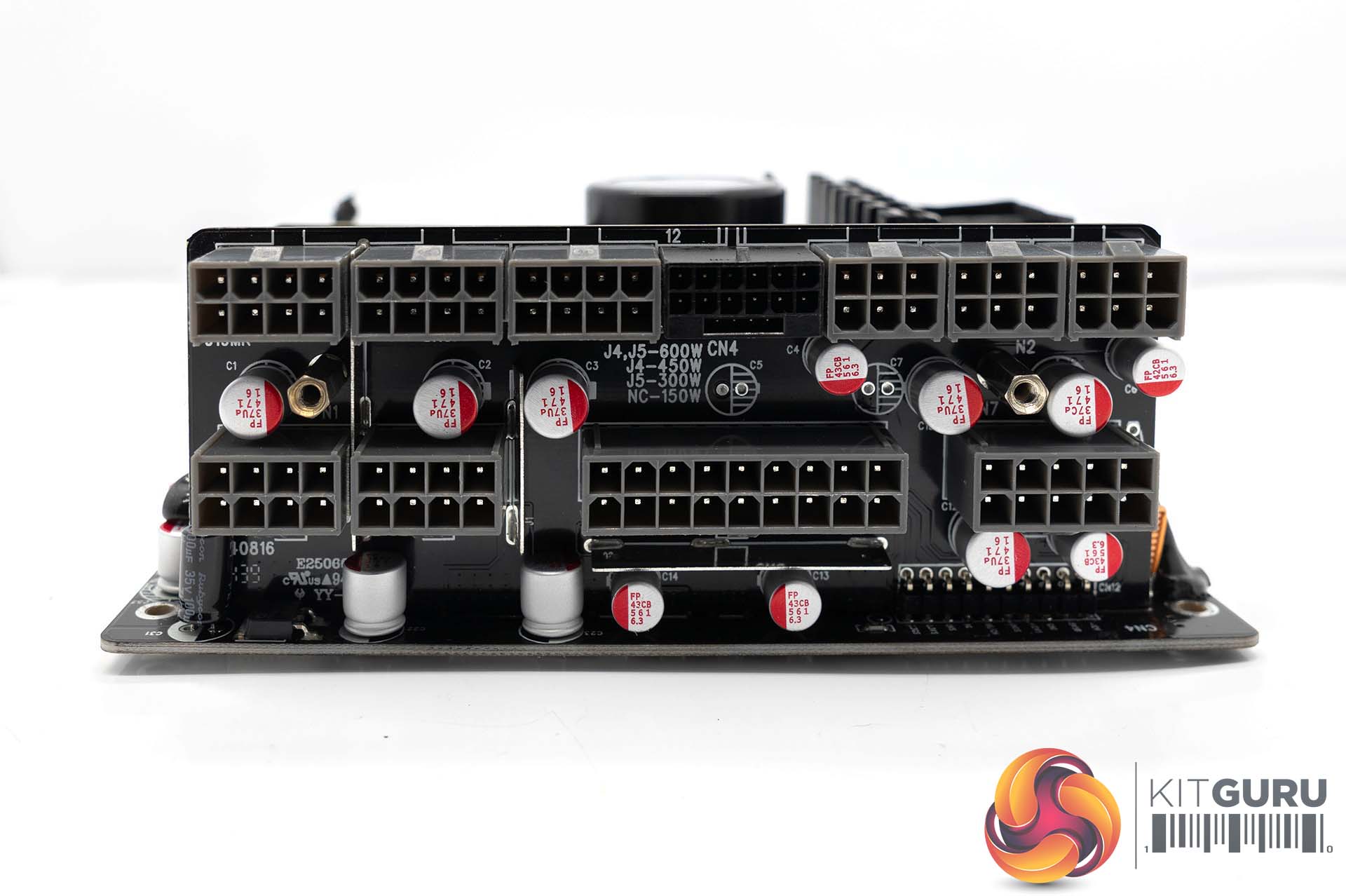
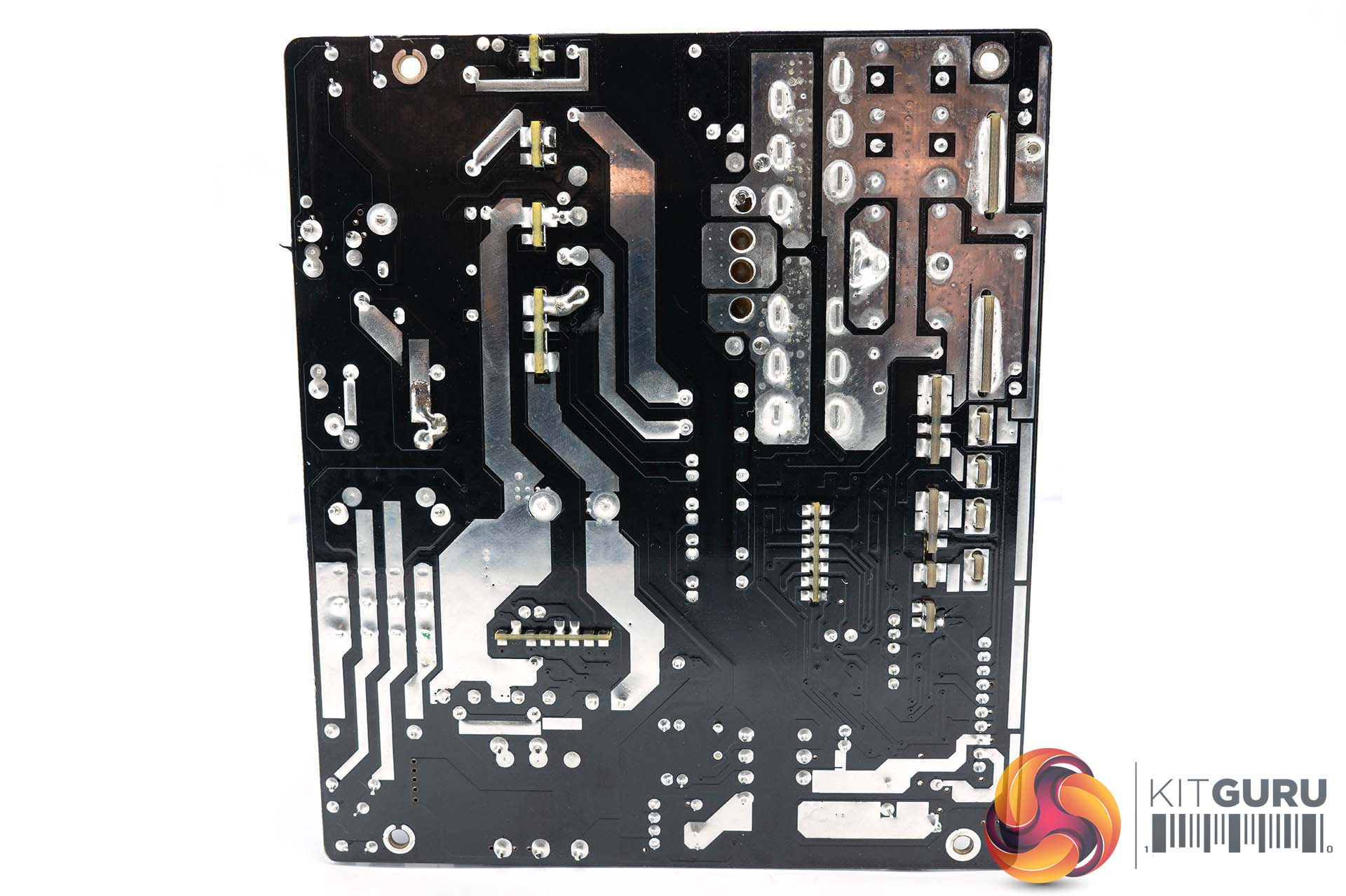
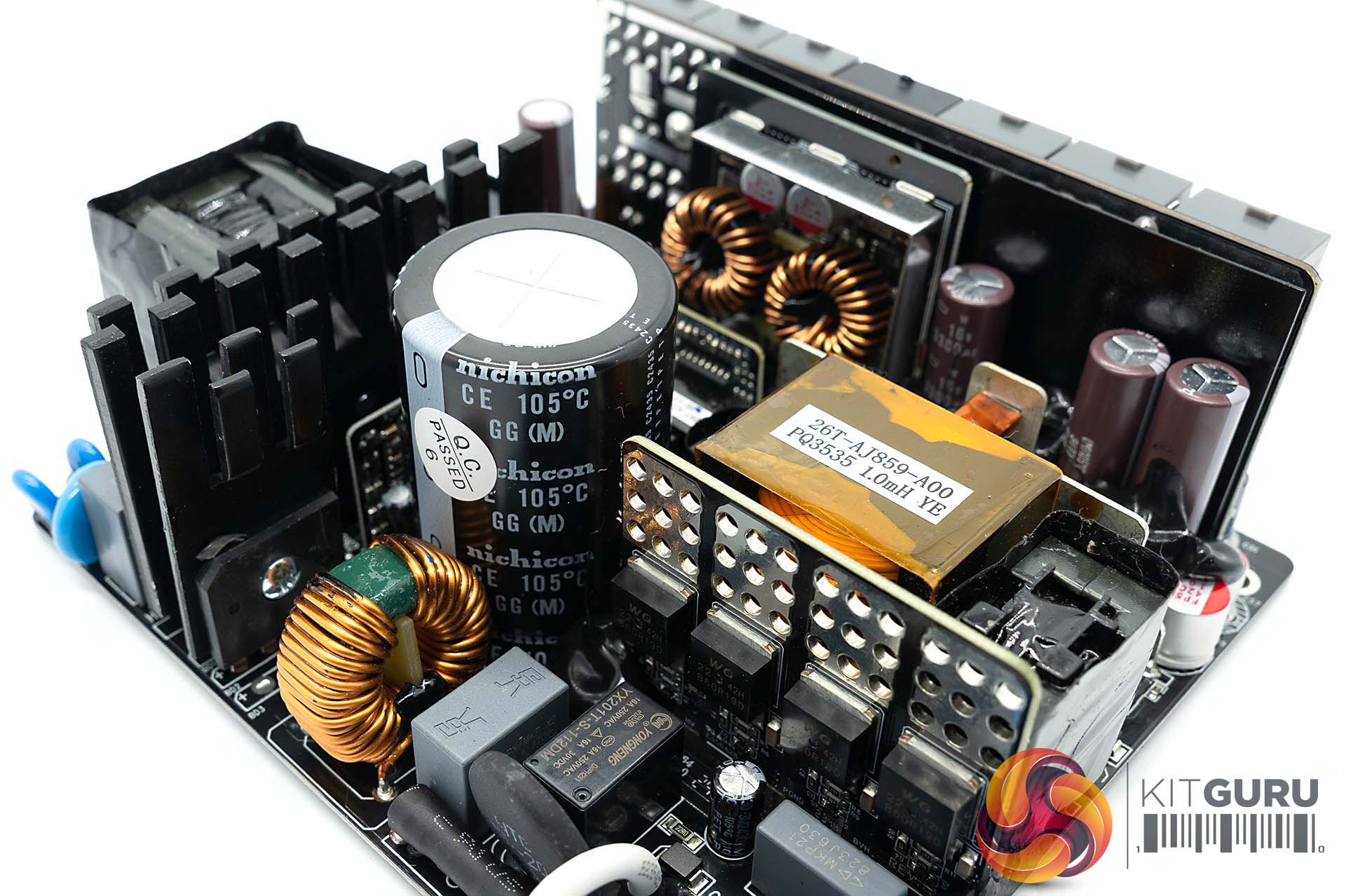
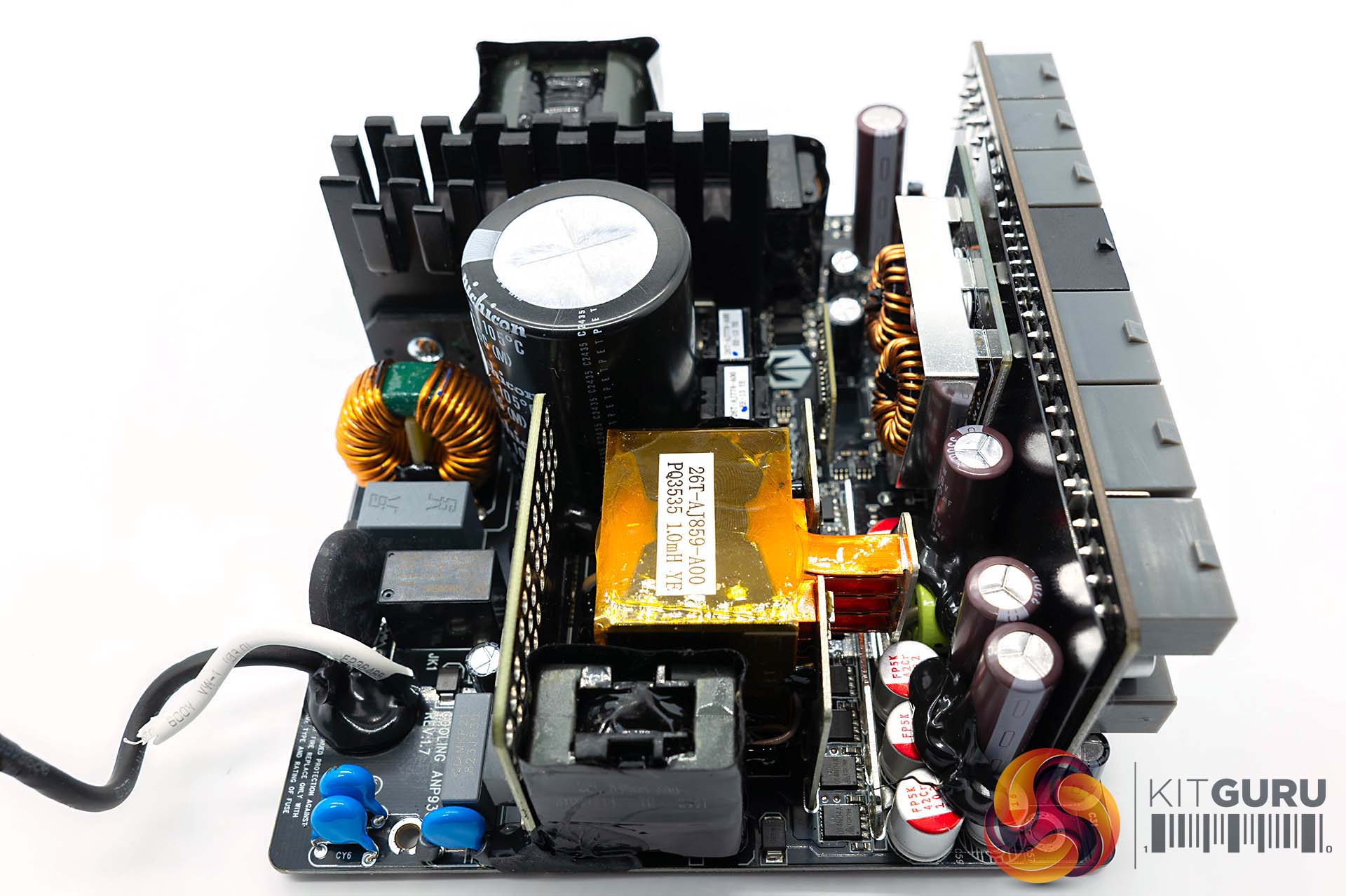
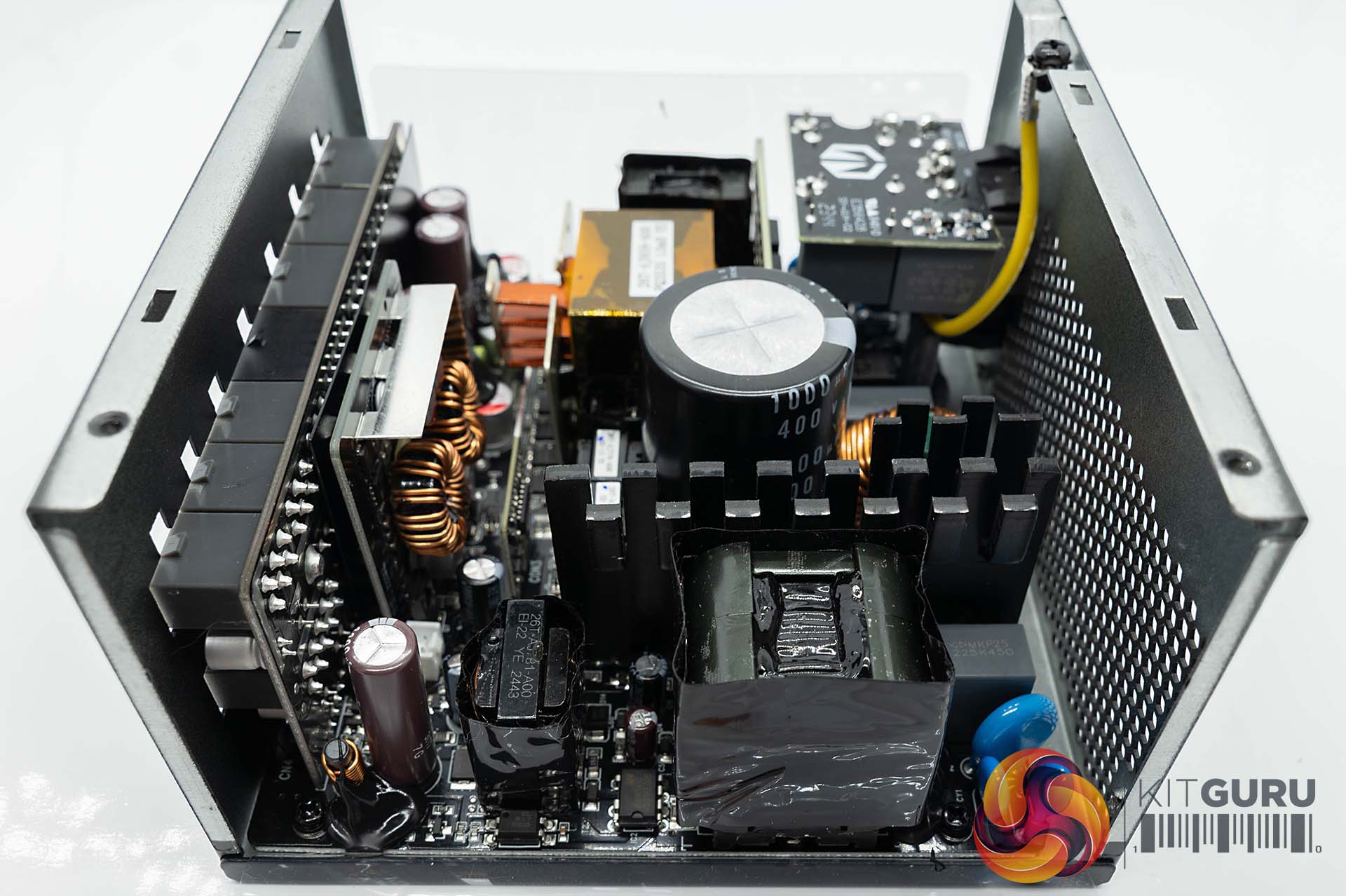
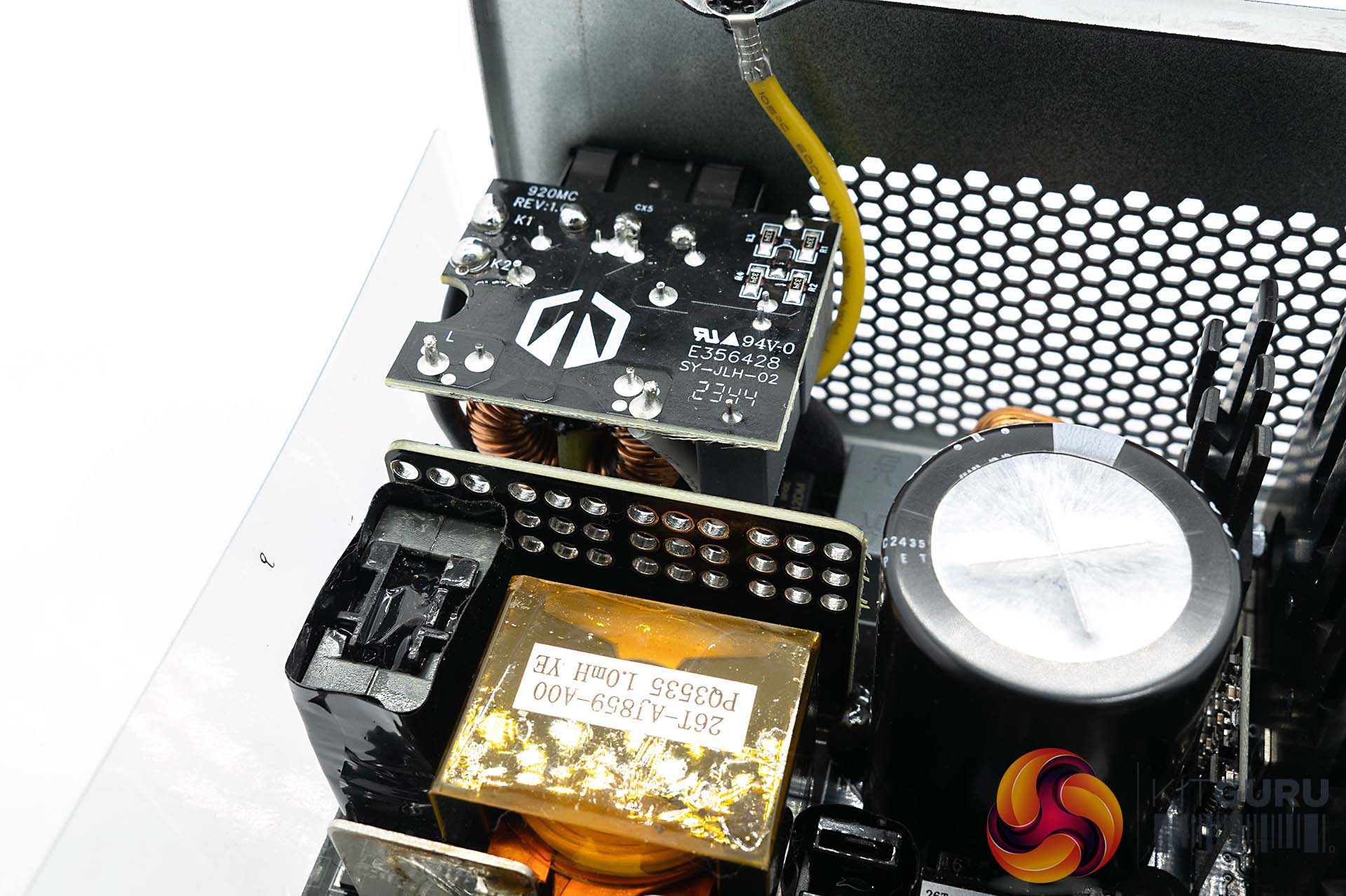
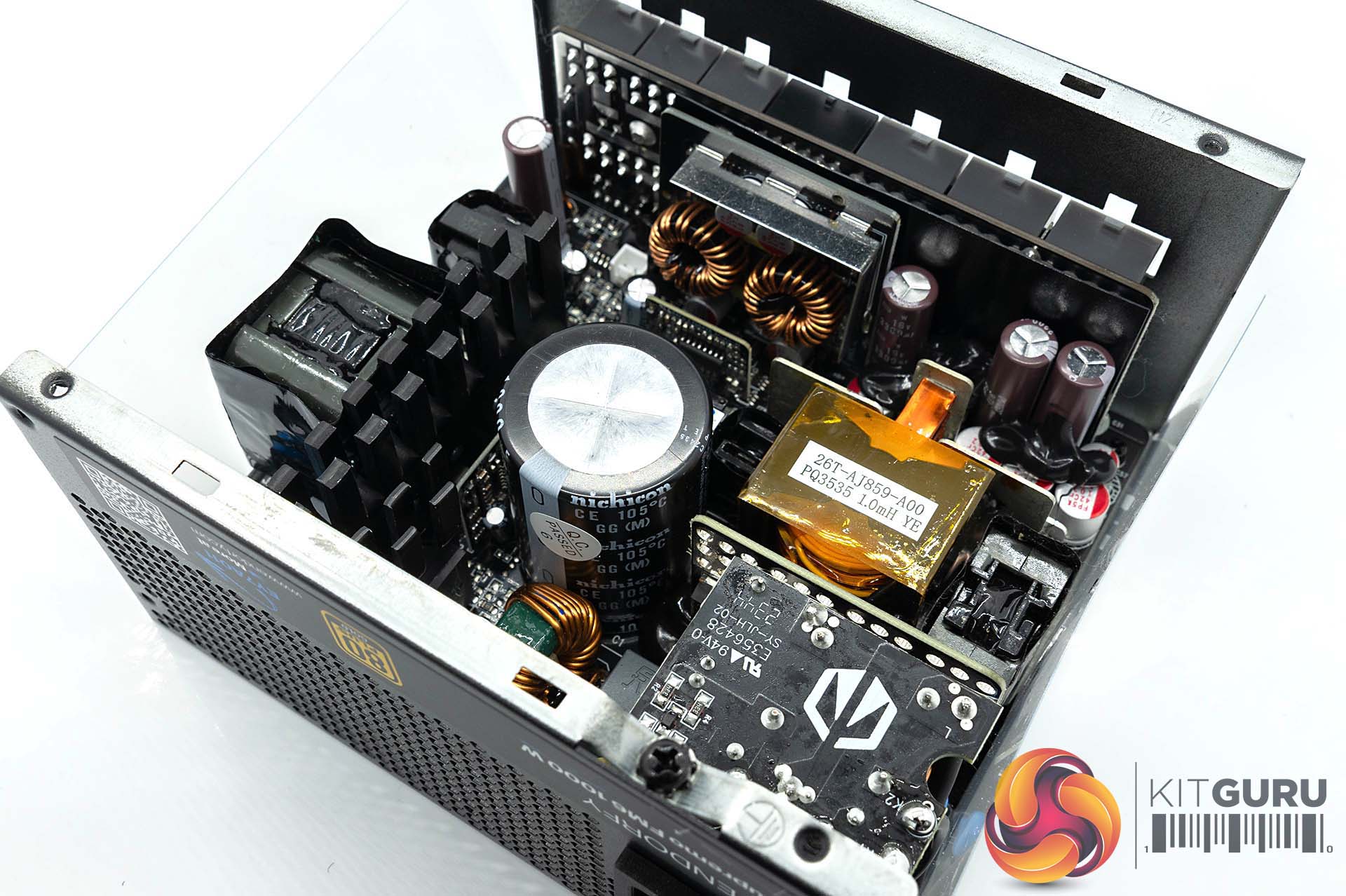
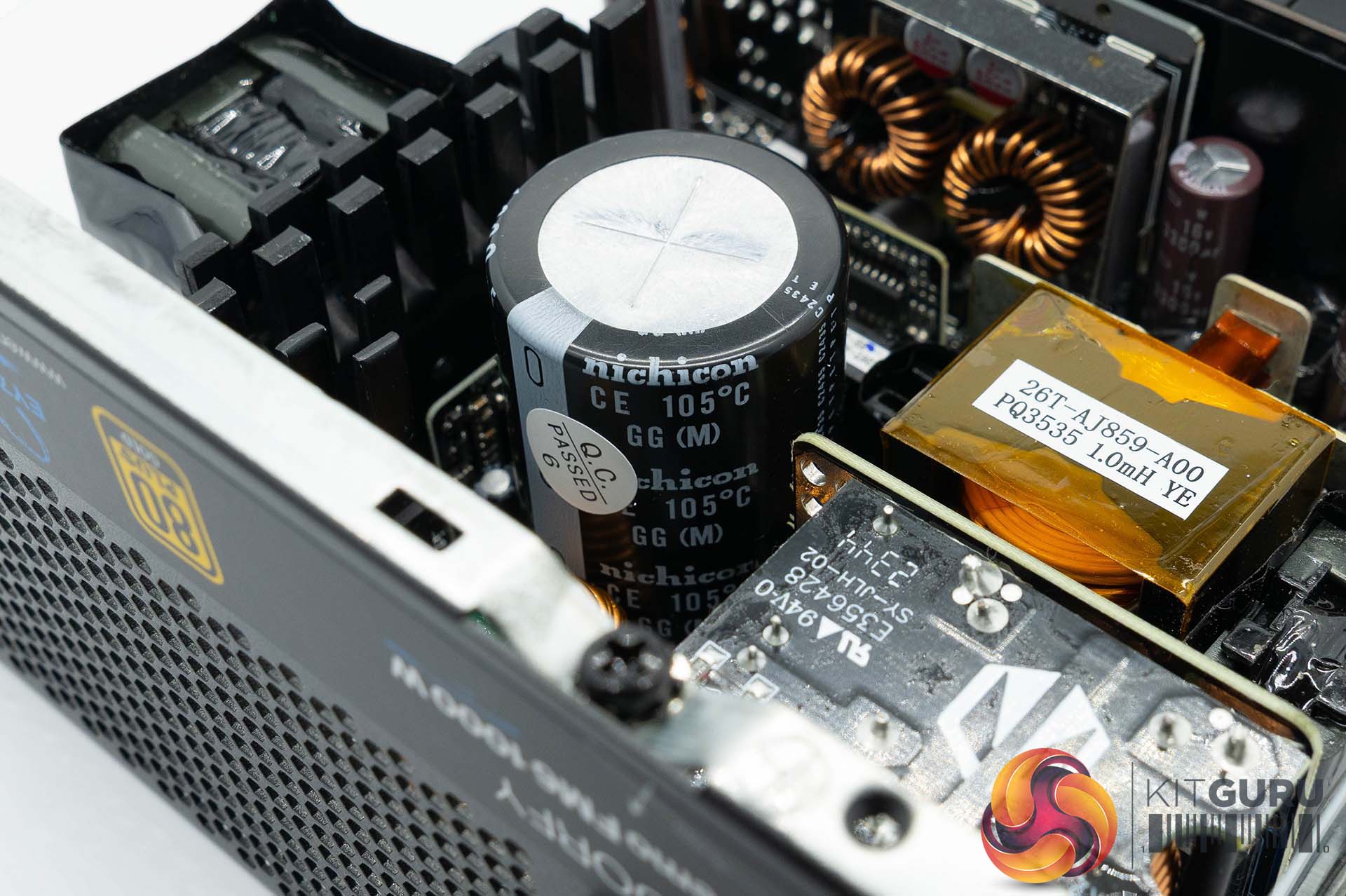
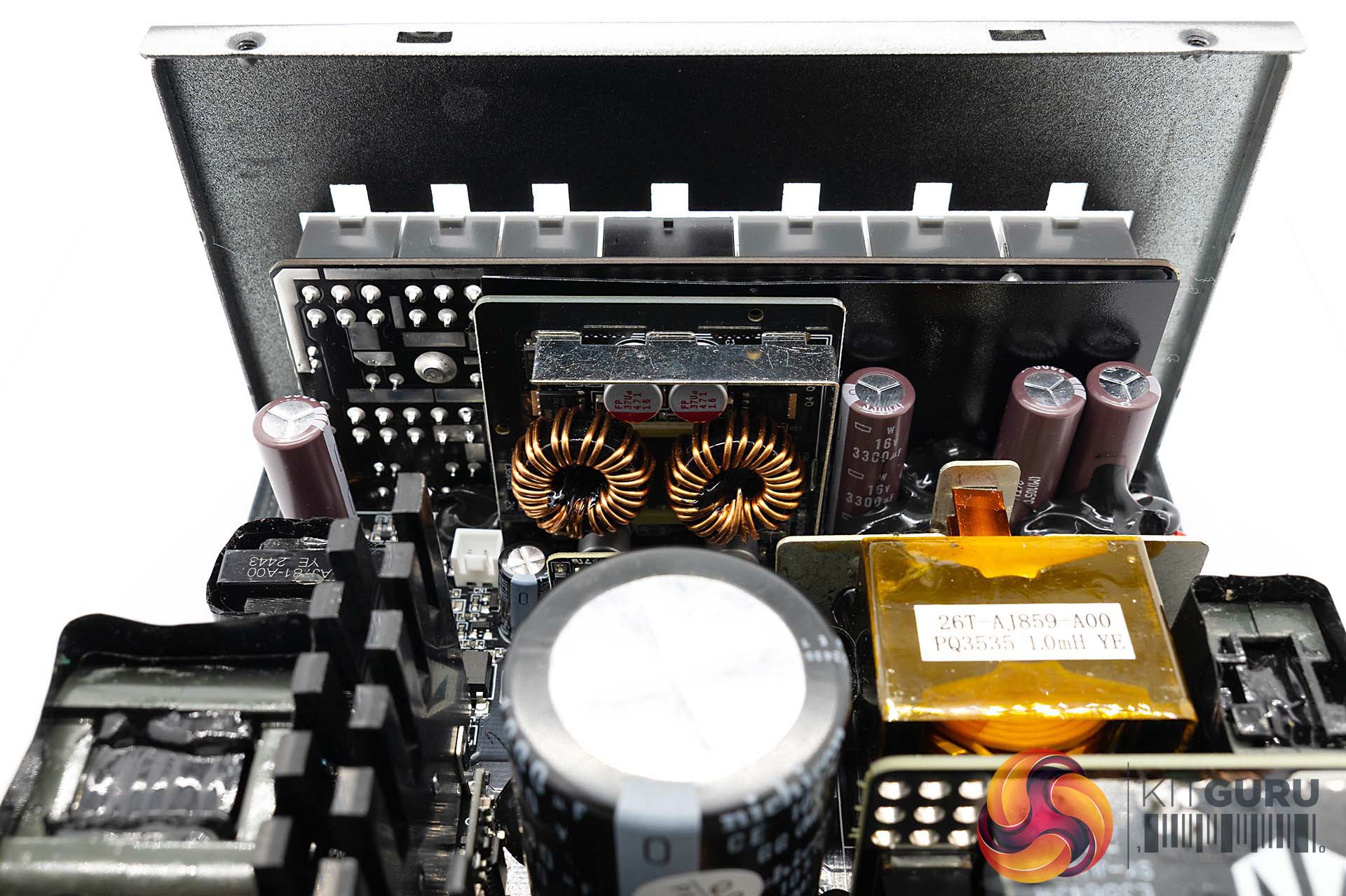
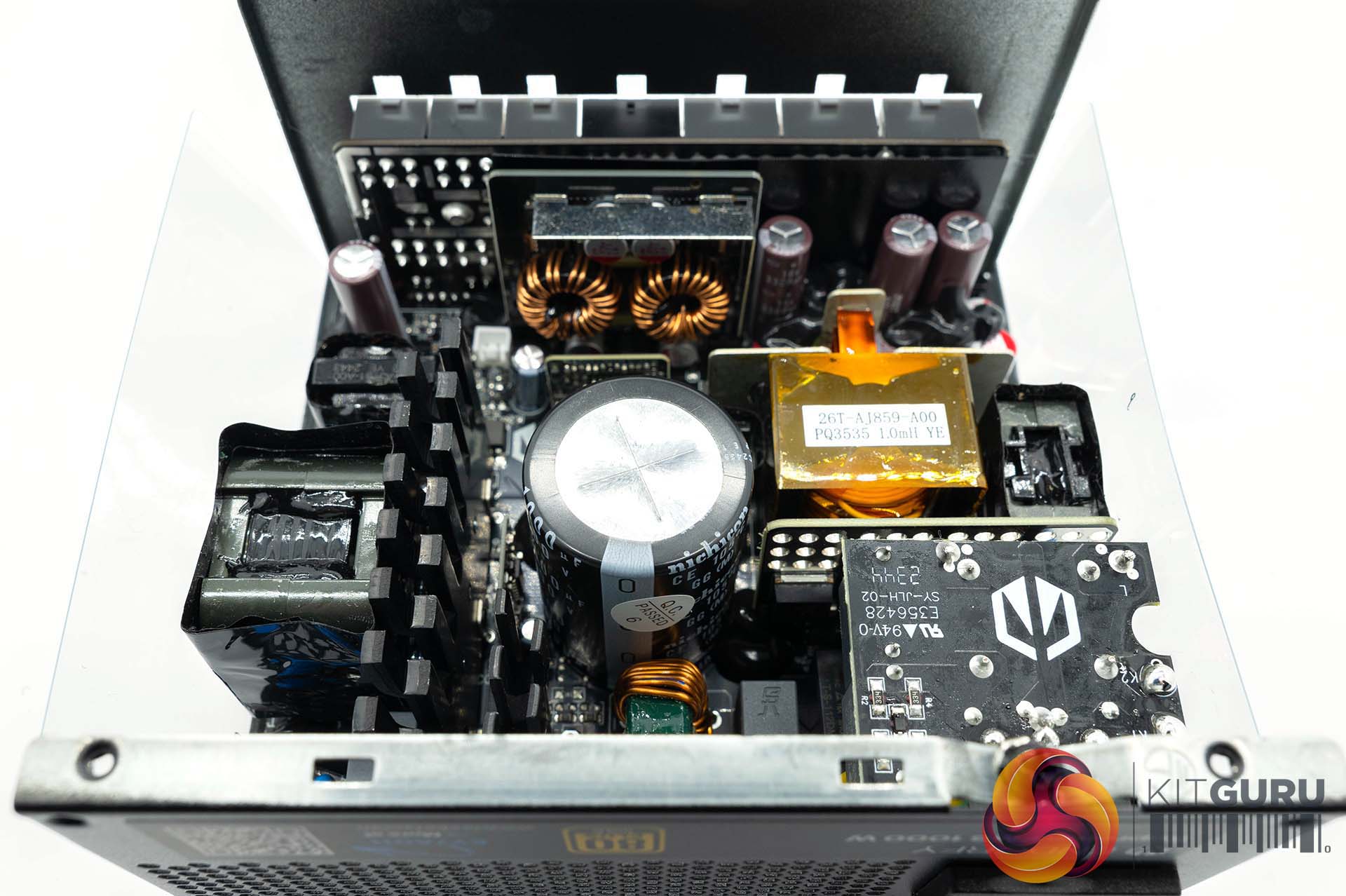
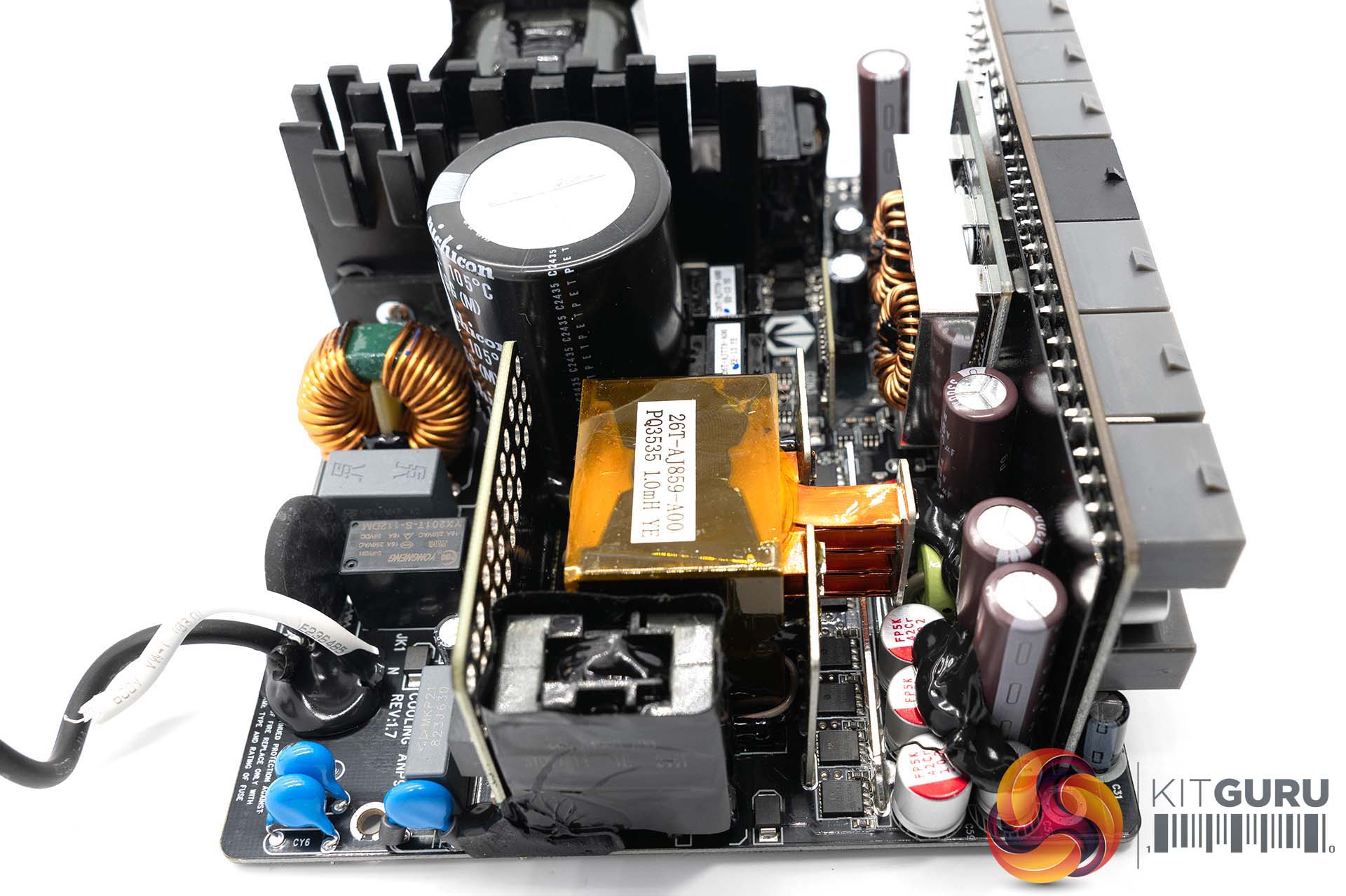
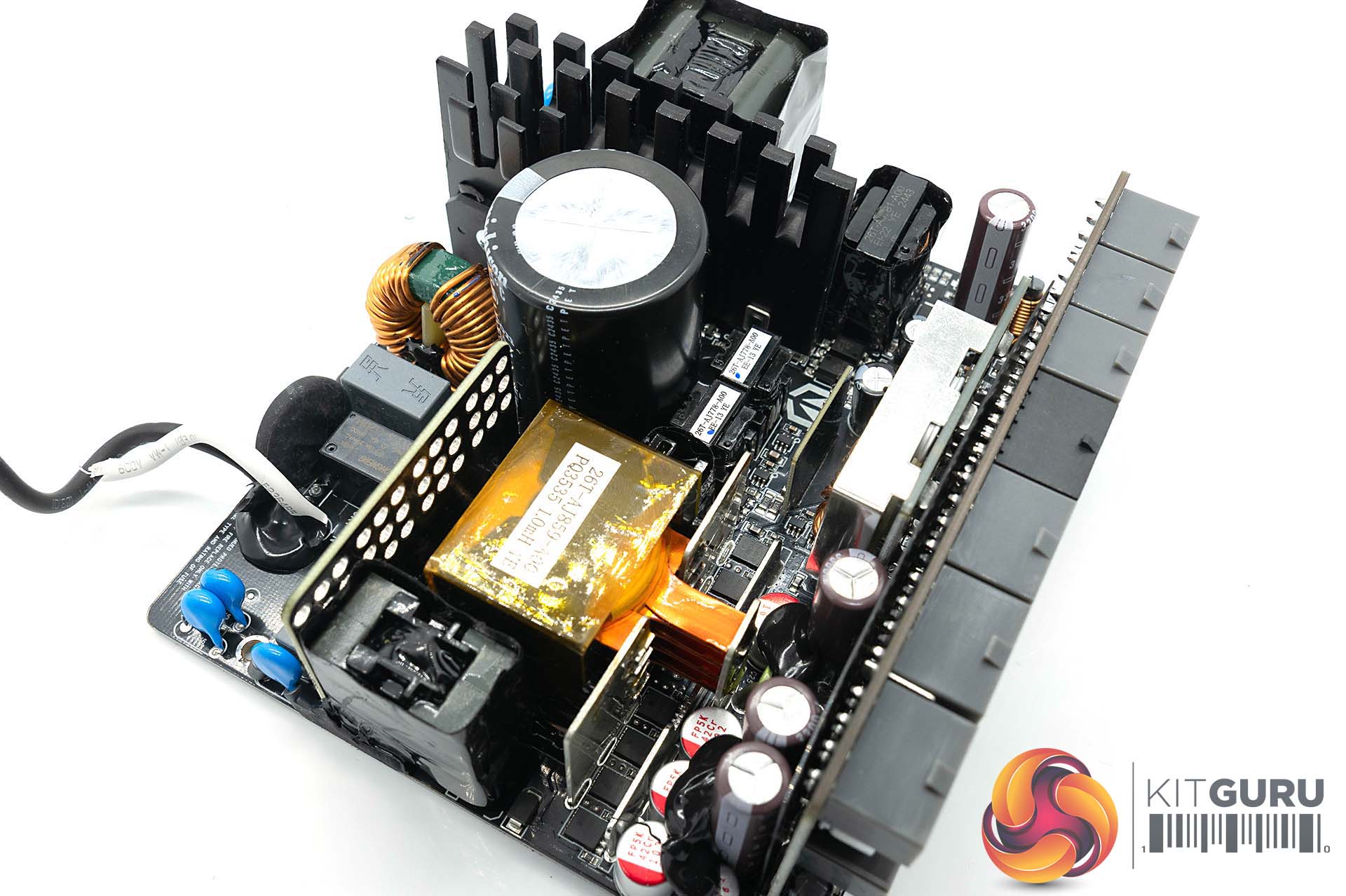
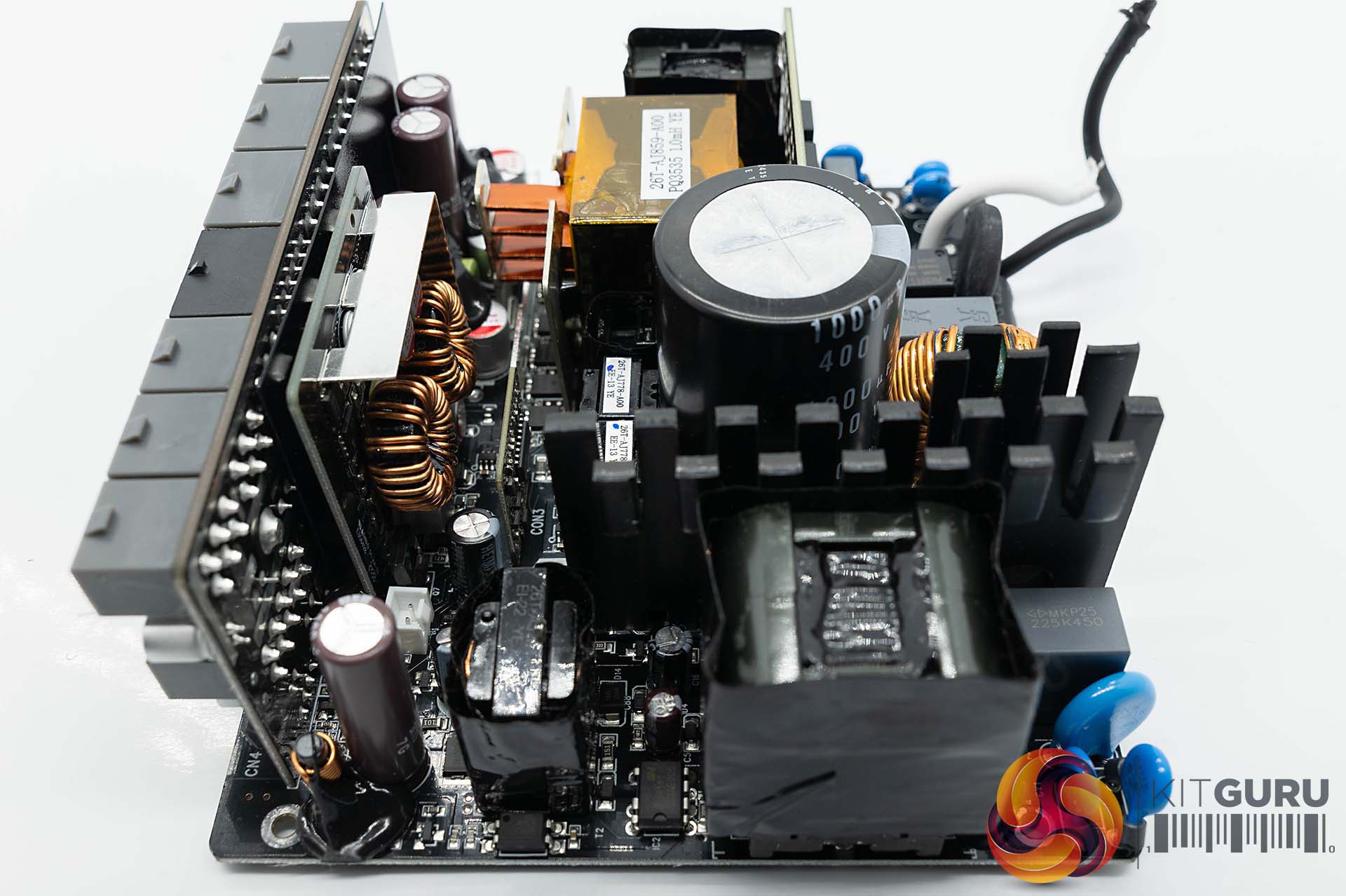
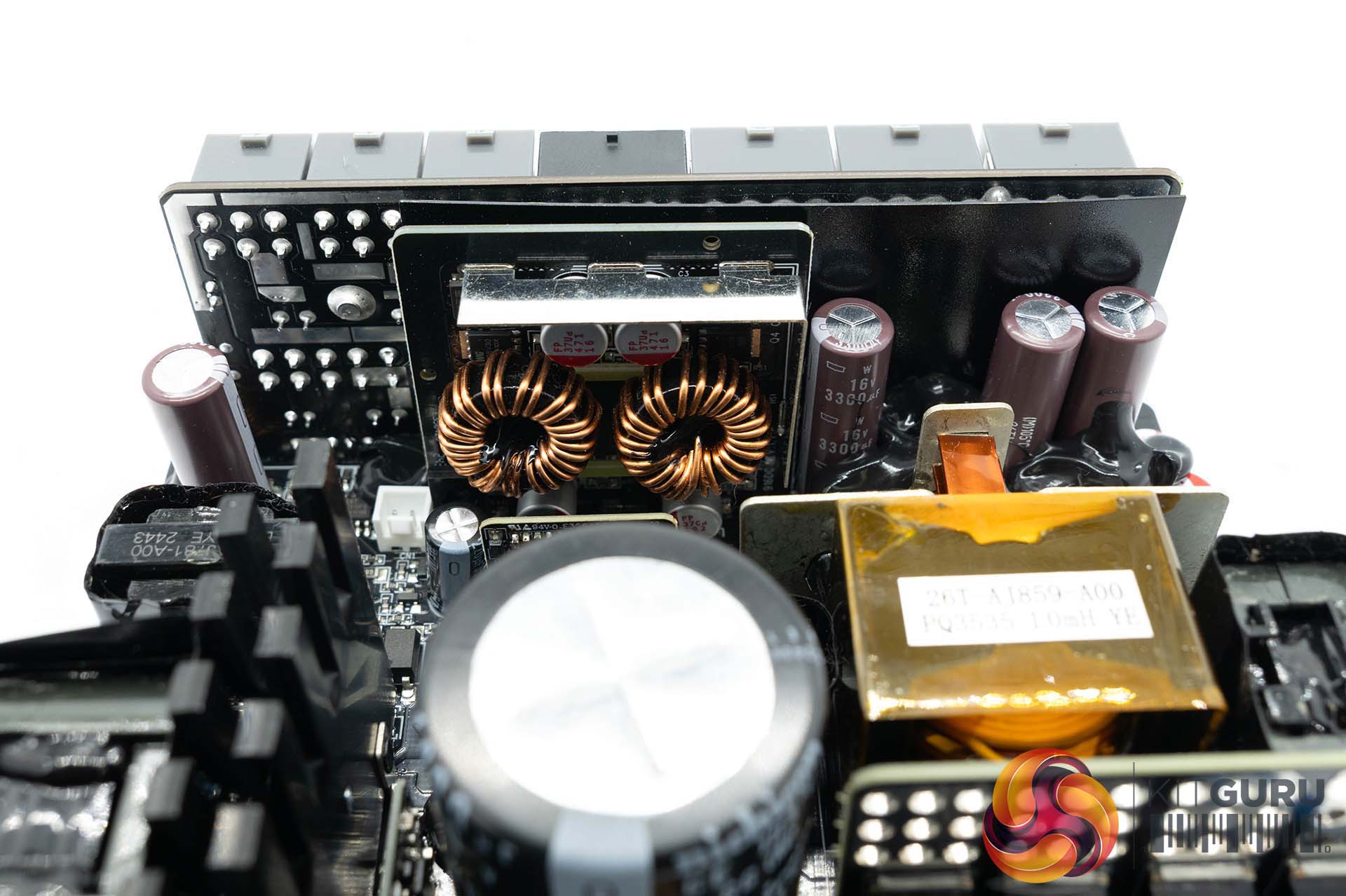
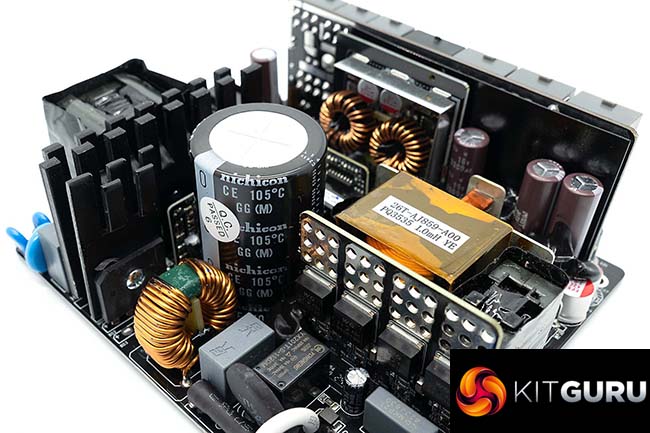
We can see that Endorfy are using SAMA as the OEM for the design, with clearly some design decisions in place by Endorfy themselves. The PCB soldering is very clean as you can see by the images above when we disassembled it and Endorfy are using some quality components throughout.
The primary stage adopts a high quality 105c rated Nichicon capacitor, rated 1000uF, 400V. Nichicon are quality capacitors, and we always like seeing them as well as other Japanese brands such as Nippon Chemi Con and Rubycon.
This is a APFC, full bridge & LLC Resonant converter design with Synchronous Rectification and DC-DC Convertors to generate the secondary rails. Filtering capacitors are from companies such as Nippon Chemi Con and Rubycon across the design. Transient filtering is 6 x Y caps, 3x X caps, 2 x CM chokes and a single MOV.
This power supply offers OVP, UVP, OCP, SCP, OPP, SIP and OTP protections.
Correctly testing power supplies is a complex procedure and KitGuru have configured a test bench which can deliver up to a 2,000 Watt DC load.
We test ambient temperatures at 35c in our environment to greater reflect warmer internal chassis conditions.
We use combinations of the following hardware:
• SunMoon SM-268
• CSI3710A Programmable DC load (+3.3V and +5V outputs)
• CSI3711A Programmable DC load (+12V1, +12V2, +12V3, and +12V4)
• Extech Power Analyzer
• Extech MultiMaster MM570 digital multimeter
• SkyTronic DSL 2 Digital Sound Level Meter (6-130dBa)
• Digital oscilloscope (20M S/s with 12 Bit ADC)
• Variable Autotransformer, 1.4 KVA
We test in a single +12V configuration.
|
DC Output Load Regulation
|
||||||||||
|
Combined DC Load |
+3.3V
|
+5V
|
+12V
|
+5VSB
|
-12V | |||||
|
A
|
V
|
A
|
V
|
A
|
V
|
A
|
V
|
A | V | |
|
100W
|
0.90
|
3.33
|
0.90
|
5.02
|
7.35
|
12.06
|
0.50
|
5.00
|
0.20
|
-12.01
|
|
200W
|
1.60
|
3.34
|
1.64
|
5.02
|
15.13
|
12.05
|
1.00
|
5.01
|
0.20
|
-12.01
|
|
500W
|
3.21
|
3.33
|
3.24
|
5.01
|
38.60
|
12.04
|
1.50
|
5.01
|
0.20
|
-12.01
|
| 750W |
4.03
|
3.33
|
4.17
|
5.01
|
58.53
|
12.02
|
2.00
|
5.00
|
0.30
|
-12.00
|
|
1000W
|
5.45
|
3.23
|
5.51
|
5.02
|
78.13
|
12.00
|
2.50
|
5.01
|
0.30
|
-12.01
|
The load regulation of this power supply is very strong across the board.
Next we want to try Cross Loading. This basically means loads which are not balanced. If a PC for instance needs 500W on the +12V outputs but something like 30W via the combined 3.3V and +5V outputs then the voltage regulation can fluctuate badly.
The power supply had no problems sustaining at constant 1000W load.
| Cross Load Testing | +3.3V | +5V | +12V | -12V | +5VSB | |||||
| A | V | A | V | A | V | A | V | A | V | |
| 885W | 2.0 | 3.33 | 2.0 | 5.01 | 72.0 | 12.00 | 0.2 | -12.01 | 0.50 | 5.00 |
| 240W | 20.0 | 3.31 | 21.0 | 5.00 | 2.0 | 12.05 | 0.2 | -12.01 | 0.50 | 5.01 |
The supply handled our cross load test very well, holding stable results across the range.
We then used an oscilloscope to measure AC ripple and noise present on the DC outputs. We set the oscilloscope time base to check for AC ripple at both high and low ends of the spectrum. ATX12V V2.2 specification for DC output ripple and noise is defined in the ATX 12V power supply design guide.
|
ATX12V Ver 2.2 Noise/Ripple Tolerance
|
|
|
Output
|
Ripple (mV p-p)
|
|
+3.3V
|
50
|
|
+5V
|
50
|
|
+12V1
|
120
|
|
+12V2
|
120
|
|
-12V
|
120
|
|
+5VSB
|
50
|
Obviously when measuring AC noise and ripple on the DC outputs, the cleaner (less recorded) means we have a better end result. We measured this AC signal amplitude to see how closely the unit complied with the ATX standard.
| AC Ripple (mV p-p) | ||||
| DC Load | +3.3V | +5V | +12V | 5VSB |
| 100W | 12 | 12 | 18 | 9 |
| 250W | 15 | 14 | 23 | 9 |
| 500W | 16 | 16 | 29 | 10 |
| 750W | 17 | 17 | 32 | 11 |
| 1000W | 18 | 19 | 35 | 14 |
Ripple noise suppression falls within the industry rated parameters, but these are not the best results we have seen. That said, while not class leading there is nothing here that would cause any concern long term, they are just a little higher than I would have liked to see overall.
|
Efficiency (%)
|
|
|
100W
|
88.3
|
|
250W
|
91.8 |
|
500W
|
93.8
|
|
750W
|
92.7
|
|
1000W
|
90.7
|
The efficiency results are really good, peaking at just under 94% efficiency between 400w-600w load. At full load the efficiency drops to just under 91%.
We take the issue of noise very seriously at KitGuru and this is why we have built a special home brew system as a reference point when we test noise levels of various components. Why do this? Well this means we can eliminate secondary noise pollution in the test room and concentrate on components we are testing. It also brings us slightly closer to industry standards, such as DIN 45635.
Today to test the Power Supply we have taken it into our acoustics room environment and have set our SkyTronic DSL 2 Digital Sound Level Meter (6-130dBa) one meter away from the unit. We have no other fans running so we can effectively measure just the noise from the unit itself.
As this can be a little confusing for people, here are various dBa ratings in with real world situations to help describe the various levels.
KitGuru noise guide
10dBA – Normal Breathing/Rustling Leaves
20-25dBA – Whisper
30dBA – High Quality Computer fan
40dBA – A Bubbling Brook, or a Refrigerator
50dBA – Normal Conversation
60dBA – Laughter
70dBA – Vacuum Cleaner or Hairdryer
80dBA – City Traffic or a Garbage Disposal
90dBA – Motorcycle or Lawnmower
100dBA – MP3 Player at maximum output
110dBA – Orchestra
120dBA – Front row rock concert/Jet Engine
130dBA – Threshold of Pain
140dBA – Military Jet takeoff/Gunshot (close range)
160dBA – Instant Perforation of eardrum
|
Noise (dBA)
|
|
|
100W
|
<28.0
|
|
250W
|
<28.0
|
|
500W
|
30.1
|
|
750W
|
32.7
|
| 1000W | 34.9 |
This is a quiet power supply. At lower demands it is not very audible. When the demand reaches around 700 watts, the fan ramps up a little to deal with rising temperatures inside the chassis. At full load the fan is clearly audible, peaking at close to 35dBa. This fan does not spin very highly even at full load – we measured around 1,300 rpm.
If you value a relatively quiet running PC and have a constant system load between 400 watts to 600 watts, this PSU ticks the right boxes.
|
Temperature (c)
|
||
|
Intake
|
Exhaust
|
|
|
100W
|
37
|
42
|
|
250W
|
38
|
47
|
|
500W
|
40
|
53
|
|
750W
|
45
|
58
|
|
1000W
|
46
|
62
|
Temperatures are good overall. This is a capable fan inside this power supply and the results show that the unit's high levels of efficiency combined with the quality fluid dynamic bearing fan reap excellent results.
It has been several years since we last took a look at the Endorfy Supremo FM5 and at the time we were left with somewhat mixed feelings. It is clear in the last two years Endorfy have been working hard with OEM partner SAMA. The new Supremo FM6 is a reasonable step forward, taking the best parts of the FM5 and enhancing the design and overall performance.
It is also quite a compact physical unit at 150mm long, so it will suit a wide variety of chassis designs.
Endorfy have stuck with the very plain brown box artwork, and while not entirely inspiring to look at initially, it covers the bases with plenty of detailed information available on the front and back of the box. Most people will only look at the box once before throwing it in the bin anyway.
Technically, the FM6 delivers a strong set of results. Load regulation and cross test results were both excellent and ripple suppression while far from class leading is a noticeable improvement over the previous FM5 model, especially via the primary +12V rail. The older unit was peaking at 60mV, its down to around 35mV now, at full load.
Endorfy have included the same Fluid Dynamic bearing fan as the previous models, which is no bad thing, as it performs very well under every load situation. While the power supply is not equipped with a zero fan setting, under most load situations fan noise will remain masked behind a few system fans.
I was pleased to see the adoption of superior 105c rated Japanese capacitors from Nippon Chemi Con, Rubycon and Nichicon. The main 105c Japanese Nichicon capacitor is 1000uF rated, so it is very highly specified.
The Supremo FM6 excelled in the efficiency tests earning Cybenetics Platinum certifications. Cybenetics also gave it an A rating for Noise – which would tie in pretty well with our findings too.
In the UK you can get this power supply from EBUYER for £122.79 over HERE. Endorfy are working on European availability, so it is wise to check your favourite stores to see if stock is starting to filter through in your region. With a full 10 year warranty its clear Endorfy are standing behind this new unit they designed in conjunction with SAMA. I personally think it is a really solid new design and it comes highly recommended.
Pros:
- 10 Year Warranty.
- 105c Rated Japanese Capacitors.
- Quiet unit.
- Competitively priced.
- highly efficient.
- fully modular.
- compact dimensions.
- ATX 3.1 supported.
Cons:
- Availability might prove an issue.
- Ripple suppression could be improved further.
Kitguru says: The Endorfy Supremo FM6 1000W unit is a great performer and very competitively priced. The quiet nature of the unit will suit a wide enthusiast audience looking to reduce the noise of their system. It comes highly recommended.