KitGuru KitGuru.net – Tech News | Hardware News | Hardware Reviews | IOS | Mobile | Gaming | Graphics Cards


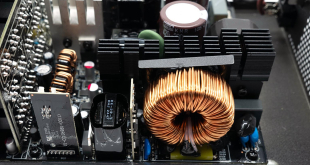
LC-Power is a brand many of our audience may not immediately recognise, but they are part of Silent Part Electronics GmbH, a German IT hardware manufacturer from the town of Willich. They are not a newcomer to the industry, having been in operation since 1996. Today we take a look at one of the company's newest power supplies, the LC-Power LC1000P2, which is a platinum rated fully modular supply populated with high grade Japanese capacitors.

LC-Power are working with OEM manufacturer RSY, a partner company who have made power supplies for brands such as Superflower and Enermax, some of which we have reviewed years ago.
There are three power supplies in this range, the LC850P2 (850W), the LC1000P2 (1000W) and the LC1200P2 (1200W). All of these new units are backed with 10-year warranty coverage.
Key Features:
- Fully modular – Allows clean cable management by connecting only the cables you need.
- 80+ Platinum – Delivers reliable performance with minimal energy waste.
- ATX 3.1 & PCIe 5.1 – Designed to meet the latest standards for future hardware compatibility.
- Native 12V-2×6 Connector – Ensures stable power delivery for modern GPUs without adapters.
- Japanese capacitors – Maximum stability and lifespan under demanding loads.
- Silent 135mm FDB fan – Offers high airflow with low noise, even under sustained load.
- Semi-passive cooling – Fan operates in zero-RPM mode during low to moderate loads for completely silent performance.
- 10 years warranty – Ensures long-term peace of mind and product reliability.
- Sleeved cables – Individually braided for flexibility, durability, and aesthetics.
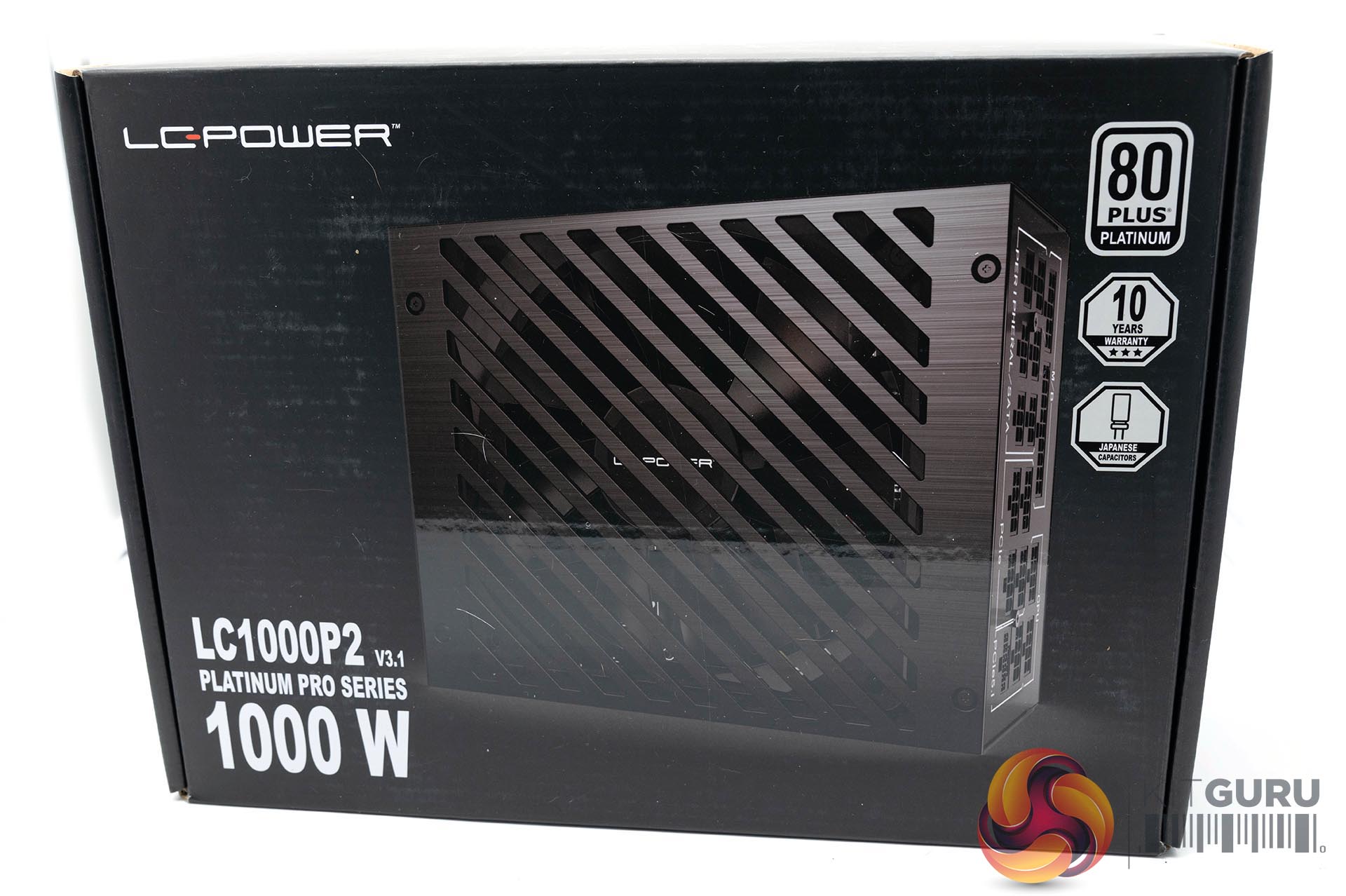
The LC-Power LC1000P2 ships in a box featuring a high resolution photograph of the power supply, with some key details along the right hand side – such as the 80 Plus Platinum certification, 10-year warranty and adoption of Japanese capacitors.
Unfortunately we don't see any Cybenetics certification and I'd urge LC-Power to contemplate getting these units approved ASAP.
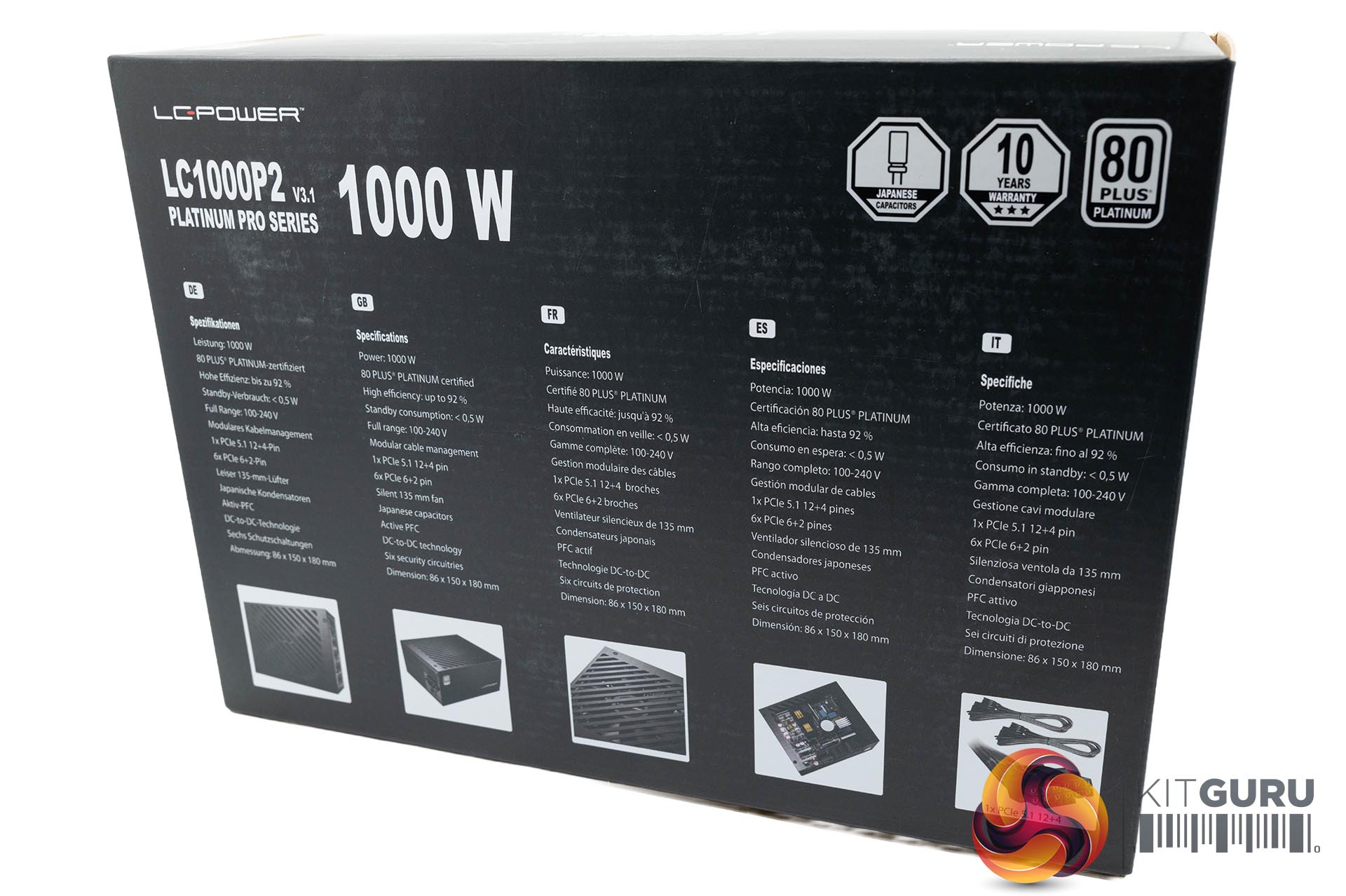
The rear of the box is surprisingly free of details regarding fan curves, or efficiency charts – they simply repeat the same three badges on the front and show some more pictures of the unit including an internal shot and some pictures of the cables.
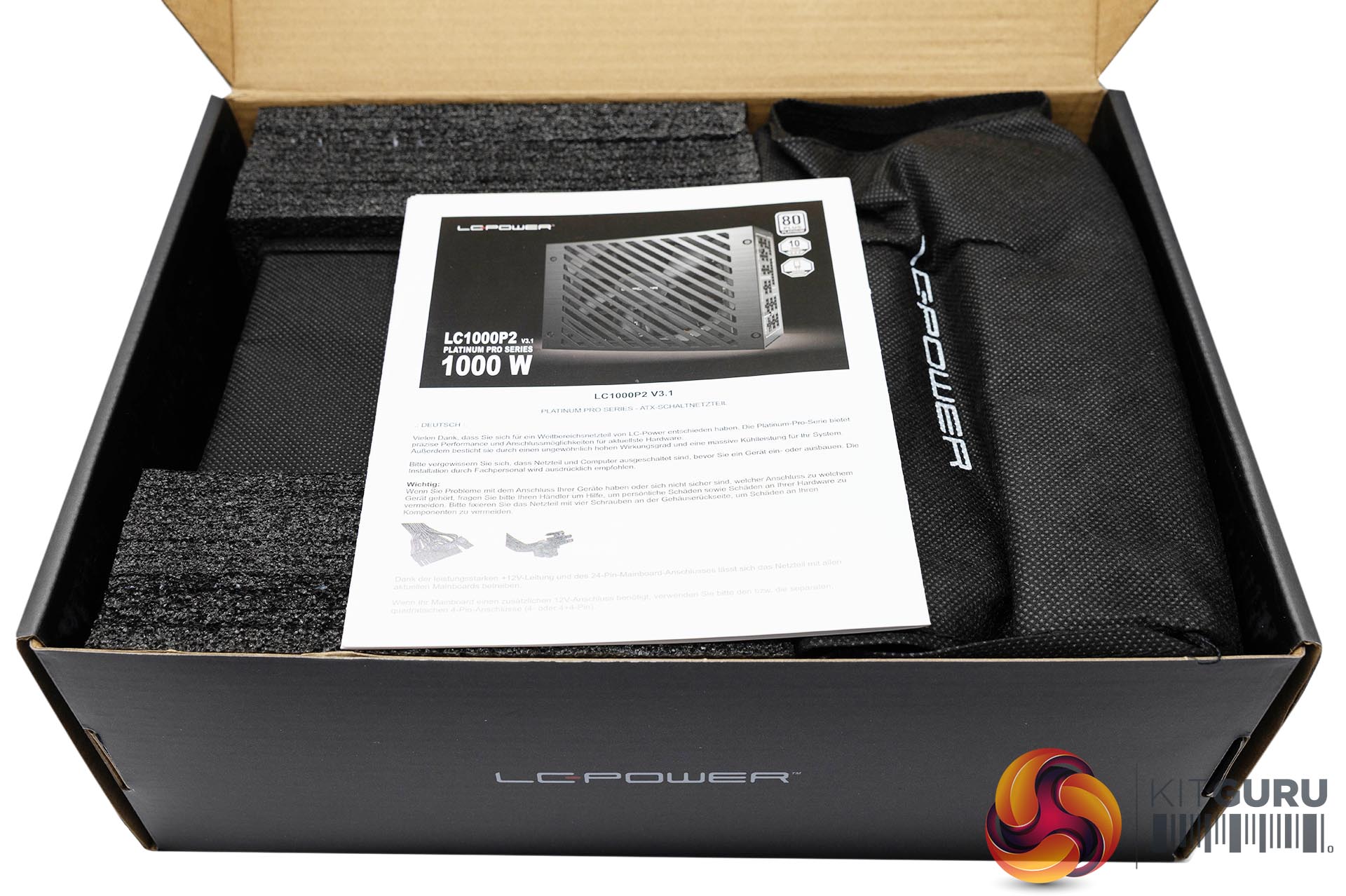
Inside the box, the power supply is sandwiched between foam on the left side, and the cables on the right, along with a little bit of documentation on top. They also include some cable ties and mounting screws and a region-specific power connector.
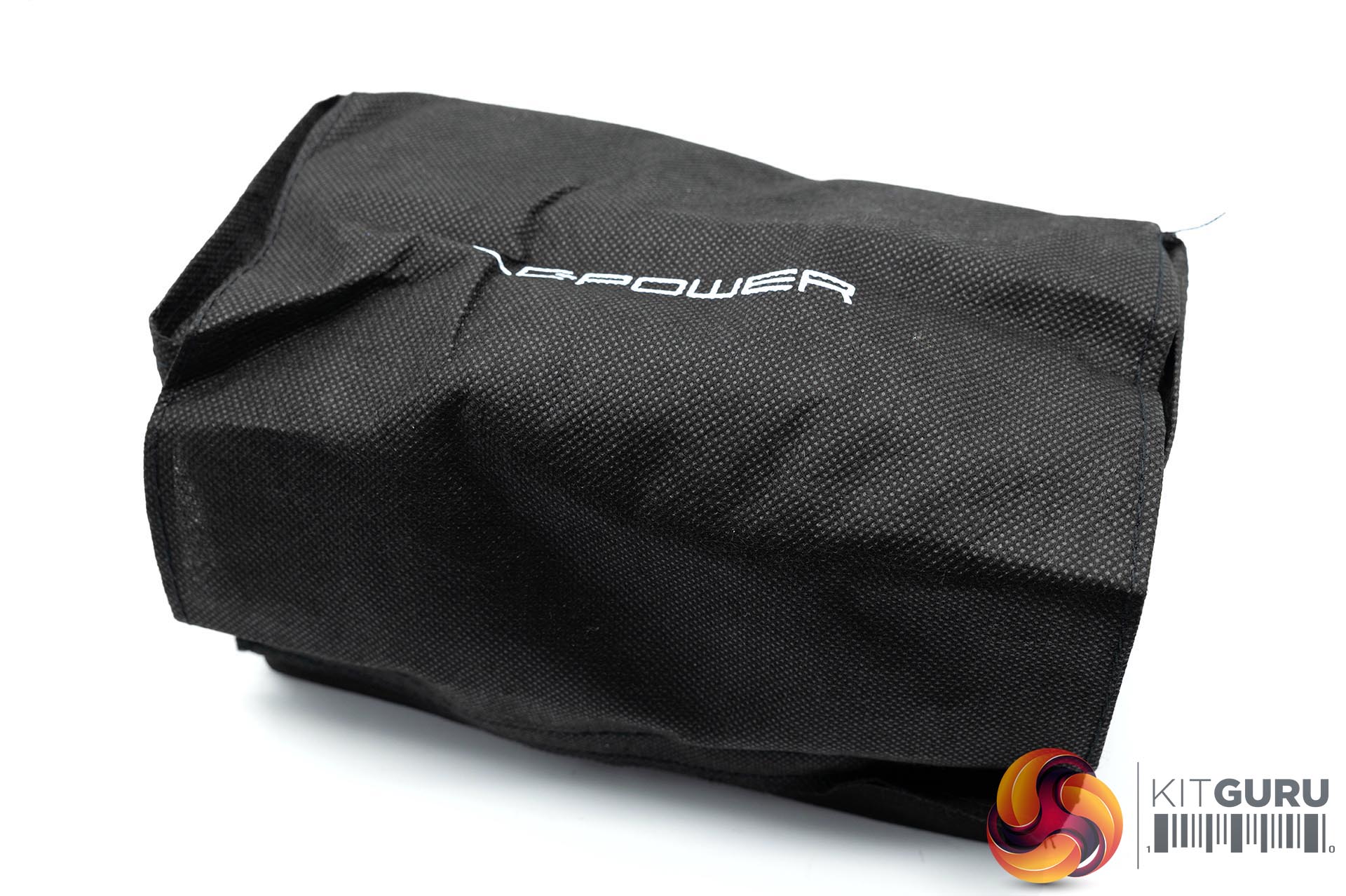
The cables are all included inside a little felt bag.
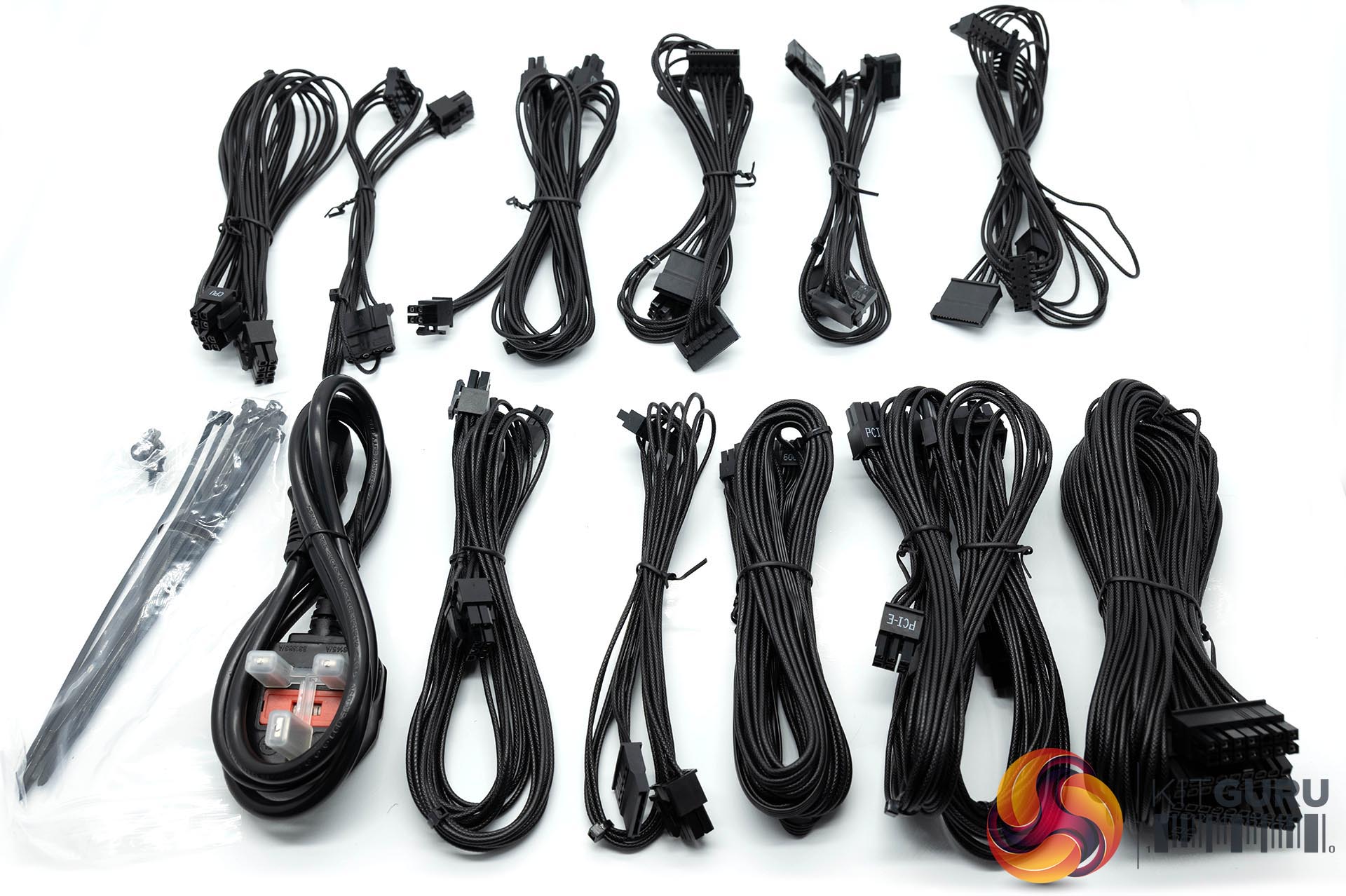
The cables are all individually sleeved and seem decent enough quality.
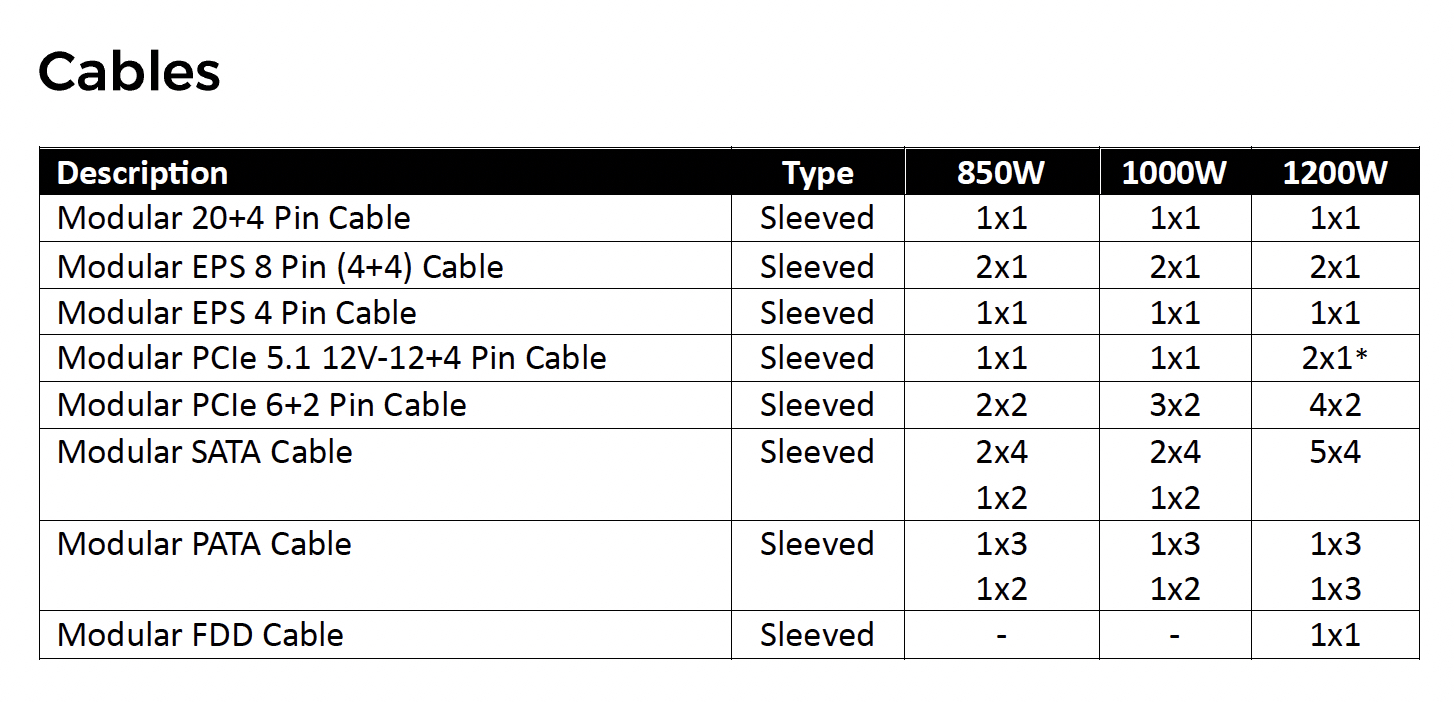
Connectors:
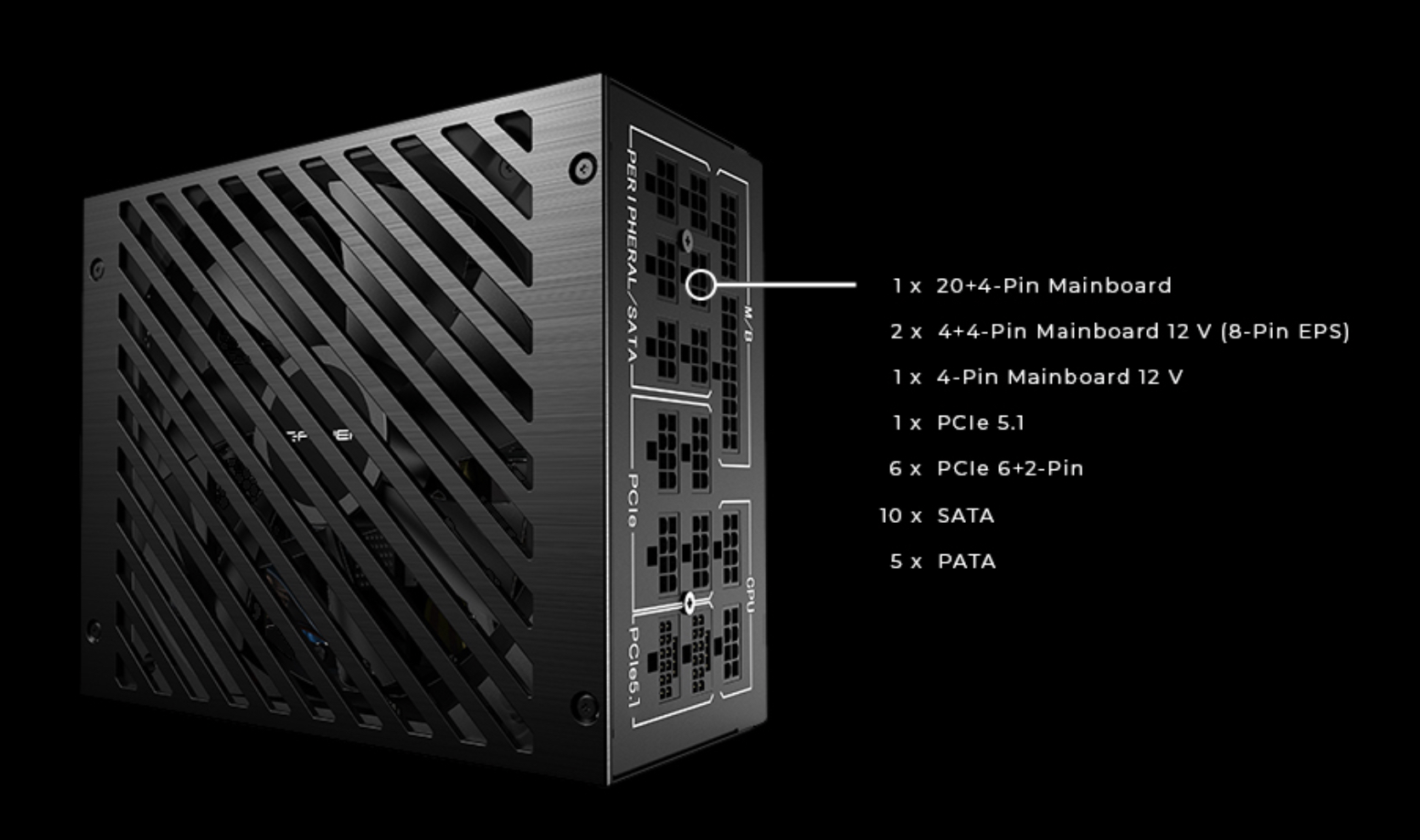
- 20+4 pin mainboard: 1 x 650mm
- 4+4 pin mainboard 12V : 2 x 650mm
- 4 pin mainboard 12V: 1 x 800mm
- PCI-Express 5.1 12+4 pin: 1 x 600mm
- PCI-Express 6+2 pin: 4 x 675 mm / 3 x 750mm
- SATA: 3 x 500mm / 3 x 650mm / 2x 800mm / 2x 950mm / 1 x 350mm / 2 x 500mm / 1 x 650mm / 1 x 800mm
- PATA: 1 x 350mm / 2 x 500mm / 1 x 650mm / 1 x 800mm
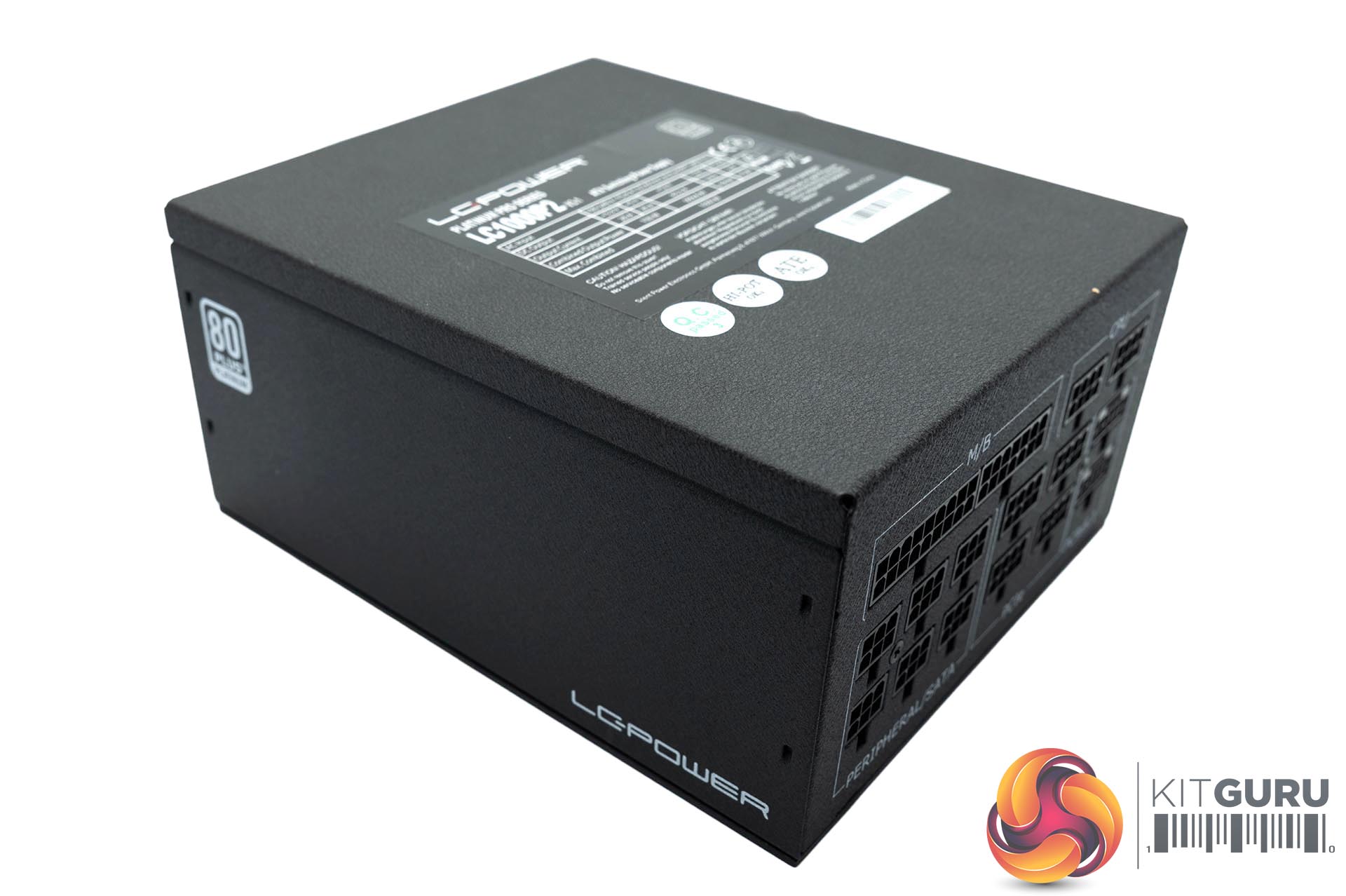
The LC-Power LC1000P2 is finished to a reasonably high standard with colour neutral accenting on the name and 80 Plus Platinum badge. A lot of systems hide the power supply now from view anyway, but at least this one will suit any colour themed system build if it is on show.
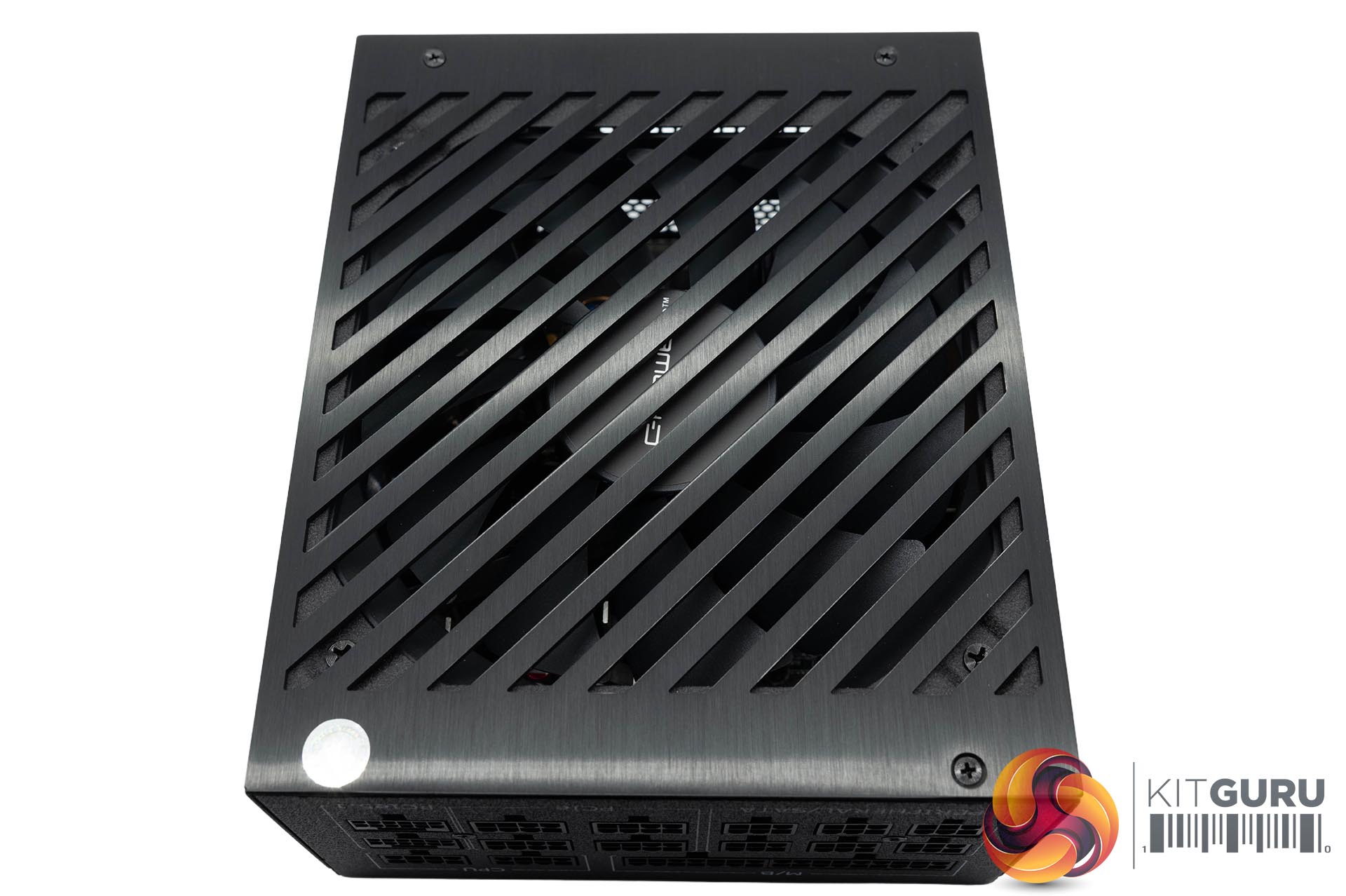
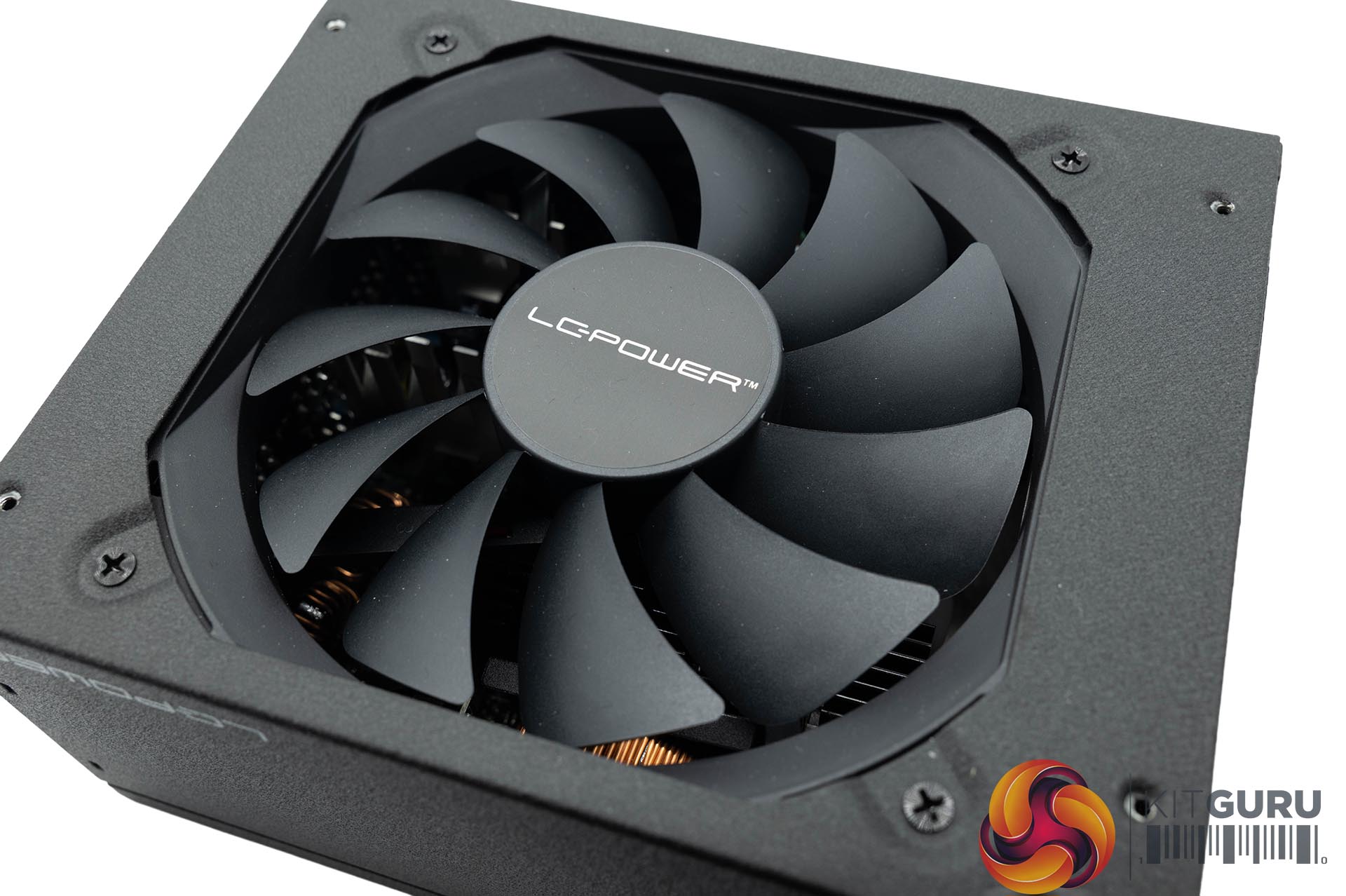
The top of the power supply has a brushed metal grille in place and the large fan is partially visible below it. If you remove the top panel you can see underneath a little better. We will take a closer look at the fan shortly when we open the PSU up properly.
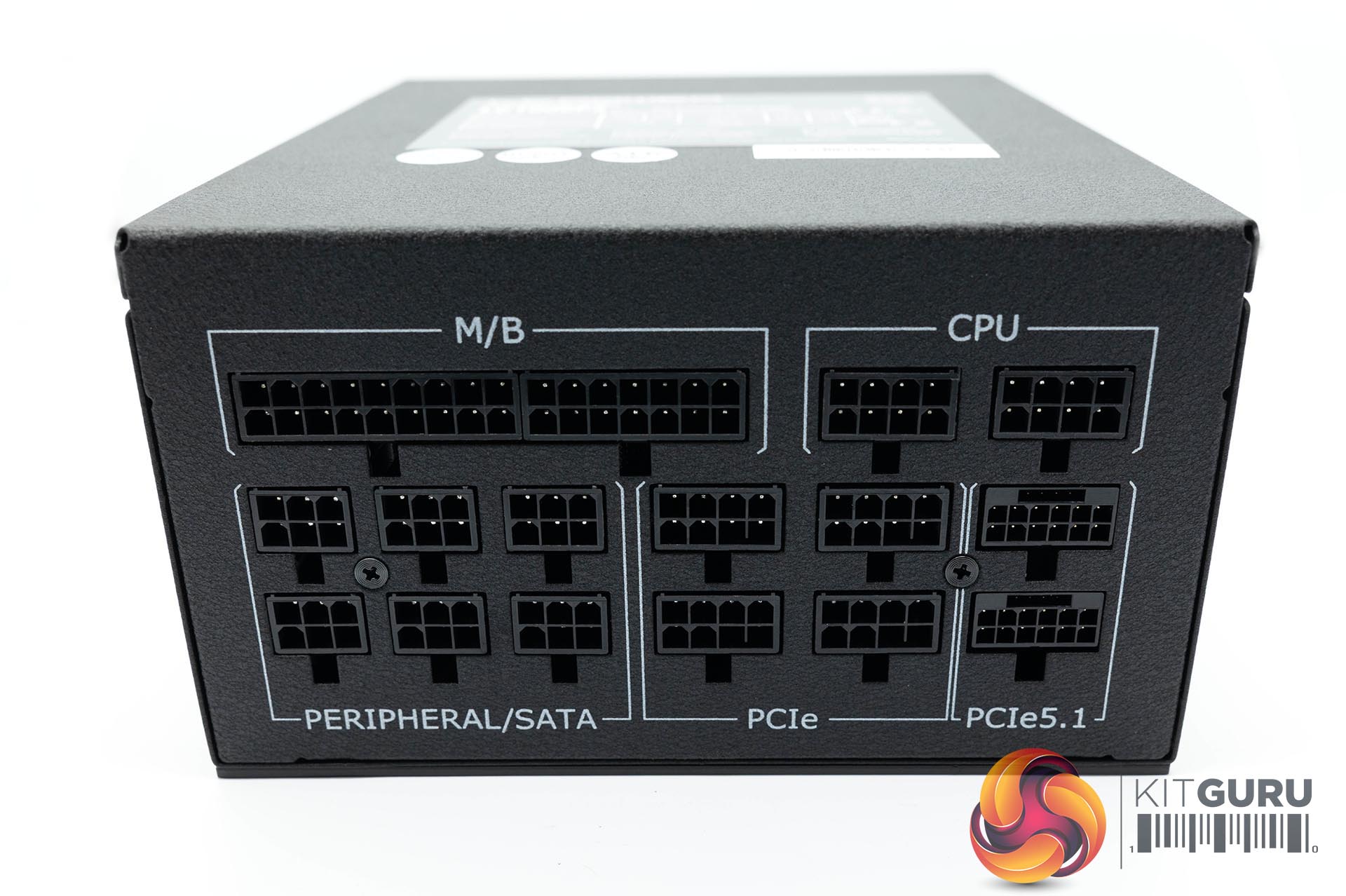
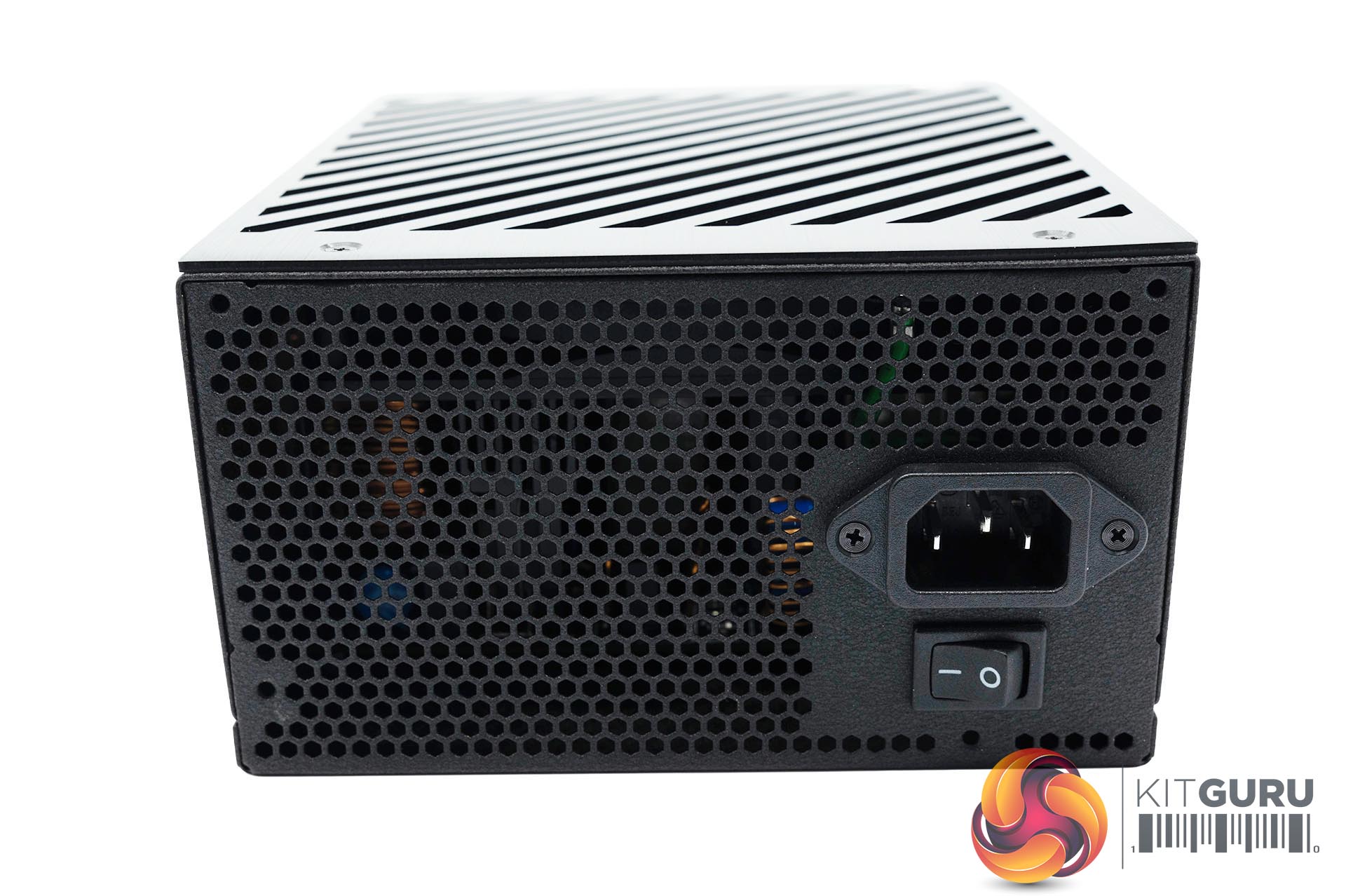
The modular side is split into three rows of connectors, all clearly labelled for ease of use during the installation phase. The power side is home to the power switch, cable connector, and a large vented panel to help with airflow.
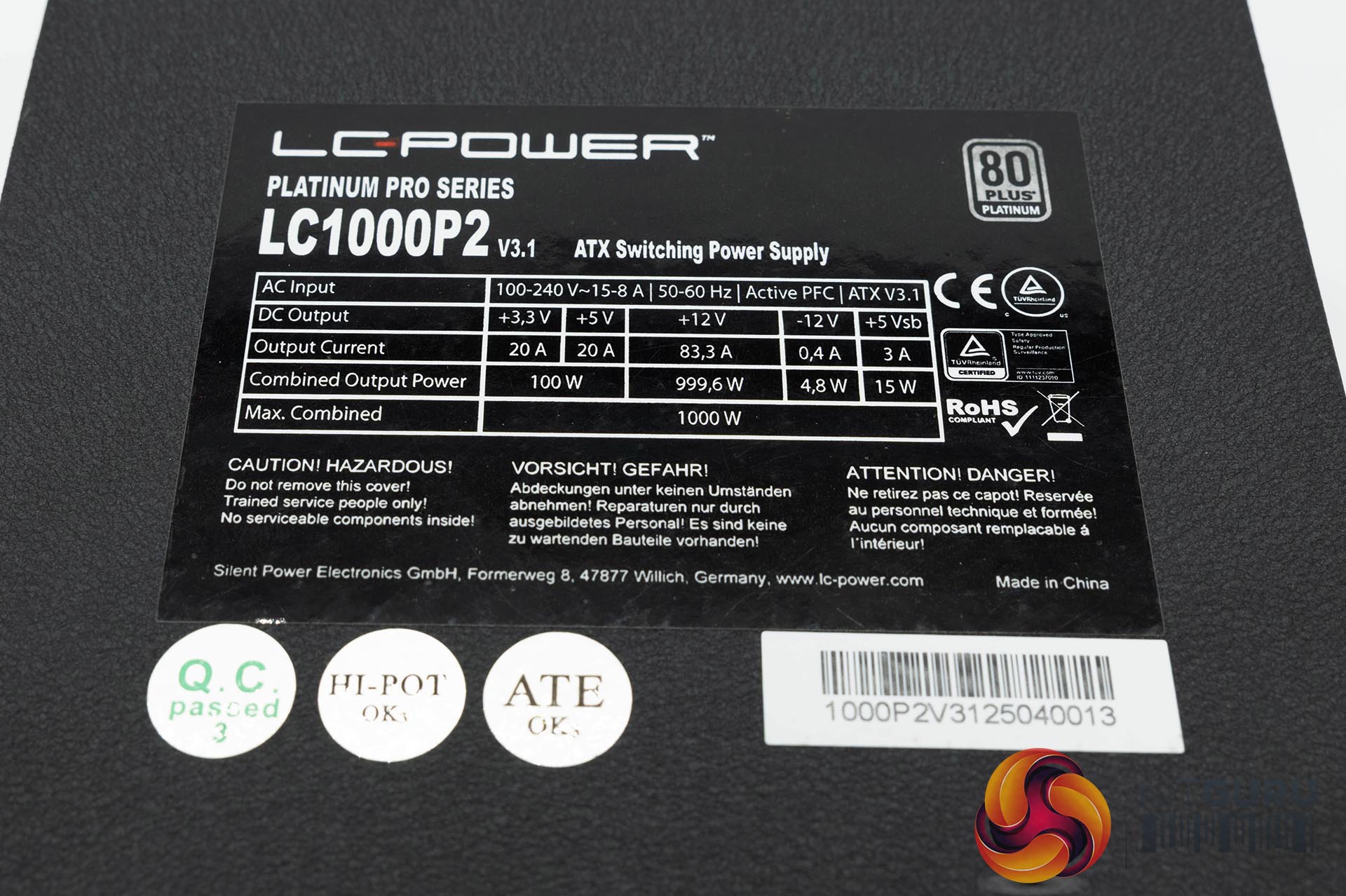
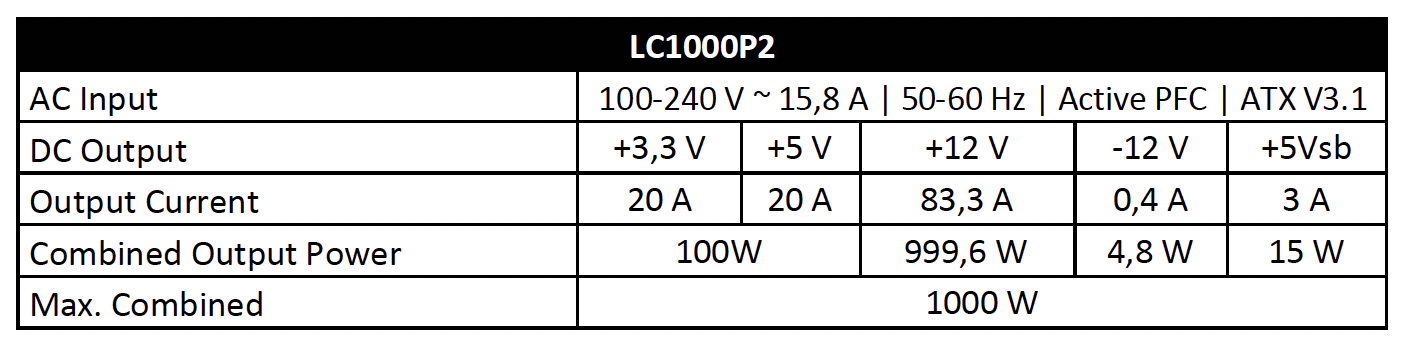
The power configuration follows a fairly traditional output for both primary and secondary rails. The +3.3V and +5V rails are rated at 20A for 100W and the primary +12V rail is rated to 83.3A for 999.6W of total output. This is identical to other units we have tested recently such as the be quiet! Power Zone 2 1000W.
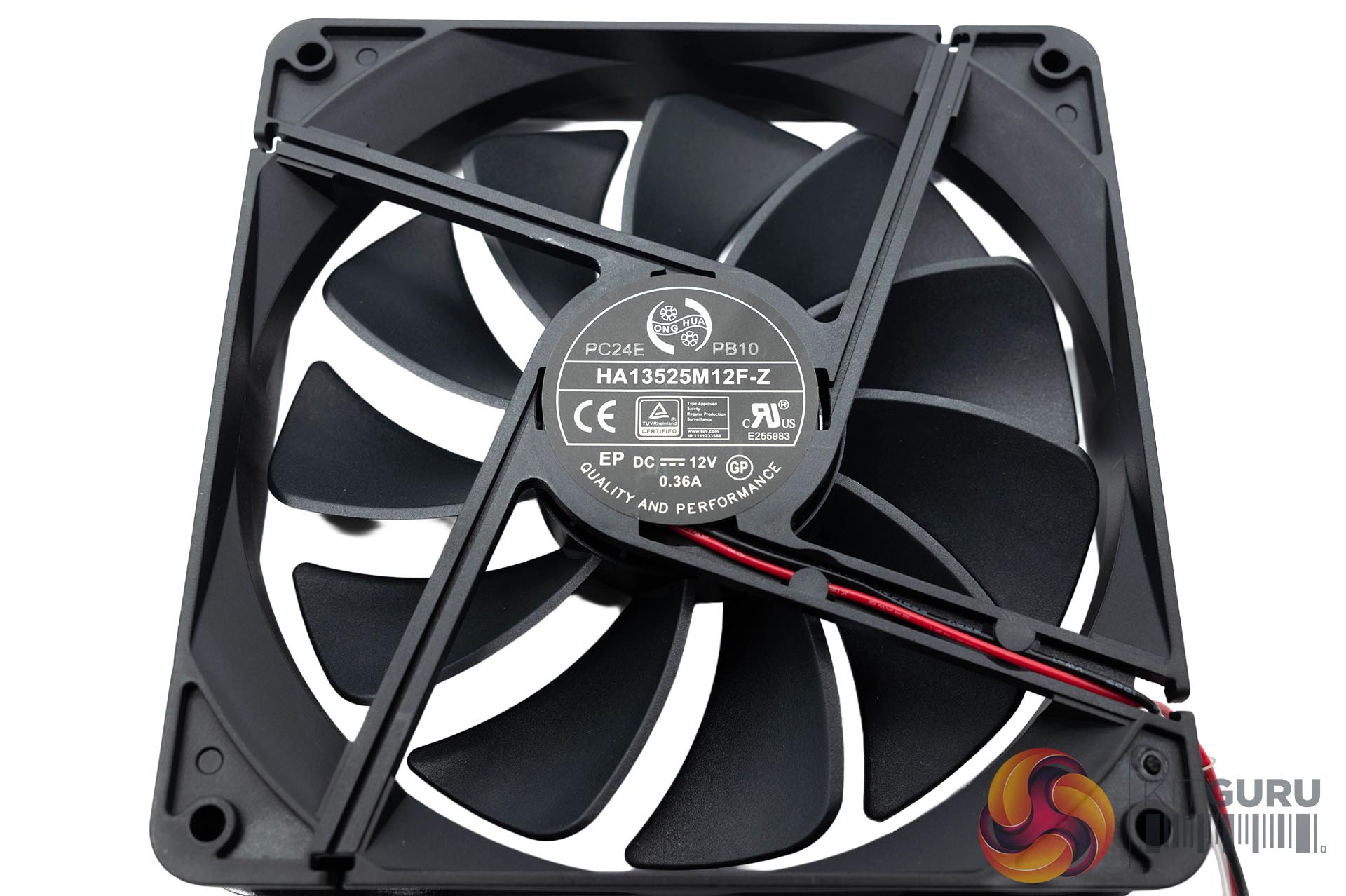
LC-Power are using a Hong Hua HA13525M12F-Z fan. While LC-Power have not really detailed this fan in any of their literature or datasheets, they really could do with pointing out that it is a quality 135mm fluid dynamic bearing (FDB) fan – we have seen the exact same fan used in many Seasonic power supplies in recent years. I don't see any mention of them adopting an FDB fan and most manufacturers will highlight this extensively!
This fan is rated 12V 0.36A with a maximum rated speed of around 1,800 rpm. These are great fans.
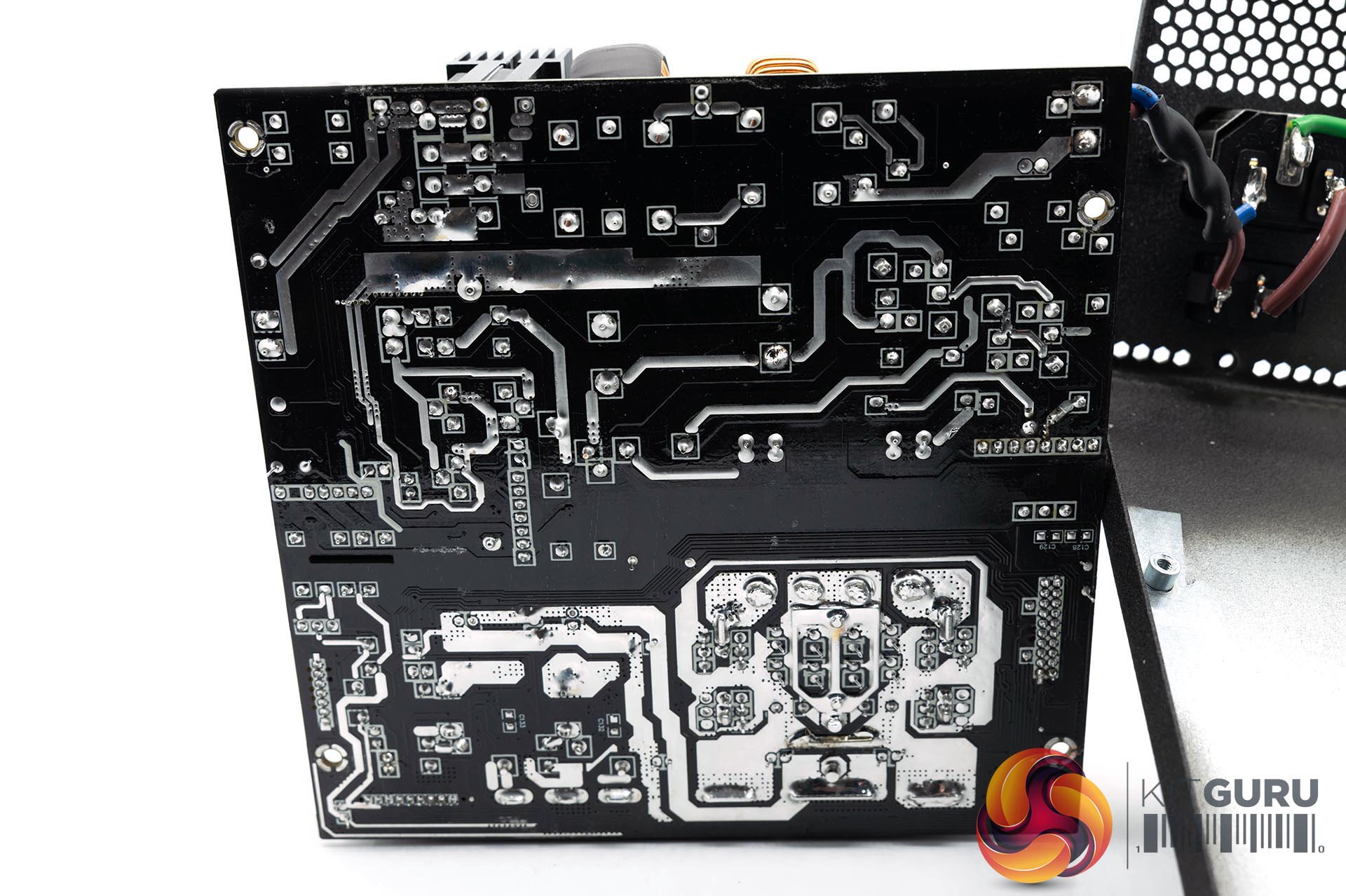
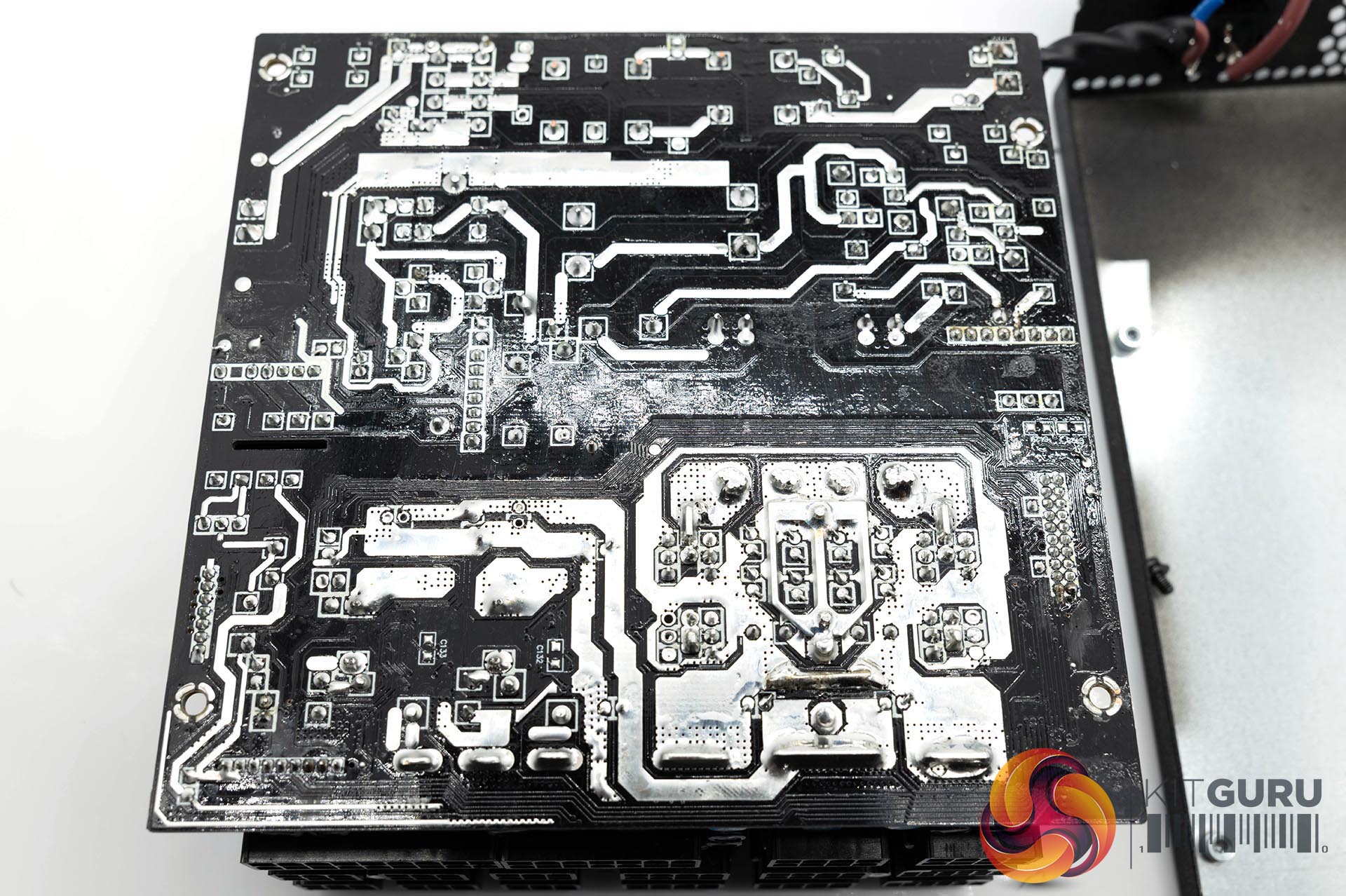
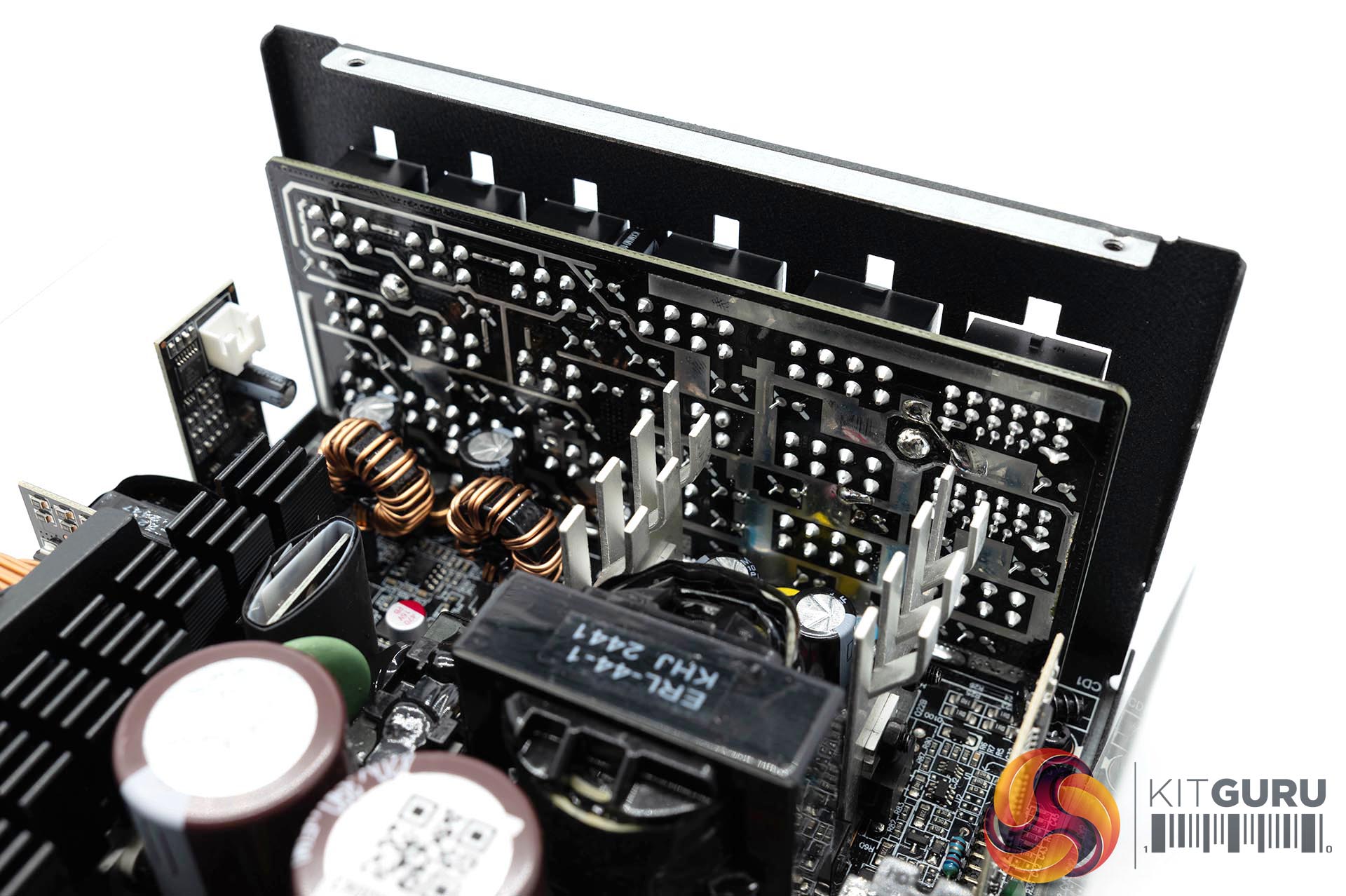
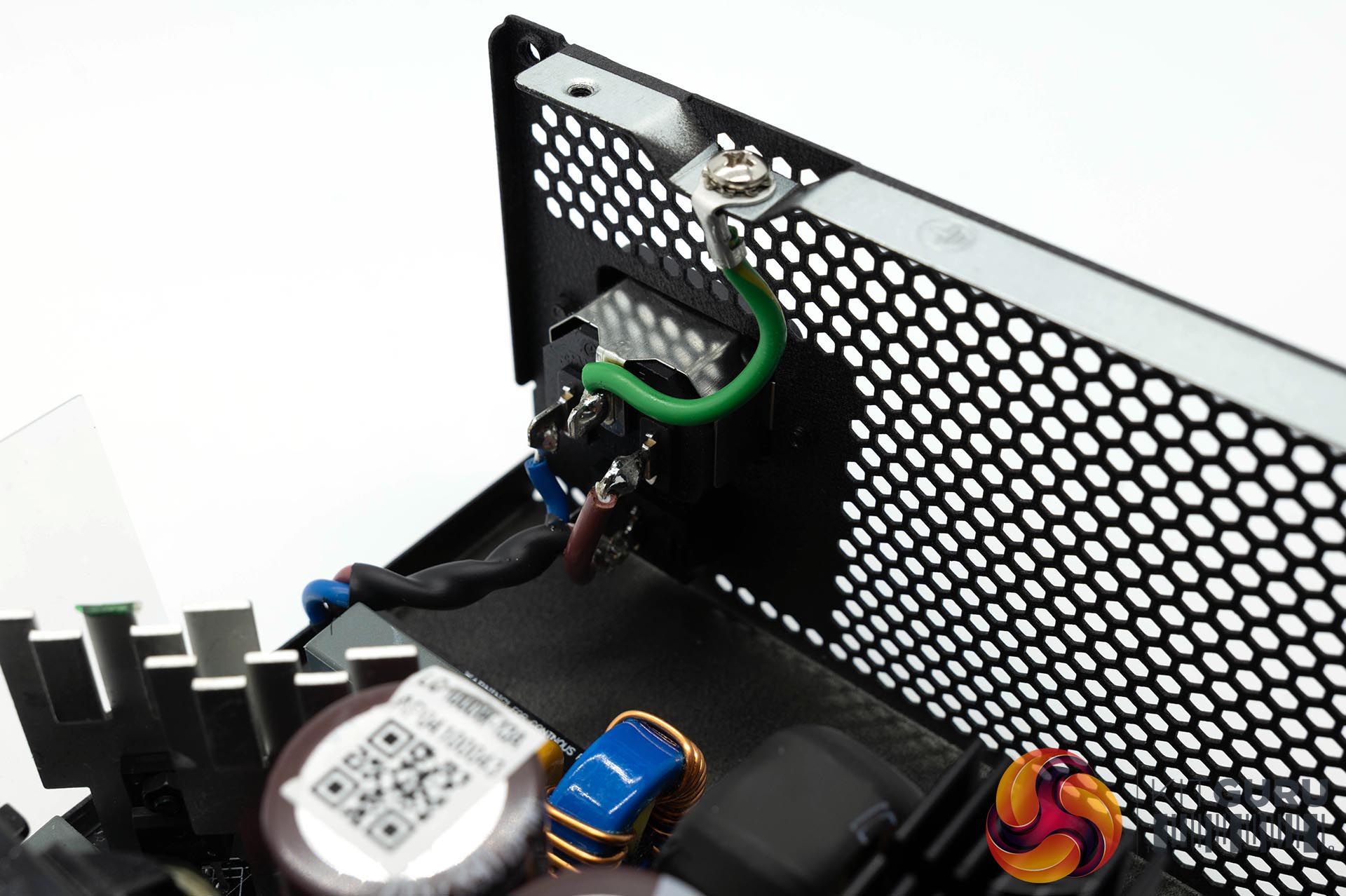
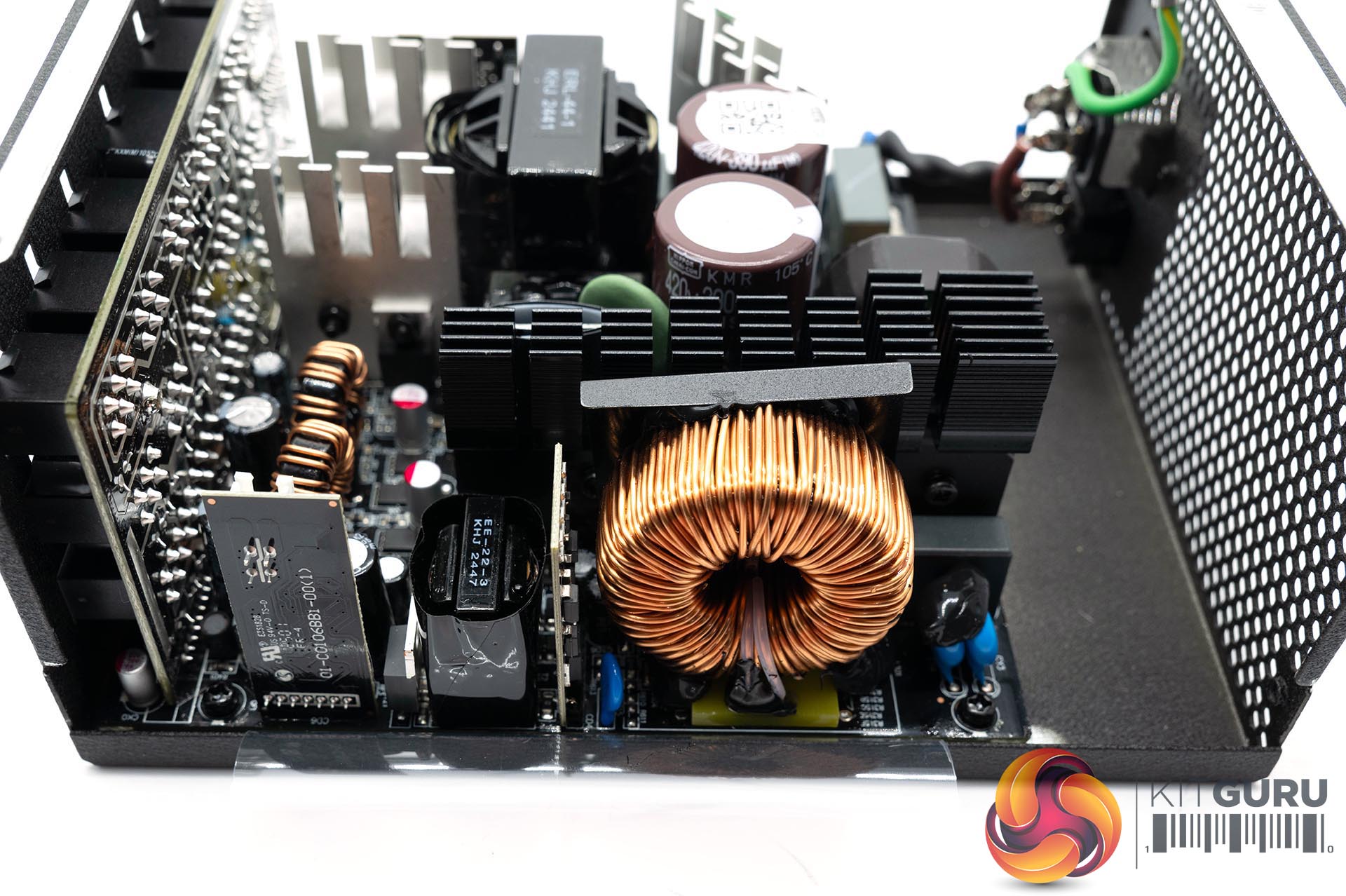
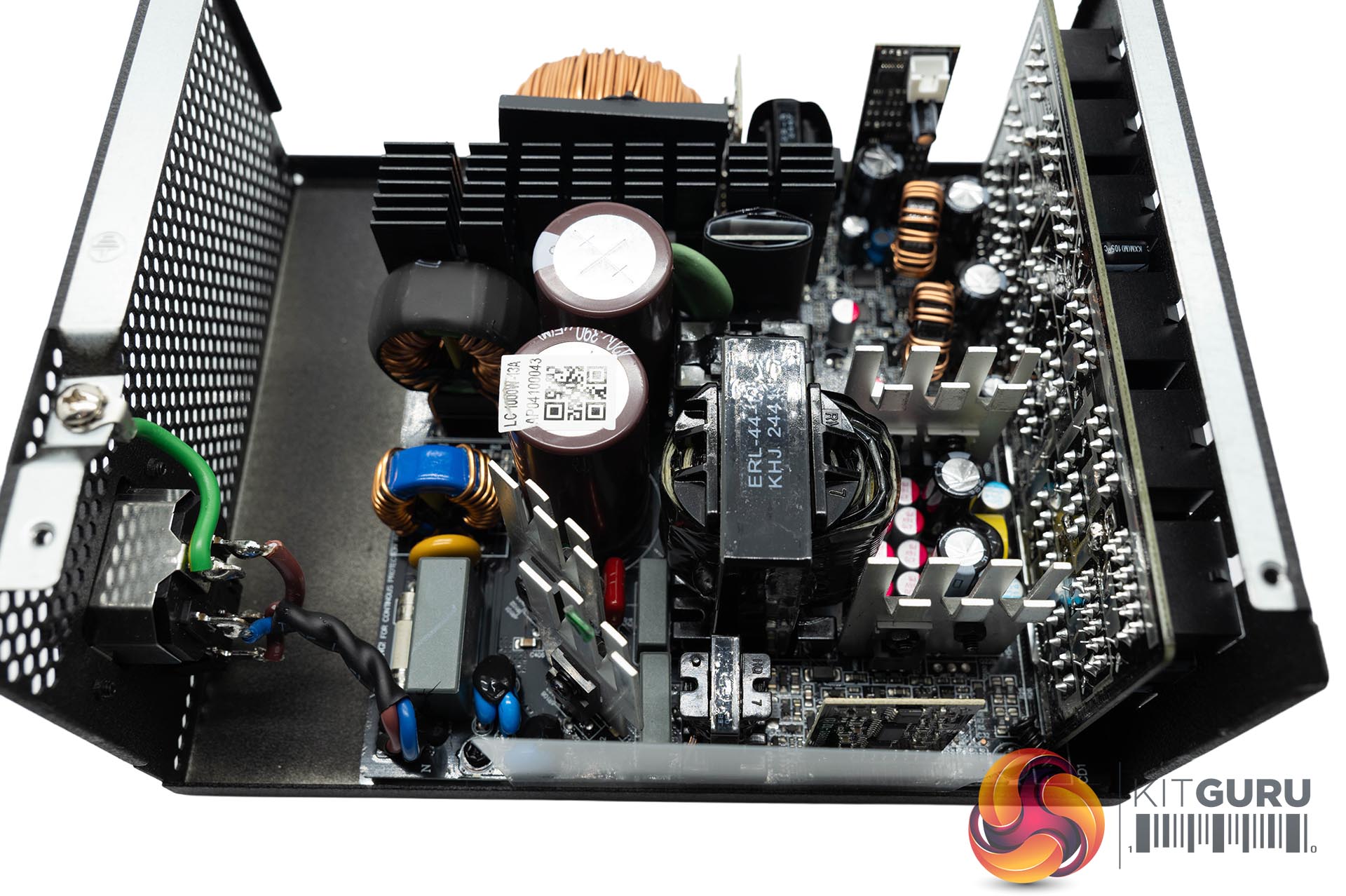
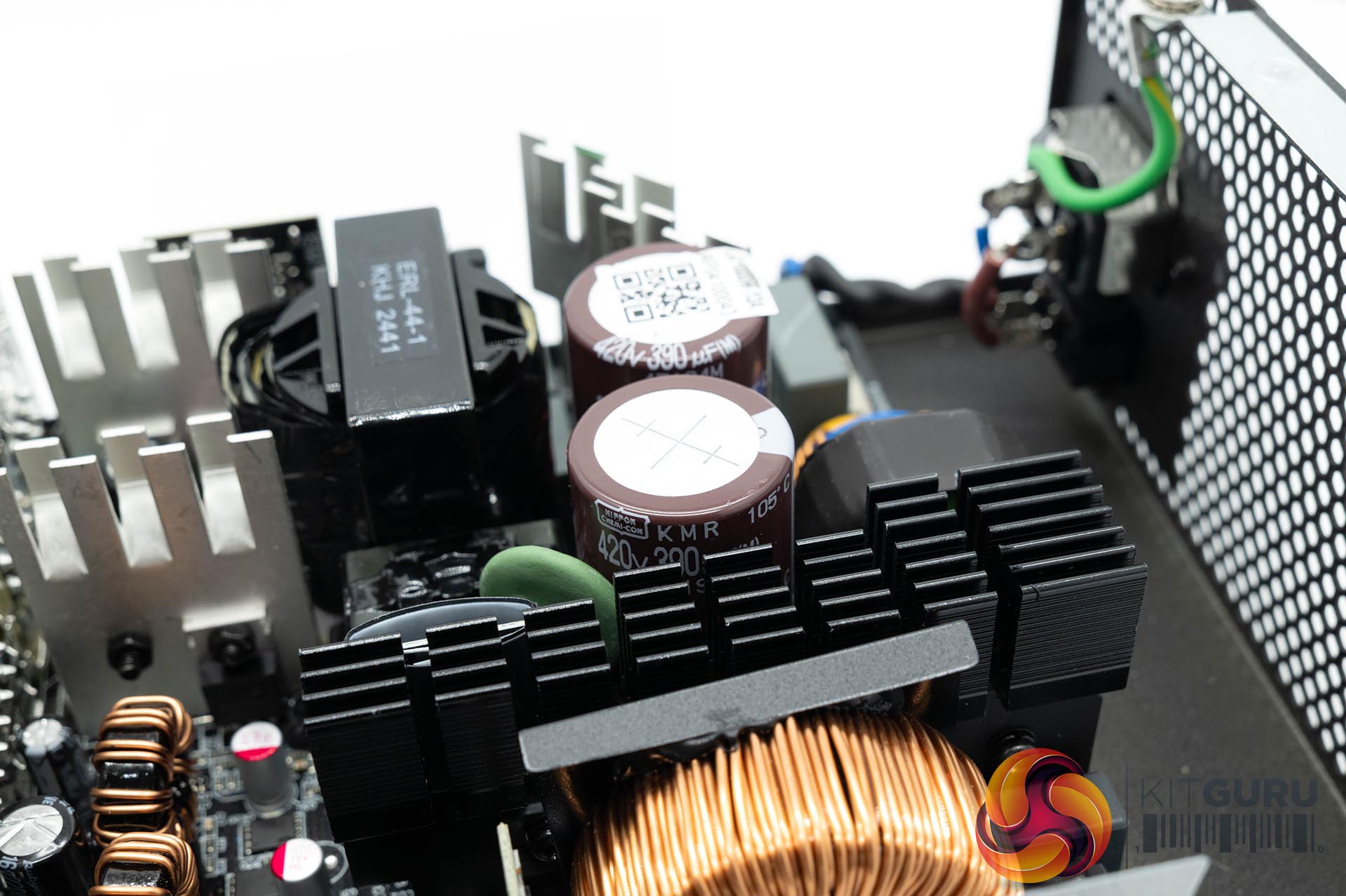
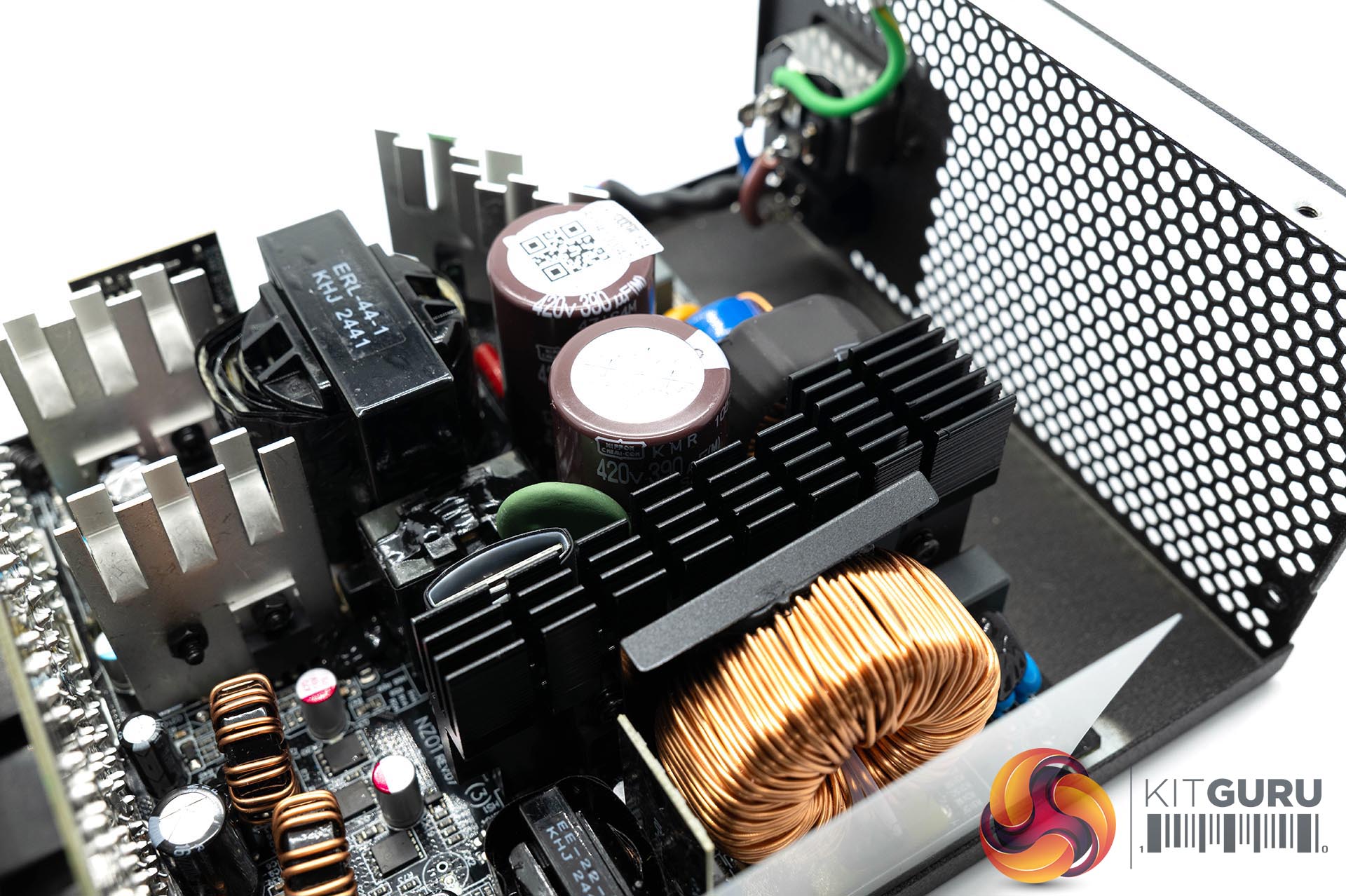
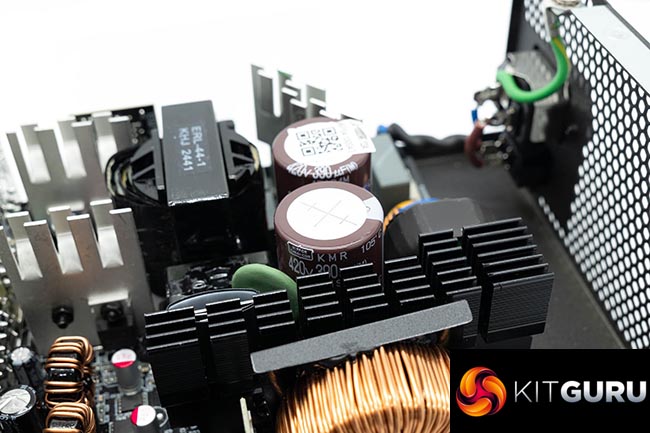
As detailed earlier in the review, this is a DC to DC design with OEM partner RSY. RSY are not one of the more widely known companies on the market for power supply designs but they have created units for Super Flower and Enermax and even some for Seasonic in their earlier budget line up. The two primary capacitors are 105C rated Japanese Nippon Chemi Con, rated 420V 390uF x2 for a total of 780uF. The main transformer is by Kai Hao Jie.
The internal design of the power supply is clean and well laid out with plenty of room for air flow across the board. The soldering quality is also very good on the main PCB and components side.
The power supply ships with OVP, OCP, OPP, OTP, SCP and UVP protections. As we said earlier, LC-Power is supporting these units with a 10-year warranty.
Correctly testing power supplies is a complex procedure and KitGuru have configured a test bench which can deliver up to a 2,000 Watt DC load.
We test ambient temperatures at 35c in our environment to greater reflect warmer internal chassis conditions.
We use combinations of the following hardware:
• SunMoon SM-268
• CSI3710A Programmable DC load (+3.3V and +5V outputs)
• CSI3711A Programmable DC load (+12V1, +12V2, +12V3, and +12V4)
• Extech Power Analyzer
• Extech MultiMaster MM570 digital multimeter
• SkyTronic DSL 2 Digital Sound Level Meter (6-130dBa)
• Digital oscilloscope (20M S/s with 12 Bit ADC)
• Variable Autotransformer, 1.4 KVA
We test in a single +12V configuration.
|
DC Output Load Regulation
|
||||||||||
|
Combined DC Load |
+3.3V
|
+5V
|
+12V
|
+5VSB
|
-12V | |||||
|
A
|
V
|
A
|
V
|
A
|
V
|
A
|
V
|
A | V | |
|
100W
|
0.90
|
3.34
|
0.90
|
5.02
|
7.35
|
12.08
|
0.50
|
5.01
|
0.20
|
-12.00
|
|
200W
|
1.60
|
3.33
|
1.64
|
5.02
|
15.13
|
12.08
|
1.00
|
5.01
|
0.20
|
-12.00
|
|
500W
|
3.21
|
3.33
|
3.24
|
5.01
|
38.60
|
12.07
|
1.50
|
5.00
|
0.20
|
-12.00
|
| 750W |
4.03
|
3.33
|
4.17
|
5.01
|
58.53
|
12.04
|
2.00
|
5.01
|
0.30
|
-12.00
|
|
1000W
|
5.45
|
3.33
|
5.51
|
5.01
|
78.13
|
12.01
|
2.50
|
5.00
|
0.30
|
-12.01
|
The load regulation of this power supply is very good across the board.
Next we want to try Cross Loading. This basically means loads which are not balanced. If a PC for instance needs 500W on the +12V outputs but something like 30W via the combined 3.3V and +5V outputs then the voltage regulation can fluctuate badly.
The power supply had no problems sustaining at constant 1000W load.
| Cross Load Testing | +3.3V | +5V | +12V | -12V | +5VSB | |||||
| A | V | A | V | A | V | A | V | A | V | |
| 885W | 2.0 | 3.33 | 2.0 | 5.01 | 72.0 | 12.01 | 0.2 | -12.00 | 0.50 | 5.01 |
| 240W | 20.0 | 3.31 | 23.0 | 4.98 | 2.0 | 12.08 | 0.2 | -12.01 | 0.50 | 5.01 |
The LC1000P2 handled our cross load test very well, holding stable results across the range.
We then used an oscilloscope to measure AC ripple and noise present on the DC outputs. We set the oscilloscope time base to check for AC ripple at both high and low ends of the spectrum. ATX12V V2.2 specification for DC output ripple and noise is defined in the ATX 12V power supply design guide.
|
ATX12V Ver 2.2 Noise/Ripple Tolerance
|
|
|
Output
|
Ripple (mV p-p)
|
|
+3.3V
|
50
|
|
+5V
|
50
|
|
+12V1
|
120
|
|
+12V2
|
120
|
|
-12V
|
120
|
|
+5VSB
|
50
|
Obviously when measuring AC noise and ripple on the DC outputs, the cleaner (less recorded/lower) means we have a better end result. We measured this AC signal amplitude to see how closely the unit complied with the ATX standard.
| AC Ripple (mV p-p) | ||||
| DC Load | +3.3V | +5V | +12V | 5VSB |
| 100W | 8 | 9 | 15 | 8 |
| 250W | 11 | 14 | 23 | 11 |
| 500W | 14 | 15 | 31 | 13 |
| 750W | 16 | 17 | 37 | 13 |
| 1000W | 18 | 19 | 41 | 15 |
The unit passes the ripple test without any issues, falling well within industry rated tolerance across the board. Both secondary rails peak at just under 20mV at full load, with the primary +12V rail peaking at around 40mV. Good results.
|
Efficiency (%)
|
|
|
100W
|
90.7
|
|
250W
|
92.3
|
|
500W
|
93.8
|
|
750W
|
93.3
|
|
1000W
|
91.8
|
The efficiency results are excellent, peaking at 93.8% at around 50% load. This drops to around 91.4% efficiency at full load.
We take the issue of noise very seriously at KitGuru and this is why we have built a special home brew system as a reference point when we test noise levels of various components. Why do this? Well this means we can eliminate secondary noise pollution in the test room and concentrate on components we are testing. It also brings us slightly closer to industry standards, such as DIN 45635.
Today to test the Power Supply we have taken it into our acoustics room environment and have set our SkyTronic DSL 2 Digital Sound Level Meter (6-130dBa) one meter away from the unit. We have no other fans running so we can effectively measure just the noise from the unit itself.
As this can be a little confusing for people, here are various dBa ratings in with real world situations to help describe the various levels.
KitGuru noise guide
10dBA – Normal Breathing/Rustling Leaves
20-25dBA – Whisper
30dBA – High Quality Computer fan
40dBA – A Bubbling Brook, or a Refrigerator
50dBA – Normal Conversation
60dBA – Laughter
70dBA – Vacuum Cleaner or Hairdryer
80dBA – City Traffic or a Garbage Disposal
90dBA – Motorcycle or Lawnmower
100dBA – MP3 Player at maximum output
110dBA – Orchestra
120dBA – Front row rock concert/Jet Engine
130dBA – Threshold of Pain
140dBA – Military Jet takeoff/Gunshot (close range)
160dBA – Instant Perforation of eardrum
|
Noise (dBA)
|
|
|
100W
|
<28.0
|
|
250W
|
<28.0
|
|
500W
|
31.8
|
|
750W
|
34.5
|
| 1000W | 37.4 |
In general use the power supply is relatively quiet, and it is only when 750 watts is tasked from it that the fan starts to actively ramp up to deal with rising temperatures inside the chassis. At full load, the fan is clearly audible peaking at over 37dBa.
|
Temperature (c)
|
||
|
Intake
|
Exhaust
|
|
|
100W
|
37
|
41
|
|
250W
|
38
|
44
|
|
500W
|
40
|
51
|
|
750W
|
45
|
53
|
|
1000W
|
47
|
61
|
Temperatures inside the chassis are good thanks to the efficiency levels, and at higher loads the fan is actively pushing warm air outside the chassis, ensuring the temperatures are never too much of an issue.
The LC-Power LC1000P2 power supply arrived with us last week, alongside several other units from the LC-Power family. First impressions are positive – the box artwork sets the tone well and the only thing I found missing was Cybenetics certifications. In 2025, we think these are more important to have than 80 Plus certifications.
On a visual level, the unit ticks all the boxes. LC-Power has not opted for some weird and wacky design, and the top brushed metal panel adds a little bit of ‘excitement' to the design, without compromising on keeping a neutral colour theme.
Technically the unit is well designed and adopts high level 105C Japanese capacitors – in the case of our sample, Nippon Chemi Con. Load regulation of the LC1000P2 is excellent, and it passed the cross load test without an issue.
Ripple suppression, while not class leading, falls well within industry rated parameters and we experienced no issues during testing. Efficiency levels are excellent, peaking around 94% during 40-50% load and the quality Hong Hua fluid dynamic bearing fan delivers high levels of airflow when needed without generating a ton of noise.
Right now we have no retailer links to share, however LC-Power confirmed pricing to be £179 in the UK for the 1000 watt P2. Swiss prices were given at CHF 179. LC-Power told us that stock is due into Amazon anytime in the coming week, so be sure to check them out over there – the pricing does seem competitive in today's market.
Update: LC-Power sent us this link for Amazon, with the PSU listed at £169.
Pros:
- 105C-rated Japanese capacitors.
- Well built.
- Fully modular.
- 10-year warranty.
- High levels of platinum efficiency.
- Technically a solid design.
- Cables are high quality.
- Pricing seems competitive (though there's no store links yet).
Cons:
- Availability might be an issue in certain parts of the world.
- Stiff competition.
KitGuru says: The LC-Power LC1000P2 is a solid power supply which delivers quality performance.