KitGuru KitGuru.net – Tech News | Hardware News | Hardware Reviews | IOS | Mobile | Gaming | Graphics Cards


Today we take a look at the new MSI MPG Ai1600TS power supply. This unit targets the ultra high-end audience and, while it is not currently available at retail, it will likely be priced around £100-£150 less than the existing Ai1600T (non-TS), which is currently listed at £550 on Scan.
This new TS model introduces MSI’s ‘GPU Safeguard+’ technology – an onboard MCU designed to monitor the current flowing through each pin of the 12V-2×6 connector, adding an extra layer of protection for modern high power graphics cards, given some of the issues that we have seen with current balancing with these cables.
The MPG Ai range appears to consist of two models: the 1600W unit we are reviewing today, and a 1300W variant, the MPG Ai1300TS. We know the ‘Ai’ branding will divide opinion, but realistically every major vendor is adopting similar naming conventions at this stage. But, yes, it is annoying.
Key Features:
- Premium protection, GPU Safeguard+ and Fan Safeguard.
- Server-grade materials, SiC interleaved PFC MOSFET.
- Supports Nvidia® GeForce RTX™ 50 series graphics cards.
- 2 x native 12V-2×6 connectors.
- Dual-color 12V-2×6 cable.
- 80 PLUS Titanium certified.
- Optimized the sound level.
- 100% all Server-grade 105C capacitor.
- Embossed Jacket Cables.
- Industrial level protection with OCP/ OTP/ OPP/ SCP/ OVP/ UVP/ SIP/ NLO.
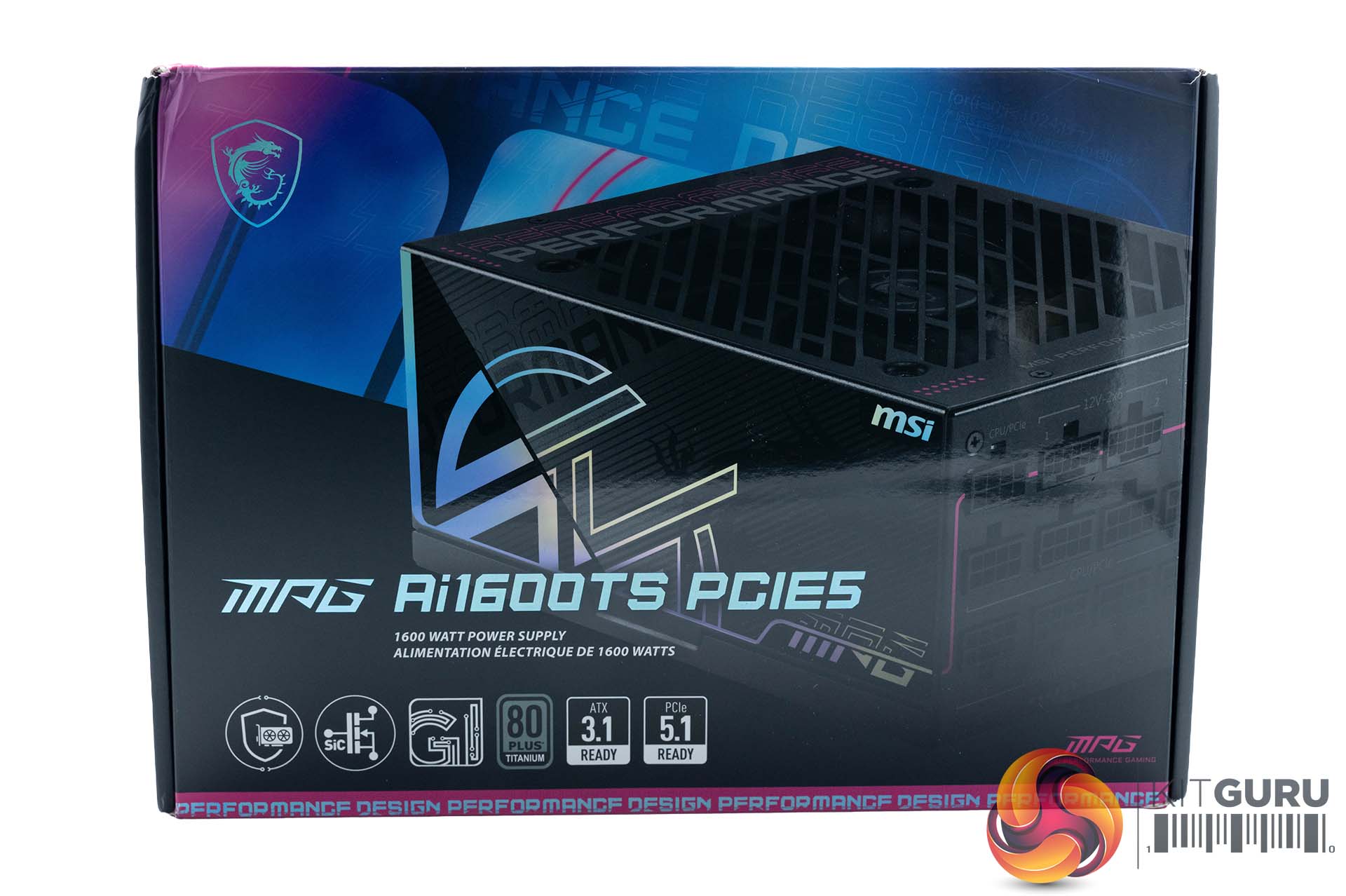
The power supply ships in a premium full-colour glossy box, with a large product image on the front and key specifications clearly outlined.
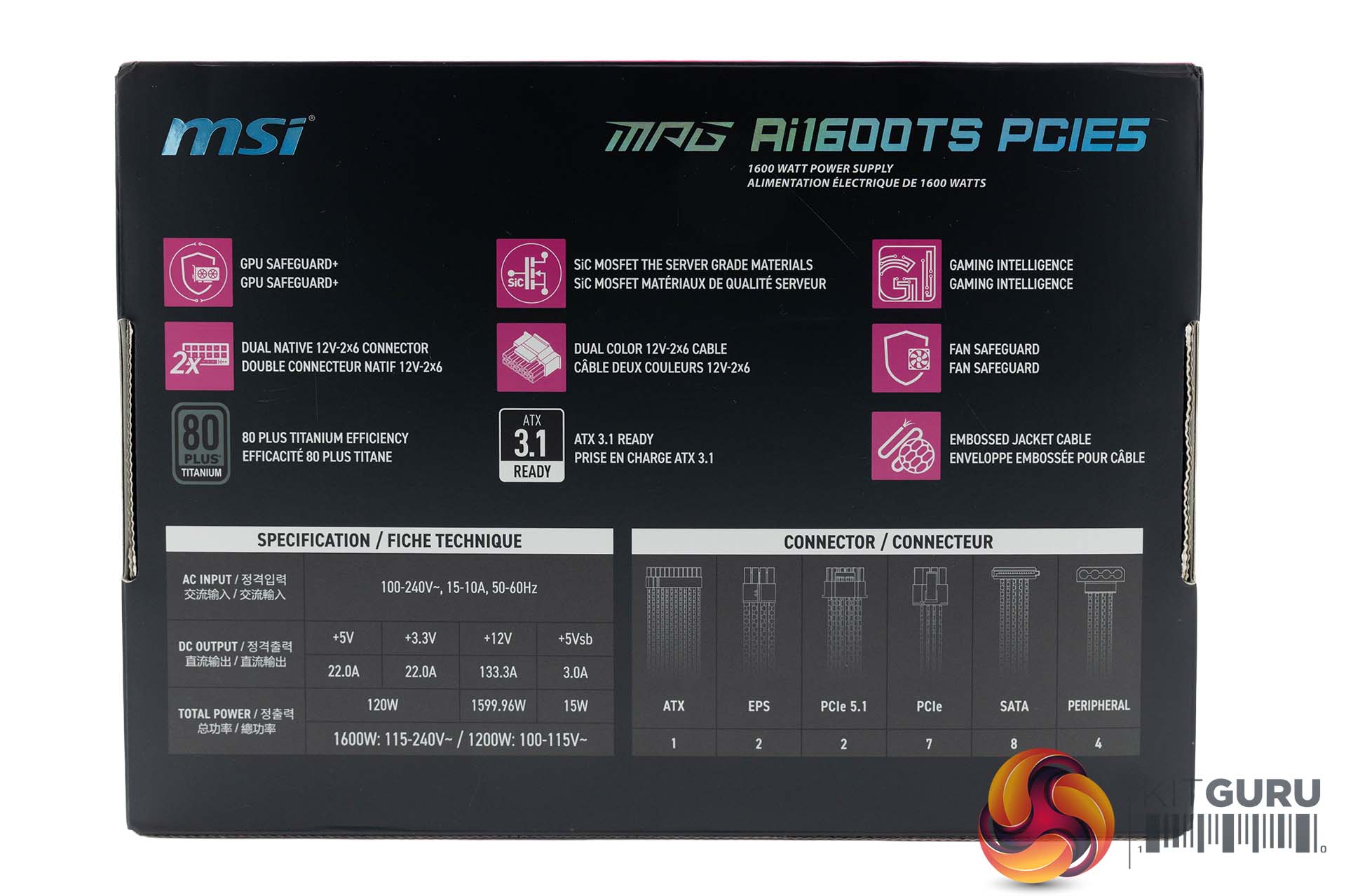
The rear of the packaging highlights features and provides a breakdown of the included cabling.
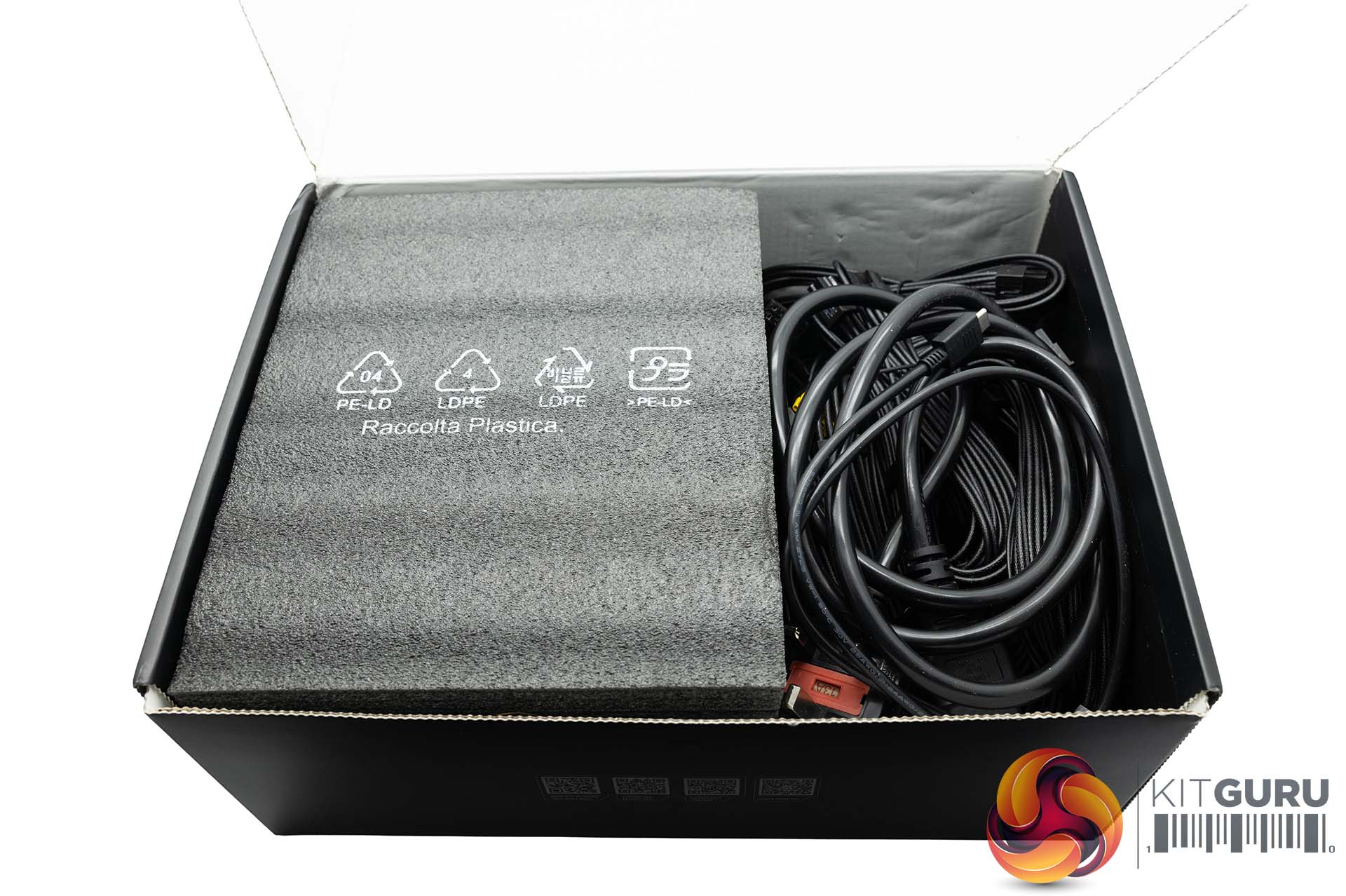
Our sample was not new, it was apparently used in MSI offices to test a 5090, a fact i realised later when I got a bit of a shock taking it apart for analysis. More fool me for not checking it was fully discharged. That said, we don't often get ‘used samples' for review purposes.
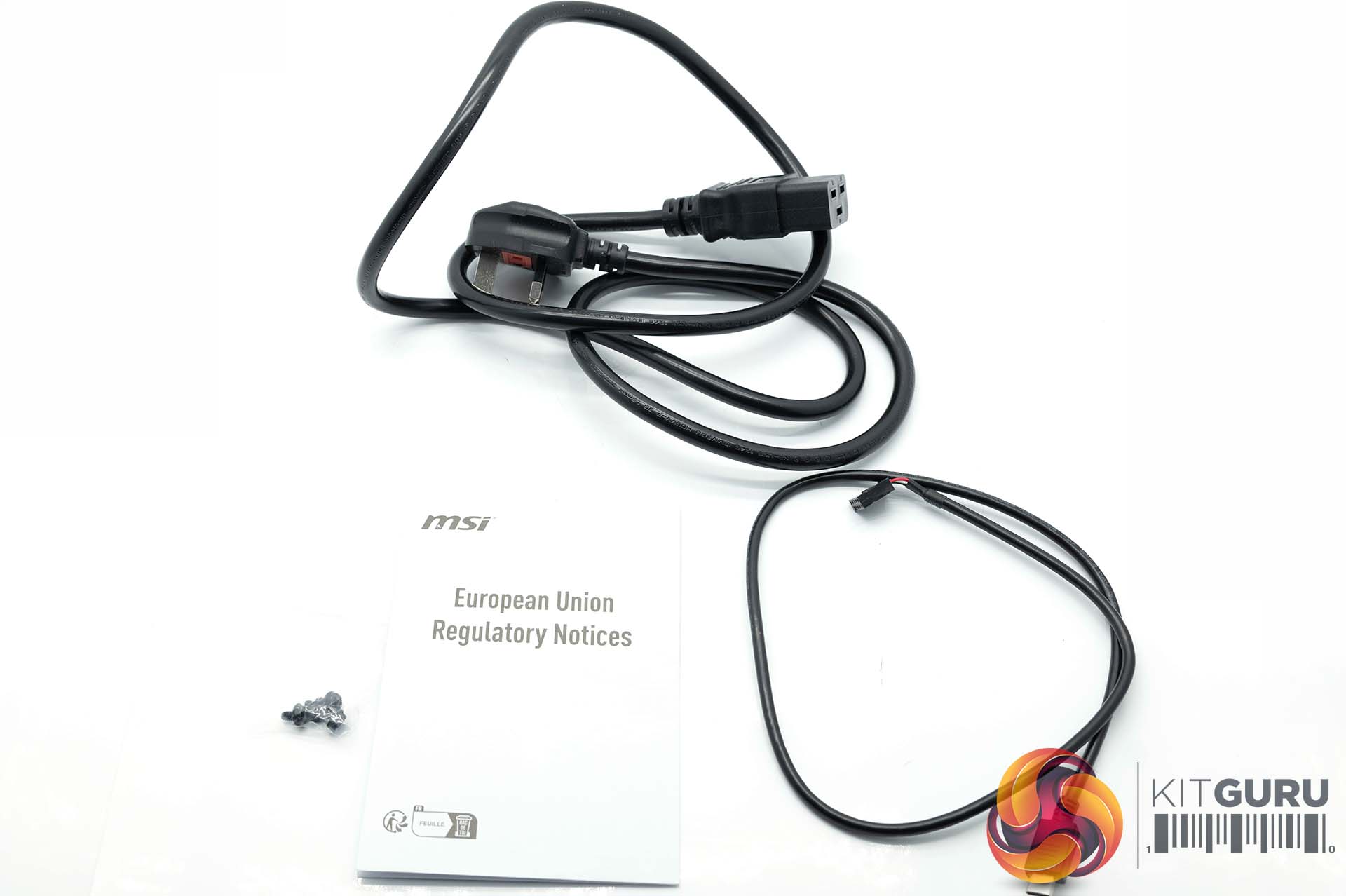
MSI include mounting screws, a user guide, a USB monitoring cable, and a high power C19 mains cable.
A standard PC power lead typically uses a C13 connector (often referred to as a kettle lead), which is generally rated for around 10A. This is sufficient for most power supplies up to roughly 1000-1200W. The C19 connector used here is physically larger, uses thicker conductors, and is rated for higher current – typically around 16A.
You will usually only see C19 connectors on very high power units, where a standard cable could become a limiting factor or generate excess heat under sustained load.
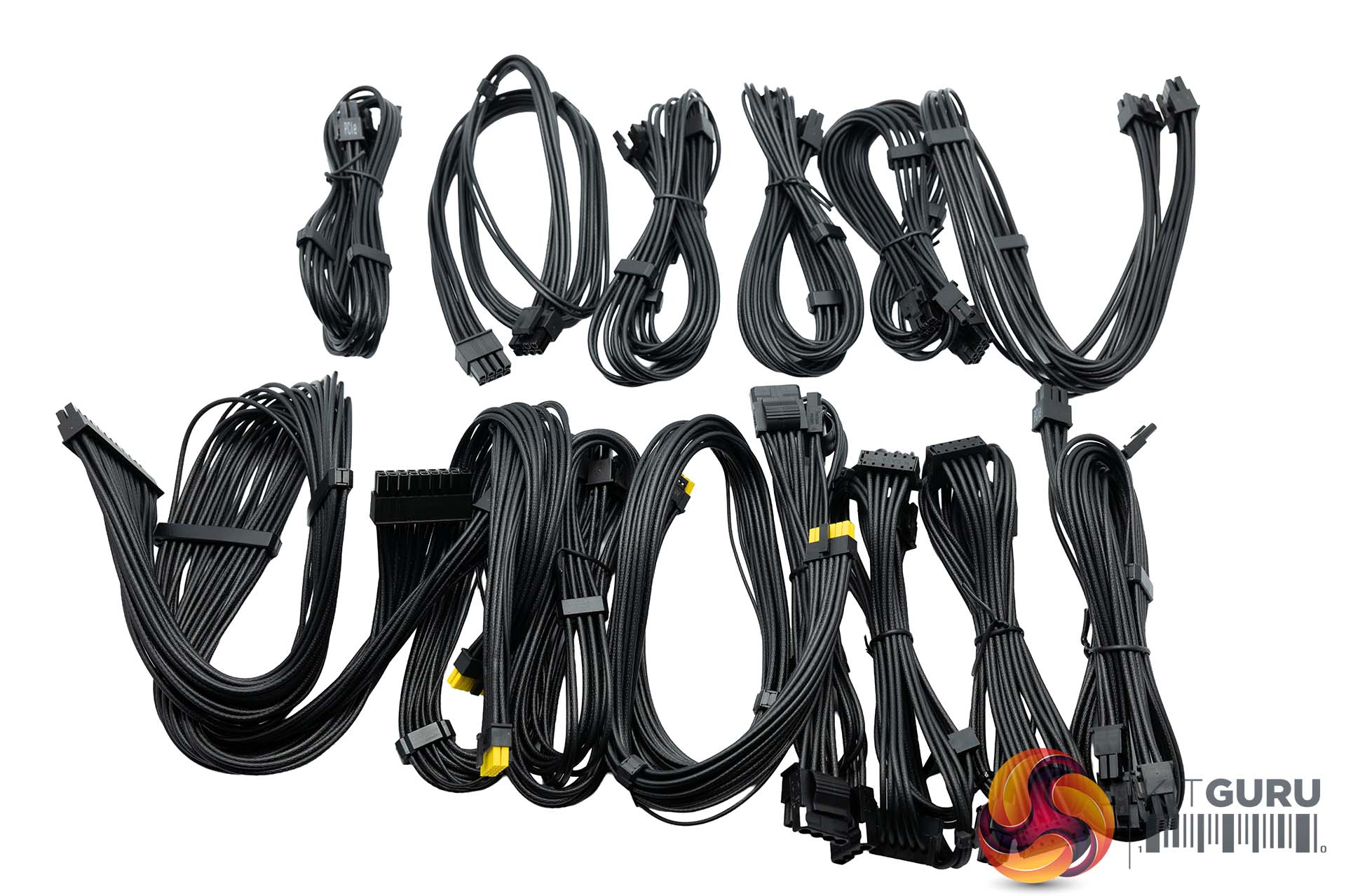
Cable quality is excellent. MSI use braided cabling throughout, primarily 18AWG tinned copper, with no in-line capacitors. The 12V-2×6 600W cable uses a heavier 16-24AWG configuration.
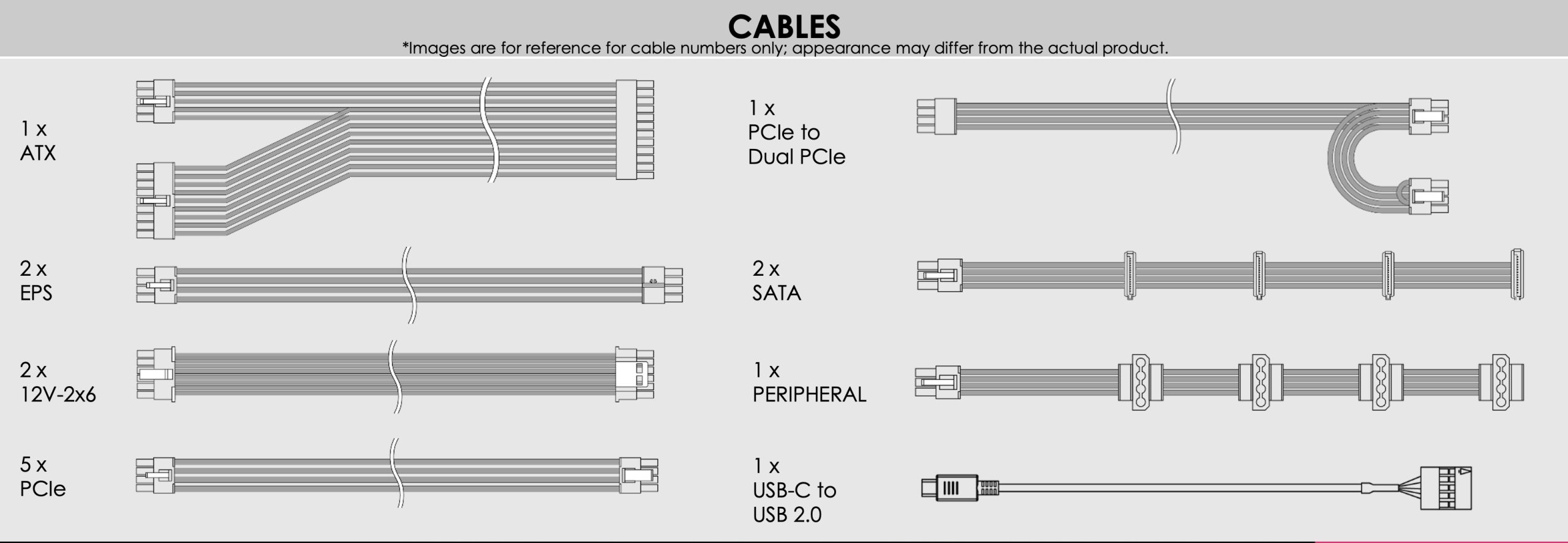
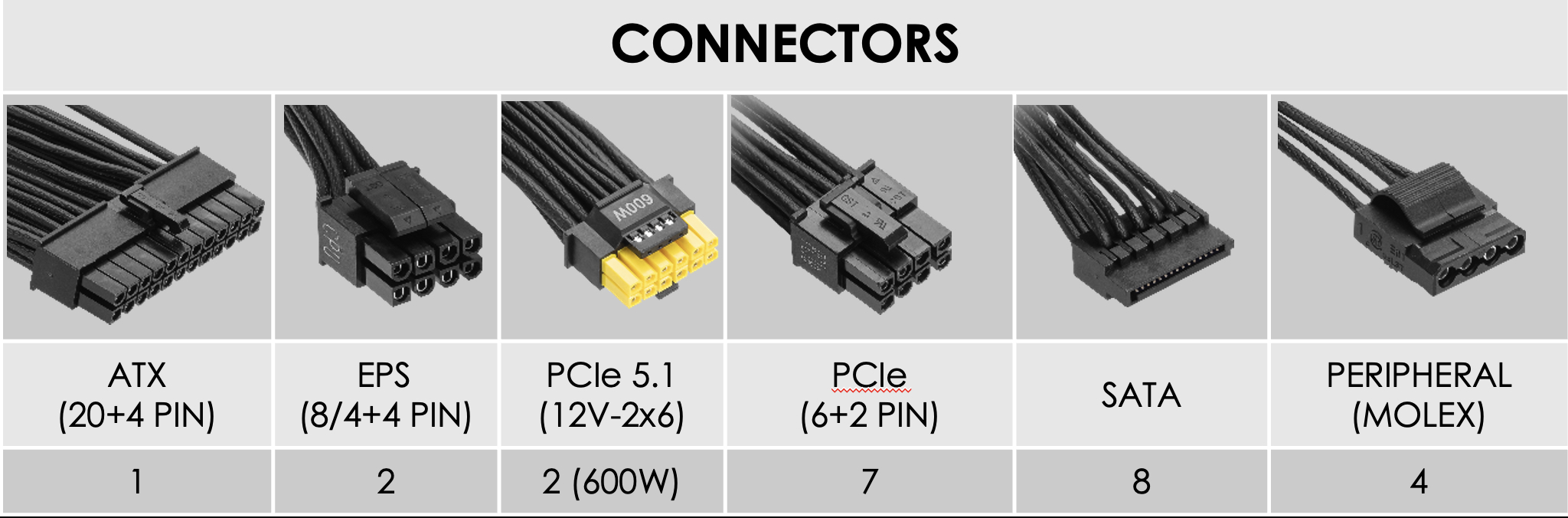
Connectors:
- 1 x Motherboard (24 pin)
- 1 x CPU (4+4 pin)
- 1 x CPU (8 pin)
- 2 x PCIe 5 (12+4 pin) / 600W
- 7 x PCIe (6+2 pin)
- 8 x SATA
- 4 x Peripheral (4 pin)
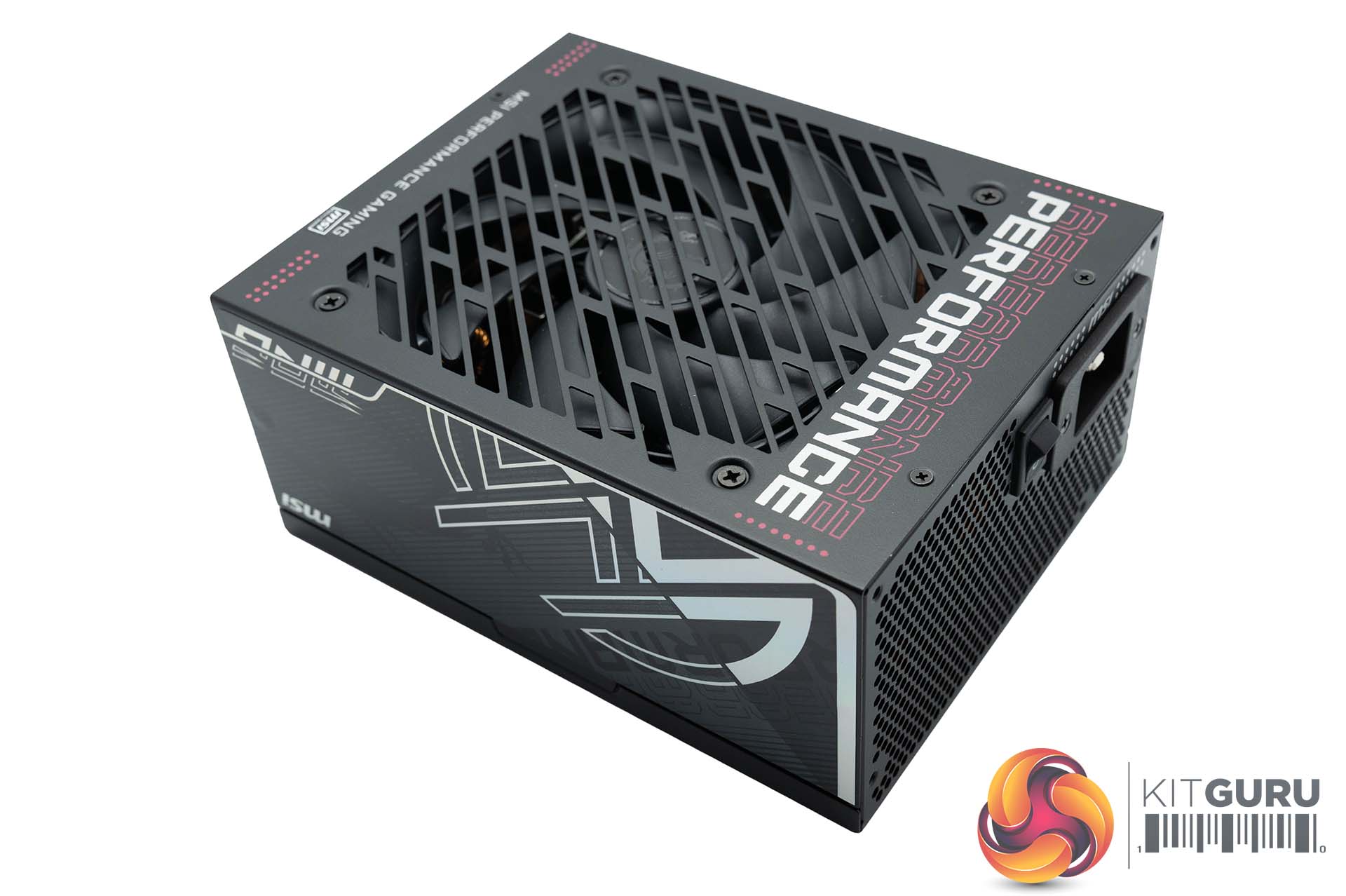
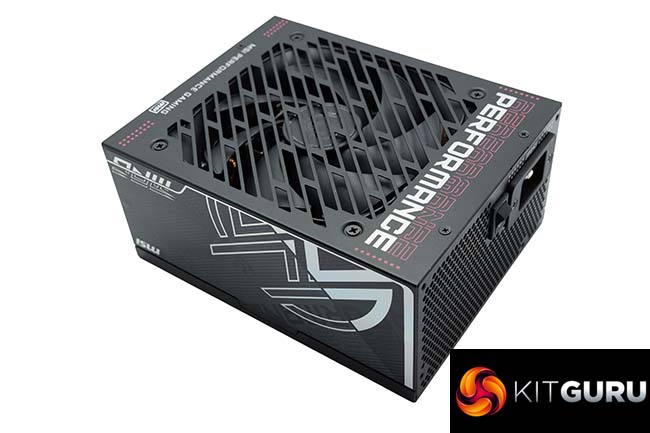
MSI have gone ‘full on gamer' with this unit. It looks smart enough, but I can't say I am a massive fan of having ‘PERFORMANCE' in capitals across the whole top panel. The unit is large, measuring 190mm x 150mm x 86 mm.
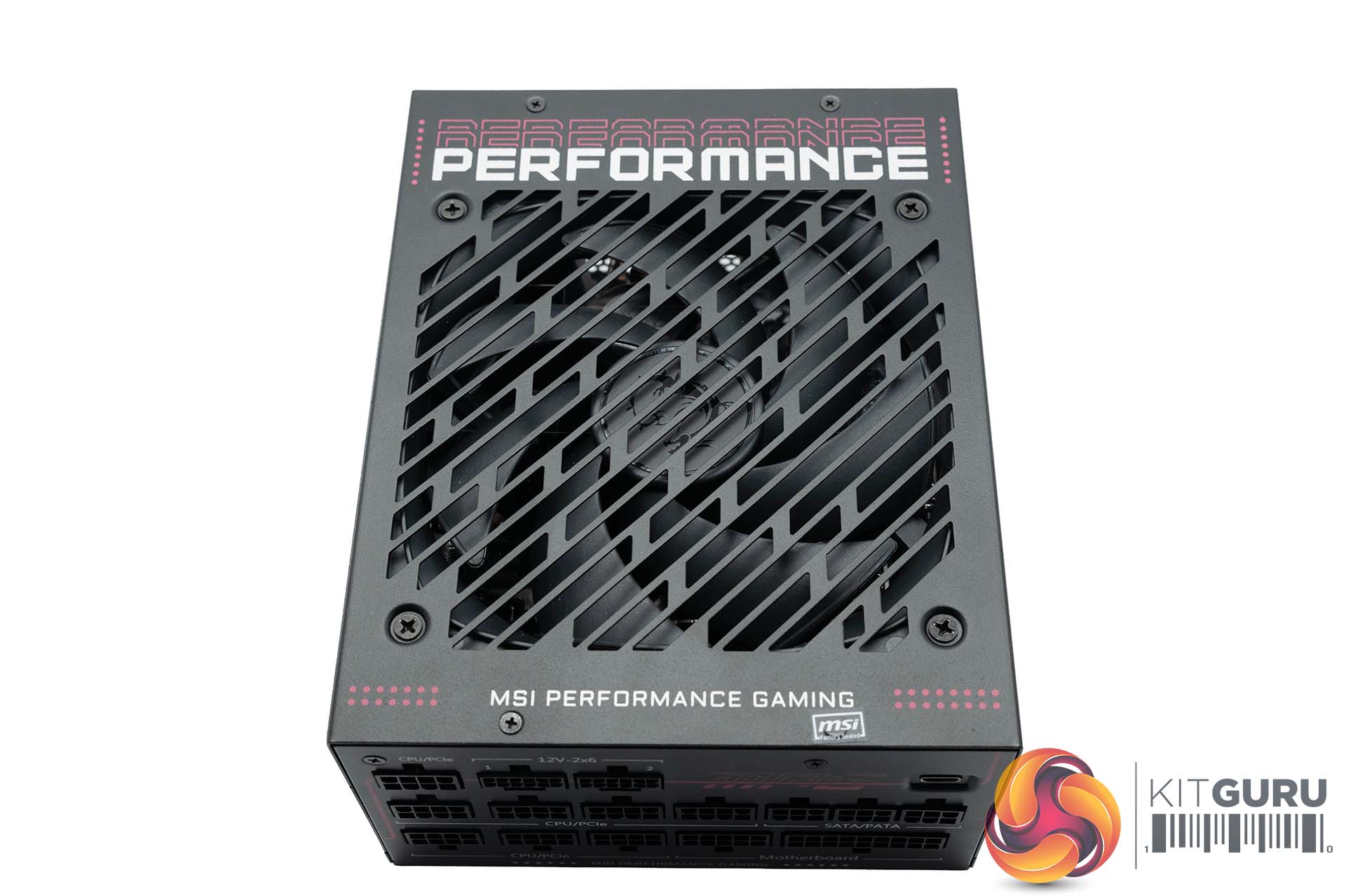
The 135mm fan underneath the top grille has plenty of wide holes above to enhance airflow. We will show the exact unit they are using in this power supply shortly.
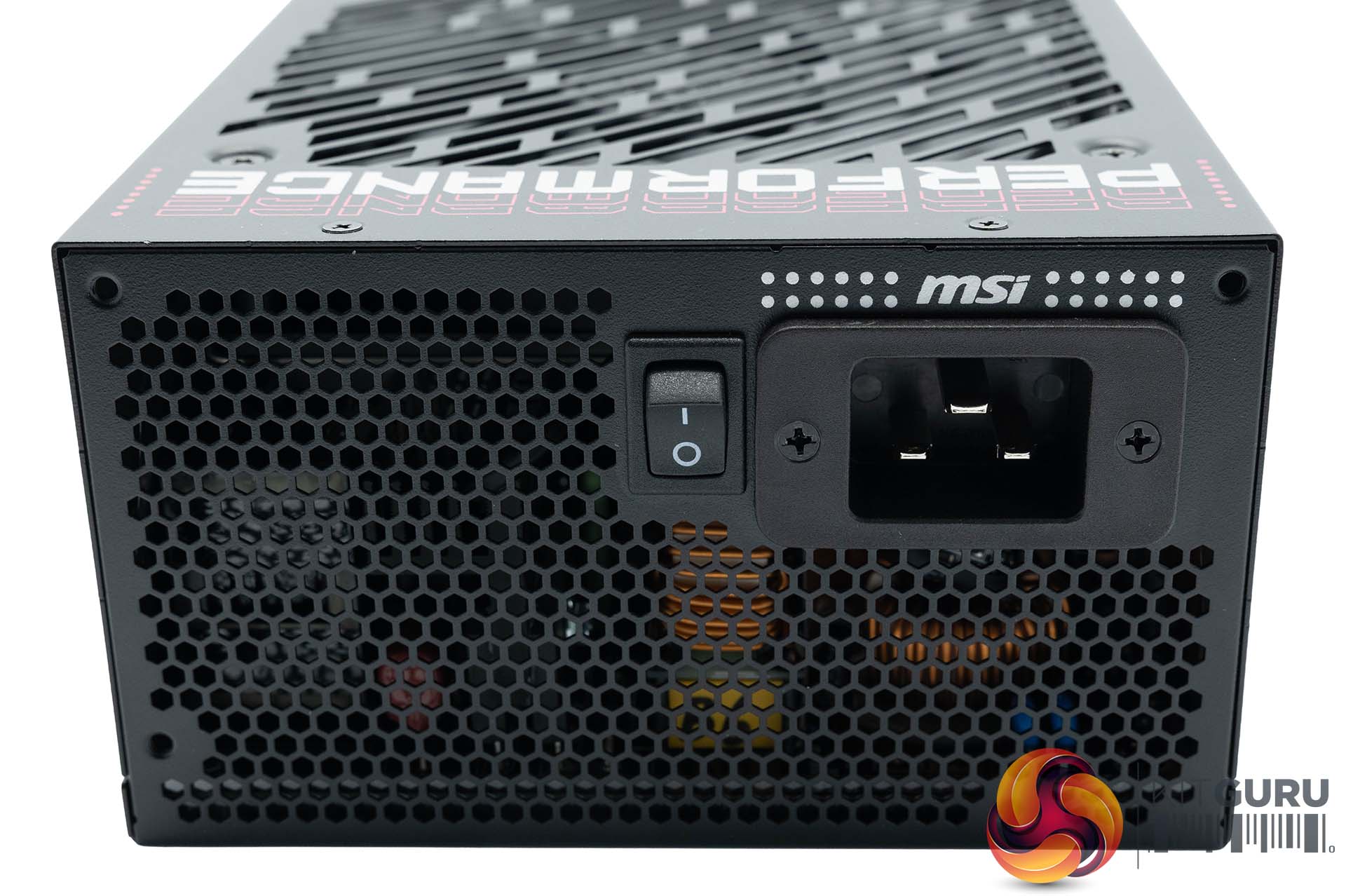
The power side of the unit has a switch and a C19 connector. A standard power cable will not work with this unit.
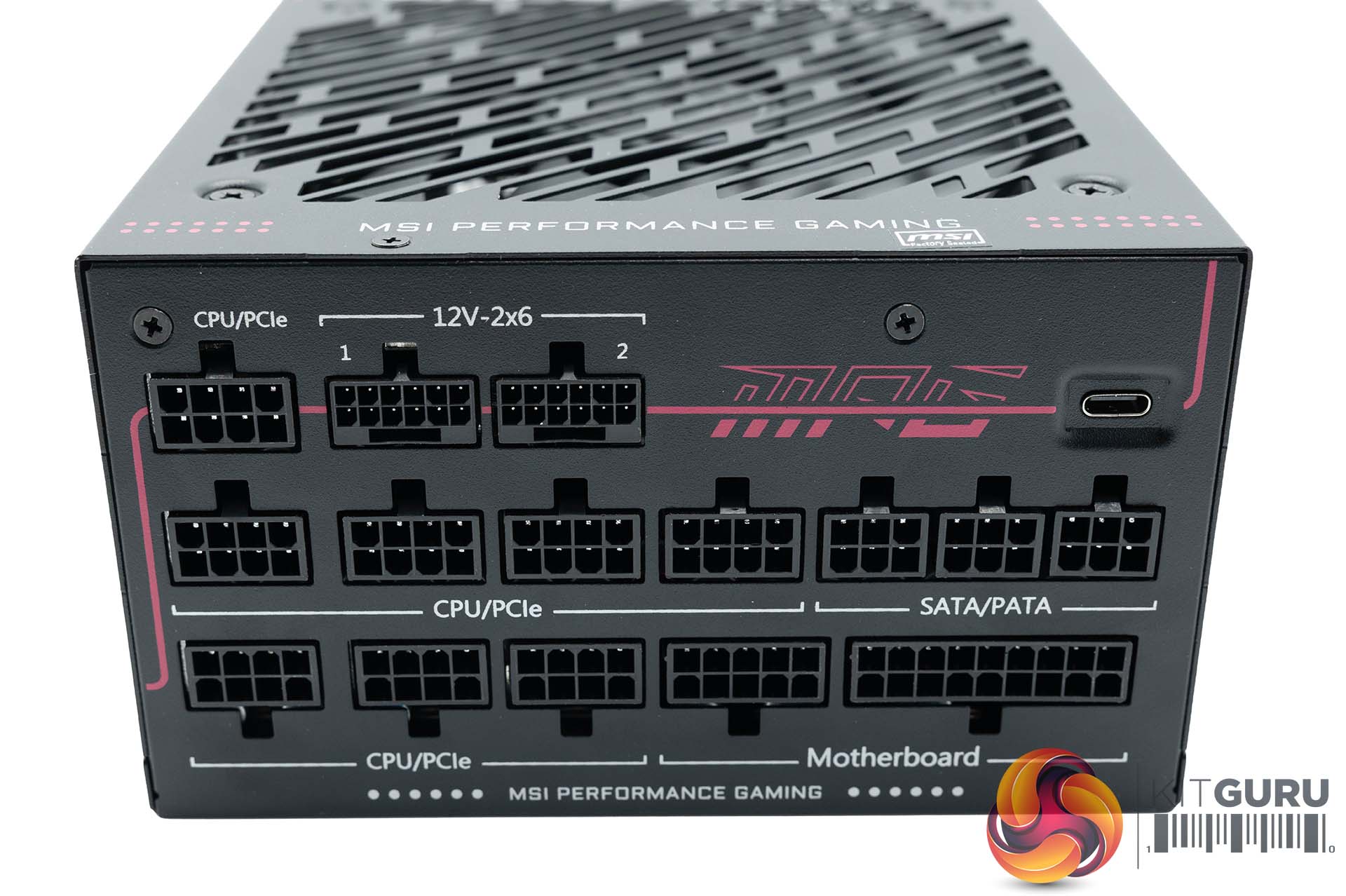
The modular side is split across three rows, all of which are labelled, There is also a USB header available (and a cable in the box) to connect to your PC for data readout. More on this in a bit.
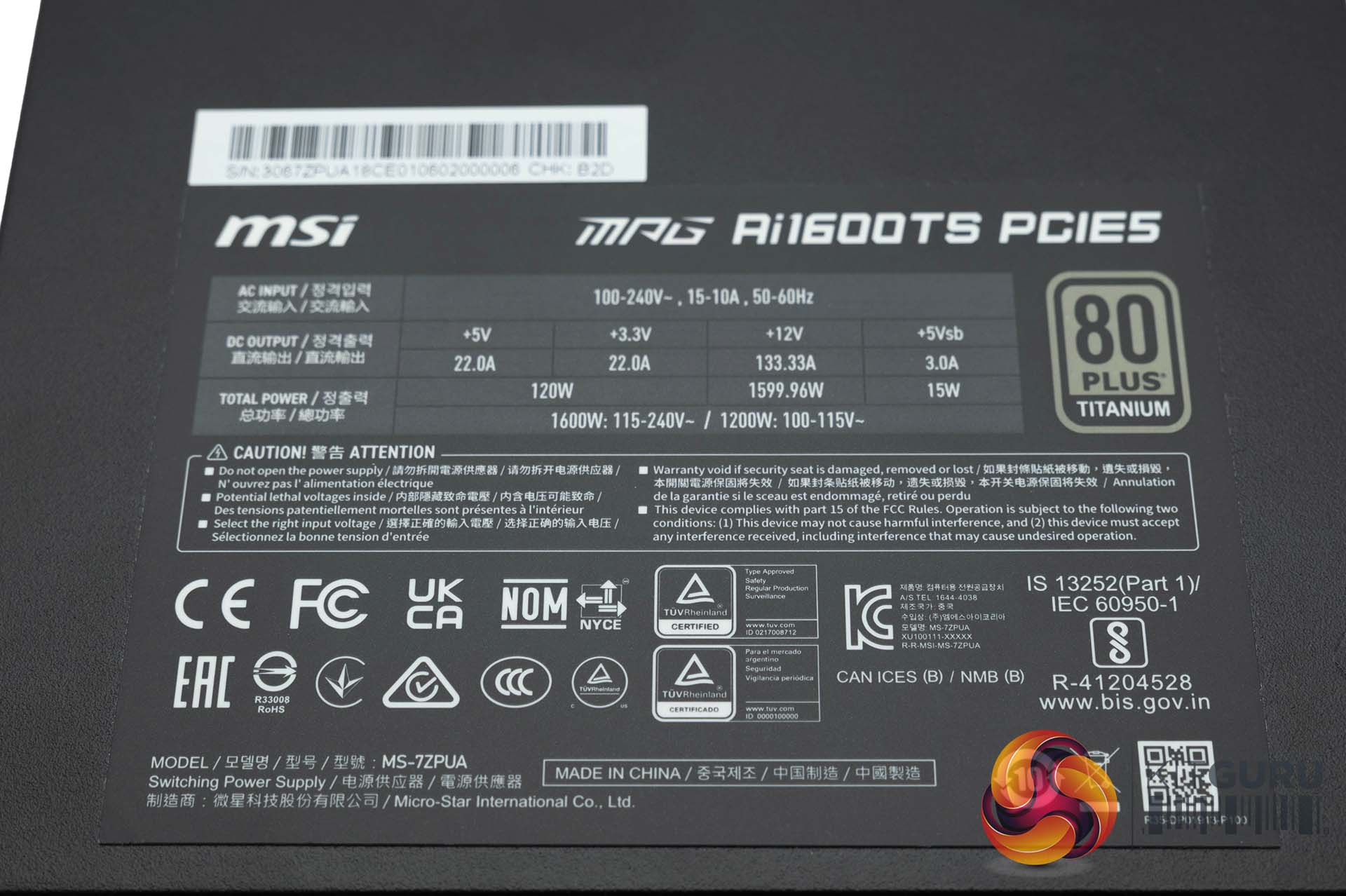
This is obviously a very powerful supply, capable of delivering 133.33 amps to the +12V rail. both +3.3V and +5V minor rails can deliver 22A.
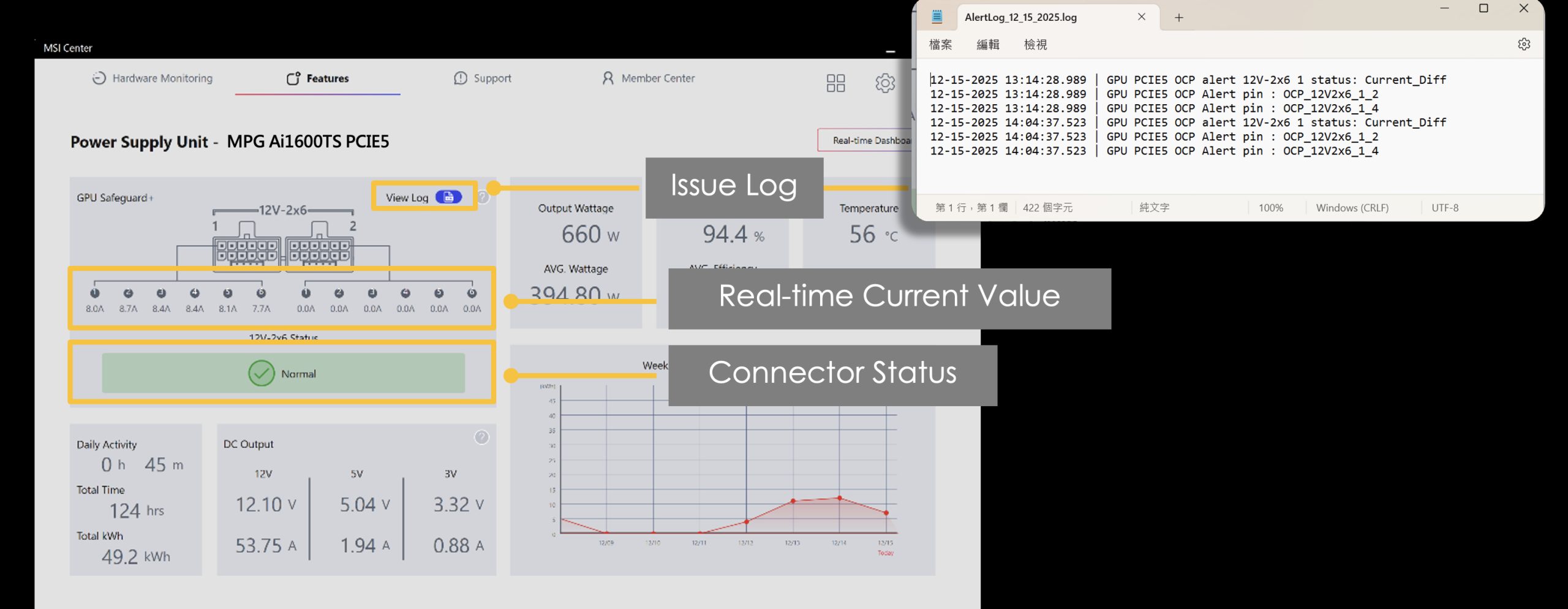
MSI allow this power supply to be connected to your PC for hardware monitoring capabilities. This MSI ‘GPU Safeguard+' Protection process was covered by us at CES earlier this year. If you head to 4:53 in the video below you will see it in action. It's a much better demo than showing 4 or 5 screenshots.
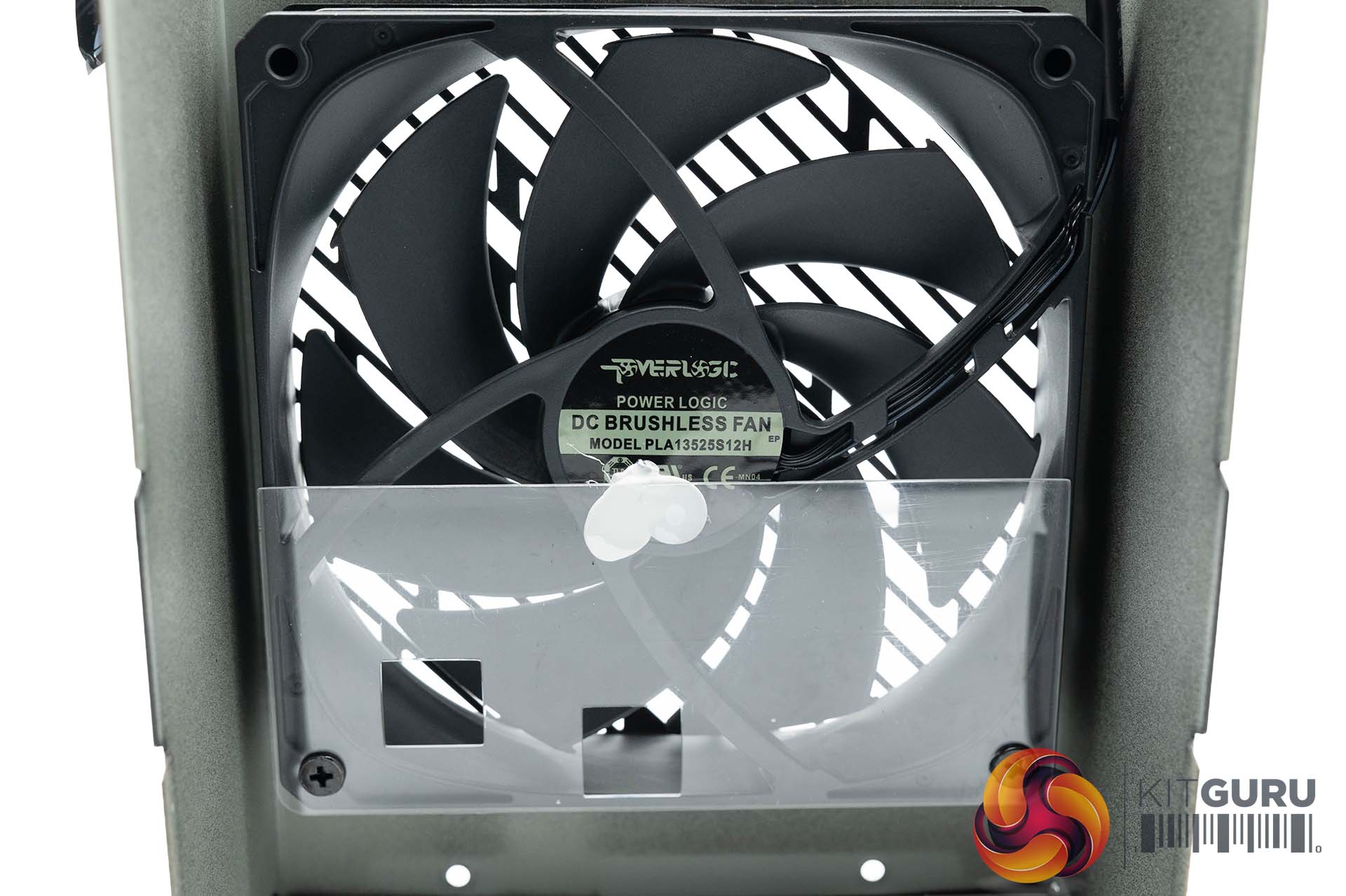
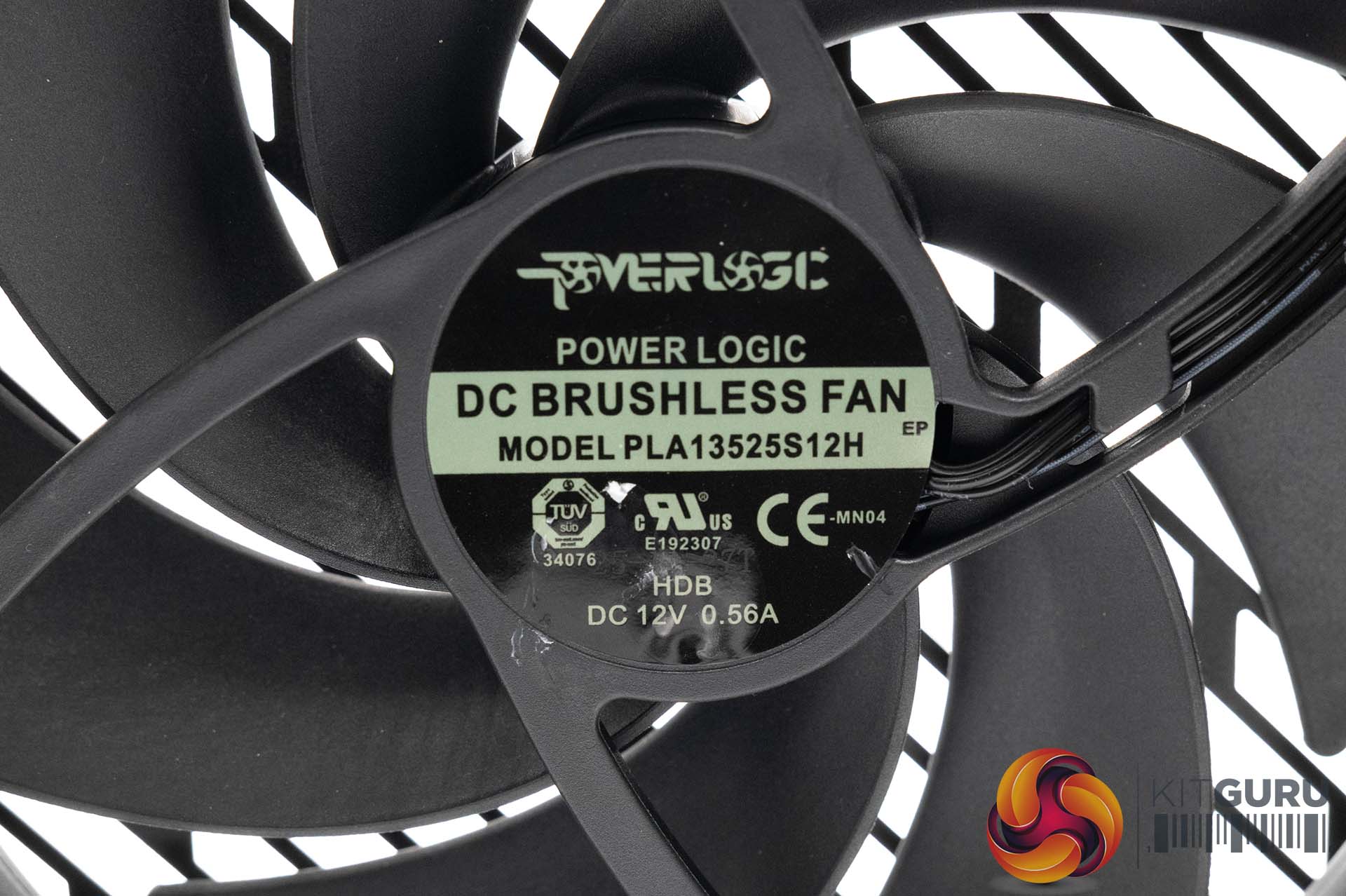
Cooling is handled by a 135mm fan mounted beneath a well-ventilated grille. The unit uses a Fluid Dynamic Bearing fan – specifically the PowerLogic PLA13525S12H, rated at 12V / 0.56A. Official specifications suggest up to 2300 RPM, although based on available data it may operate somewhat lower in practice.
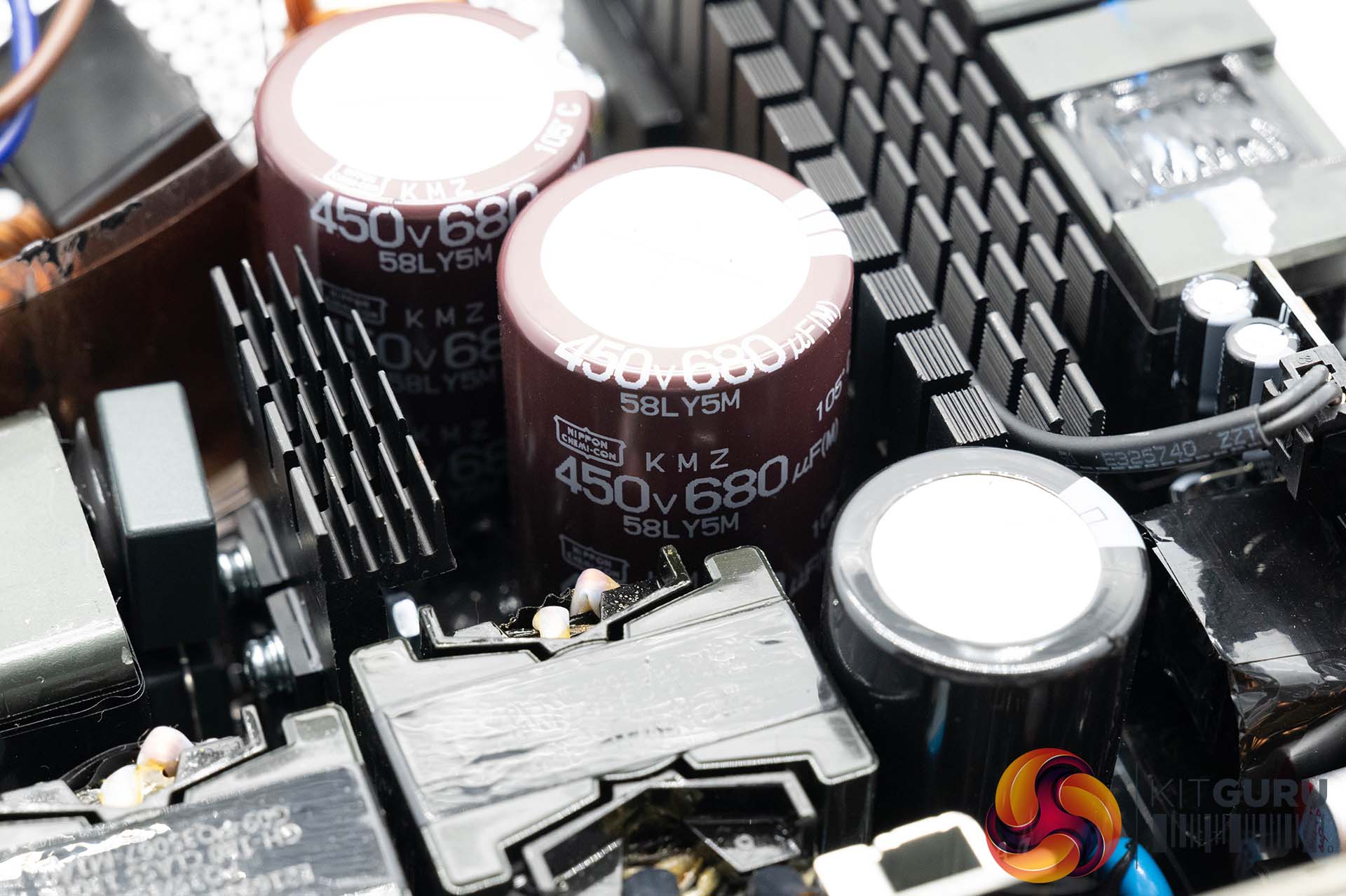
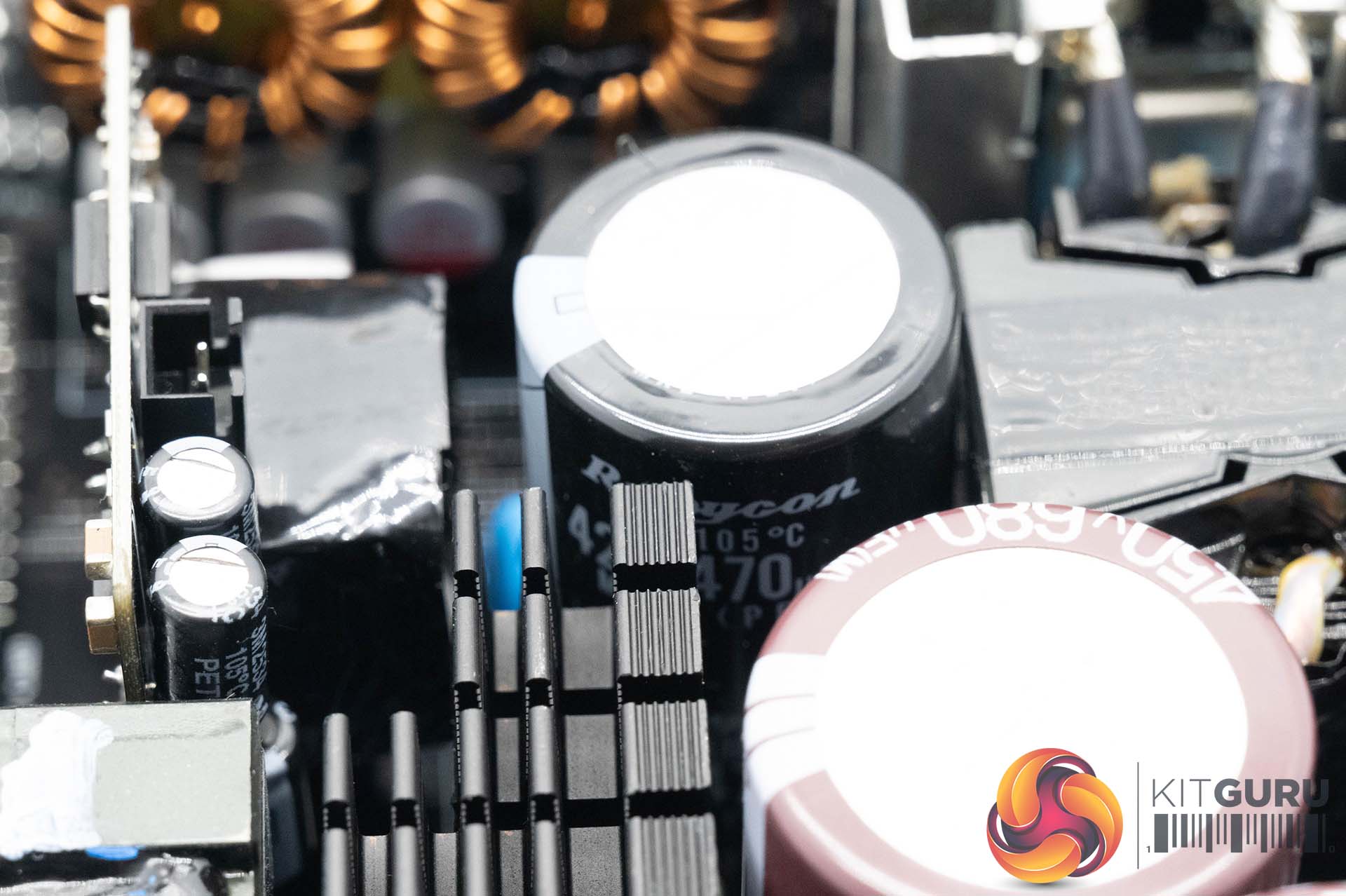
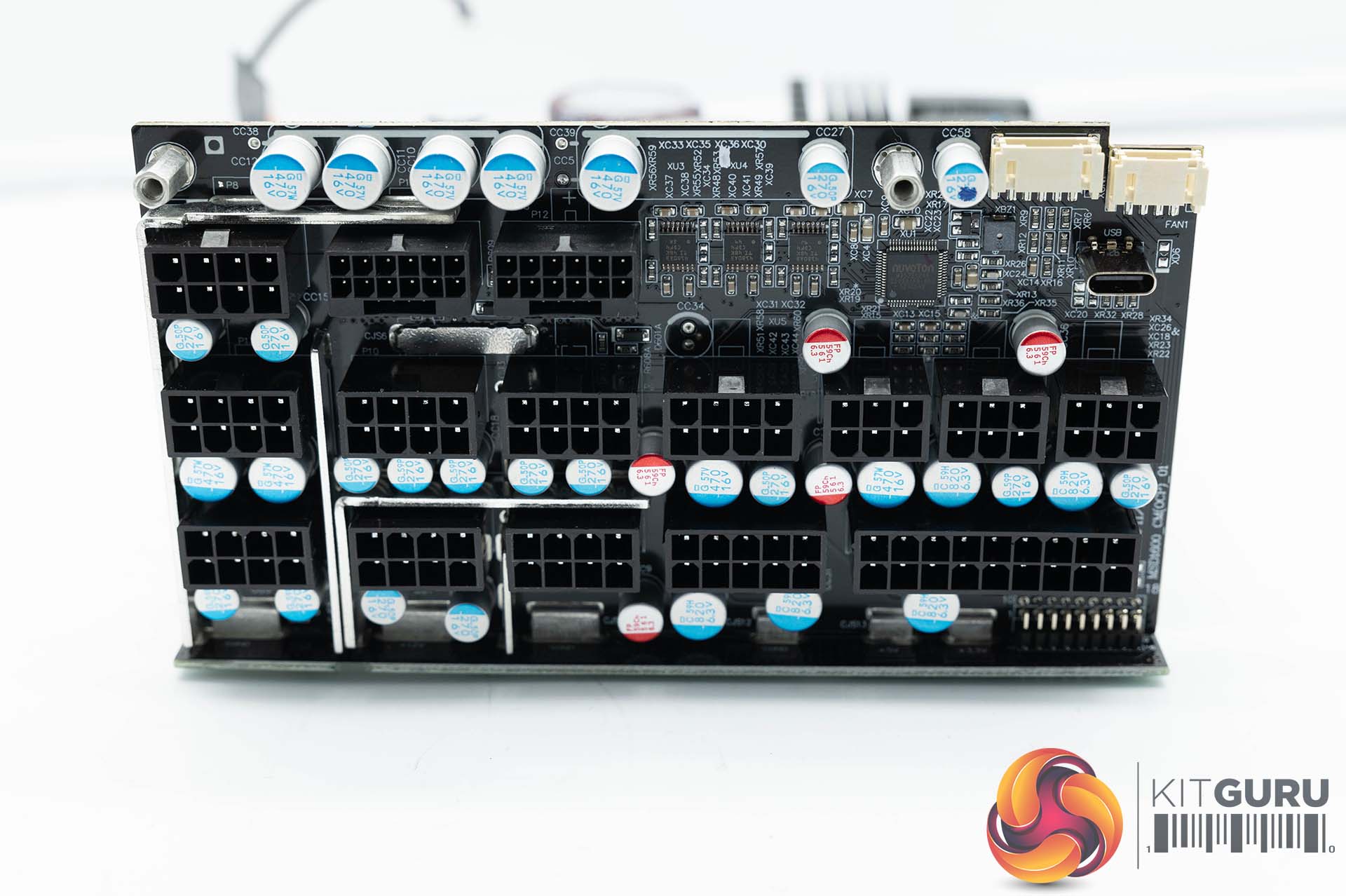
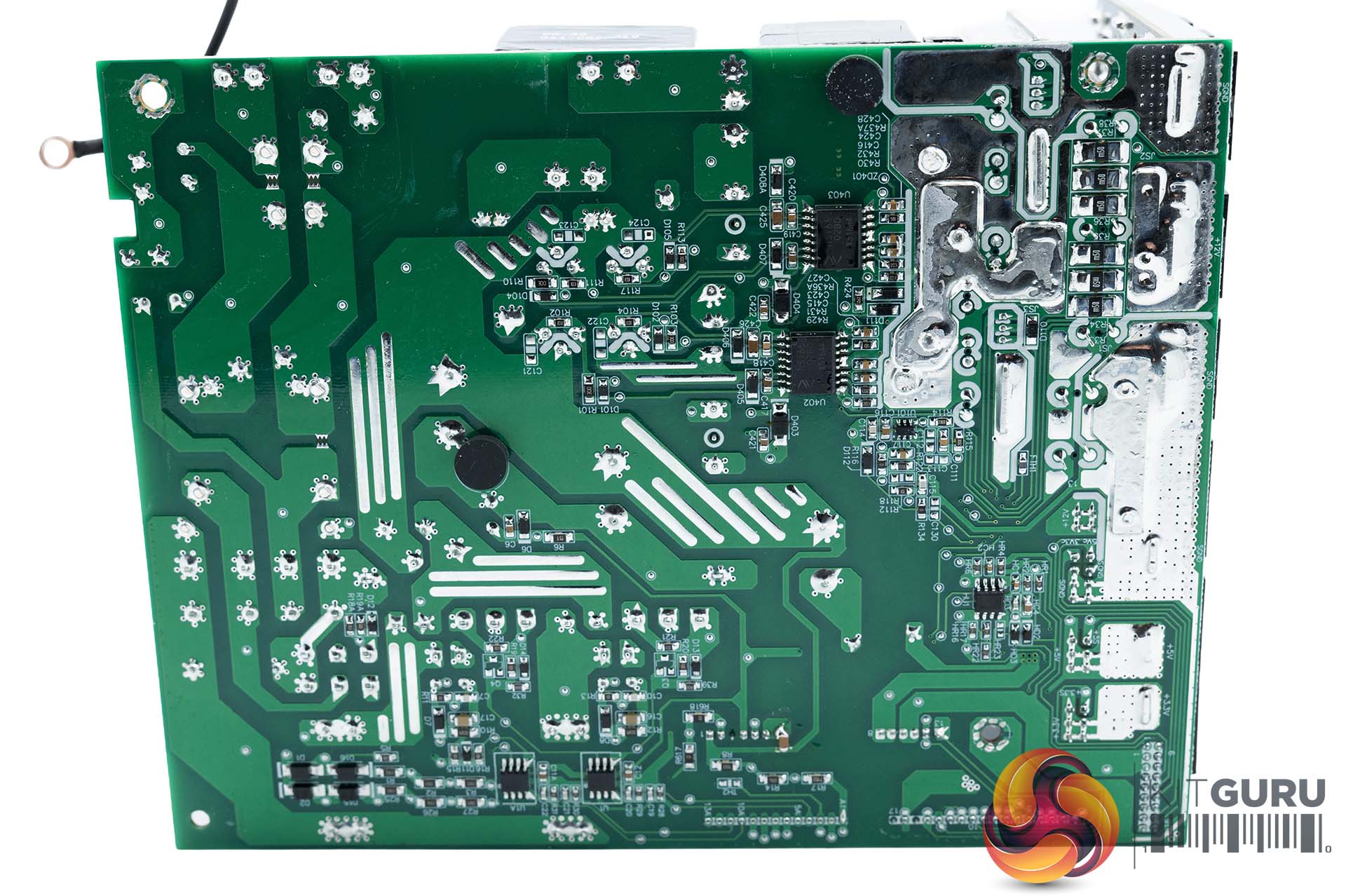
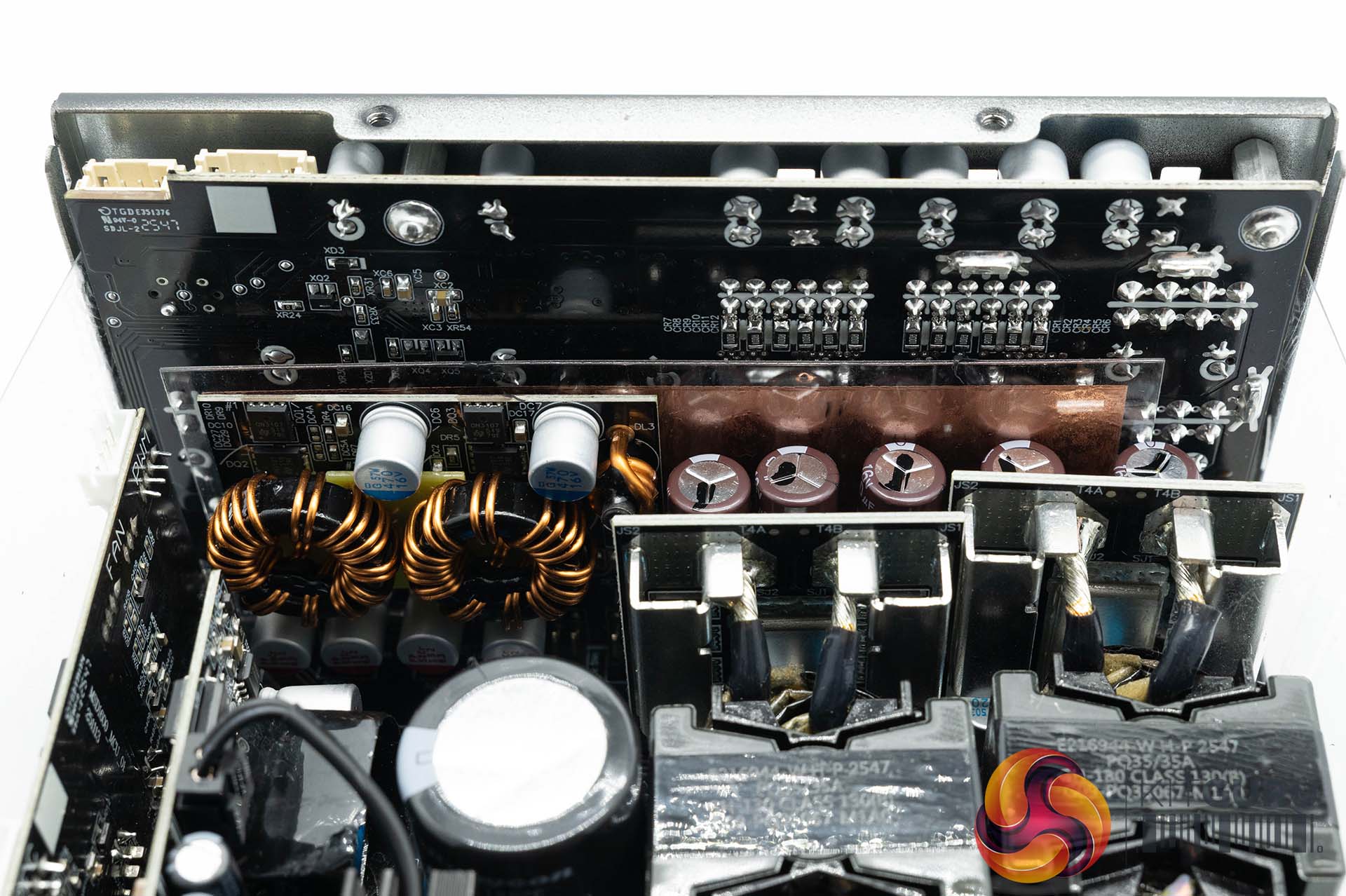
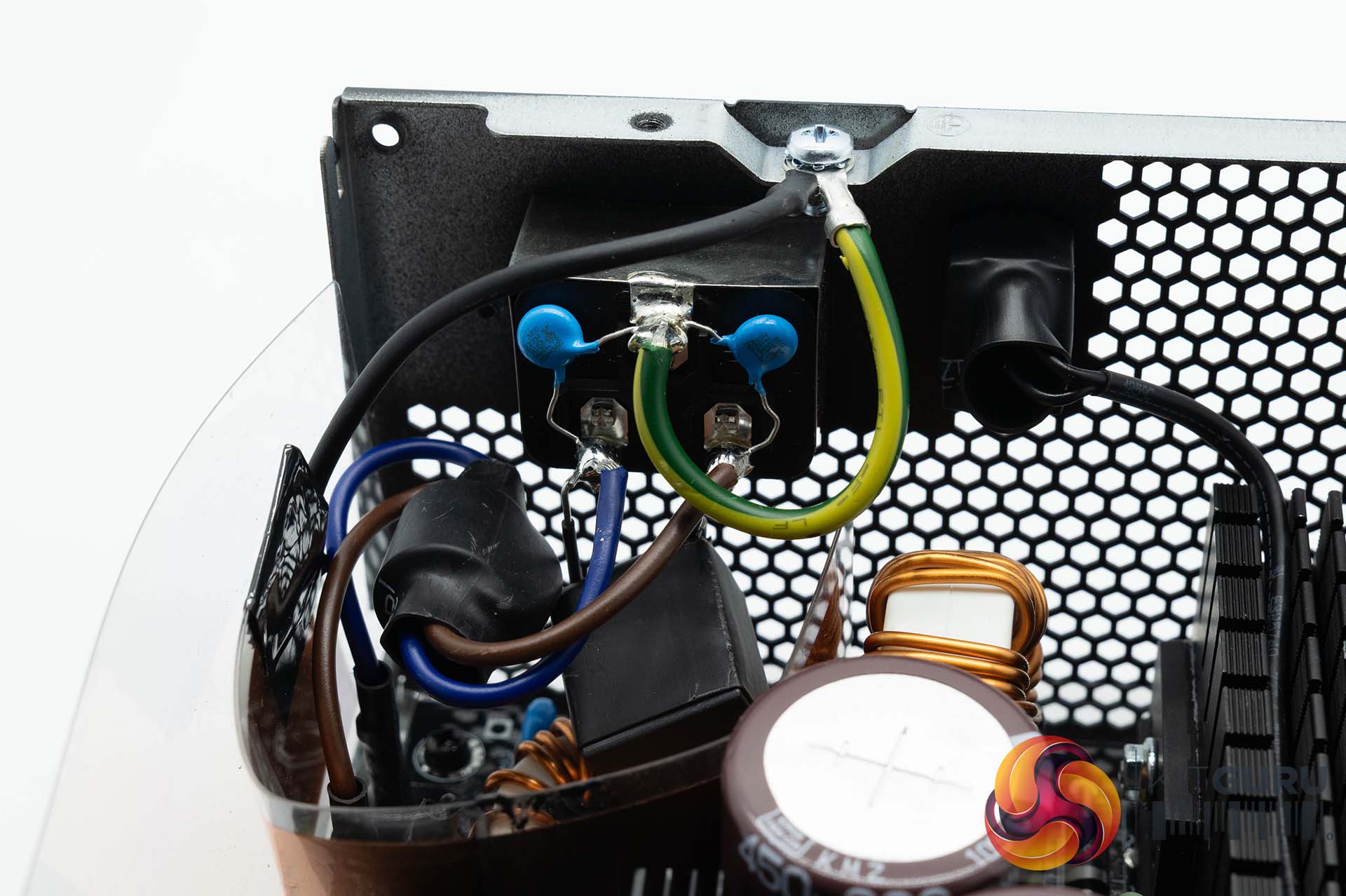
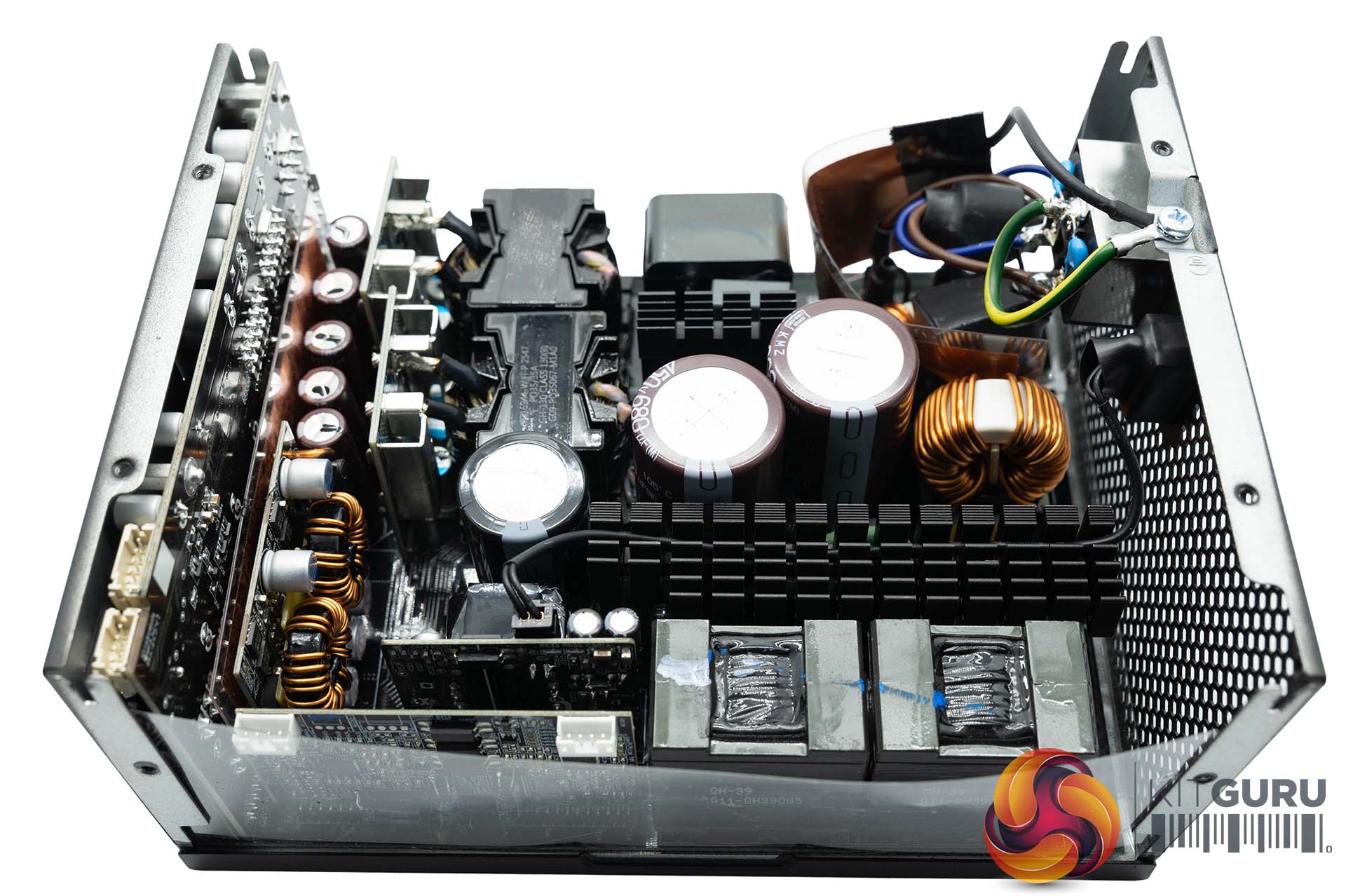
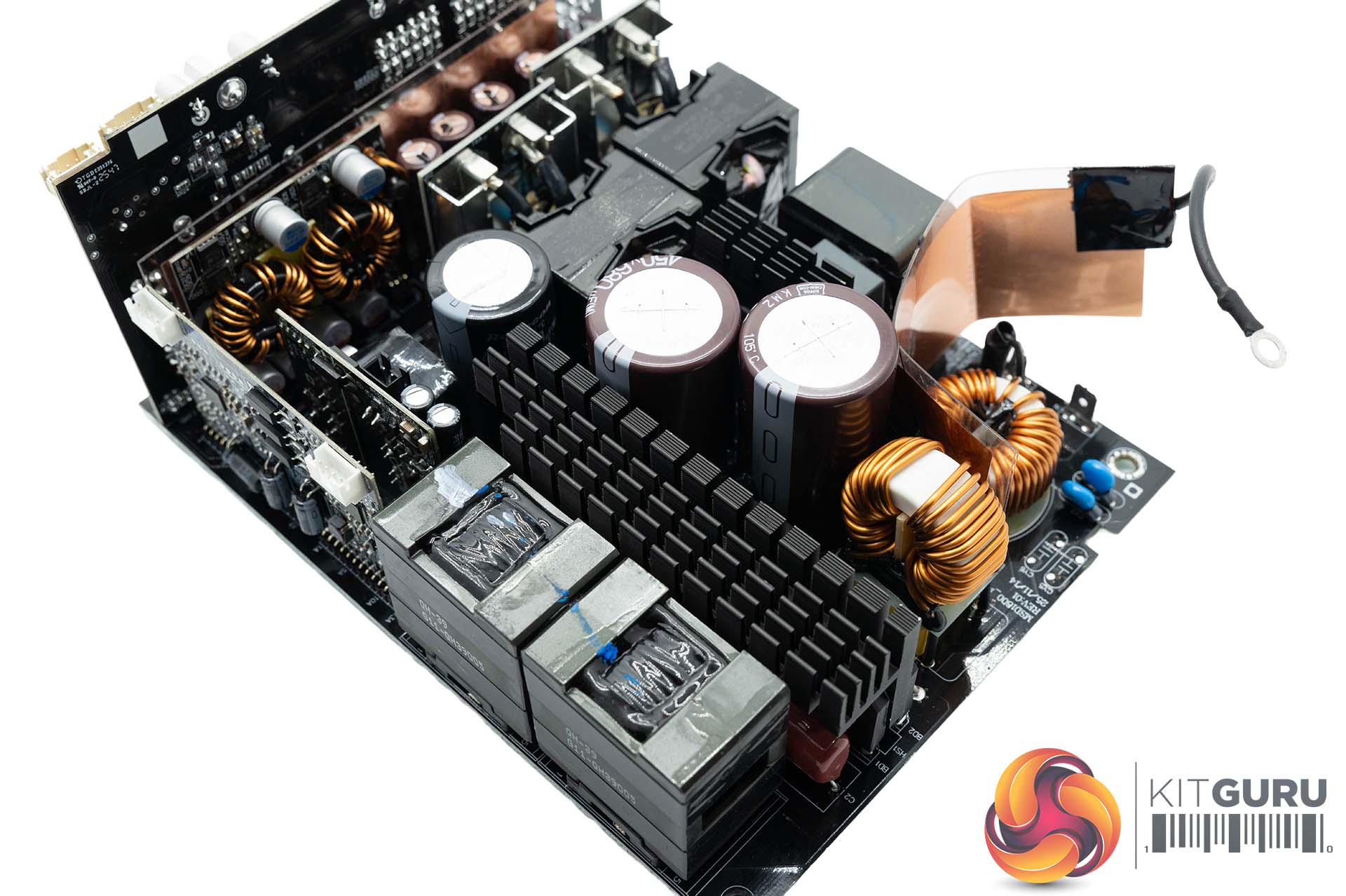
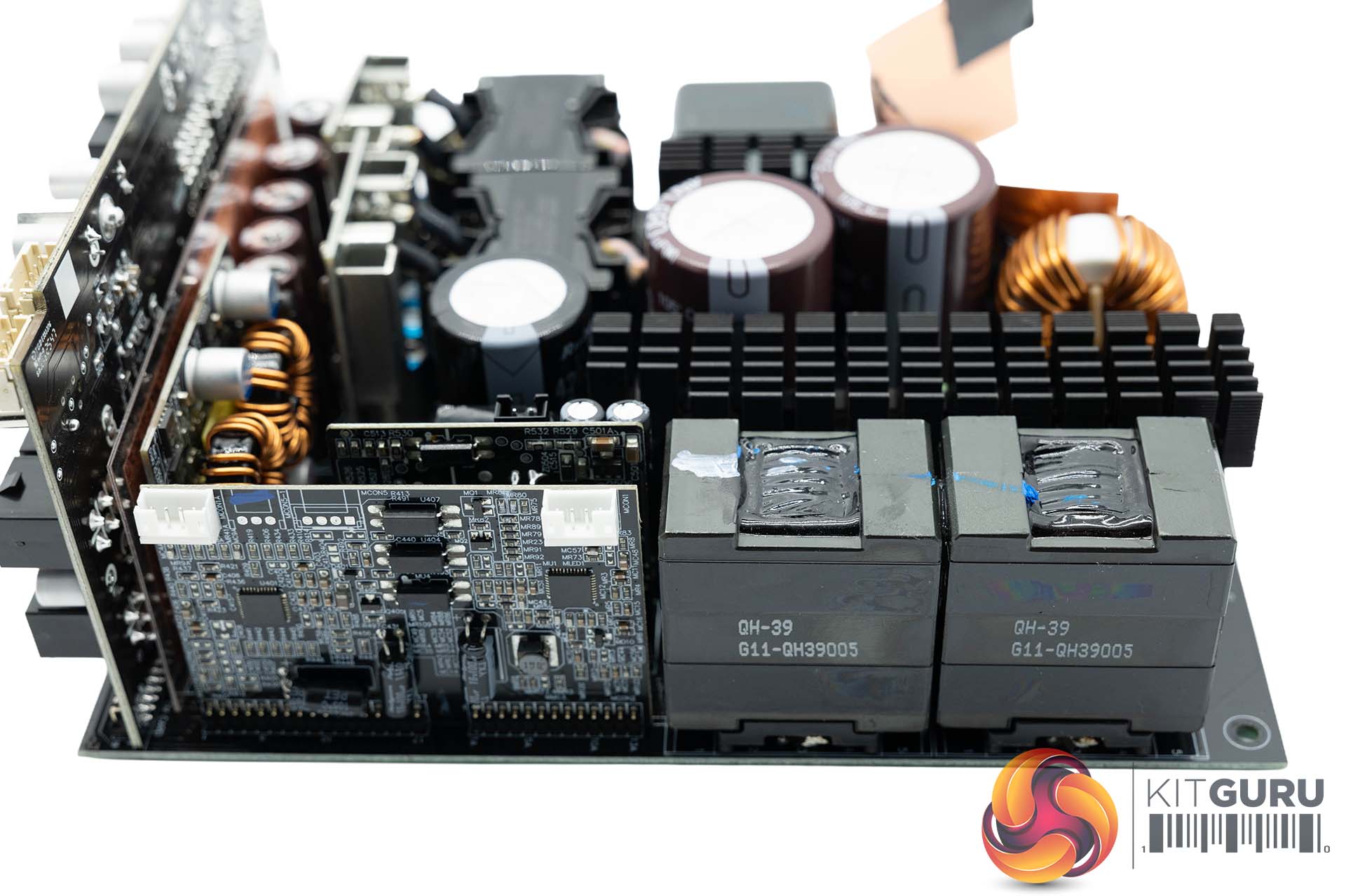
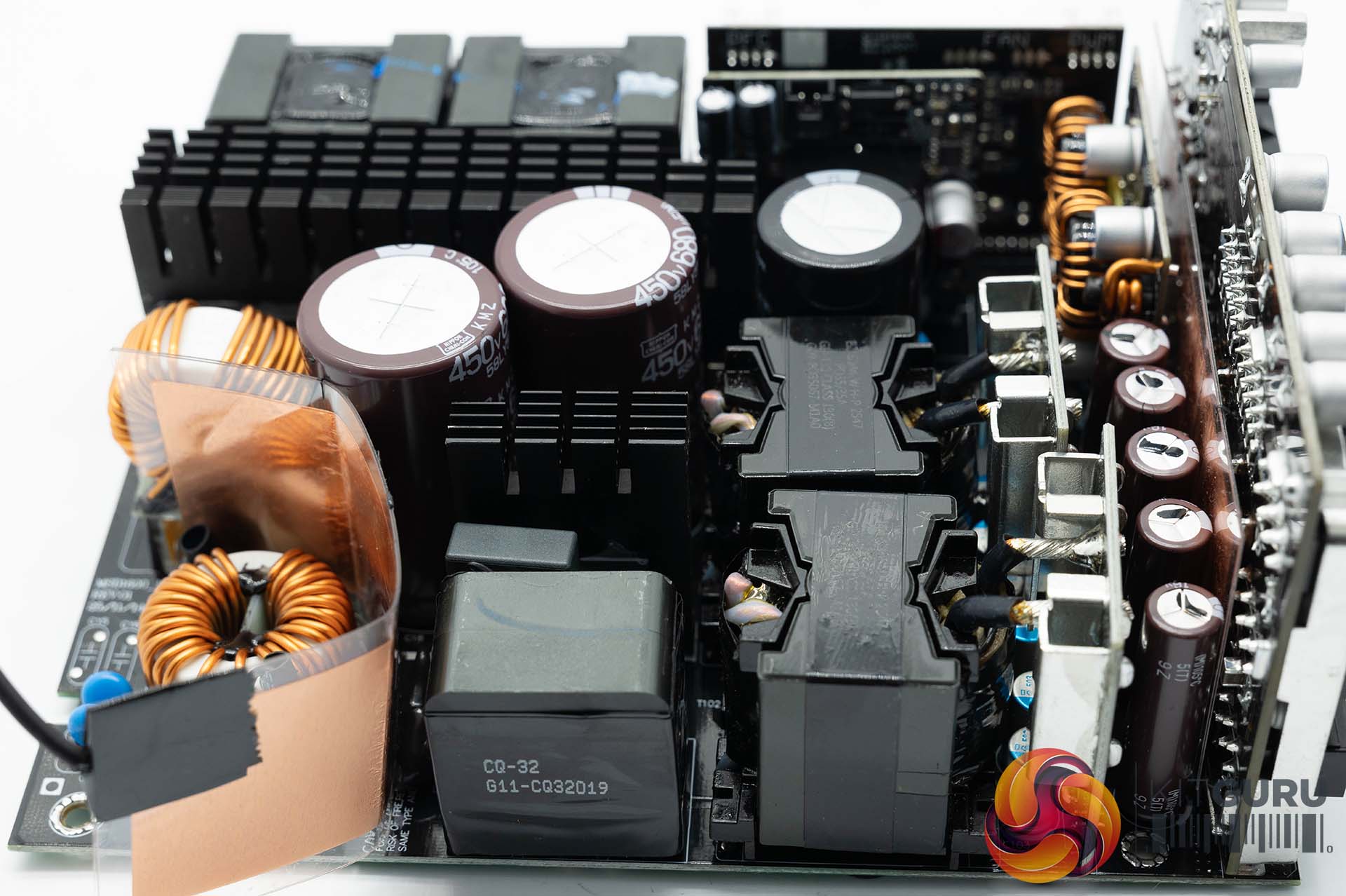
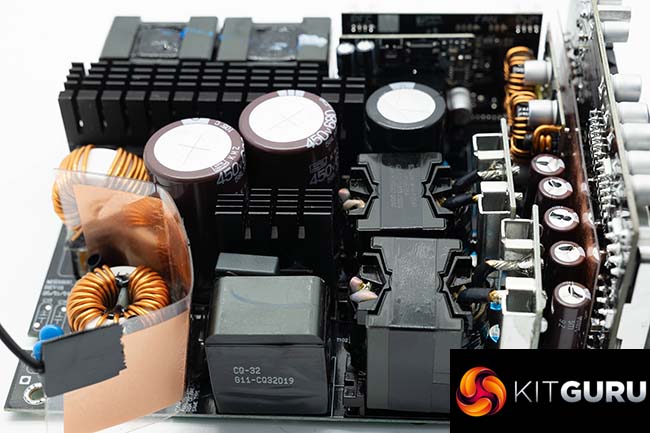
This is a CWT platform developed in collaboration with MSI.
Topology is a semi-digital interleaved bridgeless PFC design, combined with a full bridge LLC resonant converter. The secondary stage uses synchronous rectification with DC-DC conversion.
Primary capacitors are Japanese 105°C rated units from Nippon Chemi-Con (KMZ series, 450V 680µF), paired with an additional Rubycon 420V 470µF capacitor, for a combined total of 1830µF.
Transient filtering includes:
-
2 x X capacitors
-
5 x Y capacitors
-
2 x common mode chokes
-
1 x MOV
Secondary side filtering also uses Nippon Chemi-Con and Rubycon capacitors throughout. Overall component quality is excellent. The unit offers OCP/ OTP/ OPP/ SCP/ OVP/ UVP/ SIP/ NLO protections.
Correctly testing power supplies is a complex procedure and KitGuru have configured a test bench which can deliver up to a 2,000 watt DC load. Due to public requests we have changed our temperature settings recently – previously we rated with ambient temperatures at 25C, we have increased ambient temperatures by 10c (to 35c) in our environment to greater reflect warmer internal chassis conditions.
We use combinations of the following hardware:
• SunMoon SM-268
• CSI3710A Programmable DC load (+3.3V and +5V outputs)
• CSI3711A Programmable DC load (+12V1, +12V2, +12V3, and +12V4)
• Extech Power Analyzer
• Extech MultiMaster MM570 digital multimeter
• Extech digital sound level meter
• Digital oscilloscope (20M S/s with 12 Bit ADC)
• Variable Autotransformer, 1.4 KVA
12V output is single rail for our testing.
|
DC Output Load Regulation
|
||||||||||
|
Combined DC Load |
+3.3V
|
+5V
|
+12V
|
+5VSB
|
-12V | |||||
|
A
|
V
|
A
|
V
|
A
|
V
|
A
|
V
|
A | V | |
|
500W
|
7.63
|
3.33
|
8.82
|
5.04
|
36.05
|
12.02
|
1.5
|
5.00
|
0.30 | -12.01 |
|
750W
|
12.63
|
3.33
|
14.12
|
5.04
|
52.06
|
12.02
|
2.0
|
5.00
|
0.30 | -12.01 |
|
1000W
|
17.75
|
3.32
|
20.00
|
5.03
|
72.25
|
12.01
|
2.5
|
5.00
|
0.50 | -12.01 |
| 1250W | 18.84 | 3.32 | 24.04 | 5.03 | 90.14 | 12.00 | 3.0 | 5.00 | 0.60 | -12.01 |
|
1500W
|
18.87
|
3.32
|
22.64
|
5.03
|
115.90
|
11.99
|
3.5
|
4.99
|
0.80 | -12.01 |
| 1600W | 10.00 | 3.33 | 10.00 | 5.02 | 125.00 | 11.99 | 3.5 | 5.00 | 0.80 | -12.00 |
Load regulation is excellent across all rails, with very tight voltage control maintained from low to full load.
Next we want to try Cross Loading. This basically means loads which are not balanced. If a PC for instance needs 500W on the +12V outputs but something like 30W via the combined 3.3V and +5V outputs then the voltage regulation can fluctuate badly.
| Cross Load Testing | +3.3V | +5V | +12V | -12V | +5VSB | |||||
| A | V | A | V | A | V | A | V | A | V | |
| 1150W | 3.0 | 3.33 | 2.0 | 5.04 | 92.0 | 12.02 | 0.2 | -12.01 | 0.50 | 5.01 |
| 250W | 20.0 | 3.31 | 24.0 | 5.00 | 5.0 | 12.05 | 0.2 | -12.00 | 0.50 | 5.01 |
Cross-load performance is also strong, placing this unit comfortably within the top tier of power supplies tested over the last two years.
We then used an oscilloscope to measure AC ripple and noise present on the DC outputs. We set the oscilloscope time base to check for AC ripple at both high and low ends of the spectrum.
ATX12V V2.2 specification for DC output ripple and noise is defined in the ATX 12V power supply design guide.
|
ATX12V Ver 2.2 Noise/Ripple Tolerance
|
|
|
Output
|
Ripple (mV p-p)
|
|
+3.3V
|
50
|
|
+5V
|
50
|
|
+12V1
|
120
|
|
+12V2
|
120
|
|
-12V
|
120
|
|
+5VSB
|
50
|
Obviously when measuring AC noise and ripple on the DC outputs the cleaner (less recorded) means we have a better end result. We measured this AC signal amplitude to see how closely the unit complied with the ATX standard.
| AC Ripple (mV p-p) | ||||
| DC Load | +3.3V | +5V | +12V | 5VSB |
| 500W | 18 | 18 | 27 | 15 |
| 750W | 20 | 18 | 29 | 17 |
| 1000W | 21 | 20 | 31 | 17 |
| 1250W | 21 | 21 | 33 | 19 |
| 1500W | 21 | 21 | 36 | 21 |
| 1600W | 22 | 21 | 38 | 23 |
Ripple suppression is well within ATX specifications, although not class-leading. Results are solid and safe, but we have seen slightly cleaner outputs from a handful of competing high-end units.
|
Efficiency (%)
|
|
|
500W
|
92.87
|
|
750W
|
94.67
|
|
1000W
|
94.35
|
|
1250W
|
93.88
|
| 1500W | 92.41 |
| 1600W | 92.04 |
Efficiency is outstanding, peaking at close to 94.5% at mid-load (around 45-50%). It is worth adding that later in our review process MSI did send us data showing that Cybenetics only certified this unit as Platinum efficiency for the UK 230V market. Not Titanium.
We take the issue of noise very seriously at KitGuru and this is why we have built a special home brew system as a reference point when we test noise levels of various components. Why do this? Well this means we can eliminate secondary noise pollution in the test room and concentrate on components we are testing. It also brings us slightly closer to industry standards, such as DIN 45635.
Today to test the power supply we have taken it into our acoustics room environment and have set our Digital Sound Level Noise Decibel Meter Style 2 one meter away from the unit. We have no other fans running so we can effectively measure just the noise from the unit itself.
As this can be a little confusing for people, here are various dBa ratings in with real world situations to help describe the various levels.
KitGuru noise guide
10dBA – Normal Breathing/Rustling Leaves
20-25dBA – Whisper
30dBA – High Quality Computer fan
40dBA – A Bubbling Brook, or a Refrigerator
50dBA – Normal Conversation
60dBA – Laughter
70dBA – Vacuum Cleaner or Hairdryer
80dBA – City Traffic or a Garbage Disposal
90dBA – Motorcycle or Lawnmower
100dBA – MP3 Player at maximum output
110dBA – Orchestra
120dBA – Front row rock concert/Jet Engine
130dBA – Threshold of Pain
140dBA – Military Jet takeoff/Gunshot (close range)
160dBA – Instant Perforation of eardrum
|
Noise (dBA)
|
|
|
500W
|
<28.0
|
|
750W
|
<28.0
|
|
1000W
|
<28.0
|
|
1250W
|
30.2
|
| 1500W | 31.7 |
| 1600W | 32.4 |
This is really an exceptionally quiet power supply and I am very impressed with the results. At no time, even at 1300W load did the fan sound as if it was working hard at all. Even at full load, you can hear it, but it's not intrusive at all. Superb results.
|
Temperature (c)
|
||
|
Intake
|
Exhaust
|
|
|
500W
|
36
|
38
|
|
750W
|
37
|
43
|
|
1000W
|
42
|
47
|
|
1250W
|
46
|
53
|
|
1500W
|
48
|
56
|
| 1600W | 50 | 63 |
The highly efficient design and excellent fan performance deliver some super overall results.
This has been a strong showing from MSI with the MPG Ai1600TS, and it definitely feels like a more refined and better balanced product than the earlier Ai1600T in several key areas.
From a technical standpoint, the platform is solid. CWT have delivered a mature, well understood design here and MSI have paired it with high quality components throughout. Voltage regulation is tight, cross-load performance is excellent, and efficiency levels are very strong and in line with a high-end Titanium-class design (more on this below).
There are no real red flags in the electrical performance, which is exactly what you want to see at this level.
Acoustics are particularly impressive. It is not easy to keep a 1600W power supply this quiet under load, yet MSI have managed to deliver a very controlled and well tuned fan profile. Even when pushed hard at 1600W load it was barely hitting 32dBa, not something you see from every unit in this class!
The addition of GPU Safeguard+ is an interesting move. Whether you view it as genuinely useful or just another feature to tick a marketing box will depend on your perspective, but there is no denying that actively monitoring current across each pin of the 12V-2×6 connector makes sense given all the drama we have seen around high-end GPUs with this connector standard. At the very least, it adds a layer of reassurance.
Build quality is excellent throughout. The internal component selection is exactly what we would expect at this price point, and the external finish, while a little on the ‘gamer side’, is still clean enough for most high end system builds. The use of a C19 connector is also a sensible inclusion for a unit of this power level.
If we are being critical, ripple suppression, while well within specification, is not quite class leading. It is absolutely safe and perfectly acceptable in real world use, but we have seen slightly tighter results from some competing flagship units in recent years. Physically, it is also a large unit, and the bold ‘PERFORMANCE’ branding may not appeal to everyone depending on the system aesthetic you are aiming for.
It is also worth highlighting that, while MSI market this unit as 80 PLUS Titanium, the Cybenetics certification data tells a slightly more nuanced story. In the UK/EU 230V environment, this unit is actually certified as Platinum efficiency rather than Titanium. While this kind of variance is not unusual due to differences in input voltage, it does raise a valid point – if a unit is sold into a 230V market but does not meet Titanium efficiency levels under those conditions, then the branding is really just a technicality, rather than a true reflection of performance. That said, efficiency is still very strong overall, as we would expect from a high-end platform, but we do need to be clear about the actual levels.
Pricing will play a big role in how competitive this unit ends up being, and based on information provided directly by MSI, the MPG Ai1600TS is expected to land somewhere in the £399-£449 range when stock arrives towards the end of Q2. For context, the original MEG Ai1600T is currently retailing for around £550 in the UK, so MSI are clearly positioning the TS model significantly lower in the stack. Which is slightly odd, given it's a substantial price reduction for what is arguably a more refined and better balanced design.
If the unit does land at that price – which is still TBC – the Ai1600TS will be very competitive against other flagship units on the market, especially factoring in its strong performance, excellent acoustics and high quality CWT design. It also becomes much easier to overlook some of the minor shortcomings highlighted earlier. MSI could have a very compelling option on their hands here for enthusiasts building ultra high-end systems around the latest generation of hardware.
Pros:
- Excellent overall build quality.
- Very low noise levels, even at high load.
- Strong voltage regulation across all rails.
- Very good cross-load performance.
- High quality internal component selection.
- Very strong efficiency performance.
- GPU Safeguard+ adds additional monitoring layer.
- Dual 12V-2×6 connectors for modern GPUs.
Cons:
- Ripple suppression is good, but not class leading.
- Large physical size may limit compatibility in some cases.
- ‘PERFORMANCE’ branding may not suit all builds.
- ‘Ai’ branding will still annoy some people.
- Titanium rating does not fully translate under 230V conditions.
- Final pricing will be critical to overall value.
KitGuru Says: The MSI MPG Ai1600TS is a very strong high-end power supply with excellent acoustics, solid performance and a robust internal design. If pricing is positioned sensibly below the original Ai1600T, MSI will have a very competitive option in the ultra high-end PSU market.