KitGuru KitGuru.net – Tech News | Hardware News | Hardware Reviews | IOS | Mobile | Gaming | Graphics Cards


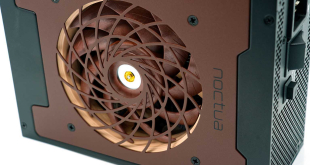
We have reviewed many power supplies from Seasonic in recent years but today we look at a rather special model in partnership with Noctua. This ‘Noctua Edition' power supply is based around one of the most expensive products that Seasonic make, and Noctua claim that this unit is quieter than the original unit which we tested some time ago.
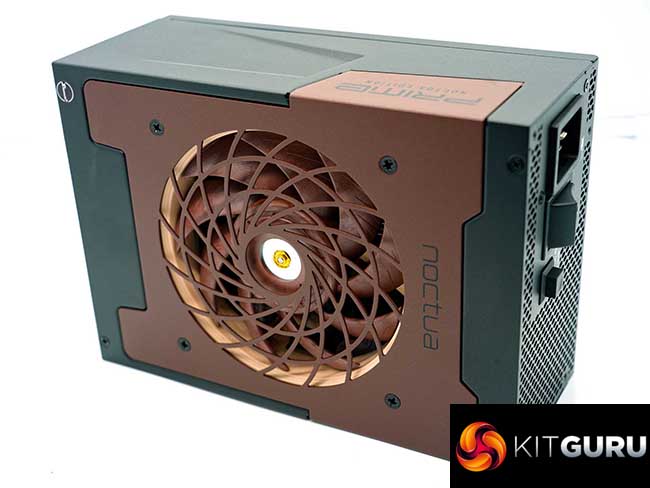
Noctua say this is not a limited edition product, so it will be sold for as long as they decide. With a price tag of EUR 499 / USD 569, it is clearly for a niche audience. While the colour scheme will split opinion (as it always does), I have to say, I thought it looked really cool when I opened the box. Anything to get away from plain white or black units is a refreshing change in my opinion.
Noctua as a brand are highly regarded for their air coolers and fan designs so this partnership with Seasonic makes a lot of sense to me.
Noctua say on their own website ‘The Seasonic PRIME TX-1600 Noctua Edition is around 8-10dB(A) quieter than the regular model across the entire fan speed range. This massive improvement is mainly due to the superior performance-to-noise efficiency of the award-winning Noctua NF-A12x25 120mm fan as compared to the regular model’s 135mm unit. However, the Noctua Edition’s custom-designed, highly optimised fan grill also contributes to its superior acoustic performance.'
The Seasonic Prime TX-1600 was one of the best performing power supplies we reviewed in 2023, so if Noctua bring their fan and cooling expertise to the sector, we have high hopes it will perform exceptionally well.
Noctua in a rather cool fashion posted on Twitter that they were sharing the design for the grille that you can print it out, with the right tools. Head over HERE for a look at that.
Award-winning performance

Cybenetics Lambda A++ sound level rating

Renowned NF-A12x25 120mm fan

Highly optimised fan grill

Semi-passive operation

Titanium level energy efficiency

ATX 3.1 and PCIe 5.1 compliant

Ultra-tight voltage regulation

Fully modular Noctua style cables

12-year Seasonic warranty
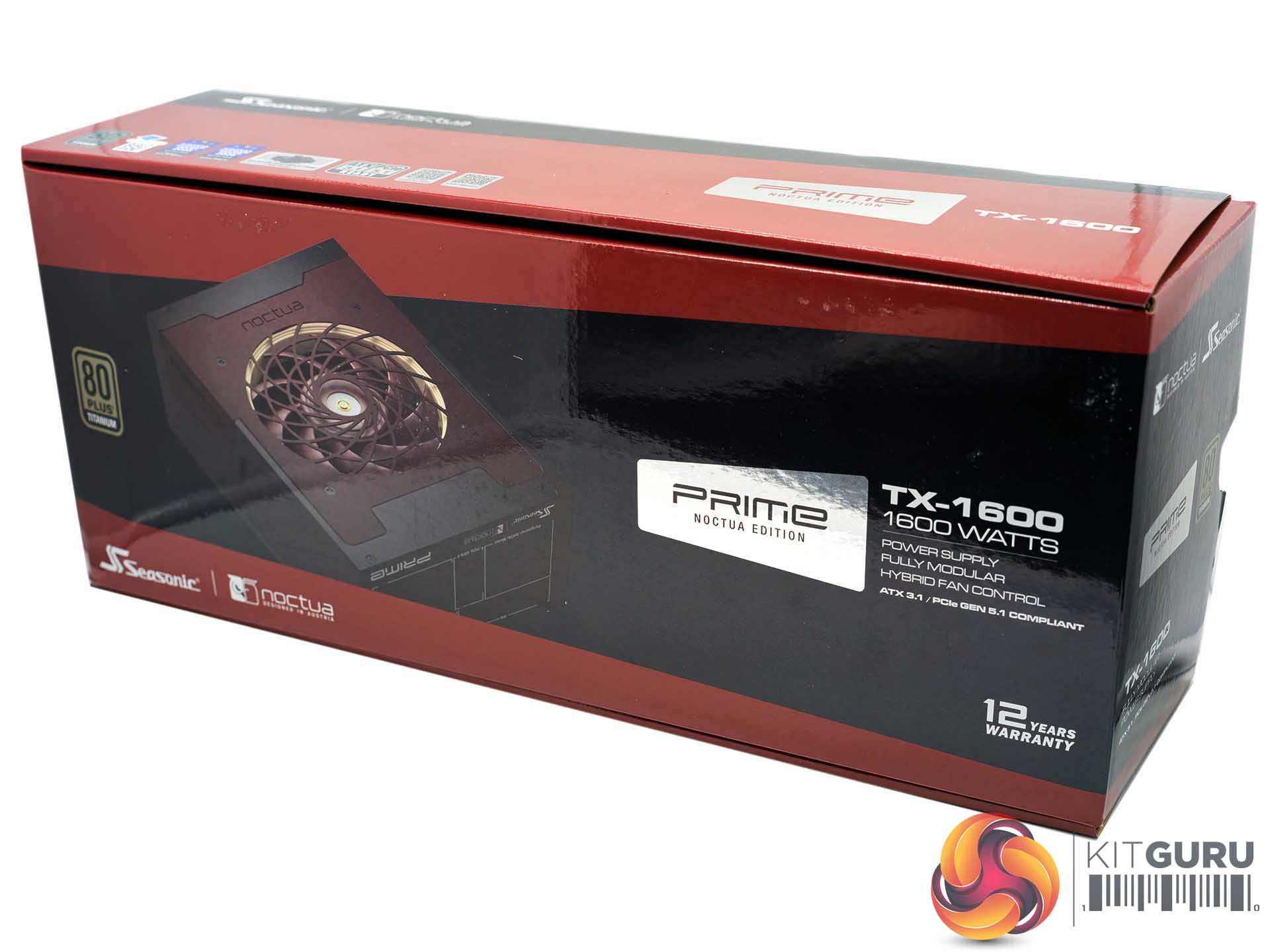
The Seasonic Prime TX-1600 Noctua Edition arrives in a colourful box. A high resolution image of the power supply is on the left of the box, along with a little list of features. I am again surprised to see no Cybenetics Logo on the front of the box. Cybenetics as I keep saying are the future of PSU certification – and more companies need to get away from the flawed 80 Plus system. Just my opinion however.
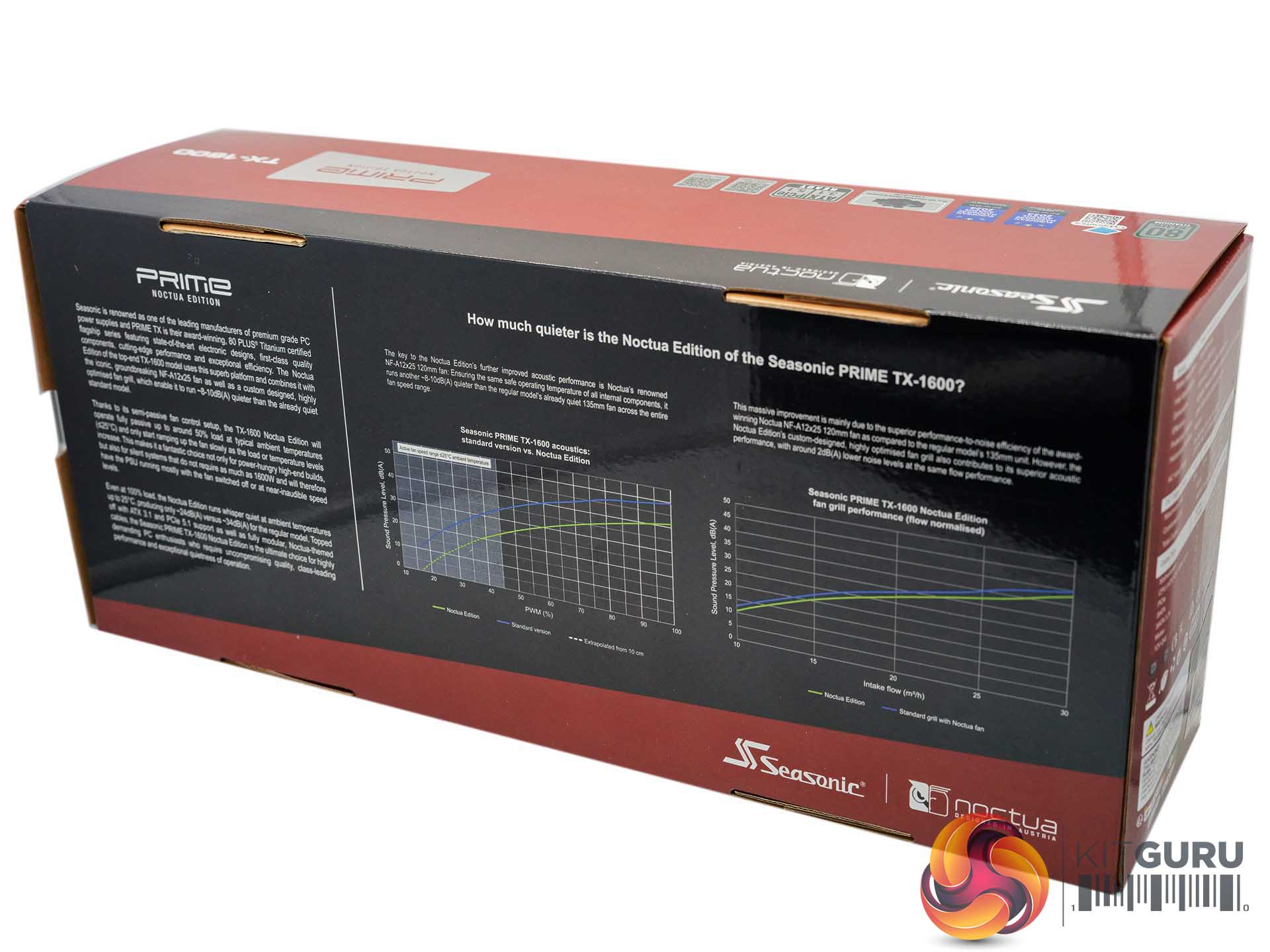
The rear of the box highlights the reduced noise levels of the Noctua version of this unit compared to the generic Seasonic version.
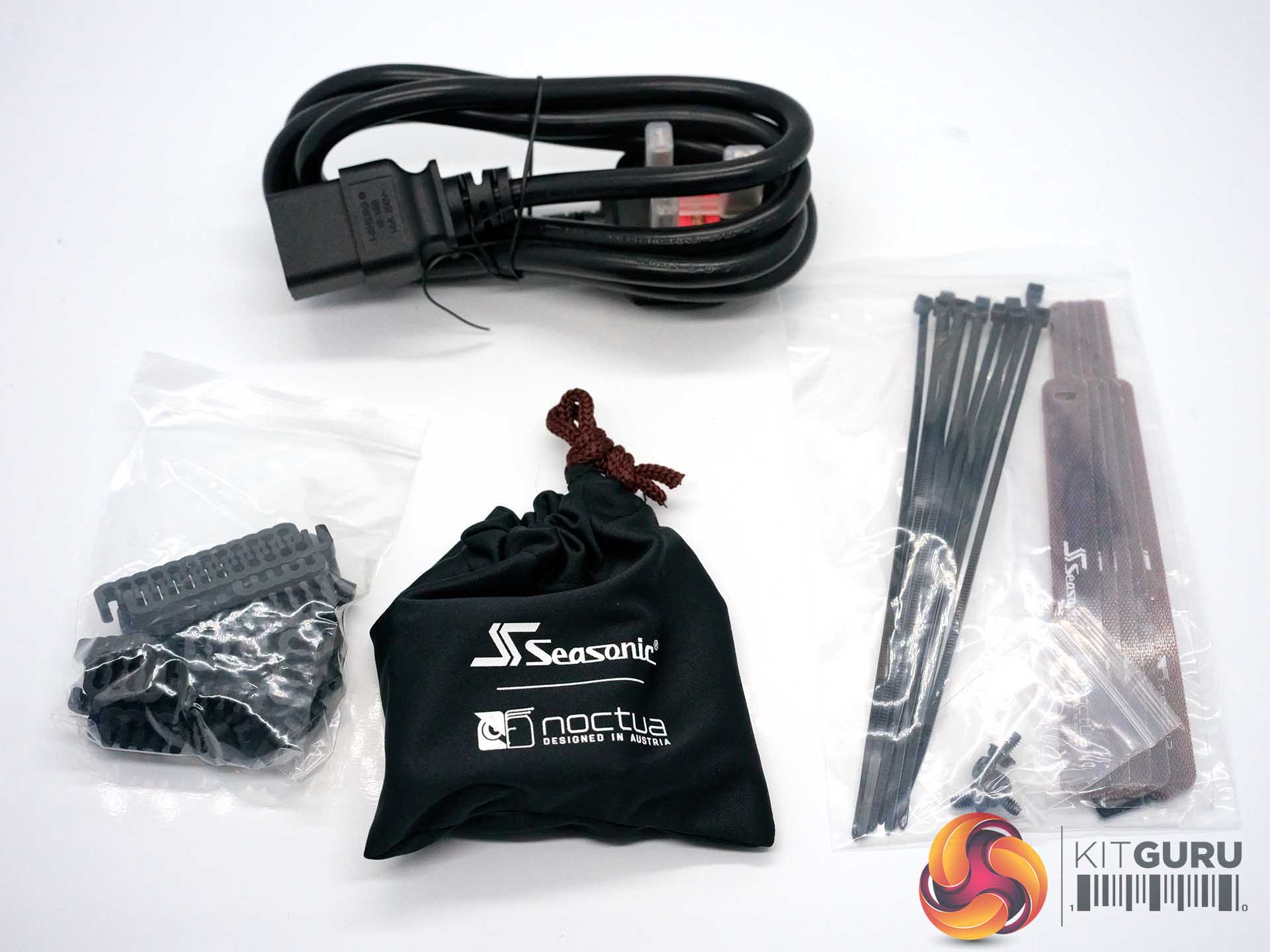
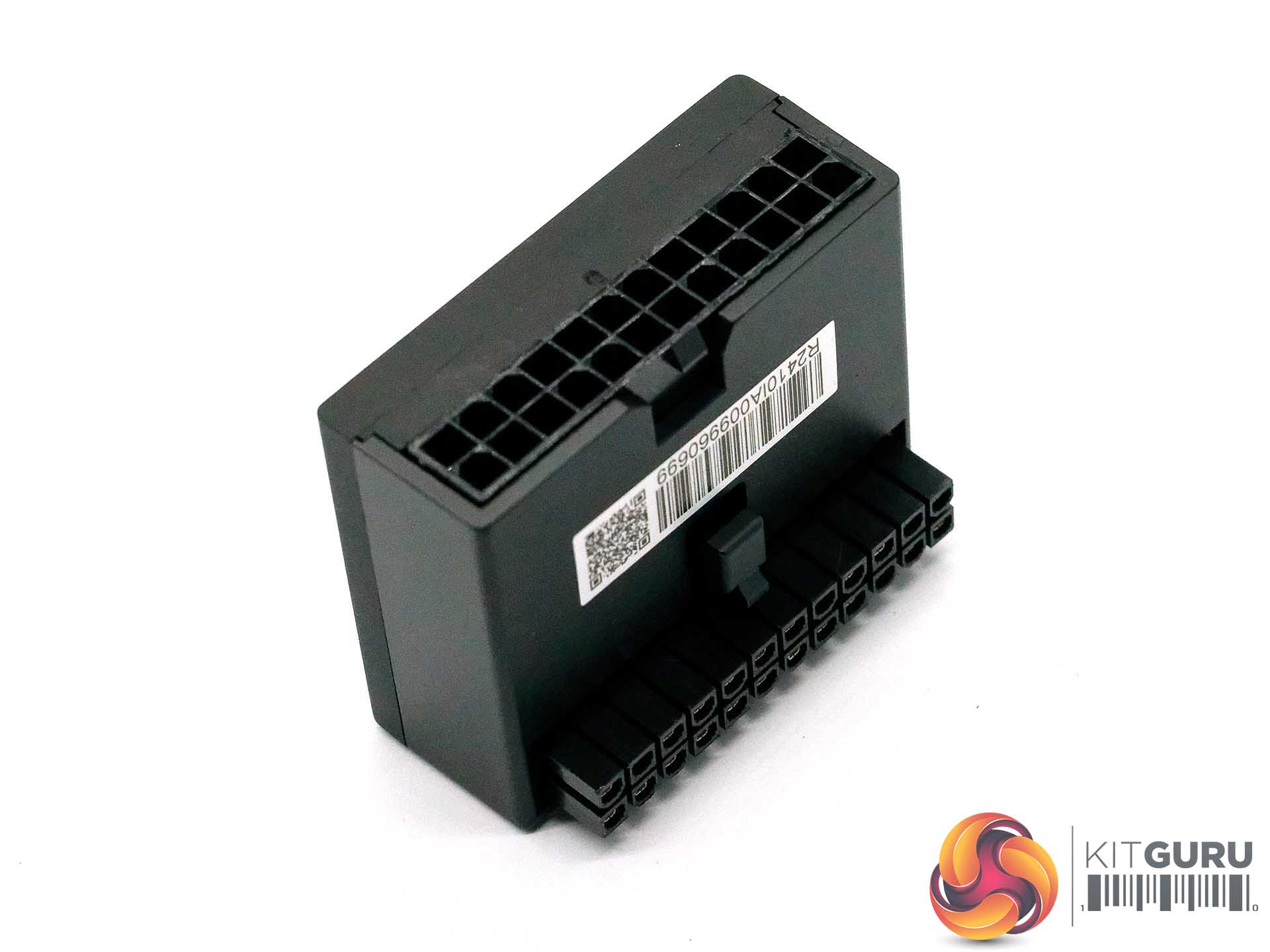
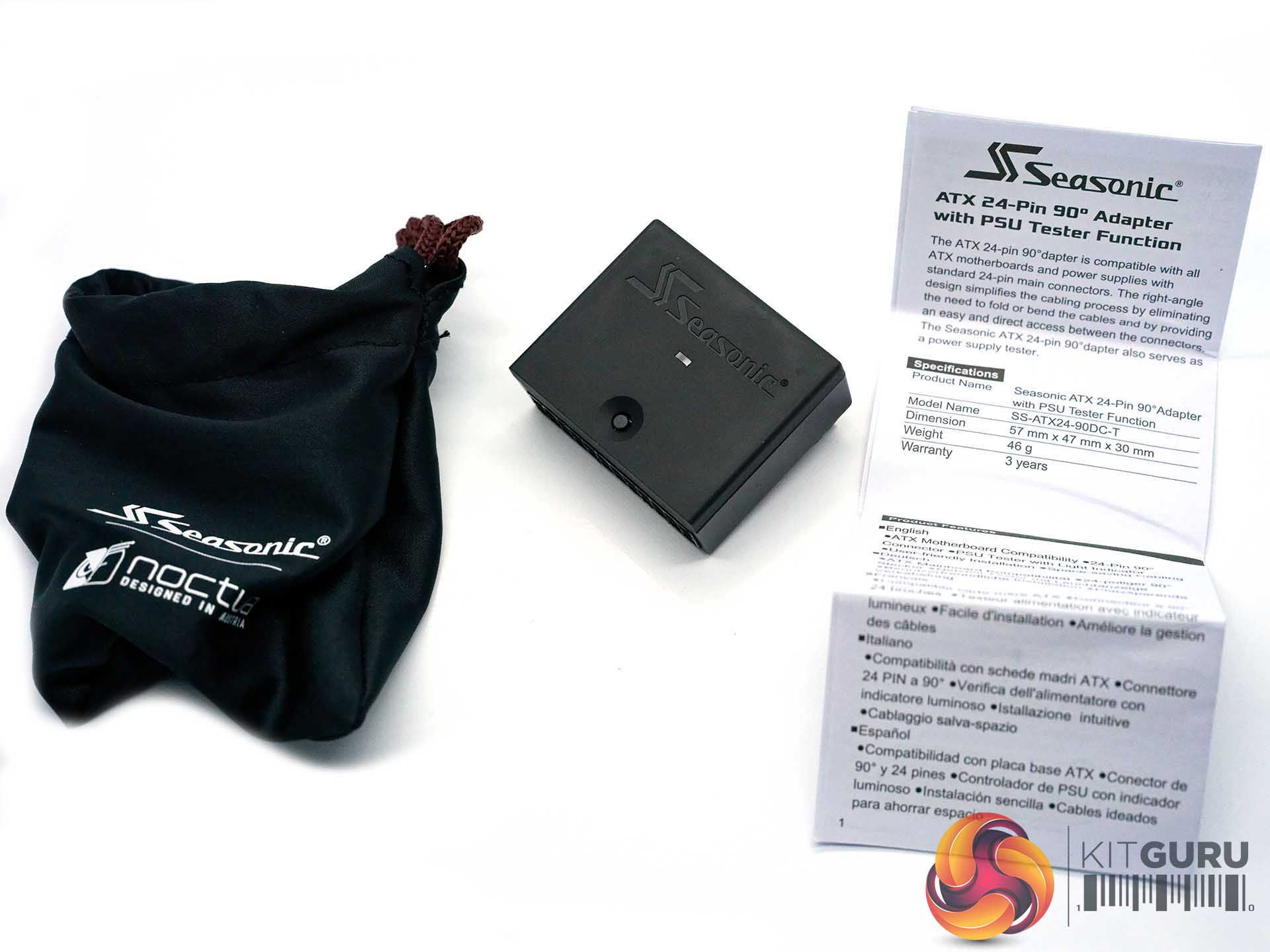
This unit ships with an array of cable ties and a heavy duty C19 power cable (which we normally see adopted on 1500watt or higher power supplies as they are better suited to high levels of power demand). Cable combs are included as well as a 24 pin 90 degree adapter and PSU tester.
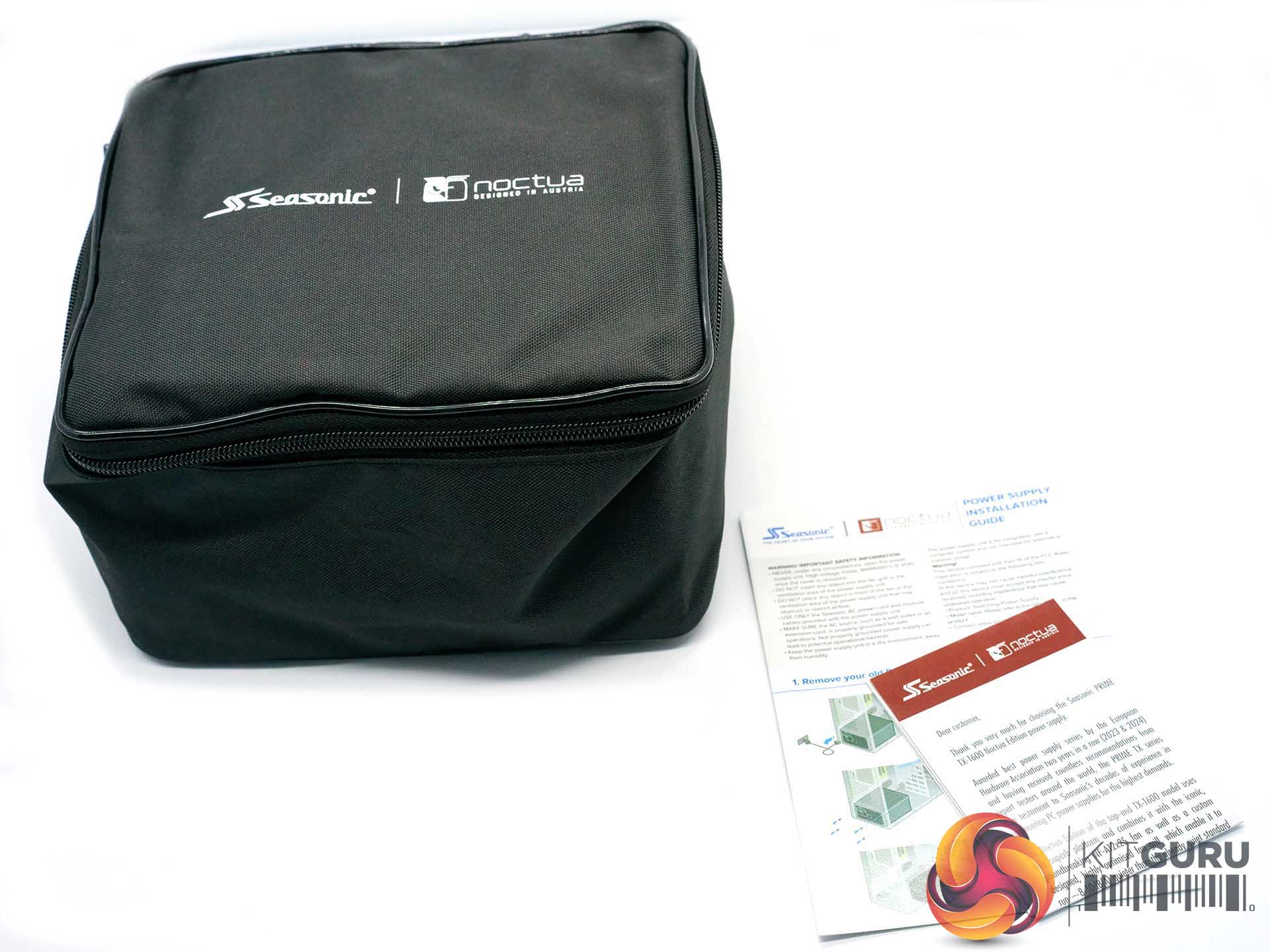
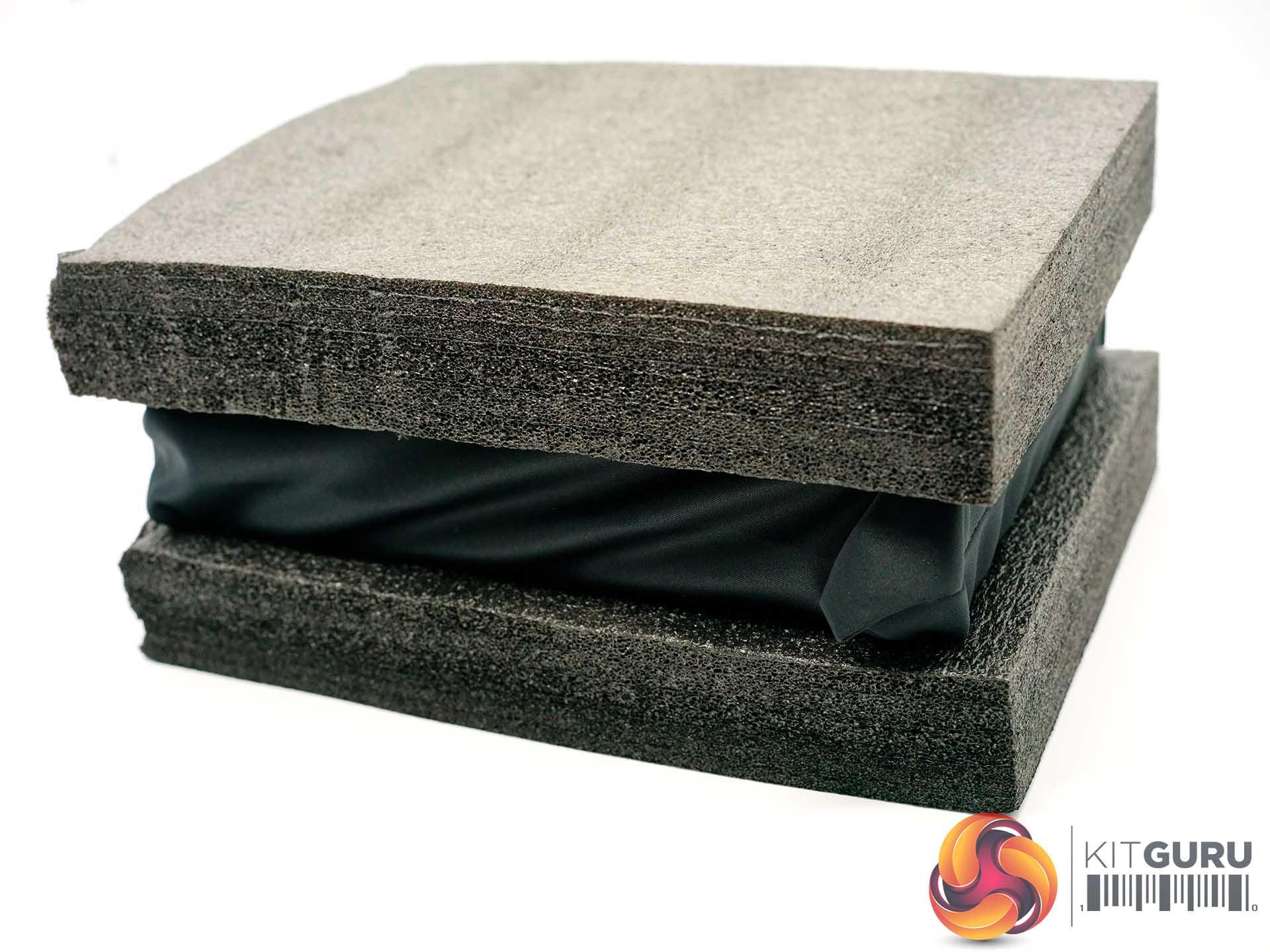
A big bag of cables is beside the PSU itself, along with some literature on the product. The power supply is shipped protected between two slabs of thick foam.
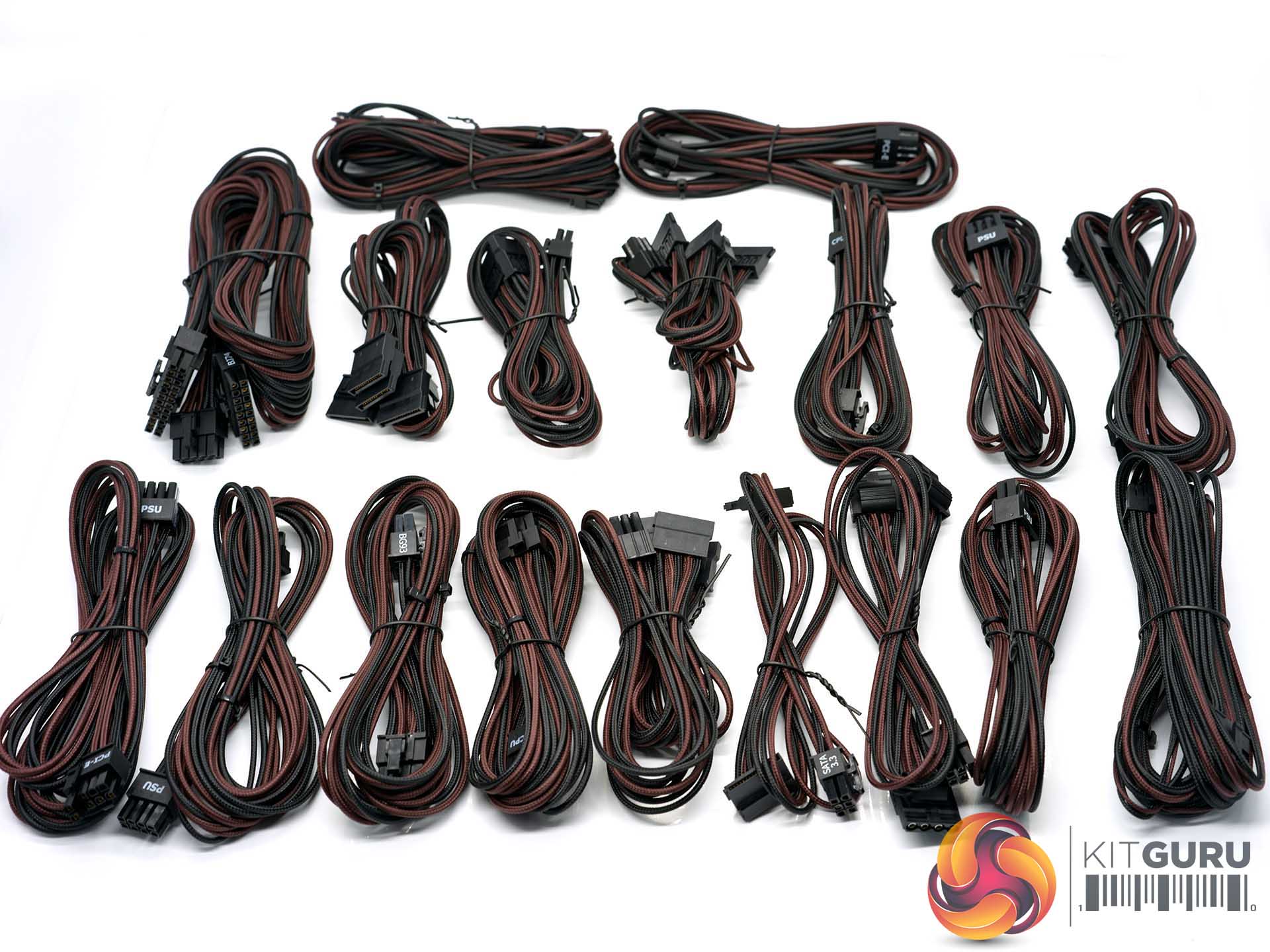
You will either love or hate these brown and black individually sleeved cables. Immediately recognisable as Noctua! They are high quality and look great in my opinion. Some orange case lighting would set these up a treat.
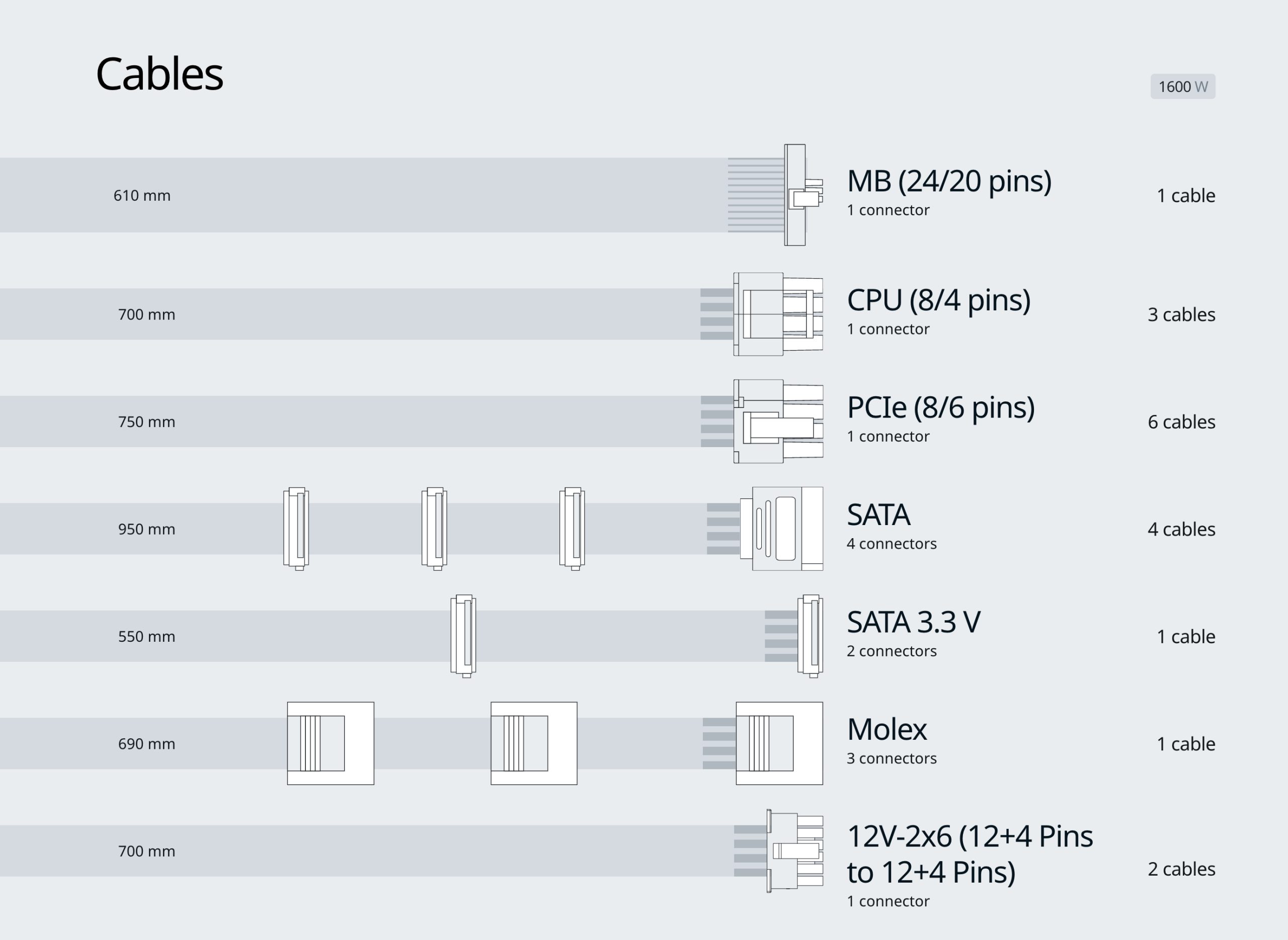
This Noctua Edition unit comes with a wealth of cabling for even the most demanding build. They supply a pair of 12V 2×6 cables that can handle up to 600 watts. We think the move to SATA connectors rather than Molex is a good move as it's a dying connector really now in 2024.
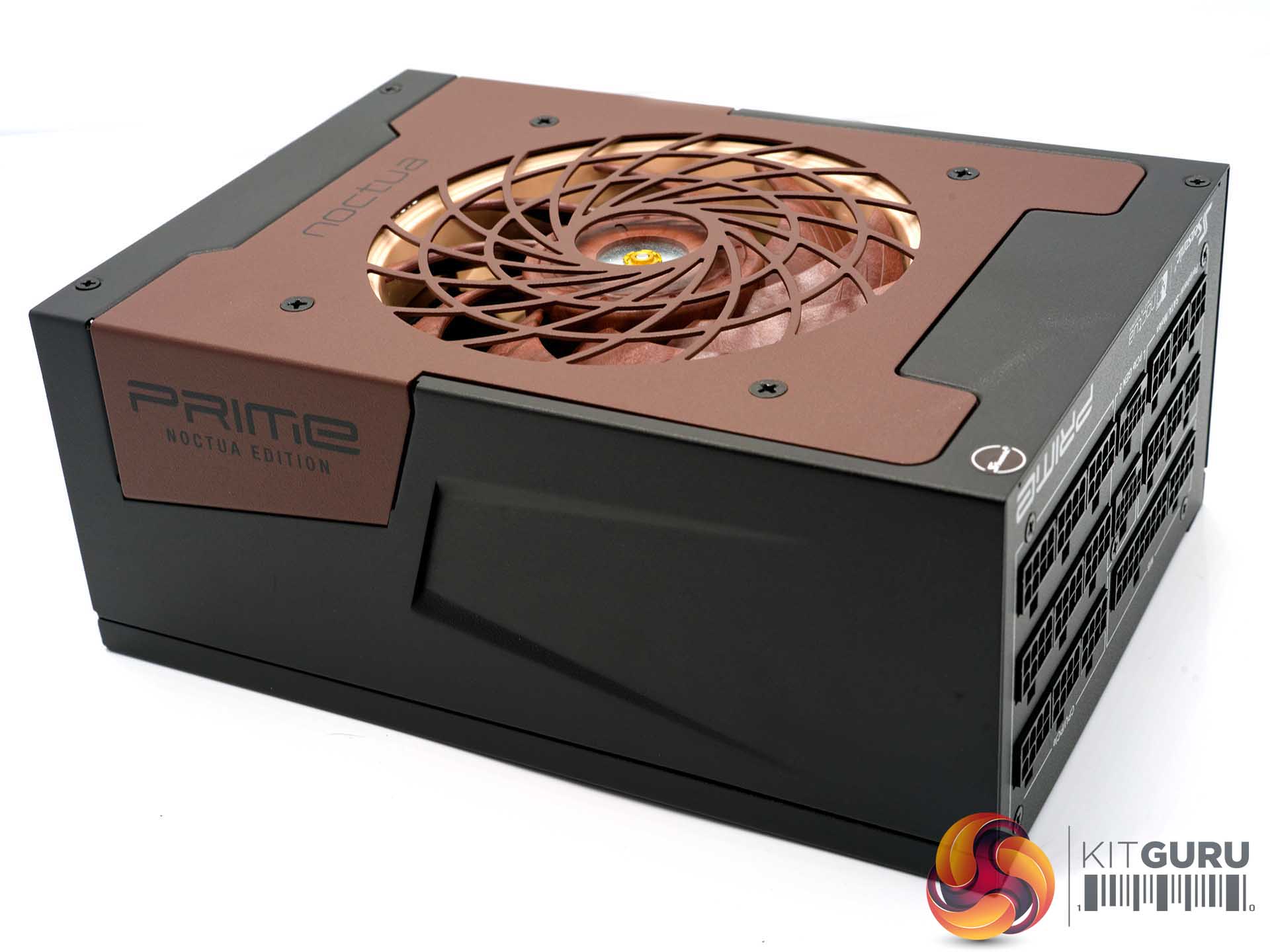
Like Marmite, you are either going to love this, or hate it. I think it's a very dramatic statement and as I said earlier, I quite like the rather bold Noctua colour scheme anyway.
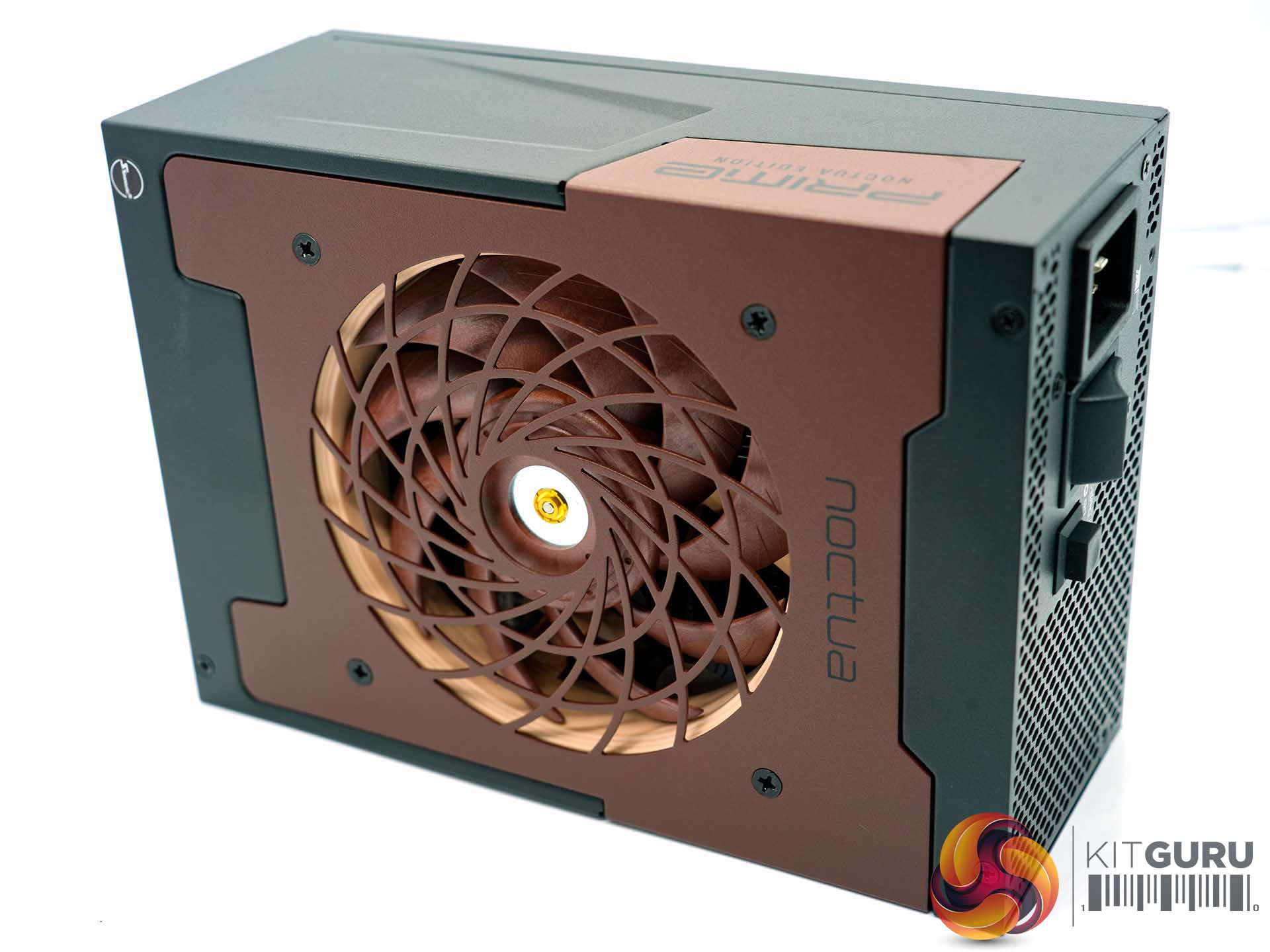
A large fan hits behind the brown grille- this will be a talking point of this particular power supply so we will get into that a bit later when we open the unit for investigation.
This grille is a topic of conversation as Noctua say the design not only reduces noise levels but increases airflow. In their own words from THIS page:
‘When it comes to the contribution of the Noctua Edition’s fan grill, it must be noted that its purpose is not only to reduce noise levels but also to increase airflow. Therefore, comparisons against the grill of the standard model must be made on an airflow-normalised basis to properly assess the acoustic benefit. If noise levels are tested without taking flow performance into account, it may actually appear as if the standard grill was performing better because noise levels are slightly lower than with the Noctua Edition grill at the same fan speed setting, especially if the Noctua fan is simply mounted to the standard 135mm grill and the openings around the fan are not sealed.
This is because the openings around the fan let air flow back towards the intake side, which reduces overall flow impedance, aerodynamic load and noise levels, but would also lead to significantly worse component cooling performance. When the openings around the fan are sealed, it will still run very slightly quieter with the standard grill than with the Noctua Edition grill, when compared at the same RPM and without taking airflow performance into account:'
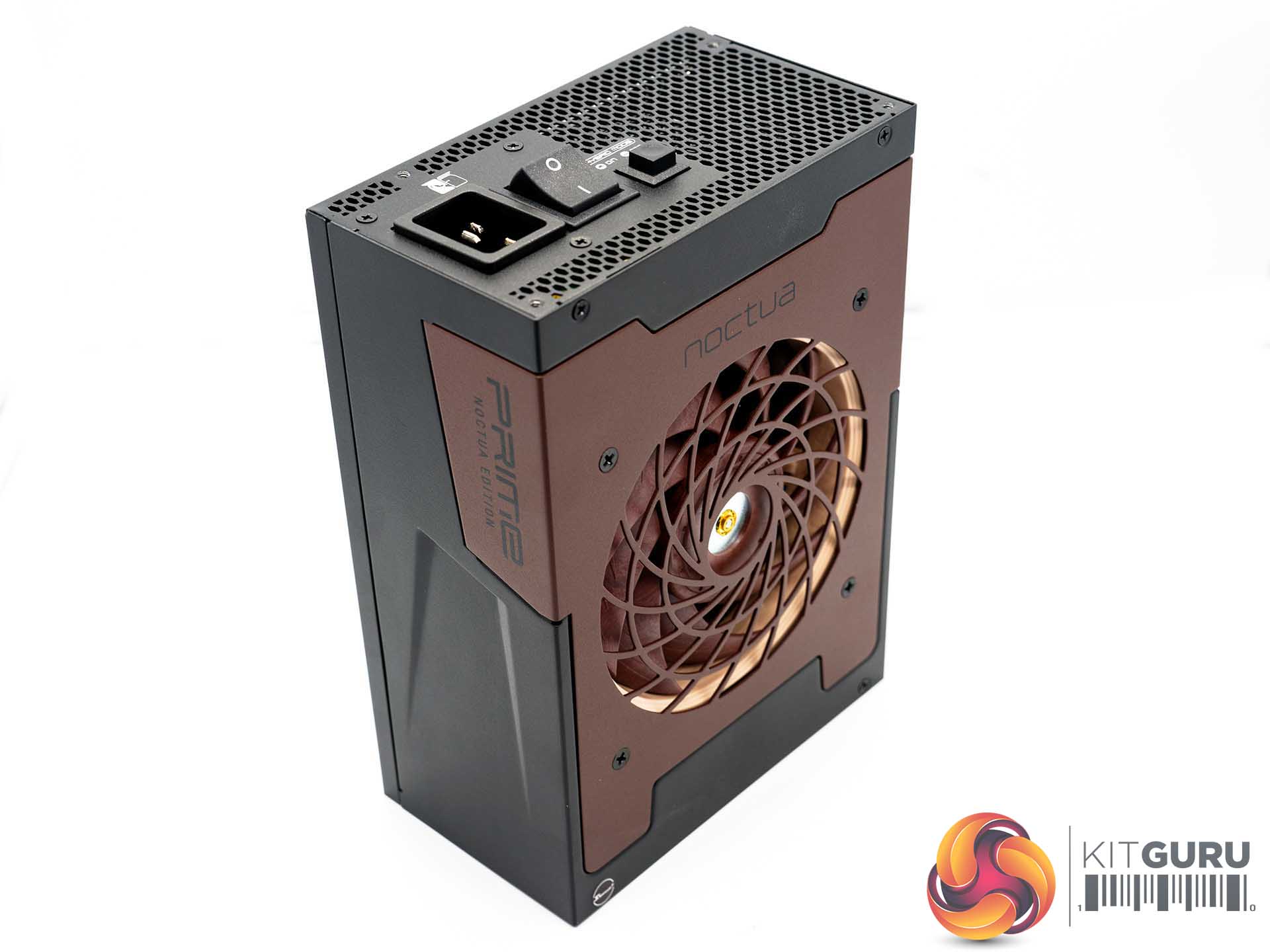
This is a rather large power supply – measuring a whopping 210 mm long. It is 150mm wide and 86mm in height. It is very unlikely to fit into smaller cases so do pay attention if you are thinking of buying one.
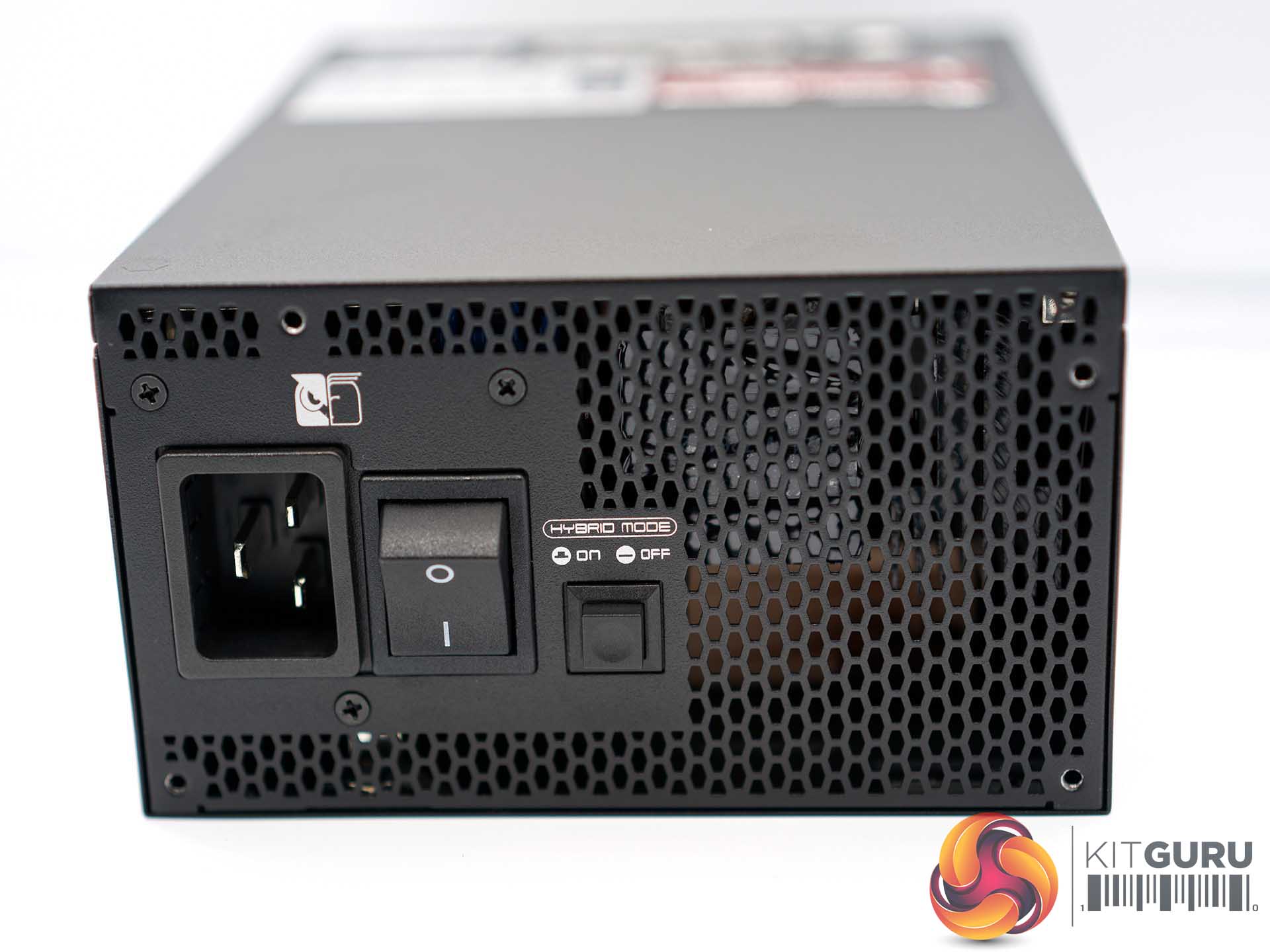
This side of the power supply is home to the power connector and switch. There is also a hybrid fan button – which allows you to disable the fan completely until a certain amount of demand is asked from the unit. Usually this is based on the ambient temperatures and up to 50% electrical load (around 800 watts).
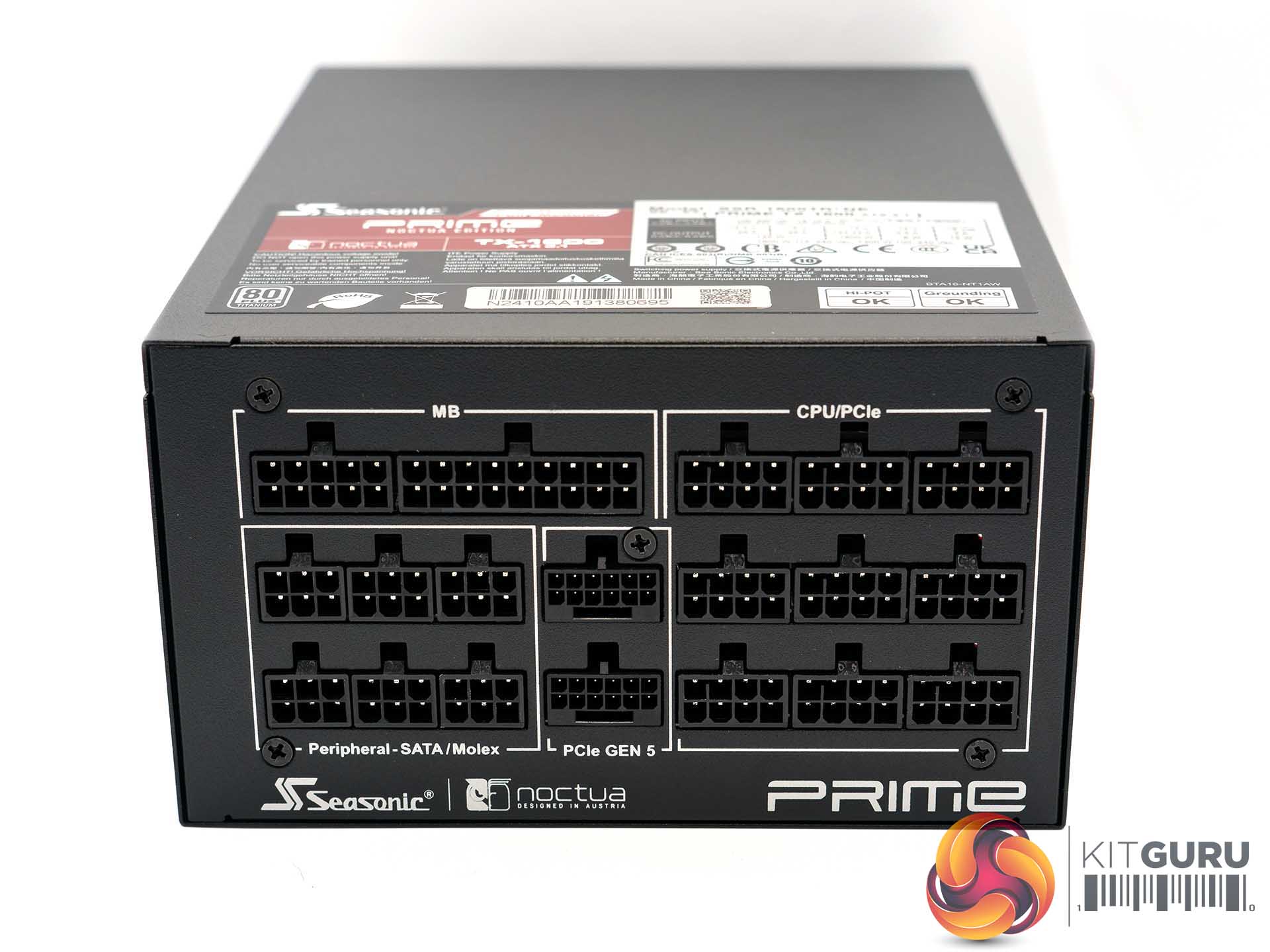
The modular side of the power supply is very neatly laid out across three horizontal rows as shown in the picture above. The sections are all clearly labelled with enough connections available for even the most demanding of systems.
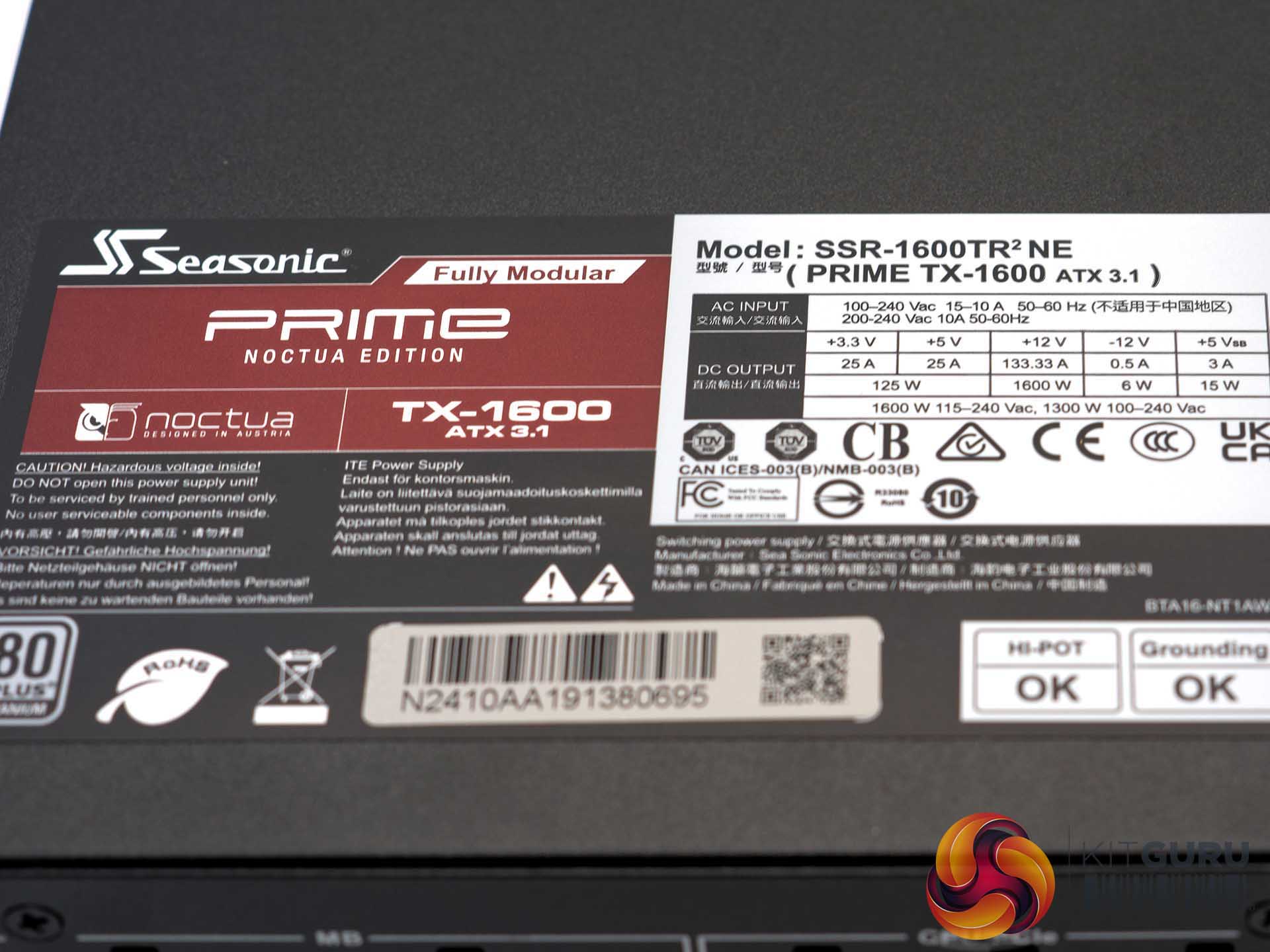
The power label shown above highlights a staggering 133.33A available via the single +12V rail. Both +3.3V and +5 rails are able to deliver 25A. If you have a flagship system with a high end 4090 (or 5090 which is coming soon) then this is a great PSU to pair with it.
‘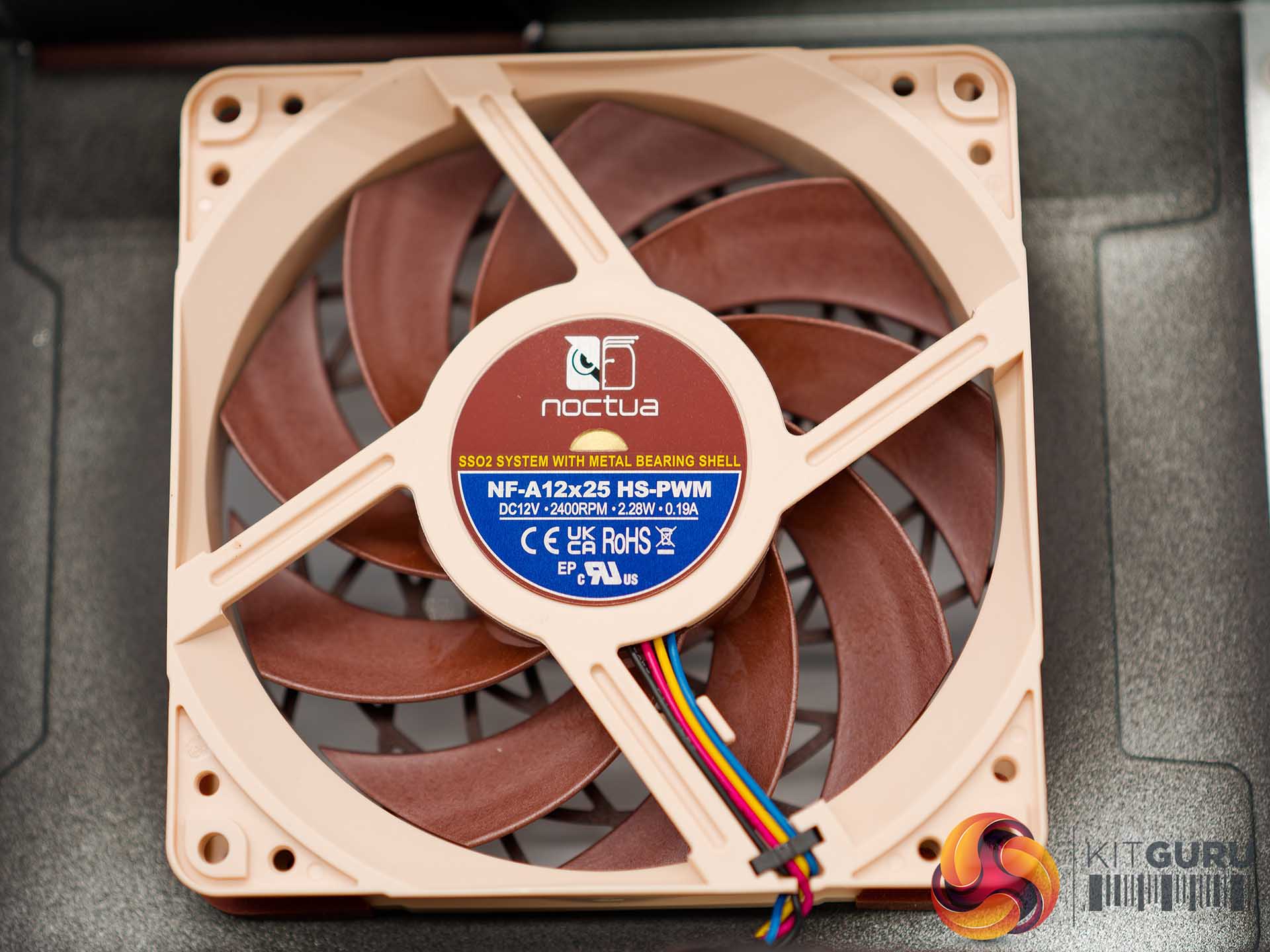
This fan is unique to this unit and not something we have seen before in a power supply. Noctua have adopted a high speed version of the award winning NF A12x25 HW-PWM fan. This is a DC12V fan rated at a maximum of 2400 rpm. 2.28W and 0.19A. Noctua claim that this fan when combined with the custom grille on the top of the PSU, reduce noise levels by 8-10dBa throughout the range of speeds. Not only is this impressive if true, but it is worth bearing in mind that this Noctua fan is only 120 mm compared with the Hong Hua HA13525H12SF-Z 135mm in the Seasonic version of this supply (which we reviewed back in July 2023).
To be truthful I would have loved to see a larger 130mm-140mm version of this fan in this power supply for even better possible results. It is a big PSU and could accommodate a larger fan without issue.
This fan uses a class leading SSO2 bearing which will last likely longer than multiple PC's combined. Noctua even include anti vibration pads on the corners. They really are trying to maximise the focus on the lowest possible noise, which we love to see.
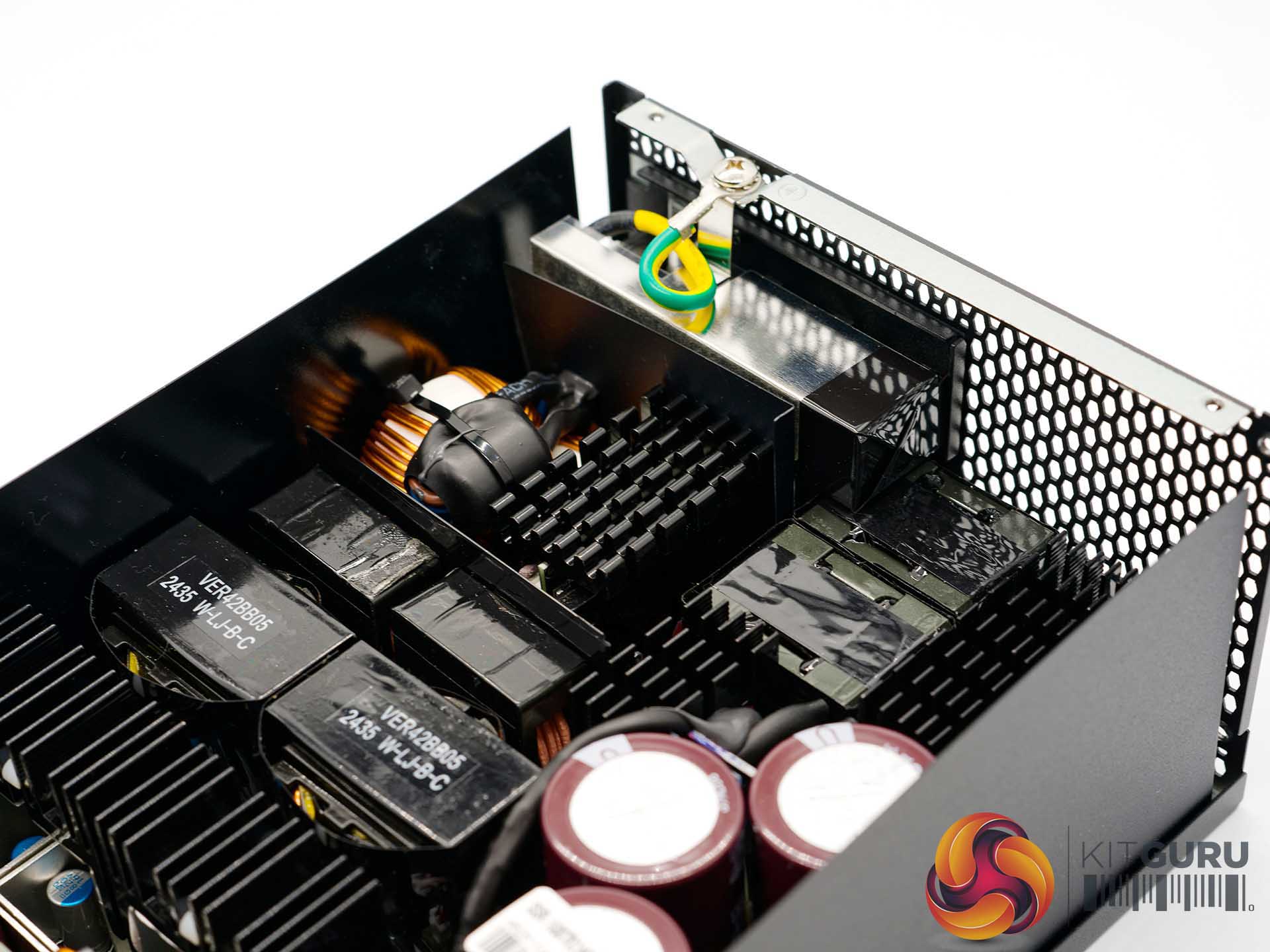
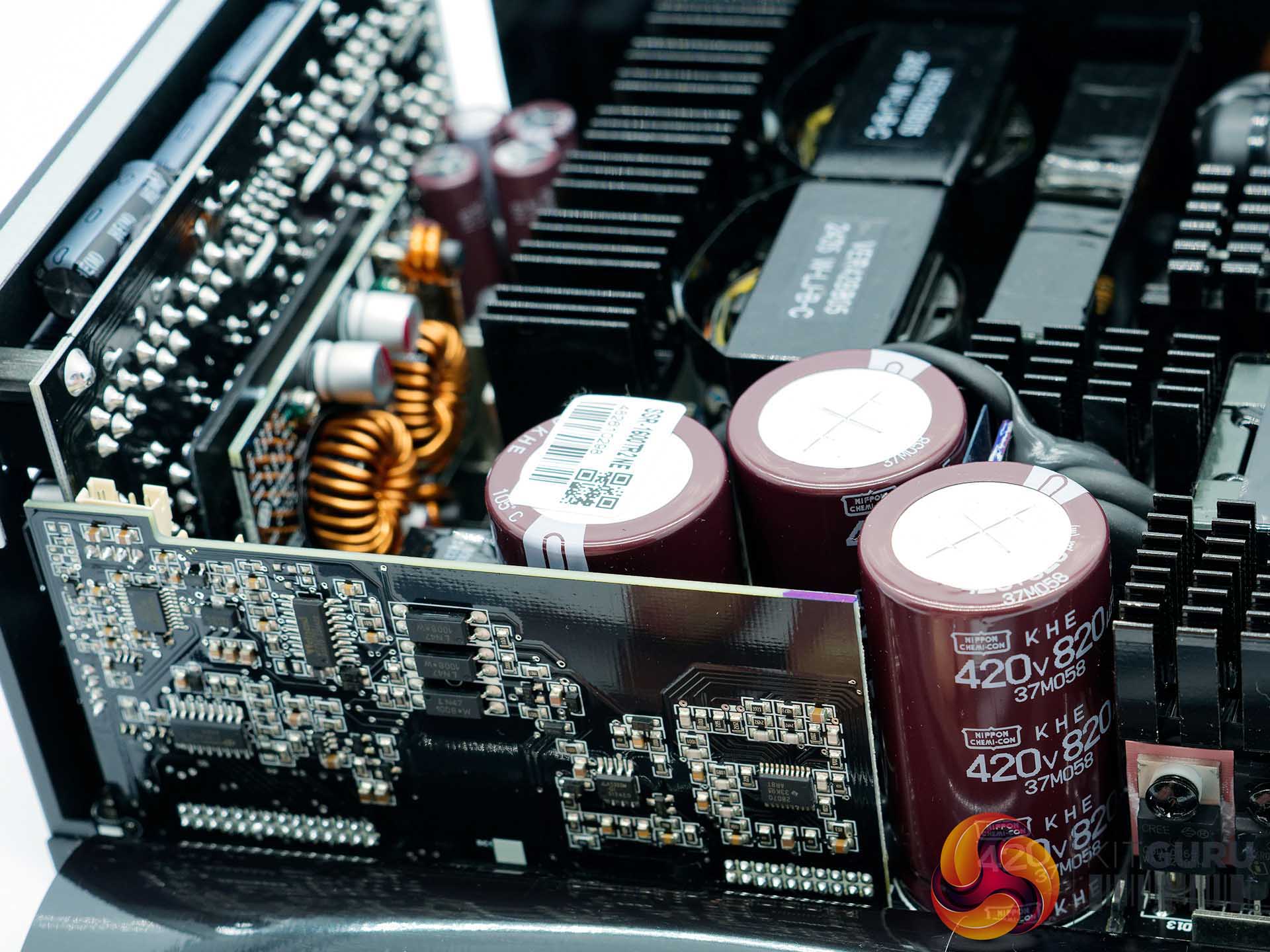
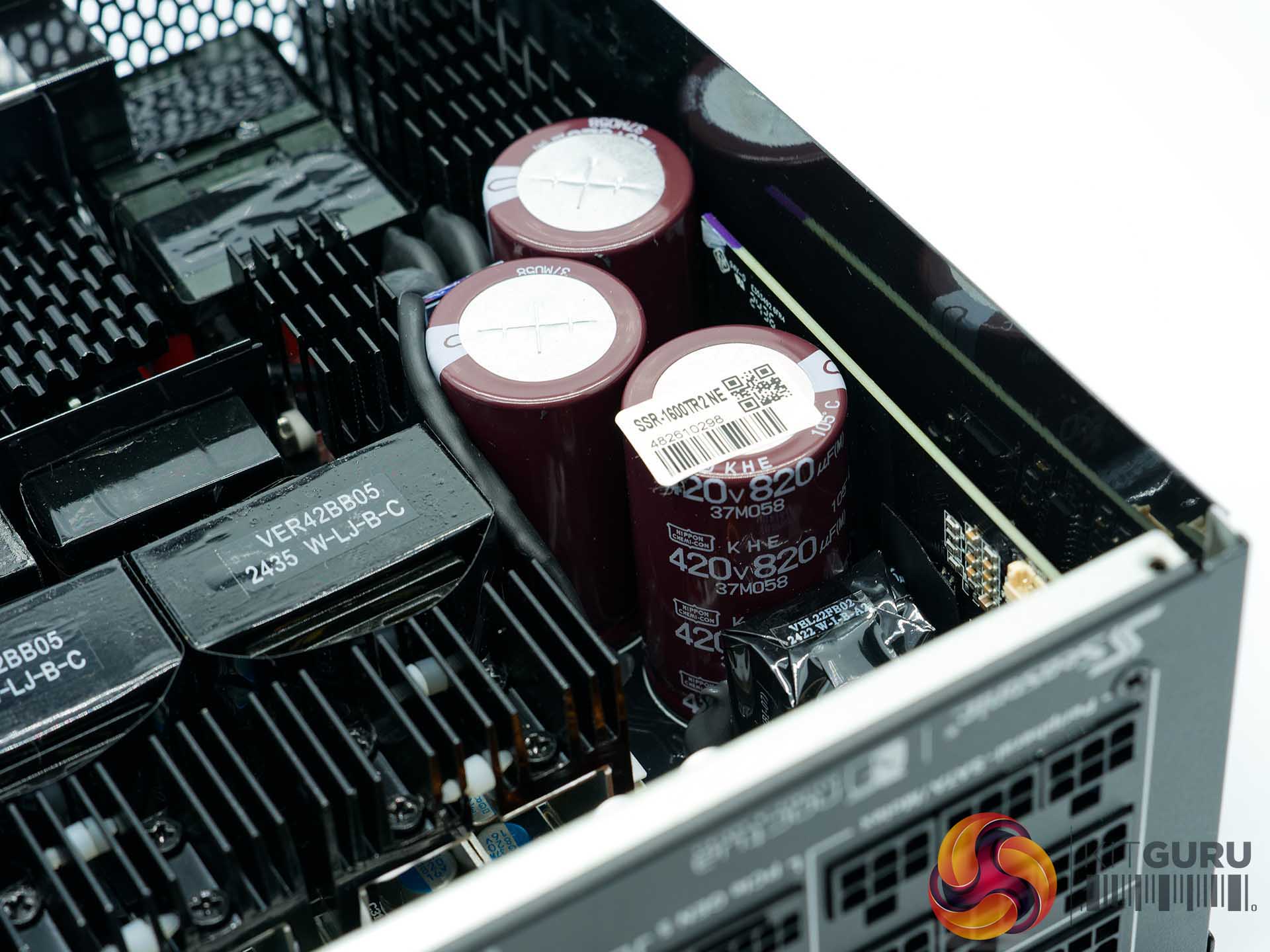
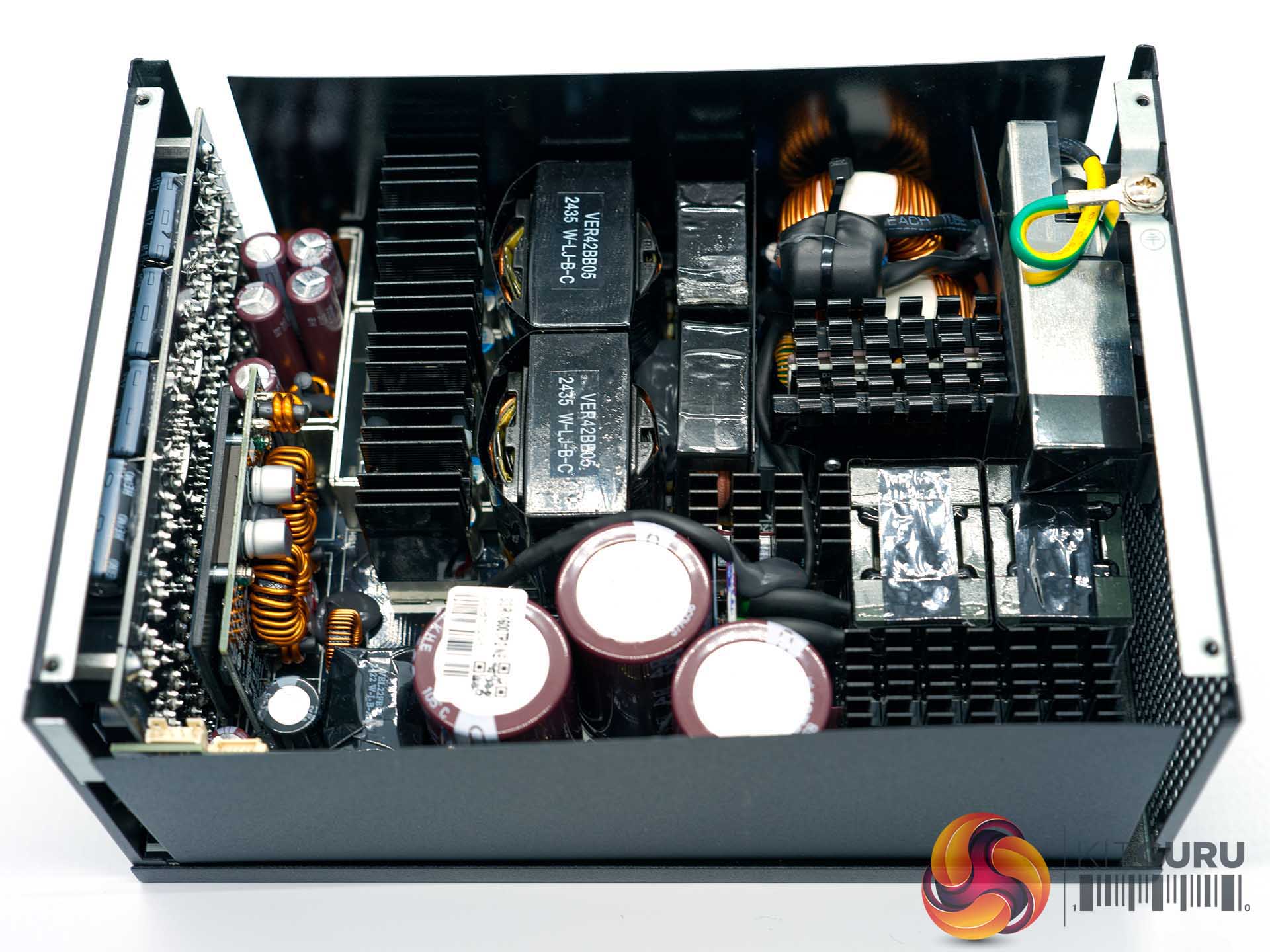
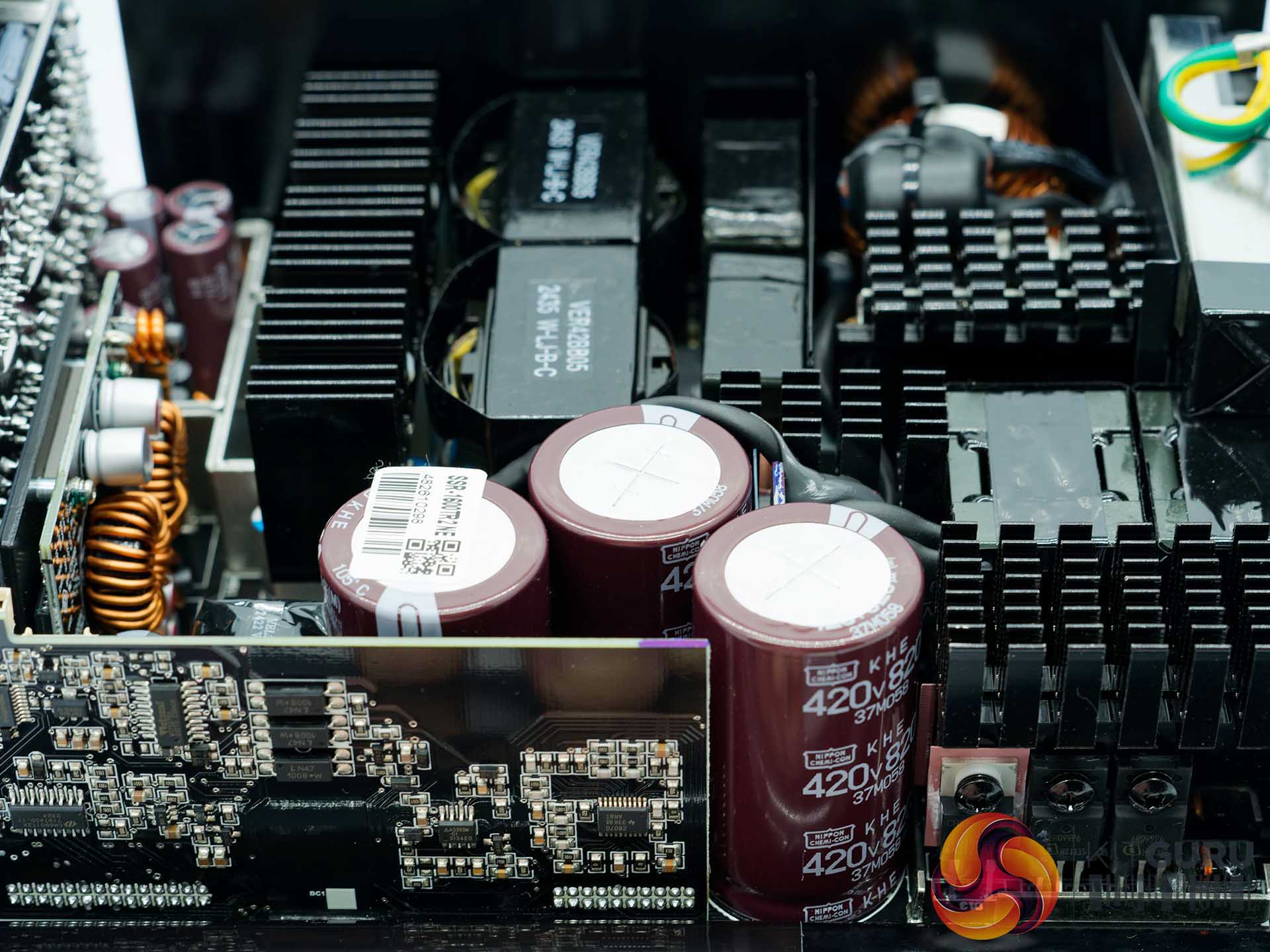
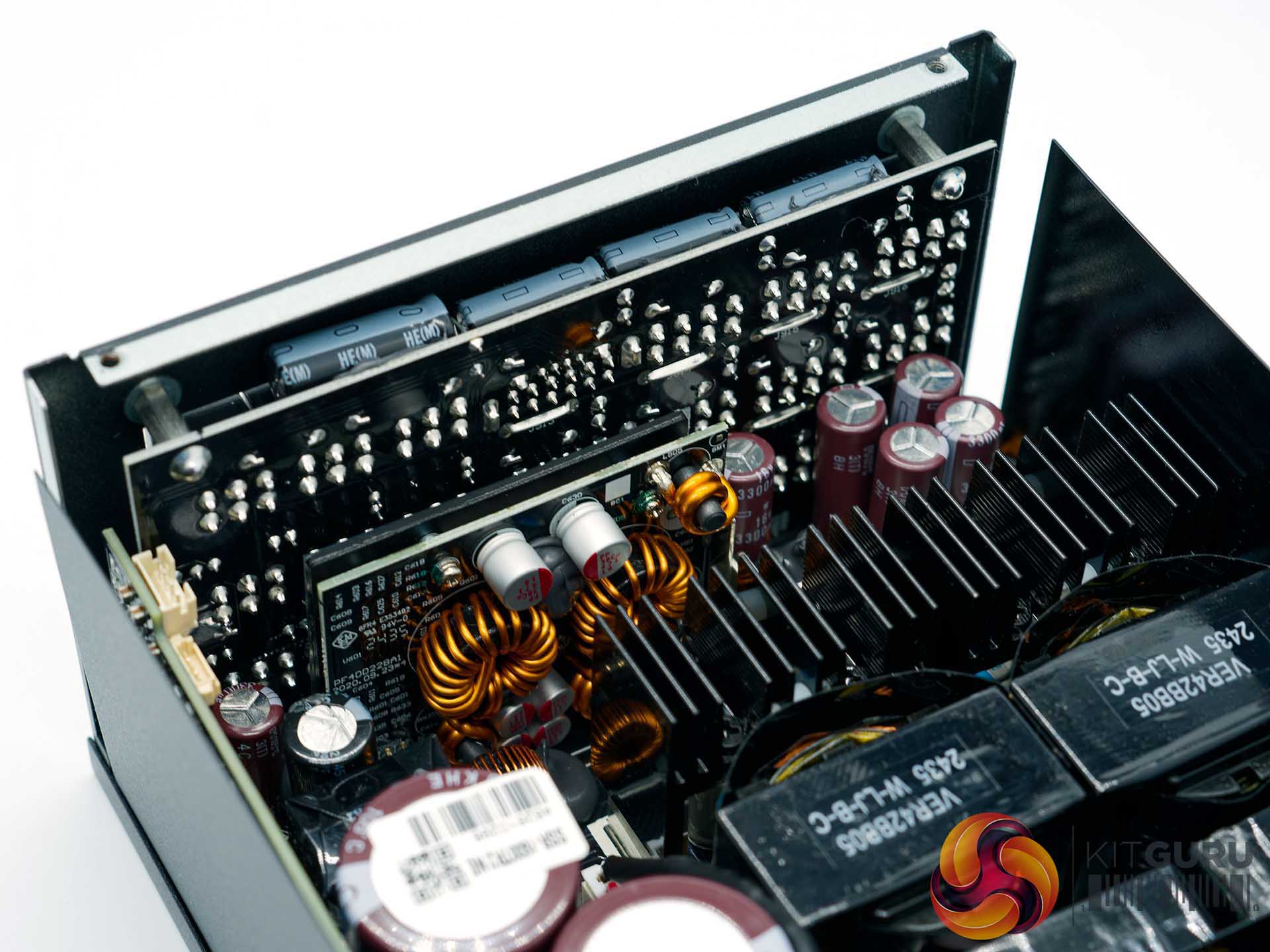
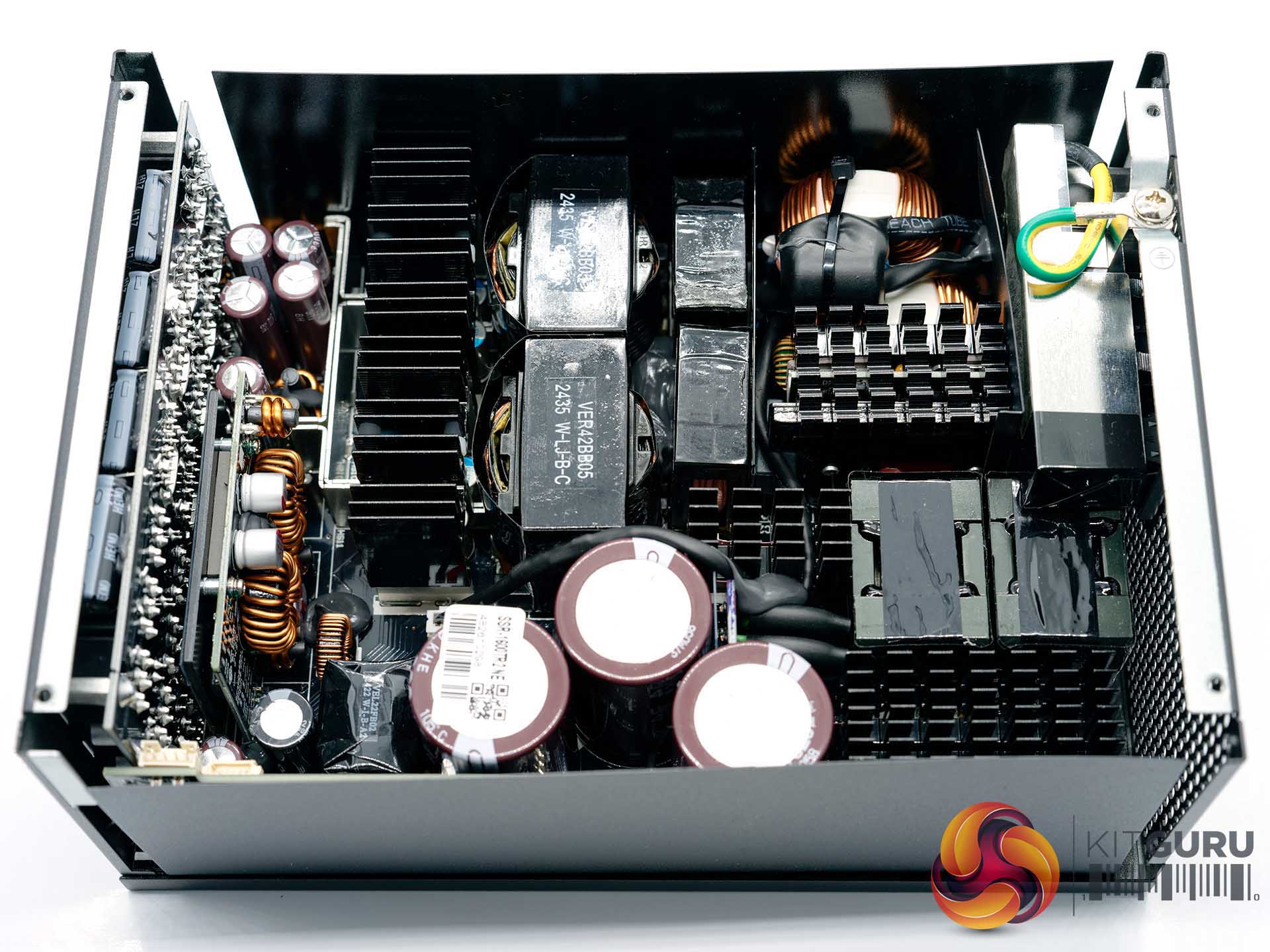
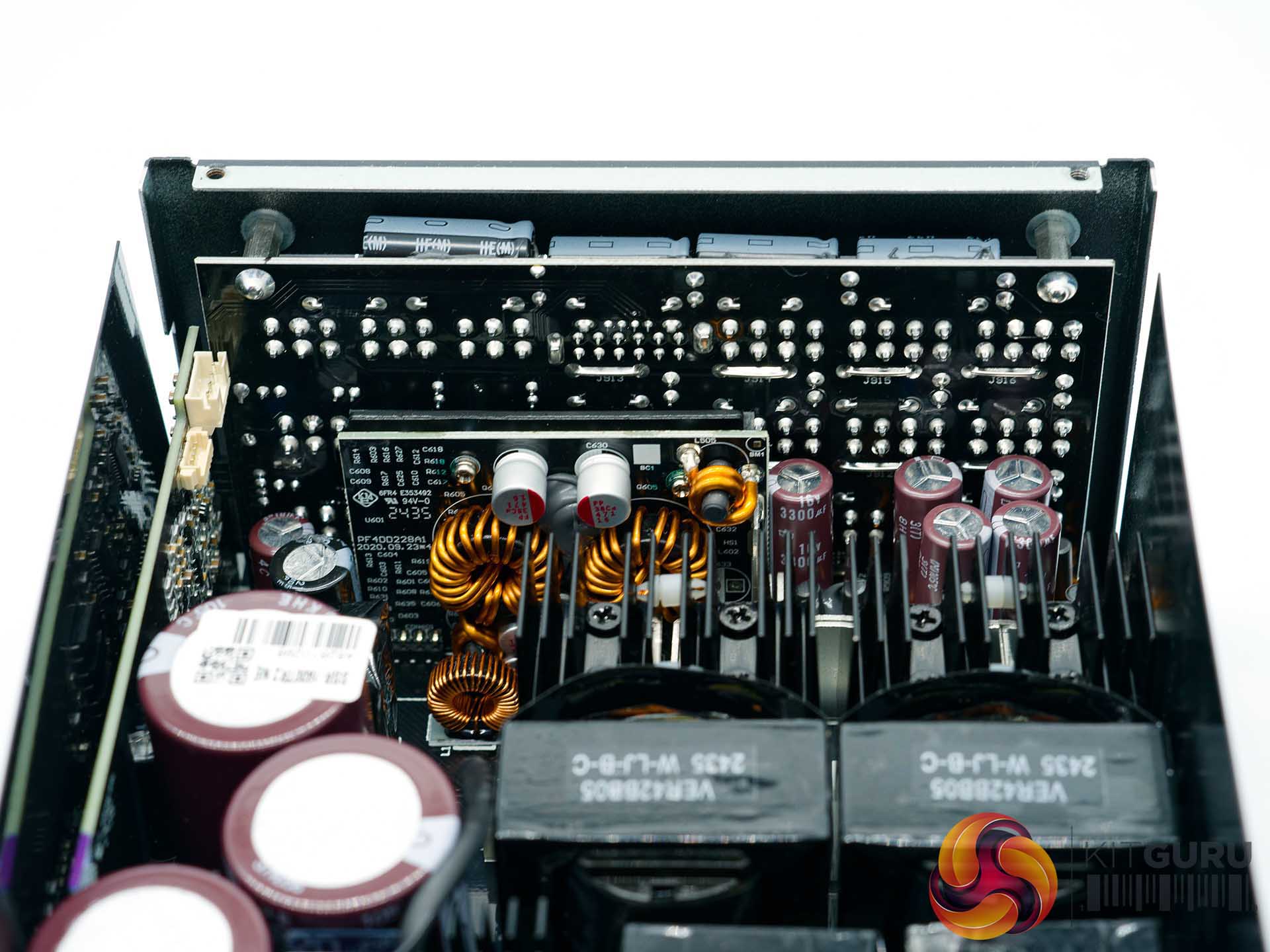
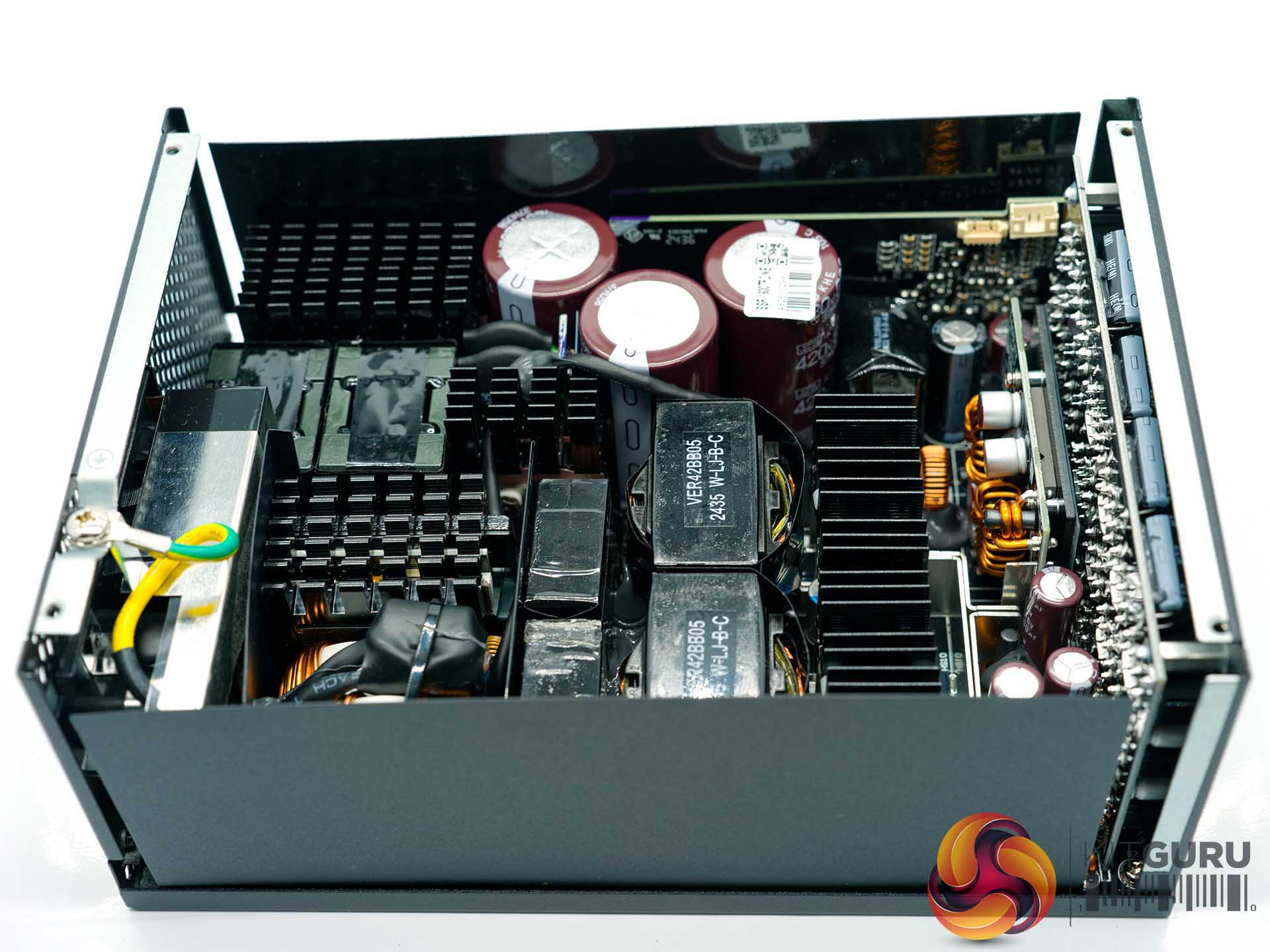
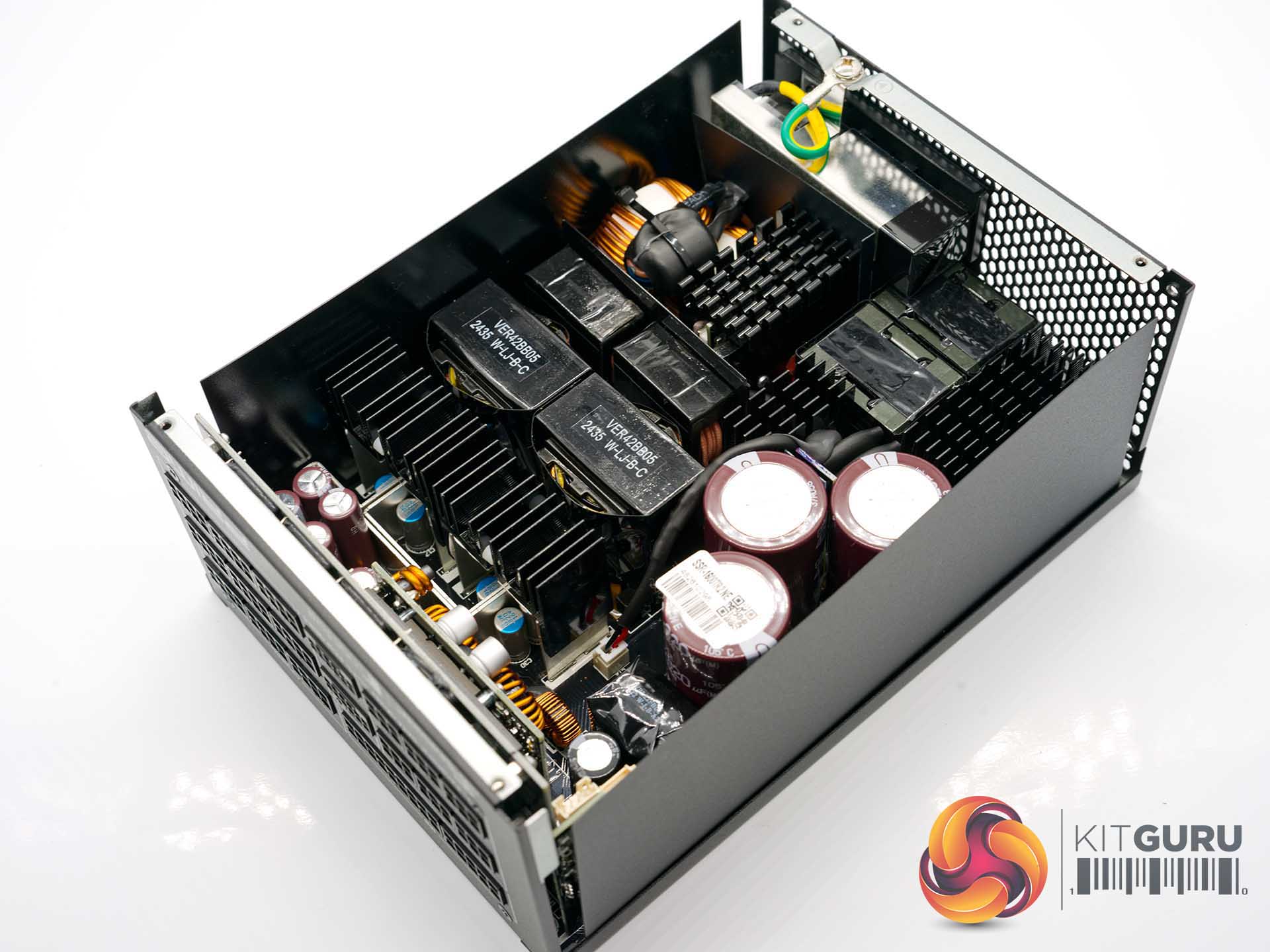
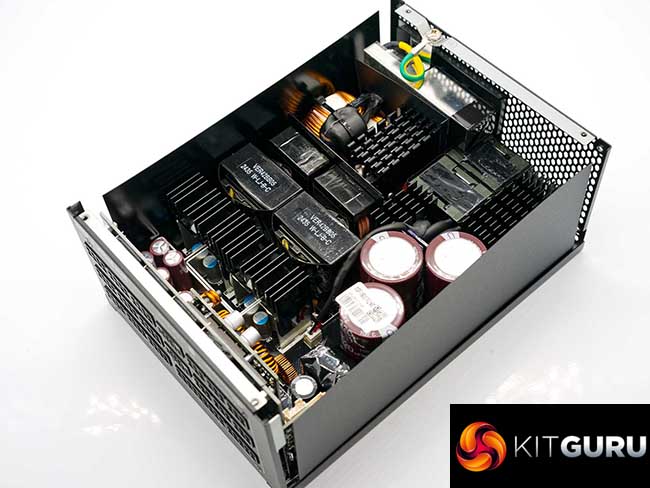
As we know Seasonic are the OEM for this design and it looks to me like Noctua have not made too many changes internally. The colours, the fan grille and the fan are obviously proprietary by design as we said earlier. Additionally it is worth mentioning that the fan above has no plastic sheet sections to direct airflow over the components as we would often see in Seasonic power supplies. Noctua are leaving the fan completely open. This is fairly unusual.
The design uses an bridgeless, interleaved PFC to ensure the highest levels of efficiency for Titanium rating – and it also adopts a full bridge topology with LLC resonant converter.
The PCB while massive is density populated with components across the board and Seasonic are using large heatsinks inside, even though this has a Titanium rated efficiency level. This obviously helps to reduce heat throughout and lower the trigger points for the fan above.
This design is generating the primary +12V rail via 16x immensely powerful Nexperia FETs. This rail is also powering a pair of DC-DC converters to generate minor rails. This is a common design across this specific Seasonic platform and is highly efficient.
As we would expect from Seasonic, the soldering on the PCB is top drawer and they are using high grade 105c rated Japanese capacitors across both primary and secondary stages. The primary stage capacitors are the distinctive Nippon Chemi con KHE family caps. Three in total for a whopping 2460uF output (3x 820uF). This is one of the most powerful units we have had in to test and is identical to the ‘plain' Seasonic branded version we reviewed back on 16th July 2023.
This unit offers OPP/OVP/UVP/SCP/OCP and OTP protections. As it falls under the Seasonic warranty terms, it has a 12 year warranty in place.
All in all an extremely impressive design, both by choice of components and quality of the execution.
Correctly testing power supplies is a complex procedure and KitGuru have configured a test bench which can deliver up to a 2,000 watt DC load. Due to public requests we have changed our temperature settings recently – previously we rated with ambient temperatures at 25C, we have increased ambient temperatures by 10c (to 35c) in our environment to greater reflect warmer internal chassis conditions.
We use combinations of the following hardware:
• SunMoon SM-268
• CSI3710A Programmable DC load (+3.3V and +5V outputs)
• CSI3711A Programmable DC load (+12V1, +12V2, +12V3, and +12V4)
• Extech Power Analyzer
• Extech MultiMaster MM570 digital multimeter
• Extech digital sound level meter
• Digital oscilloscope (20M S/s with 12 Bit ADC)
• Variable Autotransformer, 1.4 KVA
12V output is single rail for our testing.
|
DC Output Load Regulation
|
||||||||||
|
Combined DC Load |
+3.3V
|
+5V
|
+12V
|
+5VSB
|
-12V | |||||
|
A
|
V
|
A
|
V
|
A
|
V
|
A
|
V
|
A | V | |
|
500W
|
7.63
|
3.33
|
8.82
|
5.01
|
36.05
|
12.03
|
1.5
|
5.01
|
0.30 | -12.02 |
|
750W
|
12.63
|
3.33
|
14.12
|
5.01
|
52.06
|
12.03
|
2.0
|
5.01
|
0.30 | -12.01 |
|
1000W
|
17.75
|
3.33
|
20.00
|
5.02
|
72.25
|
12.03
|
2.5
|
5.01
|
0.50 | -12.01 |
| 1250W | 18.84 | 3.33 | 24.04 | 5.01 | 90.14 | 12.02 | 3.0 | 5.01 | 0.60 | -12.02 |
|
1500W
|
18.87
|
3.33
|
22.64
|
5.00
|
115.90
|
12.01
|
3.5
|
5.01
|
0.80 | -12.02 |
| 1600W | 10.00 | 3.33 | 10.00 | 5.01 | 125.00 | 12.01 | 3.5 | 5.01 | 0.80 | -12.02 |
Load regulation is stellar, even when delivering the full 1600 watts of power.
Next we want to try Cross Loading. This basically means loads which are not balanced. If a PC for instance needs 500W on the +12V outputs but something like 30W via the combined 3.3V and +5V outputs then the voltage regulation can fluctuate badly.
| Cross Load Testing | +3.3V | +5V | +12V | -12V | +5VSB | |||||
| A | V | A | V | A | V | A | V | A | V | |
| 1150W | 3.0 | 3.33 | 2.0 | 5.02 | 92.0 | 12.01 | 0.2 | -12.02 | 0.50 | 5.02 |
| 250W | 20.0 | 3.33 | 24.0 | 5.02 | 5.0 | 12.01 | 0.2 | -12.02 | 0.50 | 5.01 |
The Seasonic TX-1600W Titanium Power Supply produced class leading results in the cross loading test. It exhibited no discernible weaknesses in any of the testing.
We then used an oscilloscope to measure AC ripple and noise present on the DC outputs. We set the oscilloscope time base to check for AC ripple at both high and low ends of the spectrum.
ATX12V V2.2 specification for DC output ripple and noise is defined in the ATX 12V power supply design guide.
|
ATX12V Ver 2.2 Noise/Ripple Tolerance
|
|
|
Output
|
Ripple (mV p-p)
|
|
+3.3V
|
50
|
|
+5V
|
50
|
|
+12V1
|
120
|
|
+12V2
|
120
|
|
-12V
|
120
|
|
+5VSB
|
50
|
Obviously when measuring AC noise and ripple on the DC outputs the cleaner (less recorded) means we have a better end result. We measured this AC signal amplitude to see how closely the unit complied with the ATX standard.
| AC Ripple (mV p-p) | ||||
| DC Load | +3.3V | +5V | +12V | 5VSB |
| 500W | 5 | 6 | 8 | 18 |
| 750W | 5 | 6 | 9 | 20 |
| 1000W | 5 | 6 | 10 | 22 |
| 1250W | 5 | 7 | 10 | 22 |
| 1500W | 8 | 7 | 13 | 23 |
| 1600W | 11 | 8 | 16 | 30 |
Great ripple suppression results throughout the testing, showcasing how good the design is.
|
Efficiency (%)
|
|
|
500W
|
93.88
|
|
750W
|
95.74
|
|
1000W
|
96.22
|
|
1250W
|
95.43
|
| 1500W | 94.58 |
| 1600W | 94.33 |
Overall efficiency is superb, peaking over 96% at around 50% load.
We take the issue of noise very seriously at KitGuru and this is why we have built a special home brew system as a reference point when we test noise levels of various components. Why do this? Well this means we can eliminate secondary noise pollution in the test room and concentrate on components we are testing. It also brings us slightly closer to industry standards, such as DIN 45635.
Today to test the power supply we have taken it into our acoustics room environment and have set our Digital Sound Level Noise Decibel Meter Style 2 one meter away from the unit. We have no other fans running so we can effectively measure just the noise from the unit itself.
As this can be a little confusing for people, here are various dBa ratings in with real world situations to help describe the various levels.
KitGuru noise guide
10dBA – Normal Breathing/Rustling Leaves
20-25dBA – Whisper
30dBA – High Quality Computer fan
40dBA – A Bubbling Brook, or a Refrigerator
50dBA – Normal Conversation
60dBA – Laughter
70dBA – Vacuum Cleaner or Hairdryer
80dBA – City Traffic or a Garbage Disposal
90dBA – Motorcycle or Lawnmower
100dBA – MP3 Player at maximum output
110dBA – Orchestra
120dBA – Front row rock concert/Jet Engine
130dBA – Threshold of Pain
140dBA – Military Jet takeoff/Gunshot (close range)
160dBA – Instant Perforation of eardrum
|
Noise (dBA)
|
|
|
500W
|
<28.0
|
|
750W
|
<28.0
|
|
1000W
|
<28.0
|
|
1250W
|
31.2
|
| 1500W | 31.9 |
| 1600W | 32.2 |
This is one of the quietest high power supplies we have ever tested. Up until 1100 watts the fan remains inaudible and even in the last 200-300 watts of power delivery our equipment hardly registered any output noise above ambient (I am slightly limited in my environment to measure less than 28dBa). I am confident if Noctua had included a 135mm version of this fan, it would almost act like a passively cooled power supply.
As it stands these are truly excellent results, and class leading by any term of the word.
|
Temperature (c)
|
||
|
Intake
|
Exhaust
|
|
|
500W
|
36
|
38
|
|
750W
|
37
|
43
|
|
1000W
|
42
|
46
|
|
1250W
|
46
|
51
|
|
1500W
|
48
|
52
|
| 1600W | 50 | 55 |
The highly efficient Seasonic Titanium design, combined with the proprietary grille design, and the custom Noctua fan ensures this is a trifecta like no other !
The Seasonic Prime TX-1600 Noctua Edition may have an almost identical design to the original Seasonic version we reviewed a little while ago, but the new grille design, state of the art fan implementation and clever fan curve mean this power supply is one of the quietest we have tested. The fact it can withstand 1600 watts while generating almost no audible noise is remarkable.
While there is no question that the brown Noctua colour scheme will split opinion, there is no doubt that regardless of the appearance, the technical design of this unit is class leading, It is basically the best design that Seasonic currently offer, with a power delivery to deal with any system demand you could throw at it.
It is not cheap, but quality like this will always be reserved for the high end enthusiast audience with deep pockets.
The main benefit of this power supply over the ‘standard' Seasonic version are the lower noise levels. Even at full load the Noctua version is almost silent, whereas the more traditional version with Hong Hua fluid dynamic bearing fan will be making a very audible hum. If you hide a power supply behind a shroud in your PC case this is really the only reason you would buy the Noctua version.
Noctua have informed me that the price of this unit will be EUR 499 / USD 569. Is this good value?
At the end of the day only you can decide if the funky Noctua colour scheme, custom grille and class leading 120mm fan are worth the extra over the regular TX-1600. My opinion is that if you value reduced noise levels and a little extra airflow along with a fan that will last longer than the Hong Hua FDB fan then it seems like a very minor cost increase.
I actually like the colour scheme because I do admire Noctua as a brand and have used their brown fans for many years without a problem. Heck, I even have some early Noctua fans from more than 13 years ago that still work perfectly well.
Discuss on our Facebook page HERE.
Pros:
- The Noctua brown look is eye catching.
- 12 year warranty.
- Superb ripple performance.
- Class leading 120mm fan.
- Grille is custom and helps reduce noise while improve air flow.
- Titanium rated efficiency levels – top of the field.
- Tight load regulation across the board.
- High grade 105c rated Japanese capacitors in both primary and secondary stages.
- Super soldering quality throughout.
- Flagship level quality design from Seasonic.
- Silent operation – almost all the way through the load range.
Cons:
- Only those with deep pockets need apply.
- I would love to have seen them adopt a 135-140mm version of this fan for even lower noise and higher performance.
- The Noctua brown look might not be appealing to everyone.
KitGuru says: The Seasonic Prime TX-1600 won our Gold award last year. Noctua have taken this unit and sprinkled magic dust over it. They have reduced noise levels throughout the range with a clever grille design and class leading fan implementation. The other bonus is that you get this custom edition in the famous Noctua brown colour scheme. It's an iconic looking power supply that performs at the every highest levels. Highly recommended.