KitGuru KitGuru.net – Tech News | Hardware News | Hardware Reviews | IOS | Mobile | Gaming | Graphics Cards


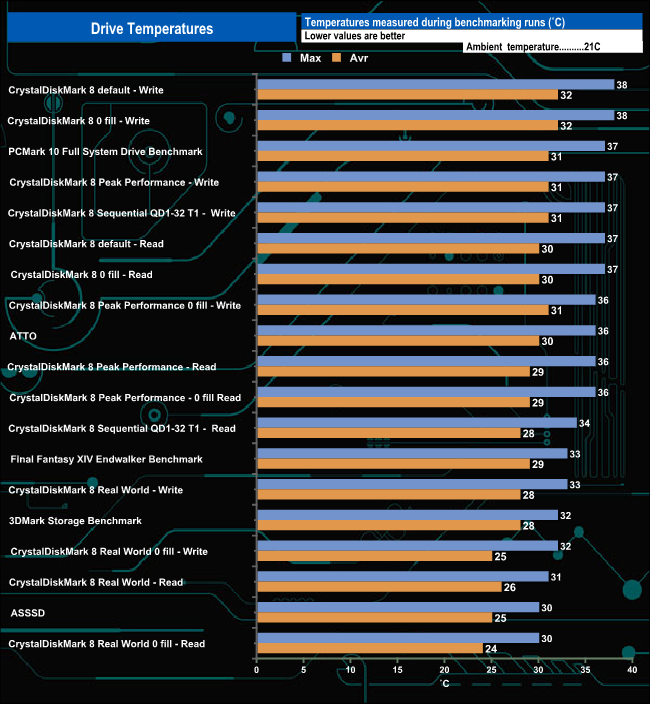
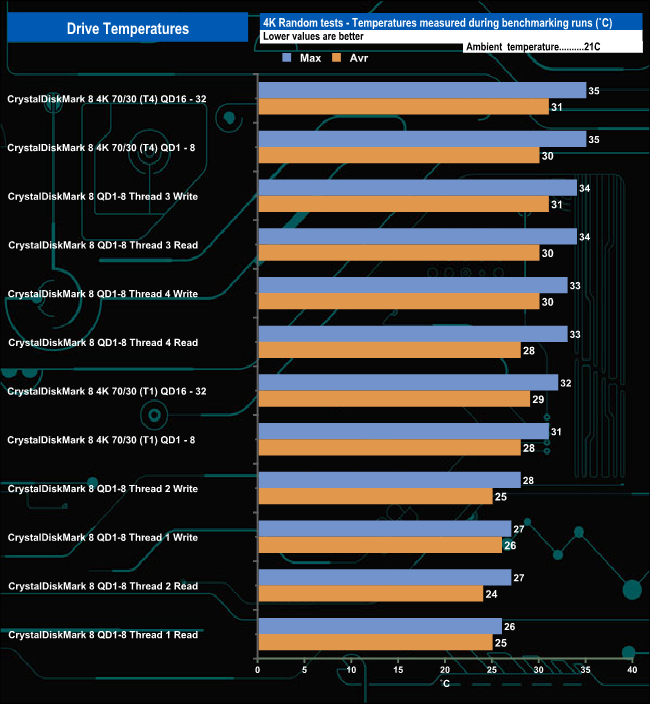
We took note of the drive’s temperature during some of our benchmarking runs.
Crucial sent us the standard drive to review (there is a heat sink-equipped version too). The standard drive does need some form of third-party heatsink or a motherboard cooling solution as it tends to run hot when pushed hard.
We ran a couple of tests without a heat sink just to see what would happen. Running the ATTO benchmark the drive reached 69° C and when running the default CrystalDiskMark 8 test it reached 73° C (reads) and 77° C (writes). But despite this, we didn't appear to see any throttle back issues during these tests
We did our standard testing using the hefty built-in heatsink on our Gigabyte AORUS X670E Xtreme motherboard. During our benchmarking runs, the hottest the drive got was 38° C during the CrystalDiskMark 8 Write test and the 0 fill Write test. For the non-4 K tests the drive averaged 34° while for the 4K-based tests, the average was 31°C.