KitGuru KitGuru.net – Tech News | Hardware News | Hardware Reviews | IOS | Mobile | Gaming | Graphics Cards


To test real life performance of a drive we use a mix of folder/file types and by using the FastCopy utility (which gives a time as well as MB/s result) we record the performance of drive reading from & writing to a 2TB Seagate FireCuda 510.
Transfer Details:
- Windows 10 backup – 118GB.
- Data file – 100GB.
- BluRay Movie – 42GB.
- Windows 11 iso – 5.4GB.
- File folder – 50GB – 28,523 files.
- Steam folder – 222GB (8 games: Alien Isolation, Battlefield 4, BioShock Infinite, Crysis 3, Grand Theft Auto V, Shadow Of Mordor, Skyrim, The Witcher3 Wild Hunt).
- Movie demos 8K – 21GB – (11 demos).
- Raw Movie Clips 4K – 16GB – (9 MP4V files).
- Movie folder – 12GB – 15 files – (8 @ .MKV, 4 @ .MOV, 3 @ MP4).
- Photo Folder – 10GB – 304 files – (171 @ .RAW, 105 @ JPG, 21 @ .CR2, 5 @ .DNG).
- Audio Folder – 10GB – 1,483 files – (1479 @ MP3, 4 @ .FLAC files).
- Single large image – 5GB – 1.5bn pixel photo.
- 3D Printer File Folder – 4.25GB – (166 files – 105 @ .STL, 38 @ .FBX, 11 @ .blend, 5 @ .lwo, 4 @ .OBJ, 3@ .3ds).
- AutoCAD File Folder – 1.5GB (80 files – 60 @ .DWG and 20 @.DXF).
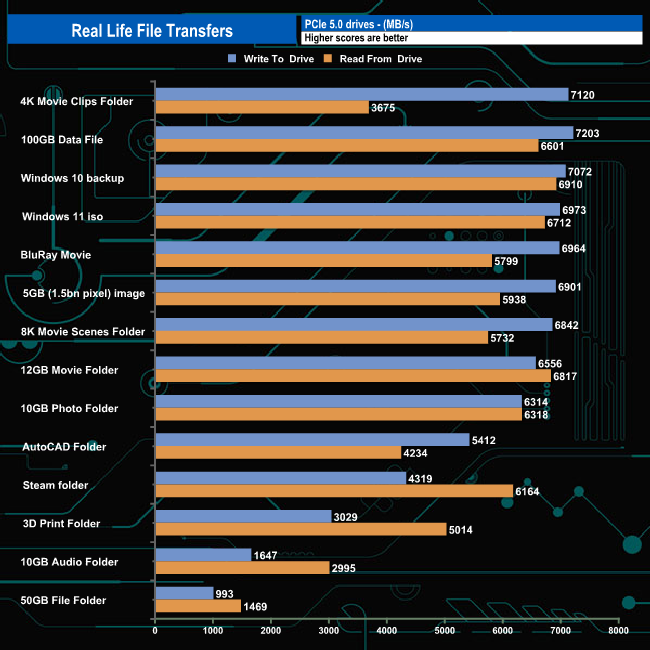
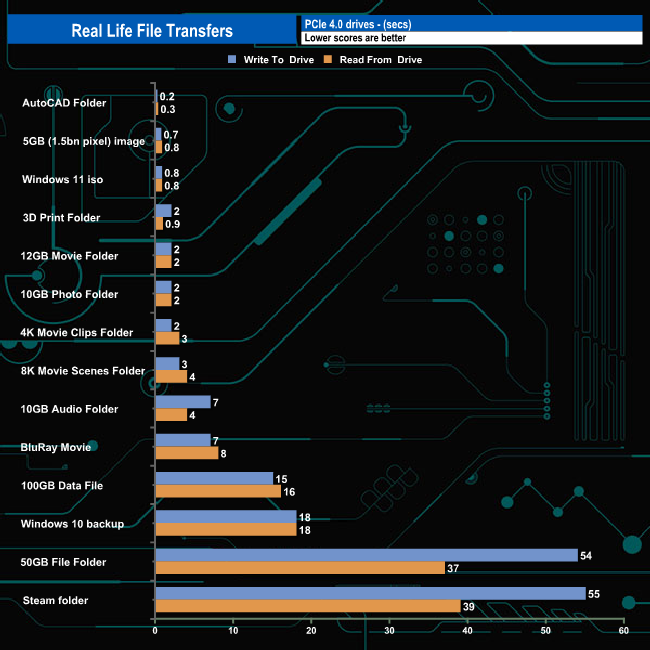
The drive averaged 5,019MB/s when writing the 14 transfer tests, with the fastest being the 7,203MB/s for the 100GB Data file transfer and the slowest being the 50GB file folder transfer at 993MB/s.
Reading back the data the average was a bit faster at 5,312MB/s. The fastest transfer this time was the Windows 10 backup at 6,910MB/s. The slowest transfer was again the 50GB file folder at 1,469MB/s.