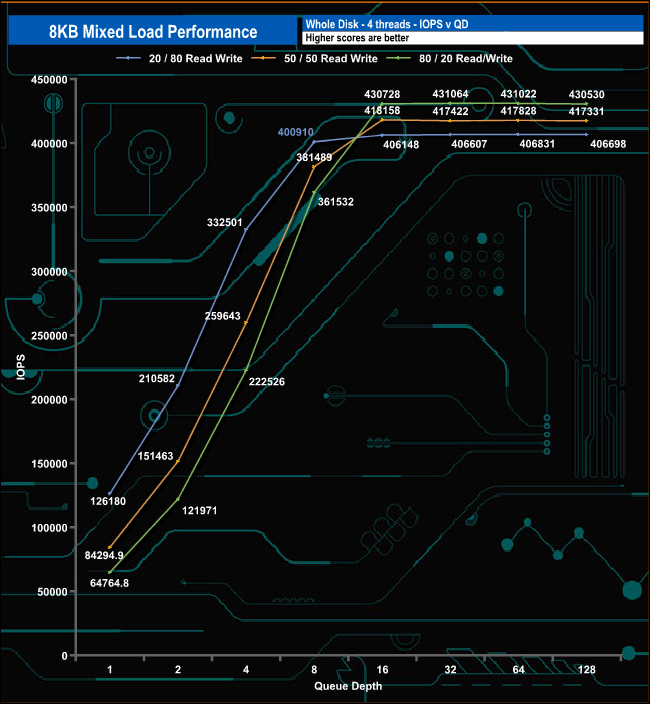
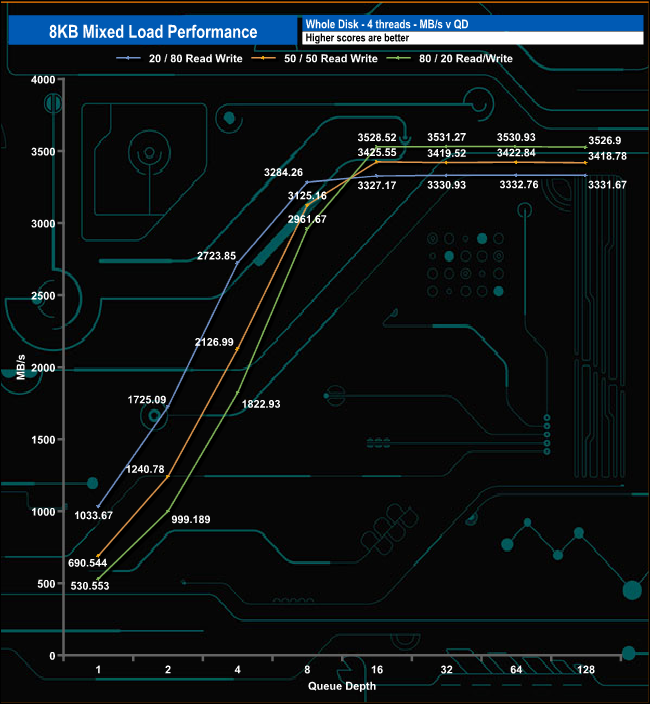
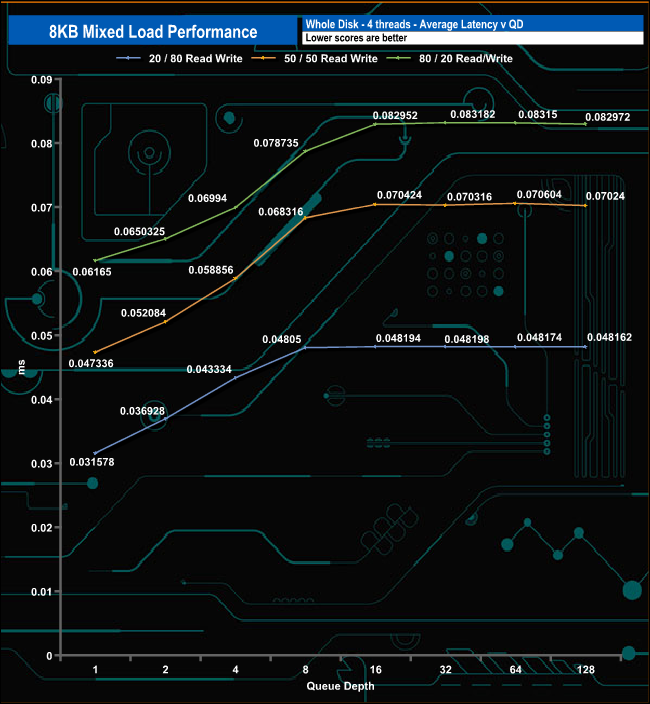
The latest SSD to join Kingston's line-up of data centre class drives is the DC3000ME, Kingston’s first PCIe 5.0 enterprise SSD, using a PCIe 5.0 x4 NVMe U.2 interface. The DC3000ME range is available in three capacities: an entry-level 3.84TB model, a 7.68TB model, and the flagship 15.36TB drive we are reviewing here. The drive uses a Marvell Bravera SC5 16-channel NVMe SSD controller, which looks after Micron 232-layer 3D eTLC B58R NAND flash memory running at 2400MT/s. Kingston quotes a maximum Sequential read figure of up to 14,000MB/s across the range. Write figures quoted are up to 5,800MB/s for the 3.84TB drive, 10,000MB/s for the 7.68TB drive and up to 9,700MB/s for the 15.36TB model. 4K read/write performance is quoted as up to 2,700,000 IOPS and 400,000 IOPS, respectively, for the 15.36 TB model. The 7.68TB drive gets ratings of up to 2,800,000 IOPS for reads and up to 500,000 IOPS for writes. The 3.84TB drive gets the same 2,700,000 IOPS as the 15.36TB model with writes rated up to 300,000 IOPS. The drive comes with a host of additional features that this market segment demands, including: hardware-based power loss protection, full diagnostics (including telemetry, Flash wear, temperature, health, etc), AES 256-bit and TCG Opal 2.0 encryption and namespace management support (128 namespaces supported). Kingston rates the power consumption of the DC3000ME as 8W for idle, 8.2W maximum reads, and 24W maximum writes. The drive has an endurance rating of 1 DWPD (Drive Writes Per Day) / 28,032TB TBW over the length of the 5-year warranty. Physical Specifications: Usable Capacities: 15.36TB. NAND Components: 232-Layer Micron B58R eTLC. NAND Controller: Marvell Bravera SC5. Cache: n/s. Interface: PCIe Gen 5 U.2. Form Factor: 2.5in,15mm U.2. Dimensions: 100.50 x 69.8 x 14.8mm. Drive Weight: 152.3g. Firmware Version: ELFA01.2 Many companies deliver their data centre/enterprise drives in plain vanilla boxes, not so Kingston, they ship theirs in blister packs just like their retail consumer drives. The DC3000ME’s blister pack has the drive’s capacity clearly labelled on the front, along with interface type and which market segment(s) the drive is aimed at, together with a logo that displays the 5-year warranty that Kingston backs the drive with. The rear of the packaging has multilingual marketing and warranty notes on it. The DC3000ME is built on a 2.5in 15mm format with the enclosure constructed from anodised aluminium with ribs on top and bottom to help with heat dissipation. The drive uses a Marvell Bravera SC5 16-channel NVMe SSD controller, which looks after 232-layer Micron B58R eTLC NAND. The Bravera SC5 16-channel (MV-SS1333) is built on a 12nm format in a 20 x 20mm package with 10 embedded processor cores mainly using Arm Cortex-R8 cores with additional Cortex-M7 cores and a Cortex-M3 processor, which has integrated instruction/data SRAM and crypto engines (AES, SHA, RSA, ECC) and supports AES-256 Encryption with FIPS compliant root of trust. The Bravera SC5 is NVMe 1.4b compliant and uses Marvell's 5th generation of NANDEdge error correction engine. It supports SLC, MLC, TLC, and QLC NAND and can be used with either DDR4 (3200MHz) or LPDDR4X (4266MHz) cache. The controller's performance is quoted as up to 14GB/s and 9GB/s for Sequential reads and writes, respectively. It is rated at up to 2M IOPS for random reads and up to 1M IOPS for writes. The drive uses a PCIe Gen 5 x4 U.2 interface. To enable us to test the DC3000ME, Kingston kindly provided us with the following hardware: Motherboard: ASRock TRX50 WS. Processor: AMD Ryzen Threadripper PRO 7965WX (24 cores). Memory: 32GB Kingston Fury Renegade Pro 5600MT/s DDR5 RDIMM. CPU Cooler: Alphacool Eisbaer Pro Aurora 360. In addition, the power supply was a Seasonic Vertex GX1000 (kindly provided by Seasonic). Software: ATTO Disk Benchmark 4 and 5. CrystalDiskMark 9. IOMeter SPECworkstation 3.1. The ATTO Disk Benchmark performance measurement tool is compatible with Microsoft Windows. Measure your storage system's performance with various transfer sizes and test lengths for reads and writes. Several options are available to customise your performance measurement, including queue depth, overlapped I/O and even a comparison mode with the option to run continuously. Use ATTO Disk Benchmark to test any manufacturer's RAID controllers, storage controllers, host adapters, hard drives, and SSD drives. Notice that ATTO products consistently provide the highest level of performance for your storage. Although we used a completely different test platform to benchmark the DC3000ME than the other data centre/enterprise drives we've reviewed, we used version 4 to use as a loose comparison to other data centre/enterprise drives and the latest version 5 to show the performance of Kingston's drive. Kingston rates the Sequential performance of the 15.36TB version of the DC3000ME as up to 14,000MB/s and up to 9,700MB/s for Sequential read and writes, respectively. Using the ATTO 4 benchmark, we couldn't get close to those figures with test results of 8,080MB/s for reads and 8,060MB/s for writes. However, those figures are the fastest we've seen for any drive we've tested that's aimed at the data centre/enterprise market segment. ATTO 5 brings new features, enhancements and changes for more accurate testing of the latest drives. Using this version of ATTO, we confirmed the official Sequential read figure with a peak test result of 14,030 MB/s (4 MB data size). When it came to writing performance, however, we still couldn't quite reach the official maximum of 9,700MB/s, with a peak test result of 9,180MB/s (24MB). In our Sequential read tests using a single thread, the drive peaked at 14,013MB/s (QD16) before dropping back to finish the test run at 13,804MB/s. Switching to four threads, the drive peaked at 14,009MB/s at QD4, both confirming the official maximum of 14,000MB/s. As for writes, single-thread performance peaked at 9,133MB/s (QD16), with four threads it peaked at 9,155MB/s (QD4); both figures are a little short of the official maximum of 9,700MB/s. 4KB Random Read Performance Kingston rates the 4K random read performance of the 15.36TB version of the DC3000ME as up to 2.7M IOPS. Using our 4-threaded testing, we couldn't get close to that figure; the best we saw was 439,018 IOPS (1,799.06MB/s) at QD128. Also worthy of note is the low-latency performance. 4KB Random Write Performance Officially, the 15.336TB DC3000ME is rated as up to 400,000 IOPS for 4K random writes. With our four threaded tests, the best figure we saw was just shy of the official maximum at 398,046 IOPS at QD4, before the performance very slowly dropped away to finish the test run at QD128 with a result of 395,206 IOPS. Once again, the low latencies are worthy of note. 8KB Random Read Performance As the DC3000ME has been designed for use in data centre's, we also tested the drive using 8K data. In our 4-threaded read test, the drive climbed steadily through the tested queue depths until QD16 (429,431 IOPS), where the rate of acceleration slowed down, and the performance started to level off, with a small peak (431,179 IOPS), at QD64, finishing the test run at QD128 with a figure of 431,166 IOPS. 8KB Random Write Performance When it came to 8K random writes, the performance acceleration peaked at QD4 (390,154 IOPS) and, as with the random reads, the performance levelled off until QD64, where the performance peaked again at 396,947 IOPS before dropping back to finish the test run at 391,159 IOPS at QD128. 4K Random 80/20 Mix Read/Write The DC3000ME has been designed to deliver high I/O performance at low latencies for mixed workloads. Our mixed load testing confirmed both of these aims, particularly at lower queue depths. 8K Random 80/20 Mix Read/Write Increasing to 8K blocks of data, the DC3000ME delivered the same high level of performance with mixed loads at low queue depths as it did using 4K data. SPECworkstation 3.1 is a specialised test designed for benchmarking the key aspects of workstation performance; it uses over 30 workloads, containing nearly 140 tests to test CPU, graphics, I/O, and memory bandwidth. The workloads fall into seven categories; Media and Entertainment – 3D animation, rendering Product Development – CAD/CAM/CAE Life Sciences – medical, molecular Energy – oil and gas Financial Services, General Operations GPU Compute. We used the WPCstorage section of the benchmark to test drives, which uses fifteen separate tests from the following categories: Media and Entertainment, Product Development, Life Sciences, Energy and General Operations. The DC3000ME handles the rigours of the SPECworkstation 3.1 test very well, as you might expect from this class of drive. We also tested the drive in a number of workload scenarios that it might face in real life. The IOMeter settings we used to test with are listed below, each test being run for 10 minutes:- Database Server Transfer Size: 8K Reads: 67% Writes: 33% Random: 100% Boundary: 4K Outstanding IO: 128 Threads: 4 Exchange Email 4K Transfer Size: 4K Reads: 67% Writes: 33% Random: 100% Boundary: 4K Outstanding IO: 128 Threads: 4 Exchange Email 8K Transfer Size: 8K Reads: 67% Writes: 33% Random: 100% Boundary: 8K Outstanding IO: 64 Threads: 4 Exchange Email 32K Transfer Size: 32K Reads: 67% Writes: 33% Random: 100% Boundary: 4K Outstanding IO: 128 Threads: 4 Media Streaming Transfer Size: 64K Reads: 98% Writes: 2% Sequential: 100% Boundary: 4K Outstanding IO: 64 Threads: 8 Search Engine A Transfer Size: 4K Reads: 100% Writes: 0% Random: 100% Boundary: 4K Outstanding IO: 128 Threads: 8 Search Engine B Transfer Size: 8K Reads: 100% Writes: 0% Random: 100% Boundary: 4K Outstanding IO: 128 Threads: 8 Web File Server 4KB Transfer Size: 8K Reads: 95% Writes: 5% Random: 75% Boundary: 4K Outstanding IO: 32 Threads: 8 Web File Server 8KB Transfer Size: 8K Reads: 95% Writes: 5% Random: 75% Boundary: 4K Outstanding IO: 64 Threads: 8 Web File Server 64KB Transfer Size: 64K Reads: 95% Writes 5% Random: 75% Boundary: 4K Outstanding IO: 64 Threads: 8 Web Server Log Transfer Size: 8K Reads: 0% Writes: 100% Random: 100% Boundary: 4K Outstanding IO: 128 Threads: 4 Video On Demand Transfer Size: 512K Reads: 100% Writes: 0% Random: 100% Boundary: 4K Outstanding IO: 64 Threads: 8 As you might expect for a drive designed to handle most of these scenarios in one way or another, the DC3000ME tackles these tests very efficiently with some very strong bandwidth figures. Although we can't really compare the performance of the DC3000ME to the other data centre/enterprise drives we tested because the test platform was completely different, these test results are by far the fastest we've seen with this class of drive (e.g. the Kingston DC1500M produced a Search Engine A test result of 438,233 IOPS, the DC3000ME, 837,260 IOPS). For the long-term performance stability test, we set the drive up to run a 20-minute 4K random test with a 30% write, 70% read split, at a Queue Depth of 256 over the entire disk. The 15.36TB DC3000ME averaged 163,679.01 IOPS for the test with a performance stability of 97%, a figure you should expect from a drive aimed at data centre/enterprise usage. We took note of the drive’s temperature during some of our benchmarking runs. Kingston's DC3000ME enclosure design includes a series of ribs on top and bottom to aid with cooling. Under benchmarking, the hottest the drive got was 63°C when the drive was running the Web File Server 64K test, which is close to the quoted maximum operating temperature of 70°C. The drive averaged 50.4°C when running our benchmarks. Kingston’s first PCIe 5.0 enterprise SSD is the DC3000ME, available (at the time of writing) in three capacities: 3.84TB, 7.68TB and the flagship 15.36TB drive, which Kingston supplied for review. Designed for use in data centre / enterprise market segments for applications including AI, Cloud services, HPC, Edge computing and software-defined storage, the DC3000ME features a Marvell Bravera SC5 16-channel NVMe SSD controller married to Micron 232-layer 3D eTLC B58R NAND flash memory running at 2400MT/s. The drive uses a U.2 (PCIe NVMe Gen5 x4) interface, which is hot-pluggable and compatible with U.2 backplanes of storage systems and enterprise servers. Kingston quotes sequential read figures for the DC3000ME range as up to 14,000MB/s for all three drives. Writes are quoted as up to 5,800MB/s for the 3.84TB model, 10,000MB/s for the 7.68TB drive and up to 9,700MB/s for the 15.36TB flagship drive. We confirmed the official read figure with our own sequential tests using a single thread, achieving a peak read test result of 14,013 MB/s, with writes peaking at 9,133 MB/s, which is shy of the official 9,700 MB/s. Using four threads, we got a best read result of 14,009MB/s with writes at 9,155MB/s. The random 4K read performance for the drive is quoted as up to 2.7M IOPS for the 3.84TB and 15.36TB models, while the 7.68TB model is rated at up to 2.8M IOPS. Write performance is listed as up to 300,000 IOPS for the 3.84 TB unit, 500,000 IOPS for the 7.68 TB drive, and 400,000 IOPS for the 15.36 TB model. When tested with our four-threaded tests, the best 4K random read figure we saw was 439,018 IOPS (1,799.06MB/s) at QD128, so it was nowhere close to the official maximum. However, the best 4K write figure was 398,046 IOPS (1,630.40MB/s) at QD8, so just shy of the official maximum figure. The best 4K random figures we saw from the drive came from a quick test using CrystalDiskMark 9, which produced a read figure of 1,340,861 IOPS, still short of the maximum official figure but much closer, while the best write result of 902,401 IOPS rocketed past the official maximum. As you might expect for a data centre/enterprise-focused drive, the DC3000ME comes with a host of features aimed at this market segment; reliability and usage statistics tracking, hardware power loss protection (PLP), telemetry monitoring, end-to-end data path protection, TCG Opal 2.0, AES 256-bit encryption and multiple namespace management (128 namespaces supported). Power-wise, the 15.36TB DC3000ME is rated at 8W idle, 8.2W for maximum reads and 24W for maximum writes. Kingston has given the 15.36TB DC3000ME an endurance rating of 1 DWPD (Drives Written Per Day) / 28,032TBW over the length of the 5-year warranty Kingston backs the drive with. You can buy the 15.36TB version of the DC3000ME for around £1380 from Ballicom HERE. Pros Overall performance. Multiple namespace support. Endurance. Cons Couldn't hit the official maximum random reads under testing. Pricey. KitGuru says: Kingston's latest flagship data centre / enterprise class drive, the 15.36TB DC3000ME, marries very large capacity with impressive low latency performance. It comes with all the features that you might expect for a drive aimed at this market segment: hardware-based power loss protection, AES 256-bit encryption, enterprise-class diagnostics, and namespace management.