KitGuru KitGuru.net – Tech News | Hardware News | Hardware Reviews | IOS | Mobile | Gaming | Graphics Cards


The latest drive to join Samsung's line-up of SSDs is the SSD 870 QVO, the company's 2nd generation 3D QLC (quad-level cell) NAND drive. Available in capacities from 1TB up to 8TB, here we look at the 4TB model and see whether or not it is worth the £438.99 asking price.
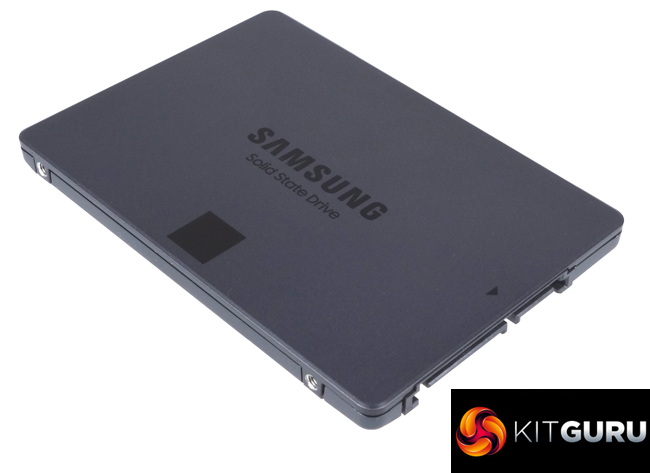
The previous generation SSD 860 QVO used 64-layer QLC V-NAND and the capacity topped out at 4TB. The new SSD 870 QVO uses 9x layer 3D QLC V-NAND (or V-NAND 4-bit MLC as Samsung call it). At launch it is available in four capacities; 1TB, 2TB, 4TB (the drive we are looking at) with the flagship model now being an 8TB drive. Looking after the NAND and the 4GB of LP-DDR4 of cache is a new MKX 8-channel controller.
The official Sequential performance figures for the new drives are up to 560MB/s for reads and up to 530MB/s for writes. Random performance is quoted as up to 11,000 IOPS for reads and up to 35,000 IOPS at a QD1 and up to 98,000 IOPS and 88,000 IOPS for read and writes respectively at QD32.
Endurance wise the 4TB drive is rated at 1,440TB TBW and Samsung backs the drive with a 3-year warranty.
Physical Specifications:
- Usable Capacities: 4TB.
- NAND Components: Samsung V-NAND 4-bit MLC (QLC) NAND.
- NAND Controller: Samsung MKX.
- Cache: 4GB LP-DDR4.
- Interface: Serial ATA (SATA) 6Gb/s (SATA III).
- Form Factor: 2.5in 7mm.
- Dimensions: 100 x 69x 6.8mm
Firmware Version: SVQ01B6Q.