KitGuru KitGuru.net – Tech News | Hardware News | Hardware Reviews | IOS | Mobile | Gaming | Graphics Cards


We recently reviewed the first PCIe Gen 5.0 drives from Samsung and Kingston, and now another big hitter, Sandisk, has launched its first Gen 5 drive under the WD_Black banner – the SN8100.
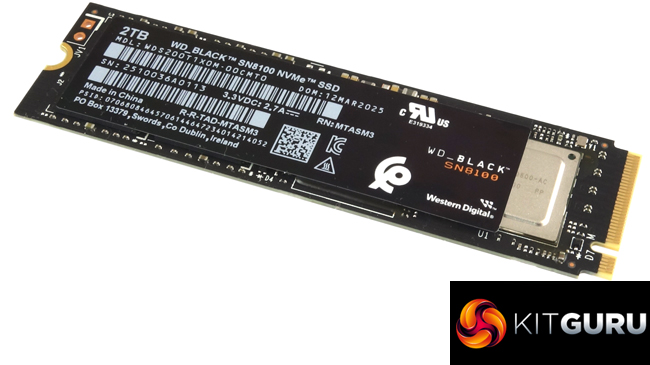
The WD_Black SN8100 comes in three capacities: 1TB, 2TB (the drive we are reviewing here), a flagship 4TB drive, and two versions, one plain and one with a heatsink. An 8TB model is expected later in 2025. The drive uses a combination of a SanDisk controller and Sandisk BiCS8 218-layer TLC 3D. The controller is based on Silicon Motion's SM2508 but with Sandisk's hand firmly in charge of the firmware and feature set.
The 2TB WD_Black 8100's Sequential read/write performance is rated as up to 14,900MB/s and 14,000MB/s, respectively. Both the 1TB and 4TB have the same read rating. The 4TB drive has a write rating of up to 14,000MB/s while the 1TB drive has a up to 11,000MB/s figure.
Random 4K performance is quoted as up to 2.3M IOPS for the 2TB and 4TB drives, with the 1TB drive back at up to 1.6M IOPS. All three drives are rated as up to 2.4M IOPS for random writes.
The 2TB drive's power consumption figures are quoted as 6.5W for average active reads and 7.0W for active writes, with a PS4 sleep rating of 5mW. The 2TB version of the WD_Black SN8100 has an endurance rating of 1,200 TBW, and the drive is backed by a 5-year warranty.
Physical Specifications:
- Usable Capacities: 2TB.
- NAND Components: BiCS TLC 3D CBA NAND.
- NAND Controller: Sandisk (Silicon Motion SM2508).
- Cache: 2GB.
- Interface: PCIe Gen 5 x4, NVMe 2.0.
- Form Factor: M.2, 2280.
- Dimensions: 80 x 22 x 2.3mm.
- Drive Weight: 7.5g
Firmware Version: 810YRC03.