 KitGuru KitGuru.net – Tech News | Hardware News | Hardware Reviews | IOS | Mobile | Gaming | Graphics Cards



Today we are going to look at a gaming rig from a manufacturer called Falcon Computers. They are an independent organisation based up in Sunderland, producing an extensive range of pre-configured and configurable gaming systems.
The Falcon Predator offers an impressive specification which includes an overclocked Intel Core i7-4770K, paired with an Asus Sabertooth Z87 motherboard and an Asus GeForce GTX 770 Direct CU II OC graphics card. This specification makes the Predator ideal for those who don't have time to build their own system, but who want to use the latest components.
At a retail price of £1,399 inc vat is this a system you should be considering on a shortlist?

Specification
- Aerocool Xpredator X3 White Case.
- Asus Sabertooth Z87.
- Intel 4770K o.c to 4.2GHZ.
- 16GB DDR3 1866mhz.
- 120 GB Samsung SSD.
- 1TB SATA.
- Asus GeForce GTX 770 Direct CU.
- DVD R/W.
- Cooler Master 700W PSU.
- Microsoft Windows 7 Home Premium.

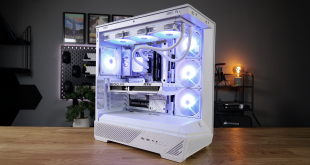
Falcon have chosen to use an Aerocool Xpredator X3 White case for this system. This is a fairly decent mid-range gaming case which offers an exciting design and an interesting set of features. For more information on this case, please check out our in depth review over here.

There is a generous selection of connections on the front of the case which are easily accessible. There are three USB 2.0 ports, one USB 3.0 port, one eSATA port and headphone and microphone jacks. We also find the power button and two fan speed controllers on the front panel.

Moving round to the rear of the case we can see there is a plentiful selection of rear I/O connections. From top to bottom we find a four USB2.0 ports, two USB3.0 ports, two eSATA ports, Displayport, HDMI and S-PDIF outputs, an RJ-45 Ethernet jack, two further USB3.0 ports and six 3.5mm audio connectors.

The Aerocool Xpredator X3 is painted entirely white inside which is pretty attractive and complements the components well. This system is based around an Asus Sabertooth Z87 Motherboard. Cable routing is not the best we have seen however it won't cause any airflow issues.

Falcon have chosen to use a Cooler Master Seidon 120M liquid CPU cooler which should offer a decent compromise between acoustic and thermal performance. The CPU in this system is a 4770K which has been boosted to 4.2 GHz with overclocking. We are also impressed with Falcon’s choice of graphics card – the Asus Geforce GTX 770 Direct CU II which features a very good quality custom cooler.

All of the parts used in the system seem to be good quality, and each one carries a familiar brand name. We were very impressed by Falcon's choice of memory, with two 16 GB sticks of 1866 MHz Corsair Vengeance memory being supplied.

Falcon has chosen to use a Samsung 840 Series 120 GB solid state drive for the OS, with a supplementary 1 TB Western Digital Blue Hard Drive for storage.


Even though the power supply doesn't have braided cables, it's a Cooler Master model so we're pretty confident in the quality.
System:
Our sample of the Falcon Predator was supplied with Windows 7 pre-installed, however you can select from a variety of different Windows operating systems.

Falcon overclocks the i7-4770K to 4.2 GHz, which should yield a noticeable performance boost. There are a number of pre-built systems on the market which ship with higher overclocks although Haswell is known to run hot so playing it a little safe might not be such a bad thing.
Looking at CPU-Z we can see that the motherboard is feeding the Intel Core i7-4770K with around 1.21V (under load) to sustain the 4.2 GHz overclock. The memory is configured to run at 1866MHz with timings of 10-11-10-30.

The inbuilt Windows benchmarks rates the system at 7.7, which is actually limited by the CPU performance of the system! This is hardly a definitive measure of performance but it gives us a vague idea of the system’s capabilities.

GPU-Z confirms that the Predator boasts a nVidia GTX 770 with 2 GB of GDDR5 memory.
We are using a Viewsonic VX2260WM 1080P monitor for testing.
Software:
PCMark 8
PCMark 7
3DMark
3DMark 11
3DMark Vantage
SiSoft Sandra 2013
Cinebench R11.5
CrystalDiskMark
Cyberlink MediaEspresso 6.7
VLC Media Player
Performance Monitor
Unigine Heaven Benchmark
Super Pi 1.5 Mod
CPUID Hardware Monitor
CPU-Z
DiRT Showdown
Battlefield 3
Call of Duty: Black Ops 2
PCMark 8 is the latest version in the popular series of PC benchmarking tools. Improving on previous releases, PCMark 8 includes battery life measurement tools and new tests using popular applications from Adobe and Microsoft. Whether you are looking for long battery life, or maximum power, PCMark 8 helps you find the devices that offer the perfect combination of efficiency and performance for your needs.


In this test, the system performs very well, showing that it will be great for non-gaming tasks too.
PCMark 7 includes 7 PC tests for Windows 7, combining more than 25 individual workloads covering storage, computation, image and video manipulation, web browsing and gaming. Specifically designed to cover the full range of PC hardware from netbooks and tablets to notebooks and desktops, PCMark 7 offers complete PC performance testing for Windows 7 for home and business use.


This result is pretty impressive, showcasing the decent all-round performance of the Predator.
3DMark is Futuremark’s latest benchmark. It can be used to benchmark and compare everything from mobile devices, such as smart phones, tablets and laptops, to high-end gaming systems. The benchmark is available for Windows, Windows RT Android and iOS.
With 3 separate tests, each of which is intended to be used alongside a specific classification of hardware, 3DMark is a very versatile benchmark. Ice Storm is intended to be used with mobile devices, Cloud Gate is good for use with laptops and home PCs, and Fire Strike can be used to push the performance of gaming PCs.
We used the ‘Fire Strike’ benchmark which is designed to be used on gaming PCs. We opted for the Normal setting, NOT the Extreme mode.


This test is reflective of the stellar gaming performance of the Predator.
3DMark 11 is designed for testing DirectX 11 hardware running on Windows 7 and Windows Vista. The benchmark includes six all new benchmark tests that make extensive use of all the new features in DirectX 11 including tessellation, compute shaders and multi-threading.
After running the tests 3DMark gives your system a score with larger numbers indicating better performance. Trusted by gamers worldwide to give accurate and unbiased results, 3DMark 11 is the best way to test DirectX 11 under game-like loads.
If you want to learn more about this benchmark, or to buy it yourself, head over to this page.


Again, this test shows us that the Predator should be very capable when gaming.
Unigine provides an interesting way to test hardware. It can be easily adapted to various projects due to its elaborated software design and flexible toolset. A lot of their customers claim that they have never seen such extremely-effective code, which is so easy to understand.
Heaven Benchmark is a DirectX 11 GPU benchmark based on advanced Unigine engine from Unigine Corp. It reveals the enchanting magic of floating islands with a tiny village hidden in the cloudy skies. Interactive mode provides emerging experience of exploring the intricate world of steampunk.
Efficient and well-architected framework makes Unigine highly scalable:
- Multiple API (DirectX 9 / DirectX 10 / DirectX 11 / OpenGL) render
- Cross-platform: MS Windows (XP, Vista, Windows 7) / Linux
- Full support of 32bit and 64bit systems
- Multicore CPU support
- Little / big endian support (ready for game consoles)
- Powerful C++ API
- Comprehensive performance profiling system
- Flexible XML-based data structures


This game really showcases the great graphics performance of this system.
SiSoftware Sandra (the System ANalyser, Diagnostic and Reporting Assistant) is an information & diagnostic utility. It should provide most of the information (including undocumented) you need to know about your hardware, software and other devices whether hardware or software.
Sandra is a (girl’s) name of Greek origin that means “defender”, “helper of mankind”. We think that’s quite fitting.
It works along the lines of other Windows utilities, however it tries to go beyond them and show you more of what’s really going on. Giving the user the ability to draw comparisons at both a high and low-level. You can get information about the CPU, chipset, video adapter, ports, printers, sound card, memory, network, Windows internals, AGP, PCI, PCI-X, PCIe (PCI Express), database, USB, USB2, 1394/Firewire, etc.
Native ports for all major operating systems are available:
- Windows XP, 2003/R2, Vista, 7, 2008/R2 (x86)
- Windows XP, 2003/R2, Vista, 7, 2008/R2 (x64)
- Windows 2003/R2, 2008/R2* (IA64)
- Windows Mobile 5.x (ARM CE 5.01)
- Windows Mobile 6.x (ARM CE 5.02)
All major technologies are supported and taken advantage of:
- SMP – Multi-Processor
- MC – Multi-Core
- SMT/HT – Hyper-Threading
- MMX, SSE, SSE2, SSE3, SSSE3, SSE 4.1, SSE 4.2, AVX, FMA – Multi-Media instructions
- GPGPU, DirectX, OpenGL – Graphics
- NUMA – Non-Uniform Memory Access
- AMD64/EM64T/x64 – 64-bit extensions to x86
- IA64 – Intel* Itanium 64-bit


Here we can see the impressive raw processing power of the Predator. Memory bandwidth is quite good too considering its dual channel.
Cinebench R11.5 is the newest revision of the popular benchmark from Maxon. The test scenario uses all of your system’s processing power to render a photorealistic 3D scene (from the viral “No Keyframes” animation by AixSponza). This scene makes use of various different algorithms to stress all available processor cores.
In fact, CINEBENCH can measure systems with up to 64 processor threads. The test scene contains approximately 2,000 objects containing more than 300,000 total polygons and uses sharp and blurred reflections, area lights and shadows, procedural shaders, antialiasing, and much more. The result is given in points (pts). The higher the number, the faster your processor.


In this test we can see the benefits of using multi-threaded applications with the Predator, which can harness the power of all four cores (eight virtual cores with hyper threading enabled).
Super Pi is used by a huge audience, particularly to check stability when overclocking processors. If a system is able to calculate PI to the 2 millionth pace after the decimal without mistake, it is considered to be stable in regards to RAM and CPU.


A very impressive result for the Predator, showcasing the single-threaded performance of the system.
A very important part of overall system responsiveness is down to hard drive performance. We use one of our favourite benchmark utilities – CrystalDiskMark X64 Edition – to rate performance from the on-board SATA controller.


Here we can see that the SSD in this system performs very well in the read test, and not quite so well in the write test, both with compressible and incompressible data.
The Matroska Media container is a very popular, open standard Multimedia container which is usually found as .MKV files. It is a very popular format in enthusiast circles and can be played directly in VLC or Windows Media Player with suitable codecs installed.
We played our 720P MKV movie using the latest version of VLC Media Player and measured the CPU usage with the Performance Monitor built into Windows.

Impressive results in this test, leaving plenty of clock cycles for other applications in the background.
CyberLink MediaEspresso 6 is the successor to CyberLink MediaShow Espresso 5.5. With its further optimized CPU/GPU-acceleration, MediaEspresso is an even faster way to convert not only your video but also your music and image files between a wide range of popular formats.
Now you can easily playback and display your favourite movies, songs and photos not just on your mobile phone, iPad, PSP, Xbox, or Youtube and Facebook channels but also on the newly launched iPhone 4. Compile, convert and enjoy images and songs on any of your computing devices and enhance your videos with CyberLink’s built-in TrueTheater Technology.
New and Improved Features
- Ultra Fast Media Conversion – With support from the Intel Core i-Series processor family, ATI Stream & NVIDIA CUDA, MediaEspresso’s Batch-Conversion function enables multiple files to be transcoded simultaneously.
- Smart Detect Technology – MediaEspresso 6 automatically detects the type of portable device connected to the PC and selects the best multimedia profile to begin the conversion without the need for user’s intervention.
- Direct Sync to Portable Devices – Video, audio and image files can be transferred in a few easy steps to mobile phones including those from Acer, BlackBerry, HTC, Samsung, LG, Nokia, Motorola, Sony Ericsson, and Palm, as well as Sony Walkman and PSP devices.
- Enhanced Video Quality – CyberLink TrueTheater Denoise and Lighting enables the enhancement of video quality through optical noise filters and automatic brightness adjustment.
- Video, Music and Image File Conversion – Convert not only videos to popular formats such as AVI, MPEG, MKV, H.264/AVC, and FLV at the click of a button, but also images such as JPEG and PNG and music files like WMA, MP3 and M4A.
- Online Sharing – Conversion to video formats used by popular social networking websites and a direct upload feature means posting videos to Facebook and YouTube has never been easier.
For our testing today we are converting a 1.43 GB 720p MKV file to Apple Mp4 format for playback on a portable device. This is a common procedure for many people and will give a good indication of system power. Hardware acceleration was disabled so that


Here we can see the impressive real world performance of the system.
According to EA, Battlefield 3 garnered 3 million pre-orders by the day of its release. It is unknown at present whether these figures are worldwide or just for the US. The pre-order total makes it “the biggest first-person shooter launch in EA history”, according to the publisher. The engine is beautiful on the PC and very demanding of the partnering hardware.

We used the settings illustrated in the screenshot above for testing.

In this test, the Predator achieved a very decent framerate indeed, thanks to the powerful GTX 770 graphics card.
Black Ops 2 is the latest episode in the Call of Duty franchise and is one of the most popular games of the moment. It uses an updated version of the IW engine, used in previous Call of Duty games, which isn't particularly demanding. This makes it ideal for testing mid-range gaming systems like this.


We used the settings illustrated in the screenshots above for testing.

An excellent score achieved by the Predator in this test, showcasing it's abilities as a gaming system.
Dirt Showdown is the latest title in the franchise from Codemasters, based around the famous Colin McRae racing game series, although it no longer uses his name, since he passed away in 2007.

We used the settings illustrated in the screenshot above for testing, as well as ultra presets.

Again we see impressive performance from the Predator.
Idle temperatures were measured after sitting at the desktop for 30 minutes. Load measurements were acquired by running Prime 95 and Furmark for 15 minutes and recording the maximum temperature reached. Room temperature was maintained at 14 degrees C for the duration of the tests.

Here we can see the thermal performance of the system is very impressive. Both the CPU and GPU are well within tolerances and could be pushed slightly further without much issue.
Ambient noise in the room is around 20-25dBa. We measure from a distance of around 1 meter from the closed chassis and 4 foot from the ground to mirror a real world situation.
Why do this? Well this means we can eliminate secondary noise pollution in the test room and concentrate on only the video card. It also brings us slightly closer to industry standards, such as DIN 45635.
KitGuru noise guide
10dBA – Normal Breathing/Rustling Leaves
20-25dBA – Whisper
30dBA – High Quality Computer fan
40dBA – A Bubbling Brook, or a Refridgerator
50dBA – Normal Conversation
60dBA – Laughter
70dBA – Vacuum Cleaner or Hairdryer
80dBA – City Traffic or a Garbage Disposal
90dBA – Motorcycle or Lawnmower
100dBA – MP3 player at maximum output
110dBA – Orchestra
120dBA – Front row rock concert/Jet Engine
130dBA – Threshold of Pain
140dBA – Military Jet takeoff/Gunshot (close range)
160dBA – Instant Perforation of eardrum

Some impressive results for the system in this test, making the Predator ideal for those looking for a low-noise gaming PC.
We measured the power consumption of our entire test system at the wall while loading the CPU using Prime95 and GPU using FurMark.

The power consumption isn't too bad, even under full load measuring around 300 watts.
We are impressed with the hardware components that Falcon has selected for the Predator. They have managed to strike a good balance between processing and gaming performance, without using unreasonably expensive components. They have also used branded components throughout, reassuring us of the quality of the system as a whole.
The system is built inside an Aerocool Xpredator X3 case in white, which is quite an unusual choice. Most other PC manufacturers would opt for a better known branded case, such as those from Corsair or Bitfenix, so this differentiates the Predator from the competition. The case is fairly competent in function and has a striking design as well.
In our tests the Predator performed very well indeed and it demonstrated impressive capabilities. Even though Falcon doesn't overclock the Predator to the same degree as some manufacturers this has a benefit when it comes to temperatures under load and subsequent fan noise. The Predator was completely stable throughout all of our tests, remaining cool and quiet at all times.
The Falcon Predator costs £1,399 including VAT as tested. We configured a similar system from Overclockers UK, as well as a bundle of the exact components that are in this system and both came out at a very similar price to the Falcon Predator system. The Predator is a great option for those who don't want the hassle of building their own system.
Visit the Falcon Computers website to configure your own system.
Pros:
- Striking case design.
- Good component selection.
- Quality, branded components.
- Performs well.
Cons:
- Massive competition in the United Kingdom right now.
- We have seen better cable routing.
KitGuru says: An impressive system from Falcon.

never heard of these guys, but I do like that case, its pretty cool looking.
the price isn’t bad really considering they have to build it. can’t be much money in system building today to cover staff, heating, premises etc.
the only systems that someone could build better than me would be the 8pack ones at OverclockersUK. but they are much too expensive for my tastes. ill continue to build my own, but this one isn’t too bad. at least they didnt use a chinese PSU in it, like mesh. that was shocking 🙁
I’m quite concerned…
On page two you have an image of the system internals (http://www.kitguru.net/wp-content/uploads/2013/09/IMG_2991.jpg): that Graphics card seems like it is twisting horribly, or are all the cool kids using curved Graphics cards now?
I can see that there is a back-plate but I suspect shipping the system with a Graphics card that is that heavy could damage the PCI-e Port if not damaging the card itself? Is the back-plate made from a plastic, it looks like it flexes a lot more than it should?
Arrangements should be made to support the card in the configuration, maybe the chassis should be swapped for one that supports a Graphics card support bracket?
This would have to be the case if the system was configured to ship with a SLi configuration.
I’m sorry for my rant, I’m sure that if the fault lies with anyone it would be ASUS (The vendor for the supplied GPU). However, arrangements should be made by the system builder if they choose to offer the card.
On the whole, a well balanced system by The Falcon Computers, well done gents.
Well written as always Henry!