KitGuru KitGuru.net – Tech News | Hardware News | Hardware Reviews | IOS | Mobile | Gaming | Graphics Cards


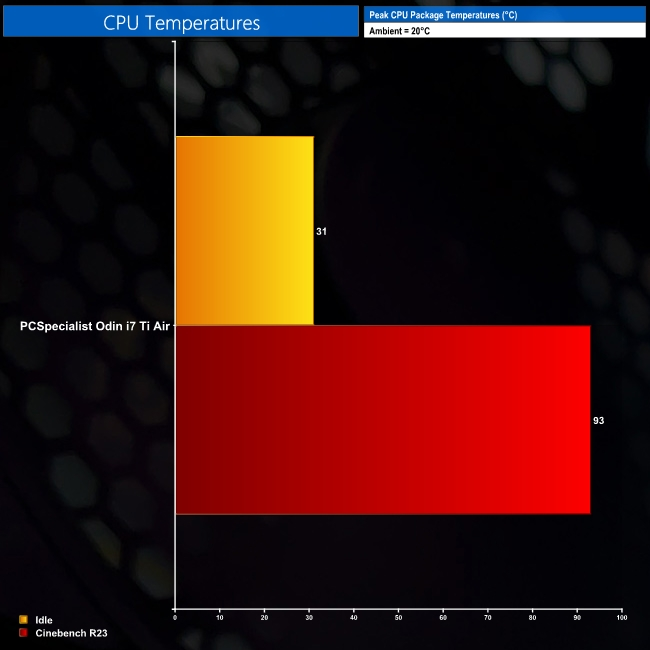
Next, we are looking at temperatures, starting with the CPU. Here the Cooler Master TD500 performs well with those three included front fans, and with it being an airflow-orientated case, our idle temperature of 31 is perfectly acceptable. Running a 30-minute Cinebench R23 loop, we hit 93 degrees, with the PCS Frost Flow CPU cooler doing its best to keep the Intel 12700K cool.
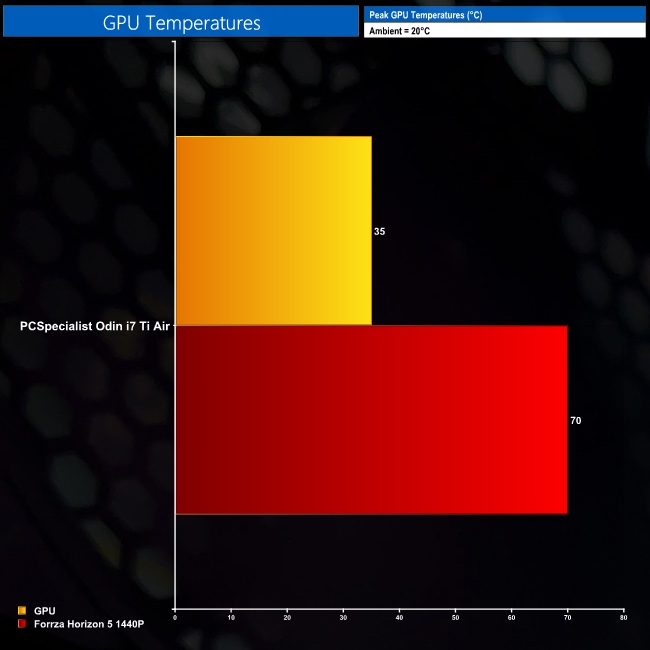
Our GPU also performs well, sitting at 35 degrees idle and moving up to 70 degrees when running our Forza Horizon 5 benchmark.
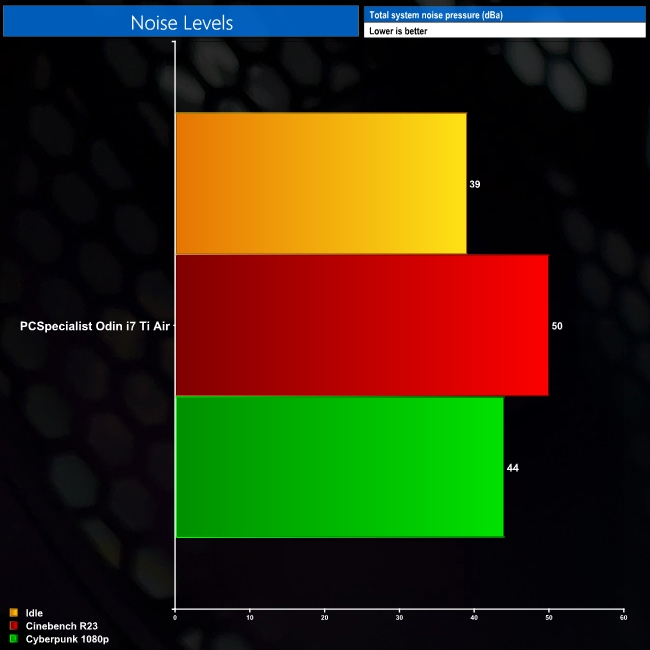
When we look at noise levels from the Odin i7 Ti Air, at idle it sits comfortably at 39 decibels while this rises to 44 decibels when we start gaming. It’s not particularly loud or distracting, and when you slap on some headphones or crank up your speakers it isn’t even noticeable.
Things do get a little louder when we ran Cinebench R23, raising the volume to 50 decibels. We could probably reduce these results if we altered our fan curve, but running these tests with the system as delivered gives you a real-world look at how this system will perform.

Our final test looks at the power consumption of the Odin i7 Ti Air. Starting with Cinebench R23 load, we saw a power draw just shy of 300W, hitting a maximum value of 292W. During our Forza Horizon 5 session, playing at 1440P, we peaked at 397W total system power draw, ensuring a fair bit of headroom if users want to upgrade this system down the line.