KitGuru KitGuru.net – Tech News | Hardware News | Hardware Reviews | IOS | Mobile | Gaming | Graphics Cards


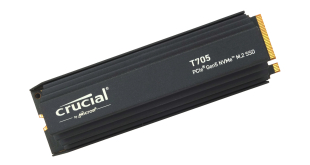
The latest SSD to join Crucial's Pro lineup is the T705, coming in as the new flagship drive of the Pro SSD line. Using a combination of a Phison controller and 232-layer NAND, it's also Crucial's fastest SSD to date. Hitting the market at around £500 for the 2TB model, we find out exactly what sort of speeds this drive can bring to the table…
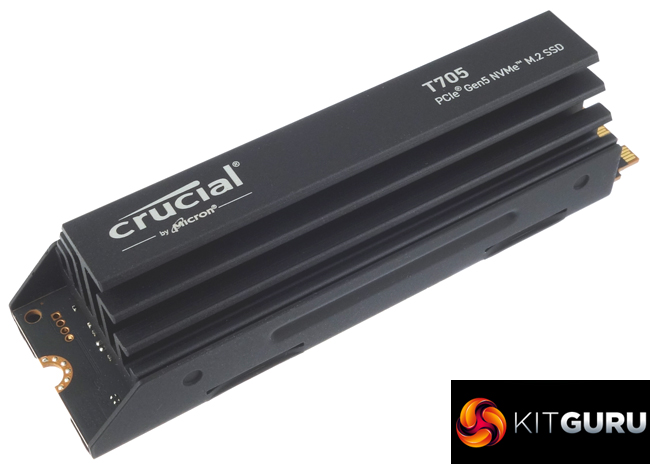
At launch the T705 is available in three capacities; 1TB, 2TB and 4TB, and two versions, standard or with a factory-fitted heatsink. A limited edition version fitted with a white heatsink is also available, but only at 2TB. Crucial kindly sent us one of the 2TB standard heatsink models for review.
At the heart of the T705 is a Phison PS5026-E26 8-channel controller which looks after Micron 232-Layer 3D TLC NAND. There's also an LPDDR4 DRAM cache chip, the size of which is based on drive capacity at the ratio of 1GB per 1TB.
Crucial quote Sequential read/write speeds for the range as up to 13,600MB/s and 10,200MB/s respectively for the 1TB drive, up to 14,500MB/s and 12,700MB/s for the 2TB model and up to 14,100MB/s and 12,600MB/s for the flagship 4TB drive.
When it comes to 4K performance the 2TB and 4TB drives are rated as up to 1,550,000 IOPS for reads and up to 1,800,000 IOPS for writes. The 1TB drive is rated as up to 1.400,00 IOPS and up to 1,750,000 IOPS for reads and writes respectively.
Crucial quote an endurance figure for the 2TB model of 1,200TBW with figures of 600TBW for the 1TB drive and 2,400TBW for the flagship 4TB model. The range is backed by a five-year warranty.
Physical Specifications:
- Usable Capacities: 2TB.
- NAND Components: Micron 232-Layer 3D TLC.
- NAND Controller: Phison PS5026-E26.
- Cache: 2GB LDDR4.
- Interface: PCIe Gen 5 x4, NVMe 2.0.
- Form Factor: M.2 2280.
- Dimensions: 80 x 22 x 21mm.
- Drive Weight: 48 g.
Firmware Version: PACR5111.