KitGuru KitGuru.net – Tech News | Hardware News | Hardware Reviews | IOS | Mobile | Gaming | Graphics Cards


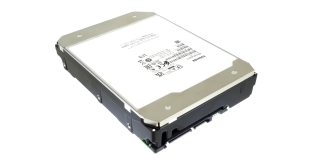
Toshiba's MG series of hard drives have been designed for the enterprise market segment. The latest addition to the top end of the range is the MG10AFA22TE, the new 22TB flagship drive taking over that mantle from the 20TB MG10ACA20TE.
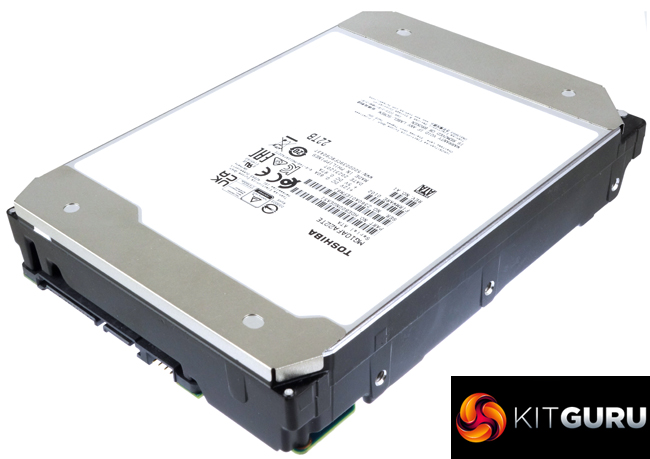
Toshiba's MG10AFA22TE uses the company's fourth-generation ten-disk / twenty-head helium-sealed platform together with Conventional Magnetic Recording(CMR) and FC-MAMR (Flux-controlled microwave-assisted magnetic recording) technologies to improve performance and capability. It has a spindle speed of 7,200rpm and a 512MB cache.
The first spec sheet for the drive we came across had the transfer speed of the drive noted down as n/a but after a quick search around the Toshiba site, we came across another spec sheet that was quoting a rating of 271MB/s for the drive so we went with that.
The official power consumption figure for the 22TB drive is 9.8W. The previous 20TB Toshiba MG10 (MG10ACA20TE) had official power figures of 8.11W when operating (Random 4K read/write) and 4.38W in active idle so the new drive is a little more power-hungry.
Toshiba quotes a workload figure of up to 550TB/year for the 22TB drive and backs it with a 5-year warranty.
Physical Specifications:
- Usable Capacities: 22TB.
- Spindle Speed: 7,200rpm.
- No. Of Heads: 20.
- No. Of Platters: 10.
- Cache: 512MB.
- Recording Method: Conventional Magnetic Recording (CMR) / FC-MAMR (Flux-controlled microwave-assisted magnetic recording).
- Interface: Serial ATA (SATA) 6Gb/s (SATA III)
- Form Factor: 3.5in
- Dimensions: 101.85 x 26.1 x 147.0mm.
- Drive Weight: 720g.
Firmware Version: 0102