KitGuru KitGuru.net – Tech News | Hardware News | Hardware Reviews | IOS | Mobile | Gaming | Graphics Cards


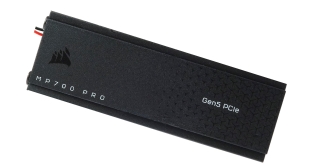
Corsair was one of the early birds to market with a PCIe Gen 5 drive in the shape of the MP700. Now we have the next chapter in the story, the MP700 PRO, offering faster performance than the original MP700. We test the 2TB model, priced at £335 here in the UK.
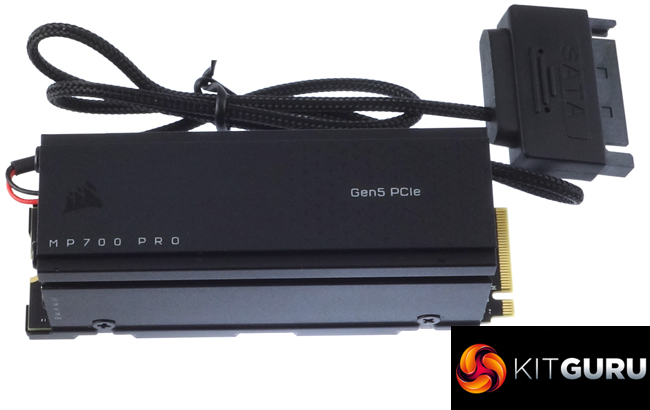
At launch the MP700 PRO comes in just two capacities; 1TB and 2TB but in three versions, a plain drive, air-cooled (Corsair kindly provided the 2TB version to us for review) and one with a waterblock fitted (2TB version only at time of writing). The drive uses a combination of Phison's PS5026-E26 8-channel controller and 232-layer Micron TLC NAND and there's also 4GB of DRAM (DDR4-4266) cache.
Officially the 2TB drive is rated as up to 12,400MB/s and 11,800MB/s for Sequential read & writes respectively while the 1TB drive has figures of up to 11,700MB/s for reads and up to 9.600MB/s for writes.
Random performance for the 2TB drive is quoted as up to 1,500,000 IOPS for reads and up to 1,600,000 IOPS for writes. The 1TB drive is slower at up to 1,400,000 IOPS (reads) and up to 1,500,000 IOPS (writes).
Corsair gives power consumption figures for the drives as up to 11W for the 1TB drive and 11.5W for the 2TB for average active read/writes. Endurance for the drives is quoted as 700TBW for the 1TB drive and 1400TBW for the 2TB model. Corsair backs the drive with a 5-year warranty.
Physical Specifications:
- Usable Capacities: 2TB.
- NAND Components: 232-layer Micron B58R TLC NAND.
- NAND Controller: Phison PS5026-E26.
- Cache: 4GB DDR4-4266MHz.
- Interface: PCI-e Gen5 x 4, NVMe 2.0.
- Form Factor: M.2, 2280.
- Dimensions: 80 x 24 x 30mm.
- Drive Weight: 97g.
Firmware Version: EQFM22.1