KitGuru KitGuru.net – Tech News | Hardware News | Hardware Reviews | IOS | Mobile | Gaming | Graphics Cards


Intel has confirmed that the Ice Lake-SP 3rd Gen Xeon processors will go into mass-production in Q1 2021. Additionally, Intel has shared a few more details about the upcoming server processors, while also claiming that they are faster than the 64-core EPYC Rome processors at certain workloads.
The Intel Ice Lake-SP architecture will power the 3rd Gen Xeon processors. This new processor architecture will be based on Intel's 10nm process node and feature up to 32 Sunny Cove cores, offering better performance per core than its predecessors, and 8x DDR4-3200 channels, increasing the total memory bandwidth.
Ice Lake-SP will support PCIe 4.0, exascale storage for up to 6TB per CPU socket, and Intel Optane PMem. The new platform will also come with “security innovations” such as Intel SGX and crypto acceleration.

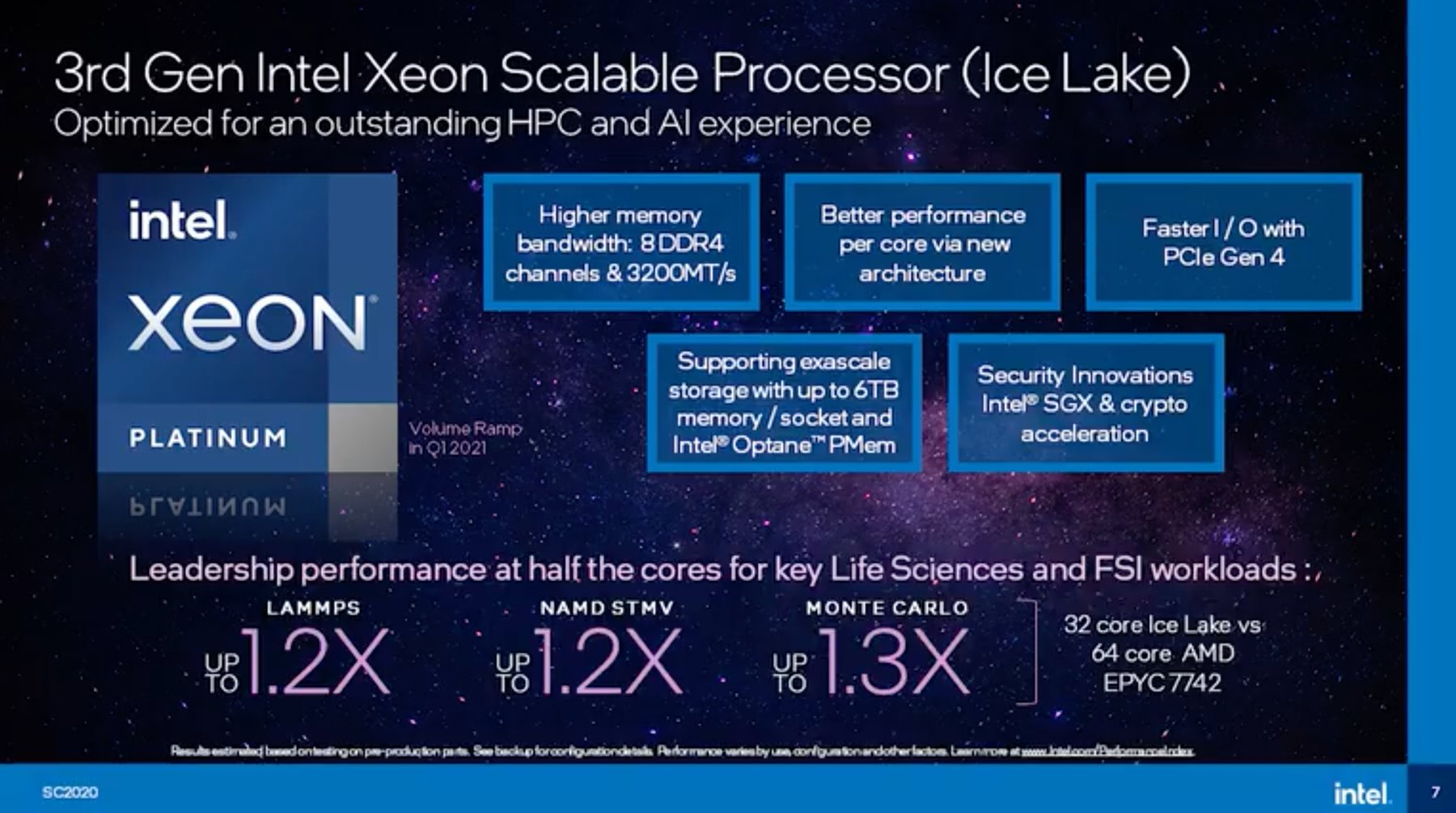
Intel claims that the 32-core Ice Lake-SP offers more performance at half the cores in “key Life Sciences and FSI workloads” when compared to the 64-core EPYC Rome 7742. In LAMMPS and NAMD STMV, Ice Lake-SP offers up to 20% more performance, while in Monte Carlo, the performance difference increases to 30%.
Intel also confirmed that the Ice Lake-SP successor will be based on the 10nm Enhanced SuperFin process node and feature next-gen Intel DL Boost. The Sapphire Rapids processors are already being “broadly” sampled by customers.
KitGuru says: Are you thinking about building a new workstation with the upcoming Ice Lake-SP processors? Do you expect these new Xeons to rival EPYC Rome processors?