KitGuru KitGuru.net – Tech News | Hardware News | Hardware Reviews | IOS | Mobile | Gaming | Graphics Cards


Asetek has just announced the first slot-in PCIe radiator card. The Rad Card is a GPU cooler and Asetek's solution to liquid-cooling GPUs in PC cases with limited space. The first PC to actually use a Rad Card will be the recently announced Alienware Aurora R11 PC.
While many consumers may not have heard of Asetek, the company produces a wide range of coolers for a number of big brands, including Fractal Design, Thermaltake and NZXT. With the Rad Card, the company is tackling the problem of mounting liquid cooling solutions in space-constrained PC cases, which would typically leave air cooling as the only possible way to cool the GPU.
By designing a new solution from the ground up, Asetek created the Rad Card GPU cooler by reimagining “the shape and location of the radiator”. Using a PCIe interface on the motherboard, Asetek has solved the space concerns traditionally associated with a typical “liquid cooled GPU heat exchanger (HEx)”.
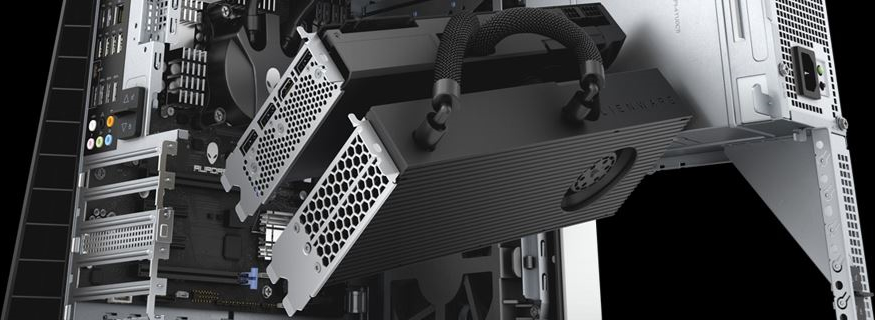
Asetek claims the Rad Card GPU cooler can offer a number of benefits, including enough space to fit both the Rad Card and a liquid-cooled CPU solution in the same system, superior cooling capabilities comparing to air cooling solutions, while it can also reduce the “hassle and clutter of tube routing for a clean and sparse system environment”.
According to the results shared by Asetek, when applying this cooling solution to an Nvidia RTX 2080 Super in the Alienware Aurora R11 PC, it results in up to 69% less noise and reduces GPU temperatures by up to 20%.
So far, the Rad Card has been confirmed for OEM partners only. Asetek hasn't confirmed that the Rad Card cooler will be available for the DIY PC market.
Discuss on our Facebook page HERE.
KitGuru says: Would you use a Rad Cooler in your case?