KitGuru KitGuru.net – Tech News | Hardware News | Hardware Reviews | IOS | Mobile | Gaming | Graphics Cards


The latest drive to join Seagate's IronWolf Pro family of hard drives is the new flagship 30TB model. Designed for use in multi-bay commercial and enterprise RAID solutions, the IronWolf Pro comes with a feature set which includes HAMR (Heat-Assisted Magnetic Recording).
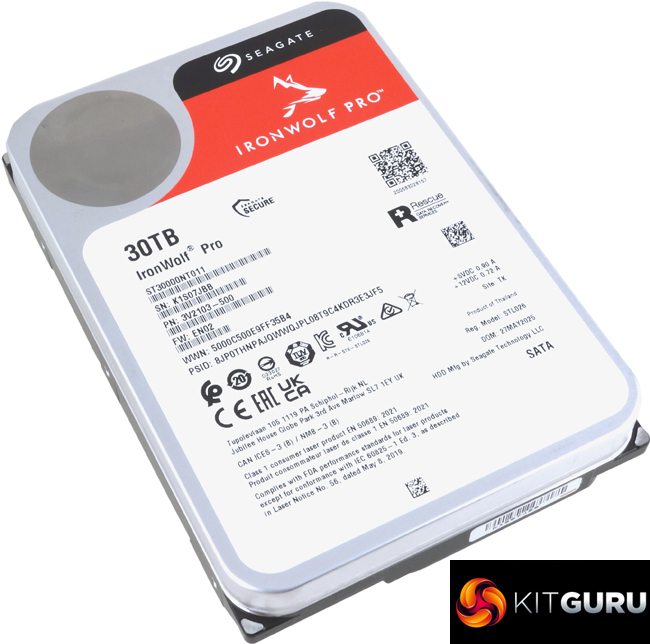
Seagate's flagship 30TB IronWolf Pro (ST30000NT011) is a CMR (Conventional Magnetic Recording) drive using Helium technology, but to achieve the high areal density of the platters, it also employs Seagate's HAMR (Heat-Assisted Magnetic Recording). Seagate has managed to cram 10 3TB platters and 20 heads into a 3.5-inch format drive with a height of just 26.11mm. The drive has a spindle speed of 7,200rpm and uses 512MB of cache. Seagate quotes an official maximum transfer rate of 275MB/s while the average latency is quoted at 4.16ms.
Seagate quotes power ratings for the 30TB IronWolf Pro as 8.3W for average operating (which is only 0.6W more than the last IronWolf Pro we looked at, the 20TB model) and 6.8W average idle. For standby and sleep, the drive is rated at 1.2W.
The official workload rating of the drive is 550TB/year with an MTBF of 2.5M hours, and Seagate backs the drive with a 5-year warranty.
Physical Specifications:
- Usable Capacities: 30TB.
- Spindle Speed: 7,200rpm.
- No. Of Heads: 20.
- No. Of Platters: 10.
- Cache: 512MB.
- Recording Method: Conventional Magnetic Recording (CMR) / HAMR (Heat-Assisted Magnetic Recording).
- Interface: Serial ATA (SATA) 6Gb/s (SATA III).
- Form Factor: 3.5in.
- Dimensions: 26.11 x 101.85 x 146.99mm.
- Drive Weight: 695g.
- Firmware Version: EN02.