KitGuru KitGuru.net – Tech News | Hardware News | Hardware Reviews | IOS | Mobile | Gaming | Graphics Cards


M.2 SSDs are fast and compact but unfortunately in a high-end rig, they can get hot, which can have an adverse effect on performance. We have already seen some motherboard makers start to integrate M.2 SSD coolers into their design but if you happen to have a board that doesn't support this, there are now some more options available. Today. Alphacool is launching the Eisblock HDX 2 and HDX 3 M.2 SSD coolers.
These new blocks come with a 4x PCIe card, so you can mount the SSD and cooler to a separate card, rather than directly to the motherboard. The reason for this is that cooling directly to the motherboard can be tougher due to space limitations, as well as the location of graphics cards.
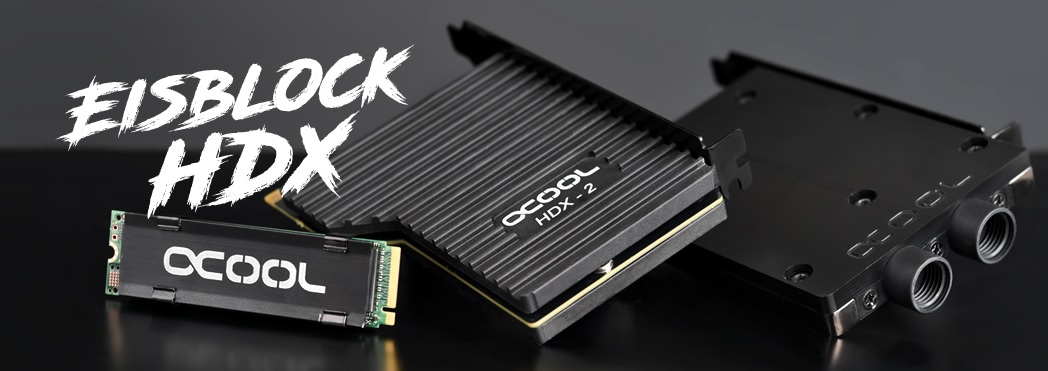
Moving your M.2 SSD onto a PCIe card with a better cooler is a good solution for tackling throttling too. Sometimes when an SSD is doing a lot of data transfers, heat can cause them to throttle performance. On top of that, the 4x PCIe connection allows for faster transfer speeds overall, with a maximum data transfer limit of around 3900 MB/s. This is a significant jump from the 640 MB/s transfer rate over a standard SATA connection.
The HDX-2 is a passive cooler with thicker aluminium fins. However, the HDX-3 is built for water cooling, allowing you to easily hook it up to a custom loop via a G1/4″ connection. The water block itself uses nickel-plated copper and is made from a single acetal block, so water will flow over the entire SSD.
Both the Eisblock HDX 2 and HDX 3 are available via aquatuning. The HDX 2 is priced at $40.95, meanwhile the HDX 3 is $84.03.
KitGuru Says: How many of you currently use an M.2 SSD? Do you ever find it throttling from time to time?