KitGuru KitGuru.net – Tech News | Hardware News | Hardware Reviews | IOS | Mobile | Gaming | Graphics Cards


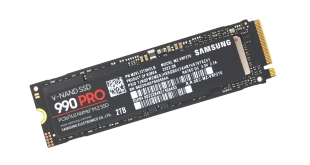
Samsung's latest flagship SSD for the consumer space is the 990 Pro, taking over from the previous high-end drive, the SSD 980 Pro. The new Gen 4 drive uses the latest in-house Pascal controller and Samsung's 7th generation V-NAND. Today we review the 2TB model, with an MSRP of £283.99.
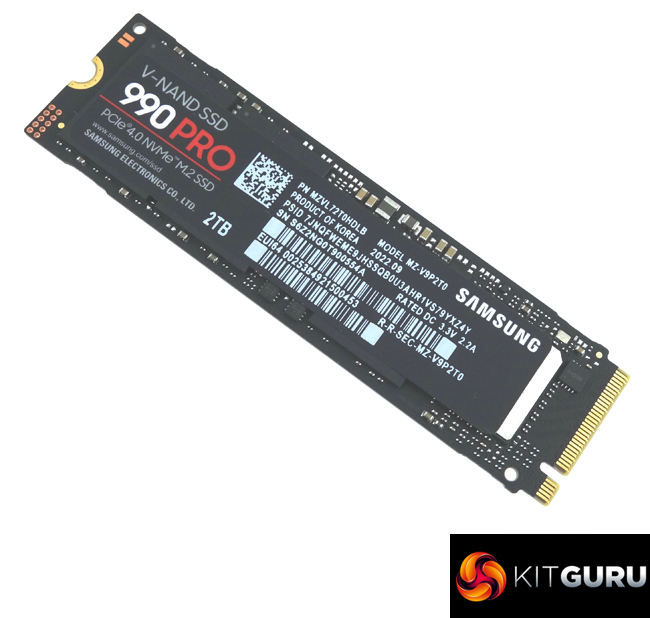
At launch the 990 Pro comes in just two capacities; 1TB and 2TB and two versions, a plain drive or a heatsink-equipped model. A 4TB non-heatsink flagship model will be along sometime in 2023. The standard drive has a copper heat spreader built into the label on the back of the drive to help dissipate heat. The heatsink version of the drive gives more thermal control.
The drive uses a combination of Samsung's latest Pascal controller and the company's 176-layer 3-bit MLC (TLC) V-NAND. Sequential performance for the two capacities is quoted as up to 7,450MB/s for reads and up to 6,900MB/s for writes.
Samsung supplies two sets of 4K random read/write figures for the drive at Queue Depths 1 (1 thread) and 32 (16 threads). At QD1 the 2TB drive is rated up to 22.000 IOPS for reads and up to 80,000 IOPS for writes. At QD32 these figures rise to 1,550,000 IOPS for reads and up to 1,400,000 IOPS for writes. The 1TB drive has the same figures with the exception of the 4K write performance at QD32 where it is rated at 1,200,000 IOPS.
Power wise the 2TB drive is rated at 8.5W maximum and 5.5W average for active use. 55mW for idle and 5mw in sleep mode.
Samsung quotes endurance figures of 600TBW for the 1TB drive and 1,200TBW for the 2TB model and back the range with a 5-year warranty.
Physical Specifications:
- Usable Capacities: 2TB.
- NAND Components: Samsung 176-layer V-NAND.
- NAND Controller: Samsung Pascal.
- Cache: 2GB LPDDR4
- Interface: PCIe Gen 4.0 x4, NVMe 2.0.
- Form Factor: M.2, 2280.
- Dimensions: 80 x 22 x 2.3mm.
Firmware Version: 02BQJXD7.