KitGuru KitGuru.net – Tech News | Hardware News | Hardware Reviews | IOS | Mobile | Gaming | Graphics Cards


An Intel roadmap for 2023 and beyond has been leaked, revealing updates for the 18th week of the year, from May 1st to May 7th. Although most of it is covered, the updated roadmap confirms the cancellation of a specific Meteor Lake-S processor for the desktop we've heard about in previous leaks.
For quite some time, there have been speculations about the cancellation of the Meteor Lake-S chip with 6P+8E cores, with rumours pointing to a replacement in the form of an Arrow Lake die with the same configuration. If the updated roadmap shared by @OneRaichu is accurate, it validates those earlier rumours.
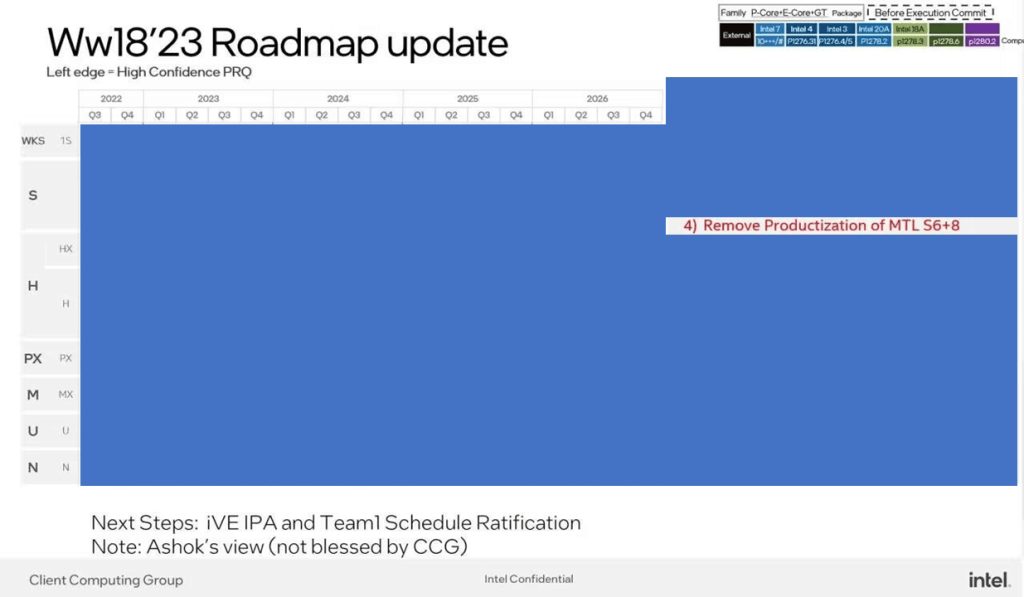
Image credit: @OneRaichu
Unfortunately, the remaining details on the roadmap are concealed. As such, there are still unanswered questions, adding to the confusion surrounding the next-generation Core series. If the roadmap details weren't hidden between 2023 and 2026, it could've provided valuable insights into Intel's plans for the next few years.
Besides the cancelled Meteor Lake-S part, rumours circulated about Intel potentially preparing a 6P+16E Meteor Lake chip, which would be offered alongside the Arrow Lake-S chip featuring an 8P+16E setup. While the upcoming Core series may not introduce a significant increase in core count compared to Raptor Lake, there will be updates to the core design with a hybrid architecture called Lion Cove and Skymont.
Discuss on our Facebook page, HERE.
KitGuru says: If Intel still produces a 6P+16E die, there's still a chance that a 6P+8E CPU will come out.