KitGuru KitGuru.net – Tech News | Hardware News | Hardware Reviews | IOS | Mobile | Gaming | Graphics Cards


The Windows operating system continues to dominate the PC market, with most commercial applications designed to run on Windows. While there are alternatives available, the widespread usage and compatibility of Windows make it the logical choice for most users. Still, Linux enthusiasts have long hoped for the “year of Linux” where Linux gains significant market share and widespread adoption.
Although this dream has not yet materialised, recent data shows that Linux has reached a milestone by surpassing a 3% market share on desktops 30 years after its release. This represents the highest market share Linux has ever achieved, with OSes based on the Linux kernel now accounting for 3.07% of the overall market.
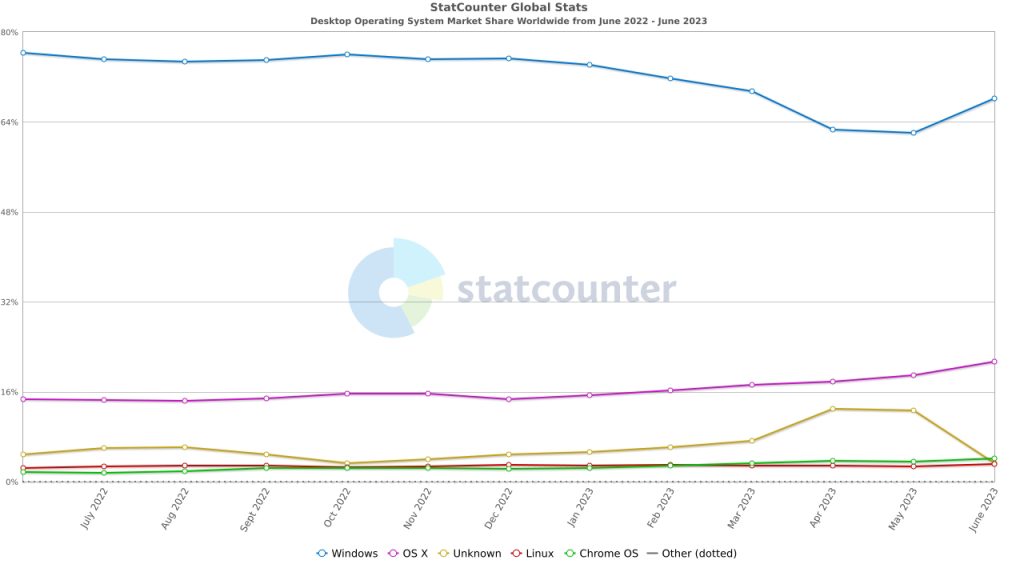
Image credit: StatCounter
According to survey data conducted by StatCounter, Windows remains the dominant operating system, with a market share of 68.23%. Apple's macOS (formerly OS X) holds a 21.32% share, while Google's ChromeOS has a 4.13% share. The category of “unknown OSes” holds a 3.24% share, which includes alternative operating systems based on the BSD kernel and others.
It is important to note that the launch of the Steam Deck, which uses SteamOS 3.0, may have had an impact on the recent increase in Linux adoption. For those who don't know, the latest version of SteamOS is based on Arch Linux.
Discuss on our Facebook page HERE.
KitGuru says: Do you have a desktop running a Linux-based OS? What do you use it for?