KitGuru KitGuru.net – Tech News | Hardware News | Hardware Reviews | IOS | Mobile | Gaming | Graphics Cards


G.Skill and ASRock have teamed up to achieve a new world record for DDR5 overclocking, pushing a single 24 GB Trident Z5 CK RGB module to a mind-bending 12,666 MT/s.
Led by renowned overclocker Splave, the team braved the depths of liquid nitrogen cooling to achieve this incredible feat. Using a combination of cutting-edge hardware and expert tuning, they managed to push the DDR5 module far beyond its rated speed, setting a new benchmark for memory performance.
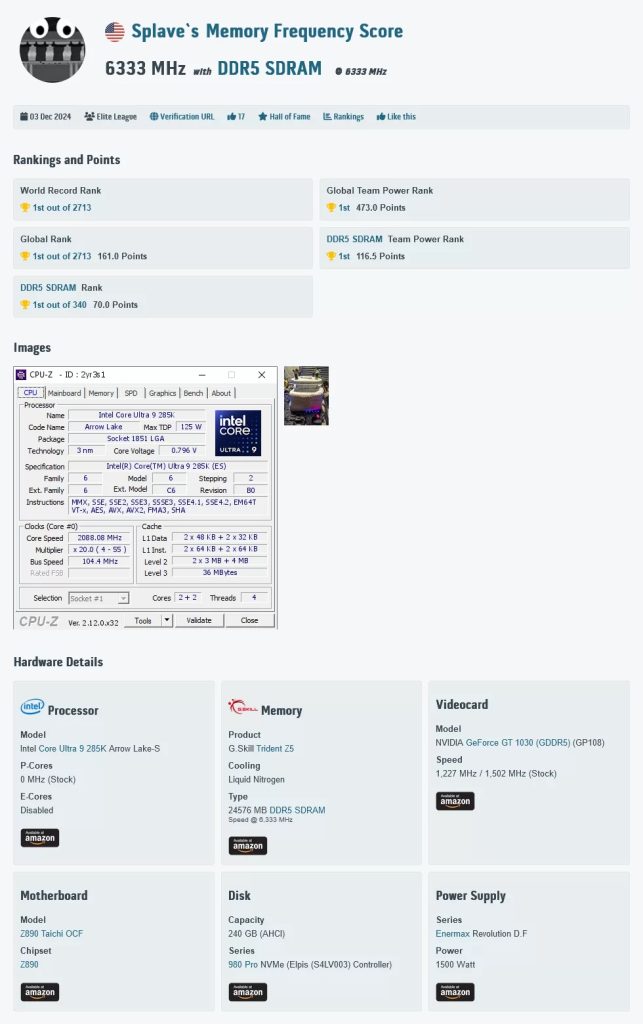
The record-breaking setup (CPU-Z) included an Intel Core Ultra 9 285K CPU, an ASRock Z890 Taichi OCF motherboard (chosen for its support for high memory speeds and enhanced stability with only two DIMM slots), and the star of the show, a G.Skill Trident Z5 CK RGB module. To maximise stability, the team downclocked the CPU to 2.1 GHz and limited it to just four cores (2P + 2E).
The Trident Z5 CK RGB module itself is built with CUDIMM technology, a new type of DDR5 that uses a Client Clock Driver (CKD) to enhance signal integrity and unlock higher frequencies. While this module is already capable of reaching DDR5-9600 out of the box, the overclocking headroom provided by CUDIMM allowed Splave and the team to shatter the previous record (DDR5-12635 by snakeeyes).
Discuss on our Facebook page, HERE.
KitGuru says: We've seen the DDR5 memory speed world record be broken quite a few times lately. As things stand, we wouldn't be surprised if there were a couple more record-breaking entries coming out before the year ends.