KitGuru KitGuru.net – Tech News | Hardware News | Hardware Reviews | IOS | Mobile | Gaming | Graphics Cards


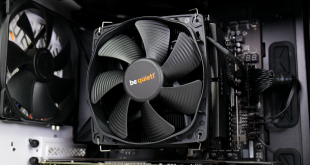
Small Form Factor (SFF) systems are just as popular as ever, yet the CPU cooling challenges remain. In a market where small AIO coolers tends to dominate, be quiet! is aiming to mix things up with the newly released Dark Rock TF 2 down-draft style air cooler. Can this £79.99 unit bear the challenge of an overclocked Ryzen CPU?
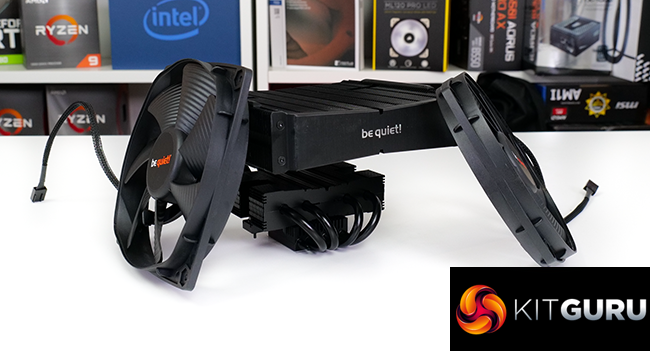
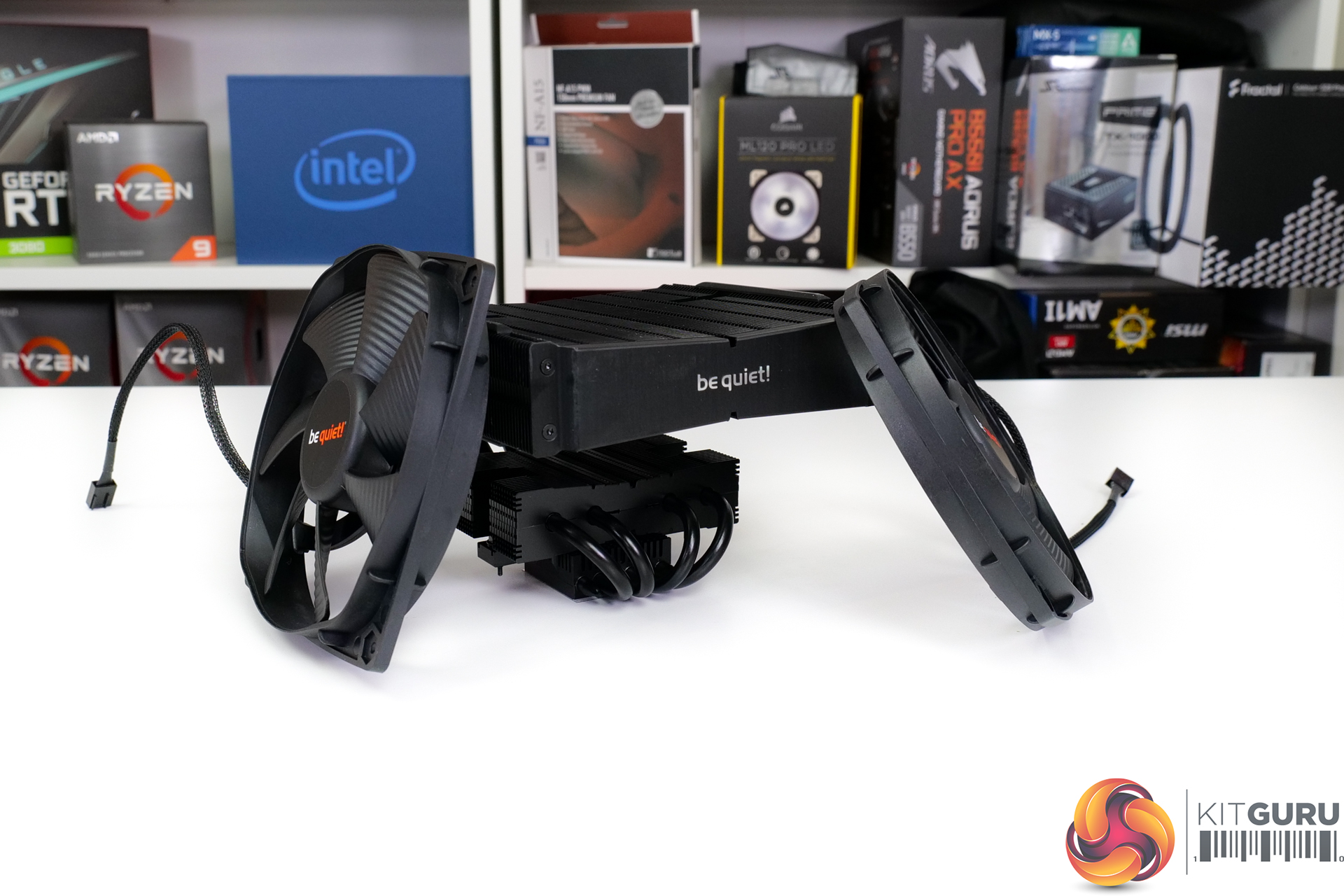
Starting out with a look at the Dark Rock TF 2 heatsink itself, be quiet! has gone for an attractive all black design that is typical of the Dark Rock series of CPU coolers. Every surface is covered in a high-quality matte black coating that be quiet! advertises as containing ceramic particles for enhanced heat transfer. The silver ‘be quiet!’ logo acts as one of the few contrasts from complete darkness.
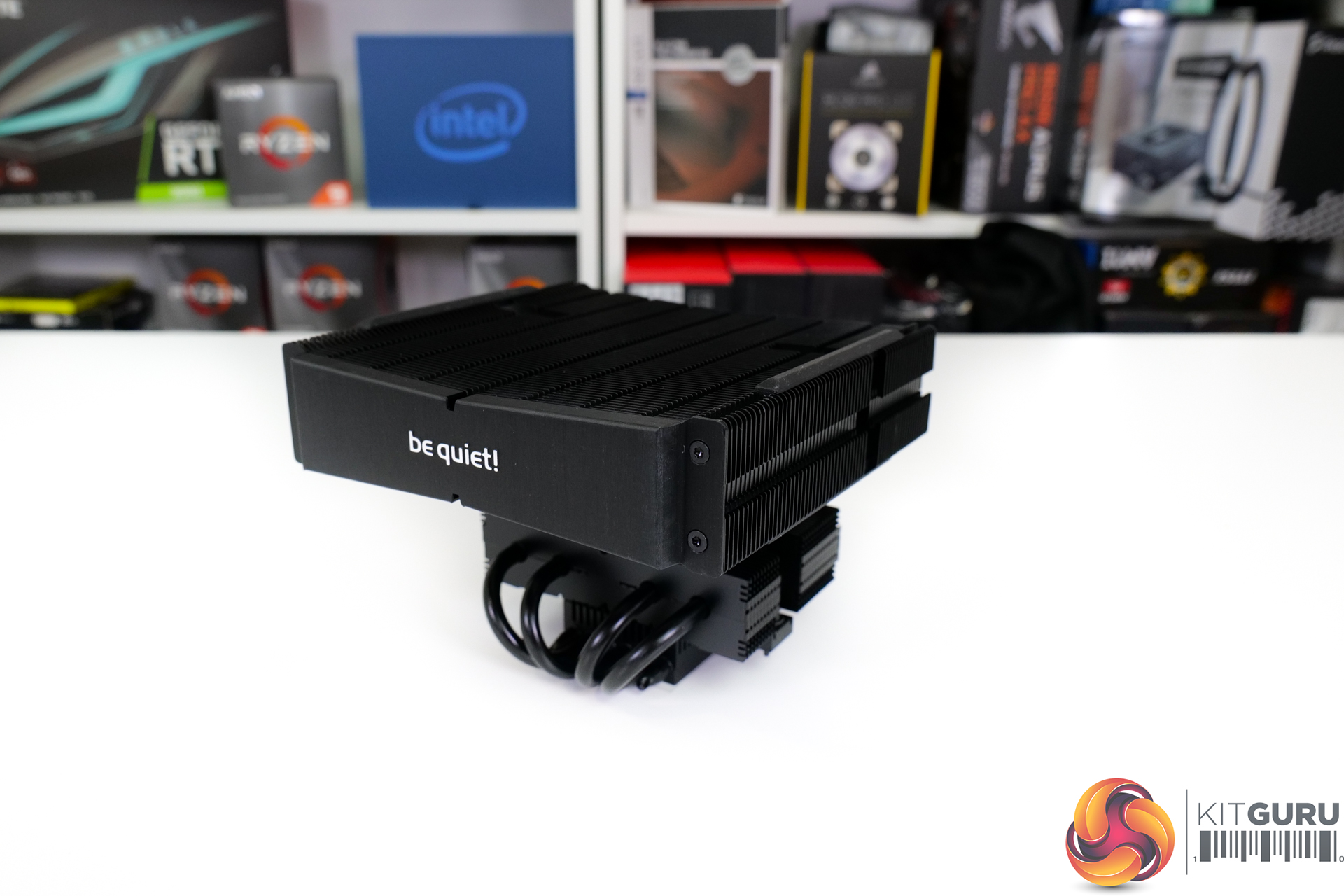
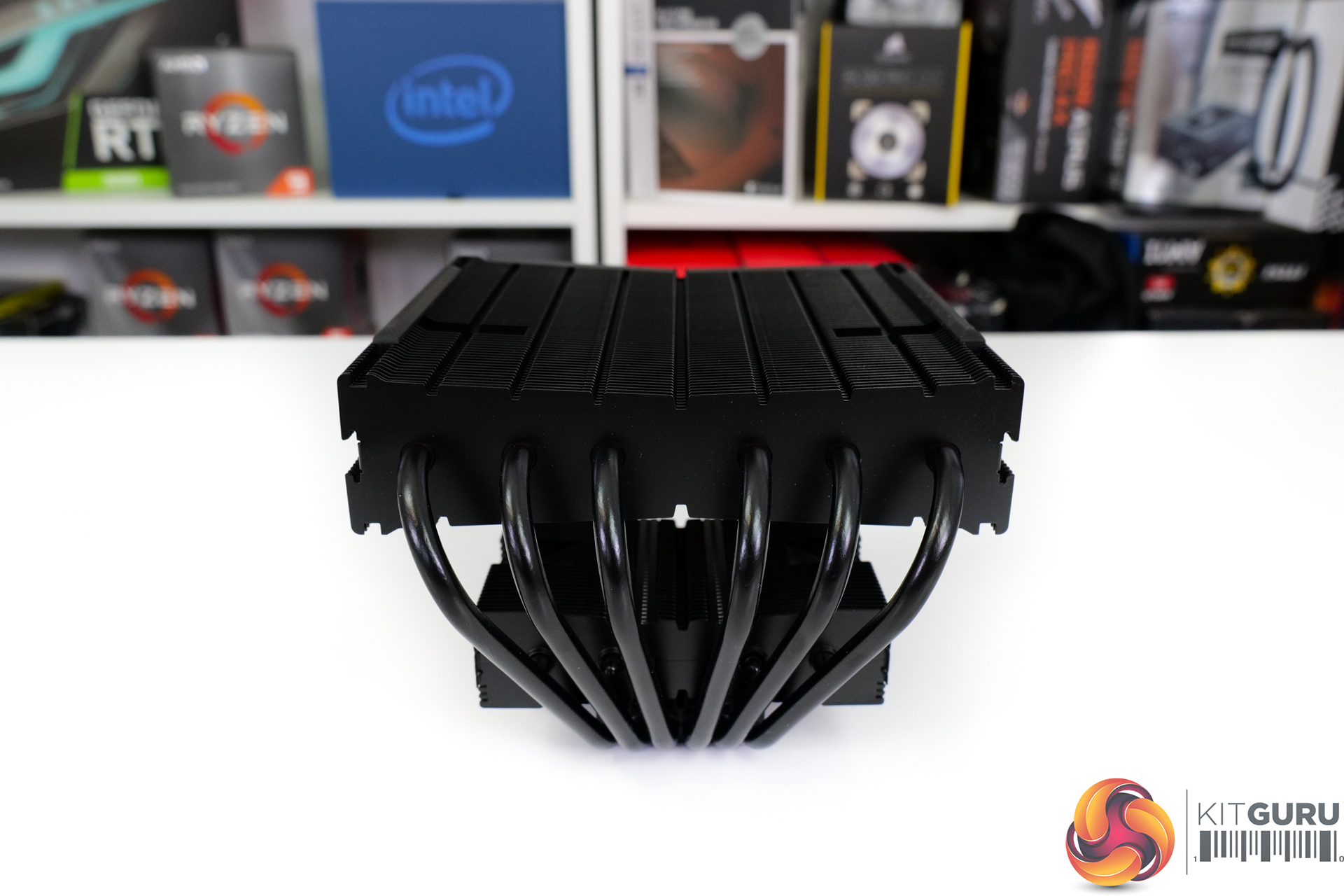
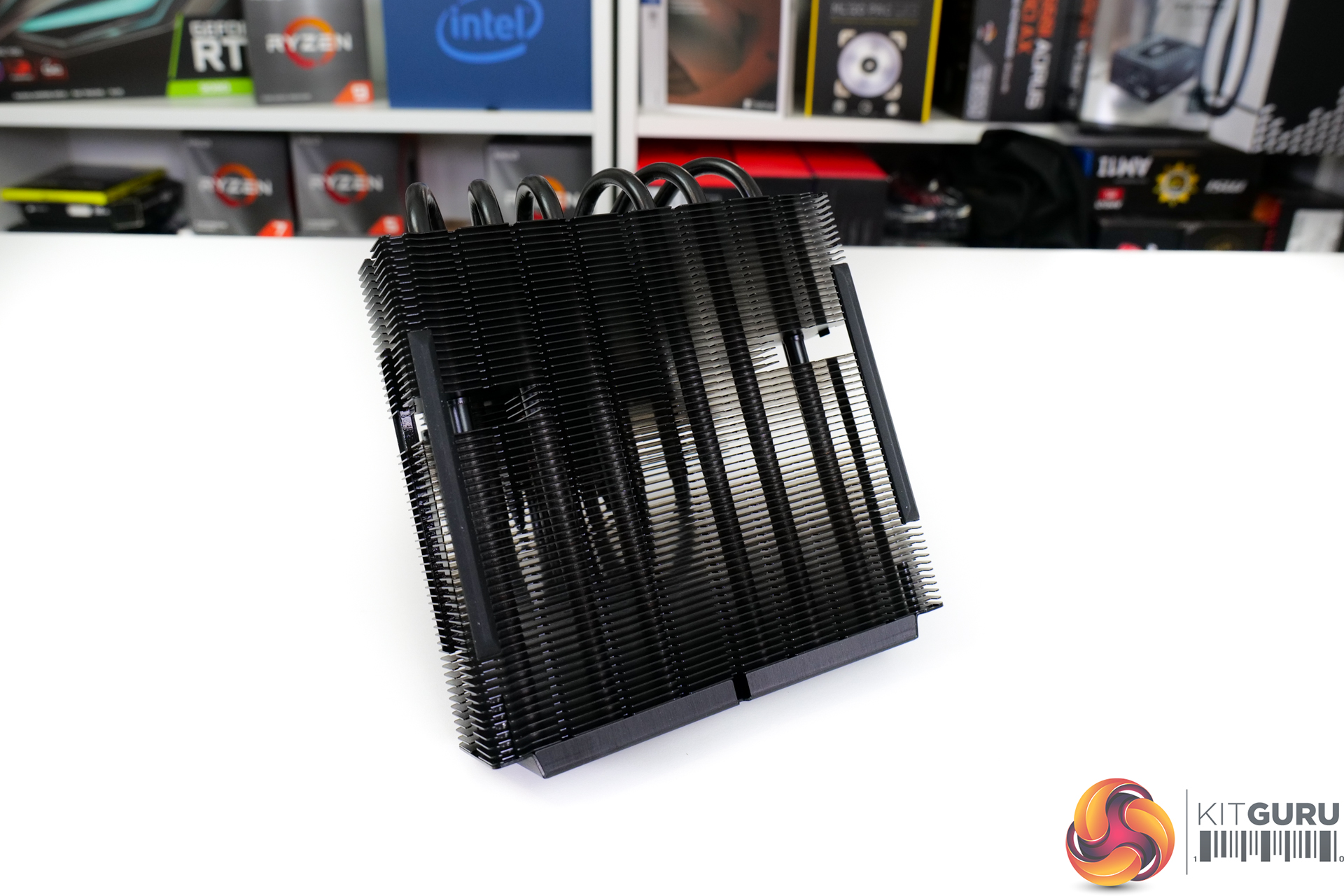
Needless to say, the metal body looks absolutely superb if you like the dark black style of colour. And there is no RGB in sight on this one.
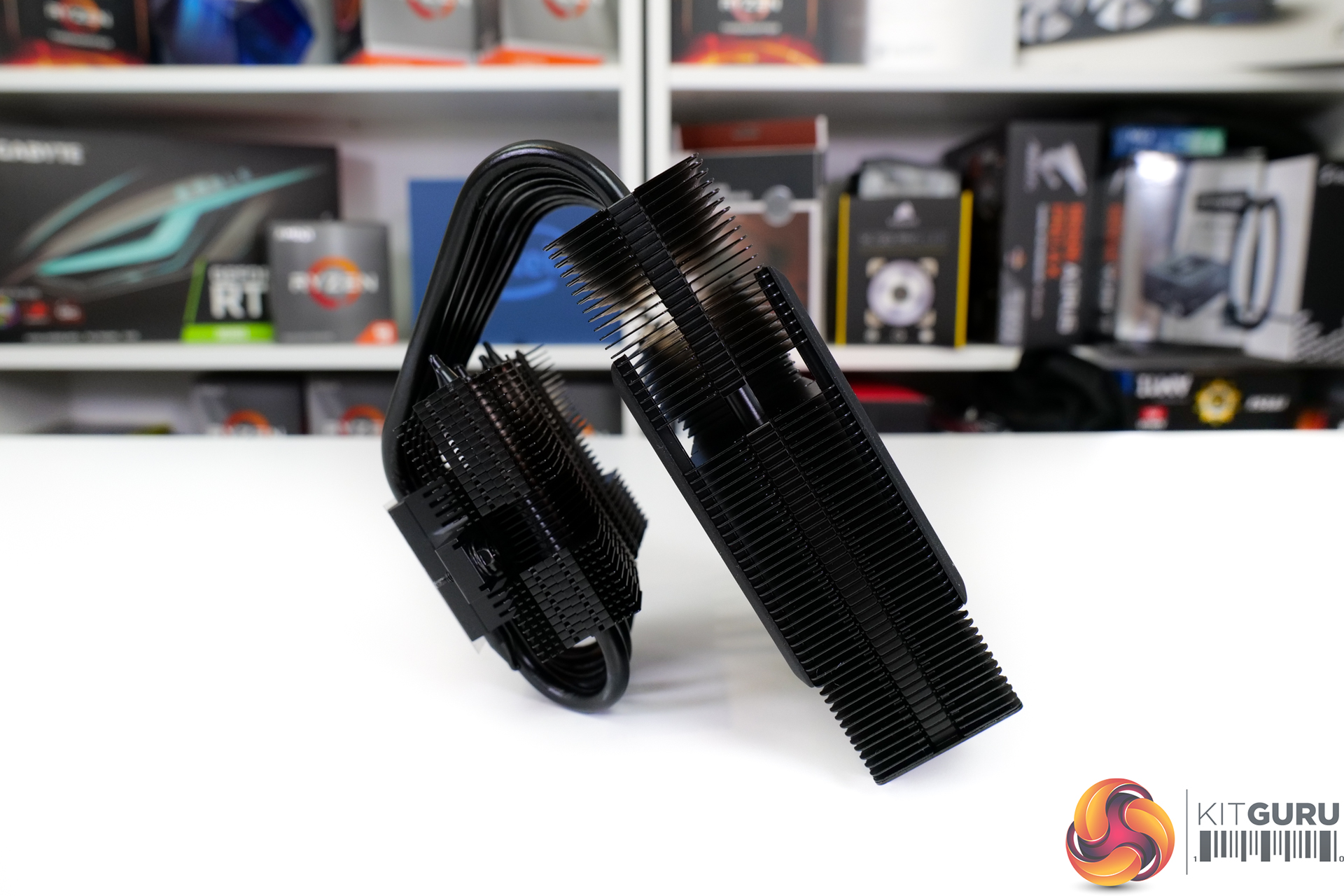
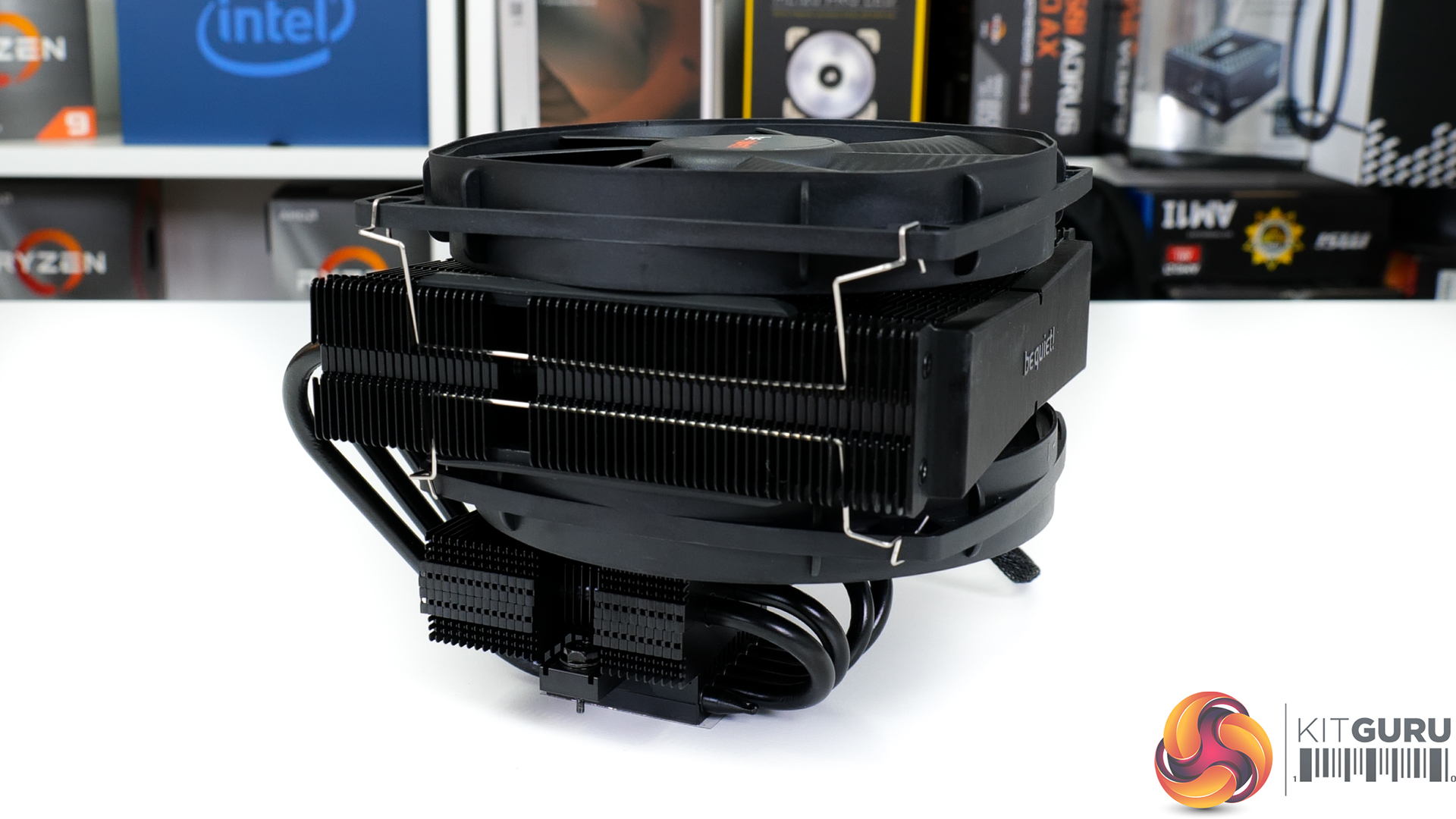
Two individual aluminium fin arrays form the Dark Rock TF 2 heatsink. The larger of these two heatsinks sits above the smaller section that is positioned just above the cooler’s base structure. Effectively, this means that hot coolant air exiting the top heatsink will also be forced through the smaller, lower heatsink thus limiting its cooling abilities.
The top array is comprised of 62 aluminium fins while the bottom uses 64 fins. Without fans attached, the heatsink dimensions are 163mm length by 140mm width with a height of 109mm.
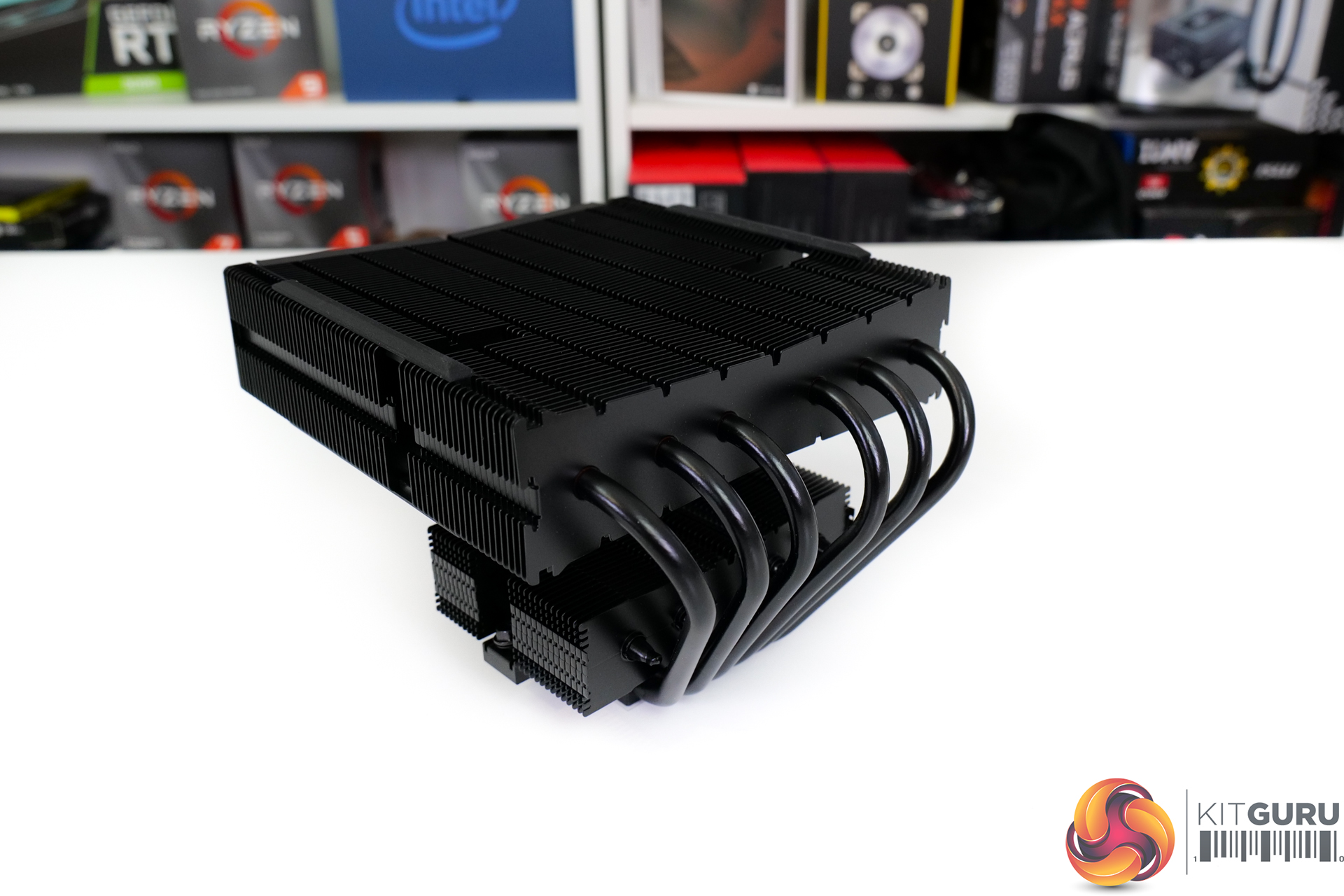
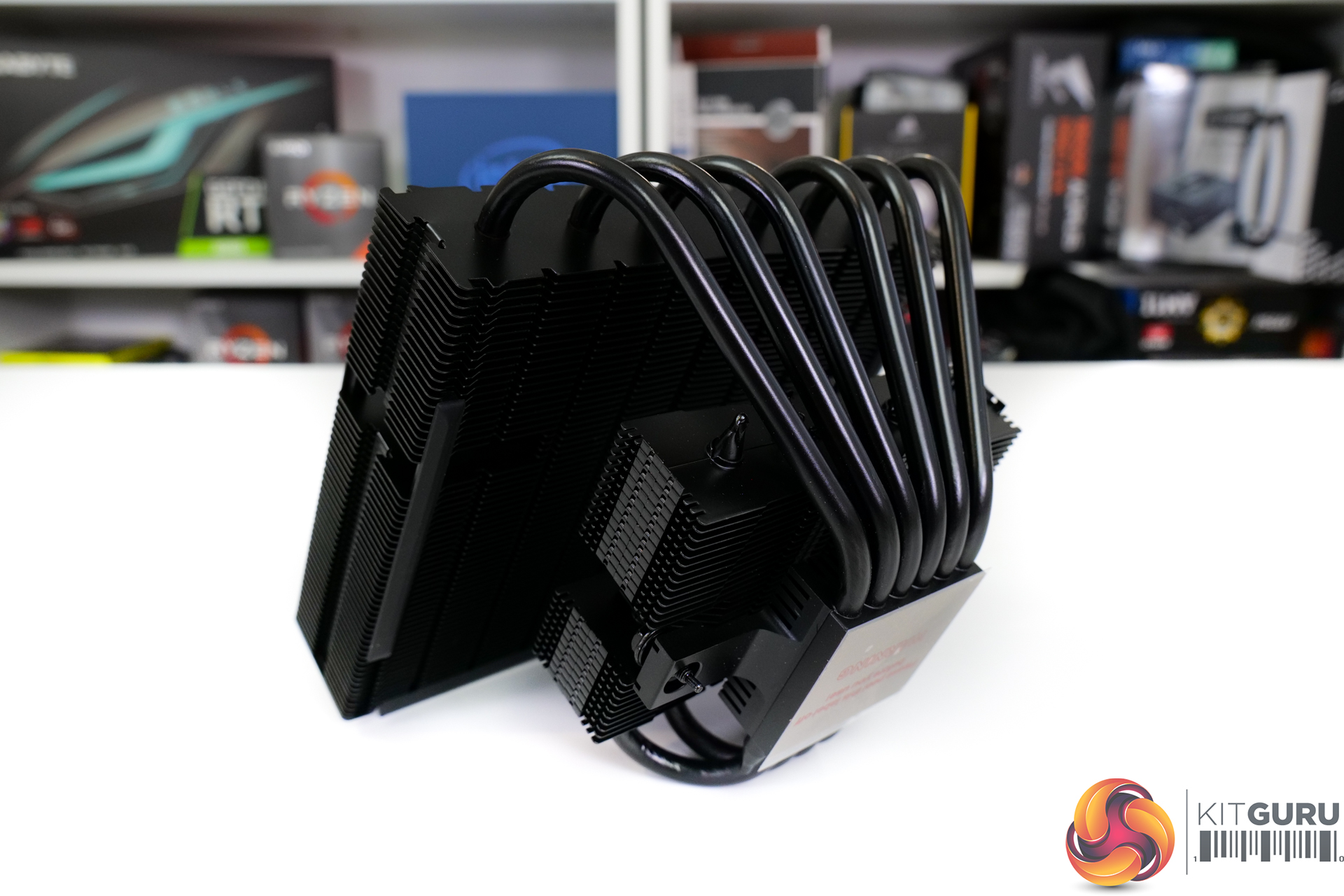
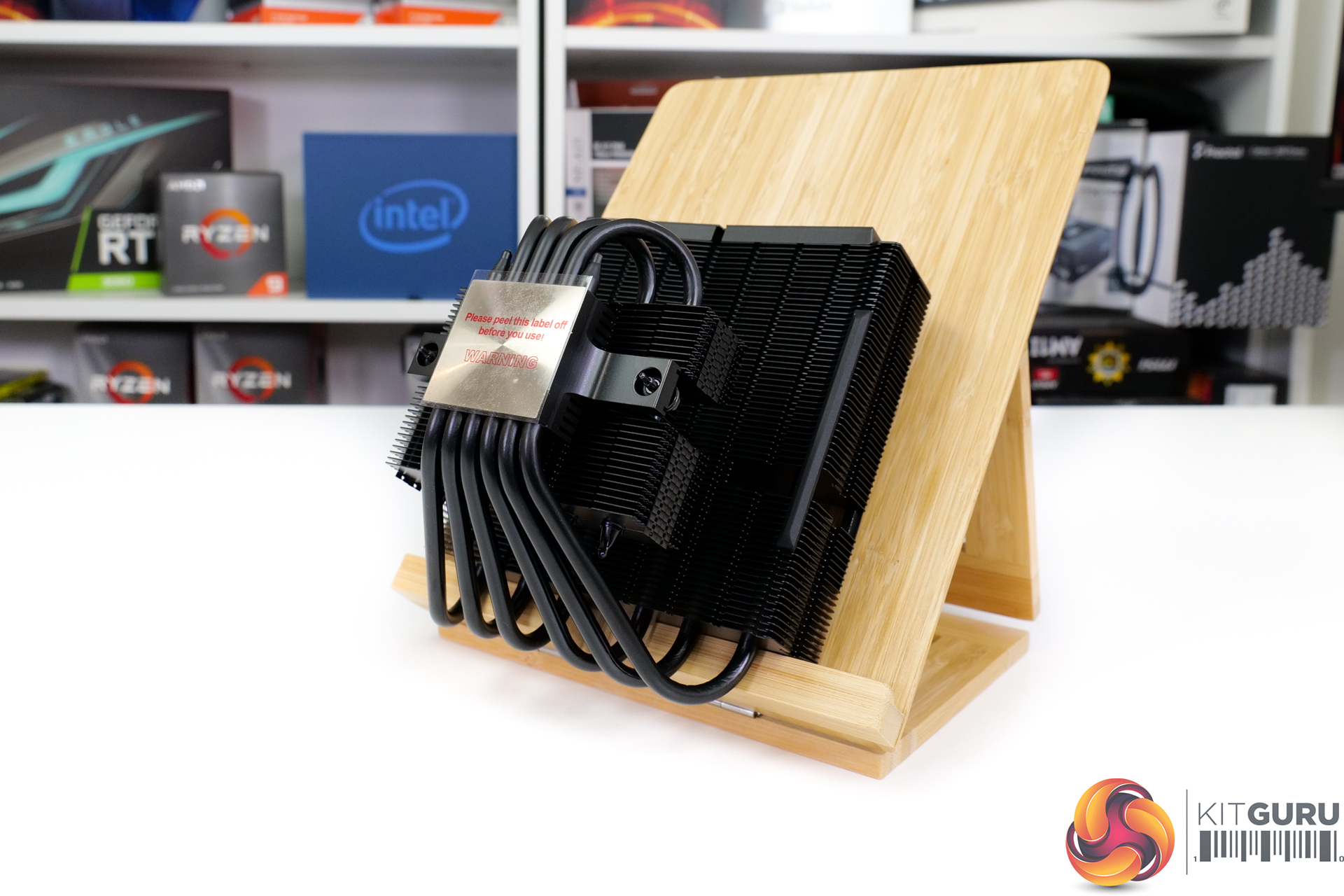
Running through the dual aluminium fin arrays are six 6mm copper heatpipes. These heatpipes emanate from the CNC machined, nickel-plated copper base.
Four of the black coated heatpipes exit the base structure to the smaller, lower fin array in one direction and the larger fin array in another. With two additional heatpipes on the outer edges running through to the larger, top-side fin array only.
In essence, there is capacity to transfer greater amounts of heat energy to the larger, uppermost fin array, as we would expect.
be quiet! gives the cooler a TDP rating of 230W. Whilst that may make sense with six 6mm heatpipes and a CNC machine base, the likelihood of the fin arrays supporting such a heat load in a down-draft configuration is highly unlikely. Not that manufacturer TDP cooling numbers mean all that much, anyway.
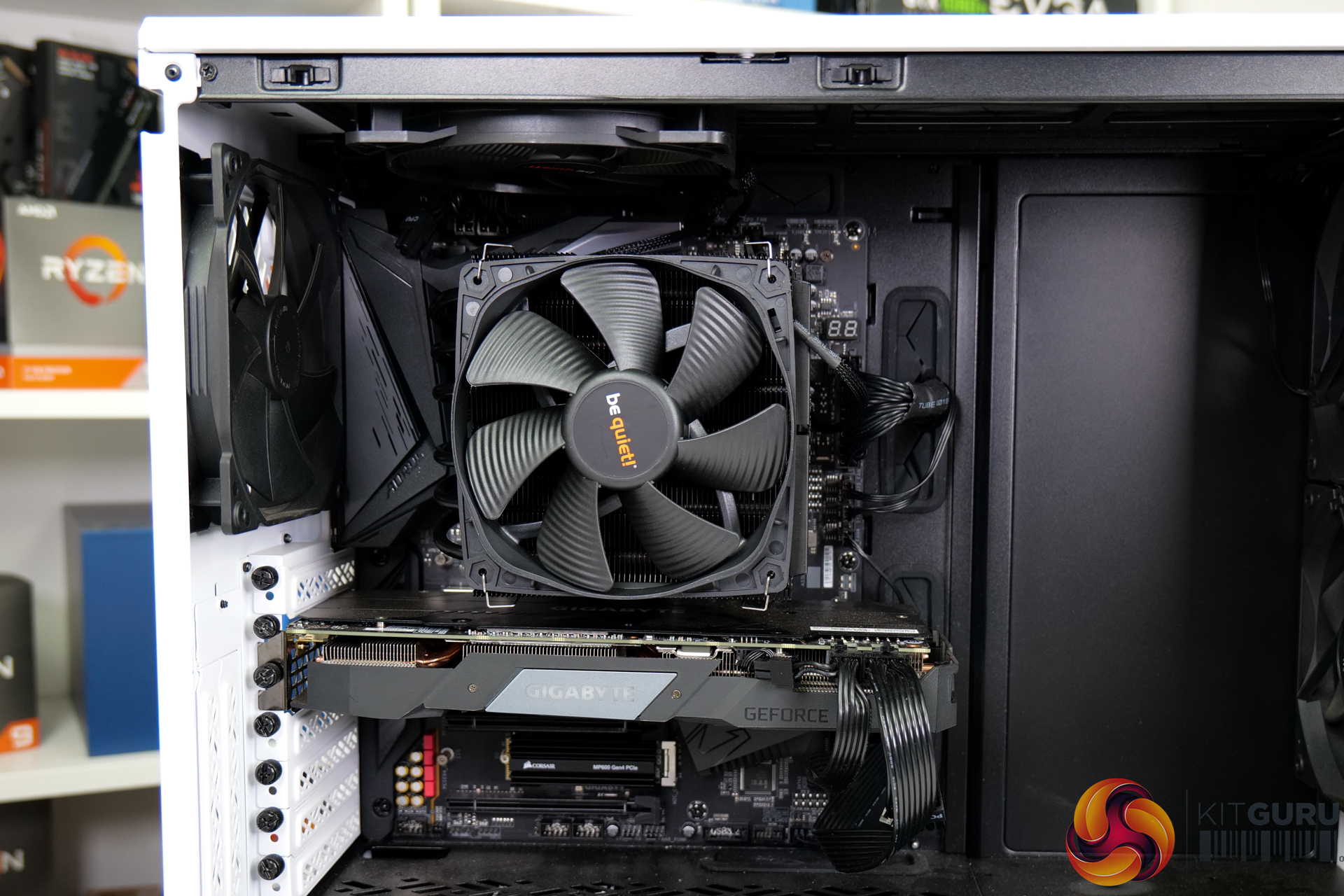
One thing to watch out for with the cooler’s design is the angle of the heatpipes. Particularly with the curvature of the six copper pieces entering the top fin array, interference with nearby components is a possibility. Though this is only likely an issue in really confined cases or with ludicrously sized VRM heatsinks (which some mITX motherboards do sport).
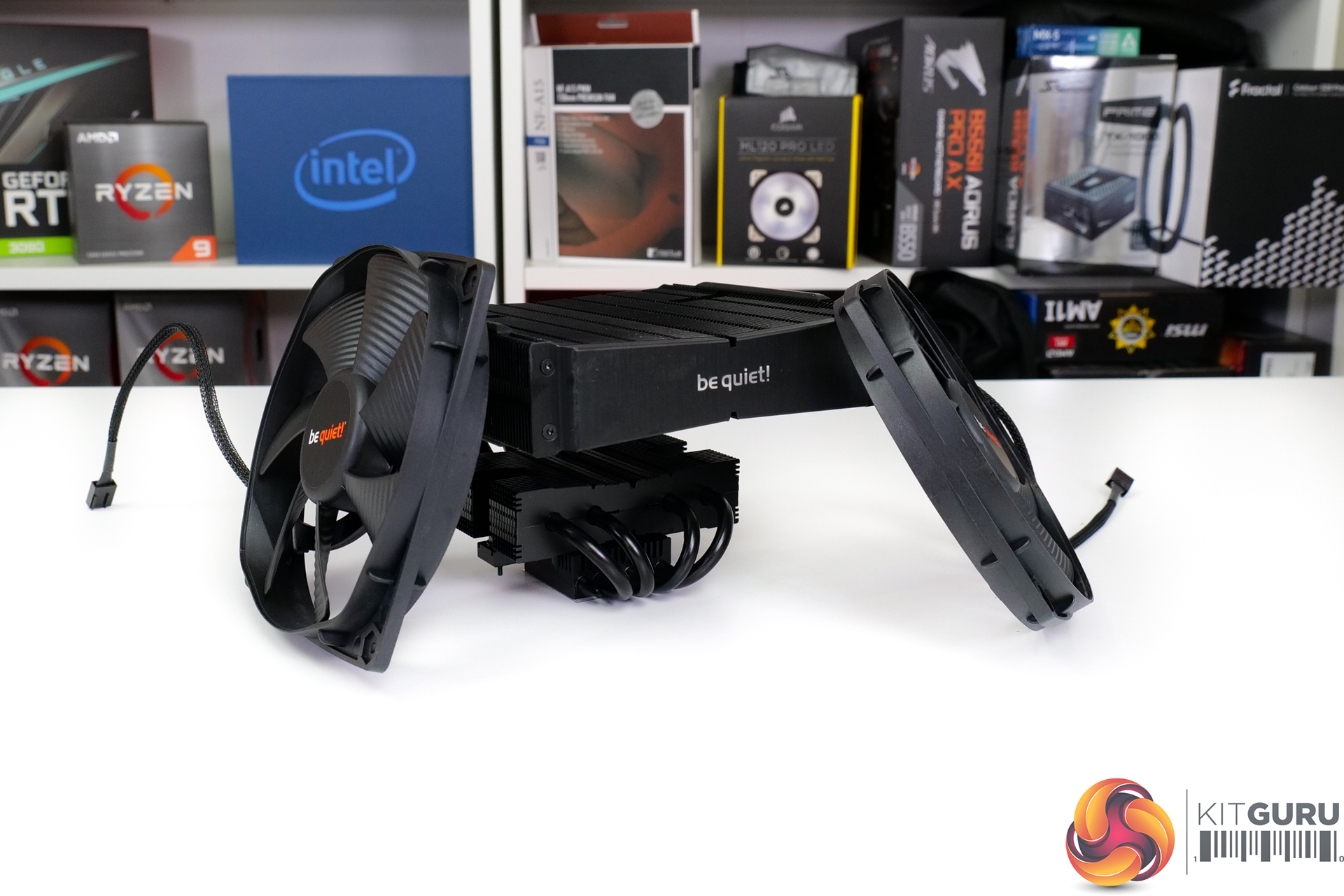
Both fans supplied with the Dark Rock TF 2 are premium models. You get one 135mm Silent Wings PWM fan rated at up to 1400 RPM and one 135mm Silent Wings 3 fan rated at up to 1300 RPM.
These are particularly high-quality fans, but that is to be expected for a CPU cooler with this sort of price tag. Silent Wings 3 PWM are one of my personal favourites sets of fans thanks to their superb balance of performance when tied with low noise output.
With 1300 RPM and 1400 RPM blowers, be quiet! is clearly gunning for low noise operation. With that said, we have previously tested competent 135mm fans in this speed range and found them to offer a very good balance between noise and sufficient cooling performance.
Bearing wise, be quiet! opts for the fluid dynamic variant alongside a 6-pole motor. These combine to give a rated lifespan of 300,000 hours, which is impressive. The 4-pin PWM connection sits at the end of a 220mm-long black, braided cable.
In theory, there is nothing preventing you from not installing the lower fan thereby extending RAM height clearance from 49mm to 73mm. Though we would assume that compatibility with 49mm tall modules makes sense for most users with constricted installation space. Corsair Dominator is unlikely to fit, but more sensibly sized modules likely will.
Total weight of the CPU cooler is 945g, which is not particularly heavy for a high-end, dual-fan unit.
be quiet! attaches a 3-year warranty to the Dark Rock TF 2 which ships at £79.99 or 85,90 Euros.
Specifications and Features (taken from manufacturer webpage):
- Extremely high cooling performance with 230W TDP
- Two heat sinks with anti-vibration rubber inserts
- Six high-performance 6mm heat pipes
- Silent Wings 3 135mm with funnel shaped air-inlet and a Silent Wings 135mm for virtually inaudible operation of max. 27.1dB(A)
- Optimized mounting system makes for an easy installation
- Special black coating with ceramic particles enables perfect heat transfer
- Brushed aluminum top cover for elegant look
- Three-year manufacturer’s warranty
- Product conception, design and quality control in Germany
Installation is conventional be quiet! for AMD; the conventional AM4 backplate is retained once the standard plastic fittings are removed.
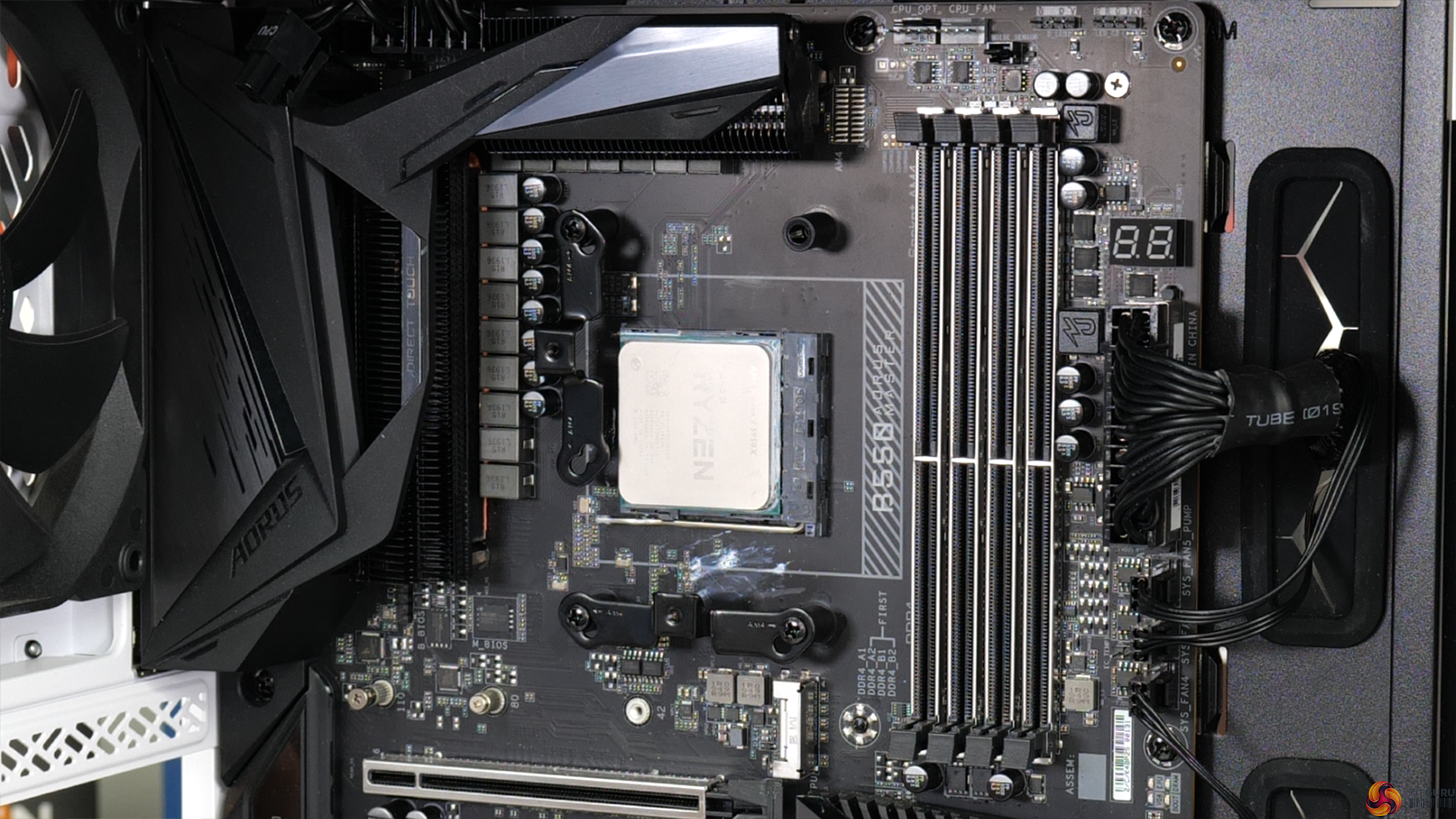
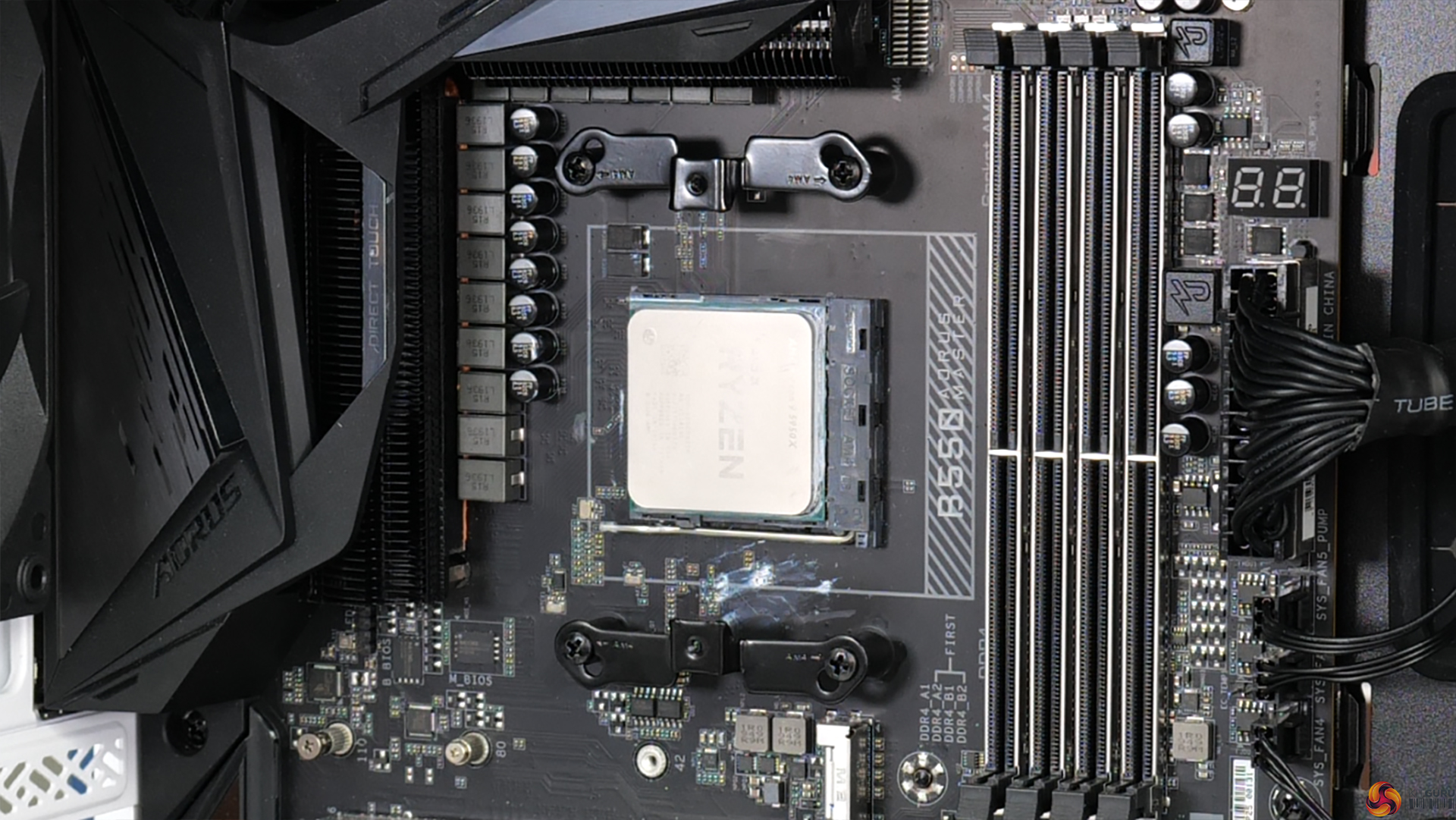
My comments from previous be quiet! reviews stand true, so I will repeat them word-for-word here. In typical be quiet! fashion, you need 3 hands to position the plastic spacers and secure the metal retention clips to the unsecured AMD backplate. This is a particularly difficult process when attempting to install the cooler inside an already build chassis with limited space (such as most SFF cases where a down-draft cooler will be used).
be quiet! really needs to make the process of installing the plastic spacers, metal retention clips, and screws more straightforward.
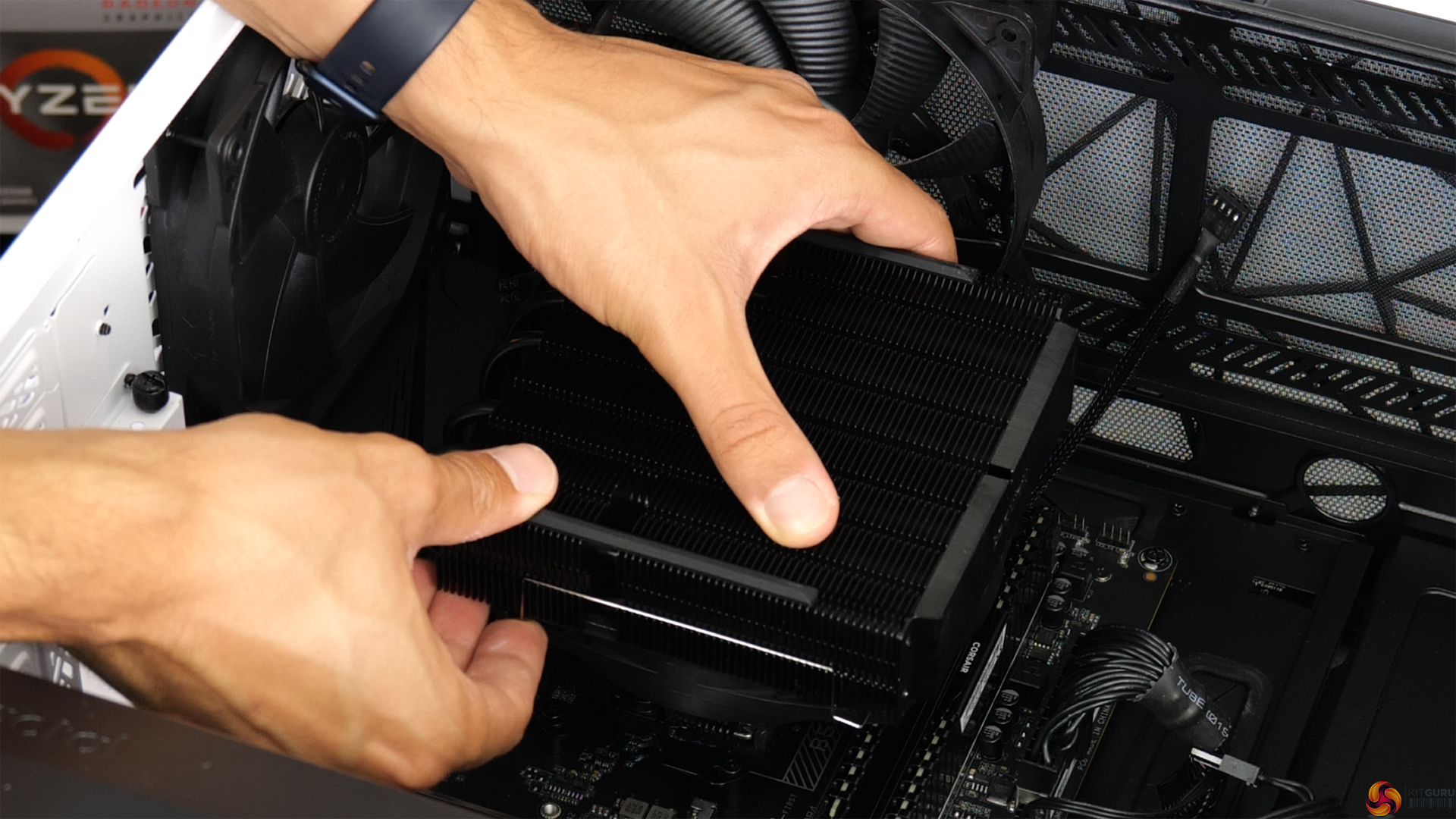
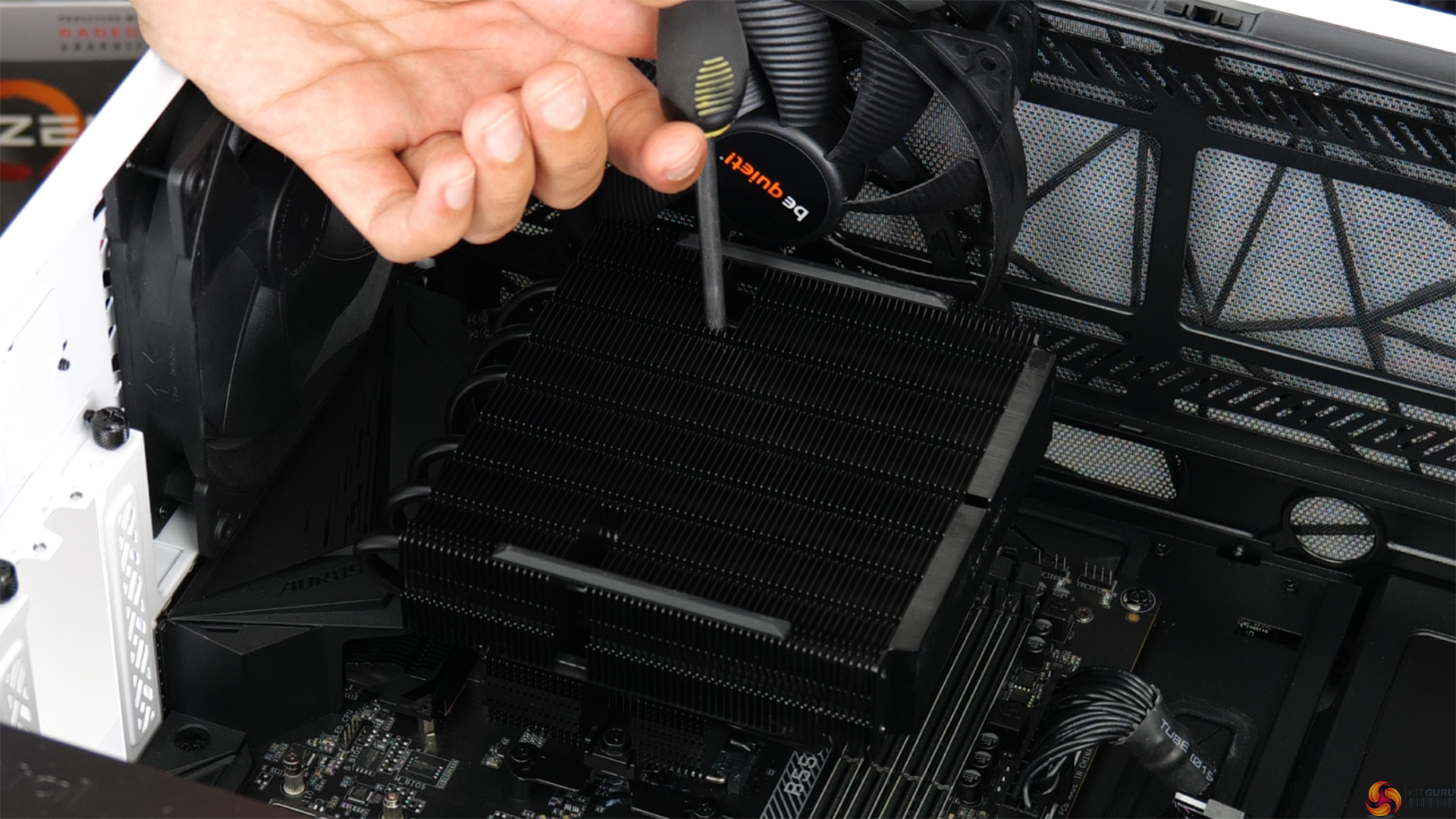
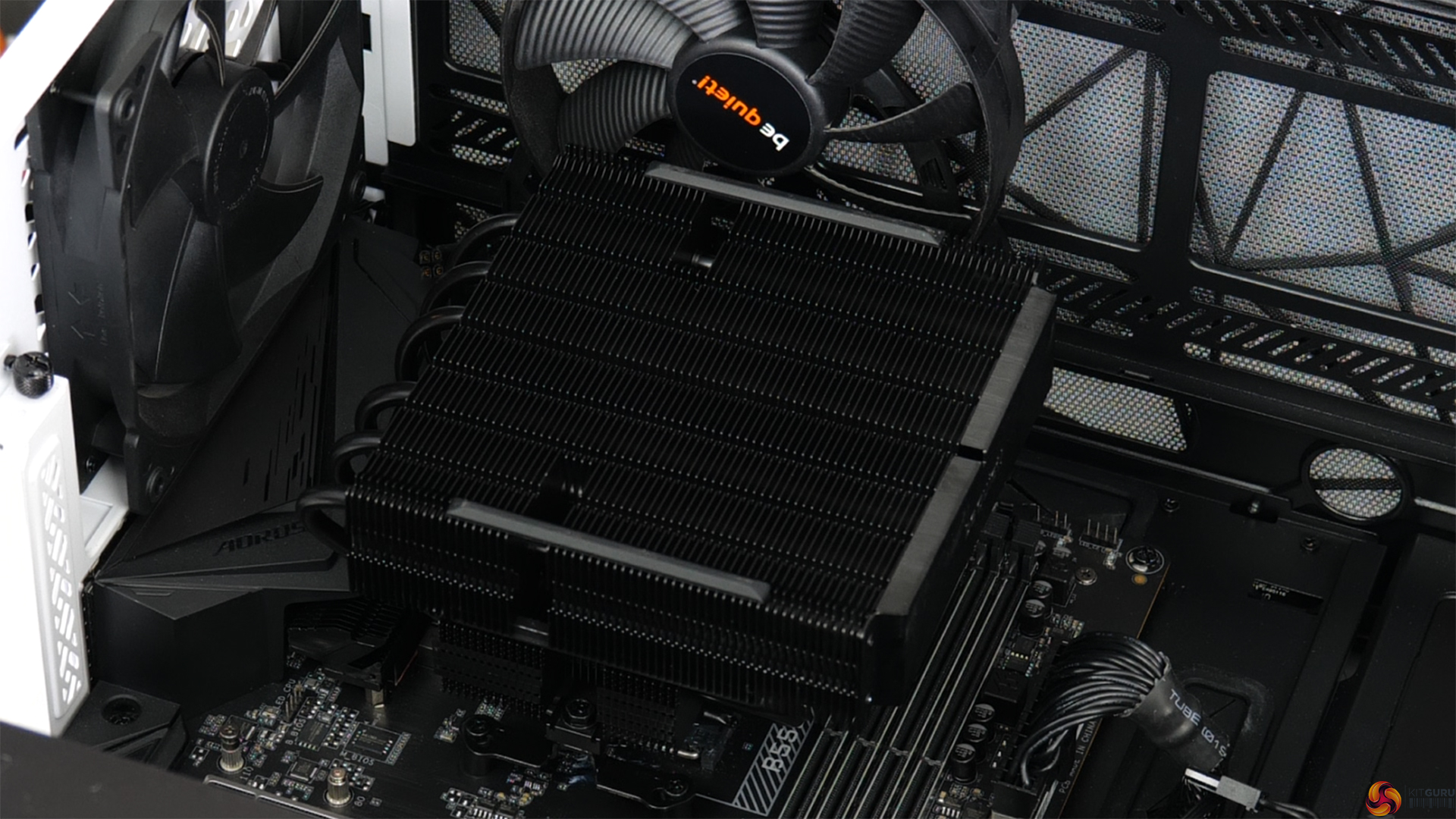
Once the retention clips are in place and thermal paste has been applied, the cooler can be sat in position.
Screwing down the cooler is easy as there are relevant gaps in the heatsink. You also get some degree of flexibility as to mounting orientation with respect to the heatpipes.
At this point, there is still plenty of space remaining below the heatsink to install sensibly tall modules such as Corsair Vengeance LPX.
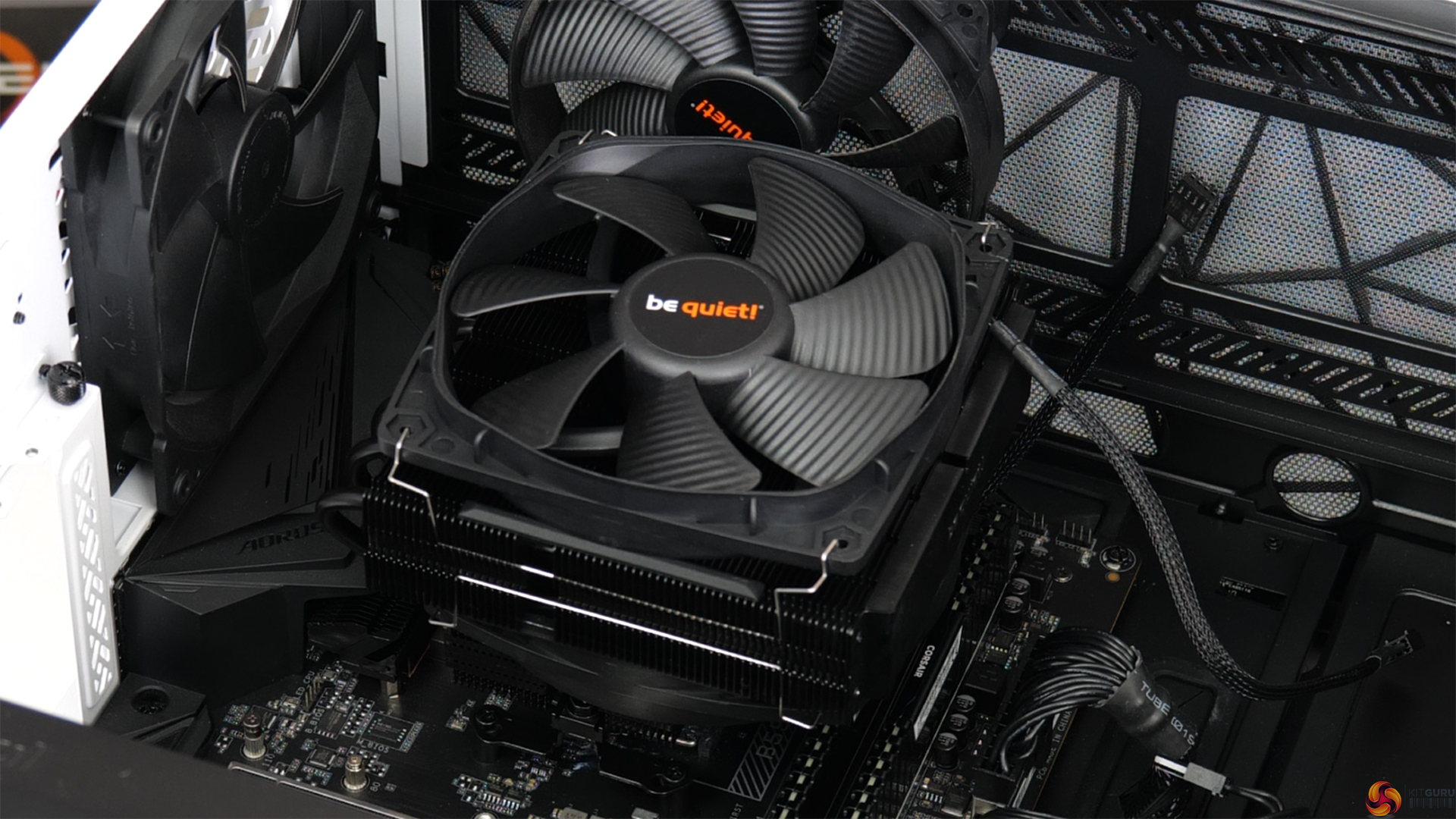
The next step is to install the bottom fan. This is another procedure that I found to be slightly trickier than it needed to be. Primarily because the fan clips are difficult to pull into place without the fan seated correctly. And it is difficult to seat the fan correctly when the two rubber damping strips are not easily visible.
Once the bottom fan is in place, clipping the top fan into position should be a straightforward process. The 4-pin PWM cables can then be connected to the included splitter as required.
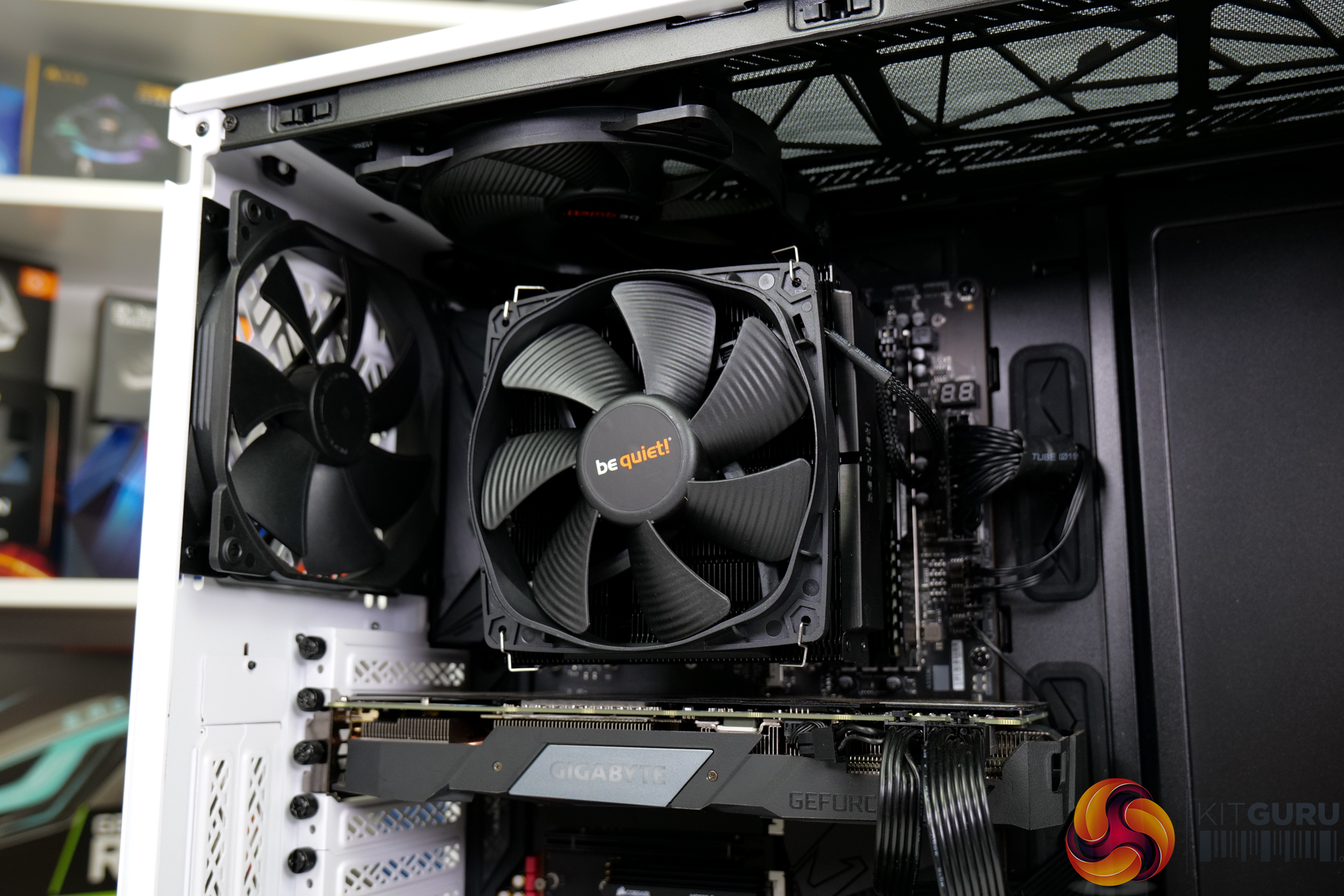
The final mount is sturdy and the installed product certainly looks good.
As usual, I would like be quiet! to make the backplate and retention bracket installation procedure a little more straightforward for AMD users. One of our audience members suggested using a piece of electrical tape to stick the backplate in position, and this seems like a reasonable solution.
I also found the bottom fan securing procedure to be a little complicated, but this is not out of the ordinary for coolers with fans in non-standard positions or orientations. So, I will certainly cut be quiet! some slack here, especially when the final mount – onto those rubber noise damping strips – feels good.
There are several perfectly valid ways to test CPU coolers. We are primarily focussing on the performance of each cooler at 100% fan speed and also when locked to 40dBA noise output. We will focus on cooling performance using a manual overclock and Precision Boost Overdrive, as well as some reference to stock numbers. We will also highlight VRM temperatures.
Typically, we go for a 4.45GHz overclock, but this was too high for mid-range performance air coolers. As such, we backed off to a reasonable 4.1GHz fixed frequency and 1.225V BIOS voltage that generates around 180W of CPU package power to deal with. Given the introduction of this new 4.1GHz mid-range cooler test, we currently have limited comparison data. But check back for future review of additional mid-range coolers we have in for testing.
We decided to test using a chassis as we feel that this is most representative of real-world use cases. It does have some unwanted influences on the test data, as does open-air test bench testing. But we feel that this is a worthwhile trade-off for real-world chassis performance of the coolers.
Our chassis of choice is the Fractal Design Meshify 2 case that Leo reviewed and scored very highly. We like this chassis thanks to its high airflow optimisation and well-vented front and top panels.
The fan configuration is the three included Fractal Dynamic X2 GP-14 fans spinning at full 1000 RPM speed. In addition to the two 140mm front-mounted fans, and single 140mm rear exhaust, we added a be quiet! Pure Wings 2 1000 RPM 140mm fan as roof exhaust for air cooler testing. The aim here was to keep consistency with the airflow path of the liquid coolers which are always roof mounted.
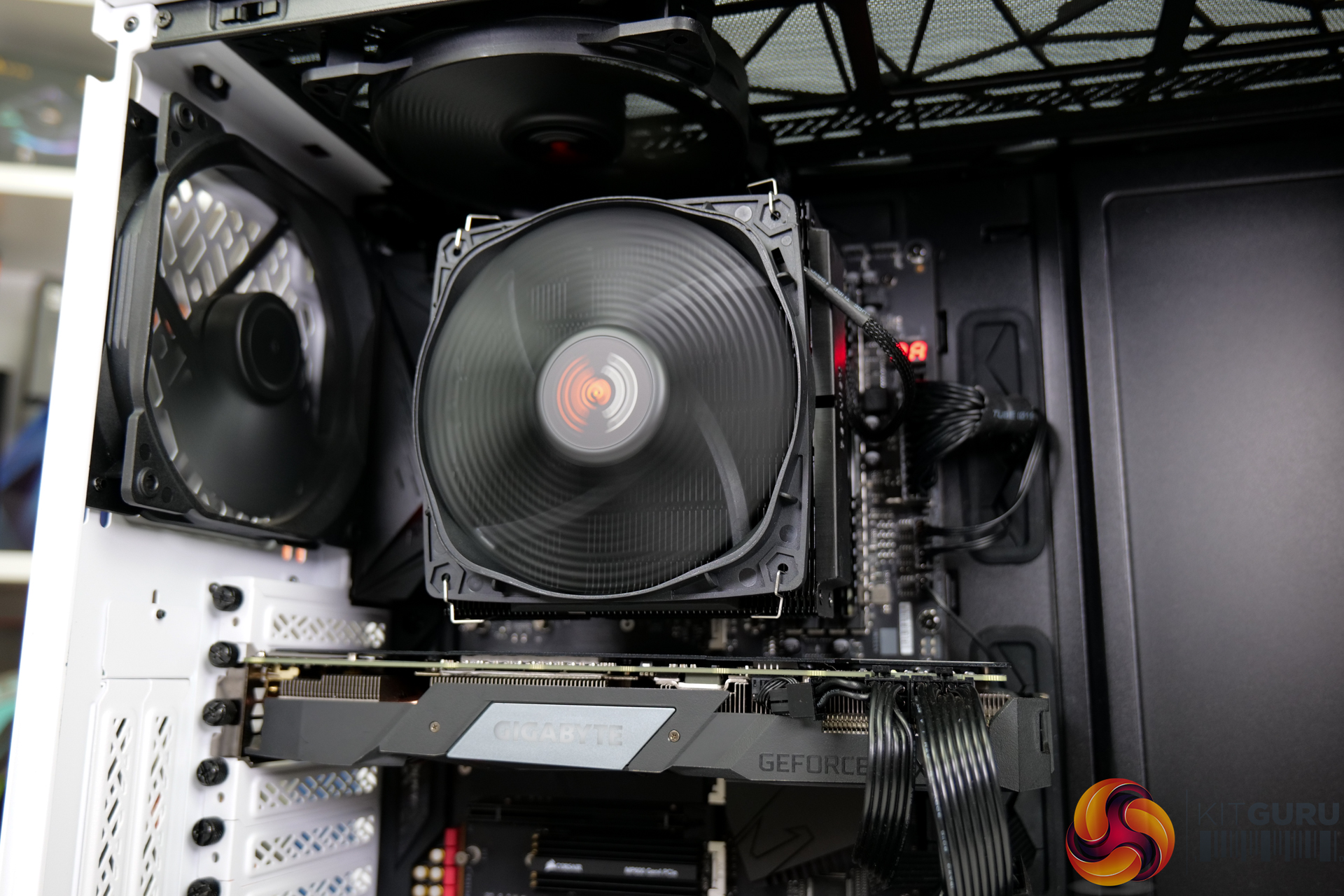
If you want more details on our CPU cooling test procedures, check out some of our previous articles HERE, HERE and HERE.
CPU Cooling Test System:
- Processor: AMD Ryzen 9 5950X
- Overclocked Settings: 4.1GHz all-core @ 1.225V (UEFI), Medium LLC – around 180W-190W delivered
- Motherboard: Gigabyte B550 Aorus Master
- Memory: 32GB (2x16GB) Corsair Vengeance LPX 3600MHz 16-18-18-36 DDR4 @ 1.35V
- Graphics Card: Gigabyte RTX 2060 Super 0dB Mode
- Chassis: Fractal Design Meshify 2
- Chassis Fans: 2x140mm 1000 RPM Fractal Front Intake, 1x140mm 1000 RPM Fractal Rear Exhaust, 1x140mm 1000 RPM be quiet! Pure Wings 2 Roof Exhaust (for air cooler testing)
- Power Supply: Seasonic Prime TX-1000
- OS SSD: Corsair MP600 NVMe M.2 SSD
- Operating System: Windows 10 Pro 64-bit
Comparison Coolers:
- be quiet! Dark Rock TF 2 – £79.99, 1x135mm 1400 RPM Fan + 1x135mm 1300 RPM Fan
- be quiet! Shadow Rock Slim 2 – £43.99, 1x135mm 1400 RPM Fan
- Zalman CNPS10X Performa Black – around £38, 1x135mm 1500 RPM Fan
- Arctic Freezer 33 eSports One – £29.99, 1x120mm 1800 RPM Fan
- be quiet! Shadow Rock 3 – £44.99, 1x120mm 1600 RPM Fan (operated up to 1750 RPM according to our motherboard sensor)
- be quiet! Silent Loop 2 – £199.99, 2x120mm 2200 RPM Fans, 2800 RPM Pump
- Deepcool AS500 Plus – £64.99, 2x140mm 1200 RPM Fans
- Noctua NH-D15 – £80, 2x140mm 1500 RPM Fans
- Cooler Master MA624 Stealth – £99.99 MSRP, 2x140mm 1400 RPM Fans
- Arctic Freezer 50 – £59.99, 1x140mm 1700 RPM + 1x120mm 1800 RPM Fans
- Cougar Aqua 240 ARGB – £89.99-£99.99 MSRP, 2x120mm 2000 RPM Fans, 3200 RPM Pump
- Silverstone IceGem 240P – £119.99, 2x120mm 2200 RPM Fans, 3000 RPM Pump
- Phanteks Glacier One 360 MP – £154.99, 3x120mm 2200 RPM Fans, 3600 RPM Pump
- G.SKILL Enki 360 AIO – $179.99 MSRP, 3x120mm 2100 RPM Fans, 5000 RPM Pump
- IceGiant ProSiphon Elite – £169.99, 4x120mm 2300 RPM Fans
Testing Methodology:
- For testing, we use a 30-minute looped run of Cinebench R23 and record the steady-state CPU temperature at the end of the test. This ensures that the CPU has had ample time to warm up and reach steady state under all of the coolers.
- Ambient is maintained around 23-25 degrees Celsius. Where there is variation beyond this temperature range, we add in extra repeated tests to ensure consistency.
- We also test each cooler with at least two fresh installs (typically three) to mitigate the likelihood of a dodgy mount spoiling results.
Let’s start off with noise performance from each cooler at 100% fan speed.
This is important as it sets the precedence for which coolers we expect to deliver the higher levels of performance based on the faster and louder fans. Assuming that their performance is efficient in comparison to their noise output levels, that is.
The chassis fans are disabled, all case panels are on, and the sound meter is placed 12 inches from the side of the Fractal chassis’ glass side panel – roughly where a desk user will be sat.
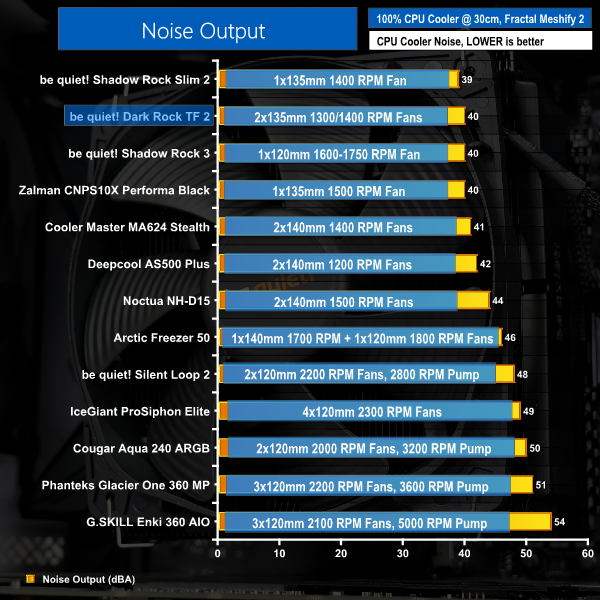
As is typical for be quiet!, noise performance is outstanding. At 12 inches away from the chassis side panel, the noise output was a smidgen below 40dBA. Noise levels even with both 135mm fans at full speed were incredibly tolerable and unobtrusive.
The decision by be quiet! to deploy high-quality – Silent Wings and Silent Wings 3 – 135mm fans was an excellent one. Low noise operation is a clear strength for the be quiet! Dark Rock TF 2.
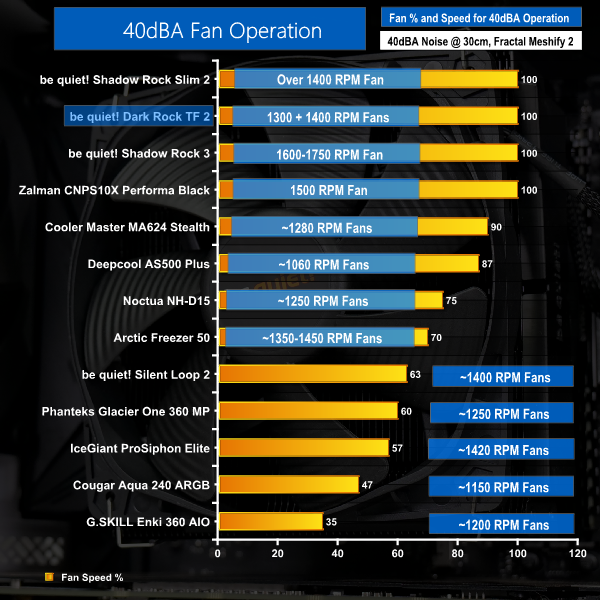
As 100% fan speed tied into a 40dBA noise output, no further tuning was required to reach such a tolerable noise level. Bear this in mind when comparing the Dark Rock TF 2 cooler's data versus other units which typically run louder (with the exception of a couple of other be quiet! coolers and the 135mm-class Zalman model).
Let’s start by looking at Precision Boost Overdrive test results. With 90C the maximum target temperature for PBO, we are looking at how the cooler achieves the balance between lower temperature operation and higher PBO clock speeds. Higher clocks with lower temperatures are better. But one cooler may run at slightly higher temperatures than another, albeit with higher clock speeds, so look out for that.
In essence, this test is showing us how far the cooler can be pushed while keeping a sensible 90C maximum. Or whether there is more room for pushing clocks and power delivery beyond the PBO limits while still sticking to a 90C target.
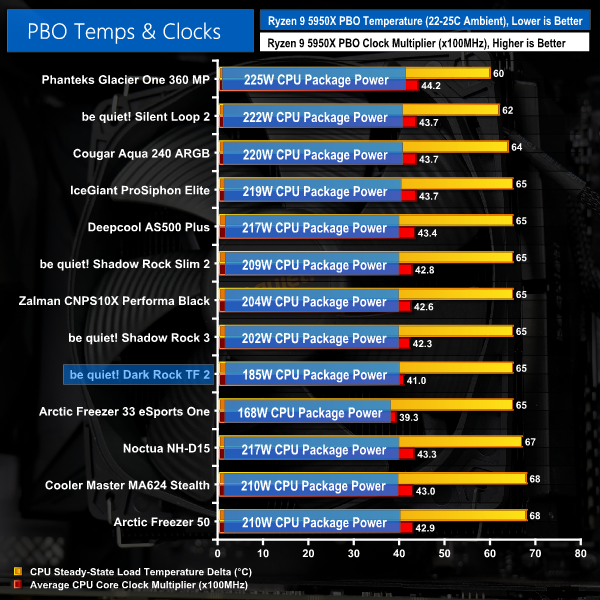
Firstly, it is critical to note that small differences in the displayed delta temperatures are not important for our PBO testing as the clock speed and cooling power achieved are more important metrics.
be quiet!'s Dark Rock TF 2 makes a tough start in our PBO test with the Ryzen 9 5950X. The temperature hits its 90C limit, as expected. However, the Ryzen 9 5950X operating frequency of around 4.1GHz when cooled by the Dark Rock TF 2 is notable lower than from alternative 135mm-class tower style CPU coolers.
In fact, the 185W CPU package power cooled result is well below the level we saw from the significantly cheaper be quiet! Shadow Rock Slim 2 which we liked a lot.
PBO testing highlights some real challenges for the down-draft style Dark Rock TF 2 CPU cooler in our test environment. Our manual overclocking testing will deliver further insight.
If you are interested, stock test results for the Dark Rock TF 2 had the cooler running around 36 degrees above ambient – which is a little worse than from the Zalman and Shadow Rock Slim 2 135mm tower-style coolers. This was 128W of package power cooled and resulted in an all-core load frequency of around 3.82GHz, which was also slightly lower than the alternative 135mm tower-style units.
Moving on to our new 4.1GHz fixed frequency overclocked test, as we have only recently added the new 4.1GHz mid-range cooler test to our suite, we have very limited comparison data at the moment. Do check back on future reviews, as we have quite a few mid-range CPU coolers for test over the coming weeks, so the charts will start to show significantly more comparison data.
As we are locking the voltage and clock speed, the temperature figures are directly comparable between competing coolers. We see package powers in the order of 180-190W for the CPU and wall power levels that exceed 260W for the system.
Note the use of delta temperature data in our charts and factor in your own ambient conditions for reference.
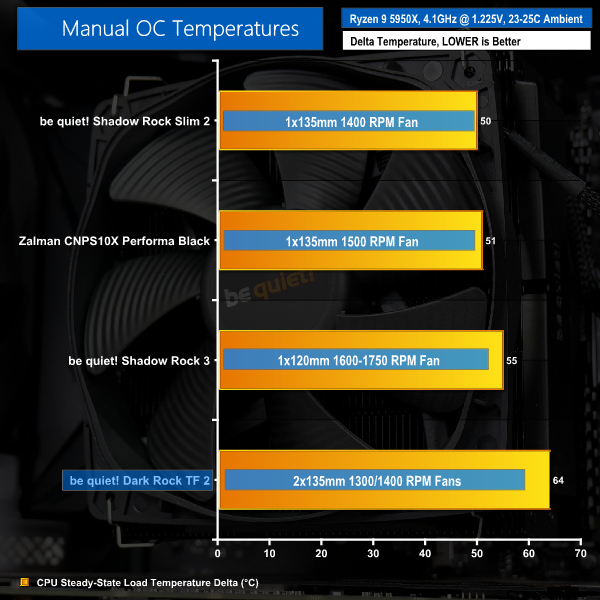
Manual OC temperature results continue to paint a tough picture for the Dark Rock TF 2. Falling quite a few degrees behind the £45-class tower-style air coolers, it is clear that the Dark Rock TF 2's down-draft format is struggling on our test system when the Ryzen 9 5950X puts out such a demanding heat load.
This result is made worse by the fact that be quiet! down-draft unit struggled with keeping the Ryzen 9 5950X around the 90C mark. This, in turn, results in the processor requiring more power than with the cooler running CPU coolers. As such, the Dark Rock TF 2 was tasked with cooling 190W of CPU package power, as opposed to around 180W for the other coolers in this chart.
But this also highlights a legitimate consideration for use of the £79.99 down-draft cooler. Many mini-ITX or alternative SFF chassis in today's market can take full-sized air coolers or – better yet – dual-fan AIO liquid coolers.
This puts the be quiet! Dark Rock TF 2 in a further compromised position. As clearly, the performance is not up to the standards of a considerably cheaper tower-style air cooler when used inside a moderately-sized chassis that is well optimised for front-to-back cooling.
But when we pit the cooler against other logical SFF competitors – which would be the 240mm-class AIO liquid coolers on the previous page – it is also difficult to compare their performance metrics as the be quiet! down-draft cooler is far behind the performance curve.
Perhaps the VRM temperature results on the next page will be a trump card for be quiet! with the Dark Rock TF 2.
We highlight VRM temperatures when using each cooler on our Gigabyte B550 Aorus Master motherboard with the overclocked Ryzen 9 5950X. Do note that the results are heavily influenced by the specific layout of the Gigabyte B550 Aorus Master test motherboard with respect to top-side or rear IO-side VRM components. Your findings may vary if you have a different motherboard VRM layout and heatsink design.
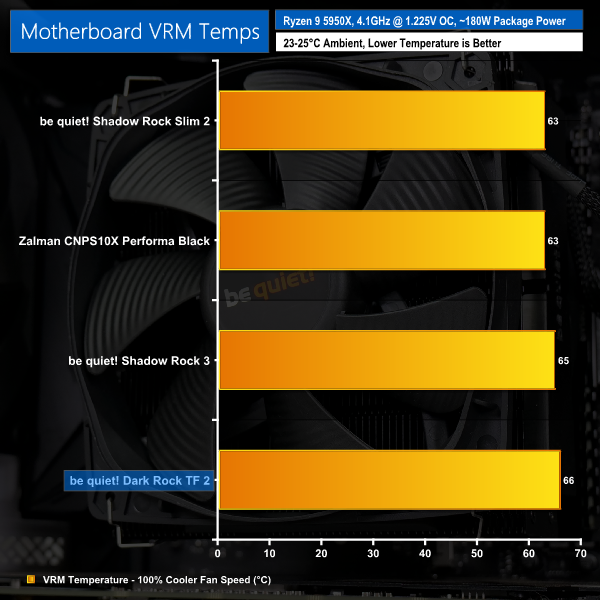
Perhaps unsurprisingly given that the cooler and power delivery solution were tasked with an extra 10W of power delivery to the CPU, VRM temperature results are not particularly impressive from the Dark Rock TF 2 either.
Down-draft cooling should deliver a strong benefit for VRM temperatures. But modern motherboards are so well designed to utilise incidental airflow from a tower-style CPU cooler that the down-draft orientation benefits are somewhat mitigated by default on our Gigabyte B550 Aorus Master motherboard.
That point is particularly true when air carrying around 190W of waste heat is forced against the motherboard PCB and VRM area; the cooling proficiency is already significantly impaired at that stage.
The be quiet! Dark Rock TF 2 is a well-built, good-looking down-draft style air cooler that features exceptional low noise operation thanks to the use of two high-quality 135mm fans.
Whilst noise levels are a clear benefit, the cooling performance left plenty to be desired in our test configuration and setup. The limited heat dissipation area and inherent size constraints of the top-down design did not bode particularly well when combined with our Ryzen 9 5950X test CPU pushing in excess of 180W.
It is clear that the Dark Rock TF 2 is not designed to deal with such high levels of heat output from an AM4 processor. However, with a down-draft cooler targeting SFF/mITX users and the AM4 platform currently being the go-to option for those builders, we feel that our test procedures are actually quite reasonable.
We even opened up the case side panel to give the Dark Rock TF 2 direct access to fresh out-of-chassis air, but this only reduced temperatures by an insignificant amount.
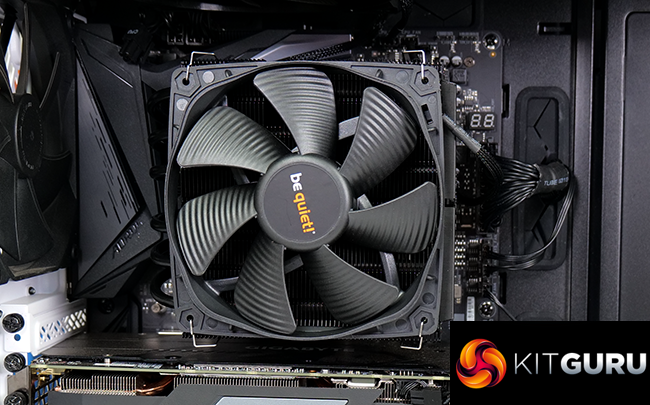
Put simply, the Dark Rock TF 2 did not like our CPU cooling test setup whether that be the motherboard socket area, chassis fans, or nearby graphics card. There's no denying that our test environment is clearly not optimised for a down-draft CPU cooler. However, this raises the questions of where down-draft coolers make sense in today's market.
Many SFF chassis – even particularly small ones such as the NCase M1 – can take a moderately-sized tower air cooler or a 240mm-class AIO liquid cooler. When looking at SFF use cases – and factoring in the expensive price tag of £79.99 – it is difficult to look past the option of using a 240mm AIO instead.
Of course, there will still be scenarios where a down-draft cooler such as the Dark Rock TF 2 can make sense. Perhaps you have a compact chassis with limited room for a tower cooler. Perhaps you do not trust liquid cooling. Or perhaps your motherboard VRM heatsink is poor and needs assistance. But we are getting into the realms of a niche user base at that point.
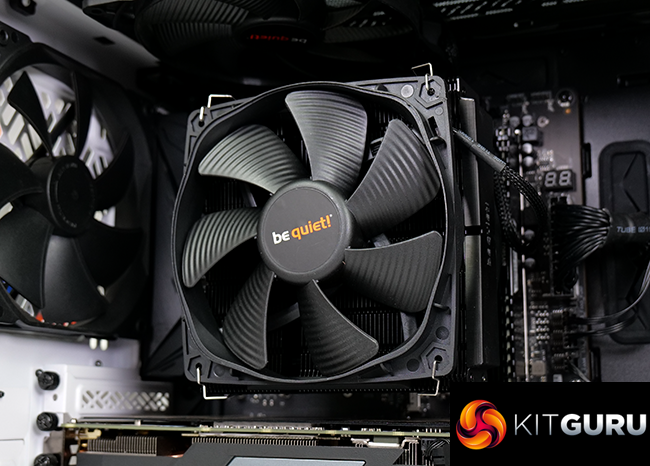
With an expensive price tag of £79.99 and with the cooling performance deficiencies versus reasonably sized air coolers in our hot-and-heavy Ryzen processor testing, it is difficult to make a compelling argument for the be quiet! Dark Rock TF 2.
Aesthetics are great, build quality is superb, and the low-noise operation truly is fantastic. But with most modern cases – even compact SFF ones – designed for a front-to-back airflow path that accommodates tower and AIO liquid coolers with relative ease, the down-draft style be quiet! Dark Rock TF 2 certainly has a niche target market.
Pros:
- Excellent low-noise operation.
- All-black aesthetics are superb.
- Fantastic build quality with a reasonable warranty.
- Good RAM clearance, especially for a down-draft cooler.
Cons:
- Very expensive at £79.99.
- Performance struggles when tasked with a particularly high AM4 heat load.
- Down-draft CPU coolers feel like a solution from a bygone era of chassis designs.
KitGuru says: Credit to be quiet! for adding another option to the under-served down-draft CPU cooler market. With that said, the Dark Rock TF 2 is very expensive and leaves CPU performance on the table in our testing.