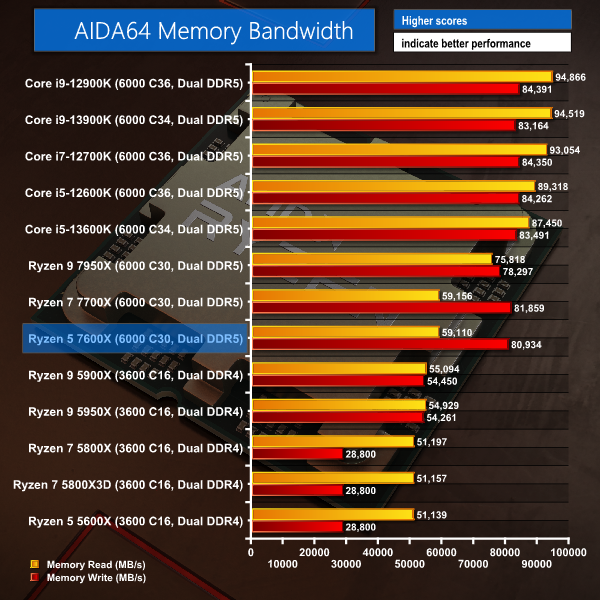
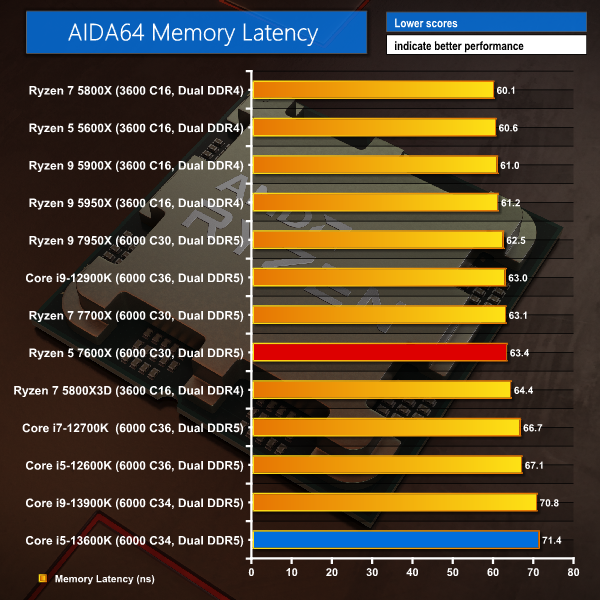
Things are heating up in the more budget-friendly segment of the CPU market. Well, I say budget-friendly with trepidation as the circa-£400 and lower mid-range section is still pricey. Now though, we have the new Zen 4 AMD Ryzen 5 7600X that we will be looking at today. And it has tough competition from the slightly more expensive Intel Core i5-13600K Raptor Lake competitor. Plus, there are the old AMD Ryzen 5000 and Intel 12th Gen Core chips to deal with. So, let’s jump into this review and see how the new six-core, £320 AMD Ryzen 5 7600X performs against the previous generation competitors, as well as the new Core i5-13600K that Leo has reviewed and given us test data for. https://youtu.be/M0_rNQ6pFqE Ryzen 5 7600X has 6 cores and 12 threads with 38MB of total cache – 32MB of which is L3. The base clock of the new TSMC 5nm-fabbed chip is listed at 4.7GHz, and the maximum boost clock is 5.3GHz. The 7600X’s TDP is 105W just like its Ryzen 7 sibling. And there is no boxed cooler, which is arguably sensible for use with AMD’s Precision Boost 2 algorithm. But in this market segment, we can also see some argument for including even a budget heatsink. There is the integrated RDNA 2 iGPU with actually decent performance capabilities and solid media consumption support. In the UK, the Ryzen 5 7600X is around £320-330. That puts it around £50-60 cheaper than Intel’s Core i5-13600K competitor and around £100 below the Ryzen 7 7700X. There is, however, notable competition from Intel’s last-gen Core i5-12600K and the AMD Ryzen 7 5800X; both of those chips are cheaper than the new Ryzen 5. Plus, they can both run on considerably cheaper DDR4 platforms, which is worth bearing in mind. It is also worth noting that the Ryzen 7 5800X3D has had a notable price drop in the last few days too. Zen 4 architecture Let’s start out with a quick overview of the new Zen 4 architecture. We have already written several articles on Zen 4 - including an announcement piece from August 2022 as well as the launch Ryzen 7000 review HERE. So, make sure you check out the previous content for more details. According to AMD, the key design goals for the Zen 4 architecture focused on efficiency gains, latency improvements, and better performance in terms of frequency and IPC. Changes to the cache structure allow AMD to enhance the data flow and reduce latency. One key area to this point is the doubling of L2 cache capacity to 1MB per core instead of 0.5MB per core on Zen 3. Front-end, execution engine and load/store advances are achieved via various measures. The enhancements are designed to improve the data flow for the new Zen 4 core versus Zen 3. And that’s particularly useful for better utilising the downstream resources whilst also reducing latency in the underlying architecture, particularly with that larger slice of L2 cache. Another noteworthy enhancement to Zen 4 is AVX-512 support. This is technically handled via a double-pumping of the 256-bit wide data path, rather than a single operation, because AMD didn’t want to spend the core area of a full 512-bit data path. While AVX-512 support is a cool inclusion, we have seen from Intel’s adjustments that it isn’t really a significant benefit for the consumer market currently. Zen 4 servers on the other hand – they’ll like that alongside BFloat16. Ryzen 7000 CPU Configuration The Ryzen 7000 chips use 8-core CCXs built on the TSMC 5nm process node. The individual Core Complexes feature a 32MB slice of L3 cache – as we saw with Zen 3 – but no 3D V-Cache like we saw with the 5800X3D. We’ll have to wait for the V-Cache chips because AMD said they didn’t want to delay these parts. Each 8-core core chiplet measures in at 70mm2 with 6.50 billion transistors. That’s an area reduction versus the 80.7mm2 Zen 3 core chiplet which featured 4.15 billion transistors. Clearly, the density uptick of TSMC 5nm is substantial. Aside from density, frequency is another huge improvement from 5nm. We now see boost clocks as high as 5.7GHz on the 16-core chip! The new Ryzen 7000 Series IO Die is a substantial improvement versus Ryzen 5000. Fabbed on the TSMC 6nm process node, AMD has gone for a more advanced, more expensive manufacturing option with its Ryzen 7000 IO Die. That’s actually a change of direction versus Ryzen 5000 which was built using significantly older 12nm process technology. This decision allows AMD to increase the transistor count from 2.09 Billion previously to 3.40 Billion now, alongside a small decrease in die area from 125mm2 on Ryzen 5000 to 122mm2 now. And they jam a bunch more functionality onto the new IO chiplet, too. We get 28 lanes of PCIe Gen 5, a dual-channel DDR5 memory controller that supports up to JEDEC-5200 and ECC, USB 3.2 and Type-C support, and USB BIOS Flashback. AMD also includes low-power methodologies borrowed from the Ryzen 6000 Series Mobile processors, such as SOC power states, clock gating, and power gating. Importantly, the IO Die also features the integrated GPU that features two RDNA 2 Compute Units. When we asked AMD about this inclusion during their tech day in Austin, Texas, the response was quite clear in that this was included to allow them to sell partner systems to businesses who require iGPU capabilities for powering a basic monitor. As we have seen on the Intel side, though, the inclusion of a modern iGPU also has the benefit of allowing for competent media encoding and decoding capabilities. Of course, it’s not just the new Ryzen 7000 series processors that have launched recently, as the new chips sit on AMD’s new AM5 platform The new 1718-pin LGA AM5 socket features a denser pin array for better power capability and improved signal integrity for high-speed interfaces like DDR5 and PCIe Gen 5. Now, we see chips with TDPs up to 170W out of the box, which means 230W of package power delivered under stock conditions. That’s a substantial uptick versus the 142W peak package power delivery for stock AM4 chips. AM5 package size is the same 40mm x 40mm as AM4. AMD could have done with a bigger area to work with but decided on a unique heatspreader design instead to permit CPU cooler backward compatibility. The new platform also gets some improved sensor data feed through for power and temperatures. This should improve operations in some domains versus previous Ryzen chips. AMD's AM5 supports DDR5, and DDR5 only. AMD wasn’t interested in adding DDR4 support, as Intel does. This was because they’d rather drag the market towards the transition to DDR5 instead of supporting the older memory technology. And that’s because the bandwidth and throughput improvements of DDR5 are very much essential to AMD’s platform design. There is technically ECC support for memory, but this will depend upon motherboard vendor implementation. As far as frequencies go, AMD supports up to 5200MHz JEDEC by default. Though, when we asked about 2 DIMMs per channel speed during the Tech Day, this was highlighted as 3600MHz nominal, and we’ve yet to see any information suggesting otherwise. Of course, actually usable speeds are high. AMD is suggesting that the new memory sweet spot is DDR5 6000MHz with tight latencies in 2x16GB form. And it is doubling down on this point by partnering with memory vendors to implement EXPO – which is essentially the AMD alternative to XMP that the company believes is more open and better suited for the AMD platform. A critical adjustment on the memory subsystem is the decoupling of the Infinity Fabric clock and the Memory Controller clock. With previous Zen, memory clocks above 3600MHz would result in a divider being applied to the Infinity Fabric clock, thus reducing its effective speed and imparting a significant latency penalty. Now, the Infinity Fabric clock is no longer linked with the memory controller clock. This means that the Infinity Fabric is generally maintained at 2000MHz while the memory controller runs at 2400MHz for DDR5-4800 or 2600MHz for DDR5-5200 or 3000MHz for DDR5-6000. Above 6000MHz RAM speed and the memory controller will run at a 2:1 divider. So, 6000MHz is a sweet spot, while DDR5-6200 and 6400 kits realistically sit in the valley of death whereby the slower memory controller will impart a latency penalty. But Infinity Fabric is decoupled so it will stay at 2000MHz frequency, thus the latency penalty is kept to the memory subsystem specifically, and not the processor and platform side of the equation. TL;DR – AMD reckons that DDR5-6000MHz with nice timings and EXPO configuration is a smart sweet spot. We’ll test this out some more over the coming weeks and months. 28 lanes of PCIe Gen 5 connectivity are positioned on the new Ryzen 7000 Series processors. Realistically, this splits out as 24 lanes usable and 4 lanes for connection between the CPU and chipset. AMD increased the count to 24 lanes usable on AM5 versus 20 lanes previously to allow for more CPU-linked storage capacity. Actual PCIe Gen 5 platform support is convoluted, though. X670E and B650E motherboards allow PCIe Gen 5 on expansion slots (graphics cards) and M.2 storage interfaces. Whereas X670 and B650 non-E motherboards will limit Gen 5 to only the storage connections. Though this may vary as AMD said it isn’t mandated to the motherboard vendors. With regards to chipsets, we currently have X670E, X670, B650E, and B650. The ‘E’ suffix denotes enhanced Gen 5 connectivity or (generally) Gen 5 limited to some storage interfaces. AMD’s processors have four PCIe lanes reserved for linking with the motherboard chipset. However, this link runs at PCIe Gen 4x4 bandwidth instead of Gen 5. AMD told us that a Gen 4x4 is ample given the likely downstream bandwidth requirements, as well as enhanced CPU-direct storage allowances. The X-series and B-series chipsets differ by their quantity of connection interfaces. But AMD makes a point in highlighting that there are no artificial limitations like overclocking capability or reduced memory frequencies. Realistically, a motherboard vendor could make a B650E motherboard that’s just as good as an X670E option, bar fewer connectivity interfaces. And those connectivity interfaces that we get through the chipset include PCIe Gen 4 links for storage and expansion cards, flexible SATA 6Gbps connections, and USB interfaces up to 20Gbps. Exactly what is included will vary from vendor to vendor. The X-series chipset uses a dual-chiplet approach to offer its enhanced connectivity options. These chiplets are daisy-chained, so there could be some bandwidth headaches in some niche – workstation-calibre – use cases, despite AMD’s assurances that these would be unlikely (and they almost certainly will be). We will be pitting the new Ryzen 7000 series chips against their logical Ryzen 5000 and Intel 12th and 13th Gen competitors. The AM4-based Ryzen 5000 processors will be coupled with 32GB of dual-rank DDR4 3600MHz C16 memory. Both DDR5 platforms use 32GB 6000MHz sets from G.SKILL’s Trident Z5 range. Though the timings differ slightly, with the AMD EXPO kit running at 30-38-38-96 versus the Intel XMP set at 36-36-36-96. This is pretty close between the two sets. The new AMD processors are tested on Gigabyte’s X670E Aorus Master motherboard featuring the BIOS revision and AGESA profile as supplied and validated by AMD. Each processor is tested at its default out-of-the-box settings. For the Intel CPUs, turbo limits as set by the motherboard with XMP enabled is the operating mode. All-core load frequencies for the tested chips are as follows: Core i9-12900K = 4.9GHz on the P-cores. Core i7-12700K = 4.7GHz on the P-cores. Core i5-12600K = 4.5GHz on the P-cores. Core i9-13900K (253W) = 5.5GHz on the P-cores. Core i5-13600K (168W) = 5.3GHz on the P-cores. Ryzen 5 5600X = around 4.3GHz. Ryzen 7 5800X = around 4.56GHz. Ryzen 7 5800X3D = around 4.4GHz. Ryzen 9 5900X = around 4.25GHz. Ryzen 9 5950X = around 3.85GHz Ryzen 7 7700X = around 5.18GHz. Ryzen 9 7950X = around 5.05GHz. CPU Test System Components: AM5 Motherboard: Gigabyte X670E Aorus Master AM5 DDR5 Memory: 32GB (2x16GB) G.SKILL Trident Z5 Neo 6000MHz 30-38-38-96 DDR5 Dedicated Graphics Card: Sapphire Nitro+ Pure Radeon RX 6950 XT CPU Cooler: 360mm AIO liquid cooler Power Supply: Seasonic Prime TX-1600 Operating System: Windows 11 Pro Z790 Motherboard: Asus ROG Maximus Z790 Hero Z790 DDR5 Memory: 32GB (2x16GB single-rank) G.SKILL Trident Z5 RGB 6000MHz AM4 Motherboard: Gigabyte X570S Aorus Master AM4 DDR4 Memory: 32GB (2x16GB dual-rank) Corsair Vengeance LPX 3600MHz 16-18-18-36 DDR4 @ 1.35V Z690 Motherboard: ASUS ROG STRIX Z690-F Gaming WiFi Z690 DDR5 Memory: 32GB (2x16GB single-rank) G.SKILL Trident Z5 RGB 6000MHz 36-36-36-96 Tests: Productivity-related and Synthetic: Cinebench R23 – All-core & single-core CPU benchmark (CPU) Blender 3.3.0 - All-core rendering of the Classroom benchmark (CPU) HandBrake 1.5.1 H264 – Convert 1440p60 H264 video to 1080p60 H264 using the YouTube HQ 1080p60 preset (CPU) HandBrake 1.5.1 H265 – Convert 4K30 100Mbps H264 video to 1080p30 40Mbps H265 using the H.265 MKV 1080p30 preset (CPU & Memory) 7-Zip v22 – Built-in 7-Zip benchmark test (CPU & Memory) SiSoft Sandra – Memory bandwidth and Cache bandwidth/latency tests (Memory) AIDA64 – Memory bandwidth & memory latency (Memory) 3DMark - Time Spy and CPU Profile Benchmarks (Synthetic Gaming) Gaming-related: Borderlands 3 - 1920 x 1080, Badass quality preset, DX11 Far Cry 6 – 1920 x 1080, Ultra quality preset, HD textures OFF, DX12 Hitman 3 – 1920 x 1080, Ultra quality preset, RT OFF, DX12 Shadow of the Tomb Raider – 1920 x 1080, Highest quality preset, no AA, DX12 Watch Dogs Legion – 1920 x 1080, Ultra quality preset, DX12 version For CPU load results, we read the power draw after running 10 minutes of the Cinebench R23 nT all-core rendering test. The same test parameters are used for temperature readings. The power consumption of our entire test system (at the wall) is shown in the chart. We also include the reported CPU Package Power. Power Consumption Power draw readings are accurate to around +/-5W under heavy load due to instantaneous fluctuations in the value. Looking at power consumption, the 142W PPT-rated Ryzen 5 7600X actually does very well in the current world of energy-sucking PC hardware. 109W for a heavy all-core load situation is fine, and shouldn’t present any major cooler headaches. This translates into 5.2GHz all-core in a Cinebench workload. Intel’s Core i5-12600K price competitor demands a little more power than AMD’s new chip. But the newer – and more expensive – Core i5-13600K demands a considerably higher level of power draw unless it is constricted to a 115W TDP mode, as tested by Leo. Temperatures Temperature recordings were taken using a 360mm AIO CPU cooler. Ambient temperatures were around 25°C. Despite offering relatively modest power draw figures, Zen 4 continues to run very hot in the Ryzen 5 7600X form. A load temperature of 91C under a 360mm AIO cooler is very high, but the reality is that AMD is pushing the chip towards its 95C limit to try to eke out every last drop of frequency. It’s not really the actual power draw that is driving this high temperature; that’s clear by looking at the higher core count Ryzen 7000 alternatives. Instead, it’s the high operating voltage that results in lofty operating temperatures. 91C is nothing to be concerned by, but it could cause some headaches for managing CPU cooler and chassis fan speeds on motherboards or hardware with less tuneable fan control options. Blender Classroom Looking at Blender Classroom rendering performance, the Ryzen 5 7600X sits close to its previous generation competitors in performance. But the new – and more expensive – Core i5-13600K is much faster! Cinebench R23 nT Cinebench R23 nT shows much of the same trend as Blender, though Intel’s Core i5-12600K – which is similarly priced to the new 7600X and has upgradability on the platform – is superior. And once again, the more expensive Core i5-13600K is much faster than AMD’s Ryzen 5. Cinebench R23 1T Single-thread performance is superb on the new Ryzen 7000 series chips. The Ryzen 5 7600X is no exception there, with highly competitive performance even against the Core i5-13600K. Handbrake H264 The Ryzen 5 7600X is very slightly behind its previous-gen Intel and AMD price competitors for Handbrake H264. Intel’s £50-60 more expensive Core i5-13600K is considerably quicker, even in its reduced power mode. Handbrake H265 H265 video conversion sees the Ryzen 5 7600X put in competitive performance versus the 12600K and Ryzen 7 5800X. But, yet again, even the power-restricted Core i5-13600K is considerably faster than AMD’s newest Ryzen 5. 7-Zip Compression and Decompression 7-Zip is typically a strength for AMD, but there is only so much performance that 12 threads can provide. Here, the new Zen 4 chip’s performance sits above the 12600K and below the 5800X. But the £380 Core i5-13600K offers significantly higher performance in the three power modes that Leo tested. AIDA64 Memory Performance Memory bandwidth for the Ryzen 5 7600X is similar to what we see from the other single-CCX Zen 4 chip - the Ryzen 7 7700X. 3DMark CPU Profile If you’re interested in 3DMark numbers, the Ryzen 5 7600X is pretty low on this chart. But I would not attach much importance whatsoever to this data unless you’re pushing for 3DMark records. Borderlands 3 has the Ryzen 5 7600X performing above its price competitors from the previous generation, but slightly below the Core i5-13600K. Nevertheless, 142 FPS average and 1% lows in triple-digits are good results. Far Cry 6 shows a wider spread in favour of the Intel chips and higher-end AMD parts. The Ryzen 5 7600X is a little slower than the 12600K and a lot quicker than the Ryzen 7 5800X, but compared to the Core i5-13600K, Intel has a very healthy lead. Despite not working properly on our AM4 test system, we still include some data for Hitman 3. The lack of AM4 test data forces the Ryzen 5 7600X to the bottom of our performance chart. But the reality is that a 166 FPS average figure will be absolutely fine for the vast majority of gamers, even if the 13600K from Leo’s review is considerably faster. Shadow of the Tomb Raider plays very well on Zen 4, particularly when compared to Intel 12th Gen and Ryzen 5000 competitors. The 13600K is only slightly quicker here, so AMD’s Ryzen 5 7600X does well. Watch Dogs Legion is a somewhat rare victory for the Ryzen 5 7600X, with AMD’s new chip outperforming the Core i5-13600K, 12600K, and 5800X by slim margins. Gaming Summary When looking at a summary of 1080p gaming performance for the Ryzen 5 7600X, it looks to be perfectly strong in isolation and generally good versus the previous generation competitors that are similarly priced. But compared to Intel’s current 13th Gen competitor – the Core i5-13600K – the Ryzen 5 7600X is not as strong a gaming CPU, even if it is £50-60 cheaper than Intel’s option. AMD’s Precision Boost 2 algorithm maintains lofty light-threaded boost clocks and continues to be my favoured way to overclock AMD processors. This time, we tried out Curve Optimiser using Ryzen Master. That’s because Precision Boost Overdrive was basically useless. Curve Optimiser worked well and delivered an almost 200MHz boost to the all-core operating frequency for our Ryzen 5 7600X. The key driver for allowing our chip to run at almost 5.4GHz all-core was a reduction in chip operating voltage. Manual Overclocking Power and temps Lower voltage resulted in lower operating temperatures and lower power draw whilst also delivering almost 200MHz higher clock speeds. This is a good overclocking outcome in my opinion, particularly as it is so easy to do through Ryzen Master. There’s also the 88W PPT Eco Mode that can be easily applied through AMD’s Ryzen Master software. This delivers a quick reduction in power consumption and thermals versus stock for the Ryzen 5 7600X. Manual overclocking performance Overclocking via Curve Optimiser and 88W PPT Eco Mode are both good ways to run the Ryzen 5 7600X that improve its overall balance. At 88W, the twelve-thread chip loses very little performance but drops power and thermals considerably. CO overclocking is positive too, and clearly a better way to run the CPU than stock conditions. However, it still puts the Ryzen 5 7600X well behind the performance of Intel’s Core i5-13600K even when that chip is restricted to 115W. Cinebench Performance Per Watt Looking at the Cinebench performance per Watt numbers, as a guide for the operating and productivity performance efficiency of each processor, Ryzen 5 7600X is pretty poor out of the box. This is by virtue of the default voltage that results in relatively high power draw for its performance level. The tuning modes of Eco and Curve Optimiser are both far better thanks to their more sensible operating voltages that rein in power consumption. Intel’s Core i5-13600K operating in its 115W is still considerably more efficient, though. Ryzen 5 7600X is an interesting one to analyse. In isolation, the processor looks pretty reasonable; it generally trades blows with its price competitors from AMD’s and Intel’s previous generation parts. But it does so whilst offering a moderately-priced - £320 - route onto the new, feature-rich AM5 platform. Gaming performance is solid too. Most people who don’t have the latest-and-greatest in GPU hardware will be happy with what the Ryzen 5 7600X offers. The real issue comes from Intel’s new Core i5-13600K. While this twenty-thread processor is indeed more expensive by around £50-60, it offers productivity performance levels that more than justify the price increase. Even gamers with the GPU horsepower to push high refresh rates are likely to prefer the new Core i5. Of course, the Ryzen 5 7600X runs on AMD’s new AM5 socket. AM5 is a very feature-rich platform with some superb X-series and B-series motherboard offerings, but it is also a very expensive platform right now, with the cheapest B650 motherboards tending to sell for around £200, or more like £230 for good starting boards. The Core i5-13600K’s cheapest DDR5 motherboards tend to be only marginally less expensive than AM5. Importantly, though, Intel’s chip should run just fine in even sub-£160 B660 motherboards alongside cheaper DDR4 memory. That’s helpful in offsetting the Core i5 chip’s higher purchase cost compared to the Ryzen 5 7600X, and the former point regarding memory is particularly true if you already have a kit of DDR4 that you’re happy to run for longer. I can’t say that I am particularly impressed by the Ryzen 5 7600X chip’s stock running conditions in our testing. A high-end X670E test motherboard and 360mm AIO still resulted in over 100W of power draw and temperatures beyond 90C. These points are fine in isolation, but the Ryzen 5 doesn’t really offer the performance levels to justifiably back them up. Eco mode and Curve Optimiser overclocking are good ways to run the Ryzen 5 7600X. They both resulted in lower power consumption, greatly reduced temperatures, and very similar performance to the stock configuration. Perhaps that highlights the niche that AMD’s Ryzen 5 7600X currently serves – small form factor systems where space and cooling capacity are at a significant premium. Overall, I think the Ryzen 5 7600X has a tough fight in the market to convince users that it is a smarter option than the old chips it is priced against, or the new Core i5-13600K that can often be just as cheap a setup due to more affordable motherboards and DDR4 memory support. I can certainly see the Ryzen 5 processor’s appeal to somebody who is adamant on going down the DDR5 route and keeping their AM5 motherboard for many years. Buying relevant memory and a decent motherboard from Day 1 proved to be an excellent formula that served early AM4 adopters well. In essence, AMD’s promised support for the AM5 platform beyond 2025 could indeed be a key selling point for a Ryzen 5 7600X-based system. Especially as Ryzen 7000 3D V-Cache processor upgrades are likely coming and should be excellent gaming chips. I can also see an argument for users wanting the lower-power Ryzen 5 7600X versus the Core i5-13600K. But Intel’s chip does more than enough to justify its higher power draw with significantly better productivity performance. Overall, I think the lack of truly affordable AM5 motherboards is a real headache for the Ryzen 5 7600X. That, coupled with the competing Intel platform’s ability to run with low-cost DDR4 memory means that I think Ryzen 5 7600X probably needs a price drop to compensate for those other factors. In the UK, AMD's Ryzen 5 7600X is £319.99 from e-tailers such as Overclockers UK. Discuss on our Facebook page, HERE. Pros: Solid gaming performance in isolation Good operation in Eco mode and Curve Optimiser Sensible for SFF systems Excellent single-thread performance from Zen 4 Affordable entry point to the upgradable AM5 platform Cons: Stock power consumption and temperatures could be better tuned Expensive setup including AM5 and DDR5 versus AM4/LGA1700 and DDR4 Core i5-13600K is a bit more expensive but much higher productivity performance Often a slim upgrade versus previous-gen Intel Core i5-12600K and Ryzen 7 competitors KitGuru says: There are some valid reasons to opt for the Ryzen 5 7600X, but right now we feel that the chip needs a price reduction or more affordable motherboard availability.