 KitGuru KitGuru.net – Tech News | Hardware News | Hardware Reviews | IOS | Mobile | Gaming | Graphics Cards


We first measure GPU temperature while the card is sat idling at the Windows 10 desktop for 5 minutes. Gaming GPU temperature is recorded by running the Deus Ex benchmark at 4K. As a maximum stress test, Fire Strike Ultra Stress Test is run 5 consecutive times and the cards’ GPU temperature levels are recorded.
Ambient room temperature was held at around 23°C.
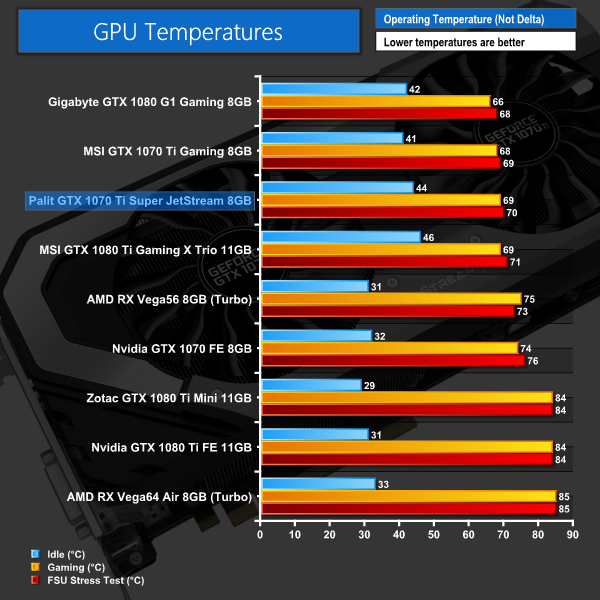
Another good showing for the Super JetStream here, I did not see it run hotter than 70C which is an excellent result. Like the MSI Gaming 8G, it also sports a ‘zero dB' mode, where the fans don't spin under low loads – that explains the 44C idle temperature, as the fans simply shut off.
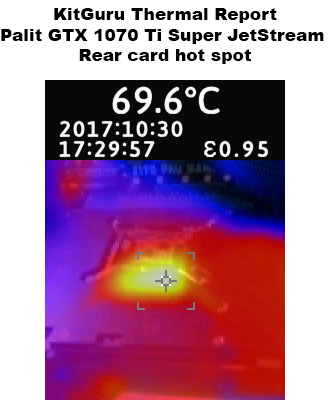
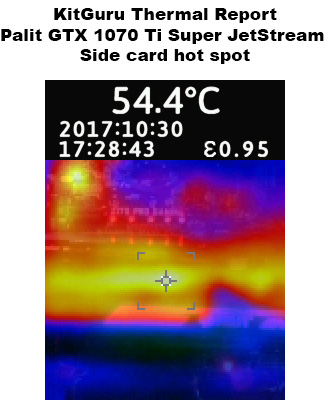
Moving on to thermal imaging camera, the first thing to note is the higher 69.6C hotspot on the rear of the card. This is the area directly behind the GPU core, so it is not surprise to see it getting quite warm. If Palit had covered the back of the GPU with the backplate, I'd wager the hotspot would be lower as there would be more surface area for the heat to dissipate.
On the side of the card, a hotspot there of 54.4C is nothing to worry about at all.

With the shortage of GDDR5X, I’m wondering if the GTX 1080 is being phased out, because this is (95% of) a GTX 1080 GDDR5. Maybe the endgame is for the 1080 to be discontinued, the GP104s going into 1070 Ti instead, and the GDDR5X to be saved for the 1080 Ti and possibly mid-range Volta cards if the early flagships use GDDR6?