 KitGuru KitGuru.net – Tech News | Hardware News | Hardware Reviews | IOS | Mobile | Gaming | Graphics Cards



Last week AMD launched their new HD6970 and HD6950 graphics cards. Kitguru has reviewed several partner boards and found them to be high performing, great value for money products. Due to adverse weather conditions in the United Kingdom our review of the Sapphire cards has been a little delayed but at least we have something special in store for you today.

Sapphire have released three versions of the HD 6970. All of the cards are clocked at standard speeds and are supplied with reference coolers.
The standard, ‘Entry level’ HD 6970 (above left) will cost £290 inc vat. The ‘Gaming Edition’ card (above centre) will ship with the full Battlefield game and a code to download Battlefield: Bad Company 2: Vietnam – this is worth £49.99. This bundle only costs £10 more and the card comes supplied with a custom sticker featuring Battlefield artwork.
The last bundle is a ‘Special Edition' of the HD6970 (above right) with the same Gaming Edition extras but in an aluminum carry case, priced at £330 inc vat. This is the one we are looking at today.
We also have their HD6950 on test today, which is clocked at reference speeds.
| Product | Sapphire HD6970 |
Sapphire HD6950
|
| Core Clock speed | 880mhz |
800mhz
|
| Primitive Rate |
2 prim/clk
|
2 prim/clk
|
| Shader Architecture |
VLIW4
|
VLIW4
|
| Stream Processors |
24 SIMD/1536 ALU
|
22 SIMD/1408 ALU
|
| Texture Units | 96 | 88 |
| ROPs/Z-Stencil | 32/128 | 32/128 |
| Frame Buffer | 2GB GDDR5 | 2GB GDDR5 |
| Memory Width/Speed | 256 bit, 5.5 Gbps | 256bit, 5.0 Gbps |
| Power Connectors | 8 pin & 6 pin | 6 pin & 6 pin |
| Display Outputs | 2xDVI + 2x mDP + HDMI | 2xDVI + 2x mDP + HDMI |
AMD was out of the DX11 stable more than 6 months before nVidia. It has now shipped and sold more than 25 million Direct X 11 graphics solutions. In addition to being first for DX11, Eyefinity is also a key focal point as the cards on test today can support between 3 and 6 displays via a single card … later on we will test some current games over a 3 screen setup. We'd love to have had a single card head-to-head across multiple screens, but nVidia are still trying to catch AMD in this regard and can't yet support more than a pair of monitors on a single card. We expect nVidia to rectify this in its next generation design, the GTX600 series.
The HD6950 will cost £220 on release and the full blown Radeon HD 6970 will be around £280 inc vat, two very attractive price points if they can deliver the goods.
That sees a straight line up between the GTX570 and the Radeon HD 6970 (more on that in a future review). At the same time, the Radeon HD6950 will cost slightly more than an overclocked GTX460. AMD state it has no direct target, but for us it is the replacement for the HD5850 of yesteryear.
There is a way to line the GTX580 up against the Radeon HD 6970 – and that's in a multi card configuration. Buying a pair of GTX580 cards will cost you about the same as three Radeon HD 6970 cards. So if you have around £840 to spend on graphics, both companies have a solution for you.
Now that we have the pricing and market positioning out of the way, lets have a look at the architecture.
When the HD6900 series was in development, AMD's goal was to enhance compute architecture and geometry performance while maintaining high levels of power efficiency. AMD have refined the VLIW4 architecture and have a dual graphics engine design with asynchronous dispatch.

This new configuration allows for up to 24 SIMD engines and 96 texture units with rendering improvements, including enhanced anti aliasing performance. This is all aided by a 256 bit GDDR5 memory interface.

All stream processing units now have an equal share as the T unit design has been made redundant. Special functions (transcendentals) now occupy 3 of 4 issue slots. Greater utilisation than the previous VLIW5 design offers a 10% improvement in performance per mm2 and a simplified scheduling and register management.

The upgraded rendering back end system allows for Coalescing of write ops and the 16 bit integer (unorm/snorm) ops are twice as fast as before. The 32 bit FP (single/double component) ops are between twice and four times as fast.

The new asynchronous dispatch architecture design means that multiple compute kernels can be executed simultaneously. Each of these kernels has its own command queue and protected virtual address domain. DMA engines are dual bidirectional for faster system memory reads and writes. Flow control has been further improved with this design and there are now faster double precision operations.
The 6900 platform also brings AMD's 8th generation tessellator to the fore – this is a dual rate geometry configuration with off chip geometry buffering.

The dual graphics engines can now process two primitives per clock with tile based load balancing and a 2x transform and backface cull rate. With dual rasterisers and up to 32 pixels per clock, this new tessellation performance is up to three times better than the HD5870 – the last class leader.


AMD are also offering new Anti Aliasing (EQAA) modes with their newest driver. New MSAA modes with up to 16 coverage samples per pixel. Additionally the number of colour and coverage samples can be independently controlled offering better quality with the same memory footprint. They are compatible with Adaptive AA, Super Sample AA and Morphological AA.

Morphological Anti Aliasing is a post process filtering technique which is accelerated by DirectCompute. It delivers full scene anti aliasing and is not limited to polygon edges or alpha tested surfaces. It bring speed benefits to the front, when compared against super sampling. The performance is similar to edge detect CFAA but it applies to all edges. The best thing is that it is compatible with any DirectX 9/10/11 application including games with no AA support and is simply enabled by Catalyst Control Center.

AMD have a sample of the modes in action (see above) and while it perhaps isn't the best example, it gives a rough approximation of the edge improvements.
AMD have introduced new PowerTune Technology, which is able to lock a GPU TDP output level to a pre determined level. An integrated control processor monitors the GPU activity in real time and it dynamically adjusts the clock to enforce the TDP.

This means that the user has a direct control setting over the GPU power draw, rather than just indirect clock/voltage tweaks. AMD state that their system provides an algorithmic approach to help ensure consistent performance across the product range.

The settings are available in the AMD Overdrive tab in CCC and it ties in with overclocking tools, allowing users to increase board power limis and also (just as importantly) to decrease limits for improved power draw and thermals in applications that demand high performance.

The Special Edition Sapphire HD6970 arrives in a beautiful aluminum briefcase, very high quality we might add.


Battlefield: Bad Company 2 Vietnam is the focus of this Sapphire bundle with a full colour motif on both sides of the briefcase.

The bundle is very impressive. Sapphire not only supply a Displayport cable, but a miniDP converter as well. There is also literature on the product, a claim form for the Vietnam game as well as power converters if you are using an older power supply. A software disc and Crossfire cable are also included. This is the most impressive bundle we have seen so far.


The card follows the reference design, with the red fan on the right, forcing air over the PCB and out the rear of the chassis. The rear features a backplate, just like all the other cards we have looked at to date.


The HD6970 is Crossfire capable – in 2/3/4 way configurations if so desired. It requires a 6 pin and an 8 pin power connector to function correctly.

Both HD6950 and HD6970 have a new switch next to the Crossfire Connectors which enables two modes. Setting 1 is an unprotected mode for user updates and setting 2 is protected as factory default. Never has modding your video card been so user friendly.

Connectivity is strong with 2 miniDisplayport connectors being complimented by an HDMI 1.4A output and 2 DVI ports (one DL and one SL).


The cooler is a 5th generation Vapor Chamber system which AMD claim has great cooling efficiency and acoustic performance but more on this later. The 2GB memory installed on the card is Hynix H5GQ2H24MF.

The packaging for the Sapphire HD6950 isn't quite as elaborate as the Special Edition HD6970, but we like the rendered female warrior on the front.

The bundle is, like the HD6970 version, very impressive. There is no free game with the HD6950 but you get a miniDP converter and full sized DP cable. Power converters, video adapter, crossfire cable, literature and software disc are also supplied.


This card also follows the reference AMD design with the red fan placed to the right, forcing the airflow over the PCB and out the rear of the chassis. On the rear there is a backplate, identical in design to the HD6970.


The HD6950 is Crossfire capable, for 2/3/4 way configurations. Unlike the HD6970, this card doesn't require an 8 pin power feed, just two 6 pin power connectors.

Both HD6950 and HD6970 have a new switch next to the Crossfire Connectors which enables two modes. Setting 1 is an unprotected mode for user updates and setting 2 is protected as factory default.

Connectivity is strong with 2 miniDisplayport connectors being complimented by an HDMI 1.4A output and 2 DVI ports (one DL and one SL).

The cooler is a 5th generation Vapor Chamber system which AMD claim has great cooling efficiency and acoustic performance but more on this later. The 2GB memory installed on the card is Hynix H5GQ2H24MF.

Today we are using our most powerful system, a Core i7 970 based configuration – liquid cooled at 4.33ghz, with a Corsair AX1200 power supply (a very wise choice for 3 way graphics card configurations) – all built into a sexy Thermaltake Level 10 chassis.

Validation available over here.

Processor: Core i7 970 @ 4.3ghz
Cooling: Coolit Vantage
Motherboard: MSI X58A-GD65 (MS-7522)
Chassis: Thermaltake Level 10
Power Supply: Corsair Ax1200
Memory: 6GB GSkill Performance Gaming ram @ 902.9 MHz (2:10) @ 7-8-7-24
Storage: Kingston SSDNow V+ 512GB Gen 2 SSD (Storage) / Crucial RealSSD C300 256GB (OS boot)
Monitors: Hazro Ultra Sharp HZ230Wi, Dell Ultrasharp U2410 Rev A00, Iiyama Prolite E2472HDD x2
Other graphics cards for comparisons:
nVidia GTX580
nVidia GTX460 OC (715/900)
AMD HD6870
AMD HD6850
AMD HD5870
AMD HD5850
Software:
Windows 7 Ultimate 64 bit
Unigine Heaven Benchmark
3DMark Vantage
3DMark 11
Catalyst 8.79.6.2RC2_Dec7
Forceware 263.09 WHQL
Fraps Professional
Steam Client
FurMark
TessMark
ShaderToy
HQV 2.0 Software
Technical Monitoring and Test Equipment:
Keithley Integra unit
Thermal Diodes
Raytek Laser Temp Gun 3i LSRC/MT4 Mini Temp
Extech digital sound level meter & SkyTronic DSL 2 Digital Sound Level Meter
Games:
Resident Evil 5
Colin McRae Dirt 2
Lost Planet 2
Far Cry 2
Alien V Predator
Mafia 2
BattleField: Bad Company
Tom Clancy HAWX 2
F1 2010
Just Cause 2
Crysis Warhead
Metro 2033
Left4Dead2
Battleforge
Medal Of Honor
Devil May Cry 4
All the latest BIOS updates and drivers are used during testing. We perform under real world conditions, meaning KitGuru tests all games across five closely matched runs and average out the results to get an accurate median figure.
Unigine provides an interesting way to test hardware. It can be easily adapted to various projects due to its elaborated software design and flexible toolset. A lot of their customers claim that they have never seen such extremely-effective code, which is so easy to understand.
Heaven Benchmark is a DirectX 11 GPU benchmark based on advanced Unigine engine from Unigine Corp. It reveals the enchanting magic of floating islands with a tiny village hidden in the cloudy skies. Interactive mode provides emerging experience of exploring the intricate world of steampunk.
Efficient and well-architected framework makes Unigine highly scalable:
- Multiple API (DirectX 9 / DirectX 10 / DirectX 11 / OpenGL) render
- Cross-platform: MS Windows (XP, Vista, Windows 7) / Linux
- Full support of 32bit and 64bit systems
- Multicore CPU support
- Little / big endian support (ready for game consoles)
- Powerful C++ API
- Comprehensive performance profiling system
- Flexible XML-based data structures

We test at 1080p so that all video cards can be compared throughout our reviews. Obviously driver updates might enhance performance slightly over time, but as a rule, its a useful way for us to present the findings.

The Sapphire HD6970 manages to inch past the identically priced GTX570, by half a frame per second. Tessellation performance from the new AMD boards is certainly improving.
Stone Giant is a benchmark tech demo that showcases and measures DirectX 11 performance using the BitSquid Engine. This is a very heavy tessellation dependant benchmark which runs very well on nVidia hardware.

nVidia solutions, unsurprisingly score the highest with the Stone Giant benchmark. This is not without some controversy however, in our recent interview with AMD guru Richard Huddy he said “With artificial tests like Stone Giant, which was paid for by nVidia, tessellation can be done down to the single pixel level. Even though that pixel can’t be broken away from the 3 other pixels in its quad. Doing additional processing for each pixel in a group of 4 and then throwing 75% of that work away is just sad”.”
nVidia hardware dominates in this benchmark taking all the top positions, with the Sapphire HD6970 just a frame behind the GTX460 overclocked board.
TessMark, is small synthetic graphics benchmark focused on Tessellation performance of Direct3D 11 and OpenGL 4 capable cards.
Like Unigine Heaven, TessMark allows to select the level tessellation. The small difference is that TessMark proposes four differents levels:
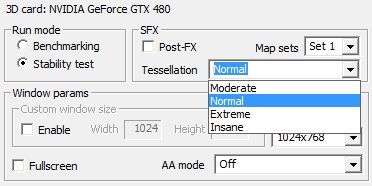
- moderate
- normal
- extreme
- insane
Moderate and normal levels are levels we’ll find in real world applications like games. Extreme and insane levels are reserved for GPU's with much tessellation processing power. We tested today with moderate, normal, and extreme settings to get an indication of the tessellation scaling with each card.


Again with this synthetic tessellation benchmark the nVidia boards are out in front. We already know that this benchmark doesn’t really relate to real world gaming at this point in time, but it is interesting to note.
ShaderToyMark is an OpenGL benchmark, developed with GeeXLab, and focused on pixel shaders only.
In the words of the author … Why ShaderToyMark? Simply because I recently played with the pixel shaders available with Shader Toy, a great WebGL tool for testing GLSL shaders. And I said to myself: that would be nice to see several of these shaders running at the same time in the same 3D window… ShaderToyMark was born.
The contributors of Shader Toy are all famous demomakers and their shaders are real gems. It’s just amazing to see what can clever people do with some sin/cos and other math tricks.

The HD6970 delivers a solid 38 frames per second while the HD6950 falls a little behind at 33 frames per second. This compares favourably with the HD5870 which scores 31 fps, showing a considerable improvement with the new AMD hardware.
Futuremark released 3DMark Vantage, on April 28, 2008. It is a benchmark based upon DirectX 10, and therefore will only run under Windows Vista (Service Pack 1 is stated as a requirement) and Windows 7. This is the first edition where the feature-restricted, free of charge version could not be used any number of times. 1280×1024 resolution was used with performance settings.

The Sapphire HD6970 scores around 21,000 which is over 2,000 points ahead of the HD5870. The HD6950 scores 18,271 points which is over 3,000 points ahead of the HD5850. The new technology is consideraly improved upon the last generation.
3DMark 11 is designed for testing DirectX 11 hardware running on Windows 7 and Windows Vista the benchmark includes six all new benchmark tests that make extensive use of all the new features in DirectX 11 including tessellation, compute shaders and multi-threading.
After running the tests 3DMark gives your system a score with larger numbers indicating better performance. Trusted by gamers worldwide to give accurate and unbiased results, 3DMark 11 is the best way to test DirectX 11 under game-like loads.
If you want to learn more about this benchmark, or to buy it yourself, head over to this page.


CrossFire performance is excellent with two HD6970's scoring 9380 points. Single card scores are much higher than the last generation, with the HD6970 scoring almost 1,000 points more than the HD5870. At the lower scale, the HD6950 scores around 1,200 more points than the HD5850.
HQV Benchmark 2.0 is an updated version of the original tool and it consists of various video clips and test patterns which are designed to evalute motion correction, de-interlacing, decoding, noise reduction, detail enhancement and film cadence detection.
There are two versions of the program, standard definition on DVD and high definition on Bluray. As our audience will be concentrating on HD content so will we.
This has a total of 39 video tests which is increased from 23 in the original and the scoring is also up from a total of 130 to 210. As hardware and software gets more complicated, the software has been tuned to make sure we can thoroughly maximise our analysis.
Read our initial analysis over here.
| Sapphire HD6970 & 6950 | |
|
Dial
|
4 |
| Dial with static pattern | 5 |
| Gray Bars | 5 |
| Violin | 5 |
| Stadium 2:2 | 5 |
| Stadium 3:2 | 5 |
| Horizontal Text Scroll | 5 |
| Vertical Text Scroll | 5 |
| Transition to 3:2 Lock | 5 |
| Transition to 2:2 Lock | 0 |
|
2:2:2:4 24 FPS DVCAM Video
|
5 |
|
2:3:3:2 24 FPS DVCam Video
|
5 |
|
3:2:3:2:2 24 FOS Vari-Speed
|
5 |
|
5:5 FPS Animation
|
5 |
|
6:4 12 FPS Animation
|
5 |
|
8:7 8 FPS Animation
|
5 |
|
Interlace Chroma Problem (ICP)
|
5 |
|
Chroma Upsampling Error (CUE)
|
5 |
|
Random Noise: Sailboat
|
5 |
|
Random Noise: Flower
|
5 |
|
Random Noise: Sunrise
|
5 |
|
Random Noise: Harbour Night
|
5 |
|
Scrolling Text
|
5 |
|
Roller Coaster
|
5 |
|
Ferris Wheel
|
5 |
|
Bridge Traffic
|
5 |
|
Text Pattern/ Scrolling Text
|
5 |
|
Roller Coaster
|
5 |
|
Ferris Wheel
|
5 |
|
Bridge Traffic
|
5 |
|
Luminance Frequency Bands
|
5 |
|
Chrominance Frequency Bands
|
5 |
| Vanishing Text | 5 |
|
Resolution Enhancement
|
15 |
|
Theme Park
|
5 |
| Driftwood | 5 |
|
Ferris Wheel
|
5 |
|
Skin Tones
|
7 |
| Total | 196 |
A very high level of image quality for both HD6970 and HD6950 graphics card.
Aliens V Predator has proved to be a big seller since the release and Sega have taken the franchise into new territory after taking it from Sierra. AVP is a Direct X 11 supported title and delivers not only advanced shadow rendering but high quality tessellation for the cards on test today.
To test the cards we used a 1080p resolution with DX11, Texture Quality Very High, MSAA Samples 1, 16 af, ambient occulsion on, shadow complexity high, motion blur on. We use this with most of our graphics card testing so cards are comparible throughout reviews.

Alien V Predator is based around an intensive Direct X 11 engine and Crossfire scaling is impressive from the AMD boards, with three HD6970's capable of delivering an average of around 133 frames per second. The HD6970 averages 57 frames per second while the HD5870 is 4 frames per second slower. The HD6950 averages 51 frames per second and the HD5850 42 frames per second, a very solid increase indeed.
Far Cry 2 (commonly abbreviated as “FC2 or “fc2″) is an open-ended first-person shooter developed by Ubisoft Montreal and published by Ubisoft. It was released on October 21, 2008 in North America and on October 23, 2008 in Europe and Australia. It was made available on Steam on October 22, 2008. Crytek, the developers of the original game, were not involved in the development of Far Cry 2.
Ubisoft has marketed Far Cry 2 as the true sequel to Far Cry, though the sequel has very few noticeable similarities to the original game. Instead, it features completely new characters and setting, as well as a new style of gameplay that allows the player greater freedom to explore different African landscapes such as deserts, jungles, and savannas. The game takes place in a modern-day East African nation in a state of anarchy and civil war. The player takes control of a mercenary on a lengthy journey to locate and assassinate “The Jackal,” a notorious arms dealer.
Far Cry 2 is still a popular game and the open world environment can be taxing on even the latest hardware available today.
Settings: 1920×1200, D3D10, Disable Artificial Intelligence(No), Full Screen, Anti-Aliasing(8x), VSync(No), Overall Quality(Ultra High), Vegetation(Very High), Shading(Ultra High), Terrain(Ultra High), Geometry(Ultra High), Post FX(High), Texture(Ultra High), Shadow(Ultra High), Ambient(High), Hdr(Yes), Bloom(Yes), Fire(Very High), Physics(Very High), RealTrees(Very High)

With the latest generation of AMD hardware, we are finding improvements with this particular engine. The HD6970 for instance shows almost an 11 percent improvement in frame rate when compared to the HD5870. Similarily, the HD6950 shows a 24 percent improvement when compared to the HD5850 of the last generation.
Resident Evil 5, known in Japan as Biohazard 5, is a survival horror third-person shooter video game developed and published by Capcom. The game is the seventh installment in the Resident Evil survival horror series, and was released on March 5, 2009 in Japan and on March 13, 2009 in North America and Europe for the PlayStation 3 and Xbox 360. A Windows version of the game was released on September 15, 2009 in North America, September 17 in Japan and September 18 in Europe. Resident Evil 5 revolves around Chris Redfield and Sheva Alomar as they investigate a terrorist threat in Kijuju, a fictional town in Africa.
Within its first three weeks of release, the game sold over 2 million units worldwide and became the best-selling game of the franchise in the United Kingdom. As of December, 2009, Resident Evil 5 has sold 5.3 million copies worldwide since launch, becoming the best selling Resident Evil game ever made.

This Direct X 10 engine has always been a good performer with AMD hardware and we can see that the HD6970 outperforms the GTX570 by three frames per second. The Sapphire HD6950 outperforms the HD5850 by 24 percent and the overclocked GTX460 by 36 percent.
Tom Clancy’s H.A.W.X. 2 is an arcade-style flight action game developed by Ubisoft Romania and published by Ubisoft. After the events of the first game, the H.A.W.X squadron is sent to Middle East, where a high level of violence is being registered, and the appearance of various insurgents leaders in various hotspots. The team also has to investigate the mysterious disappearance of Russian nuclear weapons. The player will be controlling three groups: one American (Hunter), one British (Munro) and one Russian (Sokov), each with its own pilots and supporting characters. There will also be references to other characters in the Tom Clancy universe.
We are testing in full DX11 mode with all settings to maximum.

As we mentioned before, this particular engine seems to be optimised to run much better on nVidia hardware. Getting realistic performance levels from this title is impossible, as the GTX570 shows to be faster than two HD6950's in CFx. Not indicative of the other game tests at all. We are hoping that AMD can improve the performance of this game with future driver releases.
Mafia II is a gritty drama which chronicles the rise of World War II veteran Vito Scaletta, the son of Sicilian immigrants. As the game progresses, Vito will join the Falcone Crime Family and become a made man. There are 15 chapters in the game, connected into one storyline.
We tested at 2560×1600 with fullscreen: on, antialiasing:on , Anisotrophic filtering: 16x, Shadow Quality: High, Ambient Occlusion: on, Geometry Detail: High and APEX PhysX: medium.

While we generally test Mafia 2 with physX disabled we felt with the newer hardware that a change was due. nVidia hardware clearly runs better with physX enabled. Very few of the cards on test however can handle this game with our settings and maintain 25+ frame rates throughout.
Lost Planet 2 is a third-person shooter video game developed and published by Capcom. The game is the sequel to Lost Planet: Extreme Condition which is also made by Capcom, taking place ten years after the events of the first game, on the same fictional planet. The story takes place back on E.D.N. III 10 years after the events of the first game. The snow has melted to reveal jungles and more tropical areas that have taken the place of more frozen regions. The plot begins with Mercenaries fighting against Jungle Pirates.
After destroying a mine, the Mercenaries continue on to evacuate the area, in which a Category-G Akrid appears and attacks them. After being rescued, they find out their evacuation point (Where the Category-G appeared) was a set-up and no pick up team awaited them. Lost Planet 2 runs on the MT-Framework 2.0, an updated version of the engine used in several Capcom-developed games.
We are testing in DX11 mode with all settings on the highest. Direct X 11 features are on high.

Lost Planet 2 is a rather dull game to play, but the Direct X 11 engine is a great test of modern hardware. The HD6970 and HD6950 scale fairly well in CFx and CFx 3 configurations. The HD6970 performs 8 fps better than the HD5870 at the same settings. Of particular note is the massive 74 percent performance increase when moving from the HD5850 to the HD6950.
F1 2010 is a video game based on the 2010 season of the Formula One world championship. It is the sequel to the 2009 video game based on the same series. It was released in September 2010 on the Xbox 360, PlayStation 3 and Microsoft Windows platforms. The game was confirmed by Codemasters on 23 April 2009. The game engine is based on the new EGO 1.5 engine, an unofficially titled evolution of the EGO 1.0 engine that was created specially for the title.
We are testing across three screens with 4aa and 8af enabled and ultra quality settings in DX11 mode.

Both cards manage to maintain playable frame rates at these settings, across three screens. We did notice a little juddering from time to time from the HD6950 and the AA settings might need dropped a little to push the minimum frame rate a little higher.
Colin McRae: Dirt 2 (known as Dirt 2 outside Europe and stylised, DiRT) is a racing game released in September 2009, and is the sequel to Colin McRae: Dirt. This is the first game in the McRae series since McRae’s death in 2007. It was announced on 19 November 2008 and features Ken Block, Travis Pastrana, Tanner Foust, and Dave Mirra. The game includes many new race-events, including stadium events. Along with the player, an RV travels from one event to another, and serves as ‘headquarters’ for the player. It features a roster of contemporary off-road events, taking players to diverse and challenging real-world environments. The game takes place across four continents: Asia, Europe, Africa and North America. The game includes five different event types: Rally, Rallycross, ‘Trailblazer,’ ‘Land Rush’ and ‘Raid.’ The World Tour mode sees players competing in multi-car and solo races at new locations, and also includes a new multiplayer mode.
We are testing across three screens in Direct X 11 mode with 4aa and 16af enabled. All settings are switched to high.

The best playable settings for this resolution are 4aa and 16af, with both cards managing to keep the frame rates above 25 at all times.
Crysis Warhead, like the original Crysis, is set in the near future when an ancient alien spacecraft is discovered on an island east of the Philippines. The single-player campaign has the player assume the role of former SAS Delta Force operator Sergeant Michael Sykes, referred to in-game by his call sign, Psycho. Psycho’s arsenal of futuristic weapons builds on those showcased in Crysis, with the introduction of Mini-SMGs which can be dual-wielded, a six-shot grenade launcher equipped with EMP grenades, and the destructive, short ranged Plasma Accumulator Cannon (PAX). The highly versatile Nanosuit returns. In Crysis Warhead, the player fights North Korean and extraterrestrial enemies, in many different locations, such as a tropical island jungle, inside an “Ice Sphere”, an underground mining complex, which is followed by a convoy train transporting an unknown alien object held by the North Koreans, and finally, to an airfield.
The engine is still a system killer, all these years later, but modern day hardware can finally generate the frame rates we wanted when it was released !

With a single card, the game can get a little juddery at these settings. Adding another card cures the frame rate problems. The HD6970 is definitely a better card for this particular engine.
Lost Planet 2 is a third-person shooter video game developed and published by Capcom. The game is the sequel to Lost Planet: Extreme Condition which is also made by Capcom, taking place ten years after the events of the first game, on the same fictional planet. The story takes place back on E.D.N. III 10 years after the events of the first game. The snow has melted to reveal jungles and more tropical areas that have taken the place of more frozen regions. The plot begins with Mercenaries fighting against Jungle Pirates.
After destroying a mine, the Mercenaries continue on to evacuate the area, in which a Category-G Akrid appears and attacks them. After being rescued, they find out their evacuation point (Where the Category-G appeared) was a set-up and no pick up team awaited them. Lost Planet 2 runs on the MT-Framework 2.0, an updated version of the engine used in several Capcom-developed games.
We are testing in DX11 mode with all settings lowered from single screen testing earlier.

Again, in single card mode this engine proves too much for both cards with frame rates often dropping below 25 fps. If you want to game with this engine at 5760 resolution then you are going to need a CrossfireX system.
Metro 2033 is an action-oriented video game with a combination of survival horror and first-person shooter elements. The game is based on the novel Metro 2033 by Russian author Dmitry Glukhovsky. It was developed by 4A Games in Ukraine and released in March 2010 for the Xbox 360 and Microsoft Windows.
The game utilizes multi-platform 4A Engine, running on Xbox 360, PlayStation 3, and Microsoft Windows. There is some contention regarding whether the engine is based on the pre-release X-Ray engine (as claimed by Sergiy Grygorovych, the founder of GSC Game World, as well as users who have seen the 4A Engine SDK screenshots, citing visual similarities, shared resources, and technical evaluation of the pre-release 4A Engine demo conducted at the request of GSC Game World), or whether the engine is an original development (as claimed by 4A Games and Oles’ Shiskovtsov in particular) who claims it would have been impractical to retrofit the X-ray engine with console support). The PC version includes exclusive features such as DirectX 11 support and has been described as “a love letter to PC gamers” because of the developers’ choice “to make the PC version [especially] phenomenal”.

The Metro 2033 engine is extremely demanding and with a single HD6970 the frame rate can drop below the smooth 25 fps figure. If you can afford another card then the game is transformed completely at these settings, delivering a smooth, immersive experience.
Left 4 Dead 2 is a cooperative first-person shooter game. It is the sequel to Valve Corporation’s award-winning Left 4 Dead.
Like the original, Left 4 Dead 2 is set during the aftermath of an apocalyptic pandemic, and focuses on four survivors fighting against hordes of the infected. The survivors must fight their way through levels, interspersed with safe houses that act as checkpoints, with the goal of reaching a rescue vehicle at the campaign’s finale. The gameplay is procedurally altered by an artificial intelligence engine dubbed the “Director” that monitors the players’ performance and adjust the scenario to provide a dynamic challenge. Several new features have been introduced: new types of infected, melee weapons, and a story-arc that connects the game’s five campaigns together.

A single HD6950 delivers enough power to handle this game at 5760 with all the eye candy cranked. Crossfire scaling is very good, with the HD6970 minimum frame rate improving from 46fps to 74 fps.
BattleForge is a video game developed by EA Phenomic and published by Electronic Arts. It was released on Windows in March 2009. A demo was released in the same month. BattleForge is a card based RTS. It revolves around trading, buying and winning through means of micro-transactions. Micro-transactions are not required for playing the game, only for buying new cards.
It supports DirectX 11 providing full support for hardware tesselation.

The HD6950 manages to keep the game perfectly smooth throughout most of the test run, only dropping below 25fps on one occasion. The HD6970 on the other hand doesn't experience the same drop into the danger zone, maintaining the rate at 27fps or higher.
Medal of Honor’s single-player campaign uses a heavily-modified version of Unreal Engine 3, and its multiplayer uses the Frostbite Engine. The single player campaign takes place in 2002 in Afghanistan.
For half of the game, players assume the role of a DEVGRU operator codenamed “Rabbit”, of AFO Neptune. For the remainder, the player alternates between the roles of a Delta Force sniper code-named “Deuce”, of AFO Wolfpack, as well as Army Ranger Specialist Dante Adams of the 75th Ranger Regiment, and AH-64 Apache gunner Captain Brad “Hawk” Hawkins.

Both HD6950 and HD6970 can handle this engine at 5760 maintaining a frame rate of 30fps or higher all the time. This is a great result for the AMD hardware.
Devil May Cry 4 is an action game that was published and developed by Capcom in 2008 for the Xbox 360, PlayStation 3 and Windows platforms. The game is the fourth installment to the Devil May Cry series.
In the game, the player controls both Nero and Dante, the game’s protagonist and the series’ title character as they fight enemies in close combat using firearms, swords, and other weapons. The characters Lady and Trish from previous games in the series makes an appearance, along with new characters Nero, Kyrie, Credo, Gloria, and Agnus. The game is set after Devil May Cry but before Devil May Cry 2.
We used Super high settings with HDR on high and 8aa and 16af to improve the image quality as much as possible.

Both cards can easily power through this title across a three screen resolution even with the settings maxed out. The frame rate was often above fifty for both cards, only dipping into the 40-50 zone a few times.
The tests were performed in a controlled air conditioned room with temperatures maintained at a constant 25c – a comfortable environment for the majority of people reading this.
Idle temperatures were measured after sitting at the desktop for 30 minutes. Load measurements were acquired by playing Crysis Warhead for 30 minutes and measuring the peak temperature. We also have included Furmark results, recording maximum temperatures throughout a 30 minute stress test. All fan settings were left on automatic.

Exact same results as the other cards we have reviewed before. Both cards generally maintain an average of around 73-75c when gaming, which rises to over 80c when Furmark primed. The 5th generation Vapor Chamber is actually pretty good considering the performance levels.
We then measured the temperature changes when running both HD6950 and HD6970 in our Crossfire configurations.


As the HD6970s in CFx three way are so close together, the heat levels rise significantly. The fans speed up trying to maintain sub 100c temperatures. We will look into the noise levels later. In closing however we would strongly recommend a high level of case airflow with a CFx three way configuration.
Recently we have changed our method of measuring noise levels. We have built a system inside a Lian Li chassis with no case fans and have used a fanless cooler on our CPU. We are using a heatpipe based passive power supply and an Intel SSD to keep noise levels to a minimum. The motherboard is also passively cooled. This gives us a build with completely passive cooling and it means we can measure noise of just the graphics card inside the system when we run looped 3dMark tests. Ambient noise in the room is around 20-25dBa. We measure from a distance of around 1 meter from the chassis and 4 foot from the ground to mirror a real world situation.
Why do this? Well this means we can eliminate secondary noise pollution in the test room and concentrate on only the video card. It also brings us slightly closer to industry standards, such as DIN 45635.
We load the card with FurMark.
KitGuru noise guide
10dBA – Normal Breathing/Rustling Leaves
20-25dBA – Whisper
30dBA – High Quality Computer fan
40dBA – A Bubbling Brook, or a Refridgerator
50dBA – Normal Conversation
60dBA – Laughter
70dBA – Vacuum Cleaner or Hairdryer
80dBA – City Traffic or a Garbage Disposal
90dBA – Motorcycle or Lawnmower
100dBA – MP3 player at maximum output
110dBA – Orchestra
120dBA – Front row rock concert/Jet Engine
130dBA – Threshold of Pain
140dBA – Military Jet takeoff/Gunshot (close range)
160dBA – Instant Perforation of eardrum

The cooler is reasonably good, although both can be heard when fully stressed in Furmark. Adding another raises the noise a little in both configurations.
In three way CFx, the noise levels are extremely high, due to the close proximity and raised ambient temperatures (to over 100c). We recorded around 60 dBa when all three cards were running 3dMark 11.
To test power consumption today we are using a Keithley Integra unit and we measure power consumption from the VGA card inputs, not the system wide drain. The best way to get maximum load results is by using Furmark, and even though it is not indicative of a real world situation it shows the limits the card can theoretically demand. The ‘gaming’ results are measured when playing Crysis Warhead and is a more valuable result to take from this.

If you plan on running the HD6970 in 3 way CFx then be prepared to upgrade the power supply. The demands are high, to match the stunning levels of performance.
To overclock the Sapphire cards, we used the Sapphire TRIXX overclocking tool. We use this all the time and it is one of the best pieces of software available for AMD users.
We managed to get the Sapphire HD6970 to 960mhz on the core and 1475mhz on the memory (5900mhz effective) and the Sapphire HD6950 to 850mhz on the core and 1450mhz on the memory (5800mhz effective). Very similar results to the other cards we have tested recently.

The HD6970 overclocked delivers fantastic performance increases with the Unigine Benchmark, actually surpassing the performance of the HD5870's in CFx. This is a good indication of the hardware tessellation improvements we noted earlier in the architectural section of the review.
Temperatures of both cards rose by around 3 C under load when overclocked.
The Sapphire HD6970 and HD6950 are high performing graphics cards based on the same reference design as all other AMD partner solutions right now. It will be a couple more weeks before we get our hands on the sexy customised overclocked editions with enhanced coolers. KitGuru knows you are dying to see the Toxic or VaporX Editions from Sapphire, but patience will be rewarded.
While many enthusiast users appear to have been slightly disappointed with the new 6900 range it really is worth looking at the price points that AMD's partners are achieving.
When the HD5870 was first released, it cost £320 inc vat, the HD6970 is £280 inc vat. As we have noted in our test results, the HD6970 is not only cheaper, but it is usually between 10% and 30% faster. Unigine Heaven Benchmark shows a single overclocked HD6970 is faster than two HD5870's in CrossfireX, a good indication that AMD's architectural changes have enhanced the performance throughput to the next level.

As our scaling chart shows, there is up to a 58.9% improvement from the new HD6970 when compared directly to the last generation single chip leader, the HD5870. The HD6970 is retailing for 15% less on launch as well. 2010 is a very good year to be buying a high end video card.

Sapphire's Special Edition HD6970 card costs £330 inc vat, and for the extra money you get a very high quality aluminum briefcase, a comprehensive bundle of extras, and a free copy of Battlefield: Bad Company 2 and the Vietnam addon, which is worth £50. As a Limited Edition collectors item its certainly worth the premium but if the aluminum briefcase holds no interest to you, then save the money and go for the Gamer's Edition. Sapphire also informed us that SSC members get a free copy of the Vietnam addon if they buy the full game.
Moving down the performance scale a little and we can see that the same performance principle applies to the HD5850 v HD6950. When the HD5850 was released it cost £250 inc vat, the HD6950 is £220 inc vat – about 14% less expensive on launch. Yet again, this card is significantly faster than the last generation part.

The HD6950 shows huge scaling improvements when placed side by side against the HD5850. Up to 74% in Lost Planet and a good indication of the improvements in Direct X 11 gaming due to the architectural advancements.
The new cards are hard to fault, the power consumption is great. Two HD6950's in CrossfireX consume under 300 watts when gaming for instance. A CFx setup won't need a high end power supply and the performance headroom easily supports gaming across three screens at 5760×1080.
Finally, this is another area where the AMD hardware scores incredibly well – multi screen gaming. nVidia are far behind right now and unless you are perfectly happy with a single monitor then the HD6900 cards prove much better value. For only £300 you can pick up two 24 inch monitors. If you owned a GTX570, then this £300 would need invested into another card, before you even started shopping for two new screens.
KitGuru says: The Sapphire cards are as good as we have seen to date, and we particularly like the HD6970 Special Edition Bundle from Sapphire.




I gotta say man, I dont know how you continually produce reviews of this quality on an almost daily basis. fantastic article.
Sapphire are the boards to get, either them or XFX, but I like that aluminum case, might be handy for my camera odds and ends 🙂
Absolutely brilliant. I like this new range from AMd anyway, not sure why the negative vibes are being seen by some people. its all about the price.
I think its a nice idea when you can’t release a card with a custom cooler due to AMD launch restrictions. Ship it in a cool aluminum box. Nice job Sapphire, well worth the extra. id use that for my collection of playing cards :p
mega review. and more mega products from the best company on the planet 🙂 I still want a 1100T though, what first !?
my plan for 2011 is this.
Get my credit card cleared. Get another 24 inch screen, then get a 6950 for 3 screen heaven. Might be May by the time it happens, but thats the plan.
Ok, I have a question for all you AMD fanboys. Have the catalyst drivers improved any? last time I used these cards (few years ago) they were terrible.
tempting, but im willing to spend £320 on a sapphire special cooler version without the aluminum box 🙂 fingers crossed the 6970 appears after christmas. I can wait until then, ill be drunk for two weeks anyways.
Its pretty good value, one of those cases is around £50 to buy in a photography store. not sure about cutting holes into the padding however, that might be tricky
We need a poll to find out the percentage of readers here who use a 3 screen setup. id be surprised if its more than 5%. even a poll asking how many people might be thinking of it next year. seems a lot of money to me still.
The pricing on scan is very high http://www.scan.co.uk/Search.aspx?q=sapphire+HD6970
The pricing went up earlier. http://www.overclockers.co.uk/showproduct.php?prodid=GX-255-SP&groupid=701&catid=56&subcat=1752
I am all for the HD6970 at 280-300, but once it hits 340, its only 50 less than the GTX580 which is much more powerful.
Mark it may be 340, but its extra for the case with this edition. The GTX580 is still around 420 inc vat in UK.
Actually ive seen it for £400. same one they reviewed on Kitguru http://www.yoyotech.co.uk/item-detail.php?products_id=4370825
The 6950 impresses me more as I have a 5850 and ive never seen the performance improvements broken down like that so clearly. It is a hell of a price. 220 is affordable, but 340 is a significant payment for a GFX. Might look into one once I sort out the missus and kids at xmas.
This is the best deal ive seen right now for a 6970 http://www.overclockers.co.uk/showproduct.php?prodid=GX-148-OK&groupid=701&catid=56&subcat=1752
I dig this concept from Sapphire, but for reference cooling? ill pass. surely their vapor or toxic cards are due in jan. before the 6990.
When is the game out? (vietnam), due in a day or two isnt it ?
3 in CFx looks awesome lol. bit expensive though. bit hot too !
50 quids worth of game is very good. Means the metal box is free.
I just orrdered this. Was going to buy the game at Christmas and the add-on. And I need a new card, I’ll pay it off in installments!
Nice to see the improvements from the last gen. Quite big too
6970 is Better value than 570, I only need one more screen then I will upgrade
I’m already on 6970 cfx and it’s brilliant.
Cant wait to get this game, my christmas is sorted
Only thing that puts me off is the noise. I’m waiting on the heatpioe versions, like powercolors modded ones
Very good review, found it educational too. Never knew just how much they have been improved. One site i read said the 6970 was slower than 580 so it basically sucked
It’s almost April 2011, the 6990 series is out and still no 6970 TOXIC or VAPOR cards.
Close to losing all faith in Sapphire.