KitGuru KitGuru.net – Tech News | Hardware News | Hardware Reviews | IOS | Mobile | Gaming | Graphics Cards


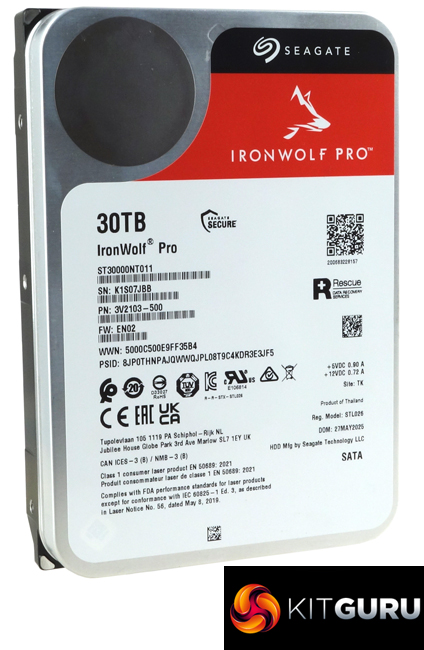
The latest drive to join Seagate's IronWolf Pro family of hard drives is the new flagship 30TB model. Designed for use in multi-bay commercial and enterprise RAID solutions, the IronWolf Pro comes with a feature set which includes HAMR (Heat-Assisted Magnetic Recording).
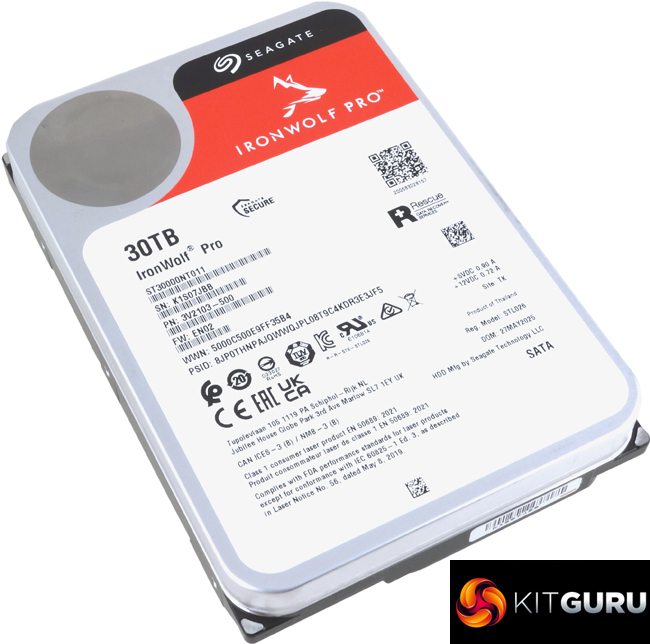
Seagate's flagship 30TB IronWolf Pro (ST30000NT011) is a CMR (Conventional Magnetic Recording) drive using Helium technology, but to achieve the high areal density of the platters, it also employs Seagate's HAMR (Heat-Assisted Magnetic Recording). Seagate has managed to cram 10 3TB platters and 20 heads into a 3.5-inch format drive with a height of just 26.11mm. The drive has a spindle speed of 7,200rpm and uses 512MB of cache. Seagate quotes an official maximum transfer rate of 275MB/s while the average latency is quoted at 4.16ms.
Seagate quotes power ratings for the 30TB IronWolf Pro as 8.3W for average operating (which is only 0.6W more than the last IronWolf Pro we looked at, the 20TB model) and 6.8W average idle. For standby and sleep, the drive is rated at 1.2W.
The official workload rating of the drive is 550TB/year with an MTBF of 2.5M hours, and Seagate backs the drive with a 5-year warranty.
Physical Specifications:
- Usable Capacities: 30TB.
- Spindle Speed: 7,200rpm.
- No. Of Heads: 20.
- No. Of Platters: 10.
- Cache: 512MB.
- Recording Method: Conventional Magnetic Recording (CMR) / HAMR (Heat-Assisted Magnetic Recording).
- Interface: Serial ATA (SATA) 6Gb/s (SATA III).
- Form Factor: 3.5in.
- Dimensions: 26.11 x 101.85 x 146.99mm.
- Drive Weight: 695g.
- Firmware Version: EN02.
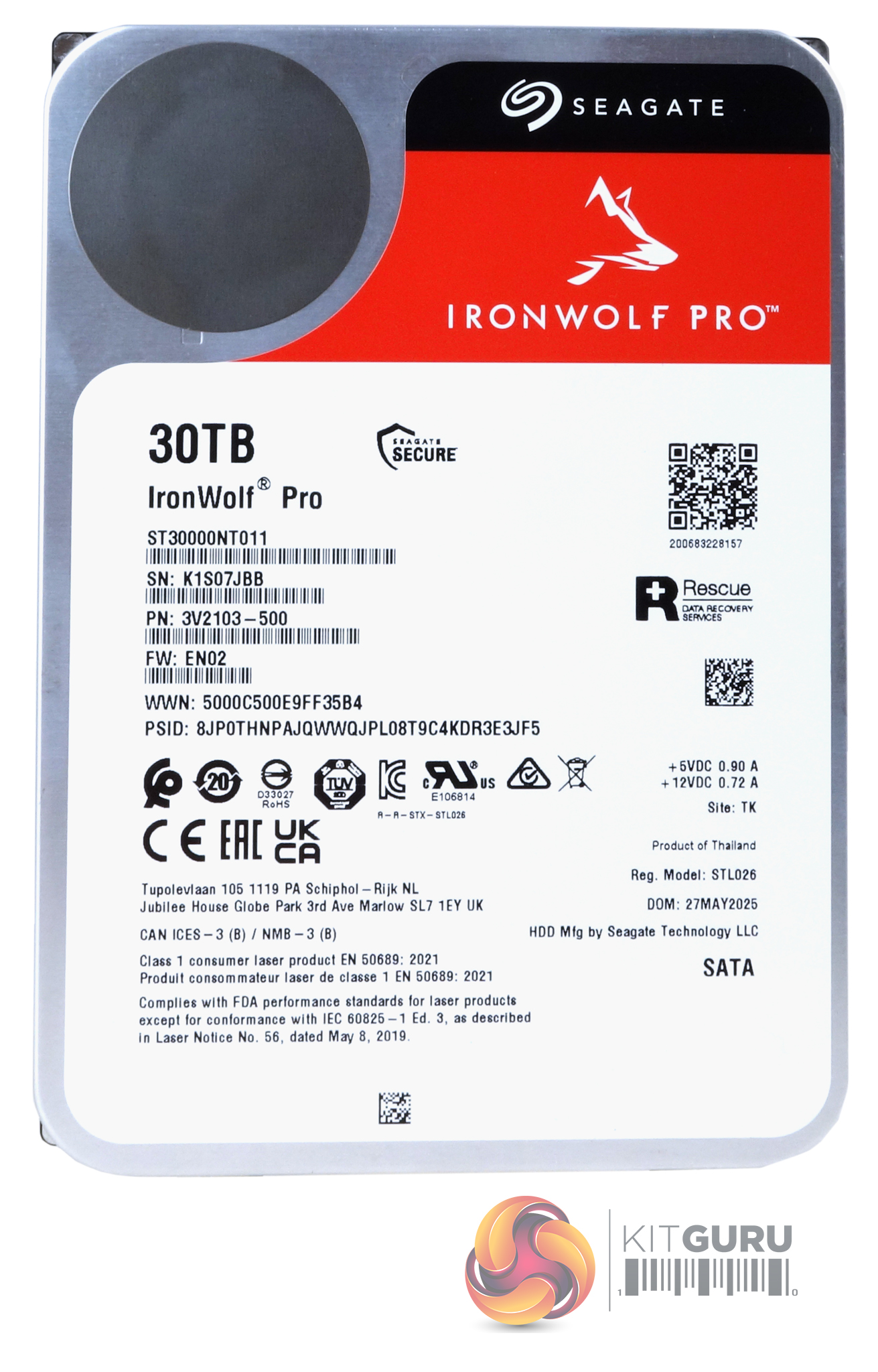
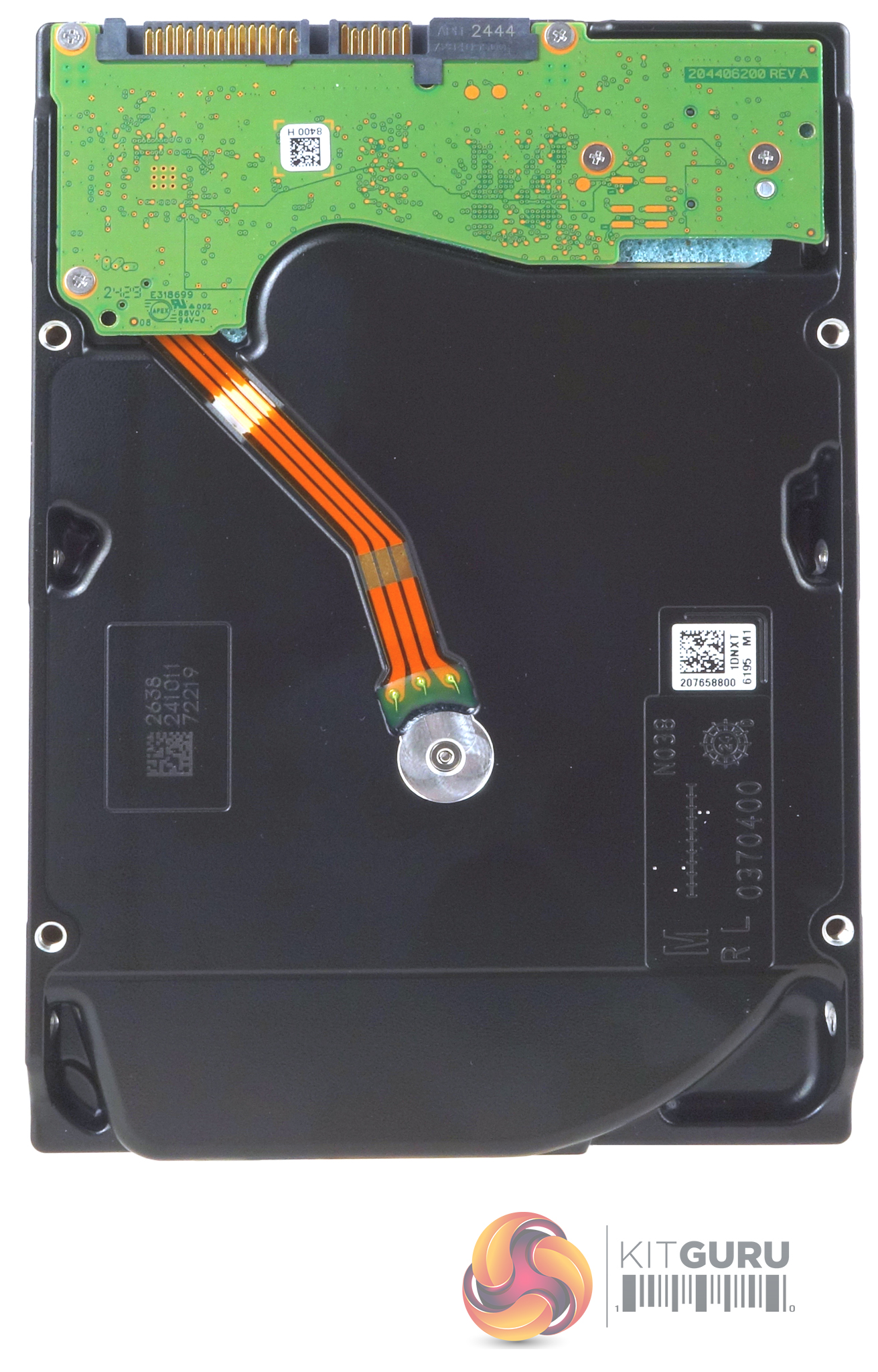
Our review sample, IronWolf Pro 30TB, was supplied to us without any retail packaging. The IronWolf Pro 30TB is built on a standard 3.5-inch format but with a thickness of 26.11mm. The drive has a spindle speed of 7,200rpm and there is 512MB of cache.
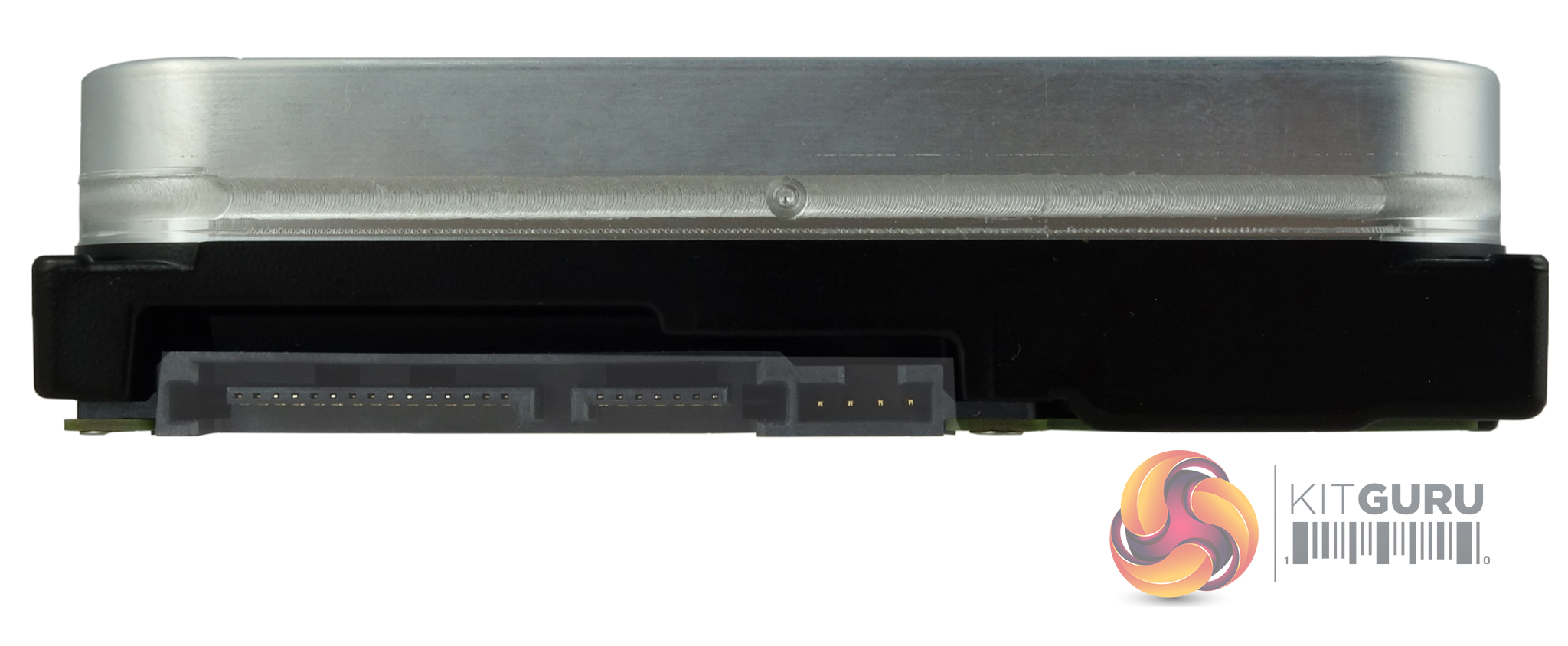
The CMR (Conventional Magnetic Recording) Helium drive is built on Seagate's Mosaic 3+ platform, which implements the second generation of the company's HAMR (Heat-Assisted Magnetic Recording) technology, enabling the high areal density (1857Gb/in²) platters that the drive uses. Seagate's Mozaic 3+ technology has been designed from the ground up to push the boundaries of how much storage space can be offered in a standard 3.5-inch platform by increasing the areal density of platters to new heights by using leading-edge technologies.
Superlattice platinum-alloy media
To get 3TB+ platter capacity, there has to be a move away from the traditional materials that were used in the past to something more exotic that allows for denser writing of data. Seagate's Mozaic 3+ technology uses Superlattice platinum-alloy media, which gets over the obstacle of magnetic instability at the nanoscale level, a by product of trying to store ever denser data. The platinum alloy recording media is made up of highly magnetic platinum (Pt) and iron (Fe) particles.
Plasmonic Writer
To prevent data instability, the platinum-alloy media is magnetically harder, which means it needs a completely new approach to writing the data – enter the Plasmonic writer. The writer is made up of three major elements:-
Nanophotonic laser
Produces a focused beam of light to heat up (800º + Fahrenheit) an area of the platinum-alloy media in less than two nanoseconds.
Photonic funnel
Channels the laser light from the laser to the quantum antenna
Quantum antenna
This focuses the laser's energy to a tiny spot on the media surface
So, having written incredibly dense data, the next challenge is to read it, that's where the Gen 7 spintronic reader comes in.
Gen 7 Spintronic Reader
Seagate's Spintronic Reader is one of the world's smallest and most sensitive magnetic field reading sensors, capable of detecting minute changes in magnetisation. It can accurately read the densely packed data thanks to its very narrow track width, which helps minimise crosstalk errors from neighbouring tracks.
With all this going on, you need something to take control of it all, and that's where Seagate's 12nm integrated controller comes in, an in-house SOC that looks after read channels, disk management, and data exchange protocols. It features the first ever RISC-V processor to be used to control a hard drive, also designed in-house by Seagate.
For testing, the drives are all wiped and reset to factory settings by HDDerase V4. We try to use free or easily available programs and some real-world testing so you can compare our findings against your own system.
This is a good way to measure potential upgrade benefits.
Main system:
AMD Ryzen 5 3600X, 32GB DDR4-3200, Sapphire R9 390 Nitro and a Gigabyte B550 AORUS Master motherboard.
Other drives
Seagate NAS 8TB
Seagate Exos X16 16TB
Seagate Exos X14 14TB
Seagate Exos X20 20TB
Seagate IronWolf Pro 14TB
Seagate BarraCuda Pro 12TB
Seagate IronWolf Pro 12TB
Seagate IronWolf Pro 18TB
Seagate IronWolf Pro 20TB
Seagate IronWolf 10TB
Toshiba MG10AFA22TE 22TB
Toshiba MG10ACA20TE 20TB
Toshiba MG08ACA16TE 16TB
Toshiba N300 8TB
Toshiba NAS N300 14TB
Toshiba P300 3TB
Toshiba X300 6TB
WD Gold 12TB
WD Black 6TB
WD Black 4TB
WD Red Pro 22TB
WD Red Pro 20TB
WD Red 4TB
WD Red 8TB
Software:
Atto Disk Benchmark.
CrystalMark 6.0.0.
IOMeter
All our results were achieved by running each test five times with every configuration, which ensures that any glitches are removed from the results.
The ATTO Disk Benchmark performance measurement tool is compatible with Microsoft Windows. Measure your storage system's performance with various transfer sizes and test lengths for reads and writes. Several options are available to customise your performance measurement, including queue depth, overlapped I/O and even a comparison mode with the option to run continuously.
Use ATTO Disk Benchmark to test any manufacturer's RAID controllers, storage controllers, host adapters, hard drives and SSD drives and notice that ATTO products will consistently provide the highest level of performance to your storage.
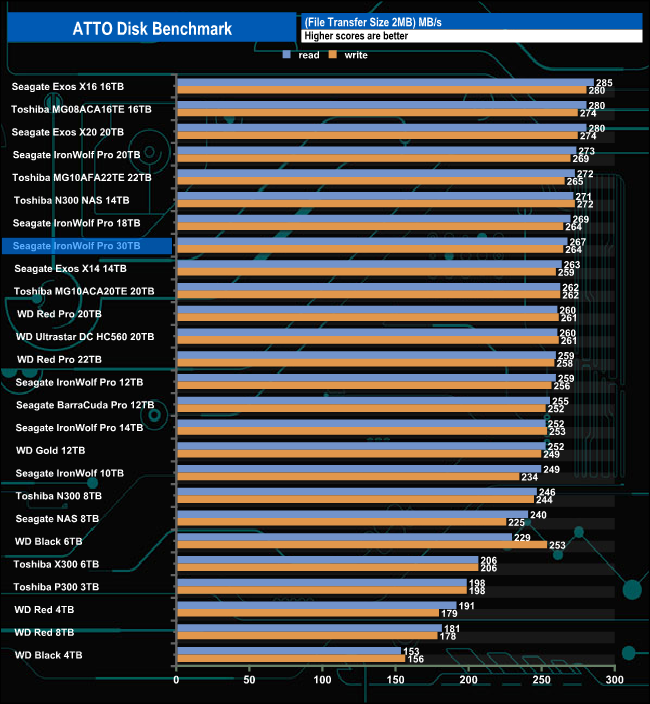
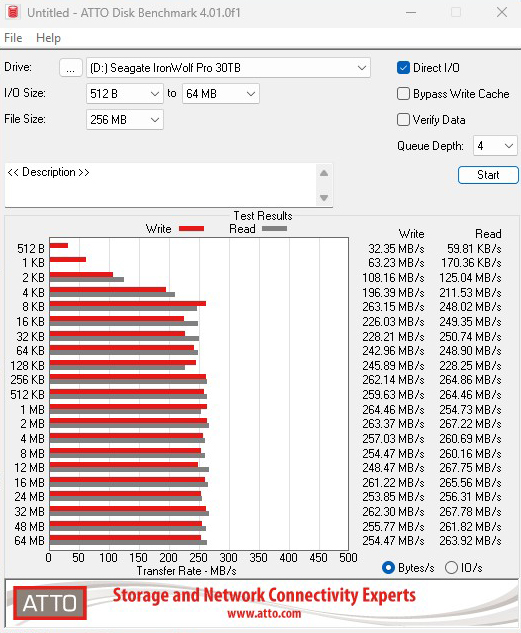
With the ATTO benchmark, we couldn't quite hit the maximum official transfer rate of 275MB/s with read/write results of 267MB/s and 264MB/s, respectively.
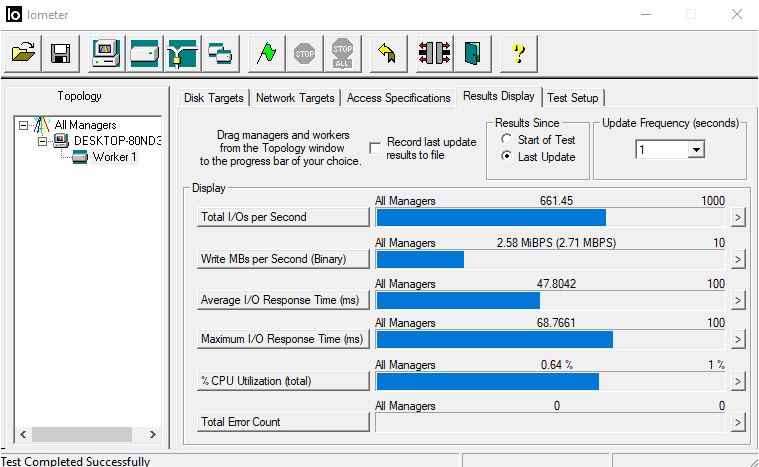
IOMeter is another open-source synthetic benchmarking tool which is able to simulate the various loads placed on a hard drive and solid-state drive technology.
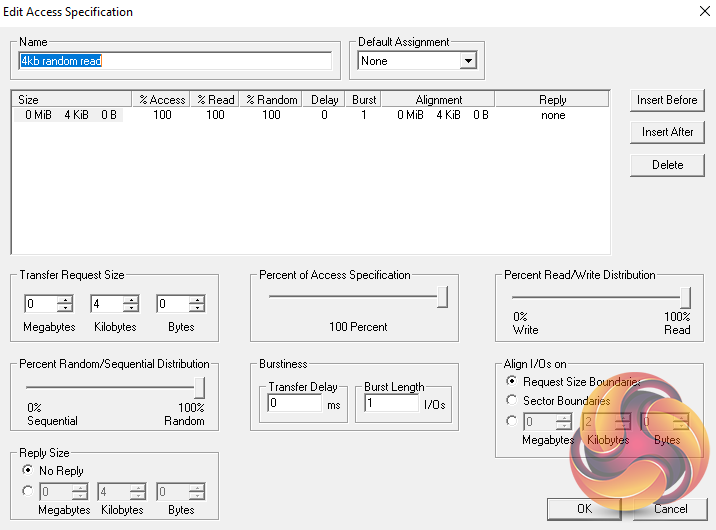
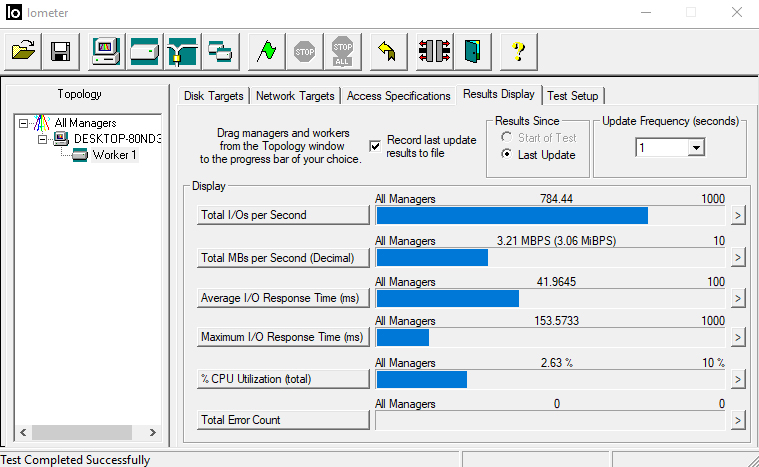
We test with both random read and write 4k tests, as shown above. There are many ways to measure the IOPS performance of a hard drive, so our results will sometimes differ from the manufacturer’s quoted ratings. We do test all drives in exactly the same way, so the results are directly comparable.
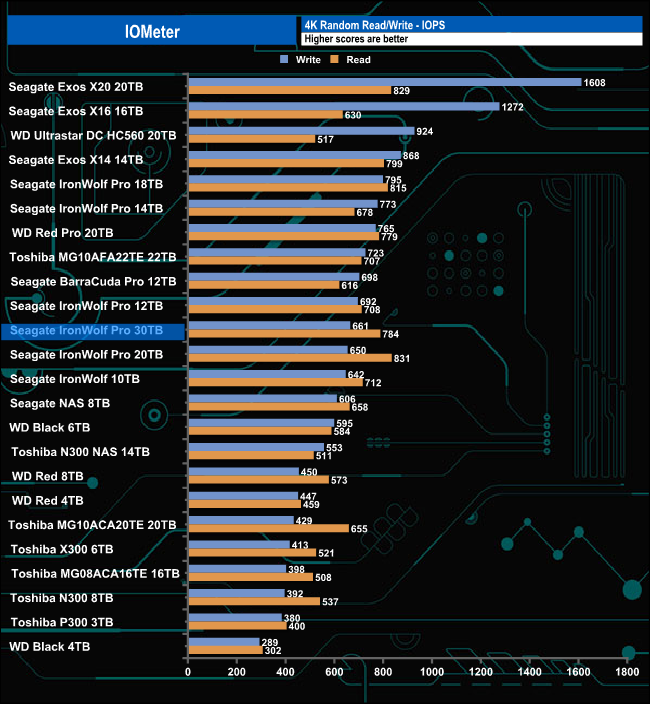
In our 4K random read/write test, the drive produced a write figure of 661 IOPS, which is slower than some other capacities of the IronWolf Pro we've tested. However, its read result of 784 IOPS is one of the fastest we've seen to date for an HDD.
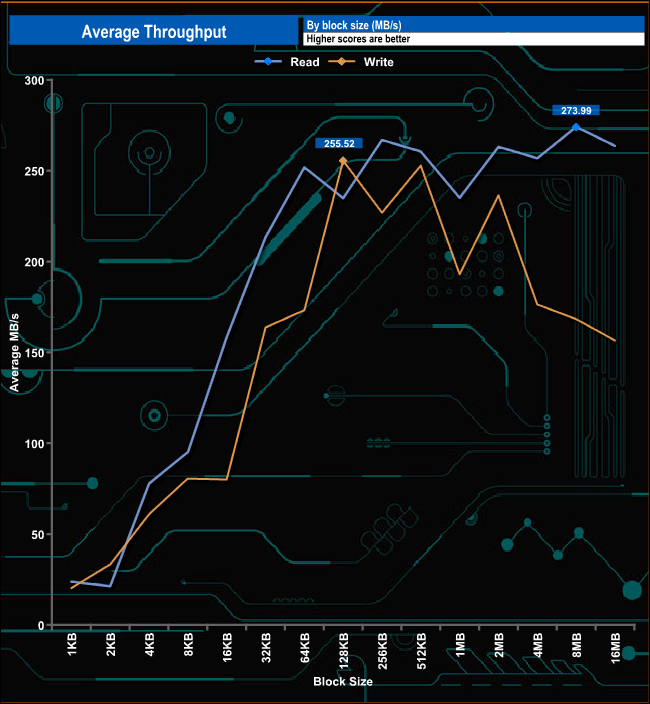
In our throughput tests, the 30TB IronWolf Pro peaked on the read run at 273.99MB/s, just shy of the official maximum of 275MB/s. Writes were further back at peaking at 255MB/s before falling away as the block size deepened.
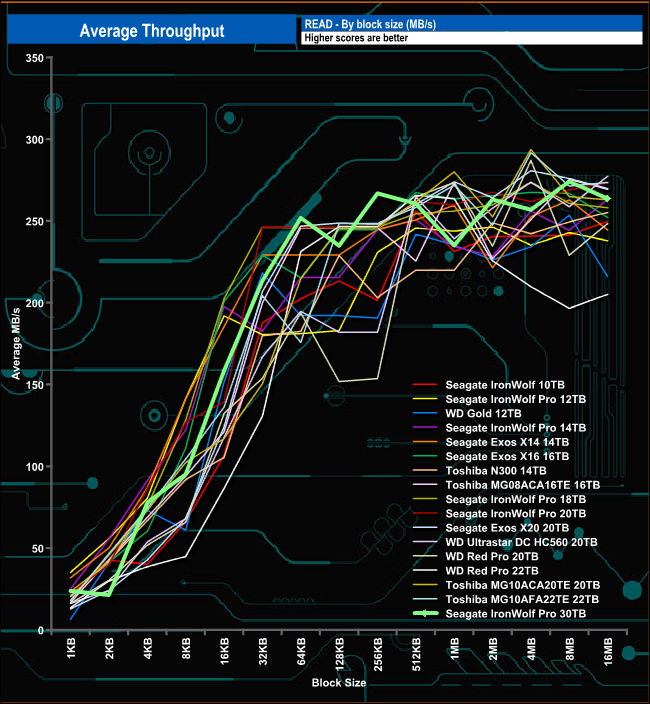
In the read throughput test, the drive peaked at the 8MB block mark at 273.991MB/s before falling back slightly at the end of the test run.
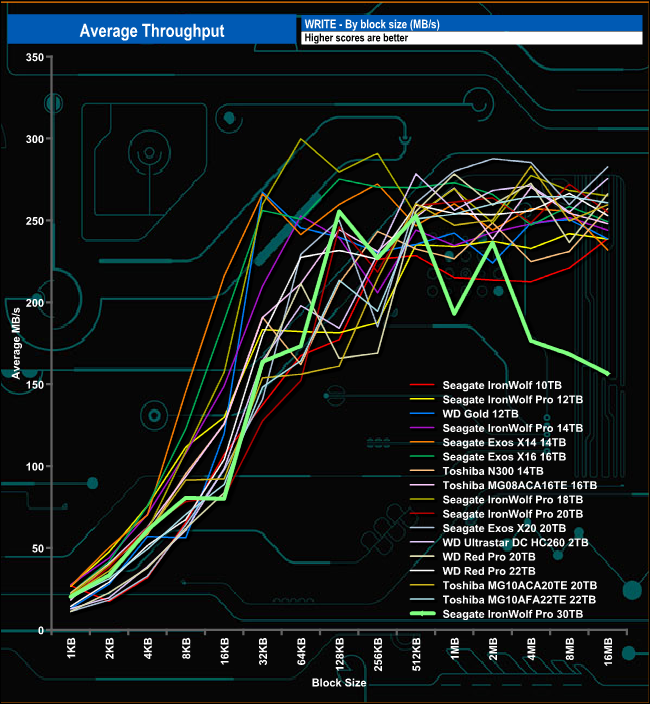
In the write throughput test, the 30TB IronWolf Pro peaked at the 128KB block mark at 255.52MB/s before dropping back erratically until the end of the test run.
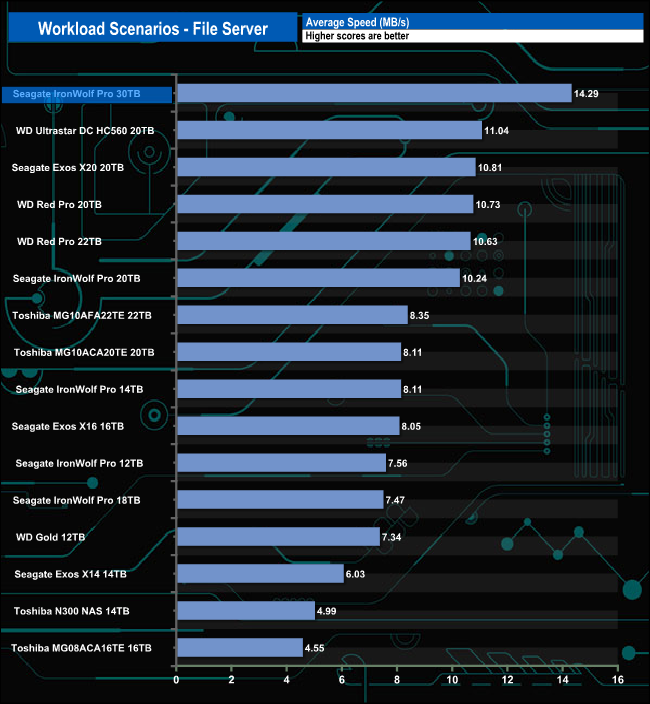
We tested the 30TB Seagate IronWolf Pro with a number of scenarios that it may face in the real world. The settings for these scenarios are as follows.
File Server
512MB file size, 16KB Block size
80% Read 20% Write 100% Random
I/O queue depth 128
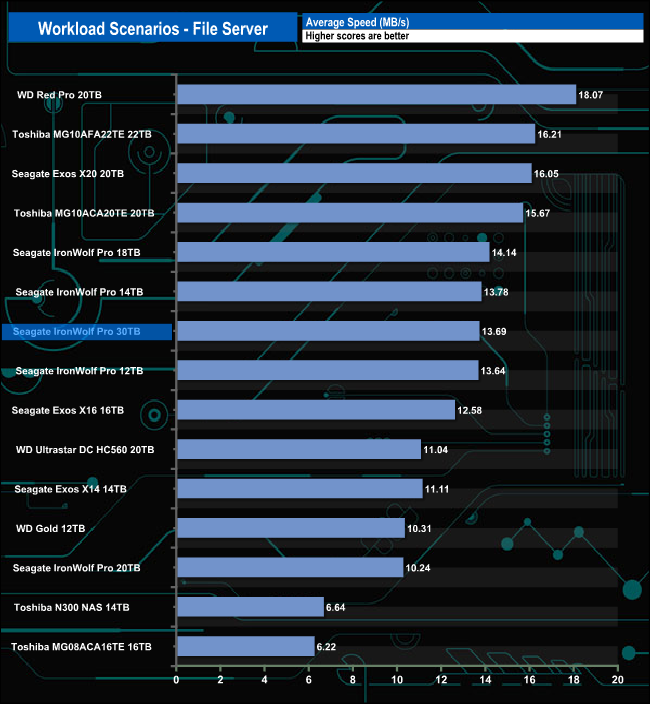
Web Server
1GB file size, 16KB Block size
100% Read 0% Write 100% Random
I/O queue depth 64
Database
2GB file size, 4KB Block size
90% Read 10% Write, 90% Random, 10% Sequential
I/O depth 128
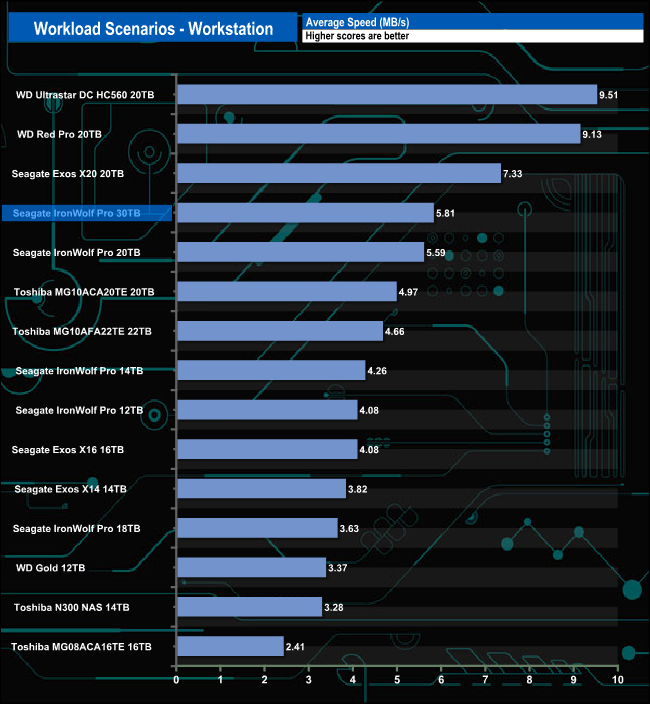
Workstation
1GB file size, 16KB Block size
70% Read 30% Write, 100% Random, 0% Sequential
I/O depth 6
File Server
Web Server
Workstation
Database
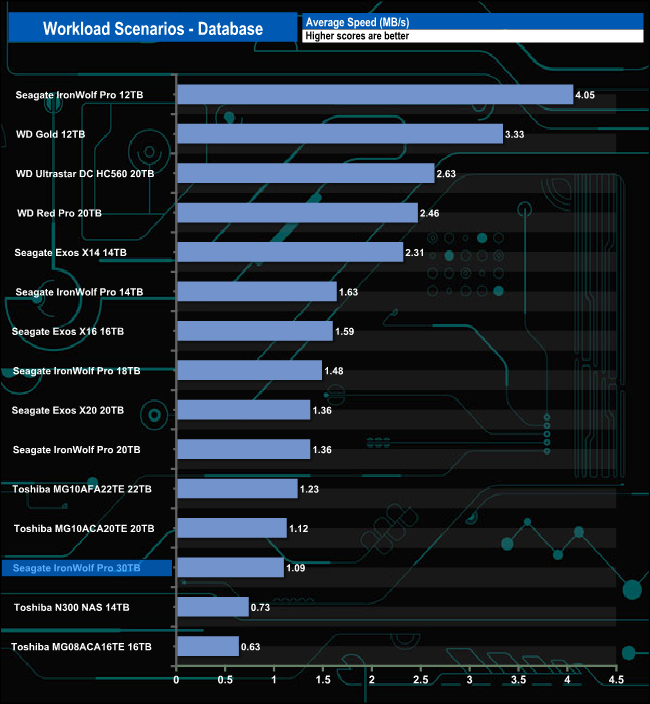
The 30TB IronWolf Pro handled the workload scenarios pretty well, with the fastest bandwidth speeds we've seen to date for the File Server test (14.29MB/s). The Web Server test sees the drive in a mid-table position, while for the Workstation test, the drive sits in fourth spot. It didn't fare so well in the Database test with a bandwidth figure of 1.09MB/s which sees it near the bottom of the results chart.
The PCMark 10 Data Drive Benchmark has been designed to test drives that are used for storing files rather than applications. You can also use this test with NAS drives, USB sticks, memory cards, and other external storage devices.
The Data Drive Benchmark uses 3 traces, running 3 passes with each trace.
Trace 1. Copying 339 JPEG files, 2.37 GB in total, in to the target drive (write test).
Trace 2. Making a copy of the JPEG files (read-write test).
Trace 3. Copying the JPEG files to another drive (read test)
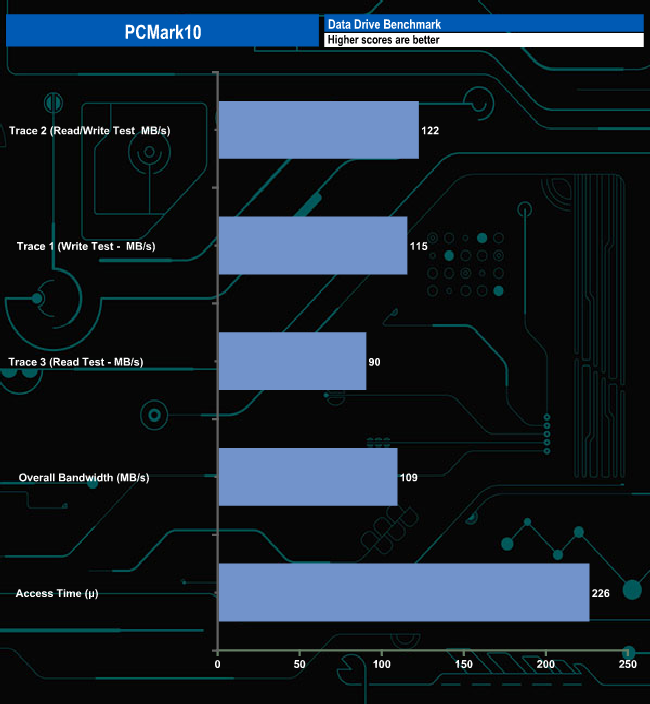
In the PCMark 10 Data Drive Benchmark, the best performance came using the read-write test trace (122MB/s). The drive produced an overall bandwidth for the test of 109MB/s.
To test the real-life performance of a drive, we use a mix of folder/file types, and by using the FastCopy utility (which gives a time as well as MB/s result), we record the performance of the drive reading from & writing to a 256GB Samsung SSD850 PRO.
100GB data file.
60GB iso image.
60GB Steam folder – 29,521 files.
50GB File folder – 28,523 files.
12GB Movie folder – (15 files – 8 @ .MKV, 4 @ .MOV, 3 @ MP4).
10GB Photo folder – (304 files – 171 @ .RAW, 105 @ JPG, 21 @ .CR2, 5 @ .DNG).
10GB Audio folder – (1,483 files – 1479 @ MP3, 4 @ .FLAC files).
5GB (1.5bn pixel) photo.
BluRay Movie – 42GB.
21GB 8K Movie demos – (11 demos)
16GB 4K Raw Movie Clips – (9 MP4V files).
4.25GB 3D Printer File Folder – (166 files – 105 @ .STL, 38 @ .FBX, 11 @ .blend, 5 @ .lwo, 4 @ .OBJ, 3@ .3ds).
1.5GB AutoCAD File Folder (80 files – 60 @ .DWG and 20 @.DXF).
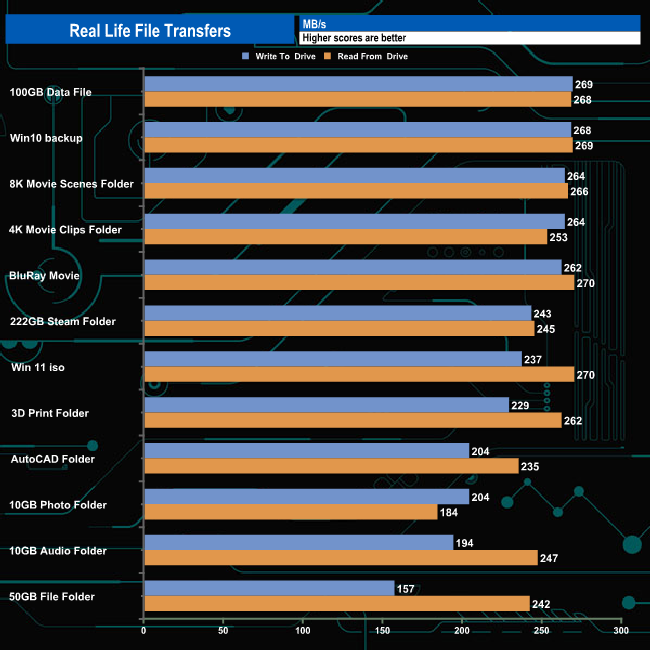
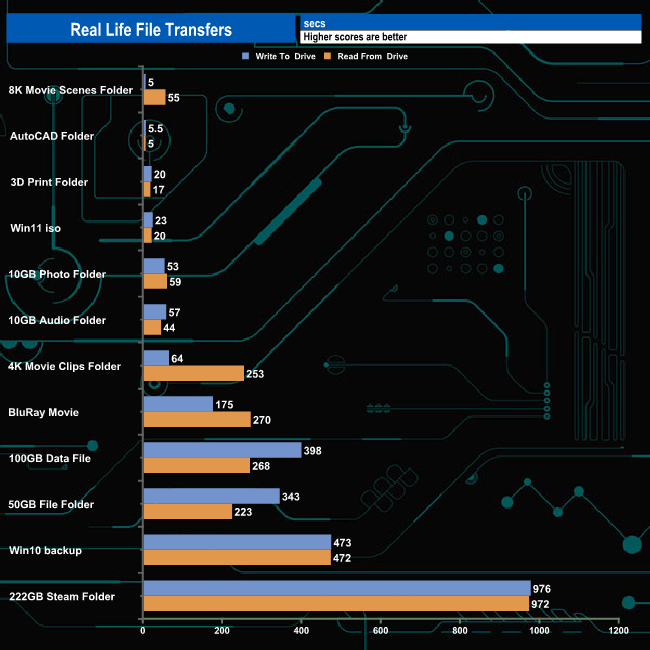
The IronWolf Pro 30TB drive had no problems dealing with any of our real-life file transfers and produced pretty consistent performance when it came to handling the larger file sizes, with an average figure for the six large file transfers of 261MB/s for both reads and writes. The slowest of the file transfers was the 50GB File Folder, full of small, bity files, with reads at 157MB/s and writes at 242MB/s.
The insatiable demand for data storage shows no signs of slowing down, with manufacturers having to come up with larger and larger capacity drives. This means denser and denser discs, which in turn leads to the possibility of data read /write errors as read/write heads try to deal with ever closer data tracks.
That's why drive manufacturers have been developing HAMR (heat-assisted magnetic recording) and MAMR (microwave-assisted magnetic recording) technologies. Seagate's IronWolf Pro 30TB (along with the Exos M 30TB) are the first HAMR hard drives to become fully available to the market using Seagate's Mozaic 3+ platform technology.
HAMR technology uses an extremely precisely aimed laser to heat up a section of the disc medium to write the data in. Using this technology means that discs will have very high areal densities and therefore more capacity per disk, e.g. the Iron Wolf Pro 30TB has 10 3TB discs inside it.
The IronWolf Pro range has been built from the ground up as heavy-duty NAS drives offering high workload rates (The 30TB IronWolf Pro is rated at 550TB/year) and 24×7 operation. To ensure that the drives can deliver this level of performance, they feature technologies to combat the effects of being housed in very large, multi-disk NAS environments. These technologies include firmware that is RAID optimised as well as Seagate's AgileArray and IHM (IronWolf Health Management).
Seagate’s AgileArray Technology combines hardware, firmware, and software to increase performance and, more importantly, reliability. It features Error Recovery Control that prevents RAID drop-offs and speeds up the data retry process. Dive vibration effects in large multi-drive NAS units have the potential to cause some real headaches, which is why Seagate’s AcuTrac Technology is part of the AgileArray package. This allows a drive to still function properly even if it’s being impacted by vibration from a neighbouring drive. The Rotational Vibration (RV) Sensors fitted to the drive also help to reduce vibration in the multi-bay enclosure, while Dual Plane Balance ensures the drive is vibration-free and quiet during operation.
IronWolf Health Management (IHM) technology adds another layer of protection by interacting with the NAS OS to display actionable prevention, intervention or recovery options for whatever is affecting the drive’s health. The technology is supported by most of the main NAS vendors, including Synology, QNAP and Asustor. A quick tour of their websites will show which models support IHM.
Seagate quote an official maximum transfer rate of 275MB/s for the 30TB IronWolf Pro. When tested with the ATTO benchmark, we couldn't quite get to that maximum with read/write results of 267MB/s and 264MB/s, respectively.
Added to all the NAS-targeted technology is the peace of mind from a 3-year subscription to Seagate’s Rescue Data Recovery Plan and a 5-year warranty.
We found the 30TB Seagate IronWolf Pro on ebuyer.com for £562.98 (inc VAT) HERE.
Pros
- Huge capacity.
- Overall performance.
- Drive Technology.
- Seagate’s Rescue Data Recovery Plan.
Cons
- Pricey.
KitGuru says: The largest IronWolf Pro drive to date, Seagate's latest 30TB flagship drive not only brings an increase in capacity but uses technology that points the way to much bigger drives in the near future.