KitGuru KitGuru.net – Tech News | Hardware News | Hardware Reviews | IOS | Mobile | Gaming | Graphics Cards


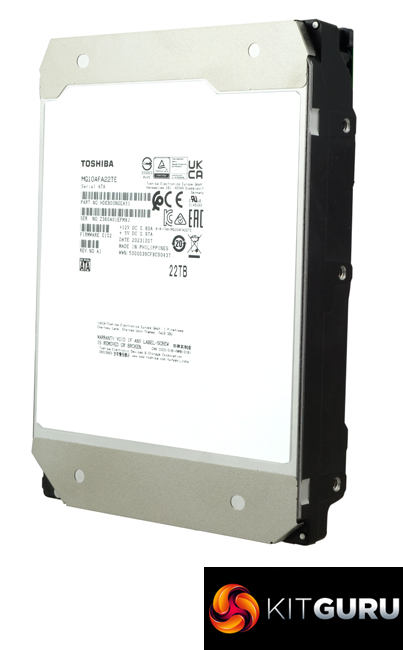
Toshiba's MG series of hard drives have been designed for the enterprise market segment. The latest addition to the top end of the range is the MG10AFA22TE, the new 22TB flagship drive taking over that mantle from the 20TB MG10ACA20TE.
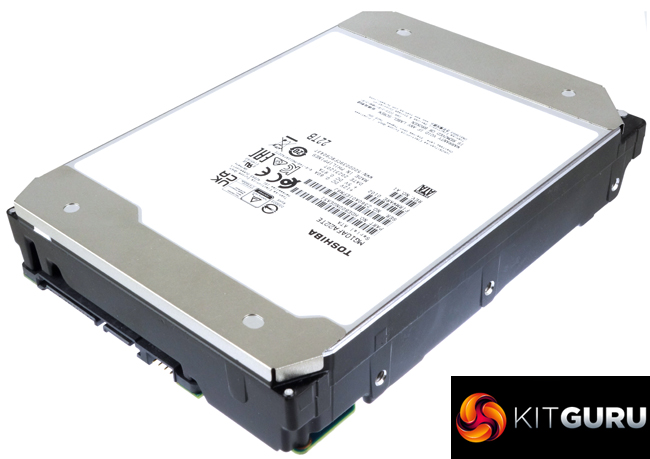
Toshiba's MG10AFA22TE uses the company's fourth-generation ten-disk / twenty-head helium-sealed platform together with Conventional Magnetic Recording(CMR) and FC-MAMR (Flux-controlled microwave-assisted magnetic recording) technologies to improve performance and capability. It has a spindle speed of 7,200rpm and a 512MB cache.
The first spec sheet for the drive we came across had the transfer speed of the drive noted down as n/a but after a quick search around the Toshiba site, we came across another spec sheet that was quoting a rating of 271MB/s for the drive so we went with that.
The official power consumption figure for the 22TB drive is 9.8W. The previous 20TB Toshiba MG10 (MG10ACA20TE) had official power figures of 8.11W when operating (Random 4K read/write) and 4.38W in active idle so the new drive is a little more power-hungry.
Toshiba quotes a workload figure of up to 550TB/year for the 22TB drive and backs it with a 5-year warranty.
Physical Specifications:
- Usable Capacities: 22TB.
- Spindle Speed: 7,200rpm.
- No. Of Heads: 20.
- No. Of Platters: 10.
- Cache: 512MB.
- Recording Method: Conventional Magnetic Recording (CMR) / FC-MAMR (Flux-controlled microwave-assisted magnetic recording).
- Interface: Serial ATA (SATA) 6Gb/s (SATA III)
- Form Factor: 3.5in
- Dimensions: 101.85 x 26.1 x 147.0mm.
- Drive Weight: 720g.
Firmware Version: 0102
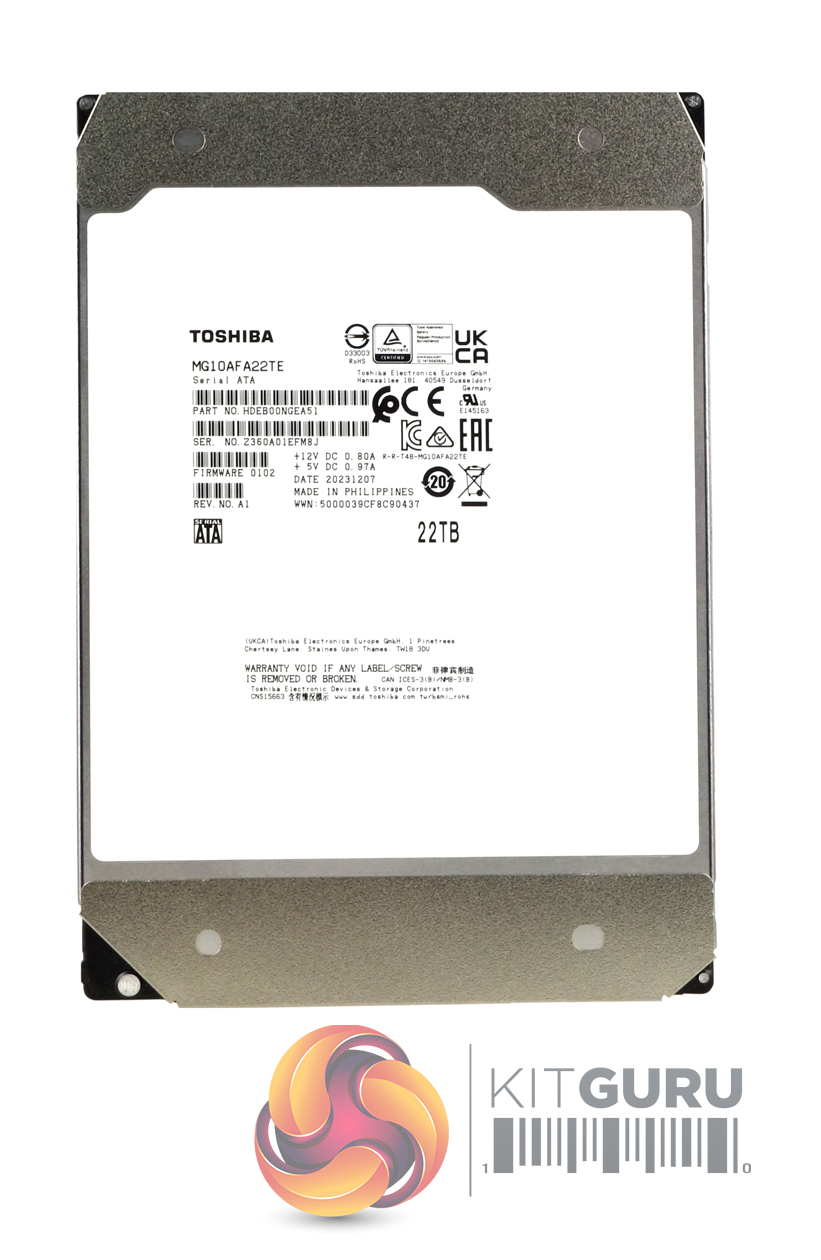

As the drive is aimed at the Enterprise market segment it comes as no real surprise to receive the drive from Toshiba in just a plain plastic shell with no retail packaging.


Toshiba's 22TB MG10 is built on a 26.11mm thick, 3.5in format. It uses Toshiba’s fourth-generation Helium technology enabling Toshiba to use ten 2TB platters and 20 heads in the enclosure. The drive has a spindle speed of 7,200rpm and there is 512MB of cache. The MG10 series uses a range of technologies to prevent data corruption which is a real risk with today's disc densities.
Along with TDMR (Two-Dimensional Magnetic Recording) technology, there is Toshiba's Flux Control Microwave-assisted Magnetic Recording, Stable Platter technology and Toshiba’s Dynamic Cache Technologies. There are also built-in RV (Rotational Vibration) sensors and Persistent Write Cache Technology.
Flux Control Microwave-assisted Magnetic Recording (FC-MAMR).
Toshiba's Flux Control Microwave Assisted Magnetic Recording (FC-MAMR) technology uses microwave energy to ensure more of the write energy is focused on the platter. Two magnetic layers are built into the write gap of the write head and a bias current is applied which reverses the magnetization of one of the layers, an effect known as spin-transfer torque, improving the recording field and the performance of the write head. Using this technology allows Toshiba to achieve an increase in areal density capability (ADC) of up to 20%.
Stable Platter
In multi-bay systems, vibration can be a serious problem causing mis-tracking problems when reading/writing data. Toshiba’s Stable Platter Technology minimizes these vibrations by stabilizing the motor shaft at both ends improving tracking accuracy and ensuring maximum performance during read and write operations.
Dynamic Cache
Toshiba’s Dynamic Cache Technology is a self-contained cache algorithm with on-board buffer management, that optimises how the cache is allocated during read/write operations.
Persistent Write Cache Technology
Designed to protect data if power is lost while being written to the disk. If there is a power supply interruption while the drive is writing to the disc, the data is saved in the large flash-based cache and written to the drive when the power is restored.
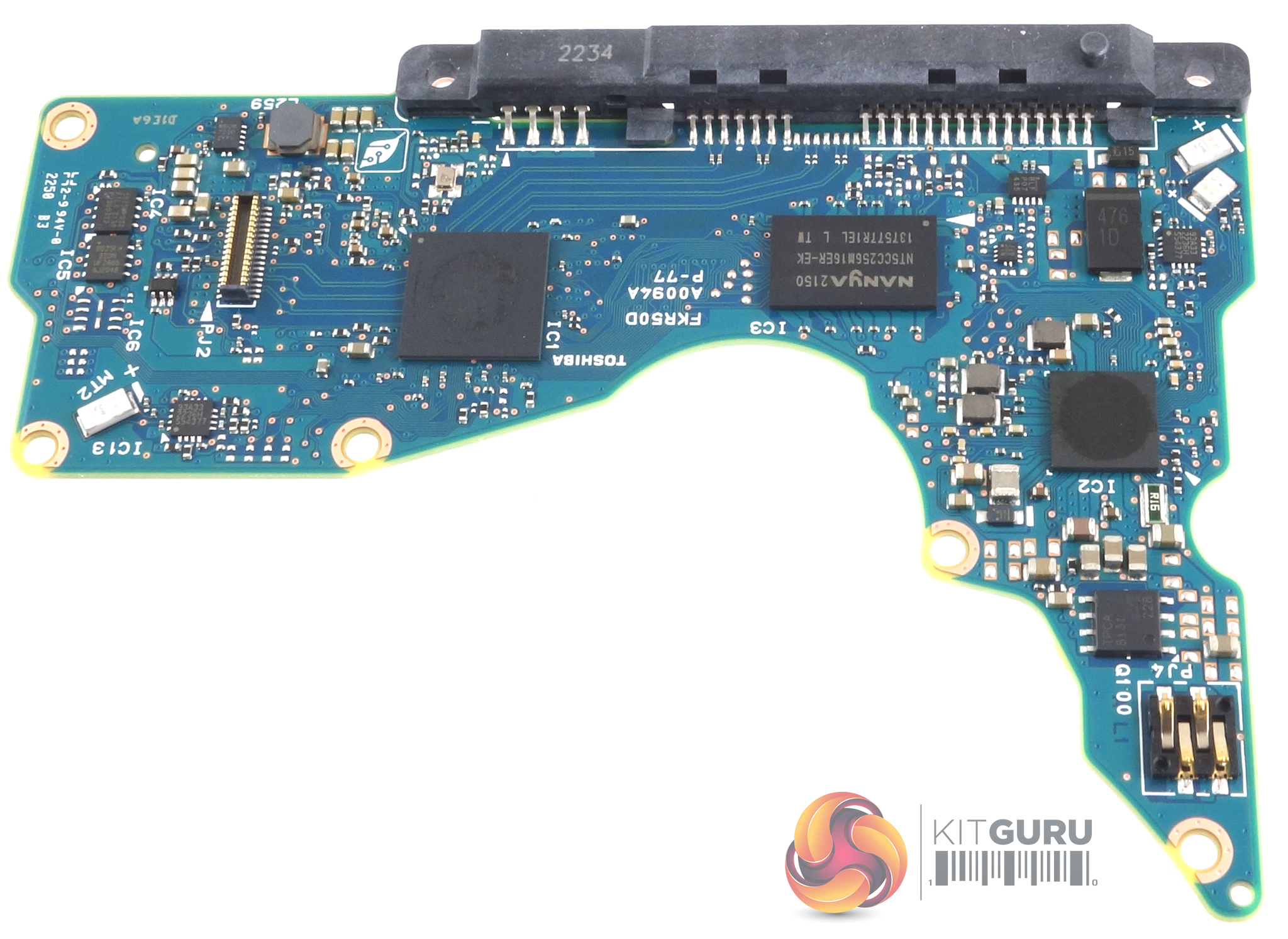
As well as Toshiba's Stable Platter Technology preventing the effects of vibration in large multi-bay systems, the drive also has built-in RV (Rotational Vibration) sensors (the small angled metal objects on the top right and bottom left of the PCB). These sensors compensate for any rotational vibration detected, eliminating the possibility of ‘knock-on' vibration in multi-bay server systems.
For testing, the drives are all wiped and reset to factory settings by HDDerase V4. We try to use free or easily available programs and some real-world testing so you can compare our findings against your own system.
This is a good way to measure potential upgrade benefits.
Main system:
AMD Ryzen 5 3600X, 32GB DDR4-3200, Sapphire R9 390 Nitro and a Gigabyte B550 AORUS Master motherboard.
Other drives
Seagate NAS 8TB
Seagate Exos X16 16TB
Seagate Exos X14 14TB
Seagate Exos X20 20TB
Seagate IronWolf Pro 14TB
Seagate BarraCuda Pro 12TB
Seagate IronWolf Pro 12TB
Seagate IronWolf Pro 18TB
Seagate IronWolf Pro 20TB
Seagate IronWolf 10TB
Toshiba MG10ACA20TE 20TB
Toshiba MG08ACA16TE 16TB
Toshiba N300 8TB
Toshiba NAS N300 14TB
Toshiba P300 3TB
Toshiba X300 6TB
WD Gold 12TB
WD Black 6TB
WD Black 4TB
WD Red Pro 22TB
WD Red Pro 20TB
WD Red 4TB
WD Red 8TB
Software:
Atto Disk Benchmark.
CrystalMark 7.0.0.
IOMeter.
UL Solutions PCMark 10 Data Drive Benchmark.
All our results were achieved by running each test five times with every configuration this ensures that any glitches are removed from the results.
CrystalDiskMark is a useful benchmark to measure the theoretical performance levels of hard drives and SSDs. We are using V6.0.3. to test HDD drives.
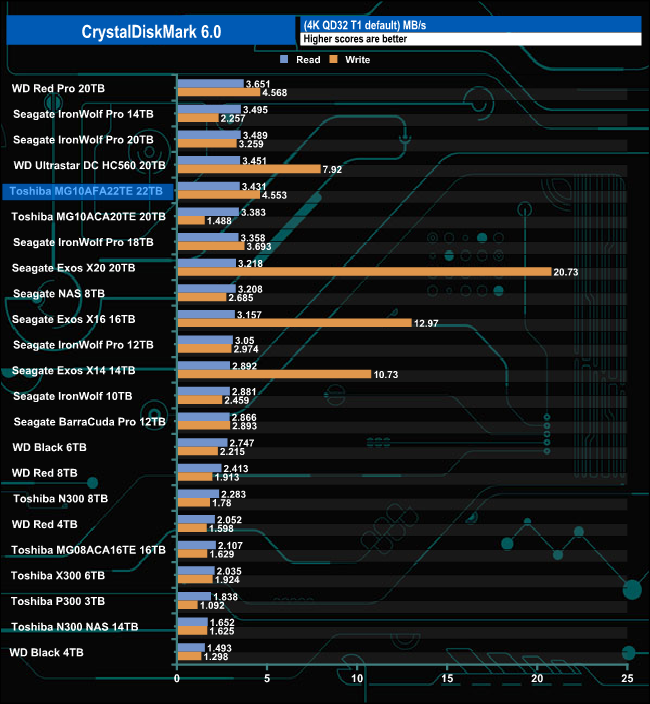

In the CrystalDiskMark 4K QD32 T1 test, the 22TB MG10 read test result of 3.431MB/s is only marginally faster than the 3.383MB/s figure obtained by the previous 20TB drive. However, its write result of 4,553MB/s is much faster than the 1.488MB/s of the previous flagship drive.
The ATTO Disk Benchmark performance measurement tool is compatible with Microsoft Windows. Measure your storage system performance with various transfer sizes and test lengths for reads and writes. Several options are available to customize your performance measurement including queue depth, overlapped I/O and even a comparison mode with the option to run continuously. Use ATTO Disk Benchmark to test any manufacturer's RAID controllers, storage controllers, host adapters, hard drives and SSD drives and notice that ATTO products will consistently provide the highest level of performance to your storage.
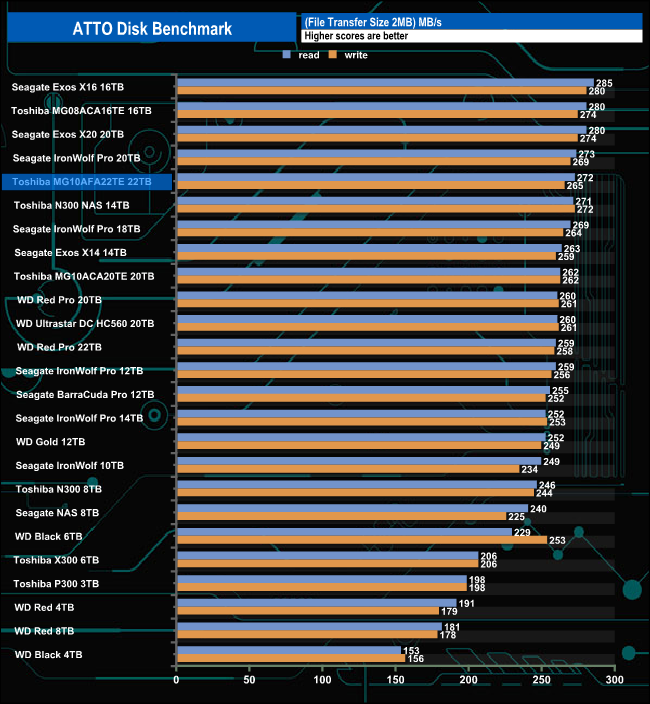
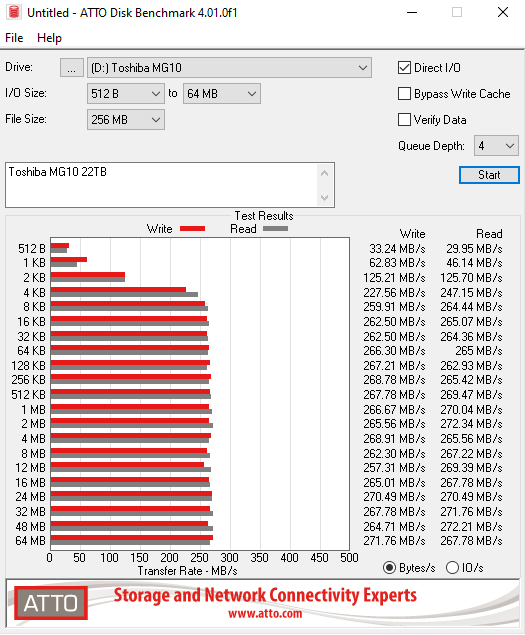
Toshiba rates the sustained transfer rate of the 22TB MG10 as 271MB/s, a figure we can confirm with the ATTO benchmark test results of 272MB/s for reads and 265MB/s for writes.
IOMeter is another open-source synthetic benchmarking tool which is able to simulate the various loads placed on a hard drive and solid-state drive technology.
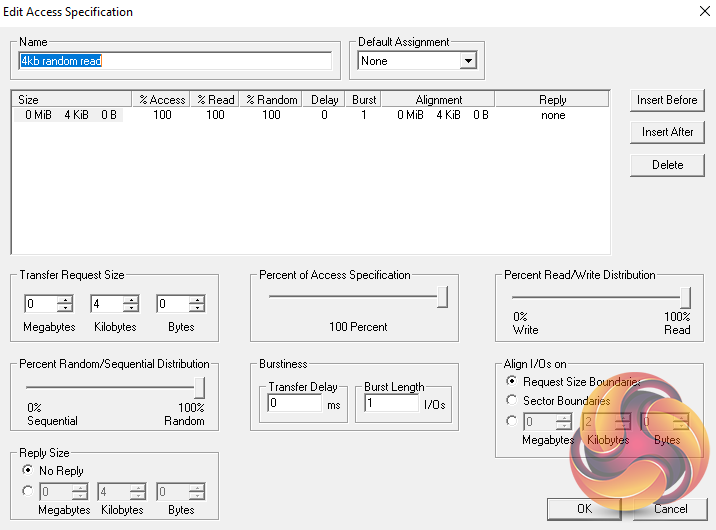
We test with both random read and write 4k tests, as shown above. There are many ways to measure the IOPS performance of a hard drive, so our results will sometimes differ from the manufacturer’s quoted ratings. We test all drives in the same way, so the results are directly comparable.
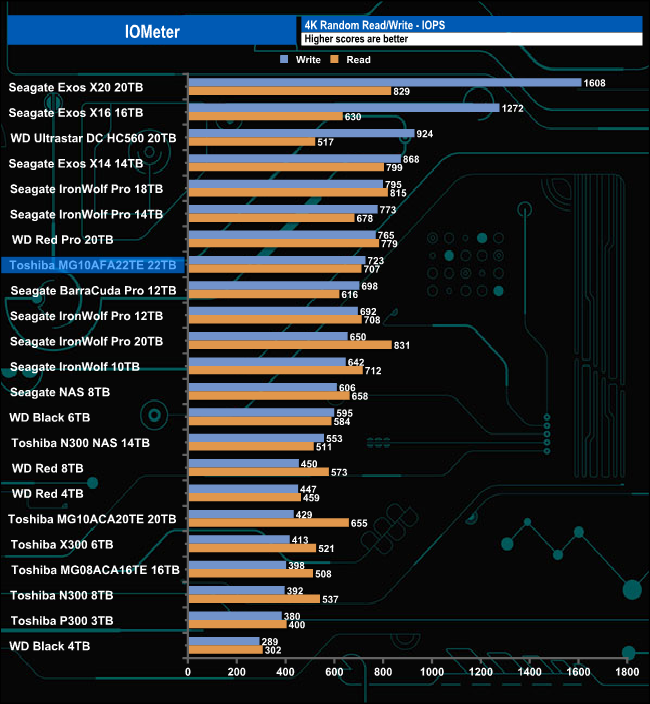
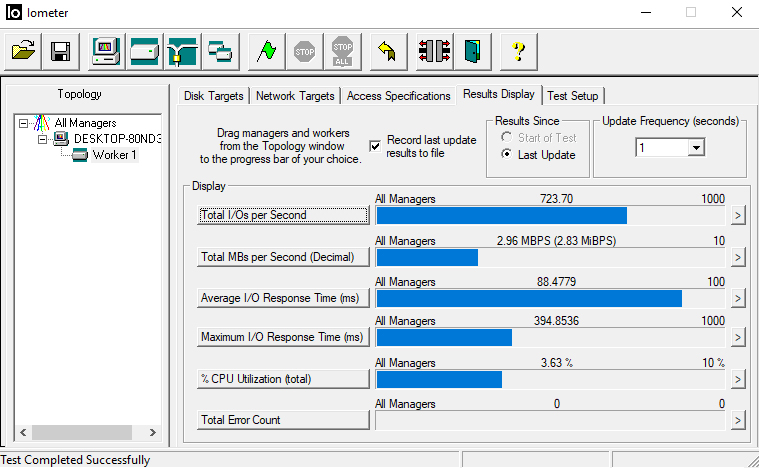
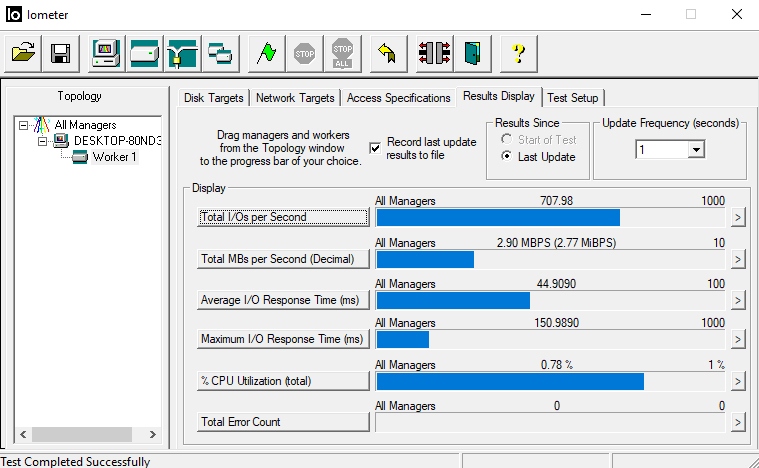
When the 4K random read/write of the drive with Iometer, we saw a read result of 723 IOPS which was slightly faster than the write performance of 707 IOPS.
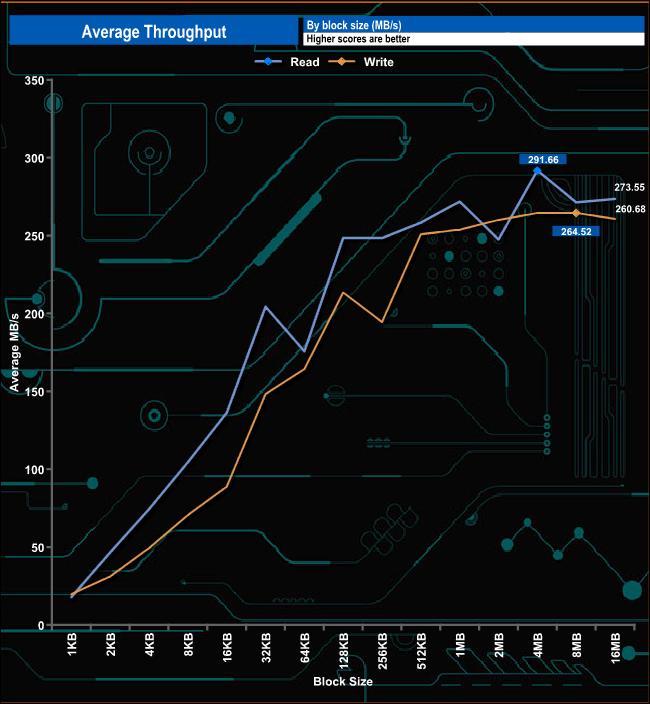
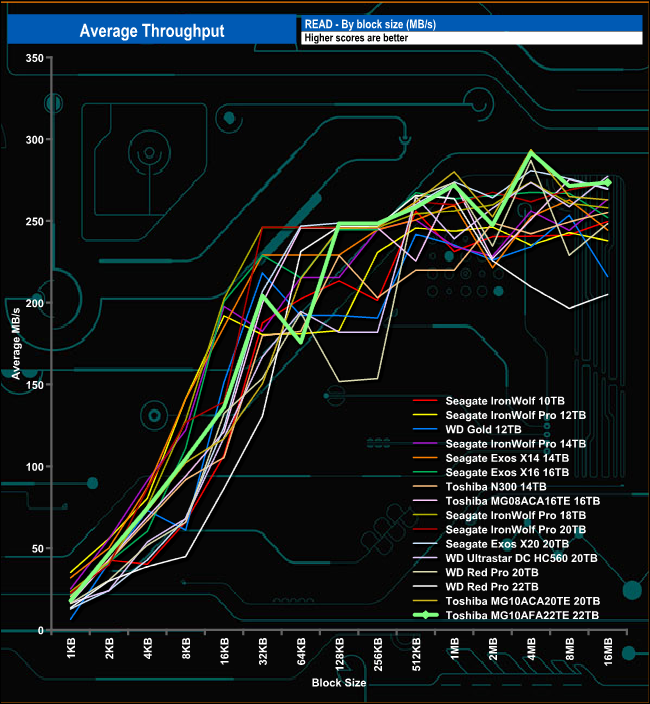
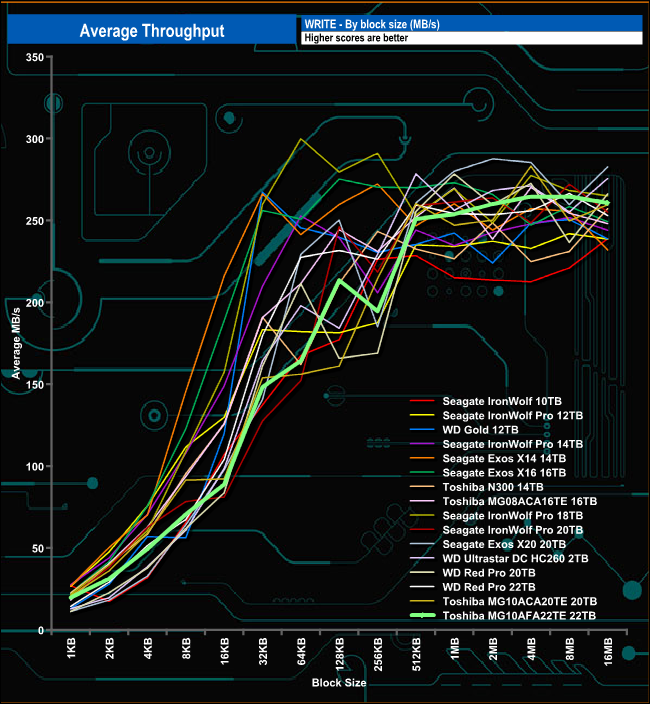
Toshiba quoted a transfer rate for the 22TB MG10 of 271MB/s. In our read-throughput test, the drive peaked at 291.66MB/s (4MB block) before dropping back to 273.55MB/s at the end of the test run (16MB block). Writes peaked at 264.52MB/s (8MB block) before finishing the test run at 260.68MB/s.
We tested the MG10AFA22TE with some scenarios that it may face in the real world. The settings for these scenarios are as follows.
File Server
512MB file size, 16KB Block size
80% Read 20% Write 100% Random
I/O queue depth 128
Web Server
1GB file size, 16KB Block size
100% Read 0% Write 100% Random
I/O queue depth 64
Database
2GB file size, 4KB Block size
90% Read 10% Write, 90% Random, 10% Sequential
I/O depth 128
Workstation
1GB file size, 16KB Block size
70% Read 30% Write, 100% Random, 0% Sequential
I/O depth 6
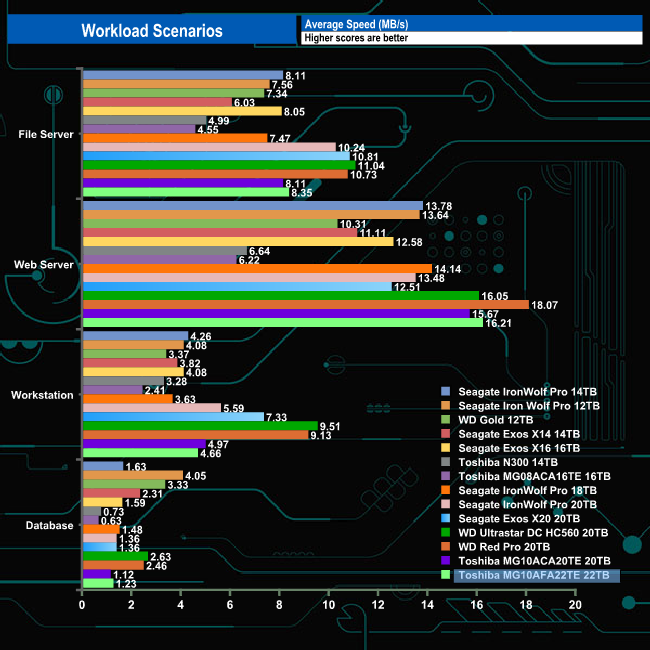
Out of our four tests, the MG10AFA22TE handled the Web Server trace the best with a test result of 16.21MB/s, the second fastest we've seen to date for this particular test.
The PCMark 10 Data Drive Benchmark has been designed to test drives that are used for storing files rather than applications. You can also use this test with NAS drives, USB sticks, memory cards, and other external storage devices.
The Data Drive Benchmark uses 3 traces, running 3 passes with each trace.
Trace 1. Copying 339 JPEG files, 2.37 GB in total, in to the target drive (write test).
Trace 2. Making a copy of the JPEG files (read-write test).
Trace 3. Copying the JPEG files to another drive (read test)
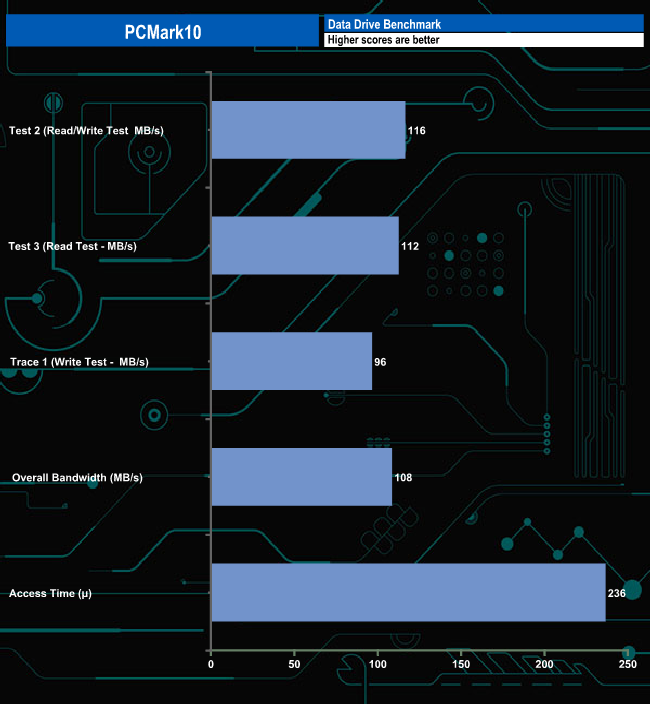
The 20TB MG10 handles the rigours of the PCMark 10 Data Drive Benchmark pretty well with an overall bandwidth figure of 108MB/s with an average access time of 236μs.
To test real life performance of a drive we use a mix of folder/file types and by using the FastCopy utility (which gives a time as well as MB/s result) we record the performance of the drive reading from & writing to a 2TB Kingston KC3000 SSD.
Transfer Details
- Windows 10 backup – 118GB.
- Data file – 100GB.
- BluRay Movie – 42GB.
- Windows 11 iso – 5.4GB.
- File folder – 50GB – 28,523 files.
- Steam folder – 222GB (8 games: Alien Isolation, Battlefield 4, BioShock Infinite, Crysis 3, Grand Theft Auto V, Shadow Of Mordor, Skyrim, The Witcher3 Wild Hunt).
- Movie demos 8K – 21GB – (11 demos).
- Raw Movie Clips 4K – 16GB – (9 MP4V files).
- Movie folder – 12GB – 15 files – (8 @ .MKV, 4 @ .MOV, 3 @ MP4).
- Photo Folder – 10GB – 304 files – (171 @ .RAW, 105 @ JPG, 21 @ .CR2, 5 @ .DNG).
- Audio Folder – 10GB – 1,483 files – (1479 @ MP3, 4 @ .FLAC files).
- Single large image – 5GB – 1.5bn pixel photo.
- 3D Printer File Folder – 4.25GB – (166 files – 105 @ .STL, 38 @ .FBX, 11 @ .blend, 5 @ .lwo, 4 @ .OBJ, 3@ .3ds).
- AutoCAD File Folder – 1.5GB (80 files – 60 @ .DWG and 20 @.DXF).
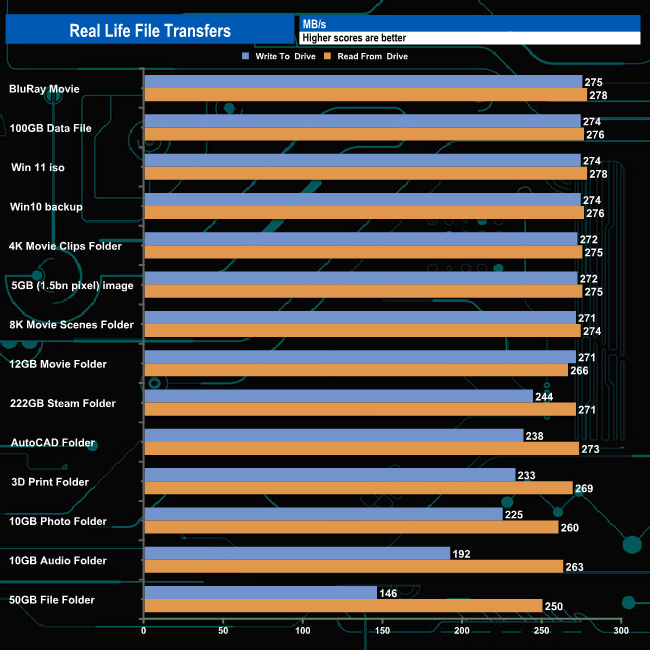
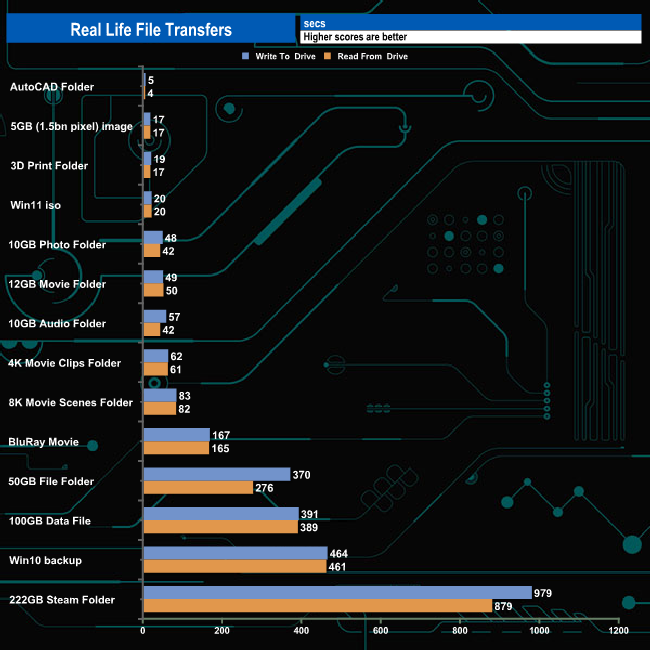
The 22TB MG10 produced very consistent performance when it came to handling the larger file sizes. When reading the data It averaged 247.21MB/s for the fourteen tests with the fastest being the BluRay Movie test at 275MB/s. Writes averaged 255.85MB/s and once again the fastest transfer was the BluRay at 278MB/s.
The new flagship drive of Toshiba's MG10 family is the 22TB model (MG10AFA22TE). Offering 10% more capacity than the previous 20TB flagship model, the 22TB drive has been designed to answer the demands of data centre and cloud-scale infrastructures including mainstream enterprise storage arrays (RAID, software-defined), enterprise and cloud archive and data recovery systems, distributed file systems, Big Data and surveillance data storage systems.
The 22TB MG10 only comes in a 512e block size on demand (at the time of writing) and two interface versions, SATA 6Gbit/s and SAS 12Gbit/s (MG10SFA22TE). Both interface versions have two security options, SIE (Sanitize Instant Erase) and SED (Self Encrypting Drive) The two SATA 6Gbit/s choices are MG10AFA22TEY (SIE) and MG10AFP22TE (SED). The SAS-based drives are MG10SFA22TEY (SIE) and MG10SFP22TE (SED). Toshiba rates the transfer speed of the new drive as up to 271MB/s.
We could confirm the official transfer rate of the drive with both the ATTO and CrystalDiskMark benchmarks. Using ATTO the best read performance we saw was 272MB/s while the best write figure was 265MB/s. Using the default CrystalDiskMark Sequential (QD32 T1) test we squeezed a little bit more out of the drive with test results of 289.7MB/s and 283.9MB/s for reads and writes respectively.
As the density of discs used in 3.5in drives using Conventional Magnetic Recording (CMR) methods gets ever greater, technology has evolved to counter the threat of magnetic inter-track interference (ITI), a potential cause of tracking problems and data errors caused by tracks being so closely packed. TDMR (Two-Dimensional Magnetic Recording) technology, which uses two read elements in the drive head, has been developed to counter these problems during read operations, while Toshiba has gone one stage further and has brought Flux-controlled microwave-assisted magnetic recording (FC-MAMR) technology to the table to improve stability during write operations.
FC-MAMR directs more magnetic field flowing from the magnetic recording pole toward the recording media to increase its recording capacity by using a type of spin-torque oscillator. Two magnetic layers are built into the write gap of the write head and a bias current is applied which reverses the magnetization of one of the layers, an effect known as spin-transfer torque, improving the recording field and the performance of the write head.
Toshiba's MG10 drive series is aimed at the enterprise segment, a market that demands drives to work in a 24/7 365-day environment which can be a challenge in multi-drive bay storage systems due to vibration. To this end Toshiba have fitted the drives with RV (Rotational Vibration) sensors which compensate for any rotational vibration detected, eliminating the possibility of ‘knock-on' vibration in multi-bay systems along with Stable Platter, a technology that reduces vibrations by stabilising the motor shaft at both ends.
There are also two cache technologies built in to maintain performance and protect data. Toshiba’s Dynamic Cache Technology combines a self-contained cache algorithm with on-board buffer management to optimise how the cache is allocated during read/write operations while Persistent Write Cache Technology protects data being written to the disc in the case of power problems. If the power fails during a write operation, the data is saved in the large flash-based cache and written to the drive when the power is restored.
We found the Toshiba MG10AFA22TE on ebuyer for £384.98 (inc VAT) HERE.
Pros
- Huge capacity.
- Drive technologies.
- 5-year warranty
Cons
- All that drive technology doesn't come cheap.
KitGuru says: Toshiba's latest flagship drive for the MG10 Enterprise focussed product line adds 10% more capacity for the data centre and cloud-scale environments. Because of the 24/7 365-day nature of the work that these drives are put to, the MG10AFA22TE comes with a host of technologies to help maintain performance and data security.