KitGuru KitGuru.net – Tech News | Hardware News | Hardware Reviews | IOS | Mobile | Gaming | Graphics Cards


G.Skill's Trident Z5 Neo RGB DDR5-6000 memory has been designed for overclocking on AMD platforms with EXPO support. It is available with a choice of two coloured aluminium heat spreaders and features customisable RGB lighting. We test a low-latency CL26 kit today.
G.Skill's Trident Z5 Neo RGB product line runs from 5600MT/s up to 8000MT/s in four kit capacities: 32GB (DDR5-5600, 6000, 6400, 7200 and 8000), 48GB (DDR5-5600, 6000, 6400 and 8000), 64GB (DDR5-6000), and finally 96GB (DDR5-5600 and 6000) in a wide range of latencies.
The G.Skill Trident Z5 Neo RGB kit we are reviewing here uses a pair of single-rank 16GB DIMMs (using SK Hynix A-die 2GB ICs), EXPO rated at 6000MHz at 26-36-36-96 at 1.45V.
G.Skill backs the drive with a lifetime warranty.
Specification
- Model Number: F5-6000J2636H16GX2-TZ5NR.
- Capacity: 32GB (2 x 16).
- Rated Frequency: 6000MT/s
- Rated Timings: 26-36-36-96.
- Voltage: 1.45V.
- Module Height: 42.8mm.
- XMP/EXPO: EXPO.

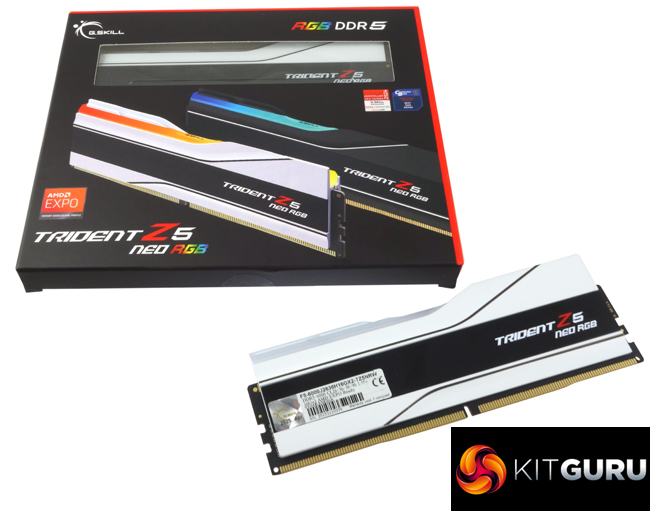
The front of the box that the memory comes in has a cut-out near the top, allowing you to see part of one of the modules. Below this are two award logos, and below these two illustrations of what the memory looks like. The bottom left of the box is home to the AMD EXPO sticker along with the Trident Z5 Neo RGB branding.
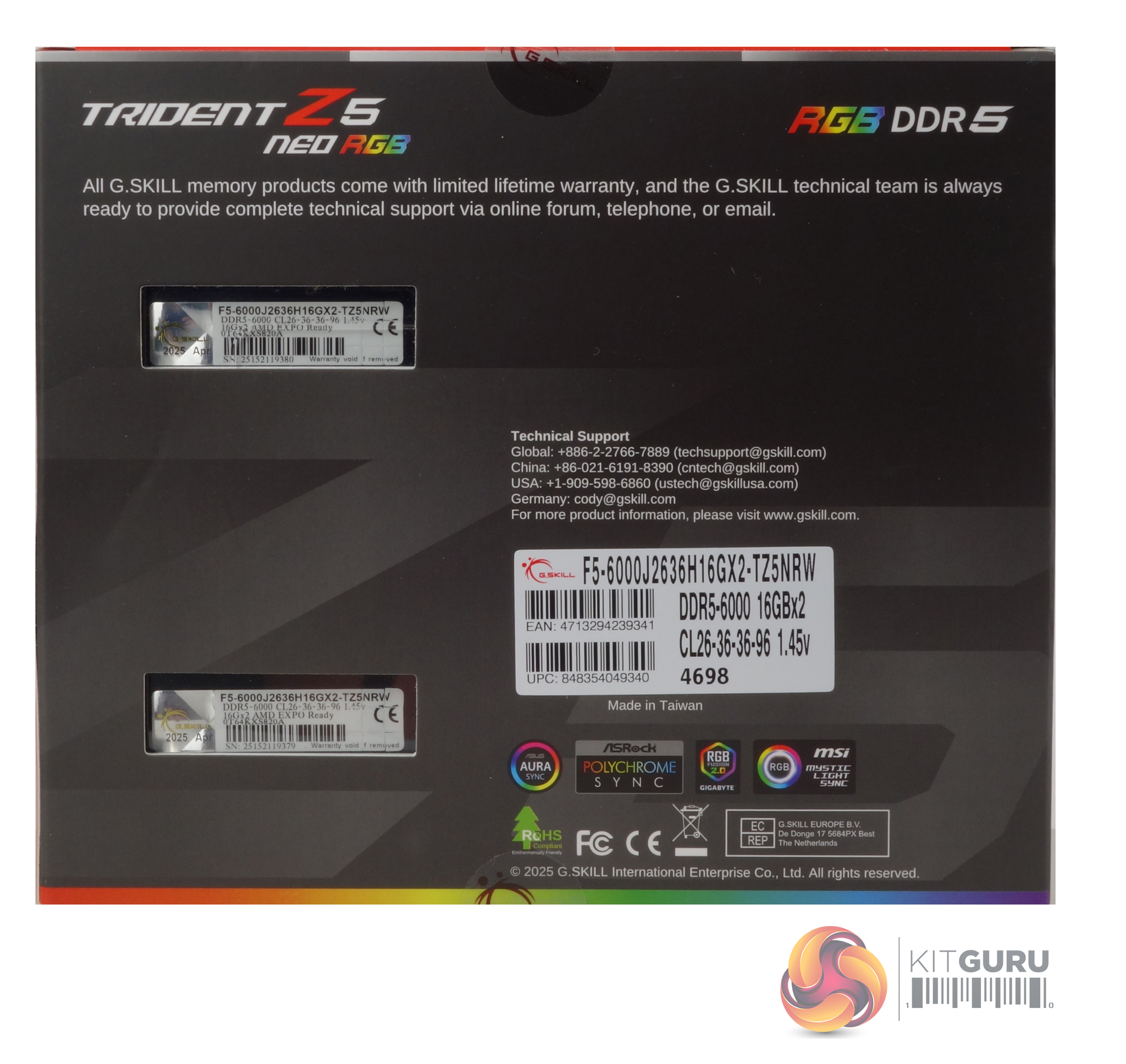
The rear of the box has two more cutouts (top and bottom), which let you see the SKU sticker attached to the module. To the right of the bottom cut-out is the product sticker that displays the module density, configuration and what the EXPO profile provides. Below this product sticker is a line of logos representing the motherboard lighting software that the modules support: Asus Aura, ASRock Polychrome Sync, Gigabyte RGB Fusion and MSI Mystic Light Sync.

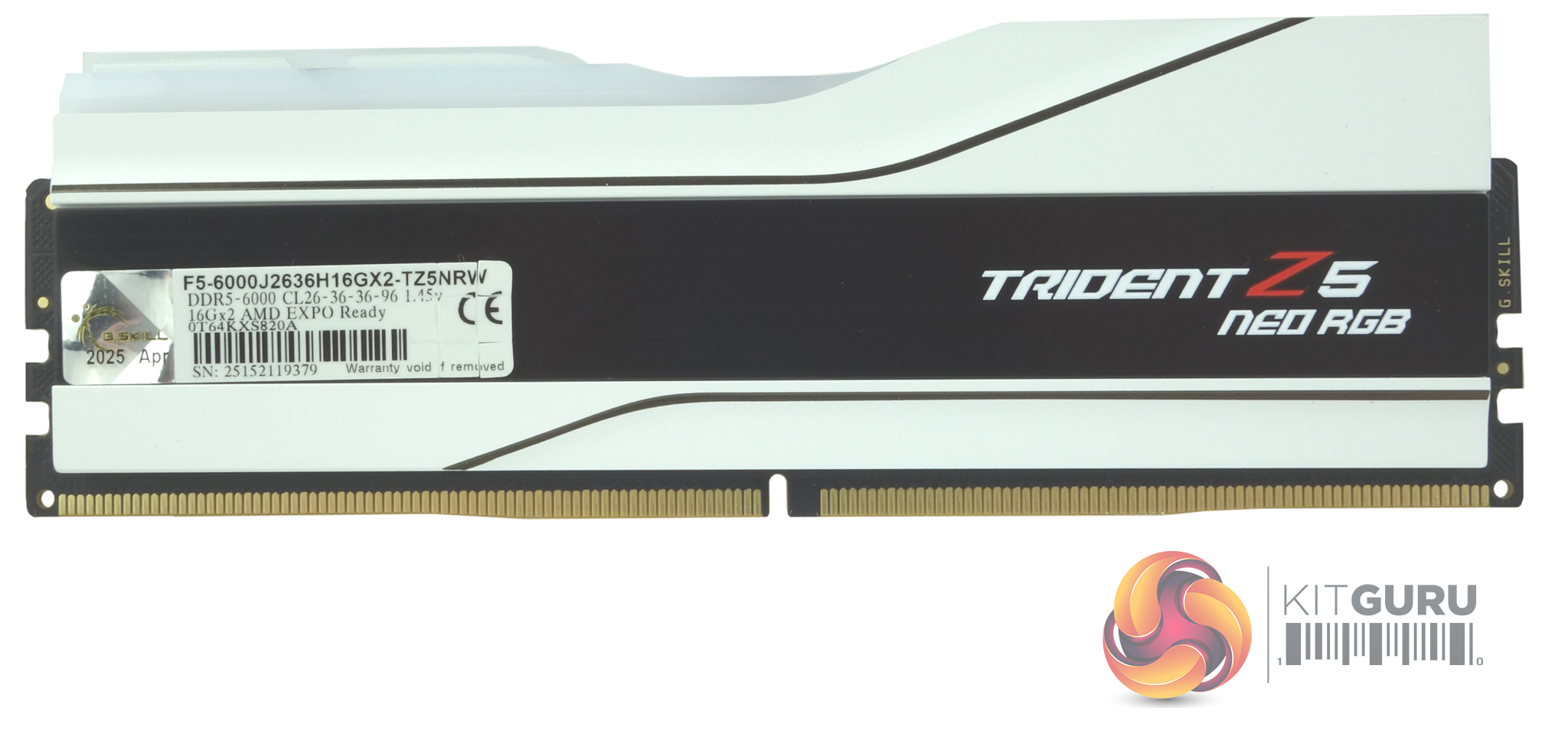
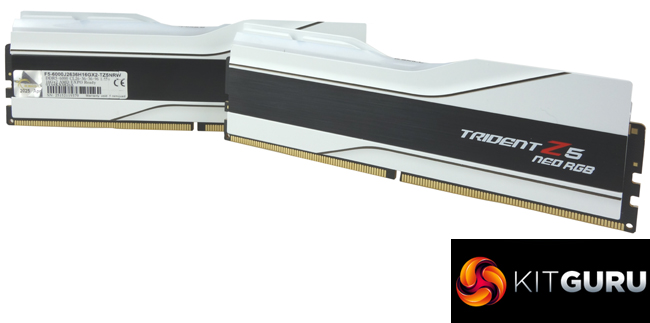
The heat spreaders on the modules are made from aluminium finished in (in the case of the review sample) matt white with a black brushed-aluminium insert (a Matt black finish is also available). The spreaders give the module a height of 42.8mm. The modules are a single-rank design, under the heatsink, there are eight 2GB SK Hynix chips (H5CG48AEBDX018 – A-die) along with a Richtek RTQ5132GQWF power management IC (PMIC).
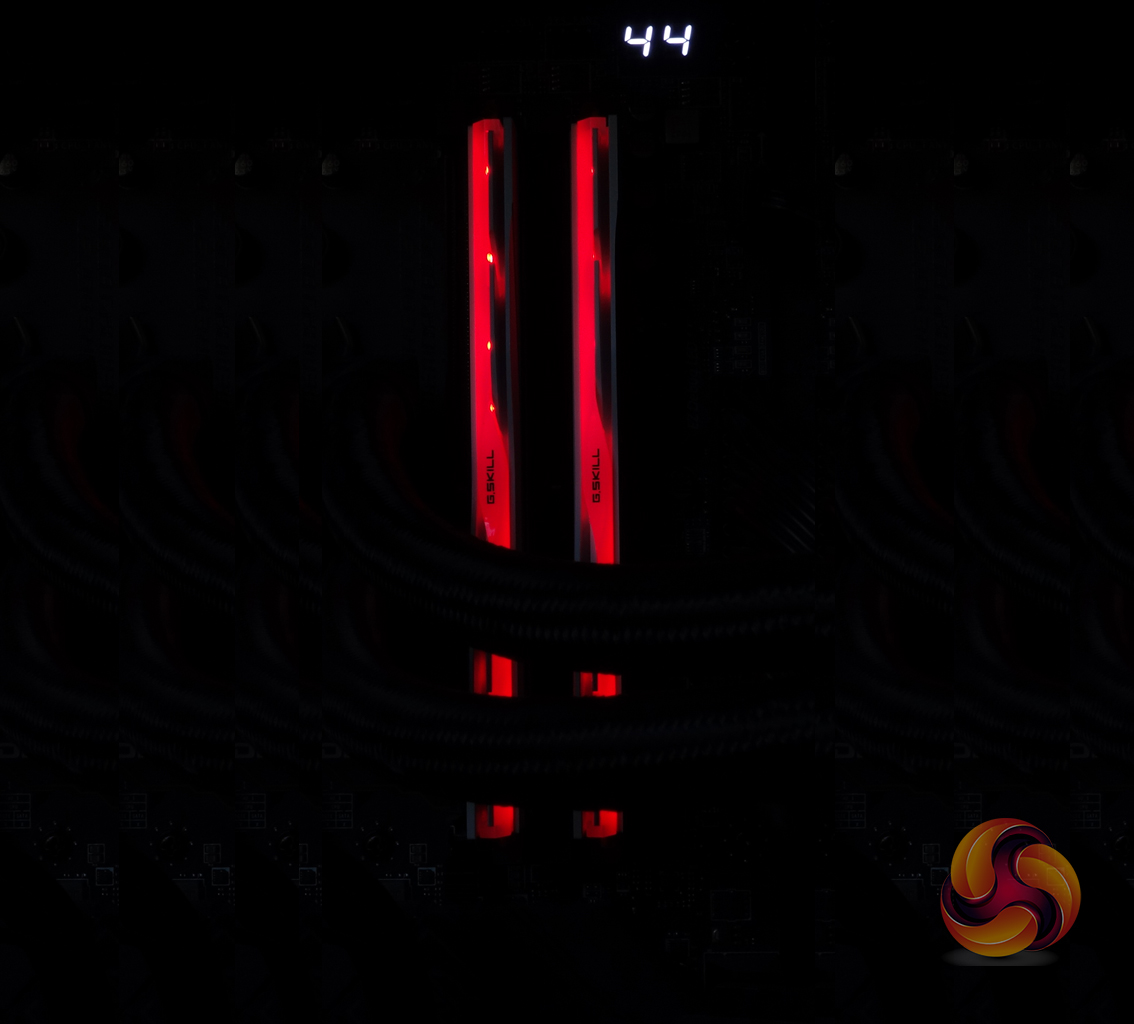
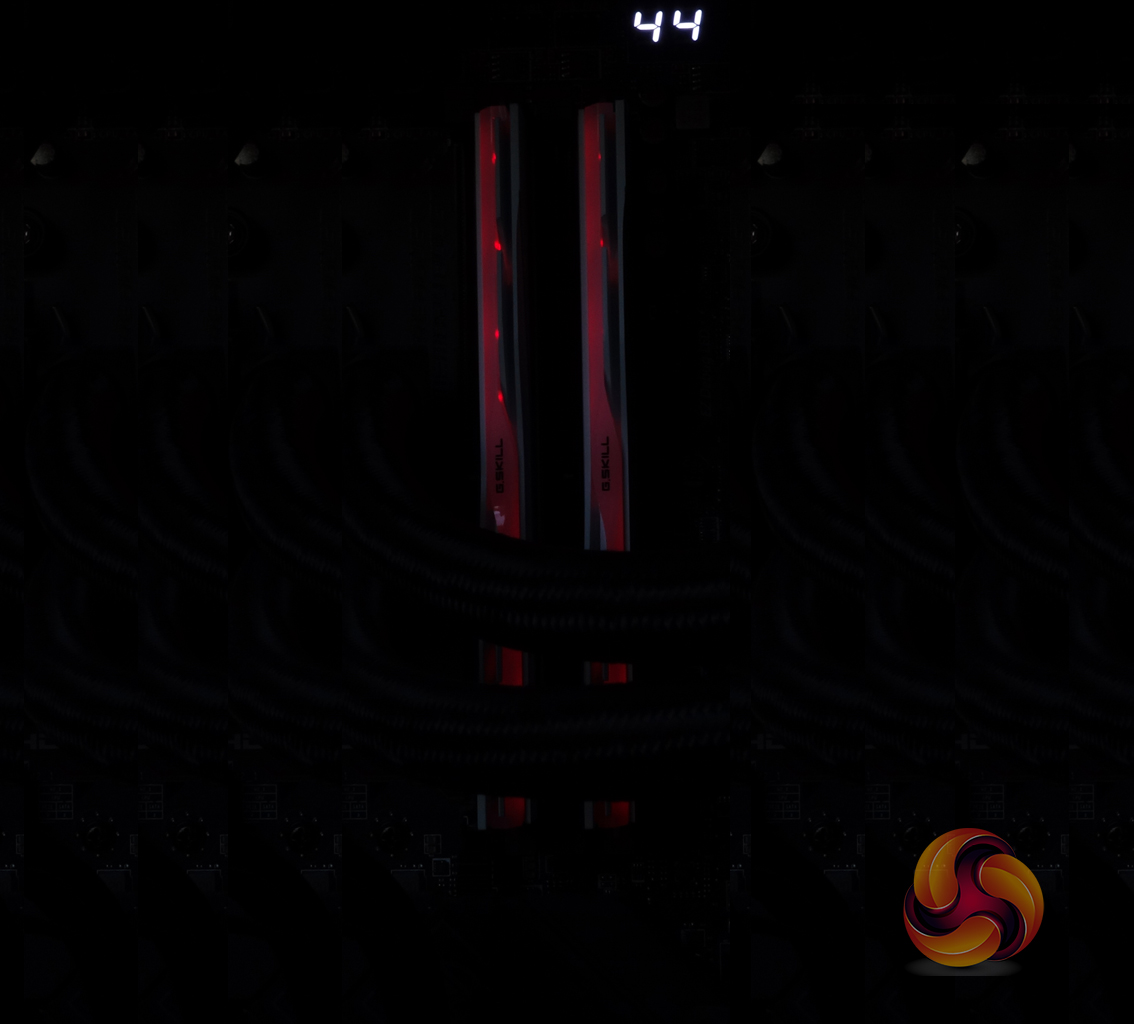
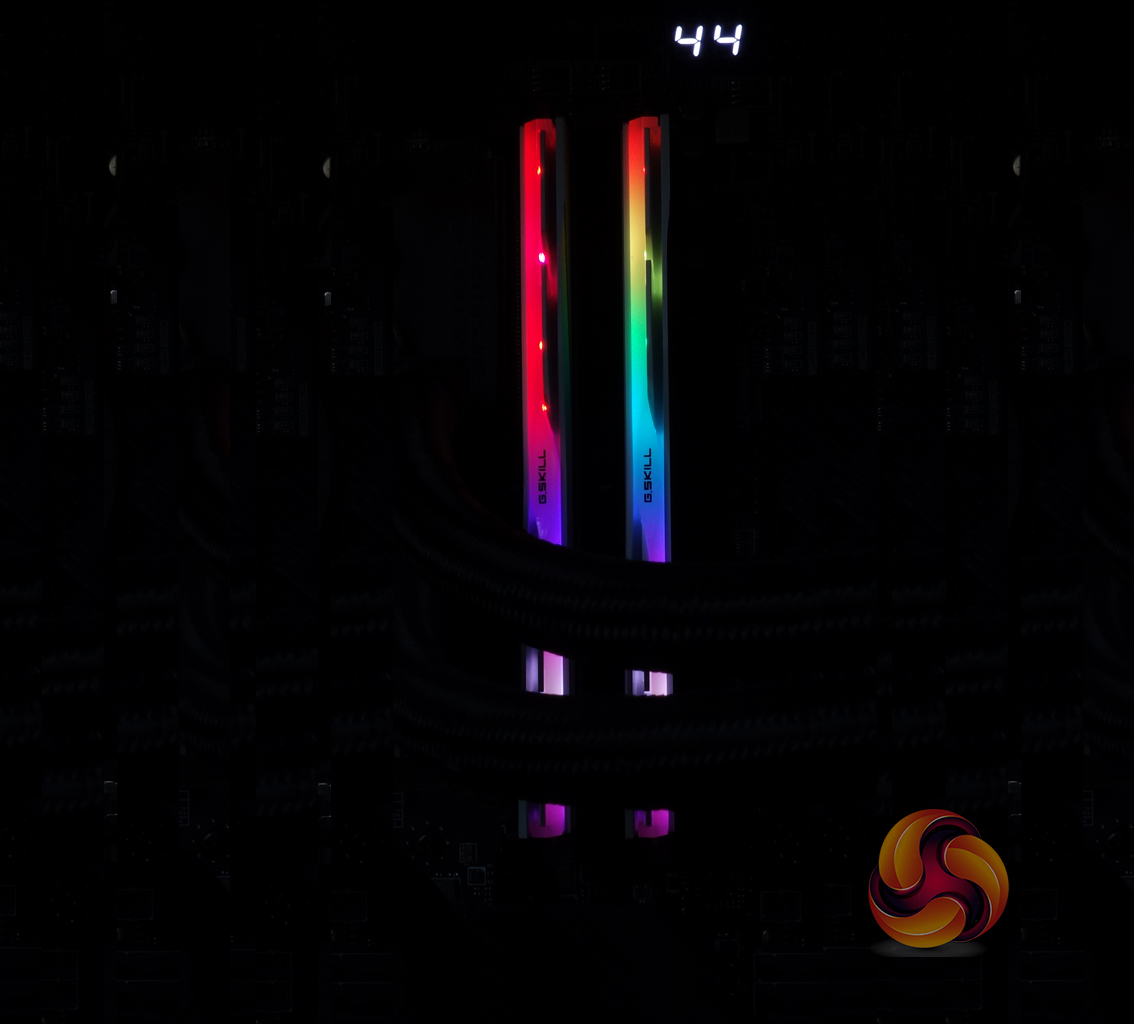
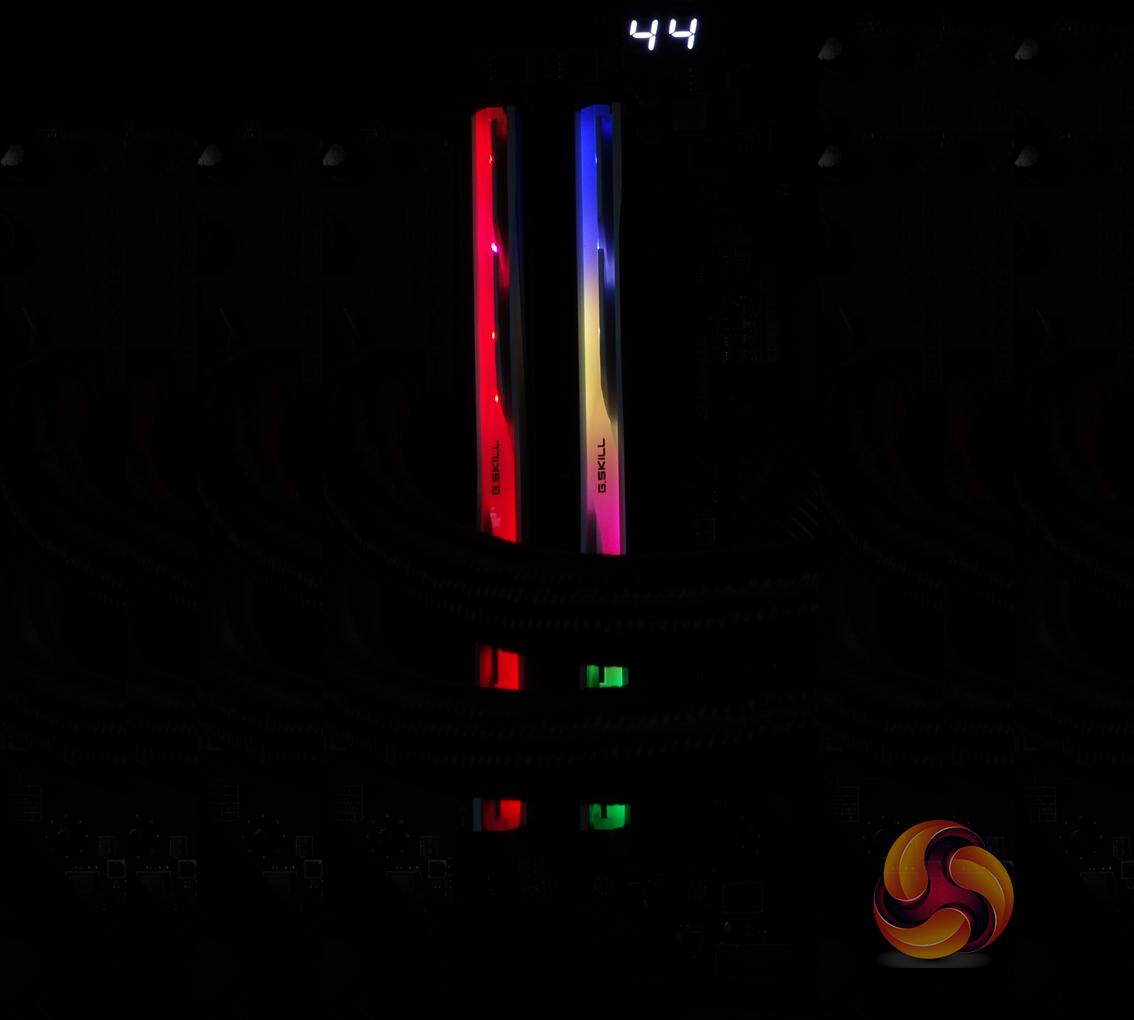
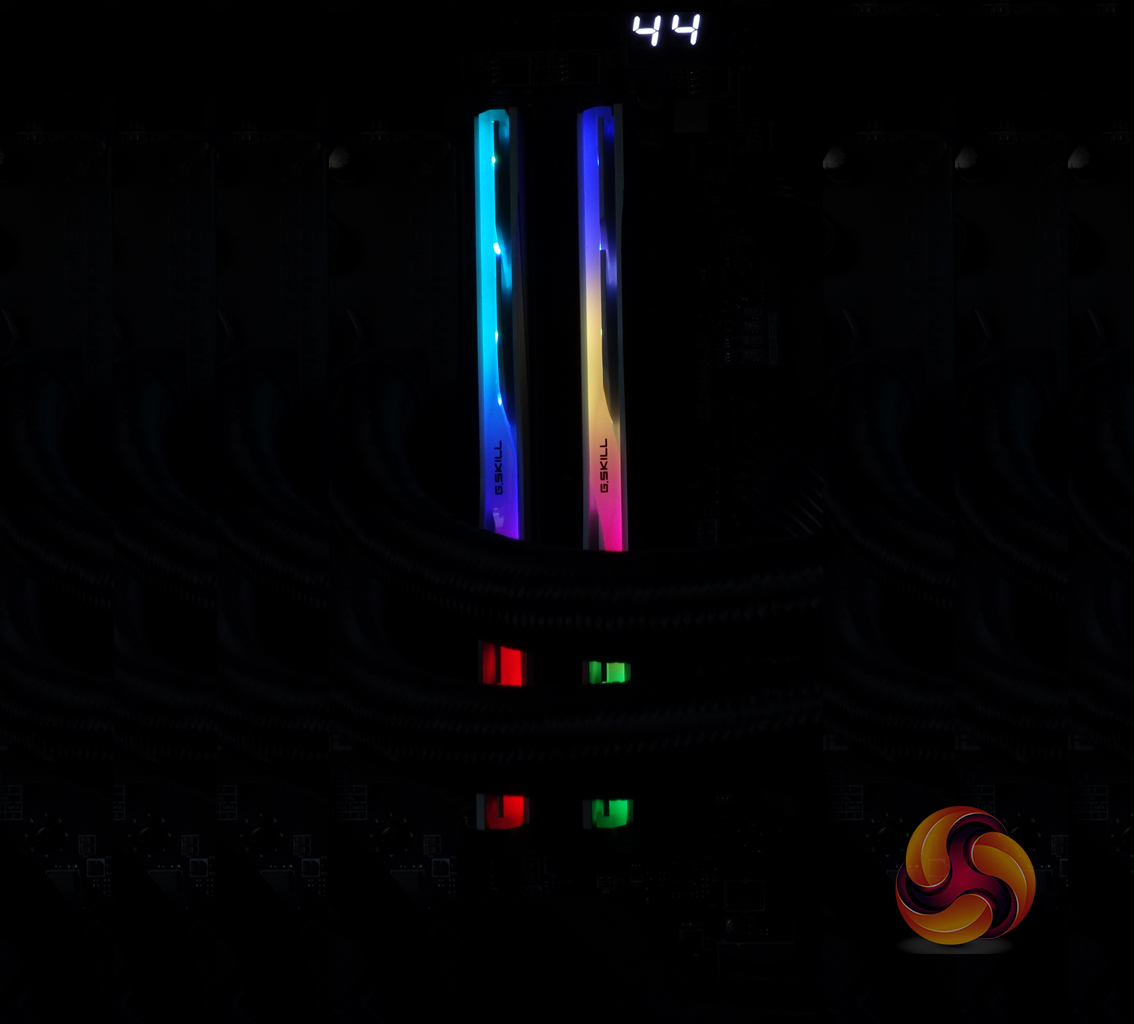
The top of the module is home to the RGB defuser bar, which covers eight RGB zones which are controlled by either G.Skill's own controller software or by the motherboard RGB system.
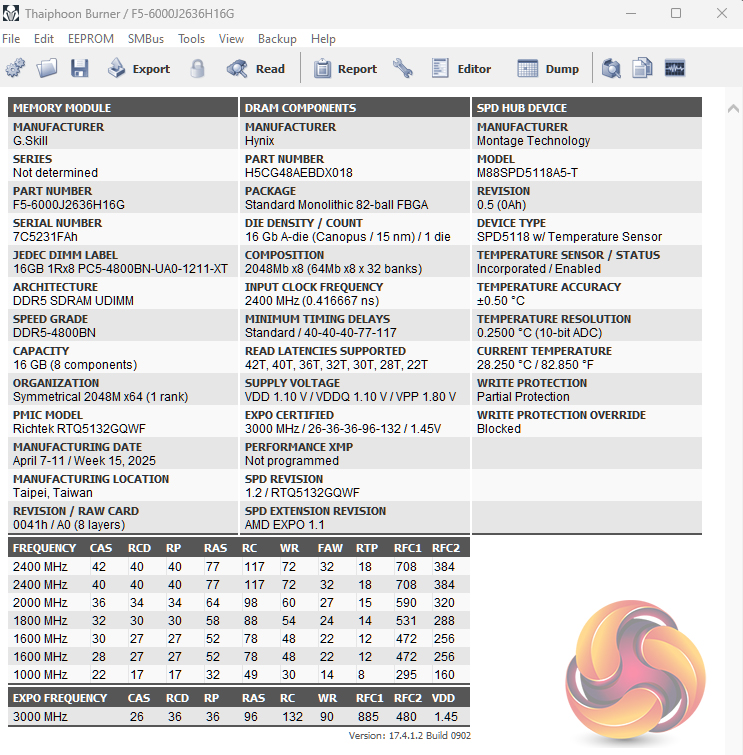
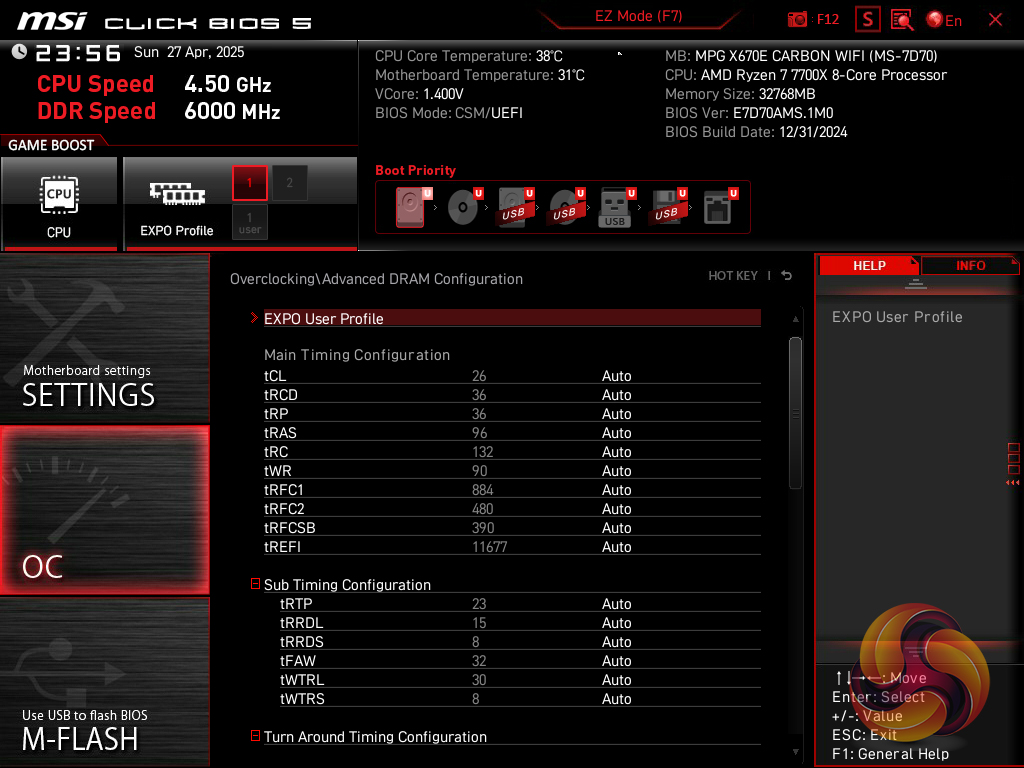
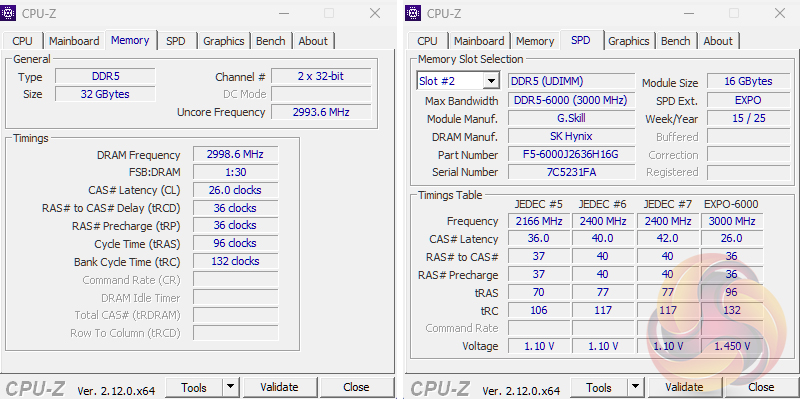
The memory runs at DDR5-4800 with timings of 40-40-40-77-117 (1.10V) natively with the single EXPO profile supporting DDR5-6000 with 26-36-36-96 timings at 1.45V.
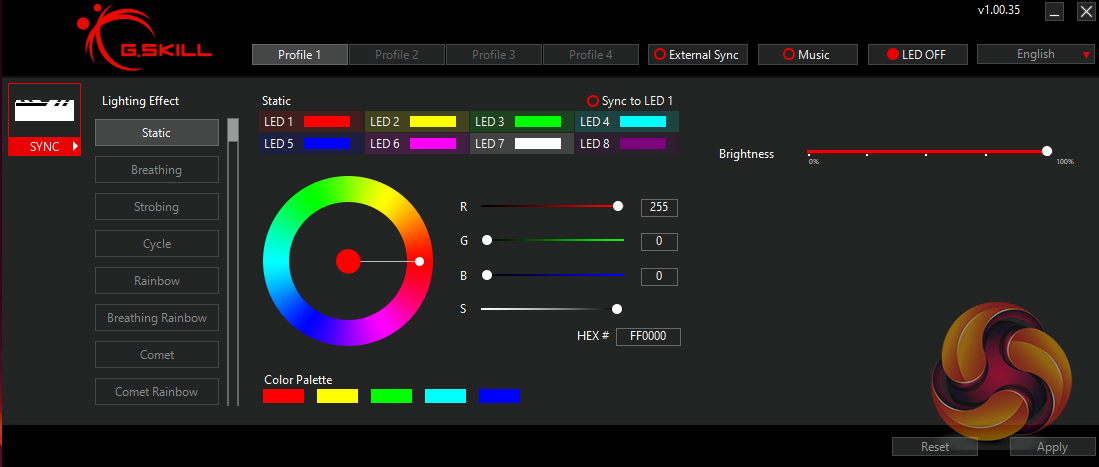

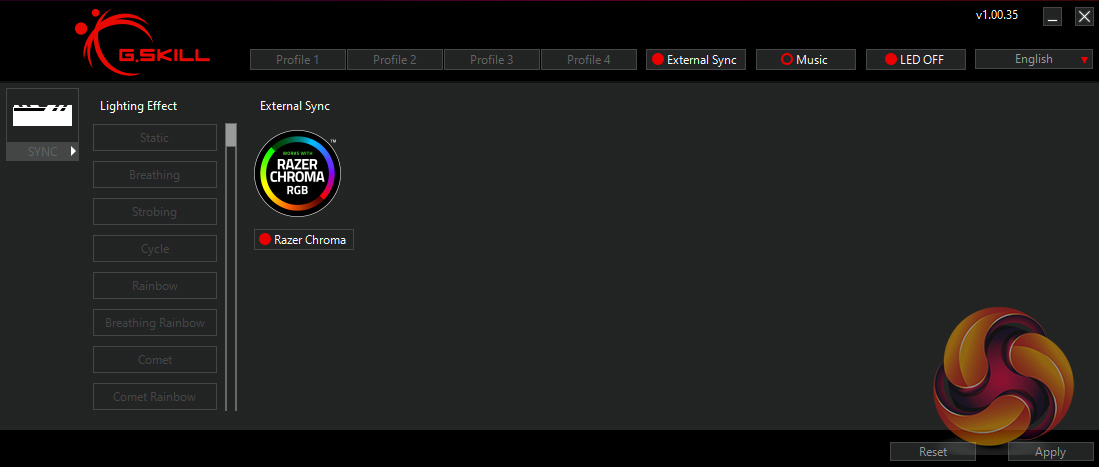
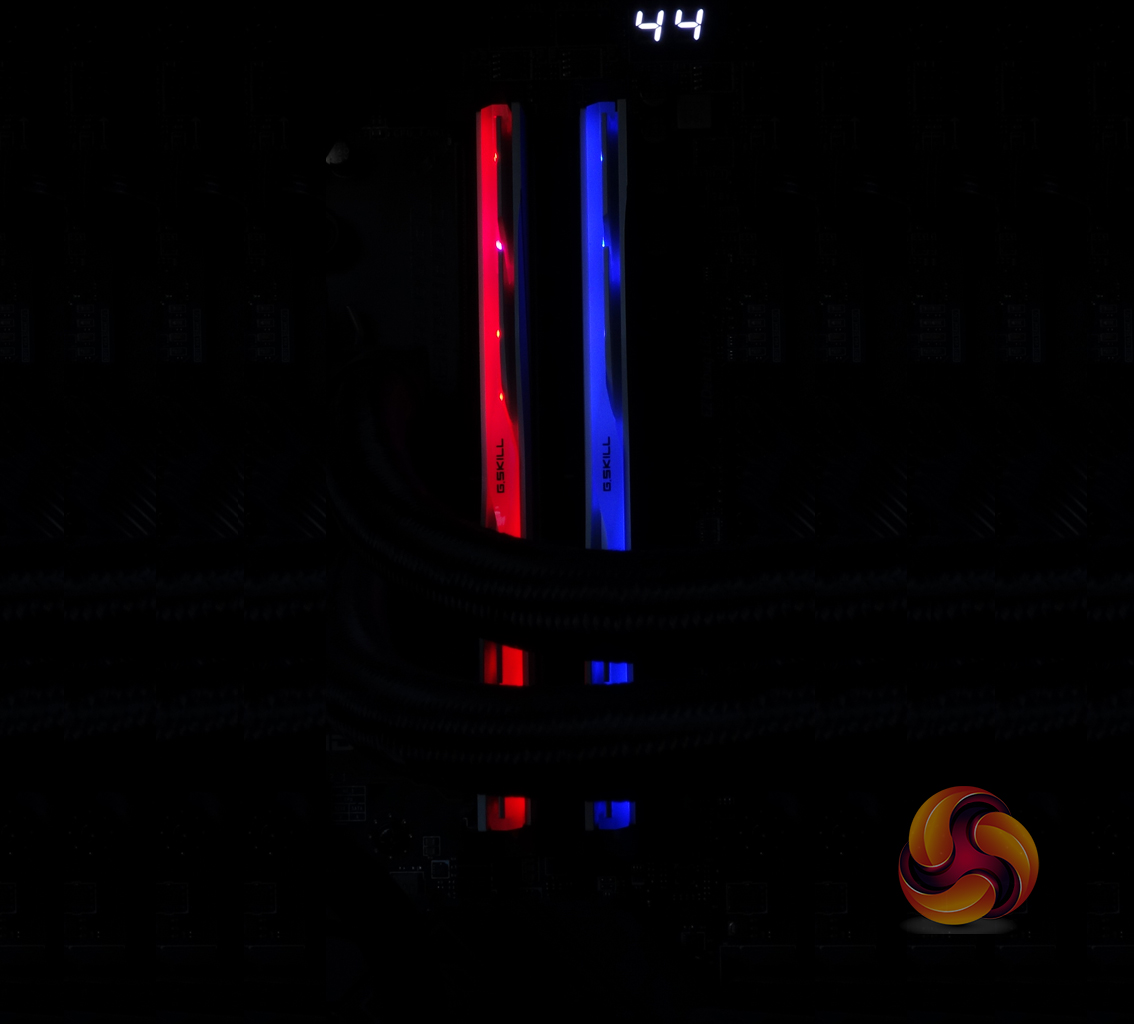
G.Skill's Trident Z lighting control software allows you to set up four profiles independently with their own custom light setup. The modules can be set up together or as individual units. The software has fourteen lightning effects and a wide colour palette to set up your desired effect. And as each module can be set up separately, you can come up with some pretty radical effects. There's also a Music Mode which can be customised, but once enabled, all the other profiles are disabled. However, in this mode, the modules will stay dark if there is no audio output.
If you want the modules to sync up with the rest of your lighting scheme, Asus Aura Sync, Gigabyte RGB Fusion 2.0, MSI Mystic Light Sync, and ASRock Polychrome Sync are all supported.
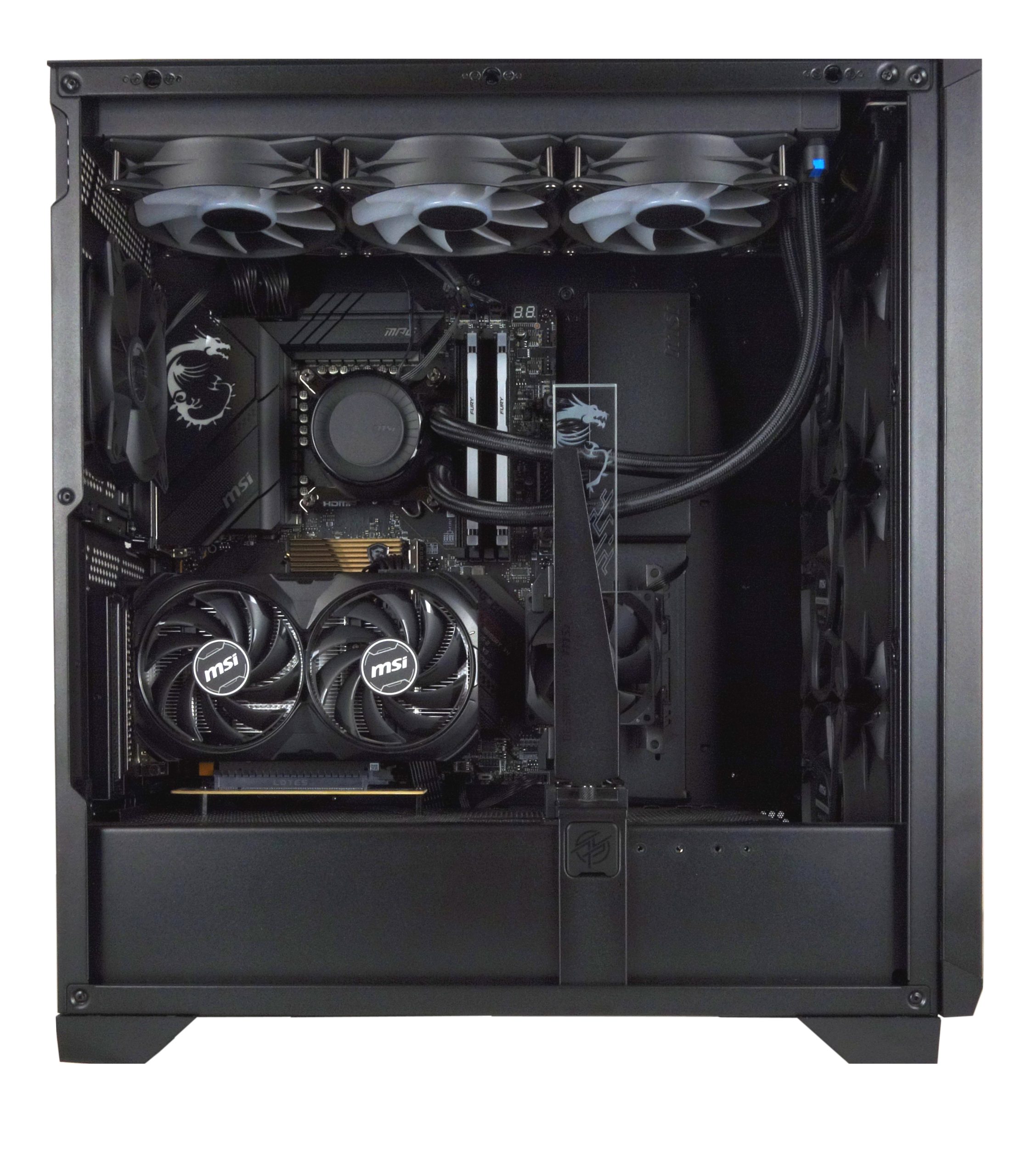
We will be testing the memory kit performance with an Intel Core i7-14700K CPU, MSI MPG Z790 Carbon WiFi motherboard and a GeForce RTX 4060 VENTUS 2X BLACK 8G OC graphics card. The processor is maintained at its stock frequency.
Test System
Processor: Core i7-14700K (20 cores/ 28 threads)
CPU Cooler: MSI MAG CORELIQUID E360
Motherboard: MSI MPG Z790 Carbon WiFi
Graphics card: GeForce RTX 4060 VENTUS 2X BLACK 8G OC
Power supply: MSI MAG A850GL PCIE5 850W
SSD: MSI SPATIUM M570
Case: MSI MPG GUNGNIR 300P AIRFLOW
OS: Windows 11
Thanks to MSI for providing the test system above.
Test Memory Kits
Our DDR5 comparison kits consist of:
ADATA XPG Lancer Blade RGB DDR5-6400 C32 32GB
Corsair Vengeance RGB DDR5-5600 C36 64GB
Corsair Dominator Titanium DDR5-6000 C30 64GB
Corsair Vengeance DDR5-5200 C38 32GB
G.Skill Ripjaws M5 RGB DDR5-6400 C32 32GB
G.Skill Trident Z5 DDR5-7200 C34 32GB
G.Skill Trident Z5 Royal DDR5-6400 C32 64GB
Kingston Fury Beast DDR5-5200 C36 32GB
Klevv Cras X5 RGB DDR5-6000 C40 32GB
Klevv Cras V RGB DDR-7600 CL36 48GB
Klevv Urbane V RGB DDR5-7600 CL36 32GB
Lexar ARES RGB DDR5-6400 CL32 32GB
TeamGroup T-Force XTREEM DDR5-7600 C36 32GB
TeamGroup T-Force Delta RGB DDR5-6400 C40 32GB
TeamGroup T-Force Vulcan a DDR5-6000 C40 32GB
Thermaktake Toughram RC DDR5-5600 C36 32GB
Thermaltake Toughram XG RGB D5 DDR5-7200 C36 32GB
Tests:
7-Zip v19.00 – Built-in 7-Zip benchmark test (CPU & Memory)
Cinebench 2024 – All-core CPU benchmark (CPU & Memory)
HandBrake H264 – Convert 1440p60 H264 video to 1080p60 H264 using the YouTube HQ 1080p60 preset (CPU & Memory)
AIDA64 – Memory bandwidth, memory latency (Memory)
Total War Pharaoh – Battle
Final Fantasy XIV-Dawntrail
Cyberpunk 2077
Memory Benchmarks
AIDA64
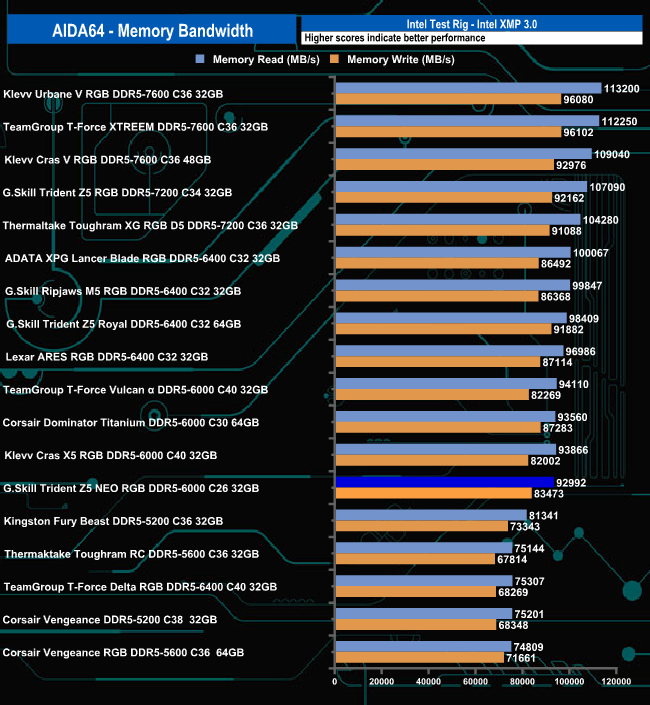
In the AIDA64 Memory Bandwidth test, the G.Skill's Trident Z5 NEO RGB read result of 92,992MB/s is the slowest of the G.Skill modules we tested to date and places the module in the bottom half of the result table.
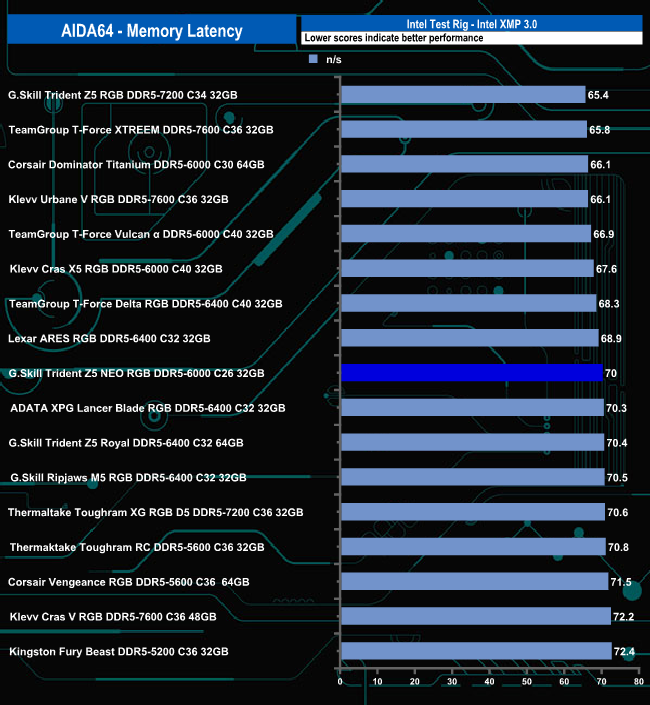
The CL26 timings don't appear to hold the memory back too much in the AIDA64 benchmark, placing it in a mid-table position.
Compute and Productivity Tests
7-Zip
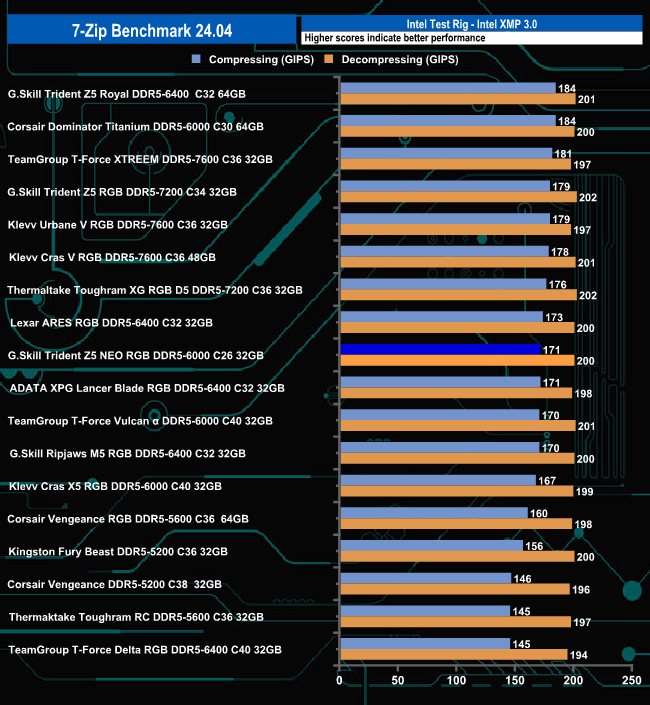
In the 7-Zip Compressing benchmark, the G.Skill Trident Z5 Neo RGB is the slowest of the G.Skill Trident Z5 modules we've tested to date, but good enough to put it in a mid-table position.
Cinebench 2024
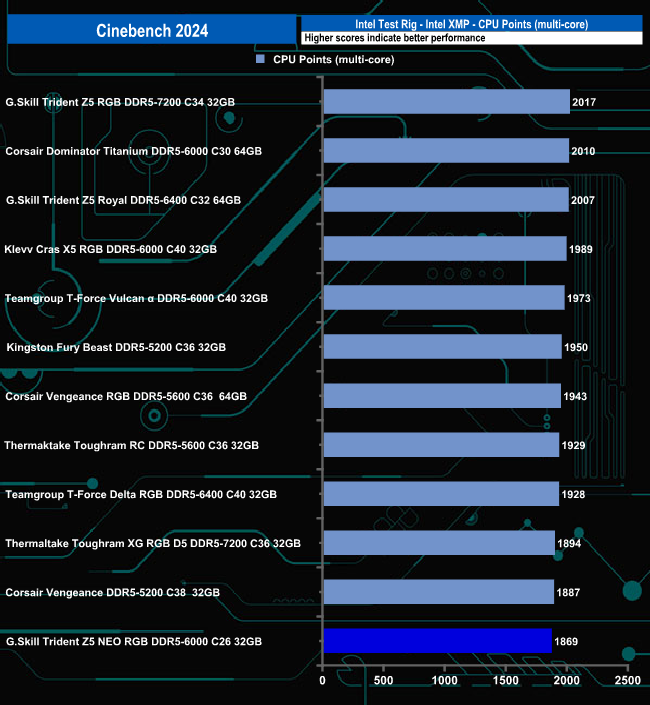
The G.Skill Trident Z5 Neo RGB DDR5-6000 doesn't seem to handle the Cinebench 2024 multi-core test too well, as it sits in last place in the results table.
Encoding
Handbrake
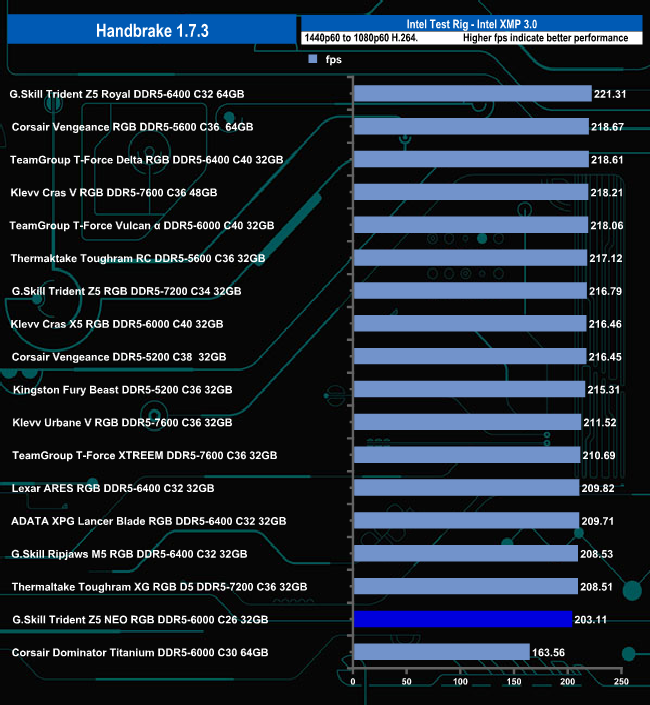
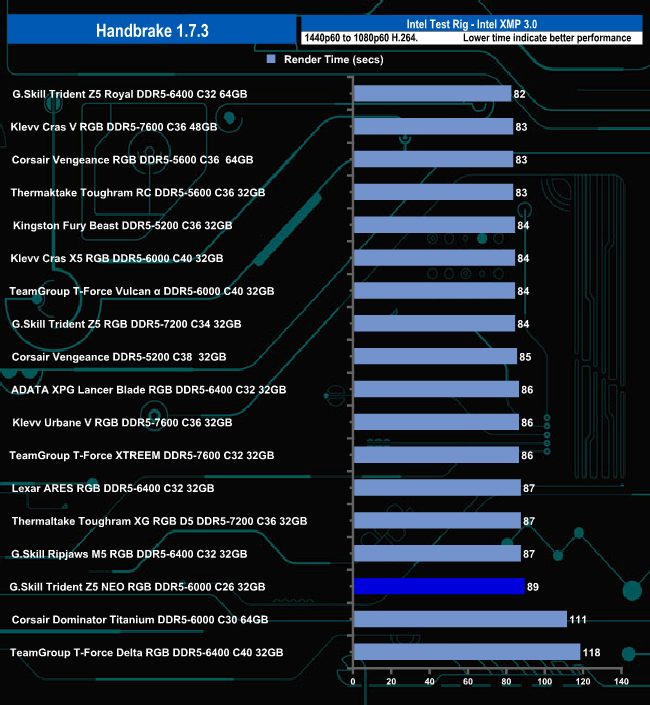
In the Handbrake test, the G.Skill Trident Z5 Neo RGB memory set sits in the penultimate spot in the results chart, 18.20fps behind the fastest modules we've seen to date, the Trident Z5 Royal 6400 C32, also from G.Skill.
Office Productivity
PCMark 10
Essentials
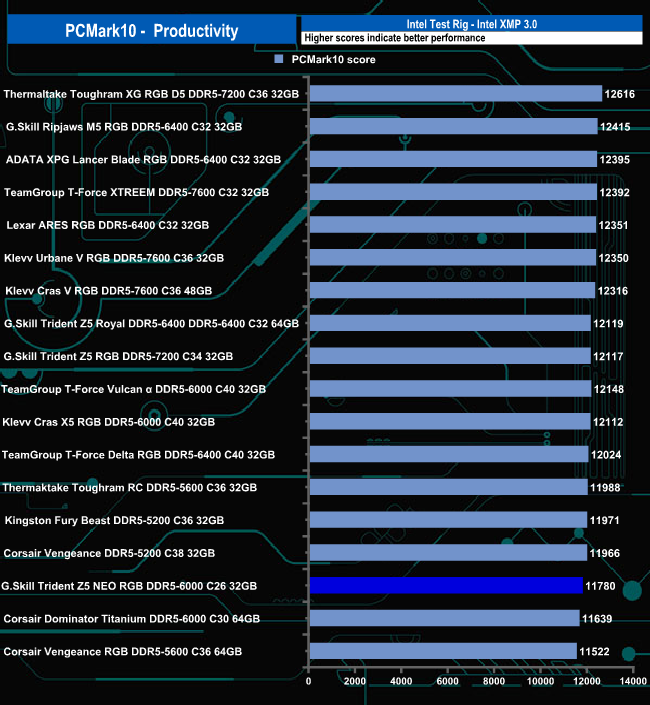
Productivity
Digital Content Creation
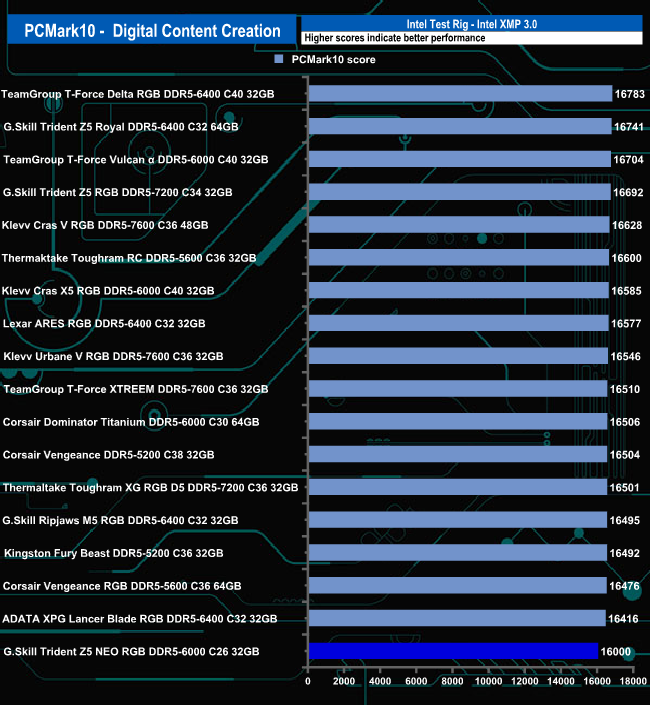
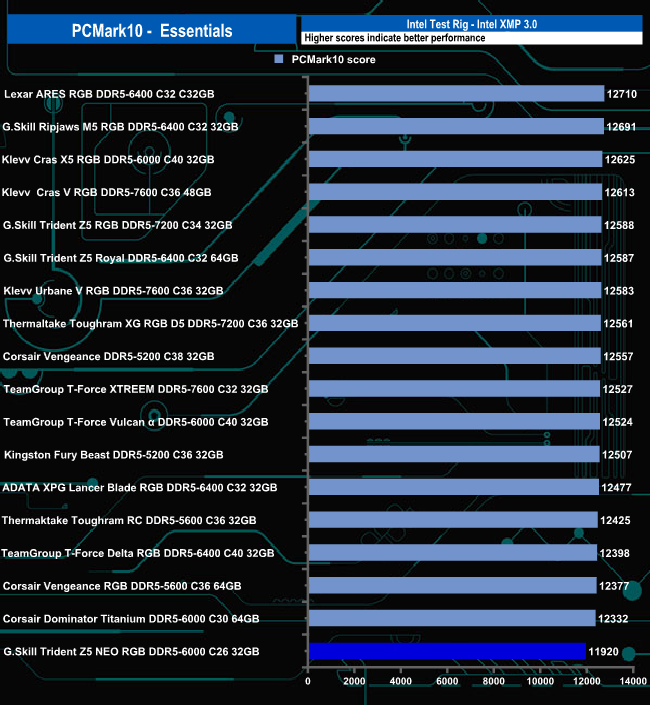
The G.Skill Trident Z5 Neo RGB 6000 doesn't seem to handle the PCMark 10 benchmark too well, sitting in last place in the Essential and Digital Content Creation tests, but shows a small improvement in the Productivity test.
Gaming (1080p)
Total War Pharaoh – Battle
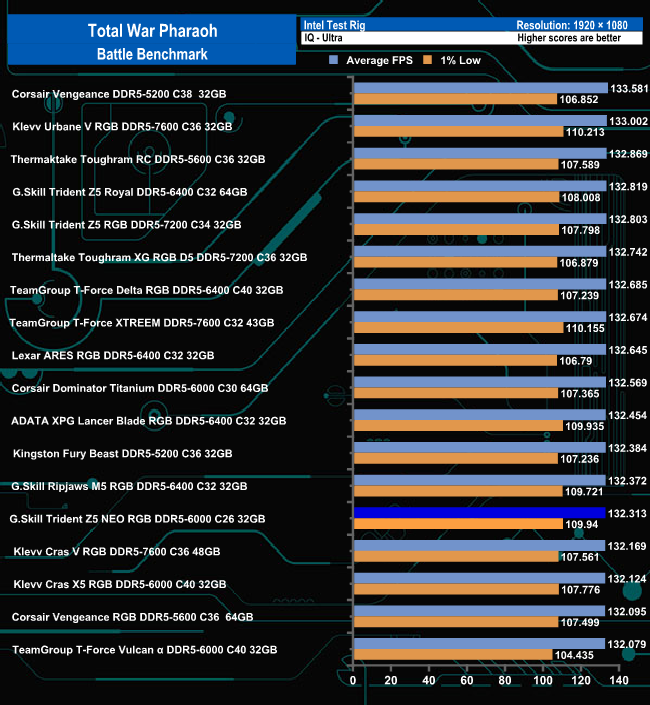
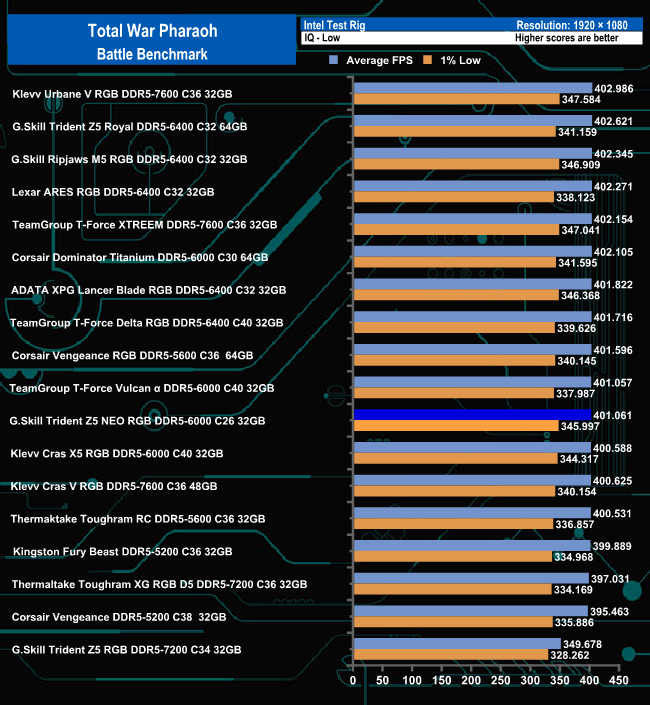
Using the Ultra quality settings, the G.Skill Trident Z5 Neo RGB 6000 memory sits in the bottom half of the results table. Easing off the quality settings down to the Low setting sees the memory moving up the table a few places.
Final Fantasy XIV-Dawntrail
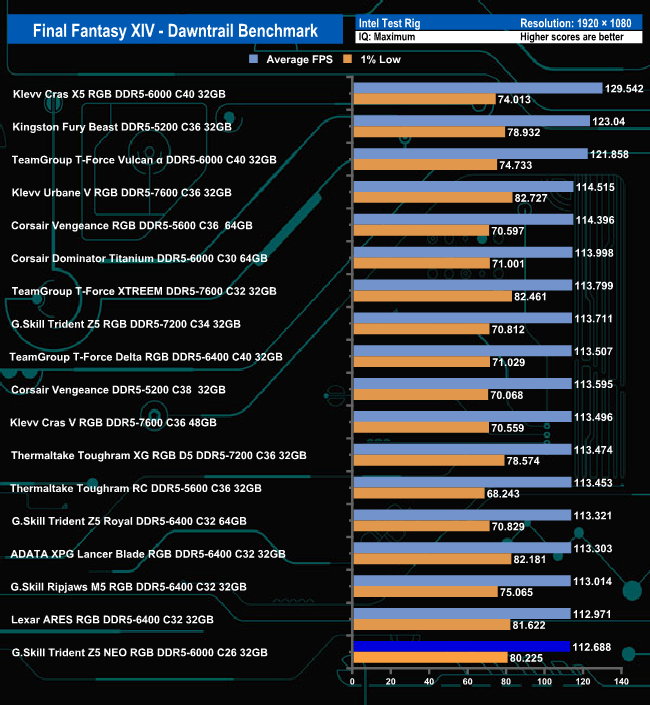
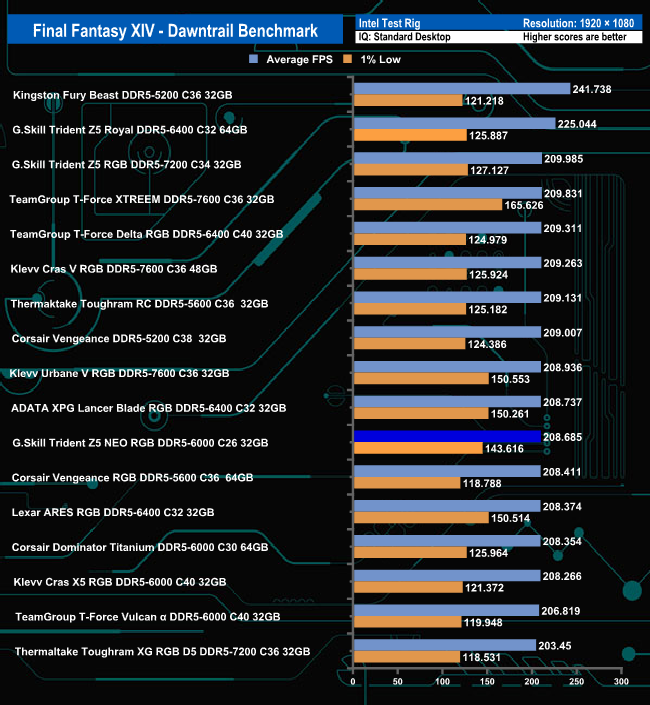
Using the maximum quality settings in the Final Fantasy XIV-Dawntrail benchmark, the memory sits in last place – but the margins are slim. Backing off the quality settings sees the modules move up the table.
Cyberpunk 2077
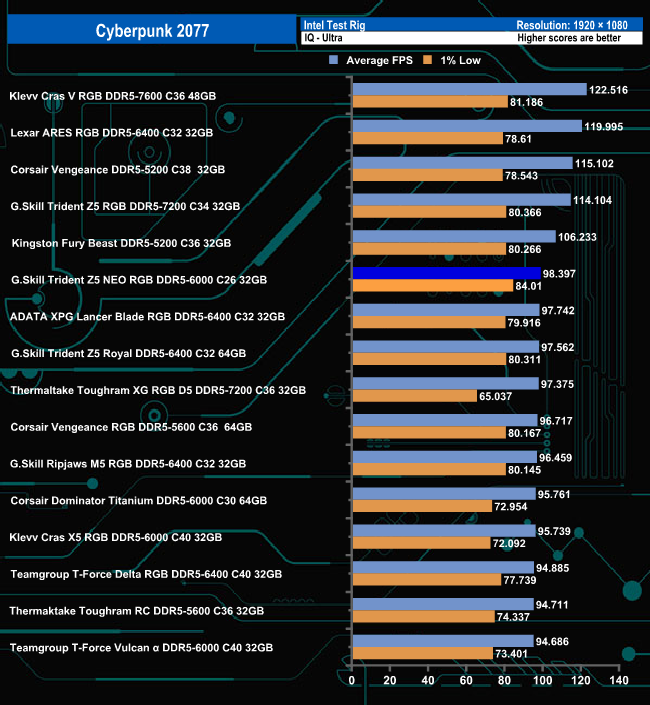
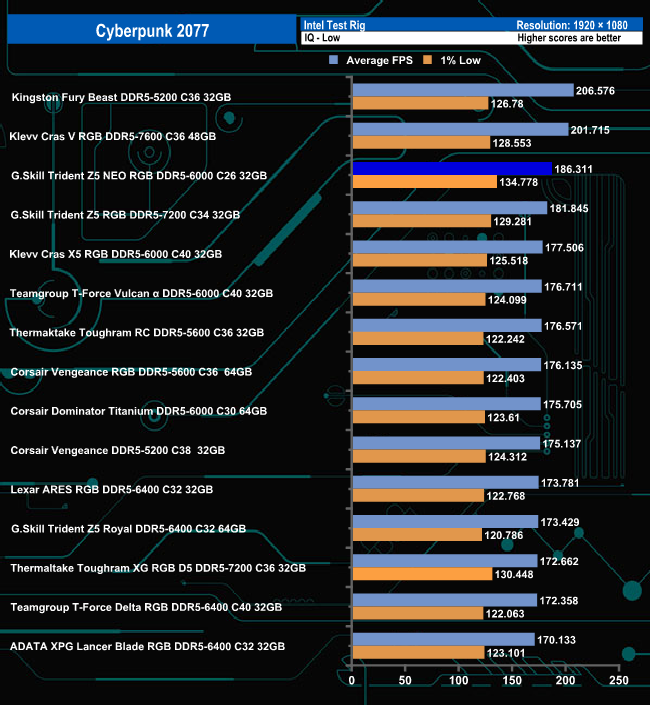
When tested with the Cyberpunk game benchmark using the Ultra settings, the drive produced test results of 96.397fps (average) and 84.01fps (1% Low), which puts the memory in the top half of the results chart. Switching over to the low setting saw the module rise to third place.
We will be testing the memory kit performance with an AMD Ryzen 7 7700X CPU, MSI MPG X670E Carbon WiFi motherboard and a GeForce RTX 4060 VENTUS 2X BLACK 8G OC graphics card. The processor is maintained at its stock frequency.
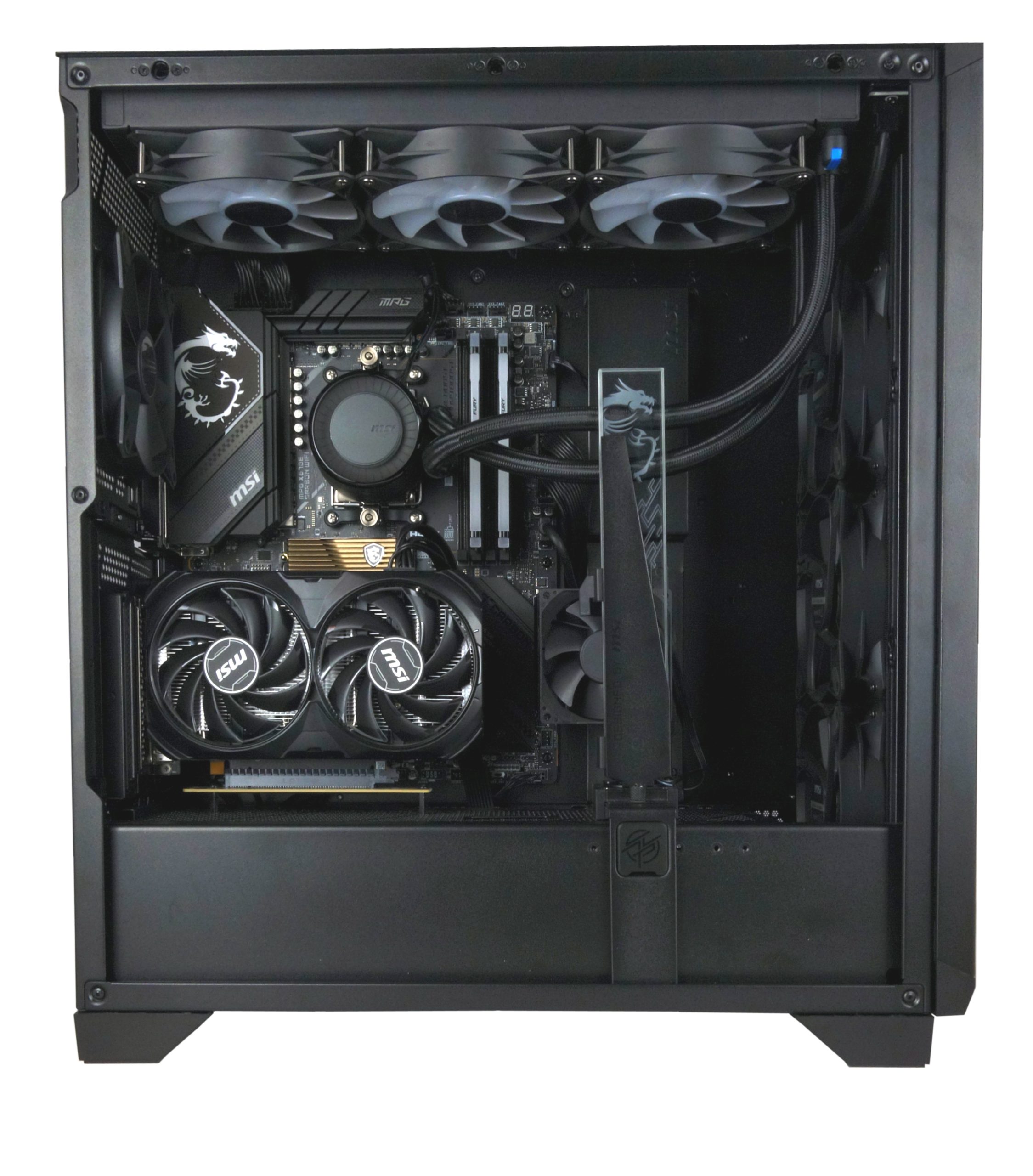
Test System
Processor: AMD Ryzen 7 7700X (8 cores/ 16 threads)
CPU Cooler: MSI MAG CORELIQUID E360
Motherboard: MSI MPG X670E Carbon WiFi
Graphics card: GeForce RTX 4060 VENTUS 2X BLACK 8G OC
Power supply: MSI MAG A850GL PCIE5 850W
SSD: MSI SPATIUM M570
Case: MSI MPG GUNGNIR 300P AIRFLOW
OS: Windows 11
Thanks to MSI for providing the test system above.
Memory Benchmarks
AIDA64
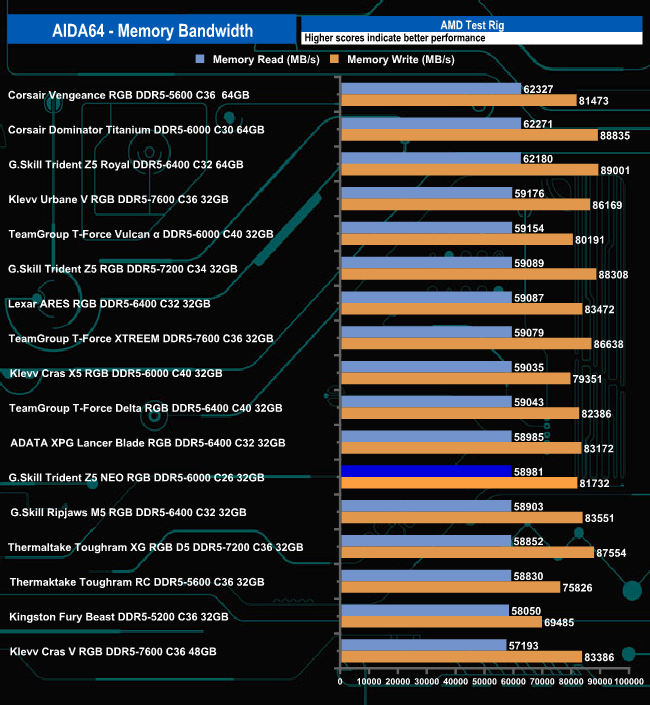
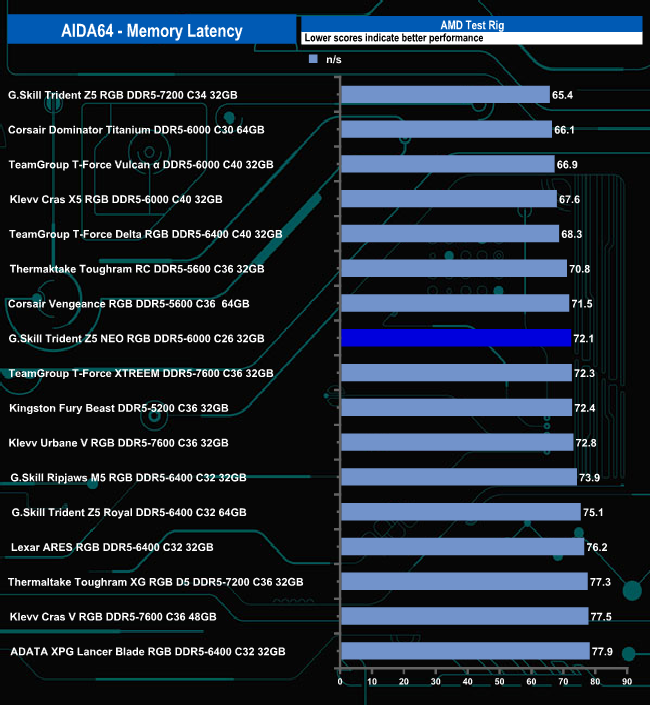
When tested with the AIDA64 memory benchmark, the 32GB kit of G.Skill's Trident Z5 Neo RGB DDR5-6000 C26 produced a read figure of 58,981MB/s a result which places the modules in the bottom half of the results chart.
Compute and Productivity Tests
7-Zip
In the 7-Zip benchmark, the G.Skill Trident Z5 Neo RGB sits in a mid-table position, but there isn't an awful lot in it between it and the G.Skill Trident Z5 Royal DDR5-6400 C32 in top spot.
Cinebench 2024
In the Cinebench 2024 multi-core test, the G.Skill Trident Z5 Neo RGB 6000 sits in last place of the results table.
Encoding
Handbrake
In the Handbrake test, G.Skill's Trident Z5 Neo RGB 6000 sits in the penultimate position on the results chart, but in reality, there is not much in it between it and G.Skill Trident Z5 Royal 6400, which sits at the top of the table.
Office Productivity
PCMark 10
Essentials
Productivity
Digital Content Creation
G.Skill's Trident Z5 Neo RGB doesn't handle the rigours of the PCMark 10 benchmark too well as it sits in last place on the results table for the Essential and Digital Content Creation tests and third from the bottom in the Productivity test.
Gaming (1080p)
Total War Pharaoh – Battle
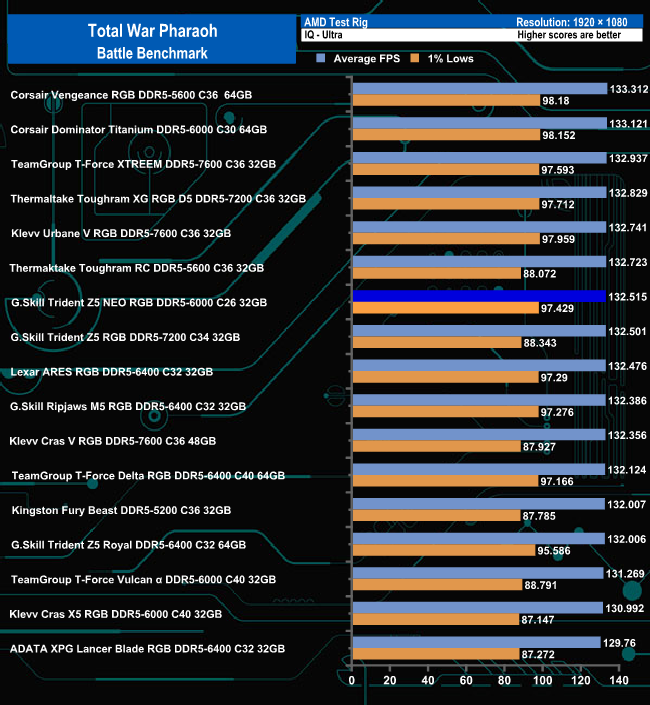
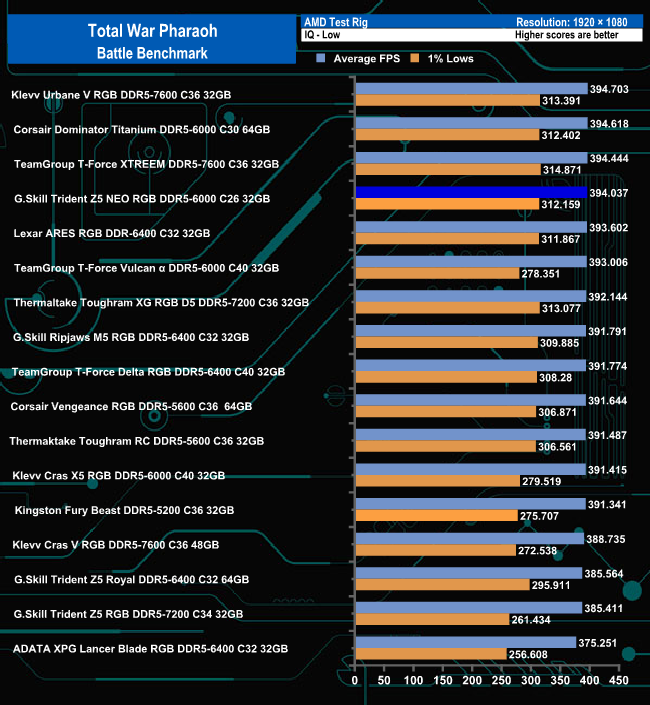
In the Total War: Pharaoh – Battle benchmark using Ultra quality settings, G.Skill's Trident Z5 Neo RGB 6000 produces an average fps score of 132.515MB/s, which puts it in seventh place. Switching over to the Low quality settings sees the drive move up to third place on the table. Its 1% Low figure is very good at both quality settings.
Final Fantasy XIV-Dawntrail
There's not much to choose from among all the kits in the Final Fantasy XIV Dawntrail benchmark using either the Maximum or Standard image quality settings.
Cyberpunk 2077
The Trident Z5 Neo RGB 6000 performs well in Cyberpunk 2077 benchmark, sitting in sixth place using Ultra quality settings but moving up to third spot when the quality settings are dropped to Low.
G.Skill's Trident Z5 Neo RGB has been designed as performance DDR5 memory for PC enthusiasts and gamers, with particular attention being given to overclocking using AMD's EXPO technology, but it still works in Intel-based systems. It features customisable RGB lighting while the aluminium heatspreaders come in matt white or matt black finishes. The modules are 42.8mm high, giving a wider range of compatibility with air coolers and motherboards.
The Trident Z5 Neo RGB product line consists of five speeds: 5600 MT/s, 6000MT/s, 6400MT/s, 7200MT/s and 8000MT/s and four kit capacities. The entry-level 5200MT/s comes in 32GB (CL28 1.35V and 30 1.25V), 48GB and 96GB, both CL40 1.25V. 6000MT/s is the current sweet spot for AMD-based systems, and it has the most options of the Trident Z5 Neo RGB product line:
- 32GB (CL26 140V, CL28 1.40V, CL30 1.35V, CL32 1.35V)..
- 48GB (CL26 1.45V, CL28 1.35V, CL40 1.35V).
- 64GB (CL26 1.45V, CL26 1.40V, CL28 1.40V, CL30 1.40V, CL32 1.40V, CL36 1.35V) and 96GB (CL28 1.35V, CL30 1.35V),
6400MT/s comes in 32GB (CL30 1.40V, CL32 1.40V) and 48GB (CL32 1.35V). 7200MT/s comes in a 32GB kit (CL34, 1.40V) and the flagship 8000MT/s models come in 32GB (CL38 1.45V) and 48GB (CL40 1.40V).
The memory kit that G.Skill sent in for review was one of the matte white 32GB DDR5-6000 kits (F5-6000J2636H16GX2-TZ5NRW) comprising two 16GB single-sided modules each using eight SK Hynix A-die memory chips. It runs natively at DDR5-4800 with timings of 40-40-40-77-117 (1.10V), but the single EXPO profile bumps this up to 6000MHz at 1.45V (26-36-36-96).
The RGB system comprises eight LED segments per module. These LEDS are very bright, but they can be turned down in the software. If you want the memory to be integrated into an existing light scheme, most of the 3rd party software is catered for with support for ASRock Polychrome Sync, Asus Aura Sync, MSI Mystic Light Sync and Gigabyte RGB Fusion 2.0. The other option is to use G.Skill's own Trident Z Lighting Control utility, which can be downloaded from the G.Skill site. The Trident Z Lighting Control supports up to four independent profiles with their own custom light setup. The software has fourteen lightning effects and a wide colour palette, and modules can be synced or set up as individual units, so pretty much the sky is the limit when it comes to custom schemes.
We did a mild bit of overclocking on the modules, just using the EXPO settings without any voltage adjustments. At 6200MT/s, the memory was fine with the best improvements seen in Cinebench 2024 up from 1083 to 1136 points, Final Fantasy XIV Dawntrail benchmark saw the average fps score in standard desktop mode go up from 178fps to 185fps, and in the Cyberpunk 2077 benchmark using low quality settings where the average fps and 1% lows rose by 18.366fps and 10.937 fps respectively. Turning the memory up to 6400 saw the system boot without any problem, but kept crashing during runs of the AIDA64 benchmark.
We found the 32GB kit of G.Skill's Trident Z5 Neo RGB 6000MT/s CL26-36-36-96 Amazon UK for around £180 HERE.
Pros
- Overall performance.
- Build quality.
- RGB.
- Limited lifetime warranty.
Cons
- Only one memory profile (EXPO).
KitGuru says: DDR5-6000 is the current sweet spot for AMD's Ryzen 7000 & 9000 series, and as you might expect, G.Skill's Trident Z5 Neo RGB has a multitude of offerings at that speed, including the low-latency CL26 version. Although designed to work on AMD platforms, it still performs well on Intel-based systems.