 KitGuru KitGuru.net – Tech News | Hardware News | Hardware Reviews | IOS | Mobile | Gaming | Graphics Cards


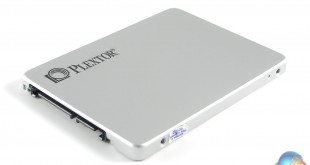
Plextor's M7V is the companies first to be based around TLC (triple level cell) NAND and is being offered as a more cost-effective solution to Plextor's existing MLC drive range. Plextor also claim it offers better durability than other TLC drives currently in the market place.
The Plextor M7V comes in two formats, 2.5in and M.2 2280 but unfortunately because of the controller the M.2 version is SATA 6Gb/s based only, so no speedy PCI-E version. Both formats support the same capacities; 128MB, 256MB and the flagship 512MB.
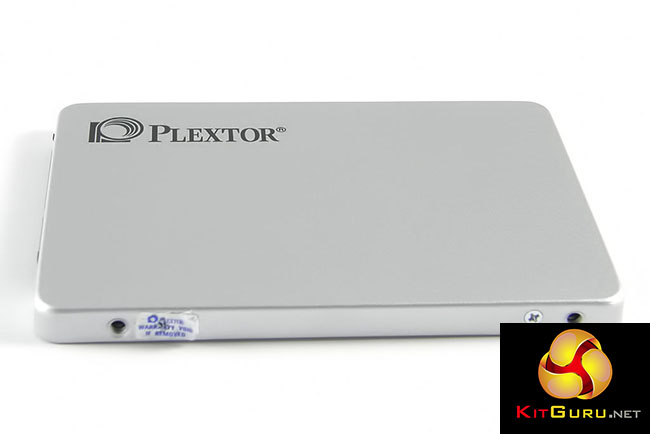
Performance for the 256GB drive is quoted as up to 560MB/s for sequential reads and up to 530MB/s for sequential writes while random 4K performance is quoted as up 98,000 IOPS and 84,000 IOPS for reads and writes respectively.
The drive has an endurance TBW figure of 160TB which works out to be around 146GB host writes per day of the 3 year warranty Plextor back the drive with.
Physical Specifications:
Usable Capacities: 128GB, 256GB, 512GB
NAND Components: 15nm Toshiba TLC Toggle
Interface: Serial ATA (SATA) 6Gb/s (SATA III)
Form Factor: 7mm, 2.5in
NAND Controller: Marvell 88SS1074B1
Dimensions: 100 x 69.85 x 6.8mm
Drive Weight: 60g
Firmware Version: 1.00
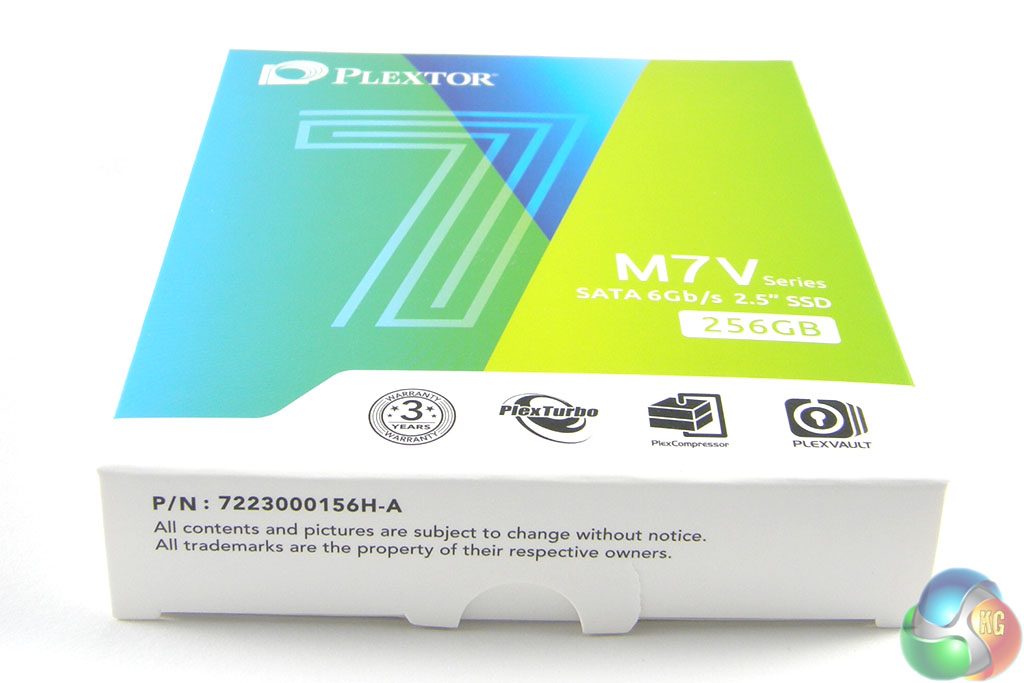
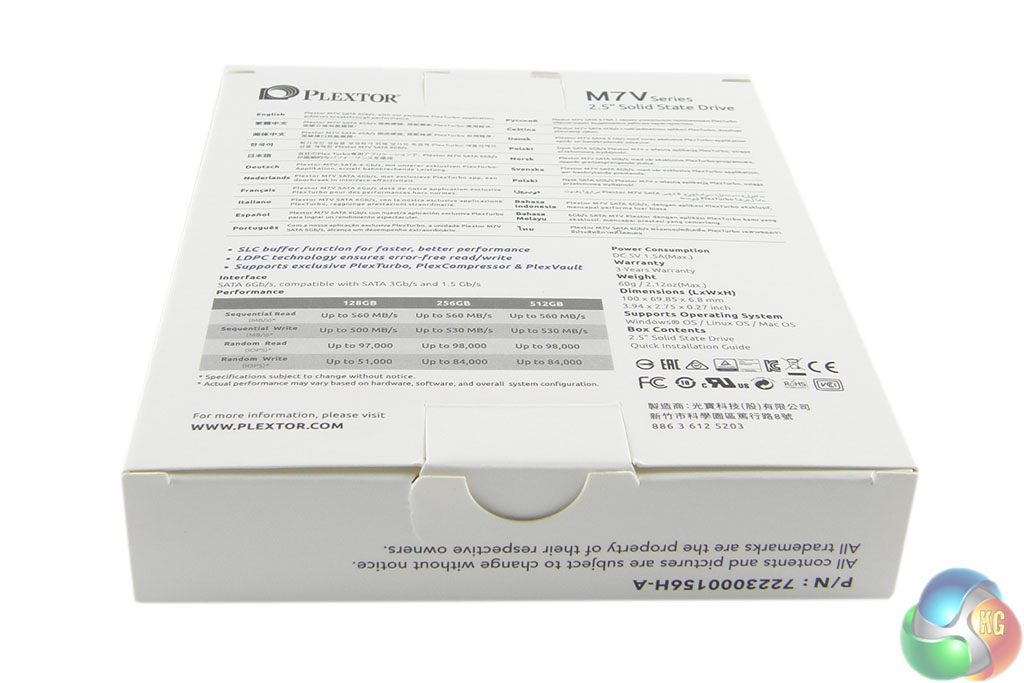
The front of the box displays the drives capacity, warranty information and the logos for three of the Plextor drive technologies the M7V supports. The rear of the box has a panel to display performance figures for the whole M7V range. It also carries a list of some of the drives specifications and the technologies it supports.
In an effort to keep the price as low as possible Plextor don't bundle anything in with the drive.
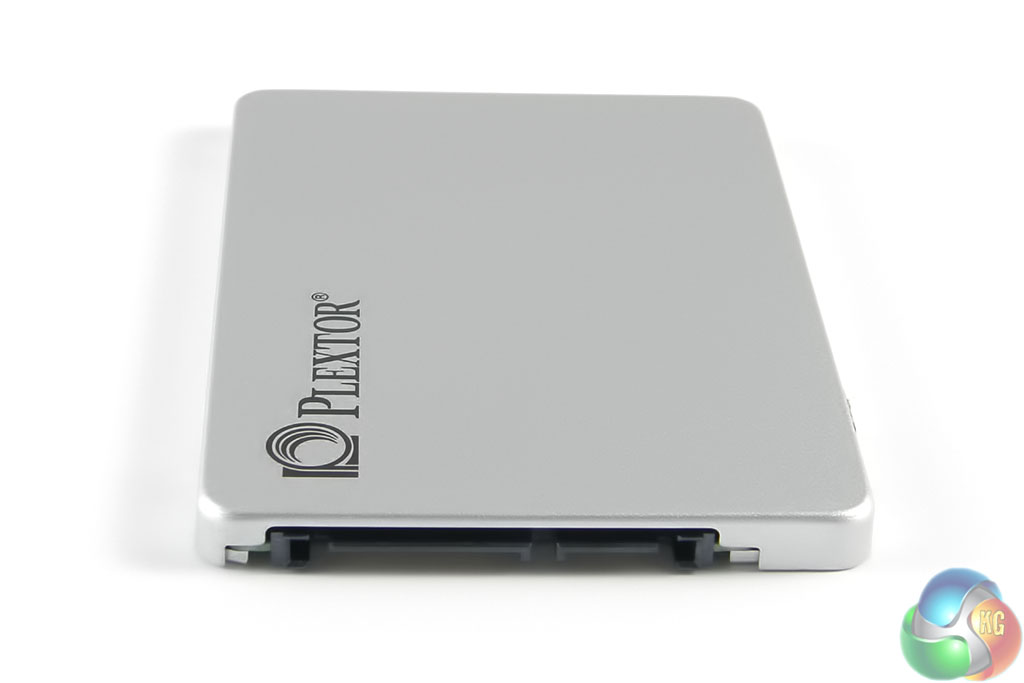
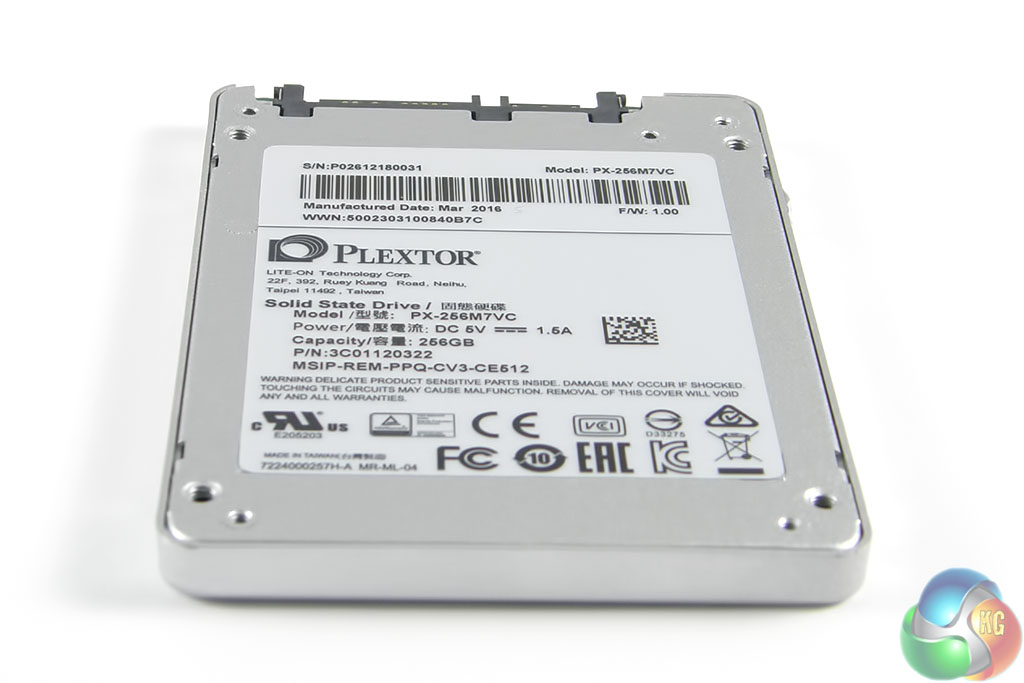
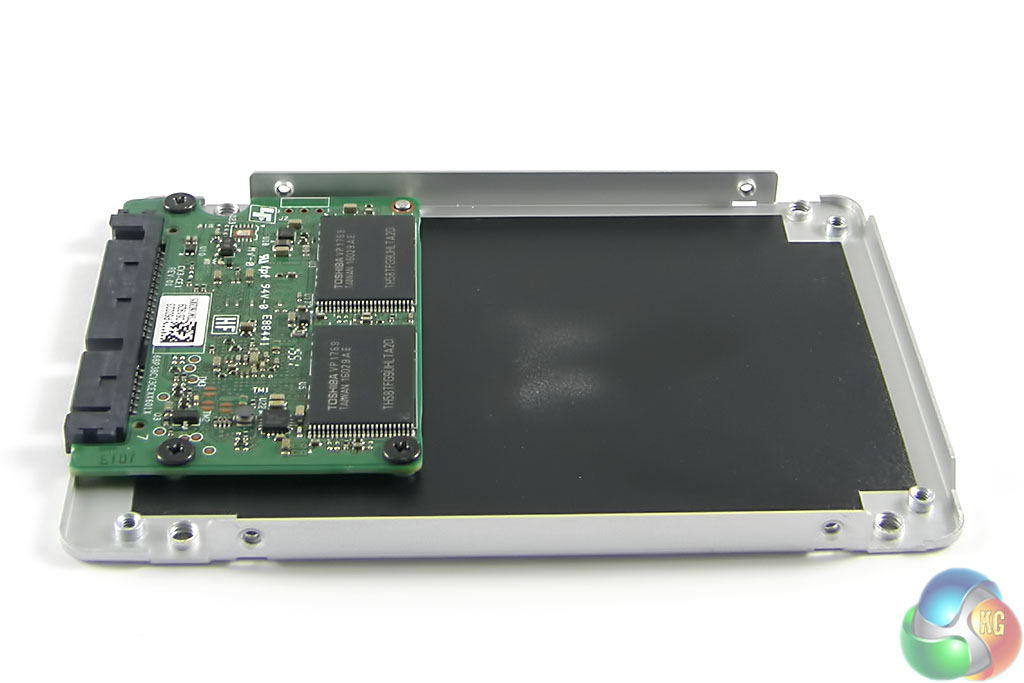
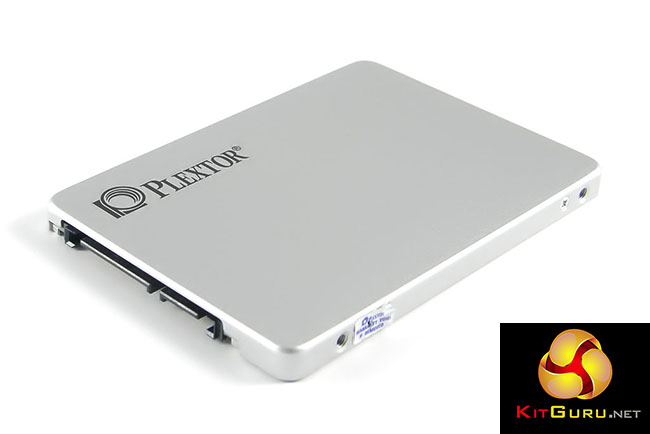
The M7V is built on a 7mm, 2.5in format with a metal case that is held together with four screws.
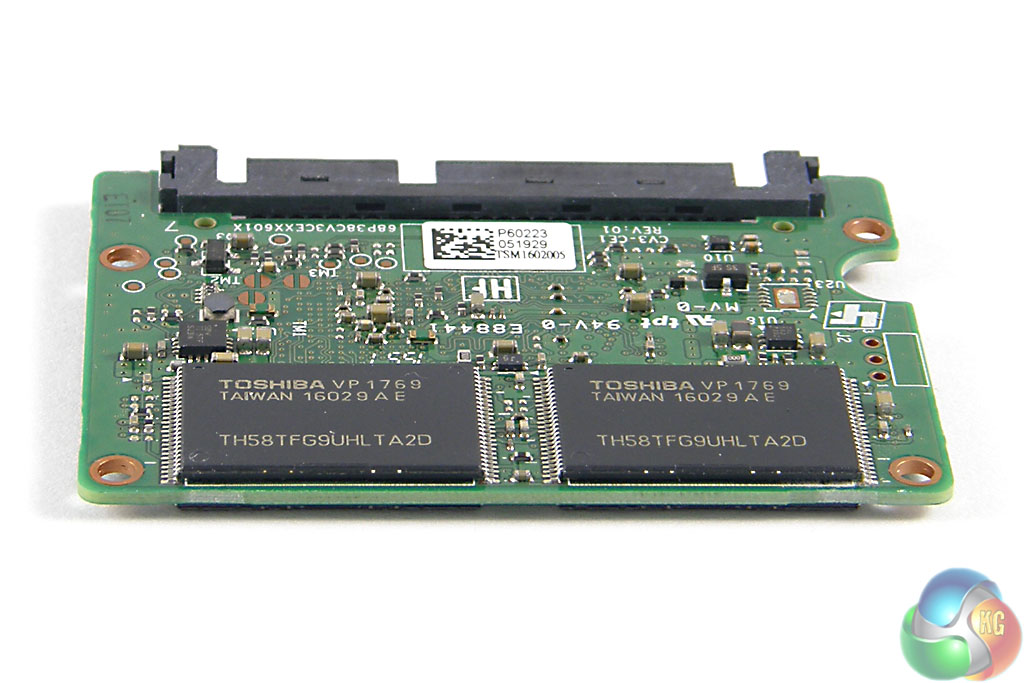
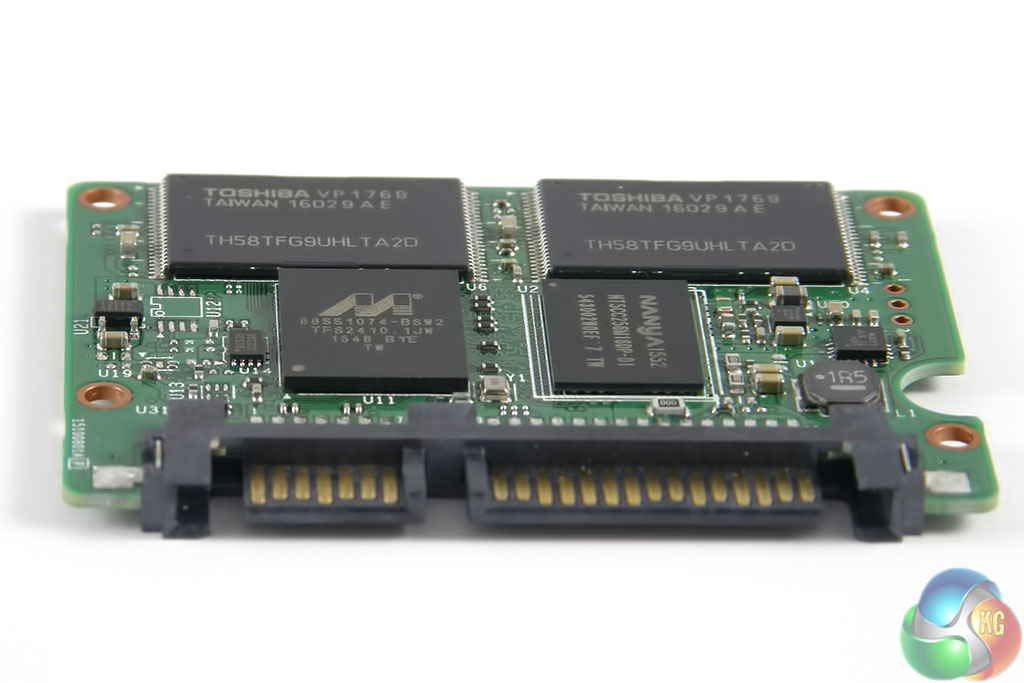
The PCB for the 256GB M7V is tiny, measuring just 40 x 52 mm. On one side are a pair of Toshiba second generation A19 15nm TLC Toggle NAND IC's (coded TH58TFG9UHLTA ) while on the other side of the board lurk two more Toshiba NAND IC's, the Marvell 88SS1074B1 8-channel controller and the 256MB Nanya DDR3L -1600 cache chip.
The Marvell 88SS1074B1 controller has been designed from the ground up to support TLC NAND and to help increase the endurance of TLC based drives includes Marvell's third generation NANDEdge error-correcting, LDPC (low-density parity check) technology.
In line with other manufacturers of TLC equipped drive, Plextor employ a write enhancing technology to boost write performance. PlexNitro has been designed especially with TLC NAND in mind and it performs a neat trick of not using any of the drives capacity. To quote Plextor “Utilizing so-called PlexNitro Cache as a buffer to improve the read and write speeds of TLC SSD, without taking away from user capacity as over provisioning.”
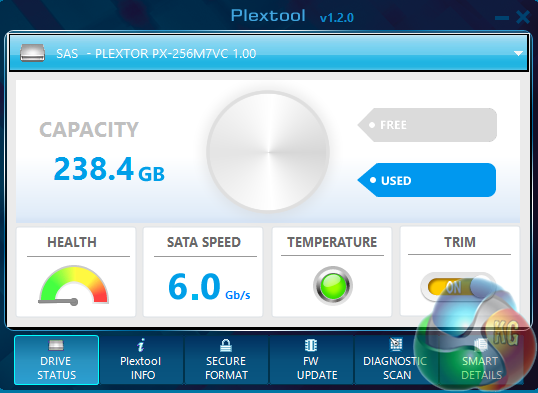
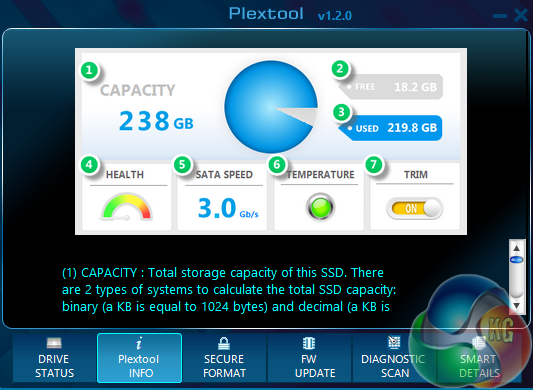
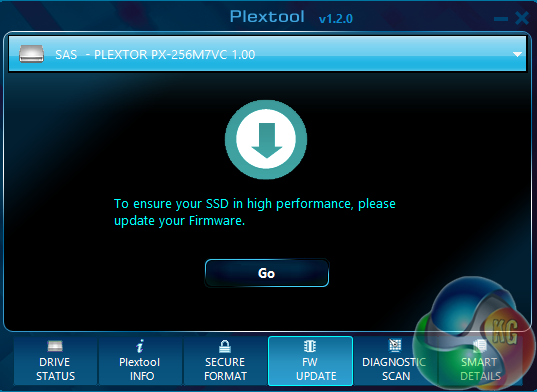
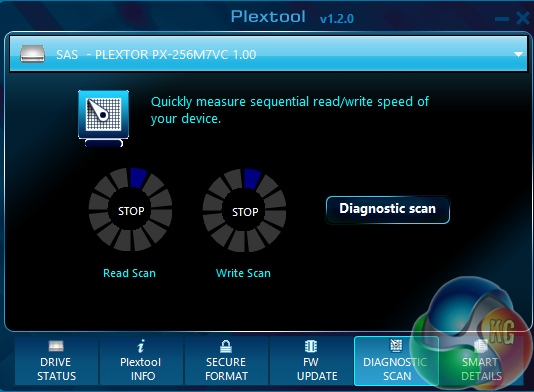
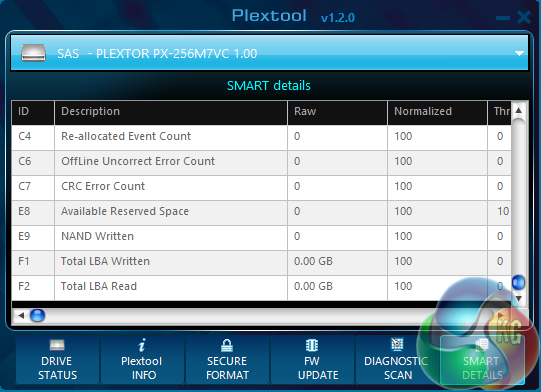
Plextor's Plextool suite of drive utilities may not be all bells and whistles like some but what's provided are basically all you need to look after the drive. With it you can look at the drive's status and its temperature, usage etc. There's a secure format facility, a page to perform firmware updates, a diagnostic scan and finally S.M.A.R.T info.
Although the M7V is a drive aimed at the value end of the market, Plextor haven't skimped on the technologies it supports; PlexTurbo, Plextor's SSD RAM caching technology, PlexCompresser, compression technology to automatically compress rarely used files and PlexVault, a secure storage area for sensitive files and documents are all here.
For testing, the drives are all wiped and reset to factory settings by HDDerase V4. We try to use free or easily available programs and some real world testing so you can compare our findings against your own system.
This is a good way to measure potential upgrade benefits.
Main system:
Intel Core i7 4790K with 16GB of DDR3-2133 RAM, Sapphire R9 390 Nitro and an ASRock Extreme 6 motherboard.
Other drives:
ADATA SX930 240GB
Crucial MX100 256GB
Intel 335 240GB
Intel SSD730 240GB
Kingston HyperX Savage 240GB
Micron M600 256GB
OCZ Agility 4 256GB
OCZ ARC 100 240GB
OCZ Trion 100 240GB
OCZ Trion 150 240GB
OCZ Trion 150 480GB
OCZ Vector 150 256GB
OCZ Vector 240GB
OCZ Vertex 3 240GB MAX IOPS
OCZ Vertex 450 256GB
OCZ Vertex 460 240GB
Patriot Wildfire 240GB
Plextor M5 Pro 256GB
Plextor M6V 256GB
PNY CS2211 240GB
PNY XLR8 240GB
Samsung 840 EVO 250GB
Samsung 840 Pro 256GB
SanDisk Extreme II 240GB
SanDisk X400 256GB
Seagate 600 Pro 200GB
Software:
Atto Disk Benchmark.
CrystalMark 3.0.3.
AS SSD.
IOMeter
All our results were achieved by running each test five times with every configuration this ensures that any glitches are removed from the results.
Trim is confirmed as running by typing fsutil behavior query disabledeletenotify into the command line. A response of disabledeletenotify =0 confirms TRIM is active.
Crystalmark is a useful benchmark to measure theoretical performance levels of hard drives and SSD’s. We are using V3.0.3.
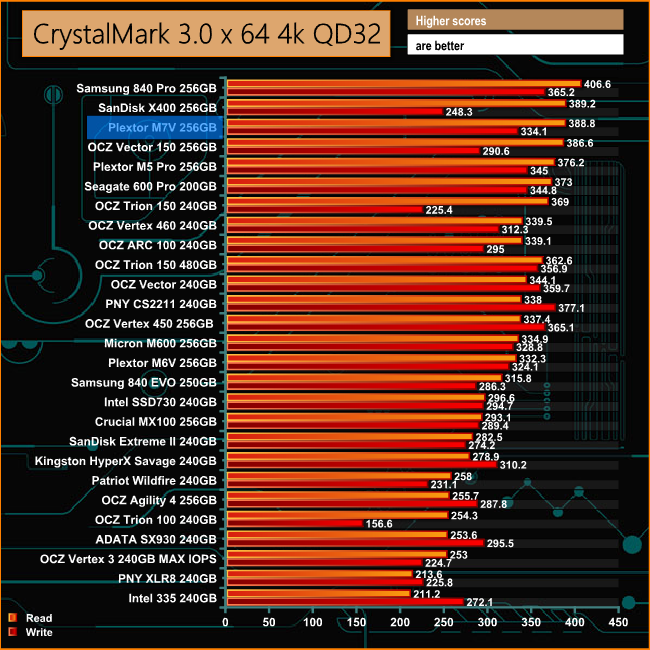
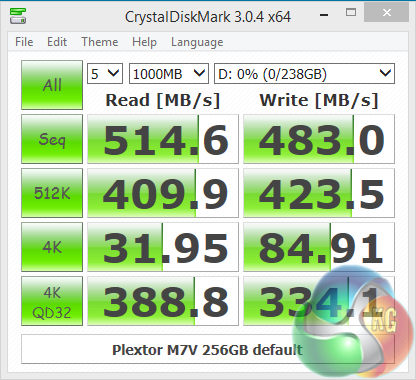

The M7V's 4K write performance is pretty solid although the 4K read performance is nothing to write home about. It also handles deeper data queue depths for read and write's pretty well too.
As can be seen from the two CrystalDisk Mark test scores the controller isn't really that fussed what type of data the drive is presented with.
The ATTO Disk Benchmark performance measurement tool is compatible with Microsoft Windows. Measure your storage systems performance with various transfer sizes and test lengths for reads and writes. Several options are available to customize your performance measurement including queue depth, overlapped I/O and even a comparison mode with the option to run continuously.
Use ATTO Disk Benchmark to test any manufacturers RAID controllers, storage controllers, host adapters, hard drives and SSD drives and notice that ATTO products will consistently provide the highest level of performance to your storage.
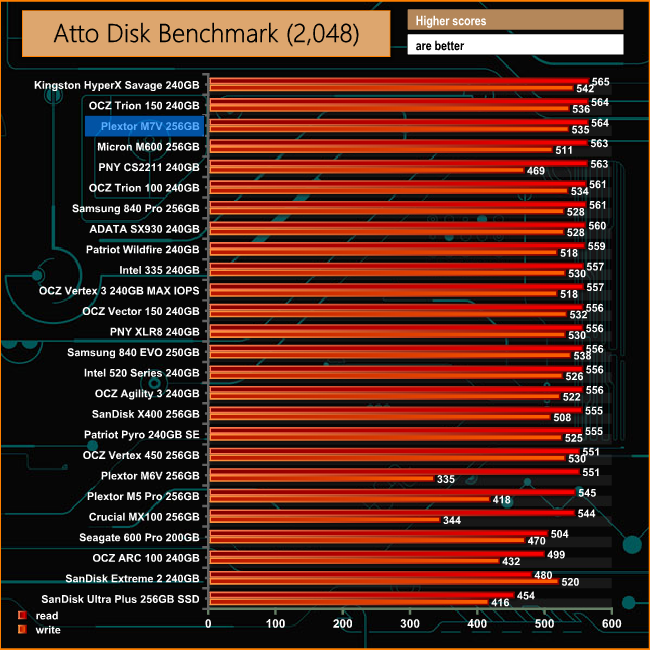
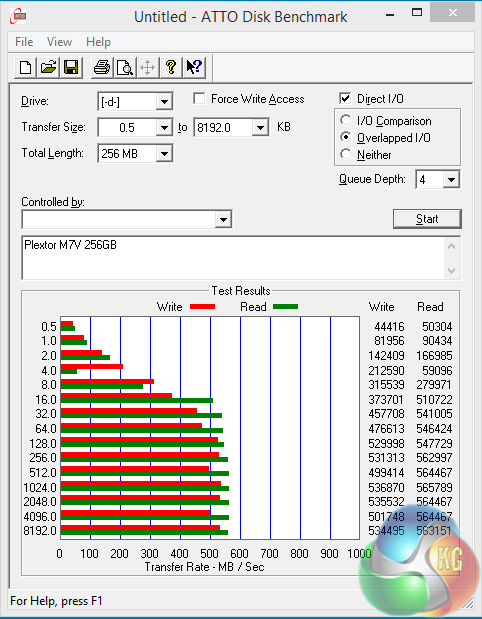
The overall sequential performance of the drive bears out the official figures. Its read figure of 564MB/s puts it firmly in the top five of the drives of its class we have tested while its 535MB/s write performance is equally good.
AS SSD is a great free tool designed just for benching Solid State Drives. It performs an array of sequential read and write tests, as well as random read and write tests with sequential access times over a portion of the drive.
AS SSD includes a sub suite of benchmarks with various file pattern algorithms but this is difficult in trying to judge accurate performance figures.
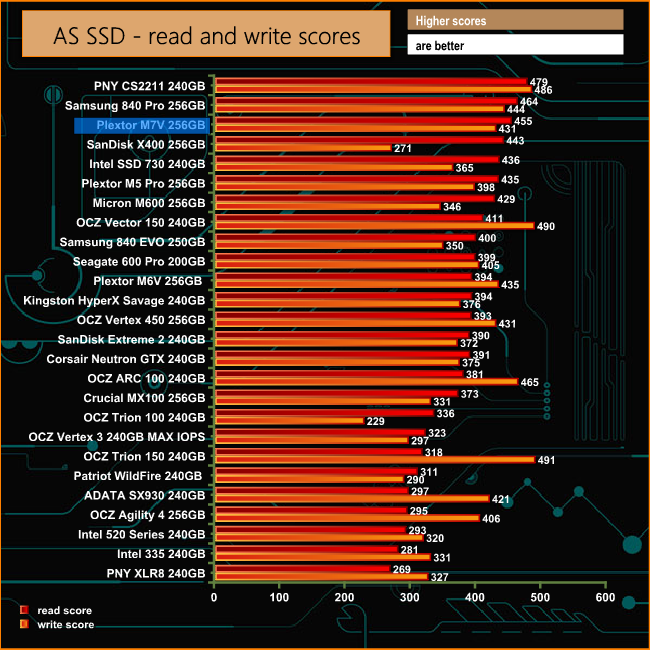
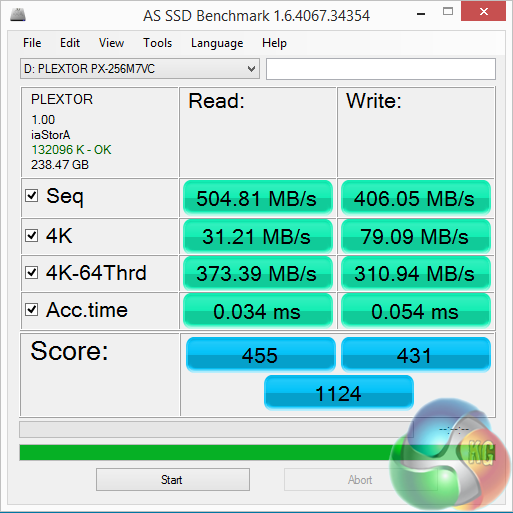
Once again the M7V makes a fairly good fist of all the AS SSD tests. The 4K write performance is good at both shallow and deeper queue depths but once again shallow depth 4K reads are disappointing.
IOMeter is another open source synthetic benchmarking tool which is able to simulate the various loads placed on hard drive and solid state drive technology.
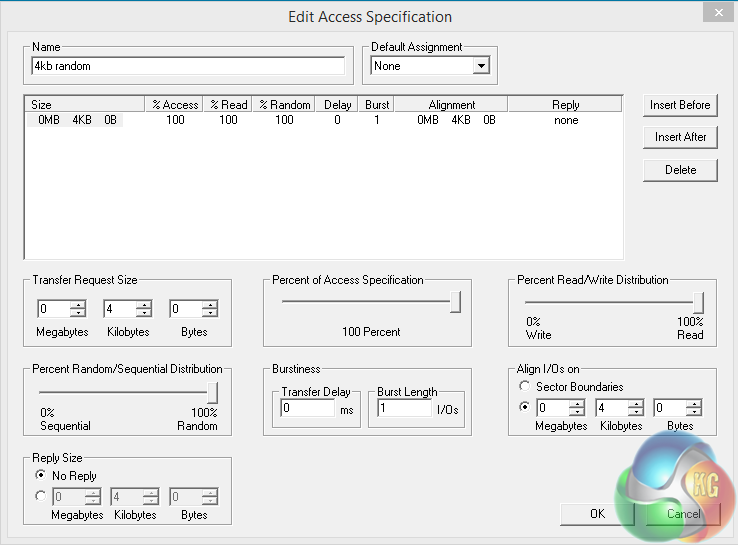
We test with both random read and write 4k tests, as shown above. There are many ways to measure the IOPS performance of a Solid State Drive, so our results will sometimes differ from manufacturer’s quoted ratings.
We do test all drives in exactly the same way, so the results are directly comparable.
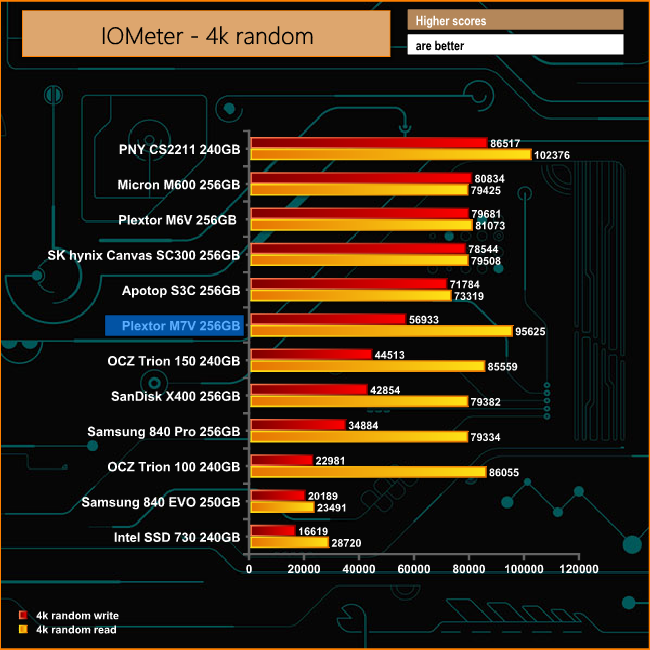
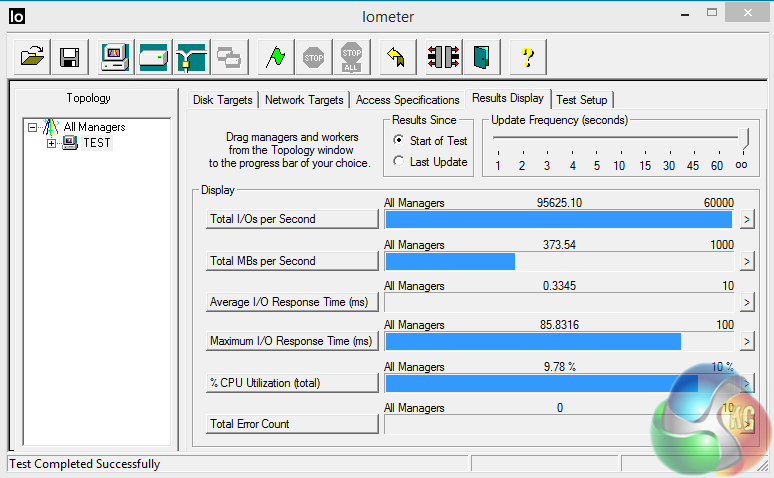
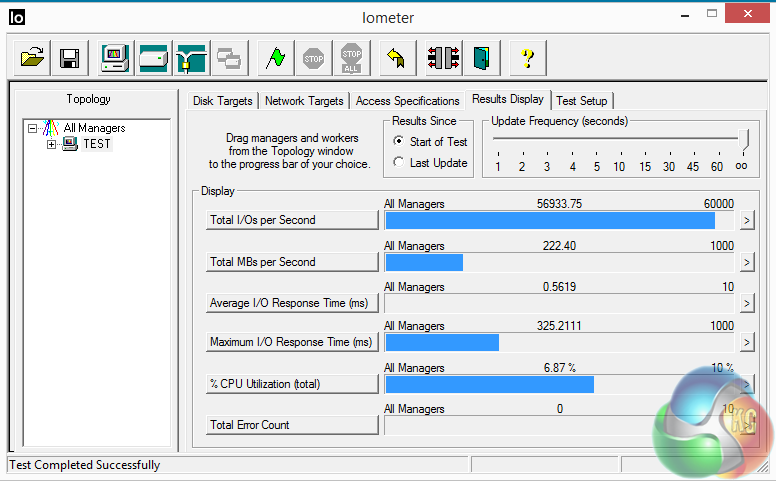
The 4K random read/write IOPS performance of the drive didn't live up to its billing. The 95,625 IOPS for reads is a little shy of the official figure of 98,000 IOPS but is still a strong performance, while its 56,933 IOPS writes fell way short of the official 84,000 IOPS.
To test real life performance of a drive we use a mix of folder/file types and by using the FastCopy utility (which gives a time as well as MB/s result) we record the performance of drive reading from & writing to a 256GB Samsung SSD850 PRO.
60GB Steam folder – 29,521 files.
50GB File folder – 28,523 files.
12GB Movie folder – 24 files (mix of Blu-ray and 4K files).
10GB Photo folder – 621 files (mix of .png, raw and .jpeg images).
10GB Audio folder – 1,483 files (mix of mp3 and .flac files).
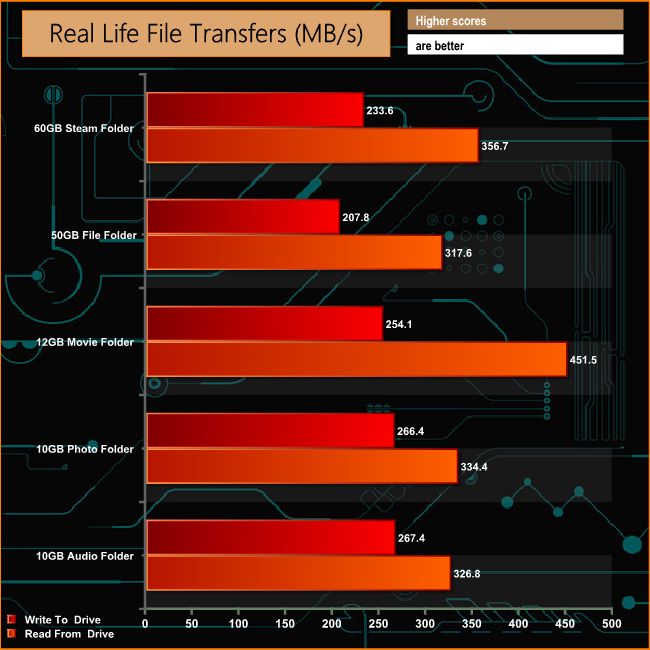
The M7V shows good consistency in the real life file transfer tests. It's particularly rapid at reading large files as can be seen by the 451MB/s figure for the 12GB Movie folder which consists of large video files. A 60GB Steam folder takes a shade under four minutes to write to the drive and two and a half minutes to read the data back.
It's taken a while but with the M7V, Plextor finally have a TLC NAND equipped drive to enable them to join the battle in the entry-level end of the market.
With the combination of the Marvell 88SS1074B1 controller, Toshiba 15mn NAND and some tweaks in the firmware they are also trying to get an edge by offering better drive endurance than its competitors.
Although the drive is aimed more towards the entry-level end of the market it still has the suite of Plextor tools found with its more expensive MLC equipped siblings plus a few of its own to try to boost that endurance.
On the whole the M7V's performance is good, beating the previous MLC equipped M6V in all but one of our tests. The official sequential read/write figures of up to 560MB/s and 530MB/s respectively proved solid as when the drive was tested with the ATTO benchmark it produced a score of 564MB/s for reads and 535MB/s for writes which puts the drive in the top five 240/256GB 2.5in drives we have tested.
Its 4K random IOPS performance though painted a different picture as our drive failed to reach the official figures for both reads and writes. For reads it tested at 95,625 IOPS which is good but still some way off the official 98,000 IOPS but the writes at a disappointing 56,933 IOPS fell way, way short of the official up to 84,000 IOPS.
At the time of writing it's not the easiest drive to find, indeed we could only find one vendor offering it – Lambda Tek priced at £60.23 inc VAT HERE
Discuss on our Facebook page, over HERE.
Pros
- Plextor's first TLC drive.
- Excellent sequential performance for its class.
- Strong 4K write performance.
- Plextor drive technologies.
Cons
- 4K read performance is a little weak.
- 4K IOPS writes performance is disappointing.
Kitguru says: Finally Plextor have a TLC drive in their range but it is pitched into a very competitive market segment with some very keenly priced competition.

I basically get paid about 6k-8k dollars on monthly basis with an online job. For everybody willing to do easy at home jobs for 2-5 hrs each day from comfort of your home and get good payment for doing it… This is perfect for you… CHILP.IT/45fc05a
adfgasdg
when will the price go down for SSD? 512GB should be at least 20$ only.