 KitGuru KitGuru.net – Tech News | Hardware News | Hardware Reviews | IOS | Mobile | Gaming | Graphics Cards


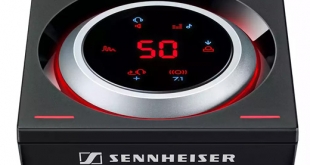
Sennheiser is well known for producing high-end audio solutions – we have even reviewed some of them. However it can also help you upgrade what you already have with its audio amplifiers. Take the product I am looking at today, for example. The GSX 1000 amplifier is designed to not only boost your gaming volume and audio quality, but give you virtual 7.1 surround sound too.
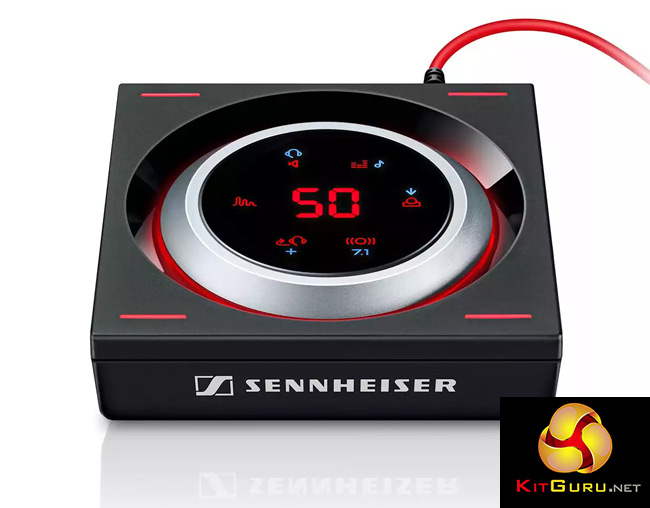
It comes with a number of interesting features, as well as a fancy volume control hub that sits neatly on your desktop. There is even some backlighting – though unlike a lot of peripherals out there at the moment, this one is not RGB compliant.
At £200 it is not cheap accessory and will need to do a lot to warrant using over built in sound cards or simply upgrading your headset – but that is what we are here to test.
Features
- 7.1 Sennheiser Binaural Rendering Engine – Surround Sound reborn.
- Exceptional immersion – delivering outstanding audio performance in movies, music and games.
- Aluminium volume wheel and high-quality materials for long-lasting durability.
- Switch between your headset and speakers with the touch of a button.
- Adjust game and communication audio separately.
- Sidetone – adjust the loudness of your own voice in the headset.
- EQ settings – Story, music, eSports, Off/neutral.
- Peace of mind – 2-year international warranty.
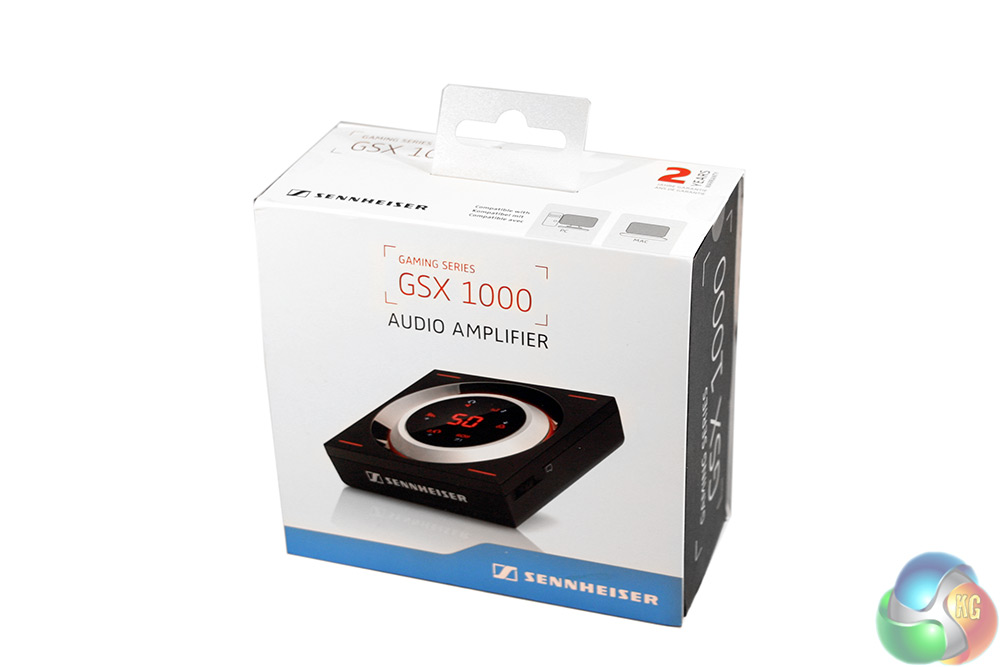
The Sennheiser GSX 1000 comes in a compact box with a high-quality, gloss card throughout. When you are spending £200 on anything, having a nice box is always appreciated.
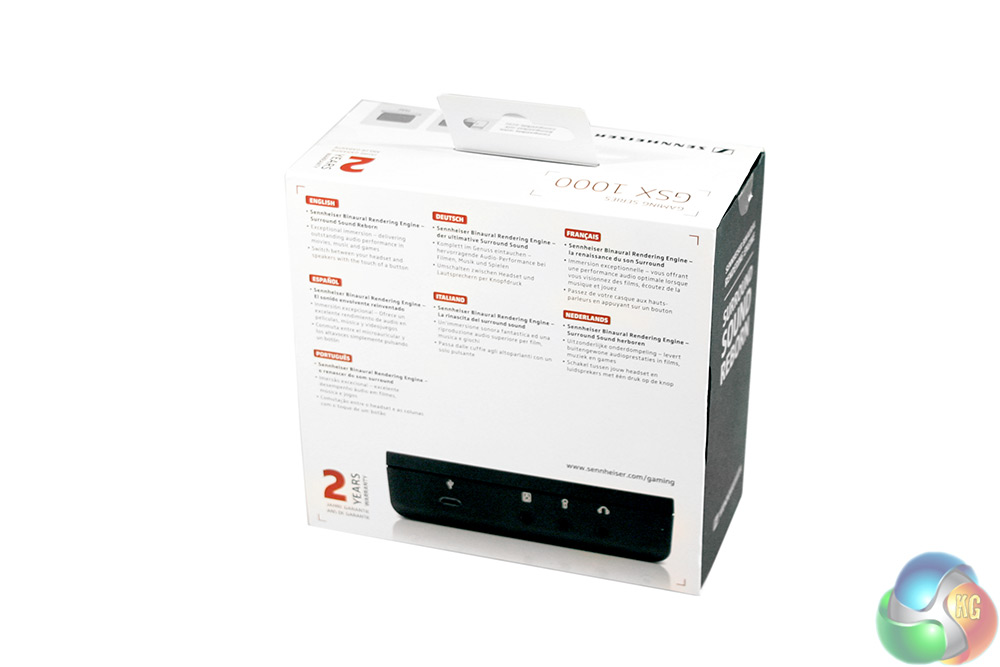
The back details important features of the amplifier in a variety of different languages and gives you a rear view of the amp itself.
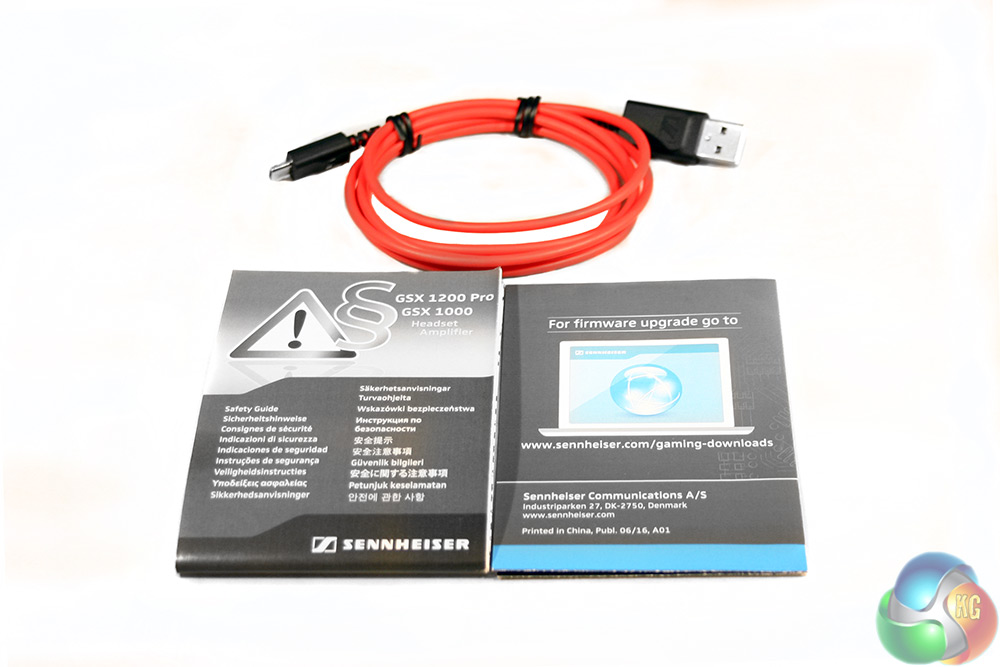
Along with the GSX 1000, you get a USB data cable, a quick-setup guide and a safety leaflet.
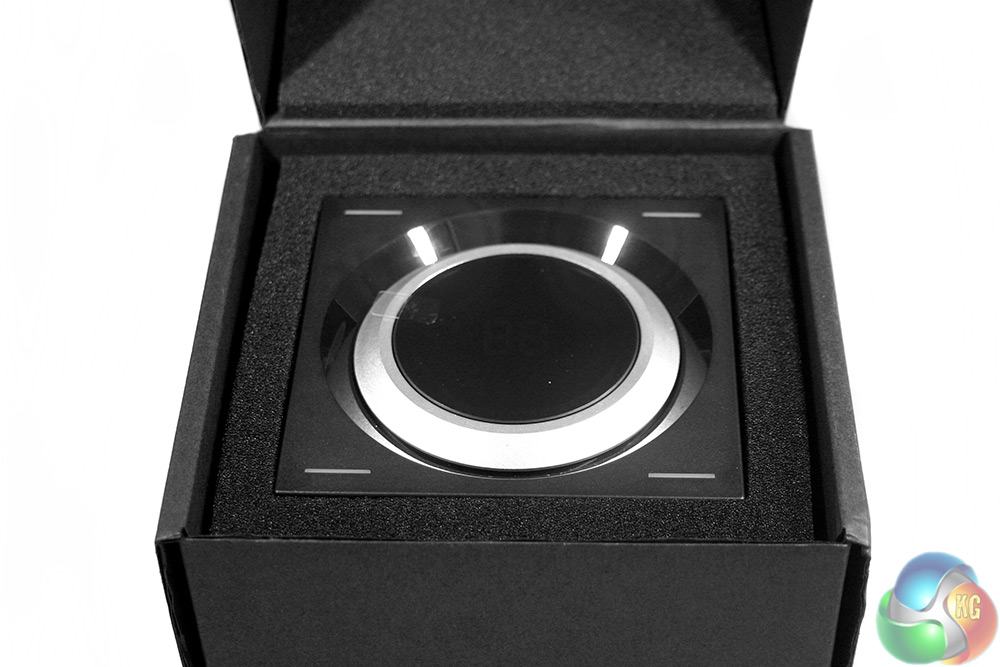
The box flips open to give you a plastic-protected view of the amplifier, nestled in a snug foam seat.
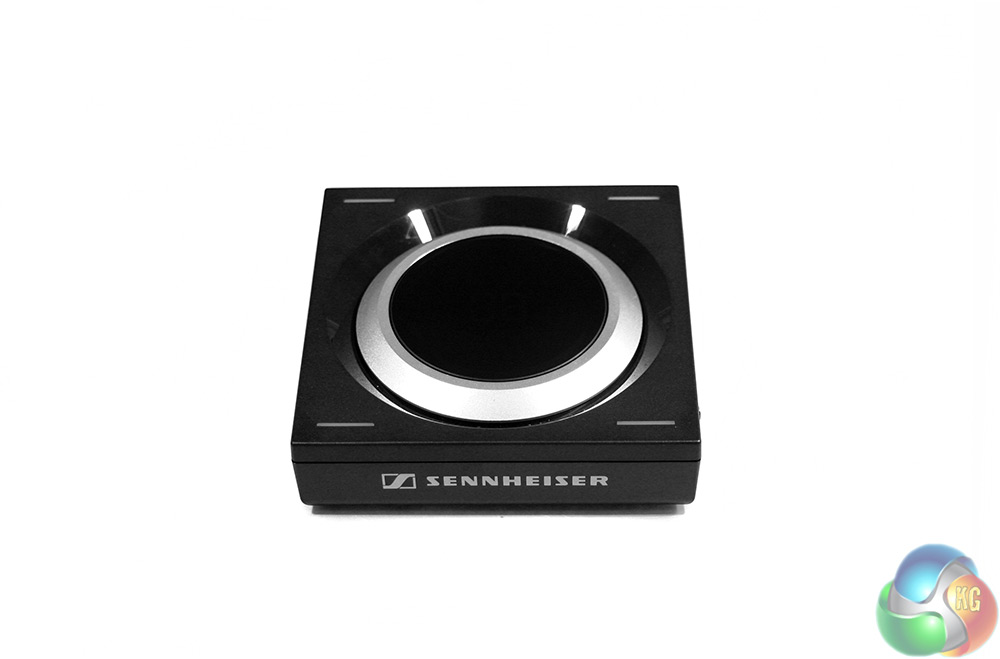
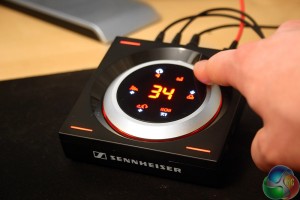
The Sennheiser GSX 1000 is a sleek looking, matt and glossy black device. It has a large, central volume wheel, which has a touch display in its centre for various indicators, which lights up when powered on.
The only other style point are four translucent strips in each corner, which also light up red when the amp is plugged in and turned on.


The aluminium disc which dominates the design rotates and acts as the device's volume wheel.
One downside of the touch screen system is of course that it does suffer from fingerprints.
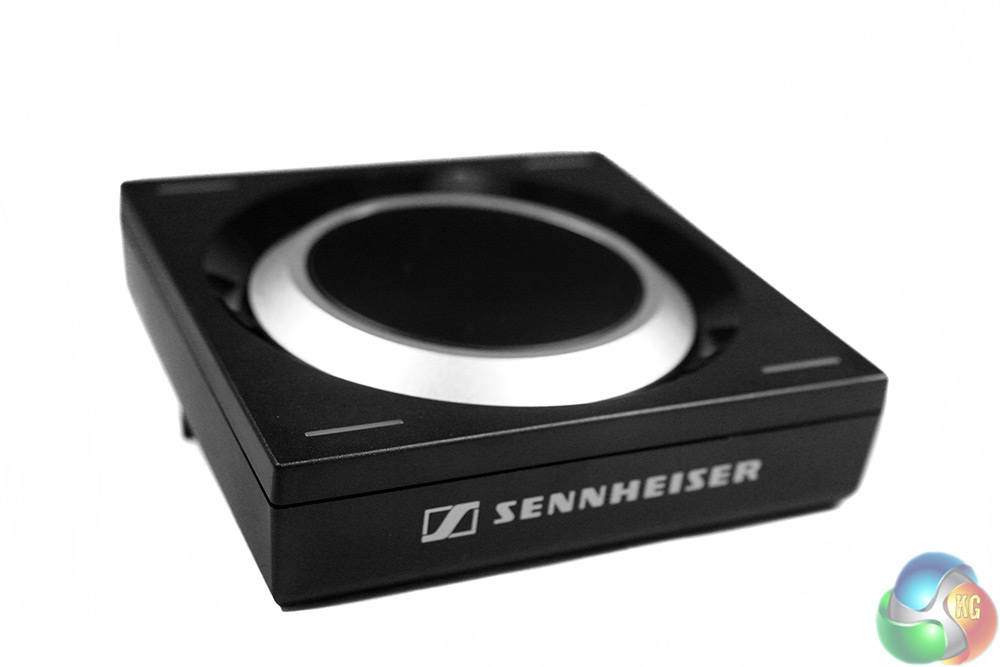
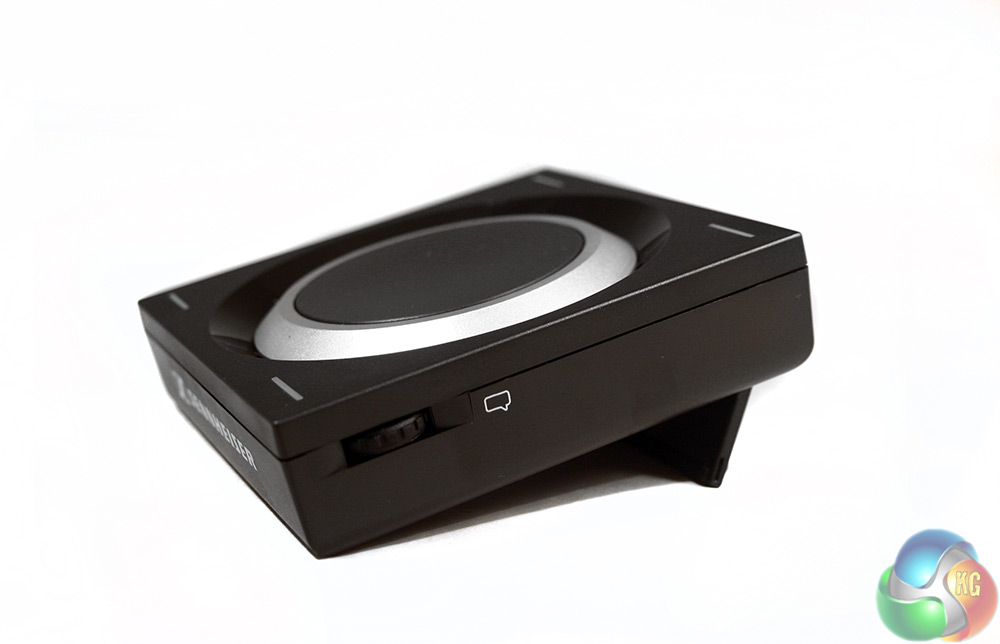
The front panel has a Sennheiser logo on it, while the right hand side has a dedicated volume dial for chat, letting you control how loud you are.

At the rear of the amplifier are four ports for various connections. The micro-USB port is what provides data and power for the device and plugs directly into your PC's USB port. Next to it are 3.5mm ports for your speakers, as well as microphone and stereo headphones.
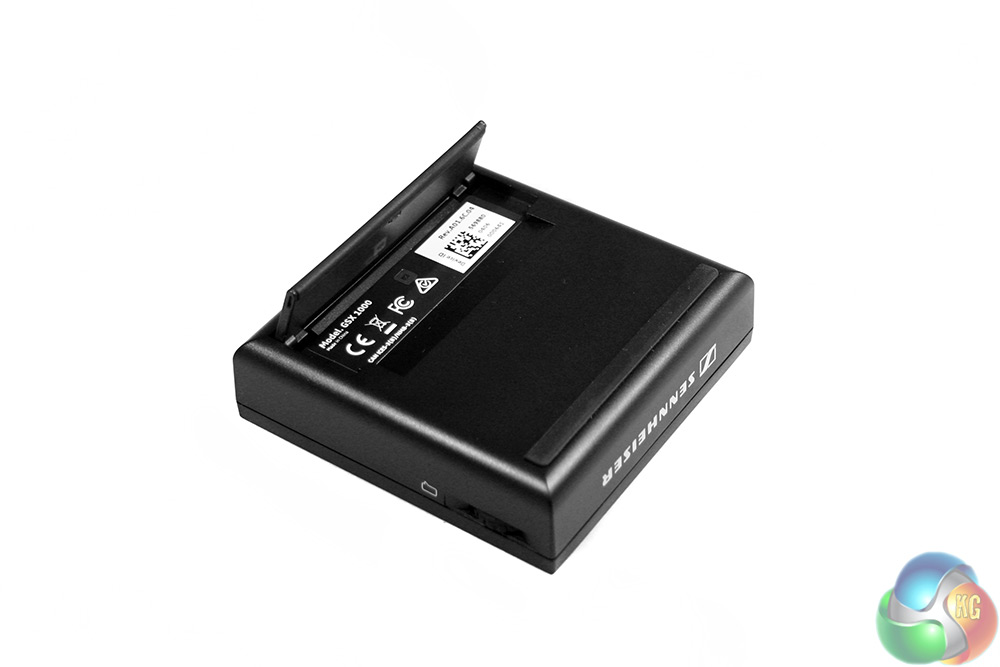
The underside of the amp features a small flip-out riser, which lets you angle the device for easier use if needed.
Methodology
To test the GSX 1000, I connected it up to a set of Harman Kardon GLA-55 2.0 speakers and a Sennheiser GSP 300 headset. I used it as my main soundcard for an extended testing period – one week – and also made comparisons between it and the Crystal Sound 2 onboard chip on the test system's ASUS Z97-K motherboard.
I looked at the sound quality for games, movies and music, as well as its ability to deliver 7.1 virtual surround sound.
Sound quality, clarity
Whether listening to music or playing games or movies I found the audio quality to be consistently high throughout the frequency range and the sound borders on the warm side of neutral, making it a very pleasant experience. Not as detailed as some of the soundcards out there, but that is where personal preference comes into play.
In my case I found the audio of a noticeably higher quality when played through the GSX 1000 than from onboard motherboard audio.
If the on board sound card is a cheap and cheerful one, you are likely to see an even bigger boost in clarity, especially if other parts of the chain – the audio source and speaker/headset – are of a comparable or better quality to this external sound card.
One big advantage that the Sennheiser GSX 1000 has over an on board sound card, is amplification. You are going to get a lot more volume out of the GSX 1000 than you would from a motherboard.
There are more powerful amplifiers out there, but the GSX 1000 seemed able to drive anything I threw at it. This is a gaming DSP first and an amplifier second.
Virtual surround sound
While sound quality is something that will always have some measure of objectivity to it – everyone has a type-preference when it comes to audio of any kind – it is hard to deny that the Sennheiser GSX 1000 is an excellent virtual surround sound solution.
Traditionally virtual surround sound is a bit of a mixed bag. It sounds ok, and slightly better than 2.0, but that is not the case with this Sennheiser hardware. It sounded not that distant from the real deal – true 7.1 surround sound – and is easily the best iteration of virtual surround sound on a headset I have yet heard.
There were moments when using the headset for testing and I had the volume low that I thought the my speakers were playing instead of the headset as it sounded much more atmospheric than I was used to.
That effect was amplified in games. It not only gives you a sense of something happening behind you as well as in front or side to side, but that the world of sound is all around you, rather than simply where you are facing. It makes the game world feel alive in a way that is not possible with standard 2.0 sound.
While I would still advocate for a true 5.1 surround sound system for the best sense of things, the Sennheiser GSX does an amazing job at emulating that effect. Better yet, it does it without sacrificing quality of the drivers in the headphones. So often ‘real' surround sound headsets that use multiple drivers in each earphone, sacrifice on their quality to keep the cost down.
While at £200 the GSX 1000 is not cheap, you can pair it up with a decent 2.0 headset and get the best of both worlds.
Features
Looking at the main lit up face of the GSX 1000, there are a number of touch-screen options you can make use of. Moving clockwise, the top left indicator switches between headphone and speaker outputs; the next option adjusts EQ settings for games, music and movies (or neutral); the next lets you amplify the front or rear of the surround sound mix; the one after that controls whether you have virtual surround sound on or not; then there is the sidetone amplification, should you wish to hear yourself while speaking, and finally we have the manual reverb control.
Each of these is easily adjustable thanks to the touch screen panel and although not the easiest to understand from their LED indicators, Sennheiser's downloadable guide explains everything neatly and succinctly for you.
The ability to switch between speaker and headphone outputs at the touch of a screen was simple and for those who find themselves switching between the two regularly, a much easier way than going into your windows options to choose the output. Better yet, because it is a hardware solution, it does not matter if you booted up a game with the wrong one selected, you do not need to load it up again to use the correct output.
EQ wise, I thought that the music and movie settings added a new punch to the lower and mid-frequencies, which for those that want it is a nice addition. Audiophiles may miss the ability to fine tune their own equaliser settings though.
I did not think the gaming EQ setting was very useful however. It seems to remove almost all bass from the soundscape entirely, which unless you are playing very specific games seems a little redundant. It has a very significant negative effect on atmosphere so is not a setting I would recommend.
If you do not care for EQ settings though, you can ditch them altogether and enable Sennheiser's 2.0 HD mode. While this does make it impossible to switch to 7.1 virtual surround too, it adds a little more clarity to the sound.
Amplifying various parts of the mix and the reverb when using virtual surround sound was useful however, depending on your personal preferences and I liked being able to control how much of my own voice I could hear.
It is nice that Sennheiser lets you manually control the reverb function too, as not everyone is a fan of it.
Audio can often feel like the power-supply of PC peripherals: it is the thing people spend the least money on. However if you take your gaming or media viewing seriously, you are missing out if you do not have a decent sound card and amplifier like the Sennheiser GSX 1000.
When combined with a decent set of speakers, or what I would personally consider a mid-range gaming headset, the effect is dramatic. Audio quality takes a big leap, as does your ability to crank the volume for those moments of added head banging.
On top of that, this is hands down the best virtual surround sound I have ever heard. It adds surround capability to a headset not designed with that sort of functionality and performs better than any software implementation I have ever come across. I would even say it sounds better than many ‘real' surround sound headsets, as those tend to have lower quality drivers to prevent the cost from being too high.
The GSX 1000 is not perfect of course. It is pretty expensive and the sound quality may be a little warm and ‘smooth' for some, but with the included EQ settings and ability to enable an HD 2.0 version for speaker listening, it is hard to imagine this being a major problem.
The physical hardware itself is great too, with a supremely smooth volume control wheel, responsive touch screen and secondary volume control for microphone input.
I love being able to easily switch between speaker and headphone outputs and additional extras like reverb and sidetone control makes the auditory experience completely customisable to the user.
Overall I cannot praise the GSX 1000 enough. While you will get more mileage from it if you have a decent set of speakers/headphones and a high-quality audio source, the Sennheiser GSX 1000 is a great way to upgrade the listening and functional experience of using your PC for gaming and media viewing.
You can buy the Sennheiser GSX 1000 on Amazon for £200.
Pros
- Sounds excellent throughout volume range.
- Great for music, movies and games.
- Best virtual surround sound unit I have ever tested.
- Looks stylish. Touch screen is functional and easy to use.
- Ability to control media and chat volume separately.
Cons
- Not the most powerful of amplifiers.
- Warm sound may not be to everyone's taste.
- Pricey.
KitGuru Says: The Sennheiser GSX 1000 might be expensive, but it has the best virtual surround sound of any solution out there and even trumps some real-world surround sound headsets. It sounds great, looks and performs well. This is a real treat for audio-obsessed gamers and media viewers, though may lack a little in top-end volume for extreme users.


Hey Jon! Interesting product. I’m wondering if purchasing this amp would make sense for someone like me who has a pair of Philips Fidelio X1 cans plugged into an Asus Xonar STX sound card. What are your thoughts on this? I assume that this amp would then effectively replace the sound card then, as it uses the USB port for data?
“it has the best virtual surround sound of any solution out there” –> wrong, you should check out the Realiser A8 or A16. Of course price is way higher too.
Google is paying 97$ per hour! Work for few hours and have longer with friends & family! !mj254d:
On tuesday I got a great new Land Rover Range Rover from having earned $8752 this last four weeks.. Its the most-financialy rewarding I’ve had.. It sounds unbelievable but you wont forgive yourself if you don’t check it
!mj254d:
➽➽
➽➽;➽➽ http://GoogleFinancialJobsCash254MarketHouseGetPay$97Hour… ★★✫★★✫★★✫★★✫★★✫★★✫★★✫★★✫★★✫★★✫★★✫★★✫★★✫★★✫★★✫★★✫★★✫★★::::::!mj254d:….,……
My gaming headset is A Sony MDR1-A which I drive through my Asus Z170 Gene. Sorry for the wall of text but would I benefit from a product like the GSX1000 when the board already has a ESS9023P Sabre DAC? £200 is slightly more than I paid for the whole motherboard.
ESS ES9023P digital-to-analog converter (DAC) with Hyperstream™ technology, ultra-low-jitter clock, Nichicon capacitors, 2Vrms headphone amp, and Sonic SenseAmp that automatically detects and optimizes any headset (32-600 ohms) for purest sound quality. SupremeFX 2015 also features intuitive Sonic Studio II for you to apply and enjoy different audio effects for perfect entertainment.