KitGuru KitGuru.net – Tech News | Hardware News | Hardware Reviews | IOS | Mobile | Gaming | Graphics Cards


XPG are ADATA's gaming arm, and the latest addition to its range of M.2 SSDs is the Gen 5 Mars 980, available with both active (980 PRO) and passive (980 Blade) cooling solutions. ADATA supplied us with a 980 Blade for this review. At the time of writing this review, the Mars 980 Blade is available in three capacities: 1TB, 2TB and a flagship 4TB model.
The ADATA XPG Mars 980 Blade uses a combination of a Silicon Motion SM2508 controller and 232-Layer Micron B58R TLC NAND. The Silicon Motion SM2508 is an 8-channel controller supporting NAND (ONFI 5.0 and Toggle 5.0) transfer speeds of up to 3,600 MT/s per channel. Built on a 6nm process, it uses a quad-core 32-bit Arm Cortex-R8 processor running at 1.25GHz in conjunction with a single 32-bit Cortex-M0. It supports both DDR4 and LPDDR4 DRAM up to 3,200MT/s.
It has full drive AES 256 encryption and supports TCG Opal 2.0, Hardware SHA 256/384 and TRNG security protocols. Because of the 6nm build process, it can offer high performance together with lower power consumption.
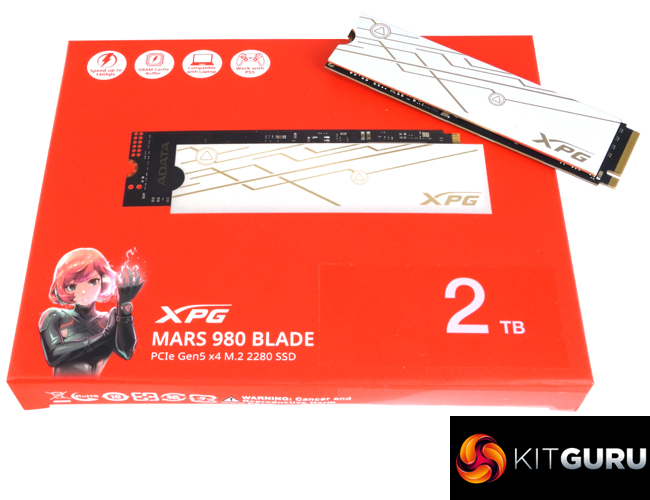
ADATA rates the sequential read / write performance of the 2TB drive as up to 14,000MB/s and 13,000MB/s, respectively. All three drives have the 14,000MB/s rating. The 1TB drive gets a write rating of up to 10,000MB/s, while the 4TB drive gets the same 13,000MB/s figure as the 2TB. 4K random read performance for the range is quoted as up to 1,600K IOPS for the 1TB drive, 2,000K IOPS for the 2TB drive and 1,950K IOPS for the 4TB drive. Write performance is the same up to 1,650K IOPS across all three drives.
Using the ATTO 4 benchmark, we couldn't get close to the maximum official sequential read/write figures of 14,000MB/s and 13,000MB/s, respectively. However, switching over to the more up-to-date ATTO 5, we could confirm the official figures with test results of 14,930MB/s and 13,420MB/s for reads and writes, respectively. We could also confirm the official Sequential figures and, as with ATTO 5, better them a little, using the CrystalDiskMark 8 default benchmark with a best read result of 14,589MB/s and a best write figure of 13,497MB/s.
When it comes to 4K random performance, the 2TB XPG Mars 980 Blade drive is rated as up to 2,000,000 IOPS for reads and up to 1,650,000 IOPS for writes. Using our 4-threaded tests, we couldn't get close to this figure with the best test results of 570.312 IOPS and 518,290 IOPS for reads and writes, respectively. Using CrystalDiskMark 8's Peak Performance default profile benchmark, we could confirm the official read figure with a peak test result of 2,025,531 IOPS with writes at 1,716,514 IOPS.
The previous generation Gen 5 drive we looked at, the Legend 970, used an active air cooling solution to keep the drive cool. It's a sign of how far controller and NAND technologies have come since the Legend 970 that the Blade version of the Mars 980 comes with an optional thin stick-on heat spreader. The heat spreader works pretty well, given the hottest we saw the drive get was 59°C during CrystalDiskMark 8's default Write and Peak Performance 0 fill Write tests.
We found the 2TB ADATA XPG Mars Blade for £195.49 on Box HERE.
Pros
- Fast Sequential Performance.
- Optional heat sink.
- AES 256-bit hardware-based encryption.
Cons
- Couldn't hit the official maximum speeds in some of our testing.
KitGuru says: ADATA's latest generation Gen 5 SSD uses up-to-date controller and NAND technologies to good effect, combining fast performance, cool running and power efficiency.