KitGuru KitGuru.net – Tech News | Hardware News | Hardware Reviews | IOS | Mobile | Gaming | Graphics Cards


The latest Gen5 SSD to land on the test bench is Crucial's T700. Part of Crucial's Pro series, the T700 uses a combination of Micron 3D TLC NAND and a Phison controller and needless to say, it's the fastest Crucial SSD to date. We test the 2TB model on sale for £330 in the UK.
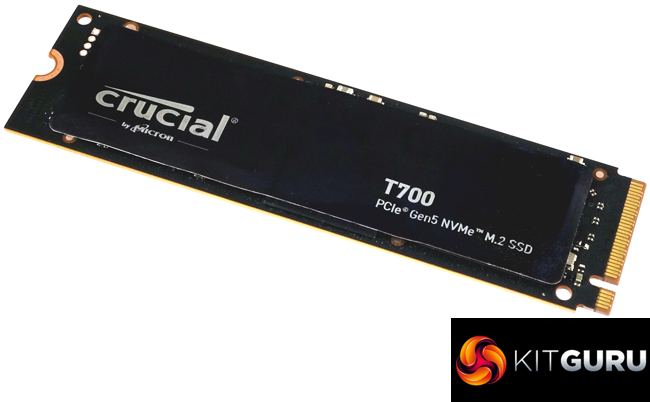
At the heart of the T700 is a Phison PS5026-E26 8-channel controller (the world's first consumer Gen 5 controller) which looks after Micron's own 232-layer 3D TLC NAND Flash. The T700 also uses Micron's LPDDR4 DRAM for caching (1GB per 1TB of NAND flash).
The T700 is available in three capacities; 1TB, 2TB (the drive we are looking at here) and a 4TB flagship model. There are two versions of the drive; plain (the drive we are reviewing here) and one with a factory-fitted heatsink.
Sequential performance is quoted as up to 11,700MB/s and 9,500MB/s for read/writes respectively for the 1TB model and up to 12,400MB/s (reads) and up to 11,800MB/s (writes) for the 2TB and 4TB drives.
Random performance ratings for the drives are; up to 1,350,000 IOPS and up to 1,400,000 IOPS for the 1TB drive with the 2TB and 4TB drives rated as up to 1,500,000 IOPS for both reads and writes.
The TBW endurance for the 2TB model is quoted as 1,200 with the 1TB drive rated at 800TBW and the 2TB model 2,400TBW. Crucial back the drive with a five-year warranty.
Physical Specifications:
- Usable Capacities: 2TB.
- NAND Components: Micron 232-layer 3D TLC NAND.
- NAND Controller: Phison PS5026-E26 8-channel.
- Cache: 2GB LPDDR4.
- Interface: PCIe Gen 5 x4.
- Form Factor: M.2 2280.
- Dimensions: 80 x 22 x 2.3 mm.
Firmware Version: PACR5101.
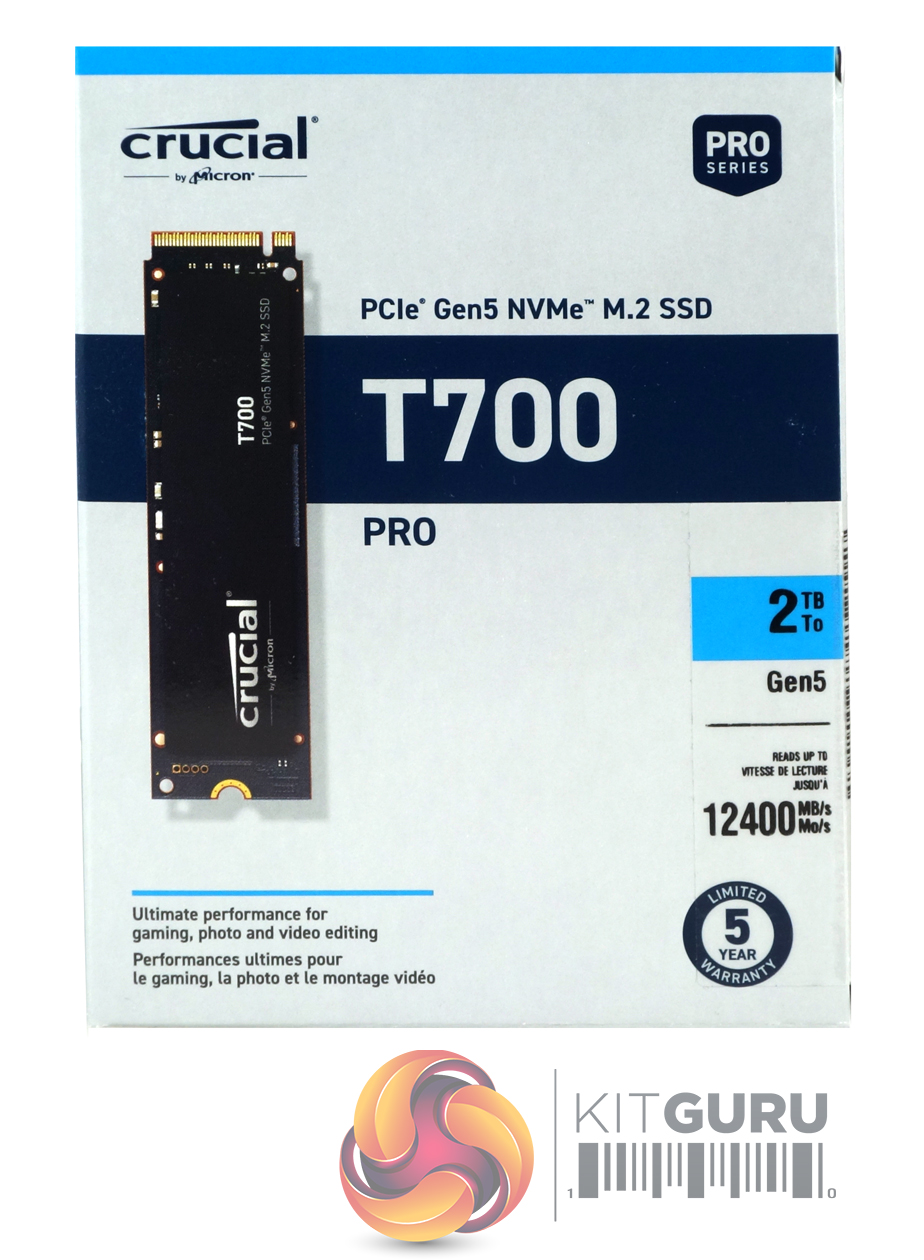
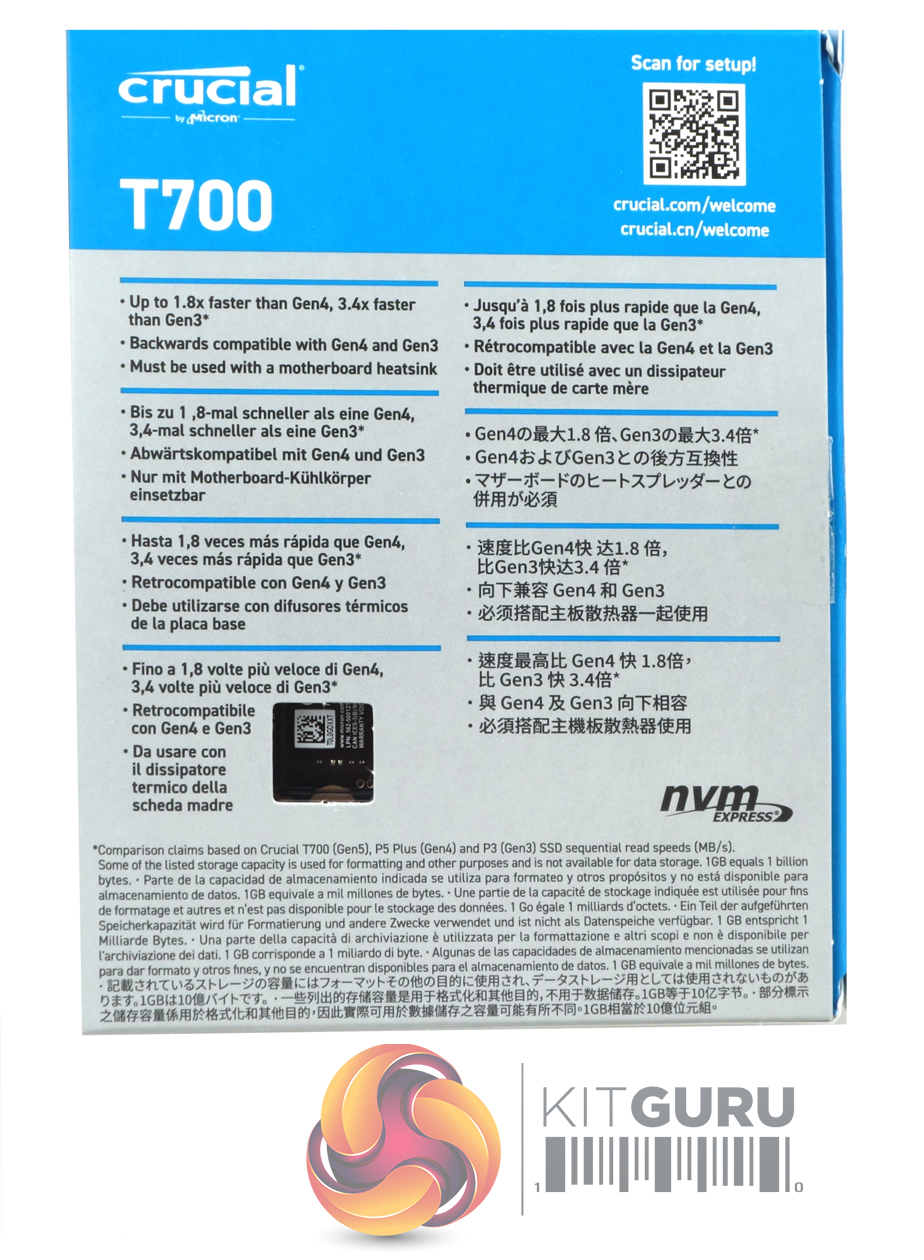
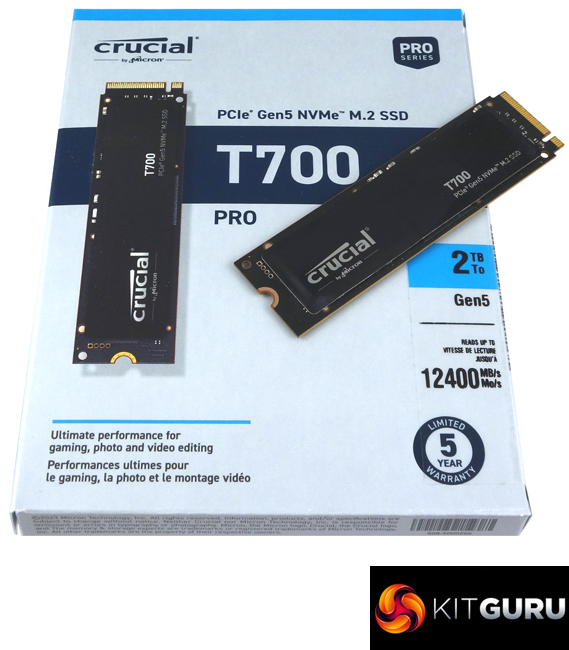
The T700 comes in a slim-line box with a good clear image of the drive on the front. To the right of this image is a longish sticker that displays the capacity of the drive, maximum Sequential read speed (12,400MB/s) and a logo stating the 5-year warranty. The rear of the box is home to some multi-lingual notes about the drive's speed, backward compatibility and warning about the need to use a motherboard heatsink/cooler.
Crucial's 2TB T700 is built on a dual-sided M.2 2280 format.
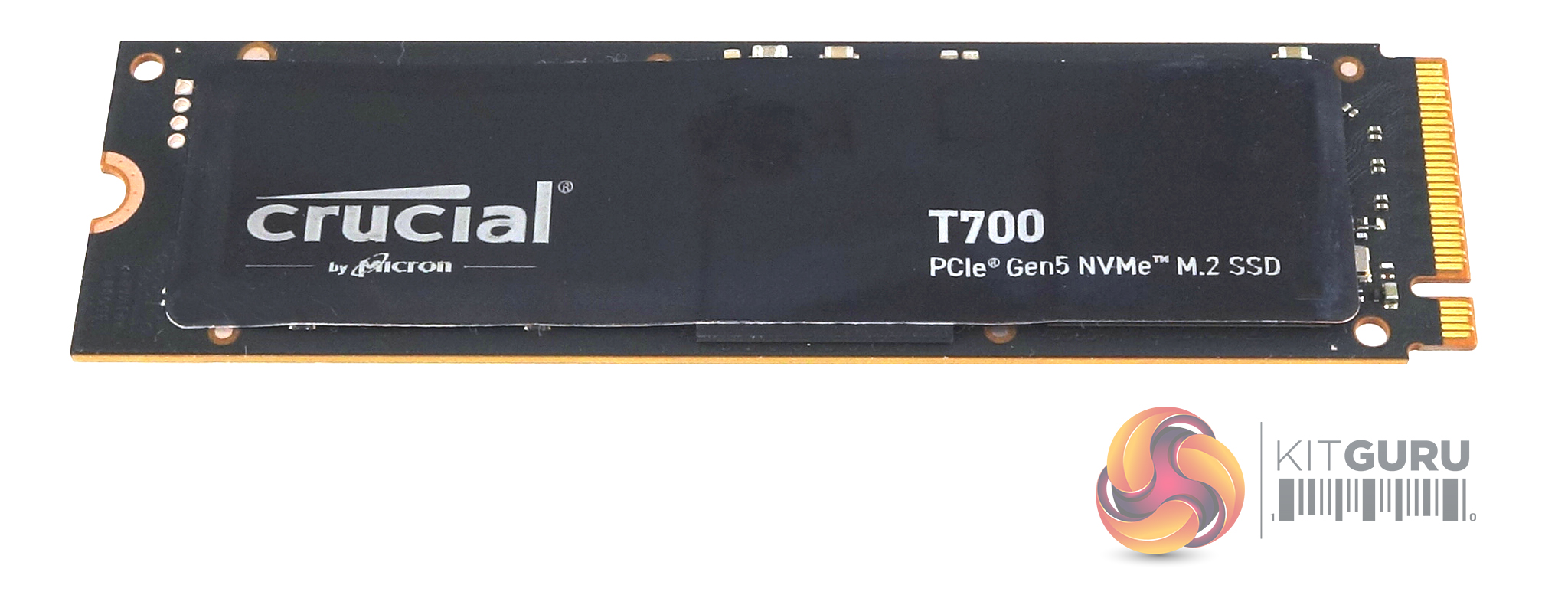

Under the top product label, which has a layer of copper built into it to help get rid of heat, there are two Micron 232-layer 3D TLC packages, an LPDDR4 DRAM IC and the Phison PS5026-E26 8-channel controller. Sitting under normal product stickers on the other side of the PCB are two more NAND packages.
Phison's PS5026-E26 is the first consumer Gen5 controller. Built on a 12nm process supporting up to 32TB of TLC or QLC NAND flash memory with data transfer speeds of up to 2400 MT/s. The controller uses dual Arm Cortex-R5 cores that work together with Phison’s specialized accelerators from its CoXProcessor 2.0 family. The controller supports Phison's 5th Generation LDPC ECC engine.
For testing, the drives are all wiped and reset to factory settings by HDDerase V4. We try to use free or easily available programs and some real world testing so you can compare our findings against your own system.
This is a good way to measure potential upgrade benefits.
Main system:
AMD Ryzen 7 7700X, 32GB DDR5-6000, Nvidia GeForce RTX 3050 and a Gigabyte AORUS X670E Xtreme motherboard.
Other drives
PCIe Gen5 2TB+
Gigabyte AORUS 10000 2TB
PCIe Gen4 2TB+
Corsair MP600 GS 2TB
Corsair MP600 PRO 2TB
Corsair MP600 PRO XT 2TB
Gigabyte AORUS 7000e 2TB
HP FX900 Pro 2TB
Kingston Fury Renegade Heatsink 2TB
Kingston KC3000 2TB
Kioxia Exceria Pro 2TB
Lexar Professional NM800PRO Heatsink 2TB
MSI Spatium M480 2TB
Patriot Viper VP4300 2TB
Sabrent Rocket 4 Plus 2TB
Sabrent Rocket 4 Plus 4TB
Samsung SSD990 PRO 2TB
Solidigm P41 Plus 2TB
Seagate FireCuda 530 2TB
WD Black SN850X Heatsink 2TB
Software:
Atto Disk Benchmark 4.
CrystalMark 8.0.0.
AS SSD 2.0.
IOMeter.
UL Solutions PC Mark 10.
UL Solutions 3DMark Storage Benchmark.
Final Fantasy XIV Endwalker Official Benchmark.
All our results were achieved by running each test five times with every configuration this ensures that any glitches are removed from the results. Trim is confirmed as running by typing fsutil behavior query disabledeletenotify into the command line. A response of disabledeletenotify =0 confirms TRIM is active.
CrystalDiskMark is a useful benchmark to measure the theoretical performance levels of hard drives and SSDs. We are using v8.0.
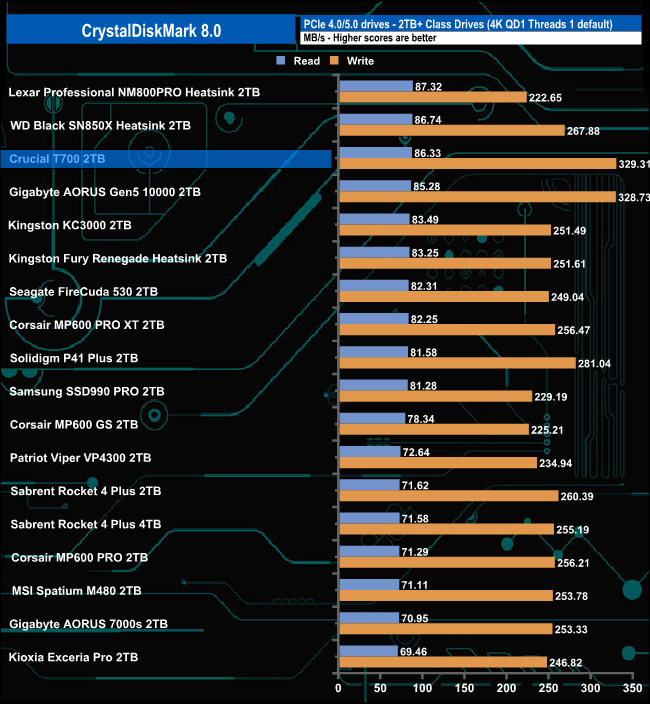
In CrystalDiskMark 8's 4K QD1 T1 test, the Crucial T700 sits just behind the Gen 4 Lexar Professional NM800 PRO and WD's Black SN850X when it comes to read performance but has a faster write speed than both of them.
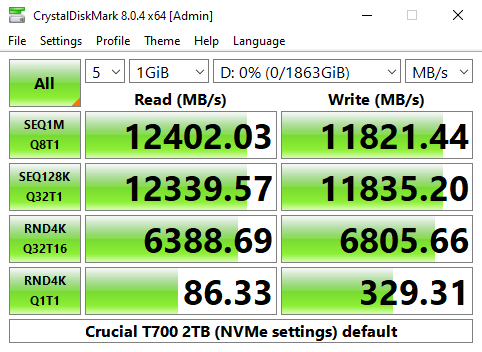
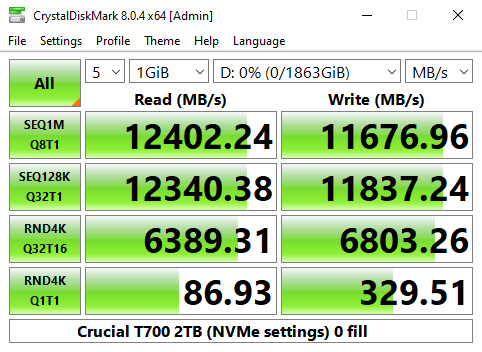
As can be seen from the benchmark result screens we can confirm the official Sequential read/write figures of 12,400MB/s and 11,800MB/s respectively with test result figures of 12,402MB/s for reads and 11,821MB/s for writes.
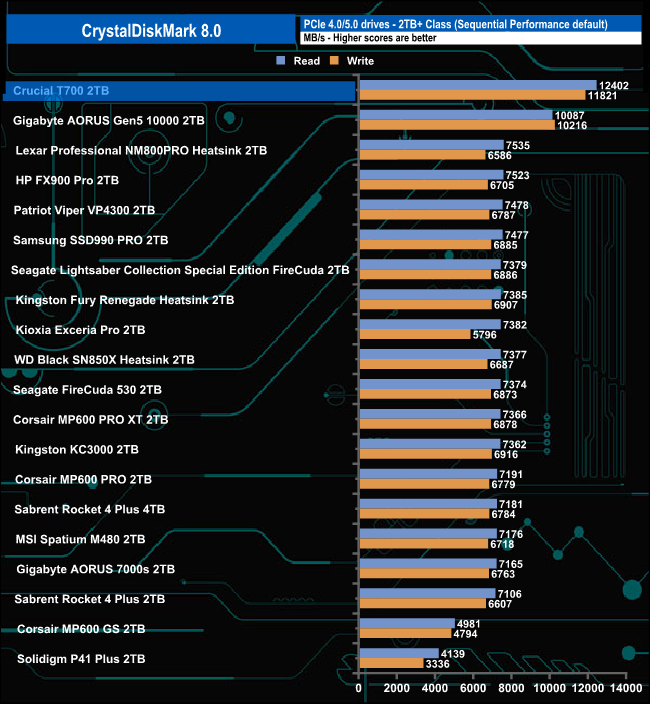
Those Sequential scores are the fastest we've seen to date for a consumer NVMe SSD and they give a hint of what's to come from Gen 5 drives in the coming months as other controllers and NAND come into play.
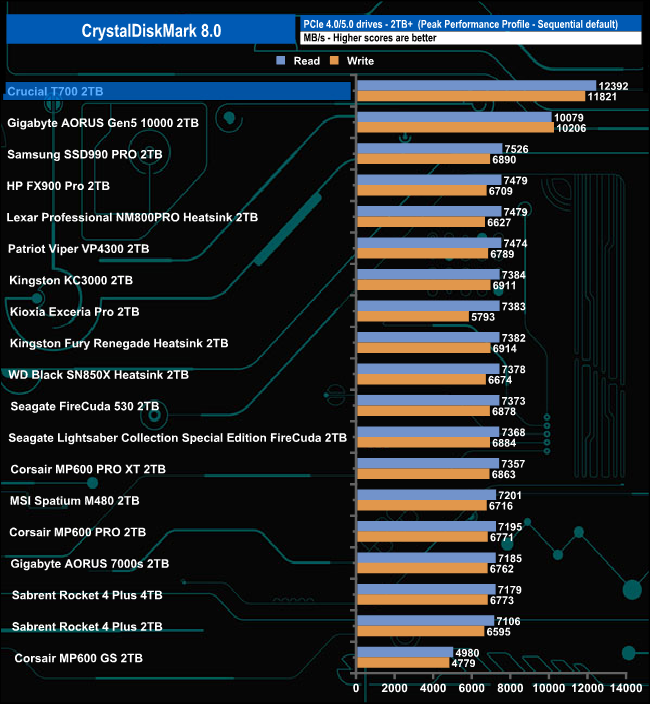
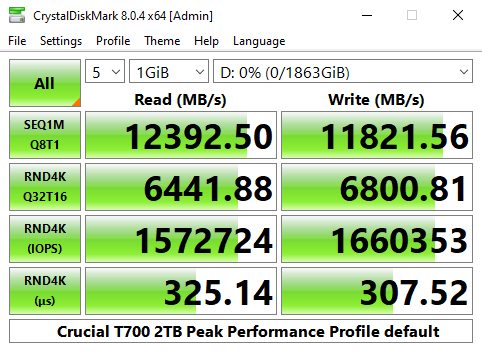
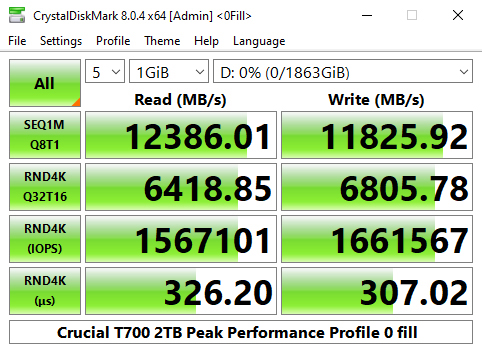
Using the Peak Performance profile of the CrystalDiskMark benchmark we could once again confirm the official Sequential performance figures.
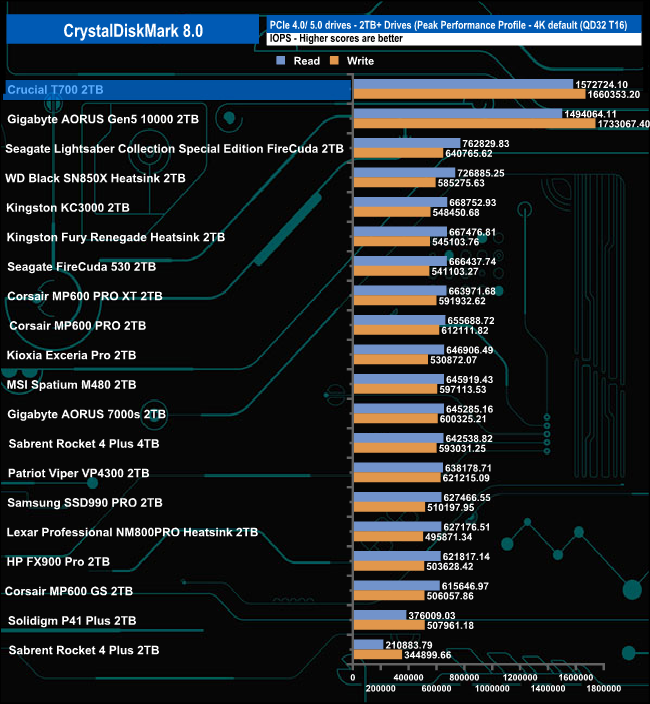
We could also confirm the official 4K random read/write figures of up to 1,500,000 IOPS for both with a read test result of 1,572,724 IOPS with writes even faster at 1,660,353 IOPS.
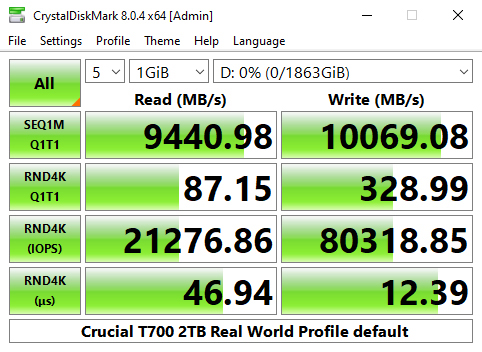
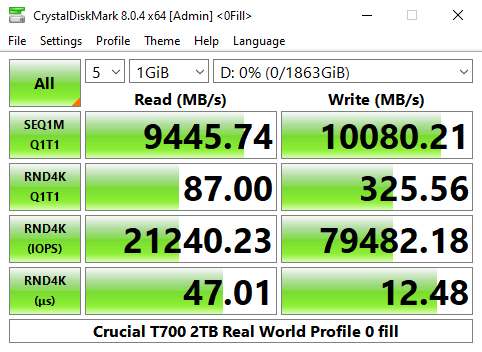
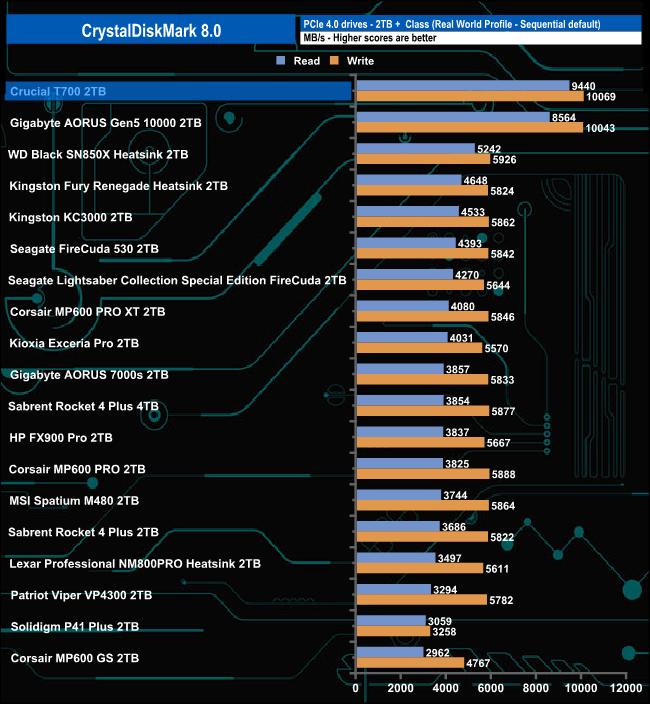
Crucial's T700 tops the Real World Profile chart with Sequential read/write scores of 9,440MB/s and 10,069MB/s, the fastest we've seen to date for this test.
The ATTO Disk Benchmark performance measurement tool is compatible with Microsoft Windows. Measure your storage systems performance with various transfer sizes and test lengths for reads and writes. Several options are available to customize your performance measurement including queue depth, overlapped I/O and even a comparison mode with the option to run continuously. Use ATTO Disk Benchmark to test any manufacturer's RAID controllers, storage controllers, host adapters, hard drives and SSD drives and notice that ATTO products will consistently provide the highest level of performance to your storage.
We are using version 4.1 for our NVMe disk tests.
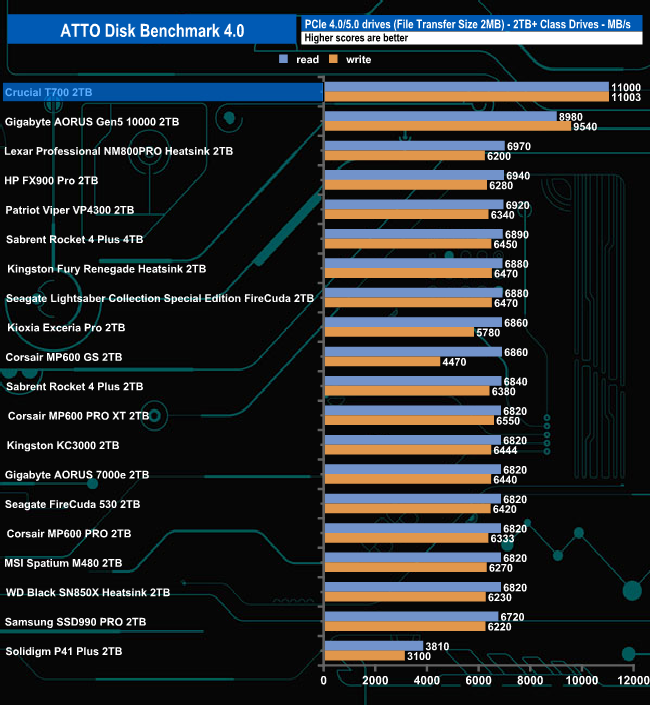
Using the ATTO benchmark we couldn't quite get to the official maximum Sequential figures of upto 12,400MB/s (reads) and up to 11,800MB/s (writes) but the best test results we did get; 11,000MB/s reads, 11,003MB/s writes are the fastest we've seen to date for a consumer drive by quite a margin.
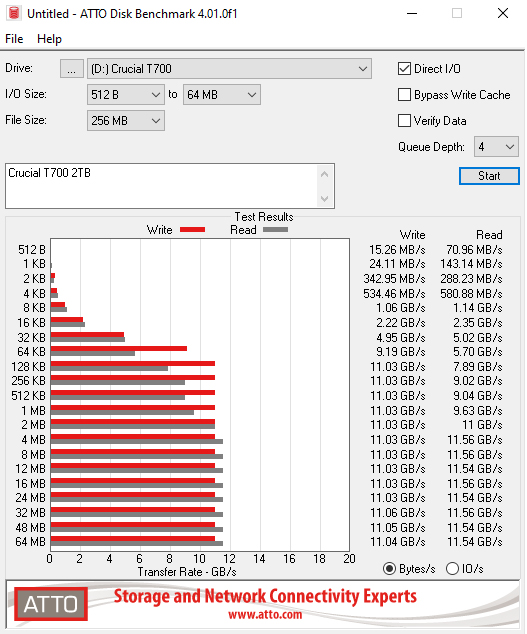
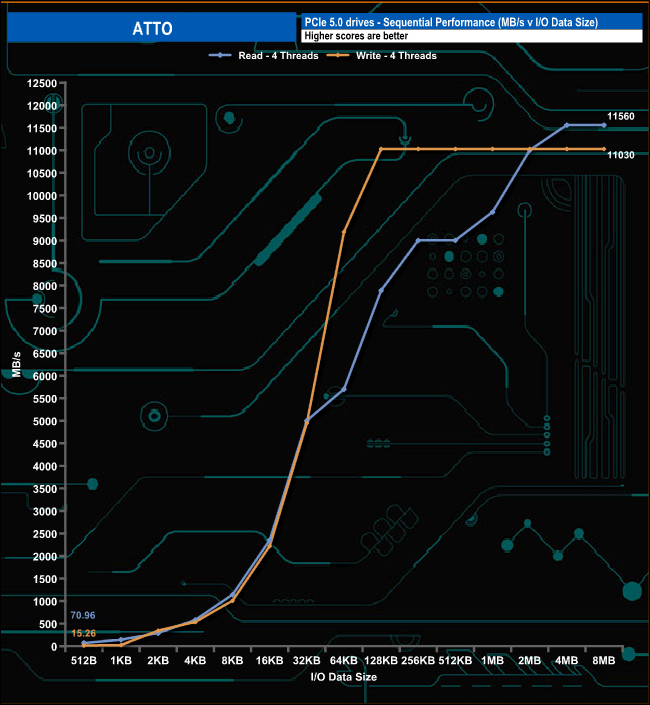
Using the ATTO benchmark, the read performance began to plateau out at 8MB (11,560MB/s), but the write performance levels off way before that at 128KB at 11,030MB/s.
AS SSD is a great free tool designed just for benching Solid State Drives. It performs an array of sequential read-and-write tests, as well as random read-and-write tests with sequential access times over a portion of the drive. It uses
incompressible data samples which many drives struggle with, so results can be viewed as the worst case scenarios.
AS SSD includes a sub suite of benchmarks with various file pattern algorithms but this is difficult in trying to judge accurate performance figures.
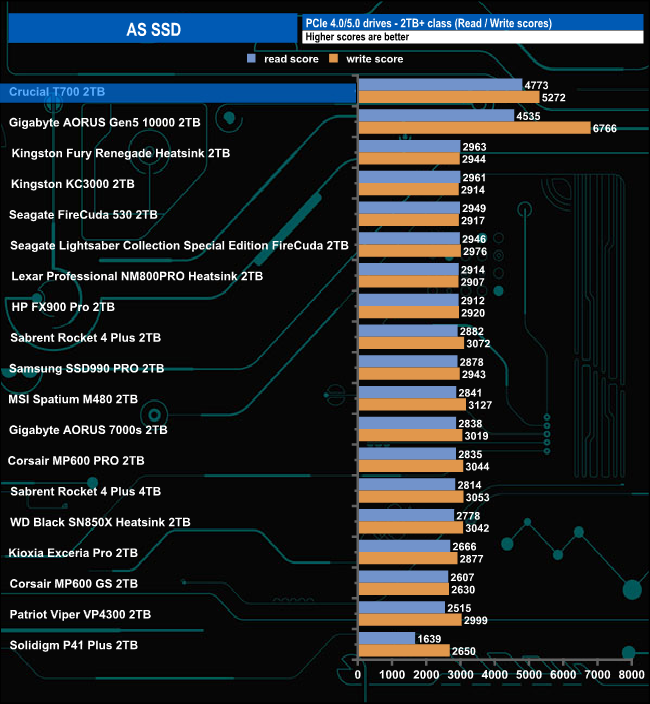
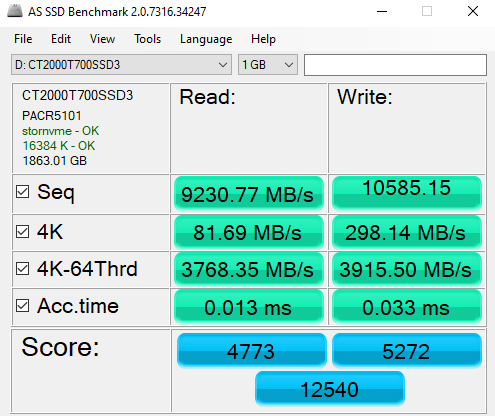
The AS SSD read score of 4773 sees the Crucial T700 on top of our results chart but it's the other Gen5 drive we've tested, Gigabyte's AORUS Gen5 10000 that has a much better write performance.
We used CrystalDiskMark 8‘s custom settings to test the Sequential read and write performance of the drive through a range of queue depths. The setup for the tests is listed below.
128KB Sequential Read / Write.
Transfer Request Size: 128KB, Thread(s): 1, Outstanding I/O: 1-32.
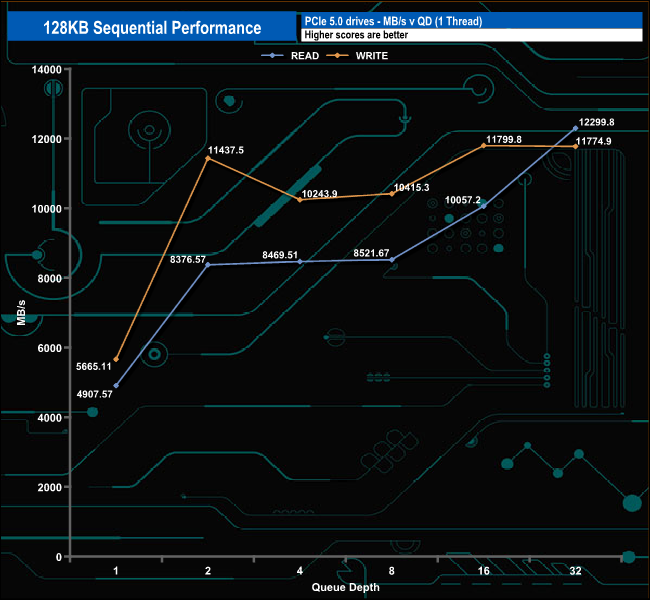
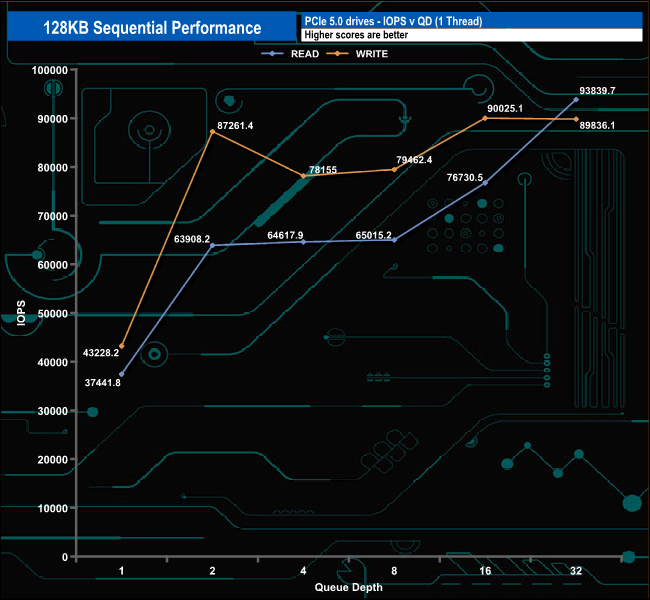
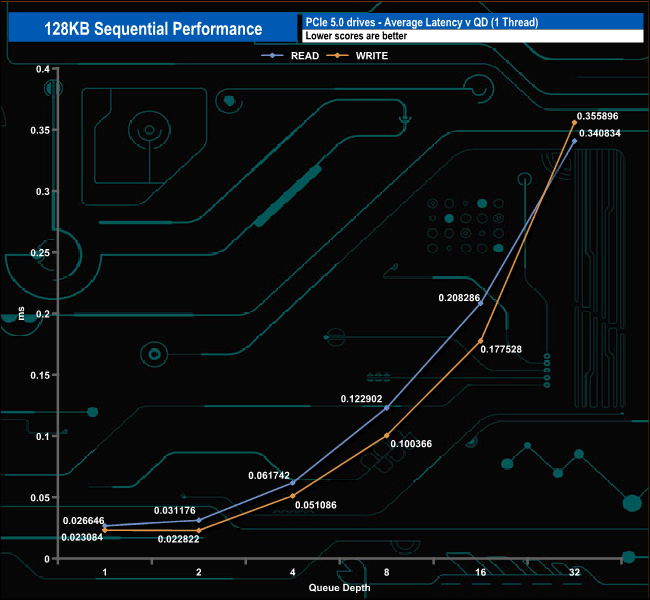
In this test, the read performance of the drive accelerates between QDs 1 and 2 before levelling off between QD2 and 8 before climbing again to finish the test run at 12,299MB/s. The write performance races away to peak at 11,437MB/s at QD2 before dropping back between QD's 4 and 8 before climbing again to finish the test run at QD32 with a test result of 11,774MB/s.
128KB Sequential Read v QD compared.
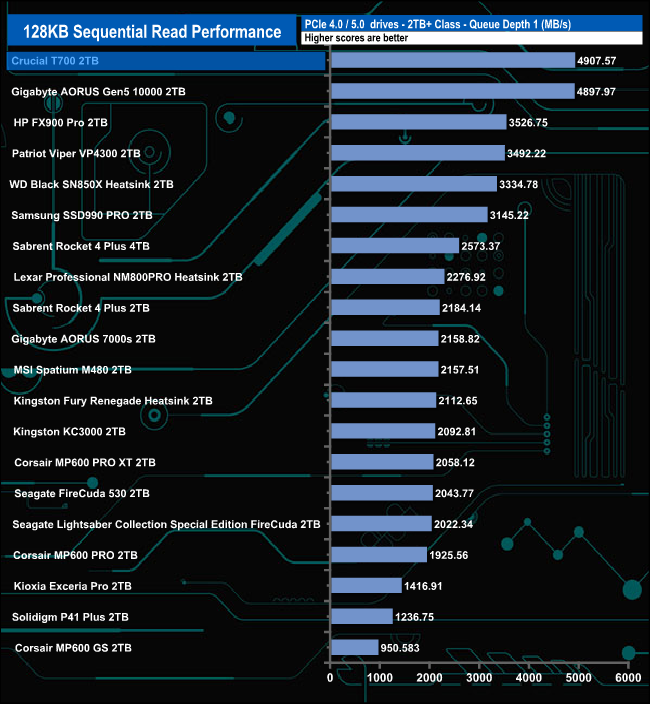
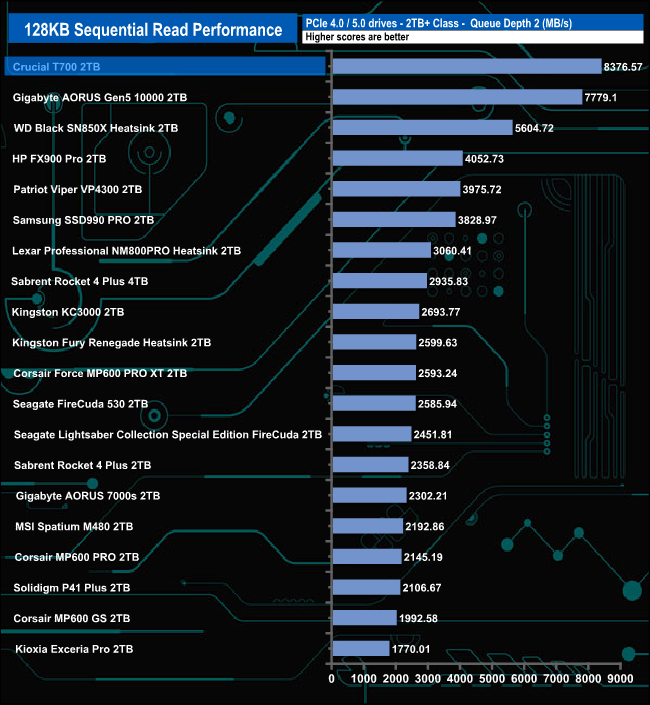
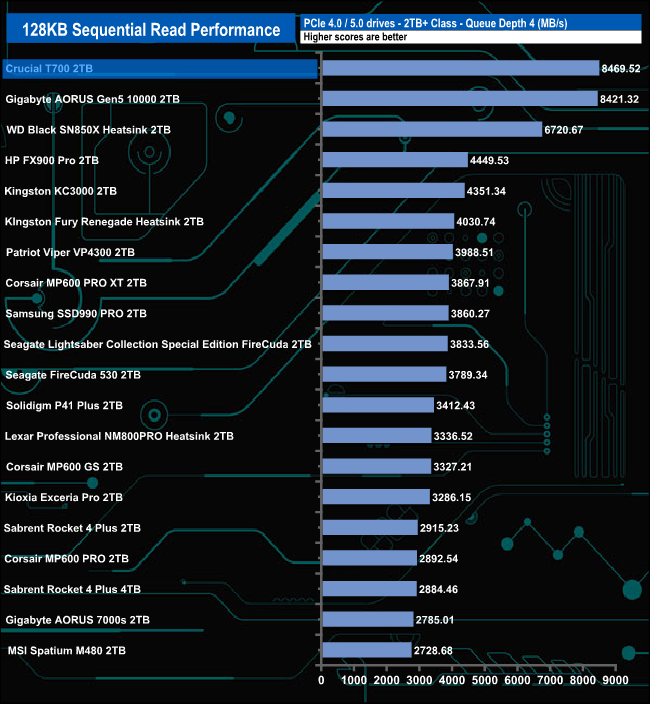
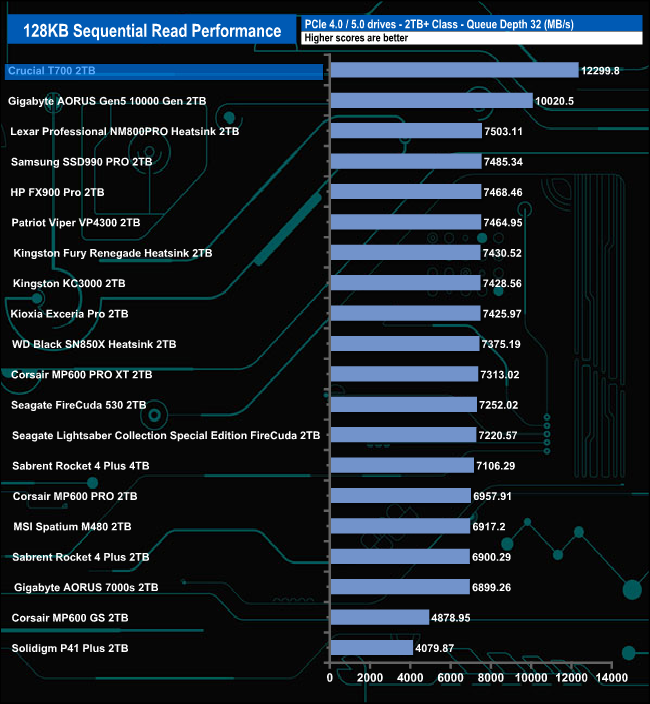
At QDs 1 and 4 the Crucial T700 and Gigabyte's AORUS Gen5 10000 are pretty much on the same pace. However, at QDs 2 and 32, the Crucial drive pulls away.
128KB Sequential Write v QD compared.
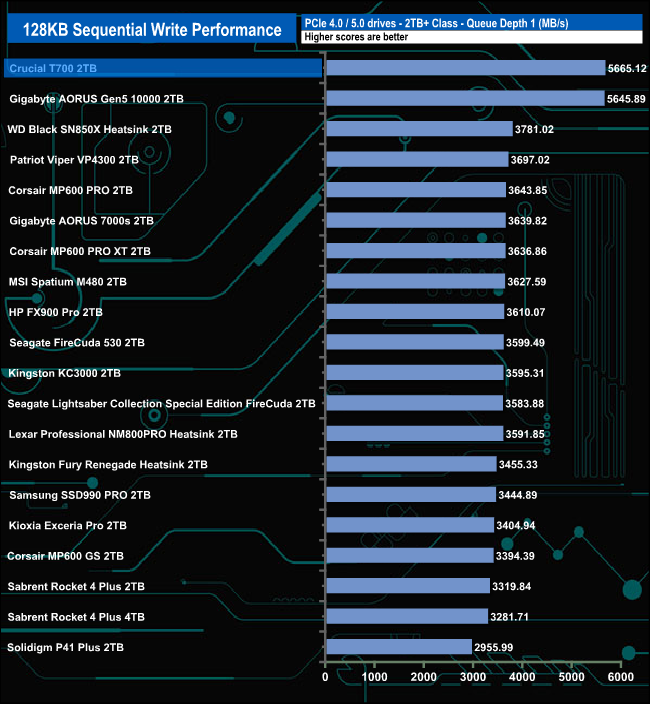
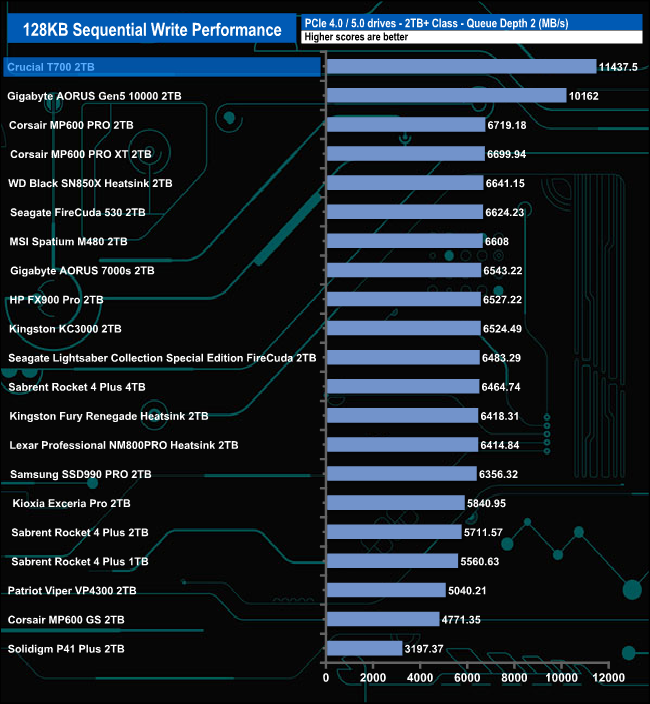
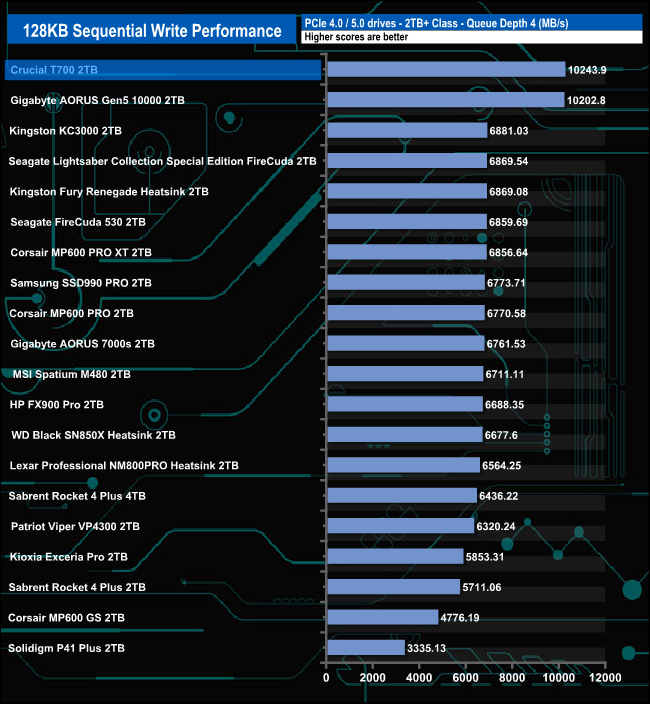
It's the same story when it comes to Sequential writes, with not much separating the two Gen 5 drives at QDs 1 and 4 with the Crucial drive pulling away in the other two tested queue depths.
We used CrystalDiskMark 8‘s custom settings to test the 4K random read performance of the drive through a range of queue depths. The setup for the tests is listed below.
Transfer Request Size: 4KB, Outstanding I/O: 1-32.

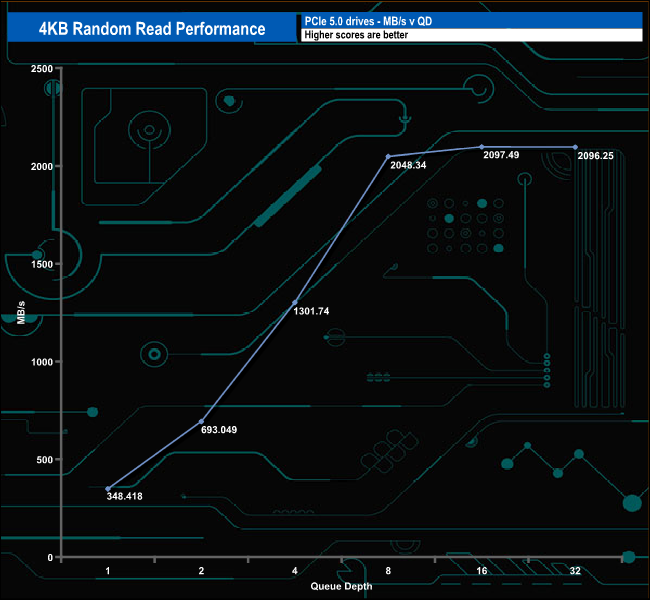
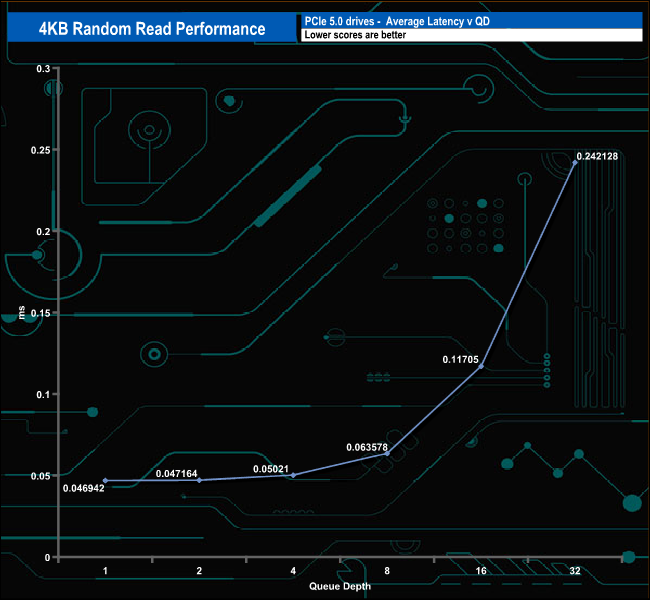
In our four-treaded 4K random read tests we couldn't get close to the official maximum of 1,500K IOPS. The best figure we saw was 512,082 IOPS (QD16) before the performance dropped back to 511,779 IOPS at the end of the test (QD32).
4K Random Read v QD compared.
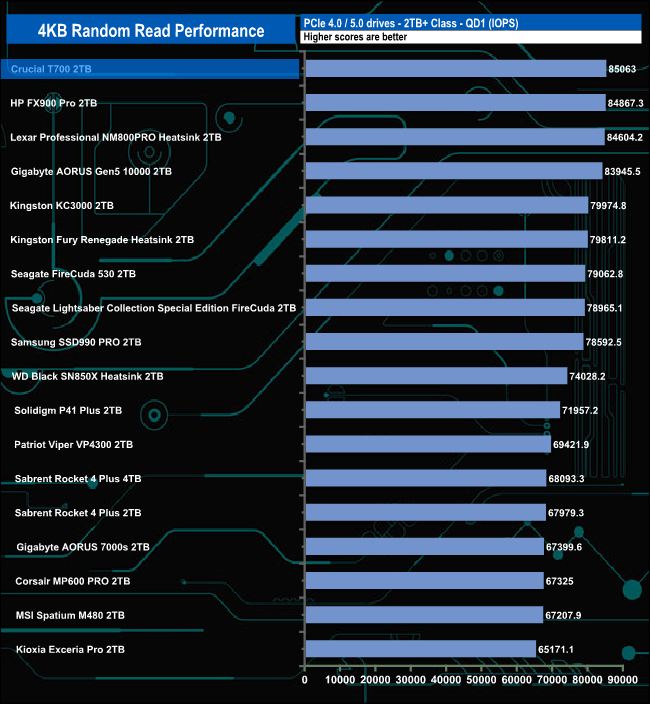
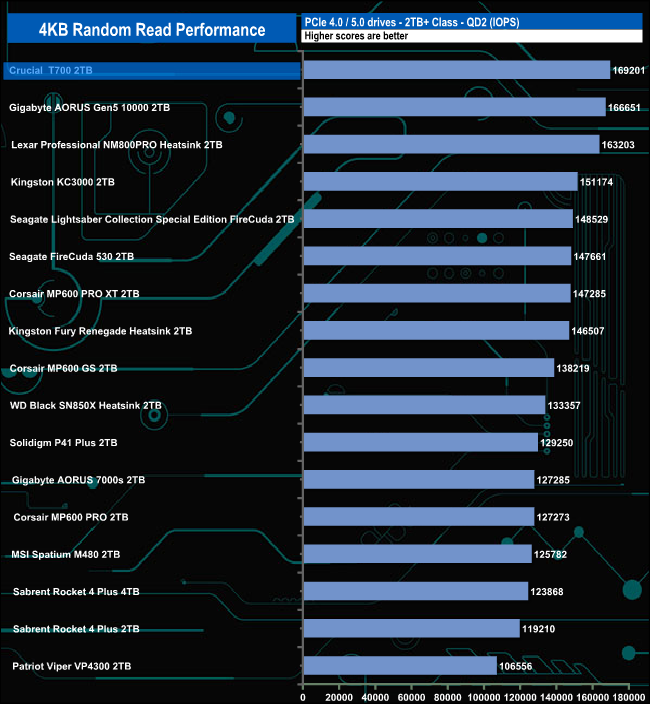
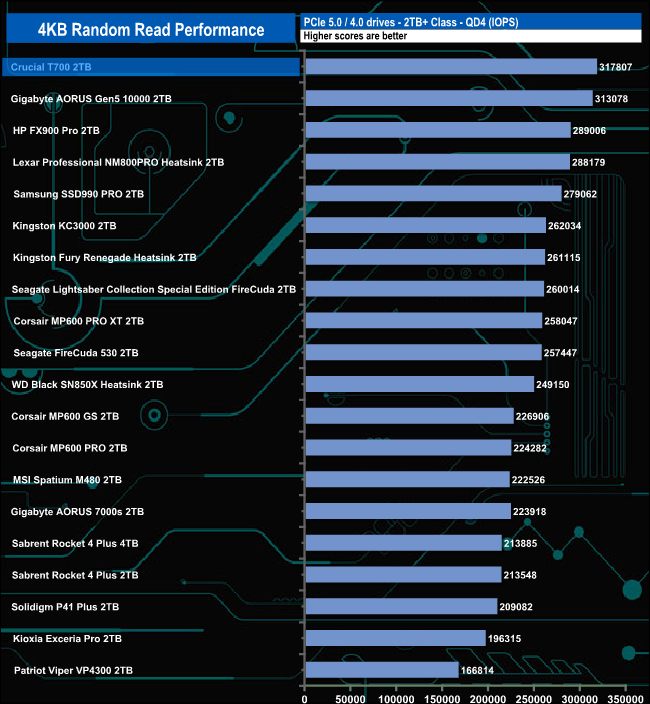
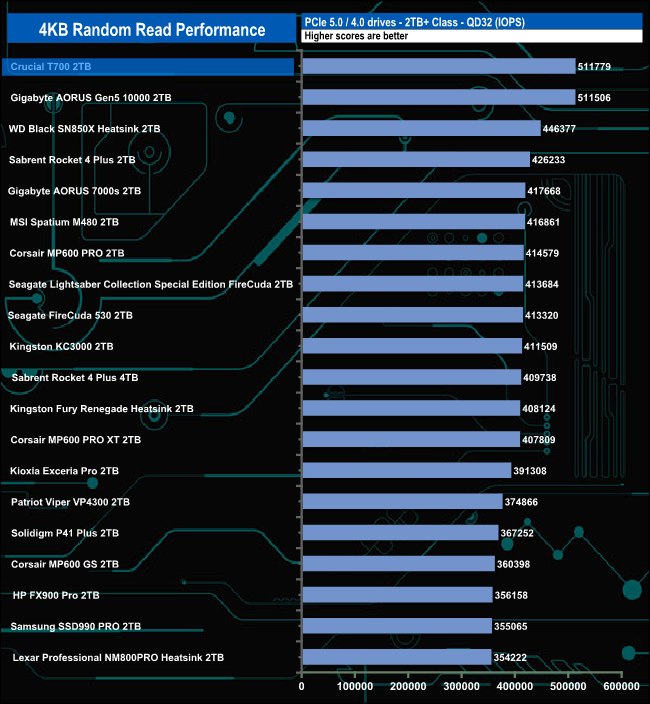
Even though our test results couldn't get anywhere near the official figure, the drive still ranks as the fastest consumer NVMe drive we've seen to date in all the tested queue depths.
We used CrystalDiskMark 8‘s custom settings to test the 4K random write performance of the drive through a range of queue depths. The setup for the tests is listed below.
Transfer Request Size: 4KB, Outstanding I/O: 1 – 32.
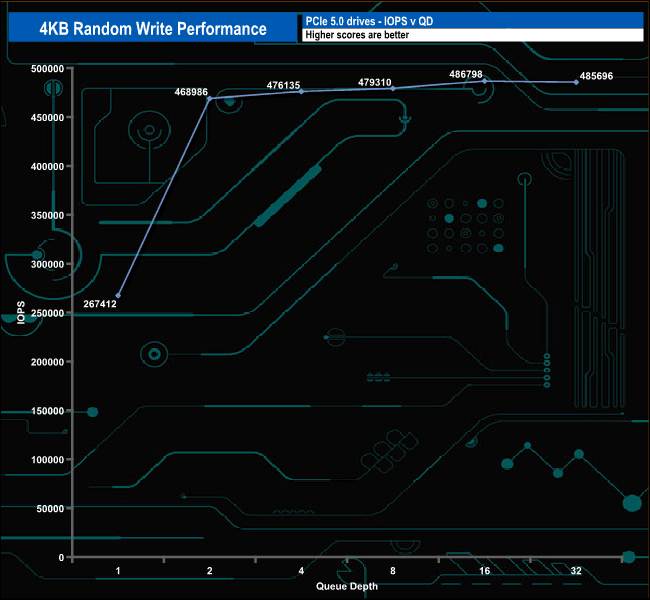
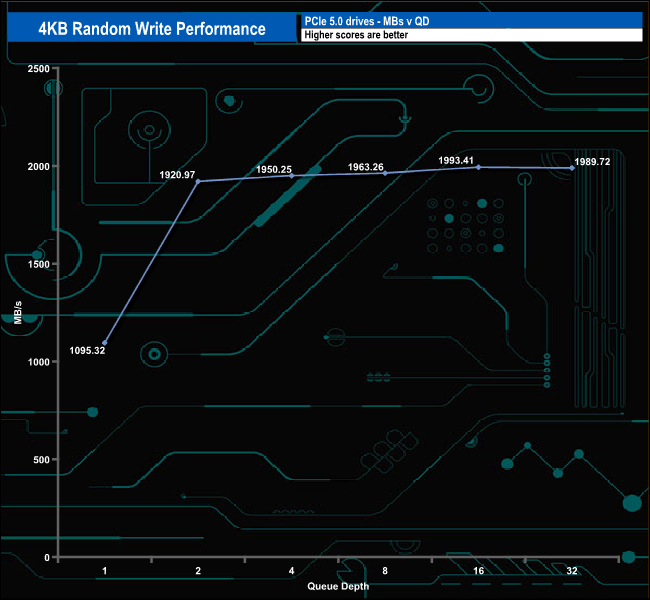
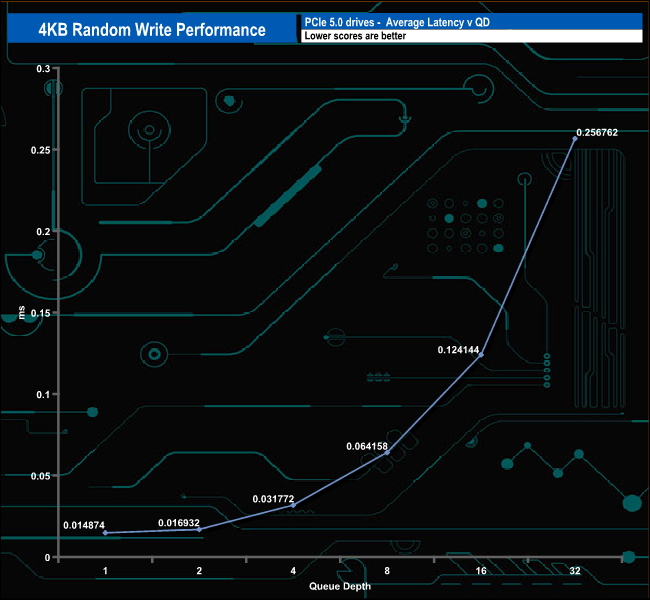
As with the random read performance, the random write test results are nowhere near the official maximum figure of 1,500K IOPS in our four-threaded testing. The drive's performance is pretty consistent from QDs 2 to 32 with the peak result of 486,798 IOPS coming at the QD16 mark before finishing the test run at 485,696 IOPS (QD32).
4K Random Write v QD compared.
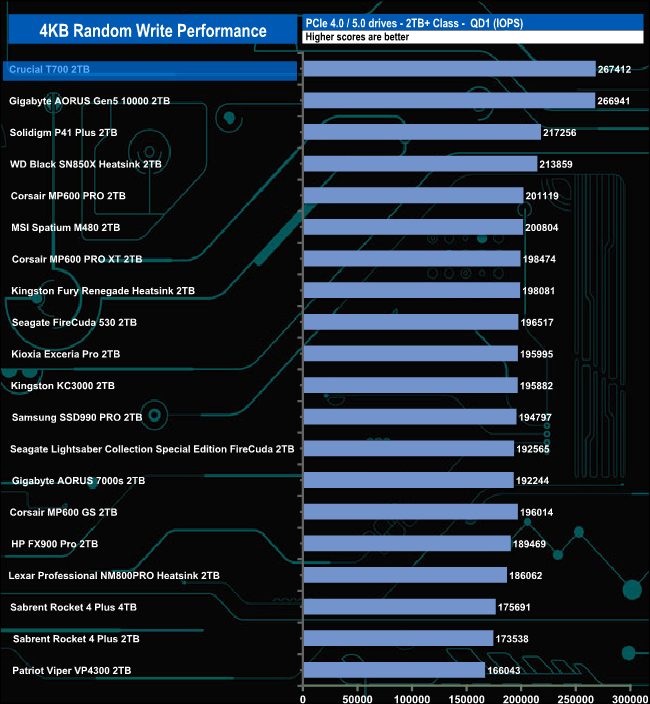
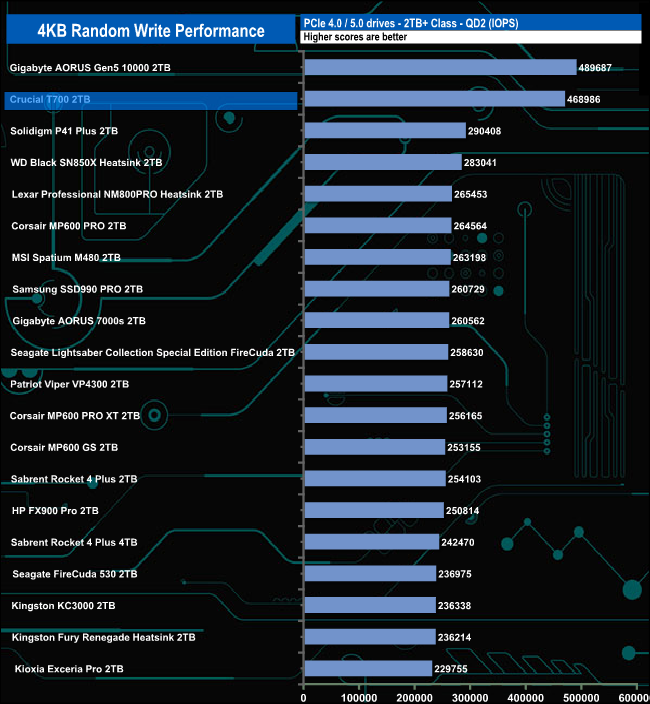

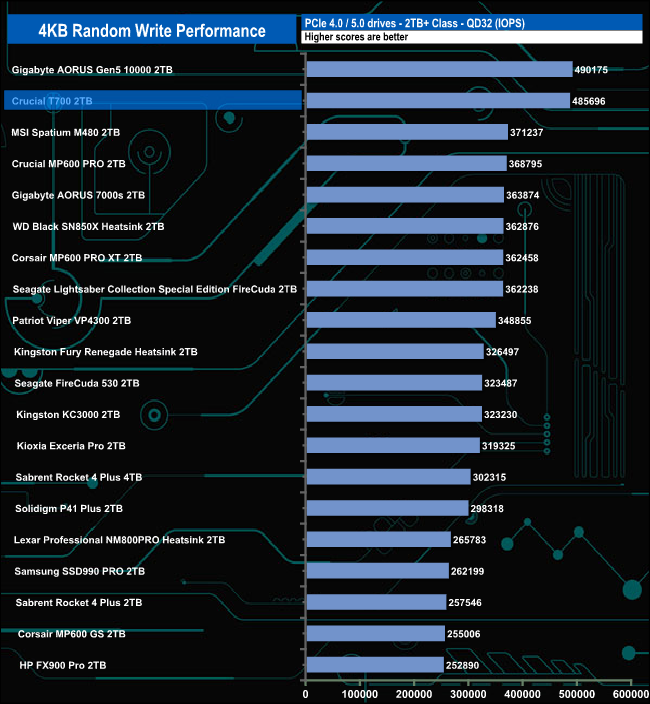
Crucial's T700 tops the chart at QD1 but as the queue depth deepens, the other Gen 5 drive, the Gigabyte AORUS Gen5 10000 takes over.
We used CrystalDiskMark 8’s custom settings to test the 4K 70/30 mixed read/write performance of the drive through a range of queue depths using a single thread and four threads.
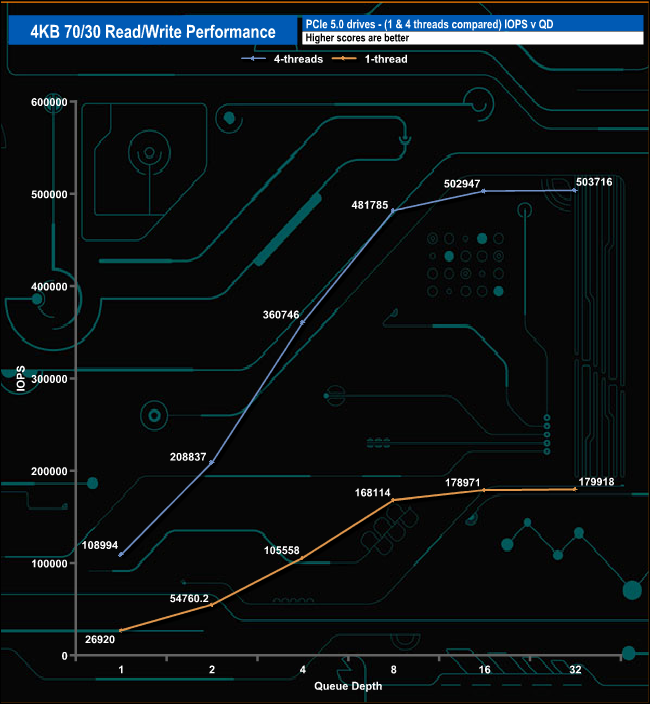
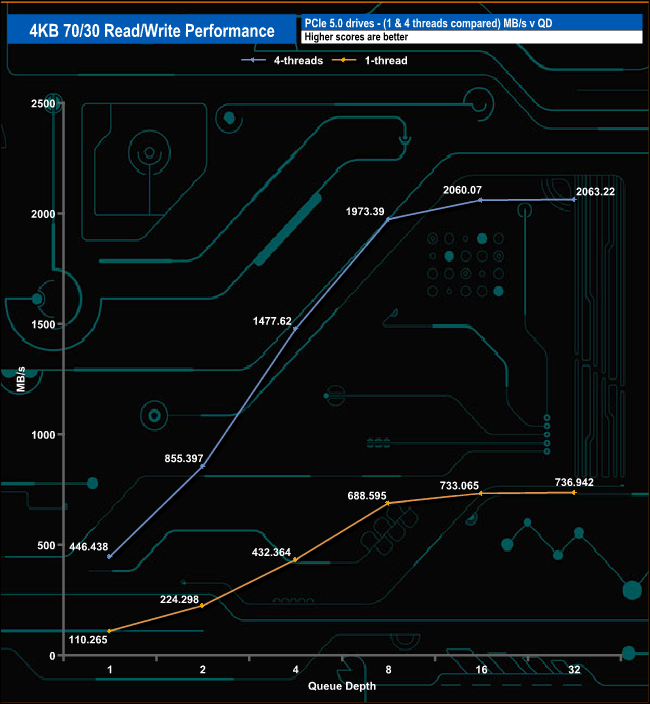

Using a single thread, the Crucial T700 performance climbs in a fairly smooth curve from 26,920 IOPS (110MB/s) at QD1 up to 168,114 IOPS (688MB/s) at QD8 where the performance slowly begins to plateau out, finishing the test run (QD32) at 179.918 IOPS (736MB/s). Using four threads the performance climbs from 108,994 IOPS (446MB/s) at QD1 to 502,947 IOPS at QD16 before slowly flattening out, finishing the test run at 503,716 IOPS (2,063MB/s).
We used CrystalDiskMark 8 to test the random performance of the drive at lower queue depths (QD1 – QD8 where most of the everyday workloads occur) using 1 to 4 threads.
Random Reads.
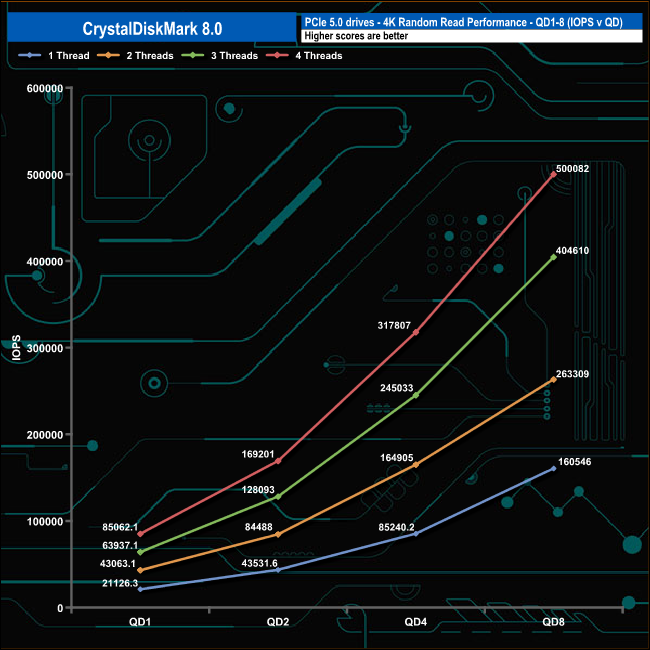
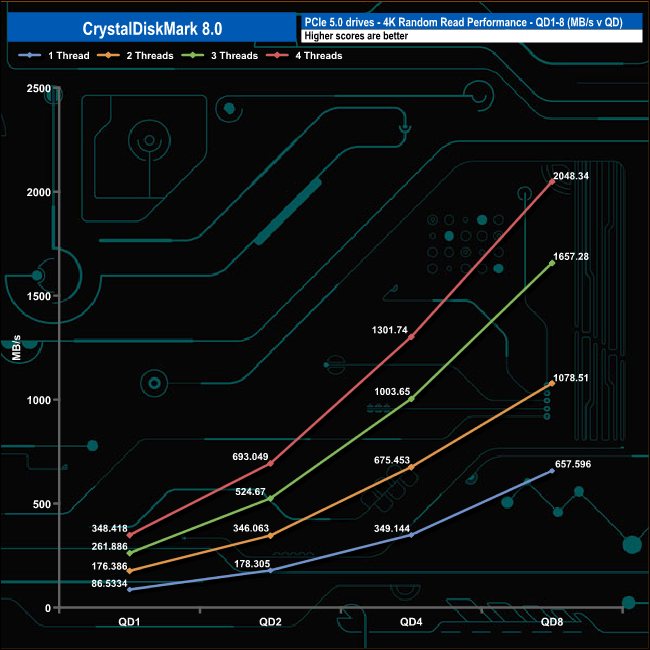
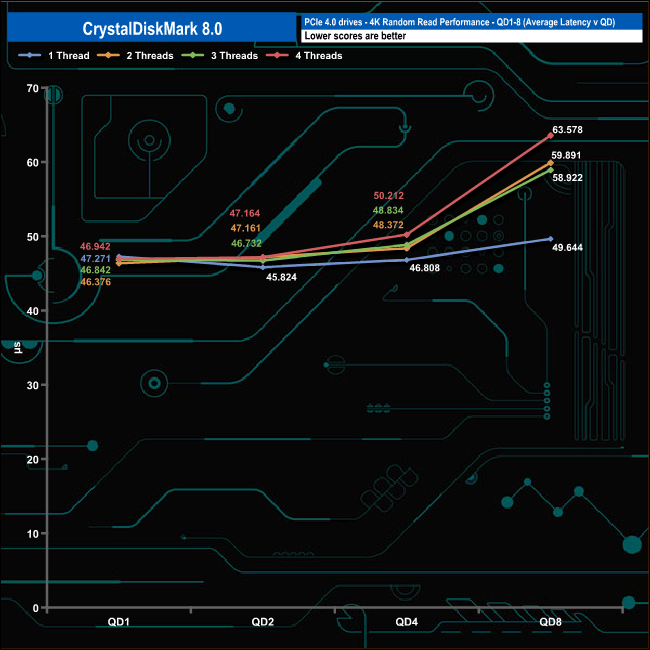
In the random read tests, all four of the tested threads displayed smooth increases in performance as the queue depth deepened with no nasty surprises.
Random Writes.

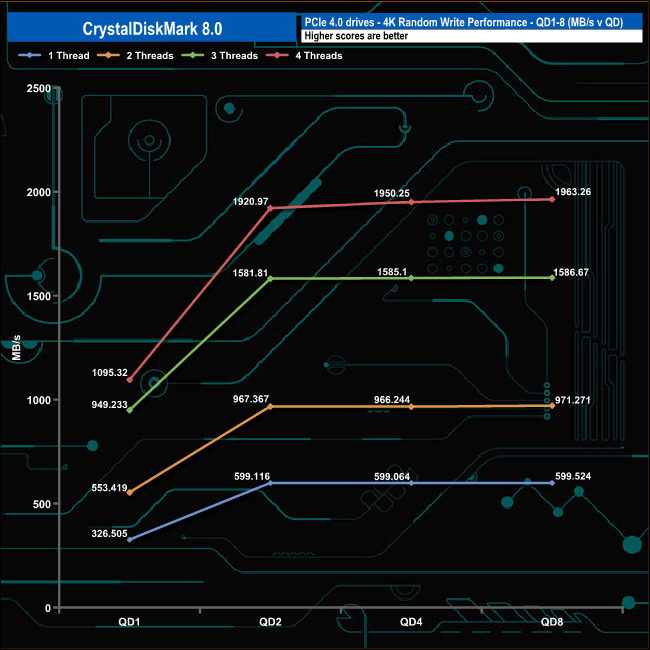
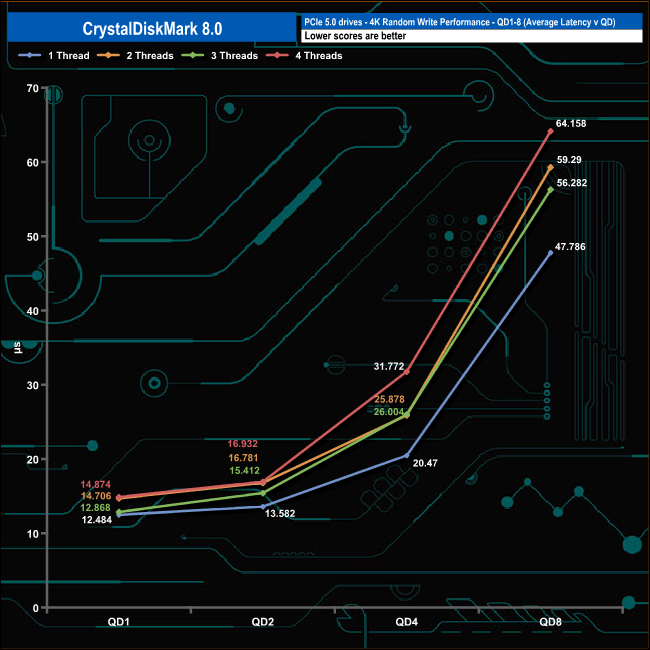
In the 4K write tests the performance rose quickly from QD1 to QD2 for all four tested threads before levelling off for the rest of the test runs.
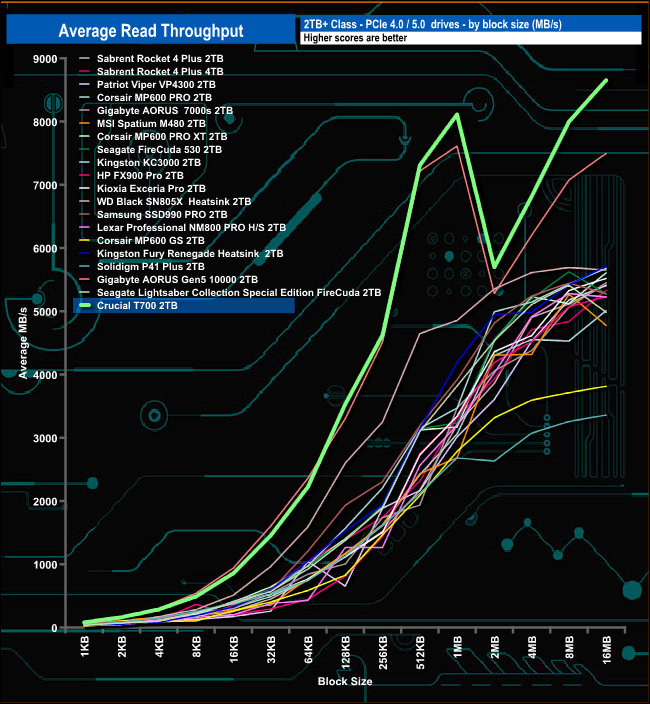
In our read-throughput tests, the Crucial T700 the performance climbed smoothly through the block marks until the 1MB mark where the performance drops off pretty considerably. After this drop the drive recovers well to finish the test runs at 8,656.08MB/s, some way off the official maximum of 12,400MB/s.
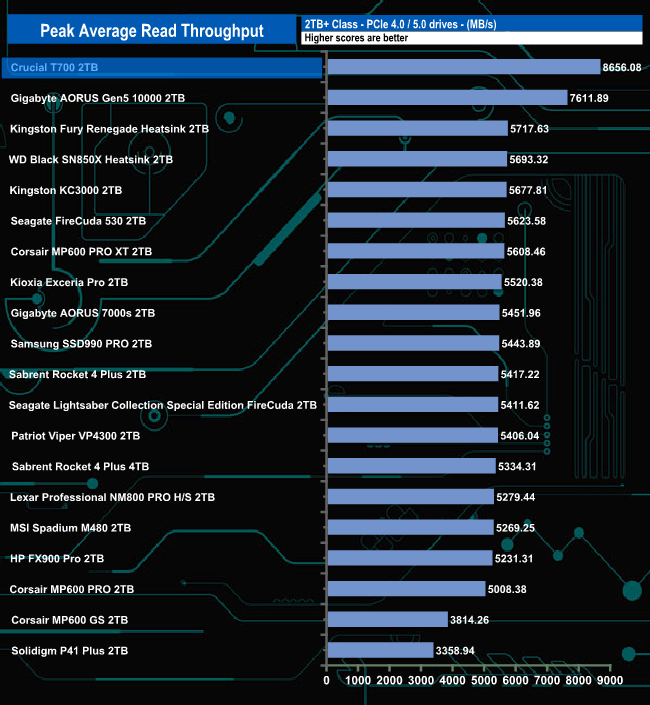
Even though that peak read result is nowhere near the official maximum figure. it's still good to enough to place the T700 in the top spot in our results chart by some distance.
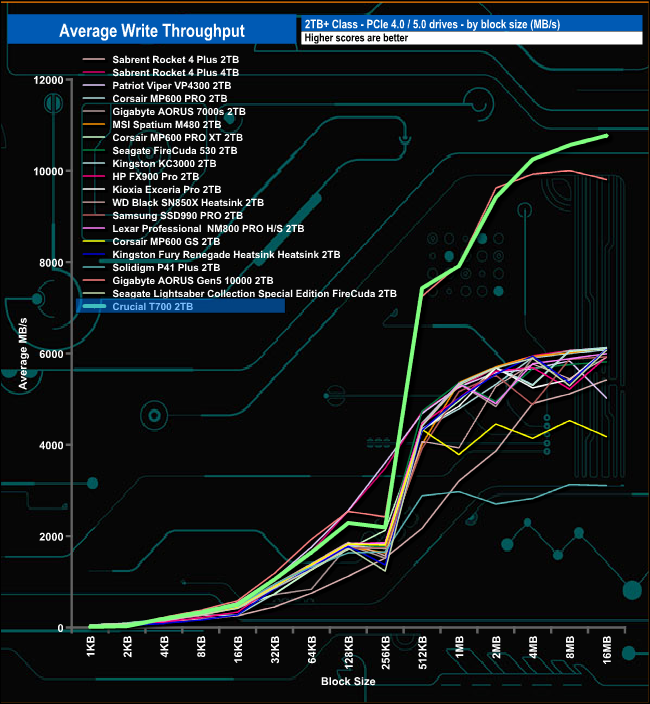
In the write-throughput test, the drive peaked at 10,768.1MB/s right at the end of the test run. That peak figure is 1,032MB/s off the official maximum.
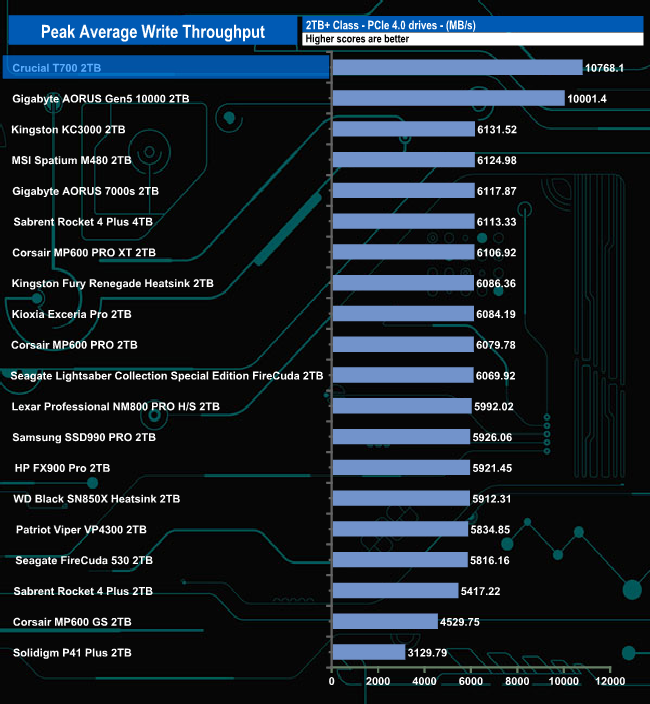
It comes as no surprise to find the tested peak write result puts the drive on the top of the results chart.
The PCMark 10 Full System Drive Benchmark uses a wide-ranging set of real-world traces from popular applications and common tasks to fully test the performance of the fastest modern drives. The benchmark is designed to measure the performance of fast system drives using the SATA bus at the low end and devices connected via PCI Express at the high end.
The goal of the benchmark is to show meaningful real-world performance differences between fast storage technologies such as SATA, NVMe, and Intel’s Optane. The Full System Drive Benchmark uses 23 traces, running 3 passes with each trace. It typically takes an hour to run.
Traces used:
Booting Windows 10.
Adobe Acrobat – starting the application until usable.
Adobe Illustrator – starting the application until usable Adobe Premiere Pro – starting the application until usable.
Adobe Photoshop – starting the application until usable.
Battlefield V – starting the game until the main menu.
Call of Duty Black Ops 4 – starting the game until the main menu.
Overwatch – starting the game until main menu.
Using Adobe After Effects.
Using Microsoft Excel.
Using Adobe Illustrator.
Using Adobe InDesign.
Using Microsoft PowerPoint.
Using Adobe Photoshop (heavy use).
Using Adobe Photoshop (light use).
cp1 Copying 4 ISO image files, 20 GB in total, from a secondary drive to the target drive (write test).
cp2 Making a copy of the ISO files (read-write test).
cp3 Copying the ISO to a secondary drive (read test).
cps1Copying 339 JPEG files, 2.37 GB in total, to the target drive (write test).
cps2 Making a copy of the JPEG files (read-write test).
cps3 Copying the JPEG files to another drive (read test).
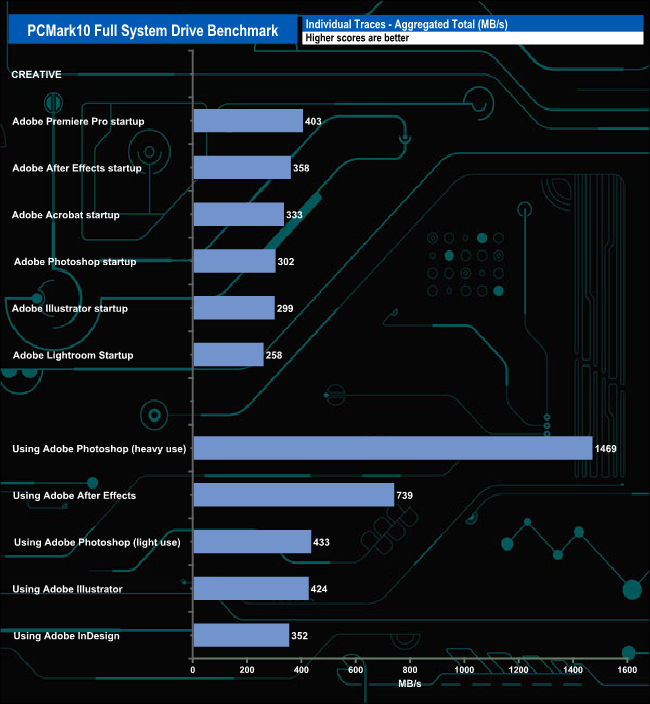
As usual in this benchmark, the fastest individual trace result came from the Adobe Photoshop heavy usage trace at 1,469MB/s. For the six Adobe startup traces the drive averaged 325MB/s while for the five usage traces it averaged 683MB/s including the Photoshop heavy usage trace.

When it came to the file transfers, the fastest was the cp1 Write test at 7,015MB/s not only the fastest result from this drive, it's the fastest we've ever seen using this test trace.
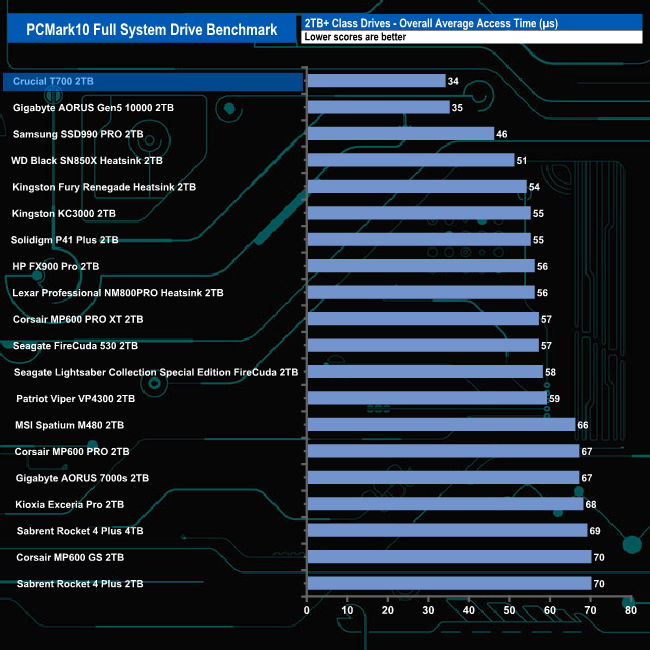
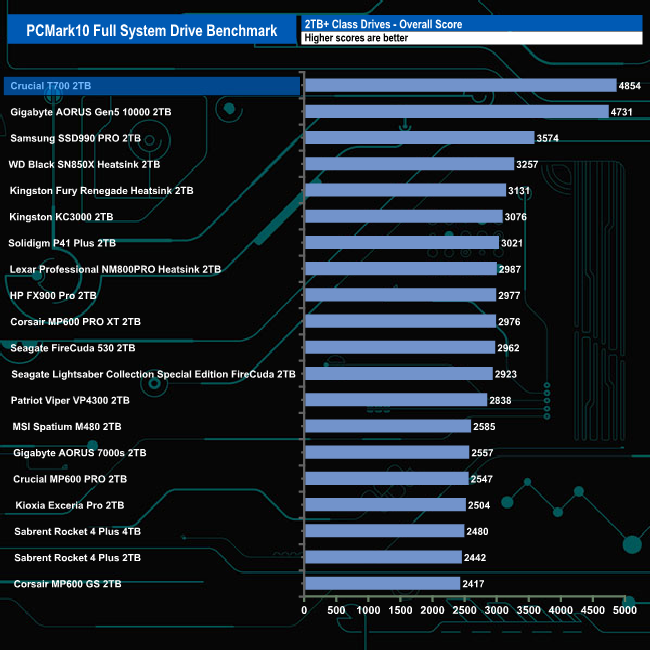
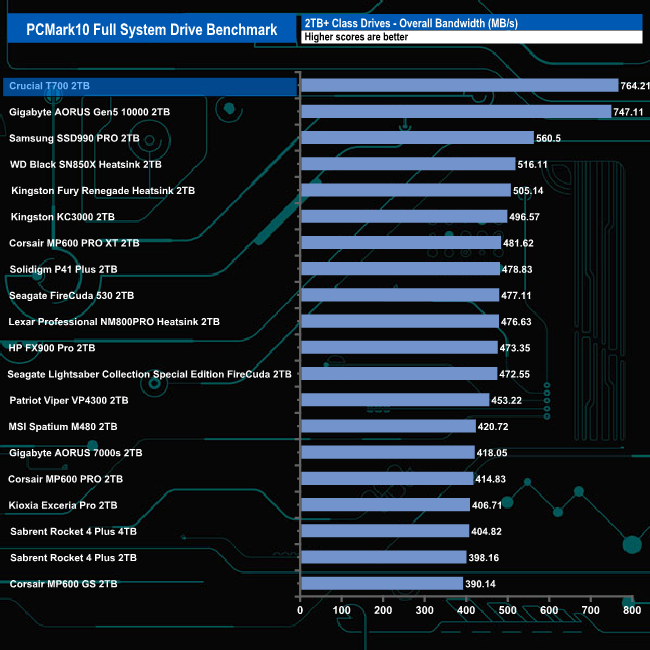
With an overall bandwidth figure of 764.21MB/s, the Crucial T700 sits in top spot on the results chart.
The 3DMark Storage Benchmark uses traces recorded from popular games and gaming-related activities to measure real-world gaming performance.
Traces used –
Battlefield V
Loading Battlefield™ V from launch to the main menu.
Call of Duty Black Ops 4
Loading Call of Duty®: Black Ops 4 from launch to the main menu.
Overwatch
Loading Overwatch® from launch to the main menu.
Game Move
Copying the Steam folder for Counter-Strike®: Global Offensive from an external SSD to the system drive.
Game Recording
Recording a 1080p gameplay video at 60 FPS with OBS (Open Broadcaster Software) while playing Overwatch®.
Installing Game
Installing The Outer Worlds® from the Epic Games Launcher.
Game Saving
Saving progress in The Outer Worlds game.
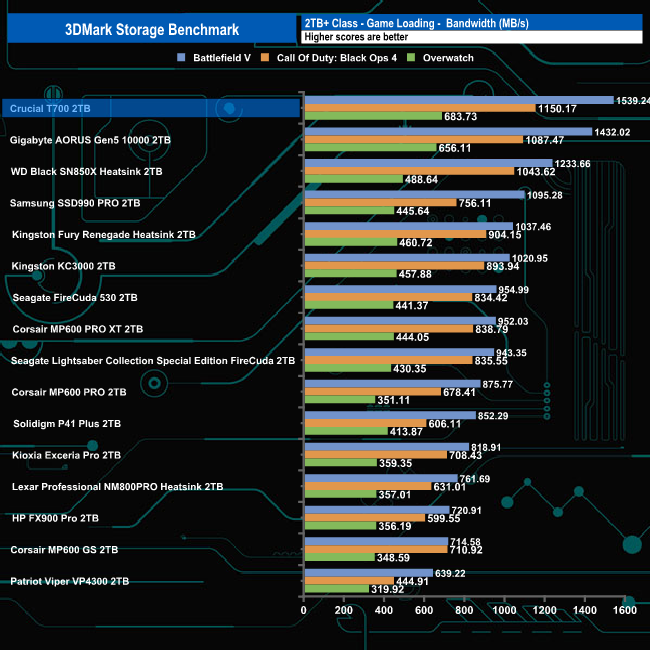
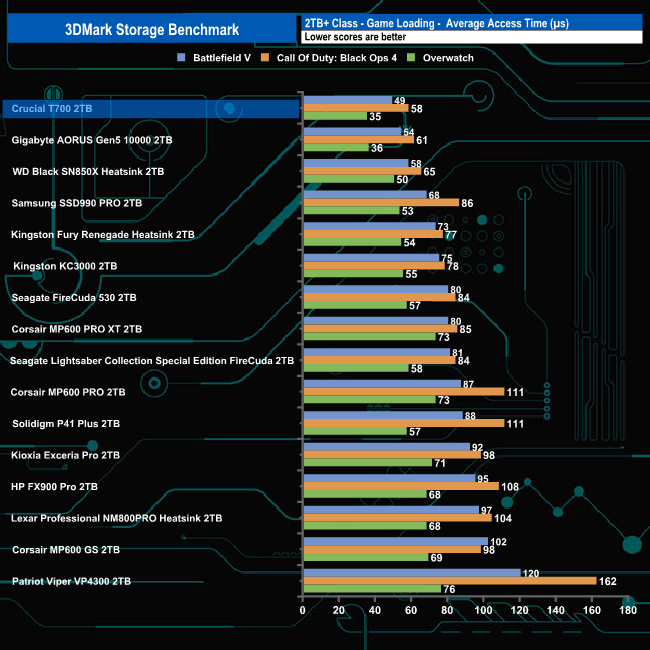
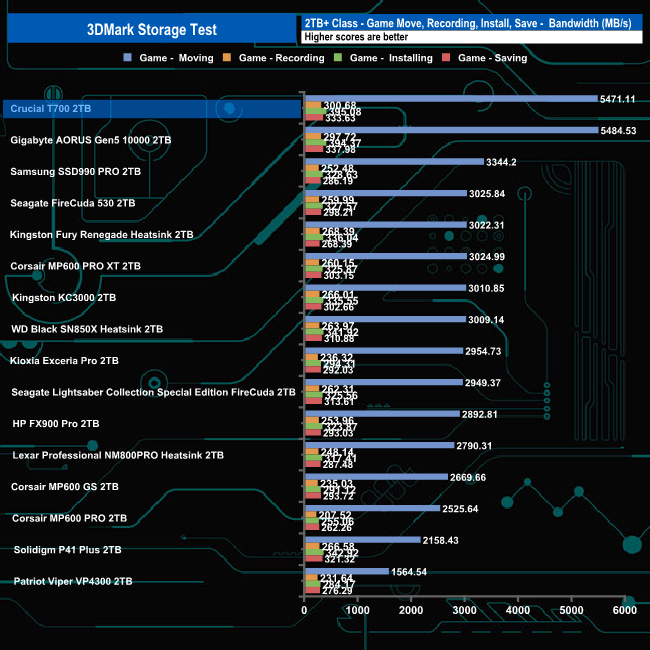
In 3DMark’s Storage Test, the drive averaged 1,124MB/s for the three-game ((Battlefield V, Call of Duty: Black Ops 4 and Overwatch) load tests with an average access time of 47µs.
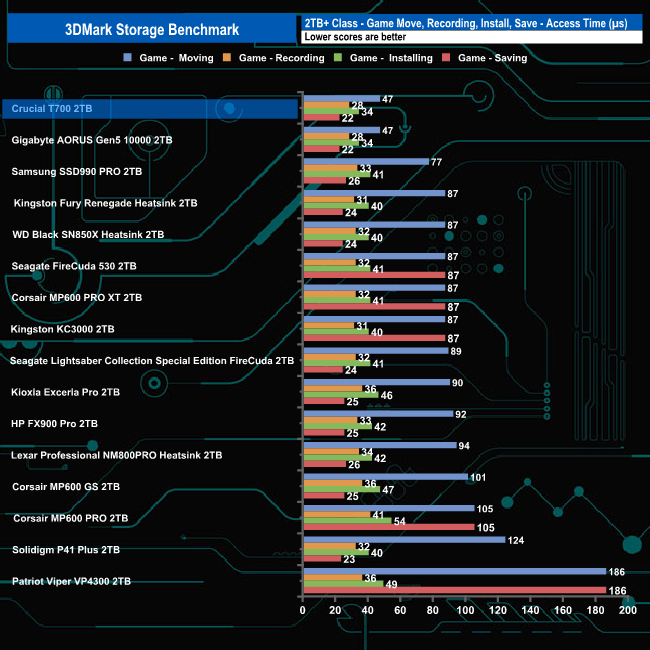
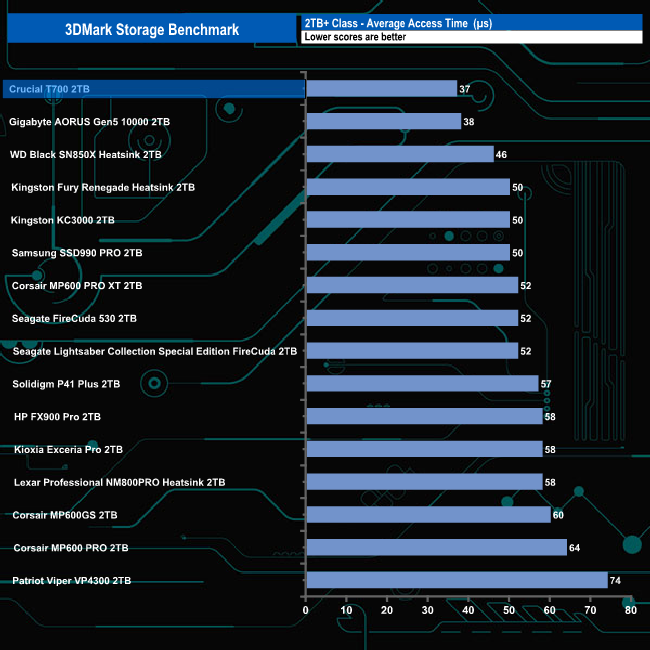
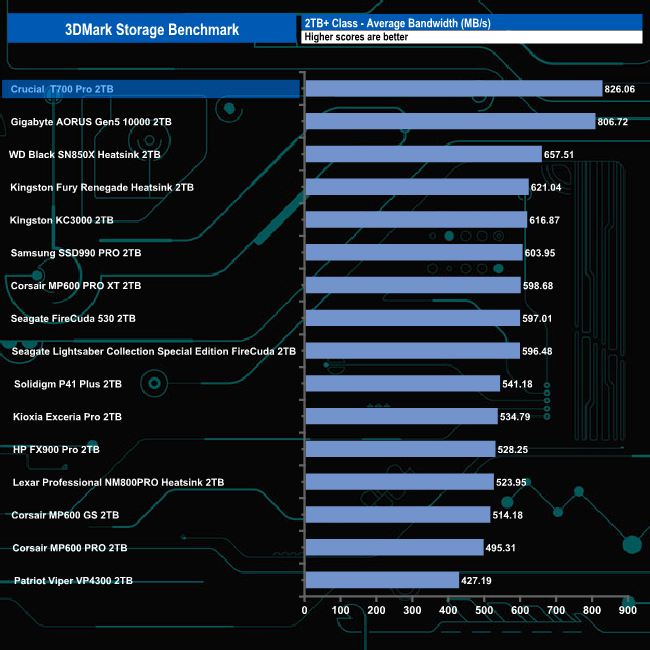
Crucial's T700 drive leads the way in all the 3DMark’s Storage Test result charts.
The Final Fantasy XIV Endwalker Official Benchmark uses actual maps and playable characters to assign a score to your PC and rate its performance including scene loading times.
The benchmark gives an overall load time as well as loading times by scene.
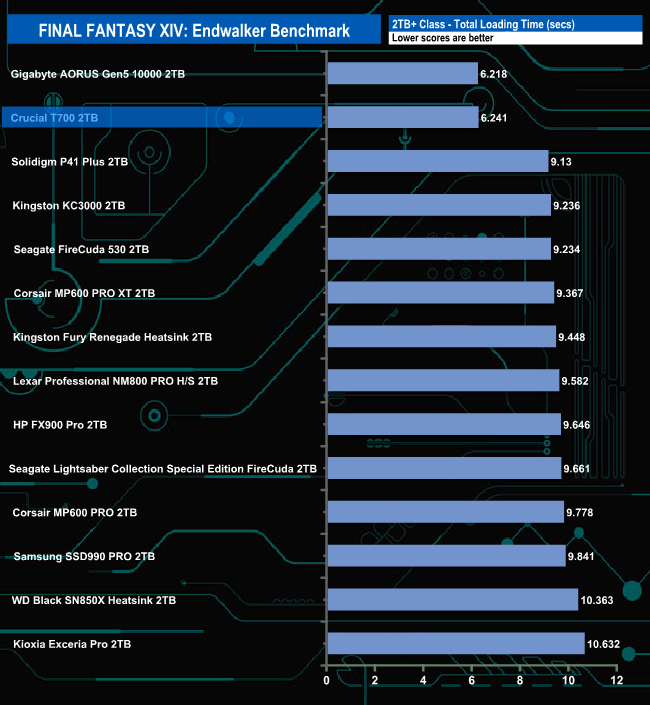
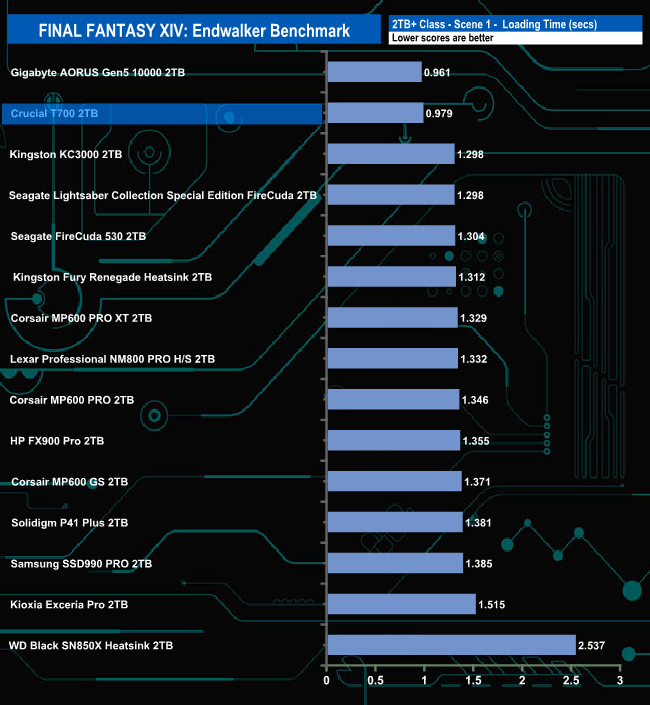
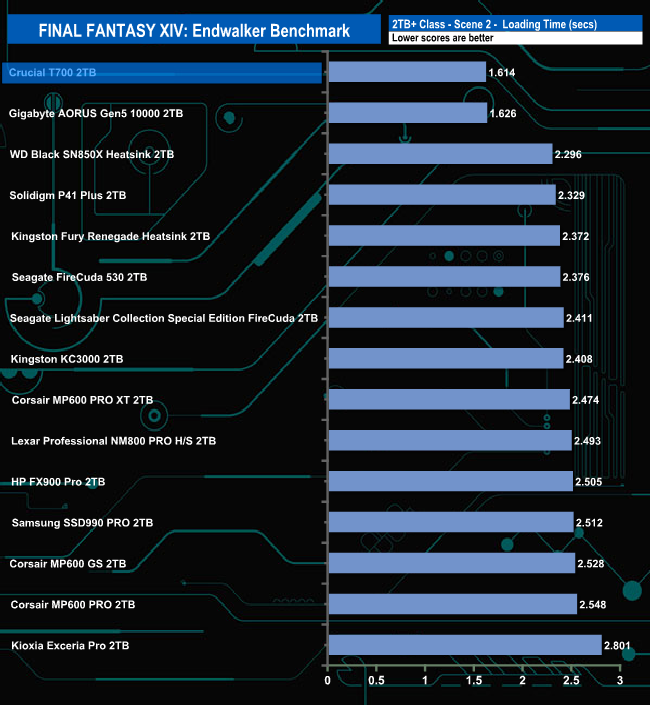
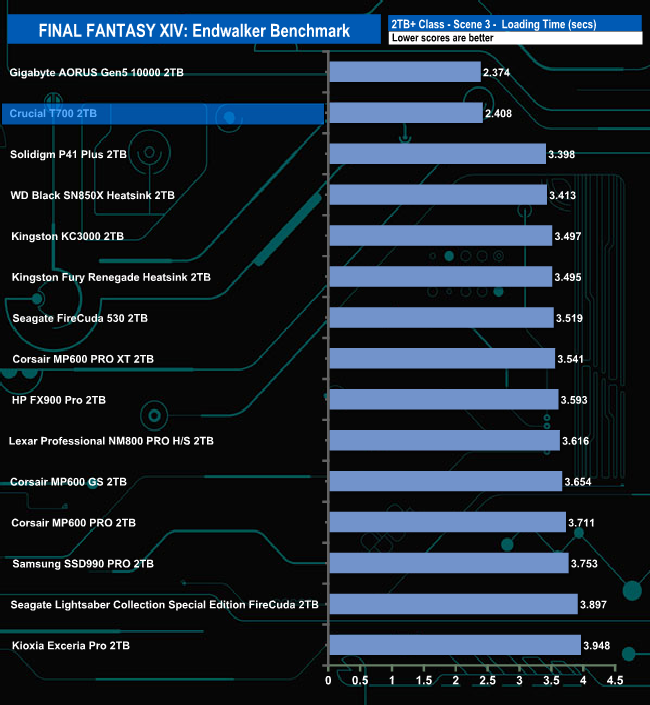
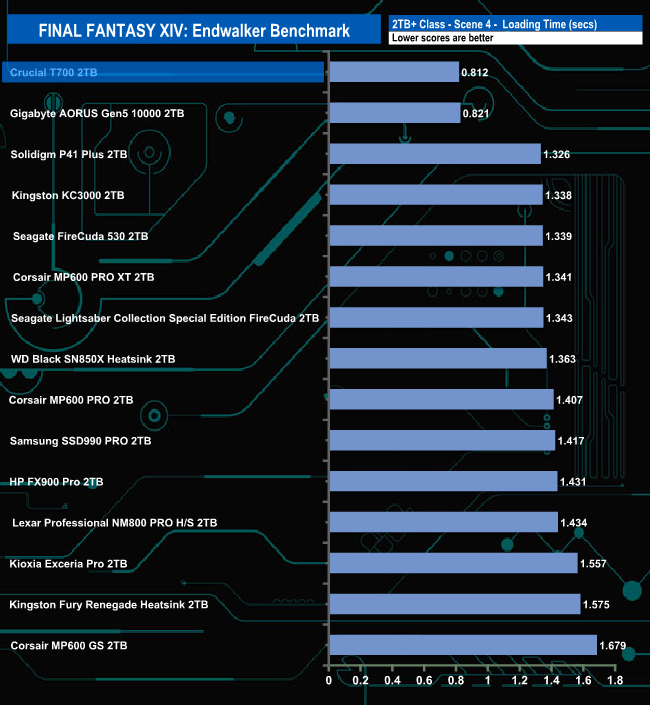
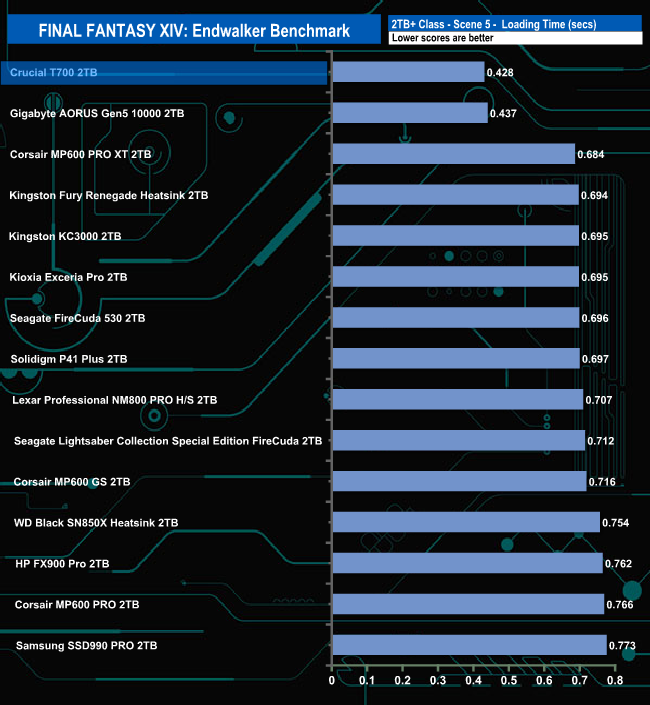
The Crucial T700 does very well in the Final Fantasy XIV Endwalker Official Benchmark topping three of the five scene load trace results. Overall though, it sits in second place behind Gigabyte's AORUS Gen5 10000 drive.
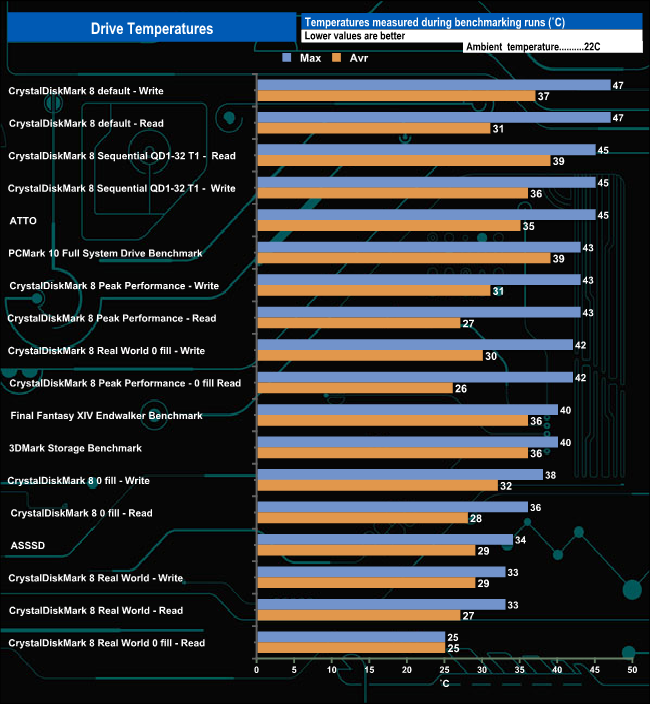
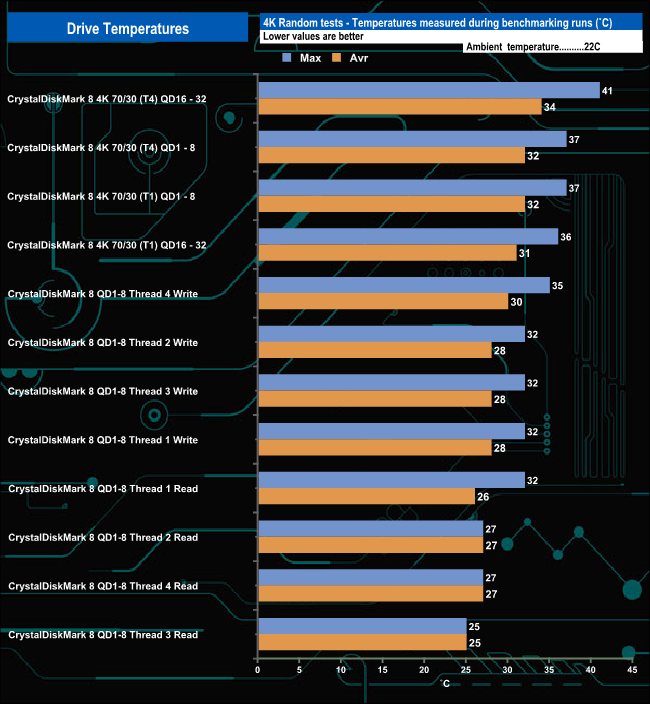
We took note of the drive’s temperature during some of our benchmarking runs. During our benchmarking runs, the hottest the drive got was 47° C during CrystalDiskMark 8 default test runs. For the non-4 K tests the drive averaged 39.72° C while for the 4K-based tests, the average was 32.72° C.
Keeping the drive cool in our test rig (Gigabyt X670E AORUS Xtreme motherboard) is a serious chunk of machined aluminium (weighing in at 150g) as a heatsink for the Gen5 slot. Not only that, there are two thermal pads that the drive is sandwiched between for maximum heat displacement.
To test real life performance of a drive we use a mix of folder/file types and by using the FastCopy utility (which gives a time as well as MB/s result) we record the performance of drive reading from & writing to a 2TB Seagate FireCuda 510.
Transfer Details:
- Windows 10 backup – 118GB.
- Data file – 100GB.
- BluRay Movie – 42GB.
- Windows 11 iso – 5.4GB.
- File folder – 50GB – 28,523 files.
- Steam folder – 222GB (8 games: Alien Isolation, Battlefield 4, BioShock Infinite, Crysis 3, Grand Theft Auto V, Shadow Of Mordor, Skyrim, The Witcher3 Wild Hunt).
- Movie demos 8K – 21GB – (11 demos).
- Raw Movie Clips 4K – 16GB – (9 MP4V files).
- Movie folder – 12GB – 15 files – (8 @ .MKV, 4 @ .MOV, 3 @ MP4).
- Photo Folder – 10GB – 304 files – (171 @ .RAW, 105 @ JPG, 21 @ .CR2, 5 @ .DNG).
- Audio Folder – 10GB – 1,483 files – (1479 @ MP3, 4 @ .FLAC files).
- Single large image – 5GB – 1.5bn pixel photo.
- 3D Printer File Folder – 4.25GB – (166 files – 105 @ .STL, 38 @ .FBX, 11 @ .blend, 5 @ .lwo, 4 @ .OBJ, 3@ .3ds).
- AutoCAD File Folder – 1.5GB (80 files – 60 @ .DWG and 20 @.DXF).
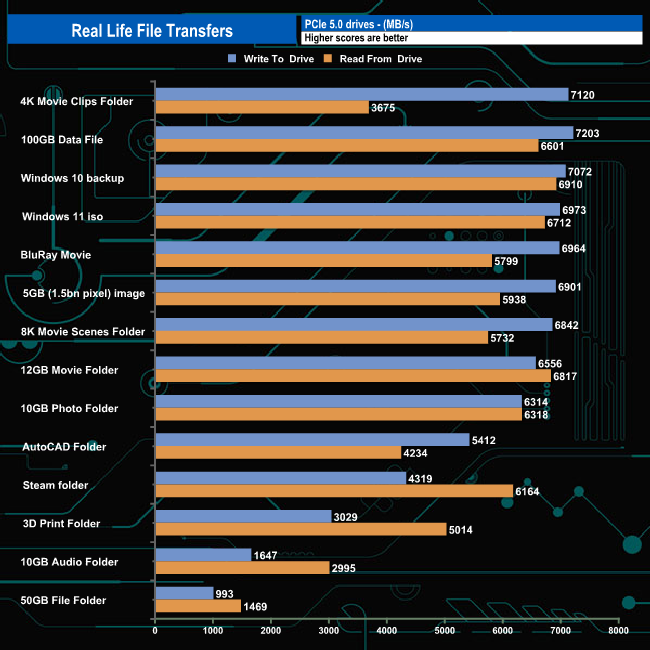
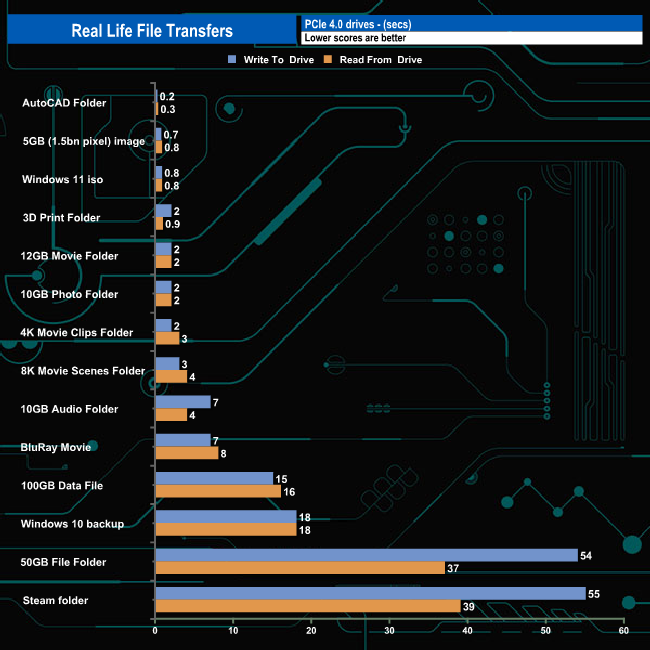
The drive averaged 5,019MB/s when writing the 14 transfer tests, with the fastest being the 7,203MB/s for the 100GB Data file transfer and the slowest being the 50GB file folder transfer at 993MB/s.
Reading back the data the average was a bit faster at 5,312MB/s. The fastest transfer this time was the Windows 10 backup at 6,910MB/s. The slowest transfer was again the 50GB file folder at 1,469MB/s.
The latest Gen 5 SSD to enter the fray is also the fastest seen to date. Aimed at professionals, gamers and enthusiasts, Crucial's T700 comes with read and write ratings of 12,400MB/s and 11,800MB/s respectively. The drive is built around Phison's PS5026-E26 8-channel controller and Micron's own 232-layer 3D TLC NAND running at 2000MT/s.
Crucial's T700 model lineup comprises three capacities; 1TB, 2TB and 4TB and is available in two guises, one with a heatsink, and one without. As noted above the 2TB and 4TB are rated at up to 12,400MB/s and 11,800MB/s for read and writes respectively. The 1TB drive is rated as up to 11,700MB/s for reads and up to 9,500MB/s. Random performance is quoted as up to 1,350,000 IOPS for reads and up to 1,400,000 IOPS for the 1TB model. Both the 2TB and 4TB models are rated as up to 1,500,000 IOPS for read and writes.
Using the ATTO benchmark we couldn't quite get to the maximum Sequential figures with test results of 11,000MB/s for reads and 11,003MB/s for writes. However, using the default CrystalDiskMark 8 benchmark we could confirm the official Sequential figures with test results of 12,402MB/s for reads and 11,821MB/s for writes.
As for random performance, using the Peak Performance profile of the CrystalDiskMark 8 benchmark we could confirm the official maximum IOPS figure of 1,500,000 IOPS for read and writes with test results of 1,572,724 IOPS for reads and 1,660,353 IOPS for writes.
One thing to remember if you decide on the non-heatsink version of the drive you must use it with a motherboard heatsink to keep it cool, in fact, there is a warning on the back of the box on this very point. The drive has been designed to start throttling back if it goes above 81° C and will thermally shut down at 90° C. To give an idea of just how important it is to use cooling with the drive, we tried running the ATTO benchmark on it without using the motherboard heatsink. In a couple of minutes the drive hit 81° C and started to throttle back almost instantly, reads dropping from 9GB/s to 5.5GB/s and writes falling from 11GB/s to 7.6GB/s. Under the motherboard heatsink, the hottest the drive got during an ATTO run was 45° C with an average temp of 35° C.
Crucial's T700 is the fastest Gen 5 drive and the fastest consumer SSD we've seen to date, and as such it tops most of our result charts. But it comes with quite a price tag and needs attention paid to keeping it cool.
We found the 2TB Crucial T700 on Crucial's website for £329.99 (inc VAT) HERE.
Pros
- Extremely fast Sequential performance.
- PCIe 5.0 interface.
Cons
- Needs a PCIe 5.0 M.2 slot to get the best out of it.
- Must be used with motherboard cooling.
- Pricey.
KitGuru says: Crucial's T700 drive is the fastest consumer SSD we've seen to date and offers a glimpse at the sort of performance that may be to come in the coming months from Gen 5 drives. But, and it's an important but, the standard T700 must be used with some form of motherboard cooling.