KitGuru KitGuru.net – Tech News | Hardware News | Hardware Reviews | IOS | Mobile | Gaming | Graphics Cards


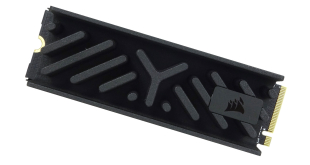
We recently looked at Phison's reference design for the new PS5031-E31T Gen 5 controller (HERE) and now we can present our review of one of the first retail SSDs powered by the new IC, the Corsair MP700 Elite with Heatsink. We analyse the 2TB model, currently priced at at £230 in the UK.
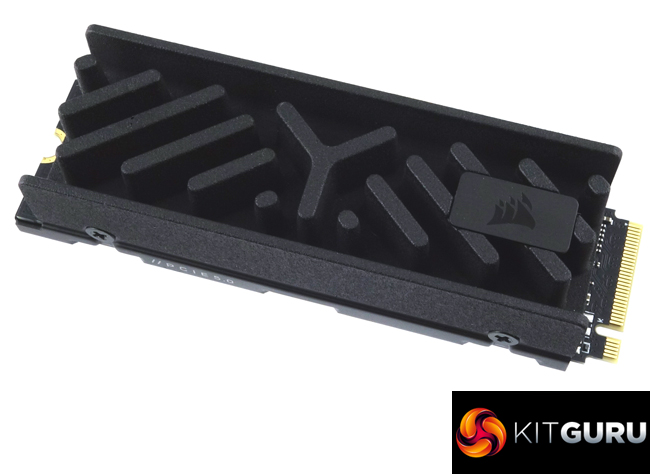
At launch, Corsair's MP700 Elite comes in just two capacities, 1TB and 2TB and in two versions, plain or with a factory-fitted heatsink, which is the version Corsair sent us for review. The new drive is built around Phison's latest Gen5 controller, the PS5031-E31T. The new controller has been designed with the mainstream market in mind, bringing a 4-channel, DRAM-less design to the Gen5 market segment. For the MP700 Elite, the controller is looking after Kioxia BiCS8 218-layer 3D TLC NAND.
Corsair quotes sequential performance figures for both capacities of the MP700 Elite as up to 10,000MB/s and up to 8,500MB/s for reads and writes respectively. Random performance is listed as up to 1,300,000 IOPS for reads with writes at up to 1,400,000 IOPS.
Corsair gives power consumption figures for the MP700 Elite as up to 5.9W for average active reads and writes. Endurance for the drives is quoted as 1,200TBW for the 2TB models and 600TBW for the 1TB range. Corsair backs the drive with a 5-year warranty.
Physical Specifications:
- Usable Capacities: 2TB
- NAND Components: Kioxia BiCS8 218-layer 3D TLC NAND.
- NAND Controller: Phison PS5031-E31T.
- Cache: None, HMB technology.
- Interface: PCIe Gen5.0 x4, NVMe 2.0.
- Form Factor: M.2 2280.
- Dimensions: 24 x 80 x 9mm.
- Drive Weight: 55g.
Firmware Version: EVTM00.0