KitGuru KitGuru.net – Tech News | Hardware News | Hardware Reviews | IOS | Mobile | Gaming | Graphics Cards


We've heard through rumours that Nvidia's next generation graphics architecture will be formally named as ‘Blackwell'. This week at GTC, Nvidia officially announced exactly that, with the Blackwell platform promising to usher in “a new era” of computing.
The Blackwell GPU is based on the TSMC 4NP process and features two reticle-limited dies connected by a 10TB/s chip-to-chip interconnect. The new architecture also features a second generation Transformer Engine, using custom tensor cores to further accelerate AI performance, particularly for LLM and MoE models. NVLink and NVLink Switch are present to pave the way for exascale computing, a new Decompression Engine is in place to accelerate end-to-end analytics for data scientists, and the new Reliability, Availability and Serviceability (RAS) engine can help identify potential faults to minimise downtime.
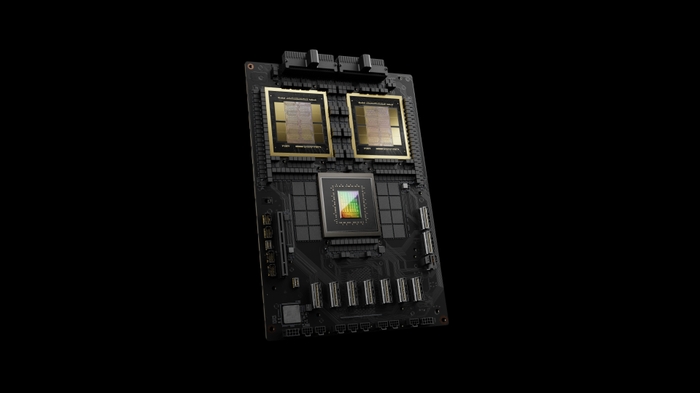
The Blackwell GPU offers up to 20 petaFLOPS of AI performance, up to 192GB of HBM3e with 8TB/s memory bandwidth and packs a whopping 208 billion transistors. The B200 will be the first Blackwell GPU to ship, and a few tech giants are already lined up to offer the GB200 as part of their services and infrastructure, including Microsoft Azure, Amazon Web Services, Google Cloud and Oracle Cloud.
If Blackwell is used for Nvidia's next generation of GeForce gaming graphics cards, we can expect the spec to look significantly different for cards like the RTX 5090, RTX 5080 and so on.
Discuss on our Facebook page, HERE.
KitGuru Says: Nvidia's next-generation architecture has arrived. It isn't necessarily an announcement that should excite gamers, but the new-generation Tensor Cores will almost certainly have an impact, further boosting RTX features like DLSS.