KitGuru KitGuru.net – Tech News | Hardware News | Hardware Reviews | IOS | Mobile | Gaming | Graphics Cards


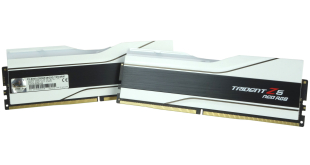
G.Skill's Trident Z5 Neo RGB memory has been designed for overclocking on AMD platforms with EXPO support. Its aluminium heat spreaders are available with a choice of two colour options and feature customisable RGB lighting. Here we test a 96GB kit of DDR5-6000 running at low latency (28-36-36-96, 1.35V).
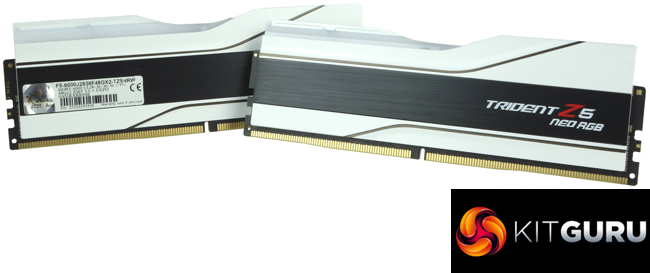
G.Skill's Trident Z5 Neo RGB DDR5-6000 model line is available in seven kit sizes and a range of latencies and voltages; 32GB (CL26, CL28, CL30, CL32 and CL36), 48GB (CL26, CL28 and CL40), 64GB (CL26, CL28, CL30, CL32 and CL36), 96GB (CL26, CL28 and CL30), 128GB (CL32, CL34 and CL36), 192GB (CL28) and 256GB (CL32, CL34 and CL36).
The G.Skill Trident Z5 Neo RGB 96GB kit we are reviewing here utilises a pair of dual-rank 48GB DIMMs (using SK Hynix M-die ICs), which are EXPO-rated at 6000MT/s with timings of 28-36-36-96 at 1.35V.
G.Skill backs the kit with a lifetime warranty.
Specification:
- Model Number: F5-6000J2836F48GX2-TZ5NR.
- Capacity: 96GB (2 x 48).
- Rated Frequency: 6000MT/s.
- Rated Timings: 28-36-36-96.
- Voltage: 1.35V.
- Module Height: 42.8mm.
- XMP/EXPO: EXPO.